Room at the Table

A Sermon for the First Sunday after Pentecost: Trinity Sunday (Year A)
May 31, 2026

Texts: Genesis 1:1-2:4a and Matthew 28:16-20

Now, O Lord, take my lips, and speak through them. Take our minds, and think through them. Take our hearts, and set them on fire. In the name of the Father, and of the Son, and of the Holy Spirit. Amen.

Every year, on the First Sunday after Pentecost, the Church celebrates Trinity Sunday. Unlike most feast days, Trinity Sunday doesn’t commemorate a particular event in the life of Jesus or one of the saints. Instead, it invites us to contemplate who God is.

That can feel like a daunting task, as though we’re supposed to figure out how to explain the unexplainable.

How can we speak of God as Father, Son, and Holy Spirit, and yet still say that God is one?

Preachers have reached for all kinds of images over the years: a three-leaf clover; water as ice, liquid, and steam; the sun, its light, and its warmth; and many others.

Some are helpful for about five seconds, and then, if you push them too far, they fall apart.

Because the Trinity is not a problem to be solved or a puzzle to figure out.

The Trinity is a holy mystery—one that teaches us that at the heart of all things is not isolation or loneliness, not a distant God sitting far off in heaven, but a God of communion.

A God of relationship and love.

Father, Son, and Holy Spirit, eternally giving and receiving, eternally sharing one life, one love, one divine being.

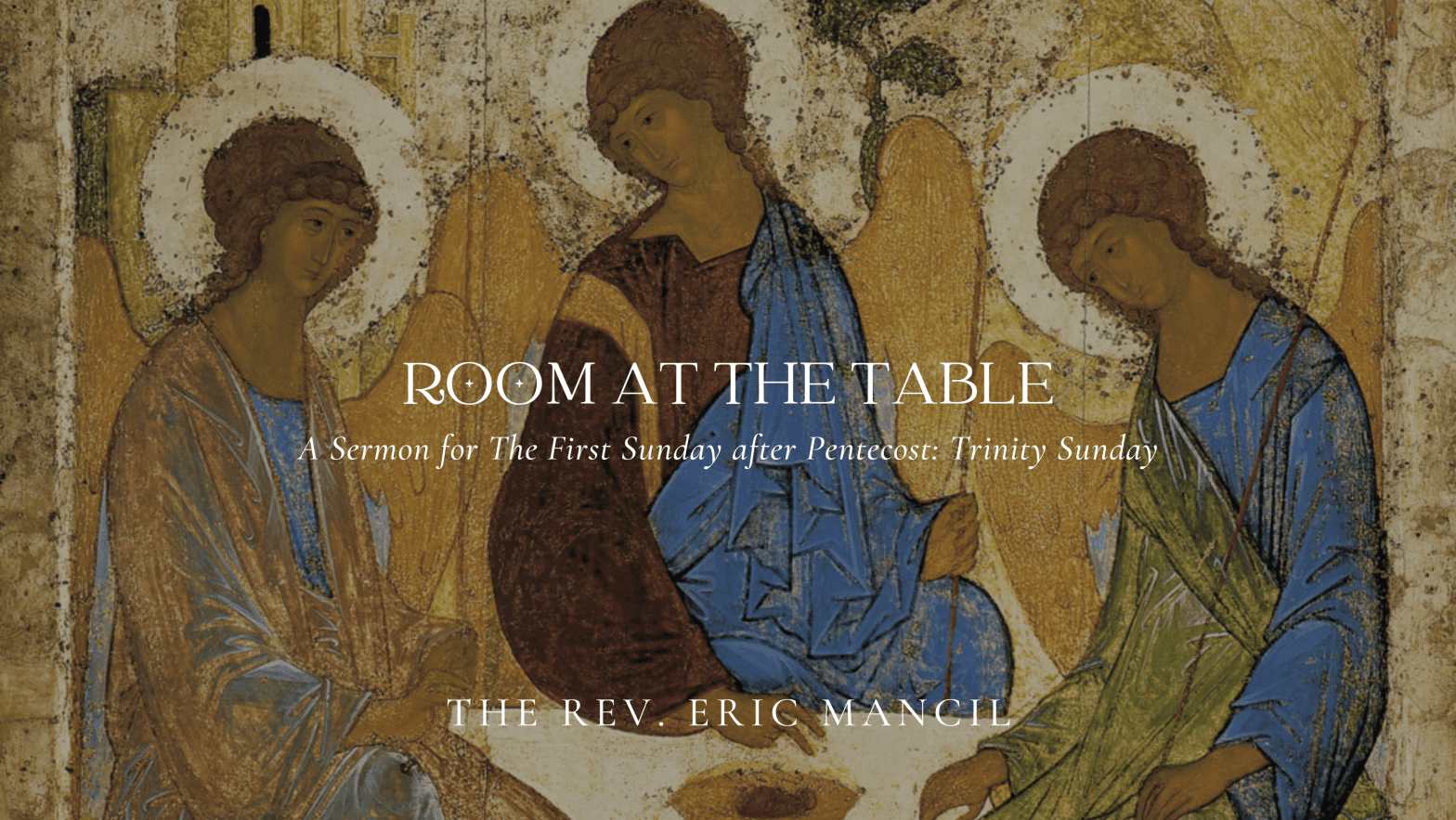
Recently, I started reading a book by Richard Rohr called The Divine Dance, and in the introduction, the author reflects on the Trinity icon by Andrei Rublev.

There’s a picture of it in your bulletin this morning.

It was painted in the early fifteenth century, and it’s sometimes called The Hospitality of Abraham, because it draws from Genesis 18, when three mysterious visitors come to Abraham and Sarah by the oaks of Mamre. Over time, Christians came to see in those three visitors an image of the Holy Trinity.

In Rublev’s icon, the three figures are seated around a table. Their bodies are turned toward one another. Their heads are inclined toward one another. Their hands gesture toward the shared meal set before them. And if you’ll notice, the three figures form a kind of circle around the table.

A circle of communion and divine love.

I’ve seen this icon many times before. But until I started reading Richard Rohr’s book, I had never noticed a specific detail.

At the front of the table, there’s a small rectangular space. Most people look right past it. Rohr points out that when the original icon was examined, traces of glue were found in that space, leading some art historians to believe that something may have been attached there at one time.

Perhaps even a small mirror.

Now, we don’t know that for sure. It may have been part of the original icon. It may have been added later. Or it may simply be a beautiful possibility.

But imagine if it were true.

If there was once a mirror on the front of that table, then the person looking at the icon would see themselves reflected there. 

The observer would become part of the image. The circle would be open to a fourth.

A place for the person looking in.

A place for you and for me.

What I love about this image is that it invites us to think deeply about the image of God we carry around with us.

Because whether we realize it or not, all of us carry some image of God in our minds and hearts.

For some people, God is mostly distant and far away—high above us, looking down from heaven, watching closely, waiting for us to mess up.

And if that is the picture of God we carry, then faith can easily become rooted in fear rather than love.

But the Trinity gives us a different image of God.

God is not distant or detached. God is not sitting far away, waiting for us to fail.

God is communion. God is relationship. God is love.

The Triune God is not looking for reasons to keep us away. God is always making room, always inviting us deeper into the life of God.

The ancient Church had a word to describe this inner life of God: perichoresis, a Greek word that points to the mutual indwelling of Father, Son, and Holy Spirit.

In other words, the three persons of the Trinity do not exist apart from one another, but in perfect communion with one another.

Some Christian writers, including Richard Rohr, have imagined this as a kind of divine dance—not because God is spinning around somewhere in heaven, but because the life of God is movement and joy, giving and receiving.

There is no competition or rivalry. No one person of the Trinity trying to stand alone at the center.

There is only mutual love.

And this love is not closed in on itself. Not because God is incomplete without us, or because God needs us in order to be God, but because God’s love is so full and generous that God desires to share that life with us.

That brings me to our reading this morning from Genesis.

In the beginning, God creates.

God speaks light into darkness. God brings forth the earth and fills it with life. And then God creates humankind in God’s image.

If God’s own life is relationship—a communion of love between Father, Son, and Holy Spirit—then to be made in the image of God means that we are made for relationship.

We are made for communion.

We are made to love and be loved.

We are made not to live as isolated individuals turned in on ourselves, but as people created for connection: connection with God, with one another, and with the whole creation God calls good.

From the very beginning, God’s desire was not distance, but relationship.

Not an empty table, but a shared one.

And that’s exactly what we see in our Gospel lesson from Matthew.

The risen Jesus gathers with his disciples on a mountain and gives them some final instructions.

“Go therefore and make disciples of all nations,” he says, “baptizing them in the name of the Father and of the Son and of the Holy Spirit, and teaching them to obey everything that I have commanded you.”

We often hear that passage and think of it as the Church’s Great Commission to go out and convert people.

And, of course, Jesus does send the disciples out to make other disciples. But I think we sometimes misunderstand what that means.

Jesus doesn’t send them out to win arguments, or pressure people into faith, or grow the Church for its own sake.

He sends them out to invite others into relationship: to baptize them in the name of the Father, and of the Son, and of the Holy Spirit; to teach them the way of love; to draw them into the same communion of love that has already embraced them.

In other words, Jesus sends them out to widen the circle.

If the Trinity is like a divine dance, then the mission of the Church is not to stand at the edge of the circle and guard the entrance.

The mission of the Church is to open the circle wider and wider, inviting others to discover that they, too, are beloved children of God.

That changes how we think about mission and evangelism. It changes how we think about what it means to be the Church.

Because if God is communion, then the Church is called to be a community of welcome. If God makes room at the table, then the Church is called to be the kind of community where people can discover that there’s room for them, too.

A parish church, like St. Mary’s, is meant to be an example of divine welcome. Not a closed circle or a private club. But a living sign of the God whose love always makes room.

And we widen the circle in all kinds of ways: every time we welcome someone looking for a place to belong, every time we make room for a child, every time we gather around the font, every time we feed a neighbor or share a meal, every time we notice someone standing alone and invite them to sit with us.

Every time we say, in word or deed, “There is room for you here.”

This is especially important at a time like this, when so many people feel isolated and alone, wondering if there’s a place for them anywhere.

Unfortunately, the Church has not always been good at reflecting the open table of God’s love.

Too often, Christians have guarded the entrance. Too often, we have made the circle smaller and acted as though God’s love was scarce, as though grace needed to be rationed or earned.

But the Trinity tells us something different.

The Trinity tells us that at the heart of God is a love that overflows and never ends.

A love that creates, redeems, and sustains.

A love that invites us to share in the divine life.

At the very end of Matthew’s Gospel, after giving them the Great Commission, Jesus says to his disciples, “And remember, I am with you always, to the end of the age.”

That’s important for us to remember.

The disciples are not sent out alone. The One who sends them also goes with them.

And the same is true for us.

Wherever we go, Christ goes with us. We never walk this Christian way of life alone. The One who sends us forth walks beside us.

We don’t have to have every answer figured out. We don’t have to be able to explain every mystery.

We are simply called to live as people who have been drawn into the love of God, and then to make room for others in that same love.

So maybe this Trinity Sunday, instead of trying to solve the mystery, we might simply receive the invitation.

Look again at the icon.

See the table. See the circle of love and the open space for you and me. And hear the invitation of the Triune God:

There is room for you here.

And then hear the call of Jesus:

Go forth.

Make room for others.

Widen the circle.

Because the life of God is communion.

The mission of the Church is invitation.

And the table of God’s love is wider than we can possibly imagine. Amen.
Five Simple Words

A Sermon for the Seventh Sunday of Easter (Year A)
May 17, 2026

Text: Acts 1:6-14

Now, O Lord, take my lips, and speak through them. Take our minds, and think through them. Take our hearts, and set them on fire. In the name of the Father, and of the Son, and of the Holy Spirit. Amen.

This past week, I came across a comic strip on Facebook that imagines the Ascension of Jesus in a way that’s both funny and thought-provoking.

In the comic, Jesus is standing with his disciples, just before he ascends into heaven. He looks at them and says, “Gotta go, dudes. Don’t forget what I taught you.”

And then, as he’s being lifted up into the air, he calls back down to them and says, “See you in the funny papers!”—which, of course, is a little nod to the fact that this is a comic strip.

The disciples stand there watching him go, and one of them waves and says, “Bye, boss.” Another one says, “Bye!”

Then, after Jesus has vanished from their sight, they begin to talk among themselves.

One of them asks, “So…what did we learn?”

Another one answers, “Pretty much, it’s love God and love your neighbor.”

Then, someone else says, “Well, that seems pretty simple. I don’t see how we can mess th…”

And just as he’s about to finish, another disciple points and says, “Uh-oh…here come the theologians!”

I love that comic because it made me laugh, but I also think there’s something important to learn from it.

Now, just to be clear, the joke about theologians is funny, but theology matters. The Church has always needed faithful people—scholars, priests, writers—to help us think deeply about who God is and what God calls us to do.

At its best, theology doesn’t lead us away from the heart of God. It leads us more deeply into it.

But, sometimes we make following Jesus a little more complicated than it needs to be.

It can be easy for us to get tangled up and lost in all the questions, and when we do that, we can lose sight of what’s really important and what Jesus first taught us to do, which is love God and love our neighbor.

Or, as a priest I once knew used to say, “Love God. Love your neighbor. Everything else is commentary.”

That line has stayed with me for years, and I thought about it this week as I prepared for today’s sermon.

In our reading this morning from the Acts of the Apostles, we hear the story of Jesus’ Ascension into heaven.

And while the comic strip tells that story with humor, it also points us toward a very real question the disciples had to face after Jesus ascended:

What now?

Jesus had been raised from the dead. He had appeared to them. He had taught them. And now, the time had come for him to return to the Father.

But before Jesus ascends, the disciples ask him one more question:

“Lord, is this the time when you will restore the kingdom to Israel?”

In other words: Is this it? Is this the moment we’ve been waiting for? Is this when everything finally gets fixed? Is this when all the pain and confusion and uncertainty are swept away? Is this when our enemies are defeated, our hopes are fulfilled, and all our questions are finally answered?

Is this when the kingdom comes in the way we expected?

Because that’s really what they’re asking. They’re not asking a random question. They’re asking from a place of hope and longing.

They’ve followed Jesus for all this time. They’ve watched him heal the sick, feed the hungry, forgive sinners, welcome the outcast, and challenge the powers of this world.

They’ve experienced his death and resurrection.

And now, after all of that, they want to know: Is this finally the moment when God makes everything right?

It’s understandable, because we ask it, too.

When we look at the world and see suffering, violence, and division, we wonder, “How long, O Lord? When will things be made right? When will God’s kingdom finally be fulfilled? When will this broken world be restored to what God intended it to be?”

The disciples wanted to know if that moment had finally arrived.

Jesus doesn’t shame them for asking. But he does redirect them.

He says, “It is not for you to know the times or periods that the Father has set by his own authority.”

That probably wasn’t the answer they wanted to hear.

They wanted a timeline.

Instead, Jesus gave them a mission.

They wanted to know the future.

But Jesus gave them work to do in the present.

“You will receive power when the Holy Spirit has come upon you,” he says, “and you will be my witnesses in Jerusalem, in all Judea and Samaria, and to the ends of the earth.”

That is their calling.

And that’s why the Ascension matters.

It’s not just about Jesus leaving. It’s not Jesus abandoning his disciples. It’s not him saying, “I’ve done my part. Now it’s time for you to figure it out.”

The Ascension tells us that, after Jesus completed his earthly ministry, he returns to the Father. He is lifted into the fullness of God’s glory. He intercedes on our behalf. He carries our humanity with him into the very heart of God.

And before he ascends, he promises his disciples that they will never be alone.

They will receive the Holy Spirit.

They will be given power.

And they will be sent out as witnesses.

And I think that’s what the comic strip from earlier gets right.

The disciples ask, “So…what did we learn?”

Love God.

Love your neighbor.

And show the world—by your life and example—what the love of God in Christ Jesus really looks like.

It sounds simple enough.

But simple doesn’t always mean easy.

It’s not always easy to love God with our whole heart, soul, mind, and strength.

It’s not always easy to love our neighbors as ourselves, especially when our neighbors are difficult or different from us or hard to understand.

It’s not always easy to love when we’re afraid.

It’s not always easy to love when being right or winning an argument matters more than being reconciled.

And maybe that’s why Jesus tells his disciples to go and wait for the Holy Spirit.

Because the mission he gives them is simple, but it isn’t always easy.

They’ll need to rely on more than just their own strength in order to do God’s work.

They’ll need the power of the Holy Spirit.

After Jesus ascends, the disciples stand there, looking up toward heaven, and two men in white robes appear and say, “Men of Galilee, why do you stand looking up toward heaven?”

In other words, don’t just stand there. You’ve been given a mission and a promise.

Now go and pray and wait for the Holy Spirit.

And that’s exactly what they do.

They return to Jerusalem. They gather together, and they devote themselves to prayer as they get ready for what’s about to happen.

And then finally, when the Holy Spirit arrives, they bear witness to what they’ve seen and heard. And we’ll hear more about that next week on the Day of Pentecost.

Dear friends, that’s the life of the Church.

We pray.

We gather together in worship.

We put our trust in God to give us what we need in order to live good and faithful lives.

And God grants us the gift of the Holy Spirit, strengthening and empowering us for the work of ministry and sending us forth into the world to share the Good News.

We’re still living in that time between the Ascension of Jesus and the fullness of God’s Kingdom.

We still have questions and struggle with doubt.

We still wonder what God is up to in the world around us.

We still look at the world and hope for things to be made right.

But Jesus doesn’t give us a timeline.

Instead, he gives us a promise—just like he did with his disciples.

He promises to never leave us or abandon us to do this work alone.

He gives us the gift of the Holy Spirit to bring us comfort and peace in our lives and to strengthen us for the work of ministry.

He gives us the gift of one another—a community of faith to lean on for strength and support.

And, by God’s grace, he gives us holy work to do.

The disciples couldn’t stay where they were after Jesus ascended, and neither can we. There is a world around us that needs mercy, forgiveness, and hope.

So we go forth to bear witness to the love of God is Christ Jesus—not just in what we say, but in how we live our lives.

We join in the work of building up God’s Kingdom, on earth as it is in heaven.

And that work really can be summed up in five simple words.

Love God.

Love your neighbor.

Everything else is commentary.

Amen.

All Are Welcome

A Sermon for the Third Sunday of Easter (Year A)
April 19, 2026

Text: Luke 24:13-35

Now, O Lord, take my lips, and speak through them. Take our minds, and think through them. Take our hearts, and set them on fire. In the name of the Father, and of the Son, and of the Holy Spirit. Amen.

This has been a hard week for our family. And before I say anything else, I just want to say thank you—to all of you who have reached out over the past several days with your prayers, your kind words, and your support.

It’s meant more than I can say.

Many of you know this already, but earlier this week, my dear friend and mentor of almost twenty-three years, Father Wells Warren, died after a sudden and quick battle with cancer.

And I’ll be honest with you—my heart’s been heavy. I’ve shed many tears over the past week.

Grief has a way of doing that.

It doesn’t come all at once, like we might expect.

It comes in waves.

There are moments of deep sadness—moments when the loss feels very real and very close.

Then there are moments of something else, and the best way I know how to describe it is gratitude.

Deep, abiding gratitude for Father Wells’s life and ministry as a priest.

Gratitude for having known him for as long as I did.

Gratitude for all the many ways he touched my life and the lives of so many others.

And I’m especially thankful that I was able to visit with Father Wells and his family last Friday, just a few days before he passed.

We spent time together, talking and sharing memories.

And I had the chance to tell him a few things I needed to say.

I told him how much he meant to me and my family.

I told him how much his life and ministry had shaped and formed me through the years and how many people he had touched along the way.

And in a moment that I’ll carry with me for the rest of my life, I was able to celebrate the Eucharist with Father Wells and his family right there in his living room.

It was truly a full-circle moment for me, being able to celebrate the Eucharist with Wells one last time.

He was the one who first welcomed me to the table, the one who helped me come to know Christ in the breaking of the bread.

I’ve been thinking about that moment all week and all the other wonderful memories I have of Father Wells.

And, for me, it feels especially timely that today’s Gospel reading is the story of two disciples on the road to Emmaus.

It’s one of my favorite Easter stories, and it’s all about how Christ is made known to us—not in the ways we might expect, but in the simple, ordinary moments of life.

In conversations and companionship and most especially in the sharing of a meal.

There are two disciples walking along the road from Jerusalem to Emmaus, trying to make sense of everything that’s just happened.

They’ve heard the news of Jesus being raised from the dead, but they haven’t seen it for themselves.

So they’re still in this confused state of grief and disappointment.

Because the one they had put their trust in—the one they had hoped would bring redemption to Israel—had been taken from them and crucified.

You can almost hear it in their voices:

“What do we do now?”

“Where do we go from here?”

And as they walk, Jesus quietly comes up beside them.

At first, they don’t recognize him.

They talk with him.
They listen.
They walk with him for miles.

And still—they don’t know who he is.

Perhaps, his identity was hidden from them in some mysterious way.

Or perhaps, in their grief over the loss of their friend and teacher, they weren’t able to see him as clearly as they once did.

But then something happens.

When they arrive at their destination, they invite Jesus to stay with them.

They sit down at the table for supper.

And Jesus takes bread…
blesses it…
breaks it…
and gives it to them.

And in that moment—their eyes are finally opened.

They recognize Jesus.

They see him in the breaking of the bread.

There’s something about the table.

Something about sharing a meal that opens us up in ways that other moments don’t.

I think that’s why so many of the stories we have of Jesus’ ministry take place around a table.

At the table, we have the opportunity to slow down.
To be present.

To enjoy the company and fellowship of others.
To make room for one another.

And it’s often there—in that simple, ordinary act of breaking bread—that Christ is made known.

When I think about my life and the special relationship I had with Father Wells, I can see how true that is.

Wells and his family were the first ones to welcome me and Chelsea into the Episcopal Church at St. Dunstan’s in Auburn.

And so much of that experience—so much of what made us feel like we belonged—happened around a table.

Every year, after the Great Vigil of Easter, we would gather in the kitchen at church for a big potluck brunch.

Every year, at the annual Beach Retreat in Fort Morgan, we would have a big Agape meal, with simple foods and fellowship.

On Tuesday evenings each week, we had a Folk Mass in the chapel, followed by a catered dinner.

And every week, after Sunday evening worship, we would stay for what Father Wells called $2 supper.

Week after week.

People sitting together.
Talking, laughing and sharing life.

And looking back on that now, I can see that those weren’t just meals.

They were moments where something deeper was happening, where I was beginning to encounter the love of God in Christ, before I even knew what it meant.

And that spirit of welcome wasn’t just something that happened around the dinner table.

It also happened in worship.

Every Sunday, before communion, Wells would stand up and say:

“All are welcome.”

And he really meant it.

It didn’t matter who you were.

It didn’t matter where you came from or what church you belonged to, or if you even went to church.

There was a place for you at the Table.

Because Wells understood that it wasn’t his Table.

It was God’s Table, and it’s a place where all who love God and who want to love God more are welcome.

And I’ll never forget the way he would invite people to stay for supper after the service.

During the announcements, he would always say, “Please stay for supper. It’s only two dollars, but if you don’t have two dollars, it’s free.”

Because for him, it was never about the money.

It was about the invitation.

It was about making sure that every person who came to church knew there was a place for them there—that they were truly welcome, no exceptions.

I carry that with me every single day.

So much of who I am as a priest—so much of how I understand this calling—has been shaped by Father Wells and the example he set.

The way I think about hospitality and welcome.

The way I think about what it means to be a pastor and priest.

I carry so much of what he taught me in the way I try to live out my own ministry.

And when I look back on all the moments in my life he was part of—

my baptism…
my confirmation…
my wedding…
the baptisms of our children…
my ordination to the priesthood…

And all the quieter moments in between—

I can see something more clearly now than I could at the time.

I can see the love of God at work in my life.

In shared meals.
In words of welcome.
In a place at the table.

That’s what today’s Gospel is all about.

That Christ is not only revealed in extraordinary moments…but in ordinary ones.

In the breaking of bread.
In the sharing of life.
In the simple act of sitting down together for a meal.

We are called to carry that radical love and hospitality forward.

We are called to create that same kind of space—to extend that same kind of invitation—to those we meet.

In many ways, we already do, right here at St. Mary’s.

Every time we gather for a meal or prepare food for one another.
Every time we serve our community.

In our parish meals.
In our Second Sunday potlucks.
In ministries like Rice and Beans and Community Dinners.

Those aren’t just nice things we do.

Those are moments where the love of God in Christ is made known—where people are seen, welcomed, and loved—maybe even for the first time.

So maybe the invitation for us today is simple.

May we continue to be a place where all are welcome at the table—at the Altar and at the dinner table.

May we continue to make space for all who seek God and a deeper knowledge of his love.

Because it may be in those very moments…

in the sharing of a meal…
in the breaking of the bread…

That someone will come to know and see Jesus more clearly.

Just as those disciples did.

And just as I did when I walked into St. Dunstan’s for the first time and met Wells Warren.

Maybe the invitation for us today is not just to remember that we are welcome…but to be that welcome for others.

To make space.
To extend the invitation.
To set the table.

And to say—clearly and without hesitation: “All are welcome.”

Amen.

Here Is the Man

A Sermon for Good Friday
April 3, 2026

Test: John 18:1-19:42

I speak to you in the name of one God: Father, Son, and Holy Spirit. Amen.

Here at St. Mary’s, over the past several weeks—during the season of Lent—we’ve taken on the practice of walking the Way of the Cross every Wednesday evening.

Most years, we only do this once—usually on Good Friday.

But, this year, I wanted to make it a weekly practice so that we could really prepare our hearts and minds to walk with Jesus during Holy Week.

Week after week, we gathered in the Nave and moved from one station to the next, retracing the final steps of Jesus’ journey to the cross.

And as we walked those stations, we were drawn—again and again—to the physical suffering Jesus endured.

We heard about the weight of the cross and how Jesus fell to the ground—not once, but three times.

We reflected on the nails that pierced his hands and feet.

We stood at Golgotha—the place right outside the city walls where Jesus was crucified.

That physical suffering is real.

And it’s an important part of the story because it shows us—in vivid detail—the depths to which God was willing to go to save us all.

But as the weeks went on, I began to notice something else—something just as important, but easier to miss.

Not only does Jesus suffer physically—his humanity is also stripped away, piece by piece, as the story unfolds.

So tonight, I want us to spend some time reflecting on those parts of the story and how they invite us to see more clearly what Jesus suffered—and what it means for us as Christians.

John’s Gospel doesn’t rush through the story.

It lingers, on purpose.

It lets us see what happens along the way.

And there are these moments—almost like scenes from a movie—where Jesus is stripped of his dignity, dismissed, and humiliated.

The first moment comes when Jesus is handed over to Pilate.

You can almost picture it in your mind.

It’s early in the morning.

There’s tension in the air.

Jesus stands before Pilate—not as a teacher or a healer, but as a problem that needs to be addressed.

A situation that needs to be handled quickly.

The crowd isn’t listening to Jesus anymore.

They’re not trying to understand him or learn from him.

They’ve already made up their minds.

He deserves to die.

And Pilate keeps his distance. He’s not interested in the truth. More than anything, he just wants to keep the peace.

In that moment, Jesus is no longer seen as a person—but a problem to be dealt with.

Then the soldiers take him.

They put a crown of thorns on his head and a robe on his shoulders, and they begin to mock him.

“Hail, King of the Jews,” they sneer.

It’s meant to be funny—but it’s cruel.

They pretend to honor him as a king, but everything they do is meant to humiliate him.

They take something central to who he is—his identity as the one sent by God—and turn it into a joke.

Then, after Pilate has him flogged, he brings him out again—beaten, wounded, and exhausted—and says to the crowd, “Here is the man.”

Not “Here is the King.”

Not “Here is the Messiah.”

Just… the man.

As if to say, “Isn’t this enough? He’s no threat to you at all. He’s nothing more than a beaten, broken-down man.

And the crowd looks at him—and still says, “Crucify him.”

There is no hesitation.

No compassion or sympathy.

Jesus means nothing.

Then we come to a moment that’s especially hard to hear.

The soldiers take his clothes and divide them among themselves, and Jesus is left exposed—completely vulnerable.

This part of the story is uncomfortable, because we all know, at least in some small way, what that kind of vulnerability feels like.

To be exposed, with nothing to hide behind.

To feel like your dignity has been taken away.

And then finally, we come to the cross.

In the Roman world, the cross was not just a means of torture and death.

It was about humiliation.

It was used to send a warning: “This is what happens to people who challenge authority.”

It was used to strip a person of their dignity in a very public way, which is why criminals were often crucified right outside the city walls, so that people passing by could see what was happening.

And as people looked on, they didn’t see glory.

They saw shame.

And the truth is, we’re not so far removed from that moment.

This is where the story begins to turn toward us in a very real way.

Because Good Friday isn’t just about something that happened a long time ago.

It’s about us as well and what the cross means for us in our walk with Christ.

If we’re honest, we know that the story of Jesus’ passion and death tells us something about ourselves.

Just as the soldiers and the crowd stripped Jesus of his dignity, we do the same.

We reduce people to labels.

We put them into categories.

We dismiss them without really knowing who they are.

We do it when we talk about people behind their backs—especially those we disagree with.

We do it when we make quick judgments about people instead of getting to know them.

We do it when we overlook people altogether because they don’t fit into our circles or seem worth our time.

Sometimes it’s obvious when we do it.

Sometimes it’s quiet—something we do without even thinking about it.

It’s much easier to judge someone than to get to know them.

It’s easier to talk about someone behind their back than to have a conversation.

It’s easier to ignore someone than to really see them.

And when we stop seeing people as fully human—when we begin to see others as less than, they become easier to hate…easier to dismiss…easier to hurt…easier to overlook.

Good Friday invites us to face that truth.

Not to overwhelm us with guilt or shame.

But to hold up a mirror.

To reveal the ways we’ve fallen short of our call to walk in love.

But that’s not all.

Because in John’s Gospel, the cross isn’t just about suffering and death.

It also reveals something about God.

We’re invited to look closely at who Jesus truly is.

Look closely, and what you’ll see is not just the suffering of an innocent man.

What you’ll see is the love of God poured out for the world.

Even on the cross, Jesus never stops being who he is.

He continues to give himself freely.

He continues to love and offer mercy and forgiveness—even to those who persecute him.

That love—that sacrifice—changes everything.

It takes an instrument of shameful death and turns it into the means of our salvation.

If the cross is what the love of God looks like, then it changes how we’re called to see and treat other people.

It calls us to slow down, to pay attention, to resist the instinct to label or dismiss or to treat others as less than.

And instead—to see everyone as God’s beloved.

To see the person in front of us as someone made in the image of God. As someone worthy of dignity and respect. As someone whose life matters to God.

And maybe, if we can learn to see who Jesus truly is—the one who freely endured the shame and agony of the cross—then we can learn to see him in others as well, especially in the people we struggle to love.

In the words of Pilate, “Here is the man.”

Behold him.

And by doing so, may we learn to love one another as he loves us.

Let us pray.

Lord Jesus,
as we behold you on the cross,
stripped, humiliated, and yet still full of love,
open our eyes to see you clearly.

Show us the ways we have failed to see others as you see them.
Soften our hearts where they have grown hard.
Teach us to recognize your presence in every person we meet.

And as we leave this place,
give us the grace to walk more faithfully in your Way—
to love as you have loved us.

Amen.

God’s Abiding Love

A Sermon for the Fourth Sunday in Lent (Year A)
March 15, 2026

Text: John 9:1-41

Now, O Lord, take my lips, and speak through them. Take our minds, and think through them. Take our hearts, and set them on fire. In the name of the Father, and of the Son, and of the Holy Spirit. Amen.

There’s a question that human beings have been asking for as long as we’ve been around. It’s the question we ask ourselves whenever life takes a turn for the worse or when something painful happens to us or someone we care about.

The question is simple.

Why?

As it happens, that question actually came up in a different way last weekend at our parish retreat at Blue Lake.

One of the things we did Saturday afternoon during our program time was play a little game called “Stump the Priest.”

People could write questions anonymously on a piece of paper—any question they wanted to ask—and I had to answer them on the spot.

Some of the questions were fun and lighthearted.

One person asked, “What’s the best rock band?”

To which I confidently replied, “The Eagles.”

(Although Journey is a very close second.)

Some of the questions had to do with me and my call to the priesthood.

But then there were some deeper questions—questions about the nature of God.

And one person asked a question that really made me stop and think for a moment.

They wrote, “How can God be just and merciful?”

In other words, how can God be a God of justice and a God of mercy at the same time?

That’s one of those questions that’s really hard to answer.

It’s the kind of question you usually want to sit with for a few days—not something you have to answer in ten seconds in front of a room full of people.

I did my best and hopefully gave a halfway decent answer.

But since then, I’ve had a little more time to think about it.

And the more I’ve thought about it, the more I’ve realized that there may be an even deeper question underneath it.

Because when people ask a question like that, they’re often wrestling with something in their lives that hits close to home.

Maybe the deeper question is this:

If God is loving and all-powerful—if God can do anything—then why is there so much pain and suffering in the world?

That’s an age-old question.

People have been asking it for centuries.

And I suspect it’s a mystery we’ll continue to wonder about until Jesus comes again.

If God created all that is and if God loves us more than we can possibly imagine, then why does God allow us to suffer?

Why are some people born with burdens they never asked for?

Why do some people suffer from illness while others live perfectly healthy lives?

Why do earthquakes, storms, and fires destroy homes and communities?

Why?

It’s the same question the disciples ask Jesus in our Gospel lesson this morning from John.

At the beginning of our story, as Jesus and his disciples are walking along, they see a man who has been blind since birth.

And the disciples immediately ask Jesus, “Rabbi, who sinned, this man or his parents, that he was born blind?”

In other words: Why?

Why did this happen?

Someone must be responsible.

Something must have caused this.

Surely there must be a good reason.

That way of thinking was very common in the ancient world.

Many people believed that suffering—whether it was illness, disability, or tragedy—was the result of sin.

If something bad happened to you, it must mean that somewhere along the way someone had done something wrong.

The disciples are trying to understand what happened to this man and why he was born with this condition.

But Jesus says something unexpected.

“Neither this man nor his parents sinned,” he says.

In other words, this was not a punishment from God.

It’s important for us to hear those words, because even today we still ask the same question.

Whenever something painful or difficult happens in our lives, our first instinct is to ask why.

Why did this happen to me?

Why did God let this happen?

What did I do to deserve this?

As human beings, we want the world to make sense.

We want things to be fair and just.

We want to believe that good things happen to good people and bad things happen to those who deserve it.

Because if that were true, the world would feel safe and predictable.

If something bad happens, we think that if we can just figure out why—if we can explain it—it would somehow make the pain easier to bear.

I see it all the time in my work as a priest.

Not long ago, I was talking with a friend who was going through a really difficult season of life.

It seemed like nothing was going her way.

One struggle after another kept piling up, and eventually she reached a breaking point.

And she asked me the question that so many of us have asked.

“Why is this happening to me? I’ve done everything right. I’ve tried to live a good life. Why would God let this happen?”

She wanted the world to make sense.

She wanted to believe that if you try to live a good and faithful life, then life should treat you fairly in return.

But the truth is, life rarely works that way.

Sometimes there is no clear explanation.

Sometimes suffering shows up in ways that make no sense at all.

Good people get sick.

Faithful people experience loss.

Innocent people suffer.

Sometimes, there’s a clear explanation why—and sometimes there’s not.

And when those moments come, the question “why” can start to weigh heavy on our hearts.

And make us wonder whether or not God really cares about us at all.

I want to bring us back to Jesus and what happens to the man who was born blind.

Jesus doesn’t blame anyone for the man’s suffering.

He doesn’t try to explain why he was born blind.

Instead, Jesus responds in the best way he knows how.

With healing and compassion.

He spreads mud on the man’s eyes, and miraculously, he receives his sight.

In John’s Gospel, the author rarely uses the word “miracle” to describe the amazing things Jesus does.

Instead, he calls them signs.

And that’s important to remember because a sign always points to something beyond itself.

This story is not just about one miraculous act of healing.

It’s a sign pointing us to the truth of who God is.

It points us to a God who heals and restores—a God who is in the process of making all things new.

But, the story doesn’t end there.

After the healing, the man is brought before the Pharisees.

They question him.

They argue with him.

They even interrogate his parents, trying to discover the truth of what happened.

And when the man refuses to back down—when he keeps telling them that the one who healed him must be from God—the Pharisees refuse to listen.

They cast him out.

This man who has spent his whole life on the margins—blind since birth and probably a beggar—is cast out once again.

And in the time of Jesus, that would have been devastating.

To be driven out meant being excluded from the synagogue, which was the center of spiritual life in the community.


It meant being cut off from the life of the community itself—socially isolated, and perhaps even separated from family and friends.

But then John tells us what happens next—and it’s a detail we often miss.

“When Jesus heard that they had driven him out, he found him.”

Jesus goes looking for the man who was cast out.

Think about that for a moment.

Jesus could’ve easily moved on.

The miracle had already happened.

The man had received his sight.

Jesus had already done more than enough.

But when Jesus hears that the man has been driven out from the community, he goes back.

He seeks him out.

Jesus is not only concerned with healing the man’s eyes.

Jesus cares about his whole life.

His dignity.

His belonging.

His place in the world.

So Jesus seeks him out and finds him.

And in that moment the man receives something even greater than the gift of sight.

He receives the gift of knowing God’s unconditional, abiding love.

He is seen as God’s beloved.

And maybe that’s the greatest miracle of all.

Because what this story shows us is the heart of God.

Our God is not a God who causes pain and suffering. 

God is not waiting around up in heaven waiting for us to mess up so he can punish us.

Our God is a God of healing and restoration, a God who seeks us out and promises to walk with us through all the changes and chances of this life.

When the world casts people aside, God is with them.

When life pushes us to the margins, God is with us.

And when we find ourselves asking “why”—when we walk through seasons of life we didn’t ask for and can’t explain—this story reminds us of God’s unconditional, abiding love.

God is always with us.

Even when we don’t understand why some things happen—

Even in the midst of despair and suffering—

Jesus is still the one who comes looking for us and promises to never let us go. Amen.

Born From Above

A Sermon for the Second Sunday in Lent (Year A)
March 1, 2026

Text: John 3:1-17

Now, O Lord, take my lips, and speak through them. Take our minds, and think through them. Take our hearts, and set them on fire. In the name of the Father, and of the Son, and of the Holy Spirit. Amen.

A lot of us grew up with the idea that being a Christian means basically two things: Number one: you show up to church on Sundays. And number two: you believe certain things about who Jesus is.

You try your best to be a good person. You pray when you’re supposed to. You’re kind and respectful. You believe Jesus is the Son of God—that he died and rose again—and that God loves you.

It’s the faith many of us learned in Sunday School.

And if you do those things—if you check all those boxes—then you’re good.

Now, I want to be really clear: coming to church matters. What we believe matters. Prayer matters. What we say in the Nicene Creed matters. The Church has always cared about seeking the truth of who God is—and that’s a good thing.

But if we’re being honest, that version of Christianity doesn’t go very deep.

Because you can come to church every Sunday and still live the rest of the week no differently than anyone else.

You can sit in the same pew year after year and still be shaped more by your worries, your habits, your grudges, and the noise around you than by Jesus.

You can believe all the right things about Jesus and still not actually follow Jesus.

We see a good example of that today in our Gospel lesson, because Nicodemus is, in many ways, the picture-perfect image of a “good religious person.”

He’s serious about God.

He’s well-educated, well-known, and respected.

He knows the Scriptures. He’s a teacher of Israel. He believes the right things about God.

And yet he comes to Jesus at night because he knows something is missing.

Bishop Russell put it this way in his closing sermon yesterday at the diocesan convention: “There is more.”

And Nicodemus knows that.

There is more to life than what he has. There is more to God than what he can explain.

So he goes to Jesus, and he says: “Rabbi, we know that you are a teacher who has come from God; for no one can do these signs that you do apart from the presence of God.”

That almost sounds like a confession of faith, doesn’t it?

Like Peter telling Jesus that he is the Messiah, the Son of God.

It sounds like the thing we wish more people would say about Jesus.

But Jesus doesn’t respond by saying, “Great job, Nicodemus—you’ve said all the right things.”

He says, “Very truly, I tell you, no one can see the kingdom of God without being born from above.”

That tells us something important.

Jesus isn’t simply interested in what Nicodemus believes.

He’s most interested in what Nicodemus is becoming.

And I think that’s what today’s Gospel has to teach us.

Being a Christian isn’t just about showing up on Sundays and believing the right things. It’s about being changed by Jesus.

Nicodemus says all the right things:

“Rabbi, we know you’re from God.”

“We know you’re a legitimate teacher.”

But Jesus says, “Knowing isn’t enough. Believing the right things isn’t enough. You must be born from above.”

In other words: you can’t step into God’s kingdom and stay the same.

But Nicodemus wants to keep things under control. He wants faith to stay safe and manageable. So he asks, “How can anyone be born after having grown old?”

And honestly, it’s a fair question. We ask it too, just with different words: “This is who I’ve always been. Can I really change?”

Jesus answers, “You must be born of water and the Spirit.”

We recognize that language, don’t we?

That’s baptism language.

That’s Jesus’ way of saying that faith isn’t just something you believe—it’s something you live.

This past week I’ve been reading a new book by John Mark Comer called Practicing the Way.

And in one of the first chapters of the book he uses a word that I think is helpful when he talks about followers of Jesus.

Instead of the word “disciple,” he uses the word “apprentice.”

Most of us know an apprentice isn’t just someone who just admires their teacher from a distance.

An apprentice arranges their entire life around the teacher, practicing their way until it becomes their own.

The author of the book names something we all know to be true: it’s entirely possible to call yourself a “Christian” without being a disciple—an apprentice of Jesus.

It’s possible to identify as Christian—even to attend church regularly—without actually organizing your daily life around the One you claim to follow.

In other words, we can be sincere in our faith and still keep it separate from the way we live.

We can have a faith that stays mostly in our head—without letting it reach our hearts.

We can come to church and still be unloving to the people around us.

We can say the Creed and still cling to resentment.

We can sing about peace and still live in anger.

We can talk about loving our neighbors and still treat people like enemies.

And Jesus is telling Nicodemus—and he’s telling us—this is not what God intends.

What God wants is not just people who believe the right things or show up when they’re supposed to.

God wants people who are being remade and reborn—people learning to live the life of the kingdom.

That brings us to John 3:16—probably the most well-known verse in the New Testament:

“For God so loved the world that he gave his only Son, so that everyone who believes in him may not perish but may have eternal life.”

It’s easy to hear that verse and assume it means, “If you believe the right things about Jesus, then you’re covered.”

But in John’s Gospel, “belief” isn’t just something you think.

It’s trust.

It’s stepping into the light.

It’s letting your life be changed.

And that’s why the next verse matters so much—and why I think it should always be paired with John 3:16:

“Indeed, God did not send the Son into the world to condemn the world, but in order that the world might be saved through him.”

Jesus doesn’t come to condemn us.

He comes to bring us new life.

Jesus doesn’t come only to save us from something.

He comes to save us for something.

We are not only saved from sin and death.

We are saved for a life shaped by Jesus—a life of discipleship, a life lived in the way of love.

So what does that look like for us?

It means we stop thinking of Christianity as just “show up and believe the right things,” and we start asking a new question:

If Jesus is my teacher, how am I patterning my life after his?

Because being an apprentice means becoming like the teacher.

It means thinking about how you begin your day. If the first voice you listen to each morning is your phone or your TV—news, emails, notifications—don’t be surprised if you start the day anxious and afraid.

Apprentices of Jesus begin the day with Jesus, even if it’s a simple prayer: “Lord Jesus Christ, have mercy on me. Help me follow you today.”

It means thinking about the way you speak when you’re stressed. When you’re tired, irritated, stretched thin—that’s when you find out what’s really forming you.

Apprentices of Jesus practice pausing before they speak. They ask: How would Jesus respond? What would Jesus say?

Becoming like Jesus means thinking about what you do with grudges and resentment. We’re really good at carrying them.

Apprentices of Jesus practice forgiveness, because Jesus forgave. Even if you’re not ready, you can pray: “Lord, I’m not ready—but make me willing.”

Becoming like Jesus means thinking about how you treat people you disagree with. I think this one is especially important right now.

Apprentices of Jesus don’t let anger rule their lives. They practice treating even those they disagree with as people made in God’s image—with dignity and respect.

Becoming like Jesus means thinking about how you use your time and your money.

Apprentices of Jesus practice generosity and simplicity. They practice rest. They practice saying “no” to things that leave no room for prayer and worship and family.

And little by little—over time—those practices become a new way of life.

That’s what Jesus means by being born from above.

Not instant perfection.

But a new direction. A new center. A life being reborn.

So I want to encourage you today, especially as we continue our journey through Lent:

If you’ve treated Christianity as just “show up and believe the right things,” Jesus is inviting you to go deeper.

Not out of guilt—but out of love.

Start small.

Choose one practice this week that helps you take a step in the way of Jesus.

And don’t do it to try to earn God’s love.

God already knows you. God already loves you. God already sees you.

Do it because God isn’t just saving you from something—God is saving you for something.

Nicodemus comes at night, but Jesus keeps speaking about light and life and Spirit and the kingdom of God.

He invites Nicodemus to step into the light and be changed.

And the same is true for us.

Jesus didn’t come to condemn the world.

He came to save it—to save us not only from sin and death, but from shallow faith… to save us for a life of discipleship, a life where the love of God is embodied in the way we live our lives.

So may this season of Lent be for you more than a time of just showing up.

May it be a season of new birth.

And may the Spirit teach us how to be with Jesus, how to become like Jesus, and do what Jesus did—until his way of love becomes the pattern of our lives.

Amen.

The Mountain Is Not the Mission

A Sermon for the Last Sunday after the Epiphany (Year A)
February 15, 2026

Text: Matthew 17:1-9

Now, O Lord, take my lips, and speak through them. Take our minds, and think through them. Take our hearts, and set them on fire. In the name of the Father, and of the Son, and of the Holy Spirit. Amen.

Every year, on the Last Sunday after the Epiphany, the Church brings us to the mountain. We’ve been walking in this season of light for weeks now. Watching for it. Listening for it. Noticing the quiet—and not so quiet—ways God has been revealing himself to us through Jesus.

The light of a star guiding the wise men to Bethlehem to pay homage to the newborn King.

The light breaking open the heavens at Jesus’ baptism.

The light of revelation when the first disciples realize that Jesus is no ordinary teacher and answer his call to follow.

The light of God’s Kingdom revealed through the Beatitudes.

The light Jesus names when he calls his followers salt and light for the world.

The season of Epiphany is all about revelation—about light breaking through, moment by moment—and God’s glory being made known through Jesus.

And now, as we come to the end of Epiphany and prepare to turn toward the season of Lent, we’re given one final, brilliant glimpse of who Jesus really is in our Gospel lesson lesson this morning from Matthew.

Jesus takes Peter, James, and John up a high mountain.

And right before their eyes, he is transfigured.

His face shines like the sun.

His clothes become dazzling white.

Moses and Elijah appear.

And a voice from heaven speaks, saying, “This is my Son, the Beloved…listen to him.”

It’s not a subtle or quiet moment.

It’s the glory of God breaking through.

Whenever we hear the story of the Transfiguration, it’s easy to assume this moment was all for Jesus—especially since it comes right before he begins his journey toward Jerusalem.

But, I don’t think this moment was for Jesus.

Jesus already knows who he is.

He’s already heard the voice from heaven declare that he’s God’s beloved Son.

He already knows the road ahead will lead to suffering and the cross.

No, this light from heaven—this moment of Transfiguration—is for the disciples.

They’re the ones who need to see it.

They’re the ones who will follow Jesus into Jerusalem and need reassurance when everything around them seems to be falling apart and all hope seems lost.

So God gives them a glimpse of glory.

Not a detailed explanation of who Jesus is.

Not all the answers to their questions.

Just a glimpse.

Enough to give them courage for the days ahead.

Enough to help them trust that even in the darkest times, God will be with them.

The light does’t remove every doubt.

But it gives them what they’ll need later. They see the light now so they can follow Jesus when the road becomes dark.

And I think that’s often how God works in our lives.

We’re given moments of light—glimpses of heaven—not so we can stay on top of the mountain, but so we can remember who we are and who we’re called to follow when life gets hard.

Those kinds of mountain-top moments still happen from time to time, and when they do, it’s important for us to hold them in our hearts.

They don’t always come with shining faces or voices from heaven. But every once in a while, we experience something that feels unmistakably holy—a moment when God’s love feels close enough to touch.

I had a moment like that—actually lots of moments—last weekend when I had the opportunity to go down to Pensacola and serve on staff for a Happening weekend.

If you’ve never heard of Happening, it’s basically a three-day retreat for high school students. A few days away from the noise and the pressure and constant performance of life.

There’s time for worship and prayer. There are small groups.

There’s laughter and late-night conversations, and there’s a lot of simple acts of kindness.

And there are lots of surprises along the way. I can’t go into detail about those because that would ruin the experience for any high school students here today who want to go to Happening.

But, honestly, I can’t recommend it enough.

It’s not a flashy weekend. There are no praise bands or fancy productions. And no one is pressured to do anything they don’t want to do.

It’s a sacred time set apart when young people can be reminded—sometimes for the first time in a long time—that God is real, that they are loved, and that they belong.

This was my first experience of Happening and serving as part of what they call the “God Squad”—a group of clergy who are mostly there in the background to help when needed and provide spiritual support for the weekend.

We weren’t there to run the program or be the center of attention. We were simply there to pray, and to listen, and to be available.

And from the background, I got to witness something pretty incredible.

Teenagers who showed up on Friday night carrying real burdens. Real questions. Real stories.

Some of these young people have lived more life than many of us here today. And they were brave enough to speak honestly about it.

I watched other teenagers—members of the staff—stand up and share their own stories of faith and struggle.

They gave their time freely to be there.

They had prepared for weeks in advance.

And they could have been doing a hundred other things with their weekend.

But they chose to be there.

They chose to show up for their peers.

And by the end of those three days, something changed.

You could see it in their faces.

You could hear it in their voices.

During the closing Eucharist, the Happeners were invited to stand up and share one or two ways they had seen God during the weekend.

They spoke about being welcomed.

They spoke about kindness.

They spoke about God’s love.

To me, it felt like a mountain-top moment.

Not because anything extraordinary happened—but because the light of Christ was clearly present.

A glimpse of God’s glory.

A reminder that God is still at work in our lives.

And like the disciples in our Gospel lesson this morning, those young people were changed. They weren’t the same as they were on Friday night.

But here’s the hard truth about mountain-top moments:

We don’t get to stay there.

On the last day of Happening, one of the youth staff came up to me and asked, “Why can’t we just stay here?”

And I said, “That’s the thing about mountain-top moments. We have to come down. Because that’s where God calls us to go.”

Peter wanted to stay on the mountain, too.

“Lord, it is good for us to be here,” he says. He wants to build tents. He wants to hold onto the moment for as long as he possibly can.

And honestly—who can blame him when God feels that close?

I think we’d all be just like Peter.

But Jesus leads them back down the mountain.

Because the mountain is not the mission.

The light is given so it can be carried into the world.

Grace is given so it can be shared.

Love is given so it can be lived out through our words and actions.

That’s what the mountain is meant to do. It changes us—and then sends us out.

Our weekend away at Happening came to an end. The students went home. Back to school. Back to ordinary life.

But they didn’t go back the same as they were.

And neither did I.

Because when you witness the light of Christ—when you hear young people say, “I know I’m loved”—it changes you.

As the season of Epiphany comes to a close, we’re reminded that we, too, have seen the light of Christ and that we’ve been changed.

We’ve seen it revealed in the life and teachings of Jesus.

We’ve seen it revealed in worship—in the breaking of the Bread and in the prayers.

We’ve seen it in one another—in the ways we live out our faith and are called to serve others.

And now the Church will lead us down the mountain into season of Lent.

The road will grow a little quieter. The questions will deepen. The shadows will lengthen as we turn toward Jerusalem.

We go into that season having seen the light.

We go remembering who Jesus is.

We go trusting that even when the road grows dark, the glory we’ve seen is still true.

The mountain is not the mission.

But the light of Christ will always be with us.

Amen.

Walk Humbly

A Sermon for the Fourth Sunday after the Epiphany (Year A)
February 1, 2026

Texts: Micah 6:1-8; 1 Corinthians 1:18-31; Matthew 5:1-12

Now, O Lord, take my lips, and speak through them. Take our minds, and think through them. Take our hearts, and set them on fire. In the name of the Father, and of the Son, and of the Holy Spirit. Amen.

Sometimes the readings we hear in church feel kind of random, don’t they? We find them interesting and meaningful, but sometimes it’s a stretch to figure out how God is speaking to us through them.

They can feel like words meant for another time and place, and we have to work a little harder to connect them to what’s actually going on in our lives right now.

And then there are Sundays like this one—where the readings practically reach out and grab us. They don’t feel distant or random at all.

They feel close. Maybe uncomfortably close—naming the tension, the fear, and the longing we’re living with right now, and inviting us to hear what God might be trying to say in the midst of it all.

Let’s start with our lesson this morning from Micah.

Micah was a prophet who lived eight hundred years before Christ, speaking to the people of Judah during a time of political unrest and social breakdown.

On the surface, things looked fine. People were worshiping. The rituals were being followed. The outward signs of faith were all there.

But underneath it all, something was deeply wrong.

The powerful were taking advantage of the weak. Justice depended on who you were and how much influence you had. Trust between people had eroded. And many were wondering whether God had abandoned them—or whether they had wandered away from God without even noticing.

Micah doesn’t spend much time arguing. He asks a simple question that cuts straight to the heart:

What does the Lord require of you?

The answer is simple, but it isn’t easy.

Do justice.

Love kindness.

Walk humbly with your God.

I think that last phrase really matters.

Walk humbly.

Not stand proudly. Not needing to have the perfect answer to every question. Not needing to be right while someone else is wrong.

Just walking—step by step—aware that we don’t see the whole picture and trusting that we need God’s guidance along the way.

Micah is reminding the people—and us—that faithfulness isn’t about saying the right things or performing the right rituals.

It’s about how we live.

It’s about how we treat others. How we carry ourselves through uncertain times.

Then, in our second reading, we hear from Paul, writing to the church in Corinth.

This was a divided church.

People were arguing about leaders and loyalties.

Everyone was convinced they were right.

Paul doesn’t deny the disagreements are real. But, he refuses to let them define the church.

Instead, he points them to the cross.

God’s wisdom, Paul says, doesn’t look like winning arguments or gaining power. It looks like self-giving, sacrificial love. It looks foolish to the world—but it’s the way God brings us to eternal life.

And then we come to our Gospel lesson this morning from Matthew, which takes place not long after he calls his first disciples.

Jesus begins his public ministry by climbing a mountain, sitting down with his disciples, and speaking to a crowd of ordinary people.

He doesn’t start with a list of instructions or warnings.

He starts with blessing.

Blessed are the poor in spirit.
Blessed are those who mourn.
Blessed are the meek.

In other words, blessed are the people who feel overwhelmed, grieving, unsure, and worn down.

Friends, I can’t think of a more fitting passage of Scripture for us today.

Because we’re living in a time right now when many people feel exactly that way.

There is unrest in our country.

Real fear. Real grief.

We see violence in the news. We hear stories that leave us shaken. We feel the strain in our communities and in our conversations.

And even when events happen far away—like what’s been happening in Minnesota—they affect us. We feel it in our bodies. It weighs heavily on our souls.

Some people are grieving deeply.

Some are afraid.

Some are angry.

Some are confused and trying to figure out how to be faithful to God right now.

And some are simply tired.

In a moment like this, it can feel risky to say anything out loud.

Any word can sound like choosing sides or being “too political.”

But the church’s calling isn’t to stay silent all the time—or to stir things up for the sake of it.

Our calling is to tell the truth about the world God loves and to listen carefully for where the Spirit is leading us.

And this is where one line from the Beatitudes really matters:

“Blessed are those who hunger and thirst for righteousness.”

That hunger—that longing for things to be made right—is something many of us feel.

We want the world to be a safer and kinder place. We want peace. We want all people to be treated with dignity and respect. We want truth to matter. We want harm to stop.

That longing can show up in lots of ways.

It can sound like grief. Or frustration. Or determination. Or even weariness.

In the Bible, righteousness isn’t about being morally superior or having all the answers. It’s about living in right relationship—with God, with one another, and with the world God loves.

To hunger and thirst for righteousness is to care deeply about how people are treated and to refuse to accept injustice as “just the way things are”.

Jesus doesn’t shame that longing.

He blesses it.

And he promises that it won’t be wasted.

Then Jesus adds another word that may be even harder for us to hear right now:

“Blessed are the peacemakers.”

Not people who avoid conflict.
Not people who pretend everything is fine.
Peacemakers.

Peacemaking can be slow work.

It requires patience.

It means staying present when it would be easier to walk away.

It means speaking honestly without cruelty and listening without immediately trying to defend ourselves.

In a world that constantly pushes us to choose sides, peacemakers choose not to be driven by fear or anger, but to stay grounded in love and faithfulness.

Earlier this week, our Bishop shared a message with the Diocese, acknowledging how heavy this moment feels and how unsure many people are about what faithfulness looks like right now.

If you haven’t had a chance to watch the video or read the Bishop’s message, I encourage you to do so.

He reminded us that prayer is not passive.

Prayer is how we listen to God.

It’s how God shapes our hearts.

It’s how we find the courage to take the next faithful step—even when we don’t see the whole path ahead.

Prayer prepares us to speak and act with love.

And that feels right to me, especially in a time like this.

Jesus doesn’t promise that following him will make life easier.

But he does promise that God is present—especially with those who mourn, with those who hunger and thirst for what’s right, and with those who work for peace.

So maybe the invitation for us today is simple.

Walk humbly with your God.

Pay attention to the hunger you feel for what’s right.

Pray—not to escape the world, but to let God open our hearts so that love might flow through us.

And trust that, even now, God is working to make all things new.

May we be a people who take Jesus seriously.

May we refuse to let fear or despair have the final word.

And may we be guided—day by day—not by anger, but by love.

Let us pray:

Gracious and loving God, we come before you this morning carrying many things in our hearts. We bring you the weight of this moment—the unrest we see around us, the fear and anxiety we feel within us, the grief borne by families and communities whose lives have been forever changed.

Be near to those who mourn. Comfort those who grieve sudden loss. Hold close those who are afraid for their safety, their future, or their loved ones. Be especially present with those who feel unseen, unheard, or forgotten.

We pray for our nation in this troubled time. Where anger is loud, teach us to listen. Where fear has taken root, plant courage and compassion. Where truth has been distorted or dismissed, guide us back to what is honest and life-giving.

Give wisdom to those who hold authority and responsibility. Grant humility to leaders, restraint to those with power, and a shared commitment to justice, dignity, and peace.

We pray for your Church, called to bear witness to your love in a divided world. Keep us from despair. Guard us against dehumanizing one another. Teach us how to speak with truth and gentleness, how to listen with patience, and how to walk humbly with you.

Shape us into peacemakers—not passive, not silent, but faithful, courageous, and rooted in love.

We pray for all who hunger and thirst for righteousness. For those longing for things to be made right. For those working quietly for healing, reconciliation, and hope. For those unsure of their next step, waiting for clarity.

Meet that hunger, O God. Fill it not with certainty, but with wisdom. Not with haste, but with courage. Not with fear, but with love.

Strengthen us by your Spirit to trust that you are at work even now—in grief and in hope, in uncertainty and in faithfulness. Embolden us, O God, not by fear or anger, but by love shaped through prayer, humility, and faithful action. All this we ask in the name of Jesus Christ, the Prince of Peace and the One who calls us all children of God.

Amen.

Andrew’s Witness

A Sermon for the Second Sunday after the Epiphany (Year A)
Service of Installation for the Brotherhood of St. Andrew
January 18, 2026

Text: John 1:29-42

Now, O Lord, take my lips, and speak through them. Take our minds, and think through them. Take our hearts, and set them on fire. In the name of the Father, and of the Son, and of the Holy Spirit. Amen.

Have you ever had something happen to you that was so exciting that you just had to share it with someone? Maybe it was a trip you took to a place you had never been before. Or maybe it was a delicious meal at a new restaurant or a movie you recently watched that moved you. Or maybe it was an experience that changed your life in some way or opened your eyes to new ideas and new perspectives.

And after it was all said and done, you just couldn’t wait to share it with someone—anyone—maybe a close friend or family member or even a simple post on your Facebook page.

I’ve had plenty of experiences like that before—some big, some small—and as I was reflecting on my sermon for this week, I came to realize that the most life-changing experiences of my life—the ones I’ve wanted to share with the most people—all have to do with camp.

Whether it was attending a Cursillo weekend or leading a week-long summer camp program down at Camp Beckwith for a bunch of kids, those are the experiences that come to mind first.

Those are the ones where I come home renewed and energized and excited to share stories about what happened and why it was so meaningful.

We’ve all had moments and experiences like that.

We’ve all experienced things that bring us so much joy that it’s hard to keep it to ourselves.

And I think—at least at some level—it’s because we have this basic, human instinct to share things about ourselves with other people—especially those things that excite us.

When you think about it, it makes perfect sense.

God created us for relationship, and one of the best ways we can build relationships with other people is by sharing with them the things that bring us the most joy—the things that matter to us most.

I want us to hold on to that idea because I think it has a lot to do with today’s Gospel lesson and the call of the first disciples.

Today’s reading comes from the first chapter of John’s Gospel.

Now, John doesn’t begin his Gospel with the story of Jesus’ birth, like it does in Matthew and Luke.

It begins with a beautiful, poetic prologue—and speaks of Jesus as the Word of God which came down from heaven to be a light for the whole world—the True Light that no darkness can overcome.

And from there, John 1 quickly moves to the introduction of John the Baptist, the one who was sent by God as a witness to testify to the Light so that all might believe through him.

And that’s where our reading picks up today.

Today’s lesson begins, not with Jesus at the center, but with John the Baptist standing at the Jordan River.

There’s a large crowd gathered around him.

People have come from far and wide to hear him preach, to confess their sins, and to be baptized.

There’s a sense of urgency in his message—a sense that something new is about to happen.

And yet, for all the attention to be focused on him, he’s very clear about one thing: it’s not about him.

Again and again, John the Baptist tells the crowd that he’s been called by God to be a witness. His only purpose is to draw everyone’s focus toward another—toward the one who is coming after him.

And then one day, Jesus walks by.

John sees him approaching and says the words that set everything else in motion: “Here is the Lamb of God who takes away the sin of the world.”

With that simple declaration, the attention turns toward Jesus. John steps back so that Jesus can step forward and begin his ministry.

Two of John’s disciples hear what he says, and instead of staying where they are, they decide to follow Jesus.

They walk behind him, unsure of what they’re looking for, but captivated none the less.

Then, Jesus turns and asks a simple question.

“What are you looking for?”

And instead of answering Jesus, they ask him, “Rabbi, where are you staying?”

Jesus doesn’t offer any explanation.

He simply says, “Come and see.”

One of those disciples is Andrew.

John doesn’t tell us exactly why Andrew and the other disciple decided to follow Jesus.

The Gospel gives us no explanation—only the sense that something amazing must have happened in their encounter with Jesus that changed their lives forever.

Because what’s the very first thing Andrew does after meeting Jesus? 

He goes and finds his brother, Simon, and brings him to meet Jesus.

Andrew doesn’t keep the Good News to himself.

He shares it.

He invites his brother to come and see for himself this amazing thing that’s happened.

Andrew serves as an example for all of us of how we’re called to share the Gospel.

We don’t have to try and sell it.

We don’t have to persuade anyone or try to convince them with prepared speeches.

All we have to do is extend the invitation.

“Come and see.”

Come and see for yourself the love of Jesus and how following him will change your life.

It’s the example of Andrew that I want to lift up today—not only because it’s in our lesson from John but also because this morning, we’re celebrating the birth of a new ministry at St. Mary’s—the Brotherhood of St. Andrew.

And I thought I might take a few minutes this morning to share with you a little bit about this new ministry and how it all began.

On November 30, 1883–The Feast of St. Andrew—a small group of young men gathered at St. James Church in Chicago.

They gathered, not to start a new group or to launch a movement, but to simply pray together and study Scripture.

Most of them were teenagers, around seventeen years old. They weren’t priests. They weren’t church leaders. They were young men, trying to figure out what it means to follow Jesus in the world around them.

They believed that the work of evangelism—the work of inviting others into a relationship with Jesus—belonged not just to clergy and missionaries, but to all Christians.

Their vision was simple. They didn’t use fancy programs or strategies. They relied on relationships. They prayed together. They studied the Bible together, and they invited others to join them.

In other words, they followed the example of Andrew.

And something remarkable happened.

That small group of men who gathered for prayer and Bible study quickly grew. Within just a few years, other groups started forming across the country.

Young men and boys gathered in churches, homes, and meeting halls to pray, study the Bible, and encourage one another in faith. They took seriously the idea that the way they live their lives—their words and actions—should point others toward Christ.

Within a decade, this movement had spread beyond the United States into other countries like England, Japan, and even China. What began as a handful of teenagers praying together on St. Andrew’s Day became an international movement of Christian witness and discipleship.

By 1908, the movement was formally incorporated by an act of the United States Congress and signed into law by President Theodore Roosevelt. It read: “The sole object of said corporation shall be the spread of Christ’s Kingdom among men.”

That movement came to be known as the Brotherhood of St. Andrew—named not after a renowned preacher or theologian, but after a disciple whose quiet faith was lived out by inviting others to experience the love of God in Christ Jesus.

That legacy continues today at St. Mary’s as we begin a new chapter of the Brotherhood and install our first members.

Today, we’re affirming a new call to ministry:

A call to prayer.

A call to service.

A call to grow deeper in faith and discipleship.

And a call to live lives that faithfully and authentically point others toward Jesus.

Our new Brothers aren’t being called to be perfect.

They’re being invited to follow Jesus more deeply—and to help create a space where others can follow him, too.

Like Andrew, they’re being called to trust that faith grows, not through pressure or fear, but through relationship. That Christ is revealed not only through words, but through lives shaped by love, humility, and service.

And the truth is, dear friends, is that this calling is not just for the Brothers of St. Andrew.

It’s for all of us.

All of us have people in our lives—family members, friends, neighbors, coworkers—people who know us well enough to know what matters to us most. People who are watching the way we go about our lives to see how faith shapes the way we live.

We may not be called to stand in a pulpit or lead a Bible study.

We might not think of ourselves as evangelists.

But we can live our lives open and honest enough that others become curious.

Curious enough to ask questions about where we find such joy and peace in our lives.

Curious enough to wonder why this Jesus is so important and how he’s changed our lives forever.

In the words of that old, beloved hymn:

“If you cannot preach like Peter and you cannot pray like Paul, just tell the love of Jesus, how he died to save us all.”

All it takes is one simple invitation.

“Come and see.”

Amen.

Righteous Joseph

A Sermon for the Second Sunday after Christmas Day (Year A)
January 4, 2026

Text: Matthew 2: 13-15, 19-23

Now, O Lord, take my lips, and speak through them. Take our minds, and think through them. Take our hearts, and set them on fire. In the name of the Father, and of the Son, and of the Holy Spirit. Amen.

One of the quiet gifts of the Christmas season is the story of Joseph. He doesn’t say very much. He never gives a speech. He doesn’t ask questions out loud.

And yet, without Joseph’s faithfulness—without his willingness to listen and respond to God’s call—the story of Jesus’ birth unfolds very differently.

The author of Matthew calls Joseph righteous.

But his righteousness isn’t the same as certainty or control. It doesn’t mean having all the answers or knowing how everything will turn out.

It looks like paying attention. Like someone who listens carefully for God’s voice and is willing to act—even when it disrupts his plans and changes the life he thought he was going to have.

Joseph’s righteousness is quiet and steady.

But it’s also costly.

From the very beginning, Joseph is asked to set aside what he wants in order to care for Mary and the child entrusted to him.

Think back to the Gospel we heard a couple weeks ago on the Fourth Sunday of Advent.

At the beginning of Matthew’s version of the Christmas story, Joseph has learned that Mary is pregnant, and he knows the child is not his.

But Matthew also tells us that he’s righteous—and unwilling to expose Mary to public disgrace.

He considers dismissing her quietly—a path that seems reasonable given the circumstances and the expectations of his community.

It would’ve been a way for him to step back and find his way out of a difficult and confusing situation—a plan that would allow him to protect Mary and preserve his own reputation at the same time.

But before Joseph acts on what seems reasonable, God steps in.

In a dream, an angel says to him, “Do not be afraid to take Mary as your wife, for the child conceived in her is from the Holy Spirit.”

Joseph is asked to trust in something he doesn’t understand and to place his life at the service of what God is doing.

That moment sets the pattern for everything that follows.

Joseph wakes up from the dream, and he does what the angel of the Lord commanded him.

He doesn’t fully understand.

But he responds.

That’s what righteousness looks like in Matthew’s Gospel—not perfection or certainty, but listening and responding to God.

In today’s Gospel, we see the same pattern—but the tone shifts in a dramatic way.

The wise men—who we’ll hear about in a couple of days on the Feast of the Epiphany—have just left the Holy Family.

Their visit, which was meant to honor a newborn king, has also stirred up fear and violence.

Word has reached Herod that a child has been born who is called King. 

And Herod, whose power is built on fear and force, responds the only way a tyrant knows how—with cruelty.

So Joseph receives another dream.

Matthew tells us that an angel appears and warns him to take the child and his mother and flee to the land of Egypt.

As one author wrote, this dream may not have been comforting or reassuring.

It may have been closer to a nightmare.

Perhaps Joseph was shown what was about to happen in Bethlehem.

Perhaps he sensed that staying would place Mary and the child in terrible danger.

Perhaps the dream carried not peace, but urgency—the kind that wakes you from sleep and leaves your heart racing.

Get up. Take the child and his mother, and leave as fast as you can.

Joseph isn’t told how long the danger will last.

He isn’t told what life in Egypt will look like.

He isn’t promised comfort or certainty.

Once again, Joseph is asked to leave behind what he knows and to trust that God is speaking even when the message is frightening and unclear.

And once again, Joseph listens.

Matthew tells us that he gets up in the middle of the night, takes the child and his mother, and leaves Bethlehem.

He does what the angel of the Lord commands him. He moves before questions can settle in. He moves because it’s what God asks him to do.

And because Joseph listens, the child lives.

Not long after, the Church remembers what happens next.

Every year, on December 28, we commemorate the Holy Innocents—the children of Bethlehem who didn’t escape Herod’s cruelty, whose lives were taken by violence beyond their parents’ control.

Their story is one we’d rather skip past, especially during the season of Christmas. And yet Matthew refuses to let us look away.

Matthew’s version of the Christmas story brings into focus a hard truth: even in the midst of Christmas joy, Jesus is born into a dark world. A world where fear still drives evil and cruelty. A world where the innocent still suffer and those who cling to power will sometimes do unspeakable things to protect it.

The story of the Holy Innocents reminds us that the brokenness of the world is not confined to the past.

The names and faces may change, but evil still exists.

And so does God’s response—not through revenge or violence, but through presence and faithfulness and the quiet, courageous protection of life whenever it’s threatened.

Joseph’s obedience doesn’t erase the tragedy of the Holy Innocents.

But it becomes part of God’s response to the darkness.

God doesn’t overcome Herod with force.

God saves a child through the faithfulness of one man.

And that matters—even for us today.

Christmas is the season when the True Light is revealed to the world.

“The light shines in the darkness, and the darkness does not overcome it.”

But Matthew reminds us that the Light doesn’t erase the darkness all at once. Instead, the Light enters it. The Light moves through it. The Light is carried forward—often quietly and at great cost.

Joseph doesn’t just bear witness to the Light.

He responds to it and shapes his life around it.

And for those of us who’ve been baptized, that same Light burns deep within us. It calls us to live differently in the world, to order our lives around love, trust, and faithfulness, even when that faithfulness leads us to places we don’t fully understand.

That call feels timely as we stand at the beginning of a new year.

2025 has come and gone. And as our Bishop recently reminded us in his Christmas Eve message, “What’s been done has been done. Let it be.”

The beginning of a new year is a time when many of us naturally reflect on where we’ve been and where we’re going.

We look back on joys and losses, on things that went as planned and things that didn’t.

And we look ahead to the new year—thinking about what we want to change, what we want to do better, and what we hope the next year will hold.

Many of us make New Year’s resolutions. We set goals. We imagine a better version of ourselves.

And those can be good and meaningful practices.

But perhaps the deeper question for us this year is not simply, “What do I want to accomplish?”

Perhaps the deeper question is, “How is God calling me to live more faithfully?”

What is God asking me to listen to right now, in this chapter of my life?

What is God asking me to protect?

What has God placed before me that I didn’t choose, but can’t ignore?

Like Joseph, we may not be given the whole picture. We may not know exactly where faithfulness will lead. We may not be promised comfort or clarity.

But we can trust that responding in love is never wasted.

Joseph didn’t know everything.

But he listened.

And time and again—when the angel spoke and the path ahead was unclear—Joseph did what God asked him to do.

That’s what righteousness looks like.

As we move into this new year, may we learn from Joseph’s quiet courage. May we listen for God’s voice—not only when it comforts us, but also when it‘s the loving thing to do. And may we have the faith to respond, shaping our lives around the True Light that’s been revealed to us in the babe lying in the manger.

Amen.