
A Sermon for the First Sunday after Pentecost: Trinity Sunday (Year A)
May 31, 2026
Texts: Genesis 1:1-2:4a and Matthew 28:16-20
Now, O Lord, take my lips, and speak through them. Take our minds, and think through them. Take our hearts, and set them on fire. In the name of the Father, and of the Son, and of the Holy Spirit. Amen.
Every year, on the First Sunday after Pentecost, the Church celebrates Trinity Sunday. Unlike most feast days, Trinity Sunday doesn’t commemorate a particular event in the life of Jesus or one of the saints. Instead, it invites us to contemplate who God is.
That can feel like a daunting task, as though we’re supposed to figure out how to explain the unexplainable.
How can we speak of God as Father, Son, and Holy Spirit, and yet still say that God is one?
Preachers have reached for all kinds of images over the years: a three-leaf clover; water as ice, liquid, and steam; the sun, its light, and its warmth; and many others.
Some are helpful for about five seconds, and then, if you push them too far, they fall apart.
Because the Trinity is not a problem to be solved or a puzzle to figure out.
The Trinity is a holy mystery—one that teaches us that at the heart of all things is not isolation or loneliness, not a distant God sitting far off in heaven, but a God of communion.
A God of relationship and love.
Father, Son, and Holy Spirit, eternally giving and receiving, eternally sharing one life, one love, one divine being.
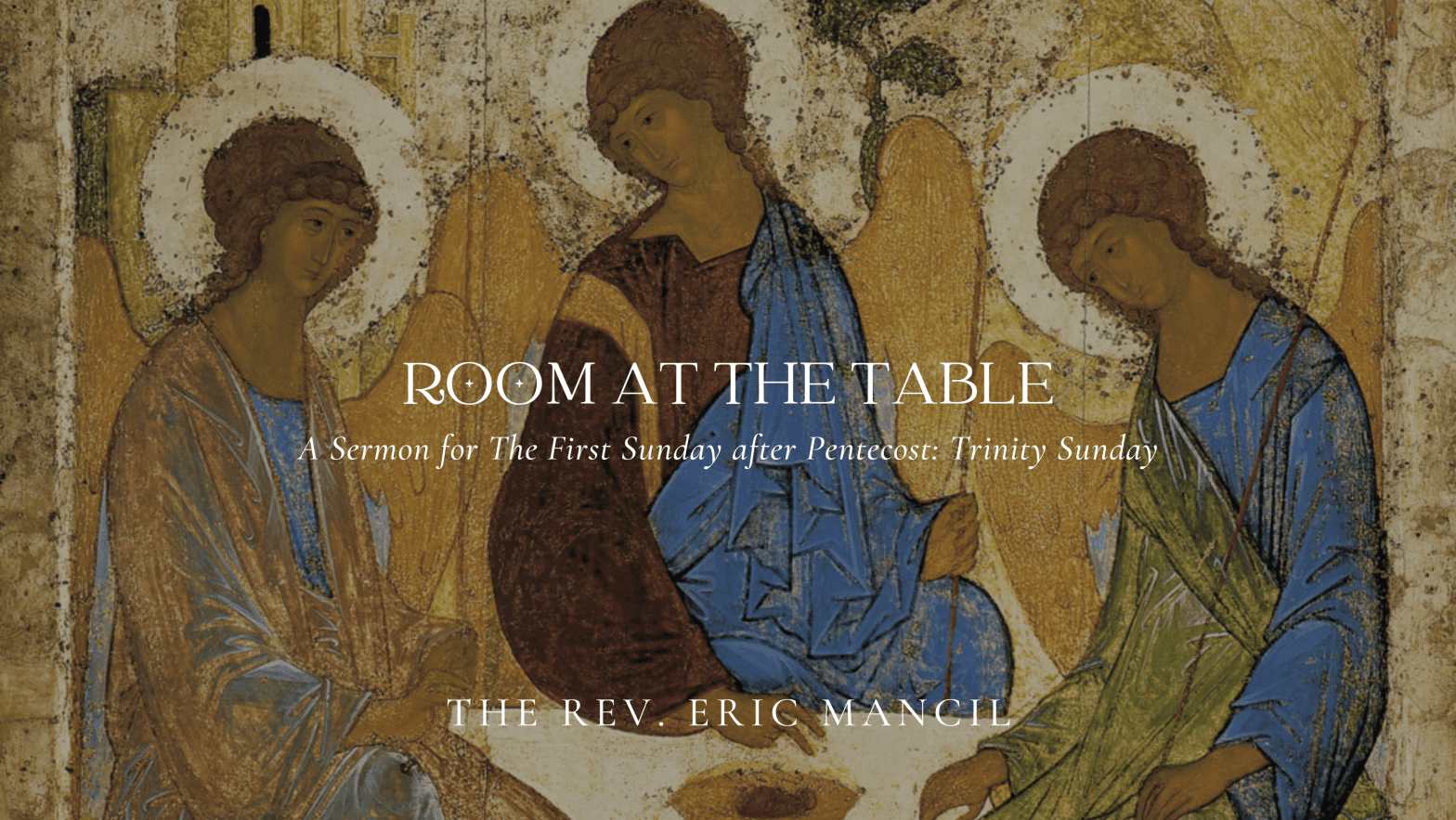
Recently, I started reading a book by Richard Rohr called The Divine Dance, and in the introduction, the author reflects on the Trinity icon by Andrei Rublev.
There’s a picture of it in your bulletin this morning.
It was painted in the early fifteenth century, and it’s sometimes called The Hospitality of Abraham, because it draws from Genesis 18, when three mysterious visitors come to Abraham and Sarah by the oaks of Mamre. Over time, Christians came to see in those three visitors an image of the Holy Trinity.
In Rublev’s icon, the three figures are seated around a table. Their bodies are turned toward one another. Their heads are inclined toward one another. Their hands gesture toward the shared meal set before them. And if you’ll notice, the three figures form a kind of circle around the table.
A circle of communion and divine love.
I’ve seen this icon many times before. But until I started reading Richard Rohr’s book, I had never noticed a specific detail.
At the front of the table, there’s a small rectangular space. Most people look right past it. Rohr points out that when the original icon was examined, traces of glue were found in that space, leading some art historians to believe that something may have been attached there at one time.
Perhaps even a small mirror.
Now, we don’t know that for sure. It may have been part of the original icon. It may have been added later. Or it may simply be a beautiful possibility.
But imagine if it were true.
If there was once a mirror on the front of that table, then the person looking at the icon would see themselves reflected there.
The observer would become part of the image. The circle would be open to a fourth.
A place for the person looking in.
A place for you and for me.
What I love about this image is that it invites us to think deeply about the image of God we carry around with us.
Because whether we realize it or not, all of us carry some image of God in our minds and hearts.
For some people, God is mostly distant and far away—high above us, looking down from heaven, watching closely, waiting for us to mess up.
And if that is the picture of God we carry, then faith can easily become rooted in fear rather than love.
But the Trinity gives us a different image of God.
God is not distant or detached. God is not sitting far away, waiting for us to fail.
God is communion. God is relationship. God is love.
The Triune God is not looking for reasons to keep us away. God is always making room, always inviting us deeper into the life of God.
The ancient Church had a word to describe this inner life of God: perichoresis, a Greek word that points to the mutual indwelling of Father, Son, and Holy Spirit.
In other words, the three persons of the Trinity do not exist apart from one another, but in perfect communion with one another.
Some Christian writers, including Richard Rohr, have imagined this as a kind of divine dance—not because God is spinning around somewhere in heaven, but because the life of God is movement and joy, giving and receiving.
There is no competition or rivalry. No one person of the Trinity trying to stand alone at the center.
There is only mutual love.
And this love is not closed in on itself. Not because God is incomplete without us, or because God needs us in order to be God, but because God’s love is so full and generous that God desires to share that life with us.
That brings me to our reading this morning from Genesis.
In the beginning, God creates.
God speaks light into darkness. God brings forth the earth and fills it with life. And then God creates humankind in God’s image.
If God’s own life is relationship—a communion of love between Father, Son, and Holy Spirit—then to be made in the image of God means that we are made for relationship.
We are made for communion.
We are made to love and be loved.
We are made not to live as isolated individuals turned in on ourselves, but as people created for connection: connection with God, with one another, and with the whole creation God calls good.
From the very beginning, God’s desire was not distance, but relationship.
Not an empty table, but a shared one.
And that’s exactly what we see in our Gospel lesson from Matthew.
The risen Jesus gathers with his disciples on a mountain and gives them some final instructions.
“Go therefore and make disciples of all nations,” he says, “baptizing them in the name of the Father and of the Son and of the Holy Spirit, and teaching them to obey everything that I have commanded you.”
We often hear that passage and think of it as the Church’s Great Commission to go out and convert people.
And, of course, Jesus does send the disciples out to make other disciples. But I think we sometimes misunderstand what that means.
Jesus doesn’t send them out to win arguments, or pressure people into faith, or grow the Church for its own sake.
He sends them out to invite others into relationship: to baptize them in the name of the Father, and of the Son, and of the Holy Spirit; to teach them the way of love; to draw them into the same communion of love that has already embraced them.
In other words, Jesus sends them out to widen the circle.
If the Trinity is like a divine dance, then the mission of the Church is not to stand at the edge of the circle and guard the entrance.
The mission of the Church is to open the circle wider and wider, inviting others to discover that they, too, are beloved children of God.
That changes how we think about mission and evangelism. It changes how we think about what it means to be the Church.
Because if God is communion, then the Church is called to be a community of welcome. If God makes room at the table, then the Church is called to be the kind of community where people can discover that there’s room for them, too.
A parish church, like St. Mary’s, is meant to be an example of divine welcome. Not a closed circle or a private club. But a living sign of the God whose love always makes room.
And we widen the circle in all kinds of ways: every time we welcome someone looking for a place to belong, every time we make room for a child, every time we gather around the font, every time we feed a neighbor or share a meal, every time we notice someone standing alone and invite them to sit with us.
Every time we say, in word or deed, “There is room for you here.”
This is especially important at a time like this, when so many people feel isolated and alone, wondering if there’s a place for them anywhere.
Unfortunately, the Church has not always been good at reflecting the open table of God’s love.
Too often, Christians have guarded the entrance. Too often, we have made the circle smaller and acted as though God’s love was scarce, as though grace needed to be rationed or earned.
But the Trinity tells us something different.
The Trinity tells us that at the heart of God is a love that overflows and never ends.
A love that creates, redeems, and sustains.
A love that invites us to share in the divine life.
At the very end of Matthew’s Gospel, after giving them the Great Commission, Jesus says to his disciples, “And remember, I am with you always, to the end of the age.”
That’s important for us to remember.
The disciples are not sent out alone. The One who sends them also goes with them.
And the same is true for us.
Wherever we go, Christ goes with us. We never walk this Christian way of life alone. The One who sends us forth walks beside us.
We don’t have to have every answer figured out. We don’t have to be able to explain every mystery.
We are simply called to live as people who have been drawn into the love of God, and then to make room for others in that same love.
So maybe this Trinity Sunday, instead of trying to solve the mystery, we might simply receive the invitation.
Look again at the icon.
See the table. See the circle of love and the open space for you and me. And hear the invitation of the Triune God:
There is room for you here.
And then hear the call of Jesus:
Go forth.
Make room for others.
Widen the circle.
Because the life of God is communion.
The mission of the Church is invitation.
And the table of God’s love is wider than we can possibly imagine. Amen.

