Room at the Table

A Sermon for the First Sunday after Pentecost: Trinity Sunday (Year A)
May 31, 2026

Texts: Genesis 1:1-2:4a and Matthew 28:16-20

Now, O Lord, take my lips, and speak through them. Take our minds, and think through them. Take our hearts, and set them on fire. In the name of the Father, and of the Son, and of the Holy Spirit. Amen.

Every year, on the First Sunday after Pentecost, the Church celebrates Trinity Sunday. Unlike most feast days, Trinity Sunday doesn’t commemorate a particular event in the life of Jesus or one of the saints. Instead, it invites us to contemplate who God is.

That can feel like a daunting task, as though we’re supposed to figure out how to explain the unexplainable.

How can we speak of God as Father, Son, and Holy Spirit, and yet still say that God is one?

Preachers have reached for all kinds of images over the years: a three-leaf clover; water as ice, liquid, and steam; the sun, its light, and its warmth; and many others.

Some are helpful for about five seconds, and then, if you push them too far, they fall apart.

Because the Trinity is not a problem to be solved or a puzzle to figure out.

The Trinity is a holy mystery—one that teaches us that at the heart of all things is not isolation or loneliness, not a distant God sitting far off in heaven, but a God of communion.

A God of relationship and love.

Father, Son, and Holy Spirit, eternally giving and receiving, eternally sharing one life, one love, one divine being.

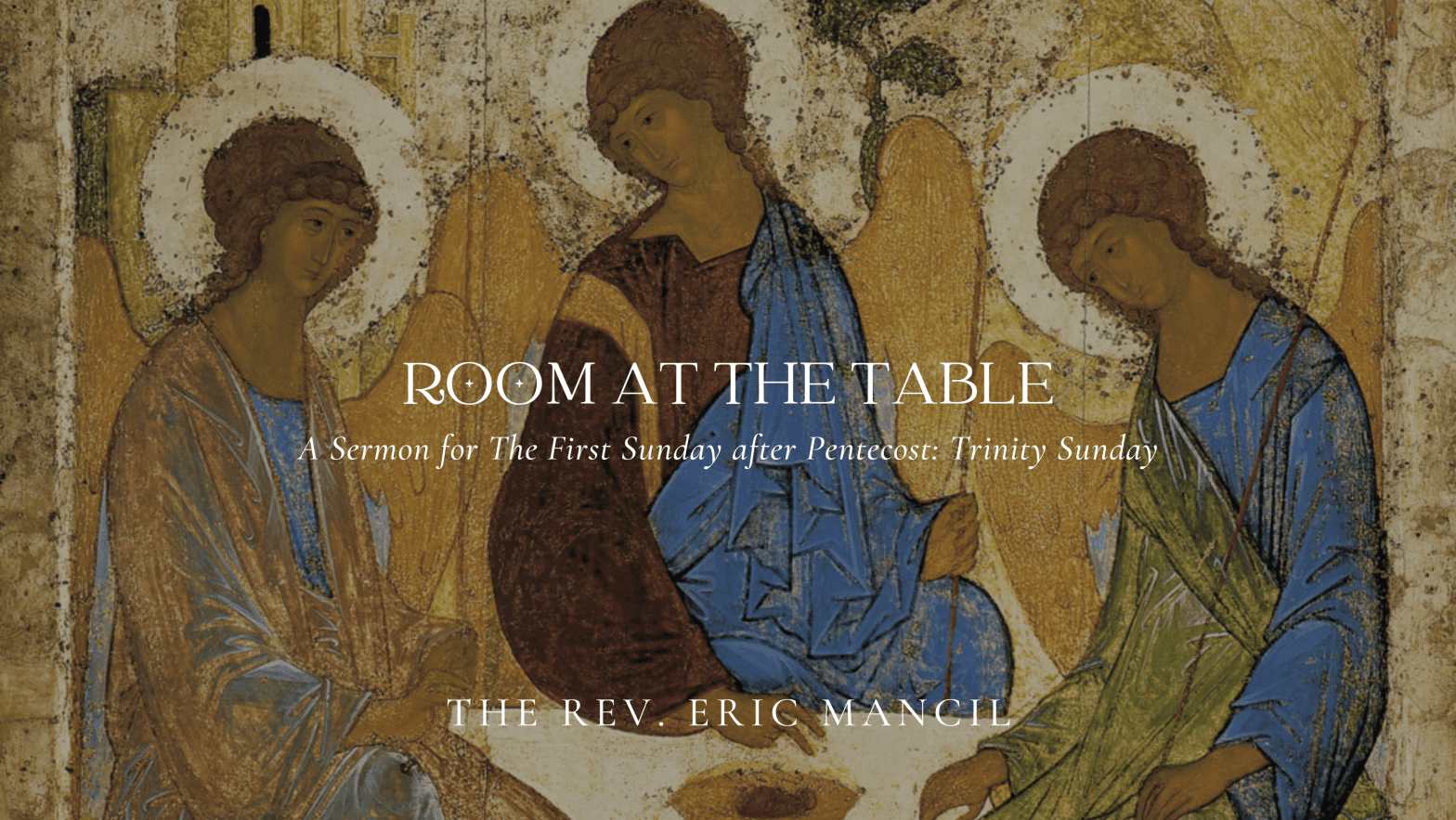
Recently, I started reading a book by Richard Rohr called The Divine Dance, and in the introduction, the author reflects on the Trinity icon by Andrei Rublev.

There’s a picture of it in your bulletin this morning.

It was painted in the early fifteenth century, and it’s sometimes called The Hospitality of Abraham, because it draws from Genesis 18, when three mysterious visitors come to Abraham and Sarah by the oaks of Mamre. Over time, Christians came to see in those three visitors an image of the Holy Trinity.

In Rublev’s icon, the three figures are seated around a table. Their bodies are turned toward one another. Their heads are inclined toward one another. Their hands gesture toward the shared meal set before them. And if you’ll notice, the three figures form a kind of circle around the table.

A circle of communion and divine love.

I’ve seen this icon many times before. But until I started reading Richard Rohr’s book, I had never noticed a specific detail.

At the front of the table, there’s a small rectangular space. Most people look right past it. Rohr points out that when the original icon was examined, traces of glue were found in that space, leading some art historians to believe that something may have been attached there at one time.

Perhaps even a small mirror.

Now, we don’t know that for sure. It may have been part of the original icon. It may have been added later. Or it may simply be a beautiful possibility.

But imagine if it were true.

If there was once a mirror on the front of that table, then the person looking at the icon would see themselves reflected there. 

The observer would become part of the image. The circle would be open to a fourth.

A place for the person looking in.

A place for you and for me.

What I love about this image is that it invites us to think deeply about the image of God we carry around with us.

Because whether we realize it or not, all of us carry some image of God in our minds and hearts.

For some people, God is mostly distant and far away—high above us, looking down from heaven, watching closely, waiting for us to mess up.

And if that is the picture of God we carry, then faith can easily become rooted in fear rather than love.

But the Trinity gives us a different image of God.

God is not distant or detached. God is not sitting far away, waiting for us to fail.

God is communion. God is relationship. God is love.

The Triune God is not looking for reasons to keep us away. God is always making room, always inviting us deeper into the life of God.

The ancient Church had a word to describe this inner life of God: perichoresis, a Greek word that points to the mutual indwelling of Father, Son, and Holy Spirit.

In other words, the three persons of the Trinity do not exist apart from one another, but in perfect communion with one another.

Some Christian writers, including Richard Rohr, have imagined this as a kind of divine dance—not because God is spinning around somewhere in heaven, but because the life of God is movement and joy, giving and receiving.

There is no competition or rivalry. No one person of the Trinity trying to stand alone at the center.

There is only mutual love.

And this love is not closed in on itself. Not because God is incomplete without us, or because God needs us in order to be God, but because God’s love is so full and generous that God desires to share that life with us.

That brings me to our reading this morning from Genesis.

In the beginning, God creates.

God speaks light into darkness. God brings forth the earth and fills it with life. And then God creates humankind in God’s image.

If God’s own life is relationship—a communion of love between Father, Son, and Holy Spirit—then to be made in the image of God means that we are made for relationship.

We are made for communion.

We are made to love and be loved.

We are made not to live as isolated individuals turned in on ourselves, but as people created for connection: connection with God, with one another, and with the whole creation God calls good.

From the very beginning, God’s desire was not distance, but relationship.

Not an empty table, but a shared one.

And that’s exactly what we see in our Gospel lesson from Matthew.

The risen Jesus gathers with his disciples on a mountain and gives them some final instructions.

“Go therefore and make disciples of all nations,” he says, “baptizing them in the name of the Father and of the Son and of the Holy Spirit, and teaching them to obey everything that I have commanded you.”

We often hear that passage and think of it as the Church’s Great Commission to go out and convert people.

And, of course, Jesus does send the disciples out to make other disciples. But I think we sometimes misunderstand what that means.

Jesus doesn’t send them out to win arguments, or pressure people into faith, or grow the Church for its own sake.

He sends them out to invite others into relationship: to baptize them in the name of the Father, and of the Son, and of the Holy Spirit; to teach them the way of love; to draw them into the same communion of love that has already embraced them.

In other words, Jesus sends them out to widen the circle.

If the Trinity is like a divine dance, then the mission of the Church is not to stand at the edge of the circle and guard the entrance.

The mission of the Church is to open the circle wider and wider, inviting others to discover that they, too, are beloved children of God.

That changes how we think about mission and evangelism. It changes how we think about what it means to be the Church.

Because if God is communion, then the Church is called to be a community of welcome. If God makes room at the table, then the Church is called to be the kind of community where people can discover that there’s room for them, too.

A parish church, like St. Mary’s, is meant to be an example of divine welcome. Not a closed circle or a private club. But a living sign of the God whose love always makes room.

And we widen the circle in all kinds of ways: every time we welcome someone looking for a place to belong, every time we make room for a child, every time we gather around the font, every time we feed a neighbor or share a meal, every time we notice someone standing alone and invite them to sit with us.

Every time we say, in word or deed, “There is room for you here.”

This is especially important at a time like this, when so many people feel isolated and alone, wondering if there’s a place for them anywhere.

Unfortunately, the Church has not always been good at reflecting the open table of God’s love.

Too often, Christians have guarded the entrance. Too often, we have made the circle smaller and acted as though God’s love was scarce, as though grace needed to be rationed or earned.

But the Trinity tells us something different.

The Trinity tells us that at the heart of God is a love that overflows and never ends.

A love that creates, redeems, and sustains.

A love that invites us to share in the divine life.

At the very end of Matthew’s Gospel, after giving them the Great Commission, Jesus says to his disciples, “And remember, I am with you always, to the end of the age.”

That’s important for us to remember.

The disciples are not sent out alone. The One who sends them also goes with them.

And the same is true for us.

Wherever we go, Christ goes with us. We never walk this Christian way of life alone. The One who sends us forth walks beside us.

We don’t have to have every answer figured out. We don’t have to be able to explain every mystery.

We are simply called to live as people who have been drawn into the love of God, and then to make room for others in that same love.

So maybe this Trinity Sunday, instead of trying to solve the mystery, we might simply receive the invitation.

Look again at the icon.

See the table. See the circle of love and the open space for you and me. And hear the invitation of the Triune God:

There is room for you here.

And then hear the call of Jesus:

Go forth.

Make room for others.

Widen the circle.

Because the life of God is communion.

The mission of the Church is invitation.

And the table of God’s love is wider than we can possibly imagine. Amen.
Breath of God

A Sermon for The Day of Pentecost
The Baptism of Charlotte Eloise Hamilton
May 24, 2026

Text: Acts 2:1-21 and John 20:19-23

Now, O Lord, take my lips, and speak through them. Take our minds, and think through them. Take our hearts, and set them on fire. In the name of the Father, and of the Son, and of the Holy Spirit. Amen.

A few weeks ago, I had the opportunity to attend an ordination at Christ Church Cathedral in Mobile. Bishop Russell ordained three new deacons in the Church, and as always, it was a beautiful and moving service.

There’s something special about an ordination.

Many of you were present at Father Antwon’s ordination to the priesthood that we hosted here at St. Mary’s last November, and you remember how special it was.

The procession. The prayers. The hymns. Gathered clergy from all across the diocese. That feeling that God is doing something new and exciting in the life of the Church.

But for me, the most powerful moment of an ordination always comes right before the bishop lays his hands on the candidates.

At that point in the service, the ordinands kneel before the bishop, and the congregation begins to sing an ancient hymn to the Holy Spirit:

Veni Sancte Spiritus.

A Latin phrase, which means, “Come, Holy Spirit.”

And then, after the hymn, something remarkable happens.

Silence.

A long period of deep silence.

The entire church becomes perfectly still as we pray for the Holy Spirit to be present among us. No one is speaking. No one is moving. We’re simply waiting and praying.

And in moments like that, the presence of God feels almost palpable. You can feel the Holy Spirit moving through the church.

We’re asking God to be powerfully present in that moment and to breathe his Holy Spirit upon those who’ve been called to the serve as ordained leaders in the Church.

I think that image of the Holy Spirit as the breath of God is one of the most beautiful and profound ways Scripture speaks about the Spirit throughout the Bible.

That image goes all the way back to the very beginning in the story of Creation.

In the opening verses of Genesis, before Creation fully takes shape, we’re told that the Spirit of God moved over the face of the waters.

The Hebrew word used in that passage is ruach, which can be translated as spirit, breath, or wind.

The NRSV translation of the Bible says it this way: “In the beginning when God created the heavens and the earth, the earth was a formless void and darkness covered the face of the deep, while a wind from God swept over the face of the waters.

Then, a little later in Genesis chapter 2, God forms humanity from the dust of the earth and breathes into Adam the breath of life.

Humanity comes alive because God shares divine breath with us. The breath of God—the Holy Spirit—brings life where there was none before.

And that same imagery continues throughout Scripture.

We see it again in the Gospels at the baptism of Jesus in the Jordan River when the Holy Spirit descends upon him like a dove.

Before Jesus begins his public ministry, the Spirit rests upon him and empowers him for the work God has given him to do.

Then we come to our Gospel reading this morning from John.

The disciples are gathered behind locked doors for fear of the Jewish authorities.

Mary Magdalene has announced to them that she’s seen the risen Lord, but they haven’t seen it for themselves. They are fearful. Uncertain. And afraid of what might happen next.

Jesus appears and says to them, “Peace be with you.”

Then, John tells us something extraordinary.

Jesus breathes on his disciples and says to them, “Receive the Holy Spirit.”

That’s an important detail.

Jesus doesn’t just talk about the Holy Spirit. He breathes the Spirit into them.

The word John uses there is the same word used in the Greek Old Testament when God breathes life into the first human being.

Another beautiful example of the Holy Spirit as breath and giver of life is found in the story of the Valley of Dry Bones, when the prophet Ezekiel describes breath entering the bones and bringing them back to life again.

To me, that seems to suggest that the Spirit’s work is not just a one-time thing.

The Spirit is always creating.

Always renewing.

Always reviving what we thought was dead.

Even when we think God is finished with us, the Holy Spirit is still moving and working in our lives.

Still breathing life into tired hearts, weary souls, broken relationships, and even scared disciples hiding behind locked doors.

And then we come to the Day of Pentecost—the story told in our lesson this morning from Acts.

The disciples are gathered together in Jerusalem when suddenly the sound of a rushing, violent wind fills the house.

Again, the imagery of wind and breath.

The same Spirit that moved over the waters of creation…
The same Spirit breathed into Adam…
The same Spirit that descended upon Jesus at his baptism…
The same Spirit breathed upon the disciples by the risen Christ…

Now rushes through the house where the disciples are gathered and fills the Church with power and new life.

What I love about the Day of Pentecost is that it reminds us that God has not abandoned us.

As we heard last week in our lesson from Acts, Jesus promised his disciples before he ascended that they would not be left alone.

Pentecost is the fulfillment of that promise.

God abides with us through the Holy Spirit.

The Spirit strengthens us.

Guides us.

Comforts us.

And equips us with gifts for ministry.

The Church doesn’t exist by its own strength or power. The Church lives because the Spirit of God continues breathing new life into it.

We see it all the time.

We see it in newly ordained deacons and priests.

We see it in new ministries being born.

We see it every time we come to the altar rail to receive the Body and Blood of Christ.

We see it every time a person renounces the evil powers of this world and turns from the way of sin and death toward the abundant life offered to us in Christ Jesus.

That’s one of the reasons why we’re gathered here today.

In just a few moments, we will bring Charlotte Eloise Hamilton to the waters of baptism.

And even though Charlotte won’t remember this day…

Even though she doesn’t understand what’s happening…

God is moving in her life in a powerful way.

Baptism is a celebration of new life. We are buried with Christ in his death and raised to new life through his resurrection.

Just as the Spirit moved over the waters of Creation in Genesis, the Spirit still moves among us through the waters of baptism.

Isn’t that amazing?

The same Spirit that hovered over the waters before the world was formed…

The same Spirit that God breathed into humankind to give us life…

The same Spirit that descended upon Jesus at his baptism…

The same Spirit that rushed through the city of Jerusalem on the Day of Pentecost…

That same Holy Spirit comes to us in baptism.

That same Spirit is poured into our lives, claiming us, strengthening us, and calling us into the life of Christ.

What that means, dear friends, is that baptism isn’t just a nice thing we do whenever a baby’s born.

It’s not just something we do to fulfill family traditions and obligations.

It’s not something we do just to say we’ve done it.

It’s about the very life and presence of God being poured out upon us.

Through the promises made by her parents and godparents…

Through the prayers of this congregation…

Through the grace of God…

Charlotte will be sealed by the Holy Spirit in Baptism and marked as Christ’s own forever.

And from this day forward, the Spirit will continue moving in her life.

We don’t know where the Spirit will lead her because like the wind, the Spirit often moves in unexpected ways, carrying us to places we never imagined we would go.

But we can trust, that no matter where she goes, the Spirit will always be with Charlotte.

Guiding and strengthening her.

Bringing her comfort and peace in times of uncertainty.

Equipping her with gifts for ministry and leading her deeper into the love of God.

And one day—by God’s grace—she’ll stand before God and the Church and claim the promises of Baptism for herself.

But even now, before she can fully understand it, God knows her and loves her completely.

And the breath of God is already moving in her life and in the lives of all of us who have committed our lives to Christ.

Every breath we take is a reminder of that gift.

And every movement toward love…
Every act of mercy…
Every stirring of hope…
Every moment of grace…

Reminds us that the Spirit of God is still breathing through this world and through the life of the Church.

Still creating.

Still renewing.

Still empowering.

Still giving life.

Come, Holy Spirit. 

Breathe on us once again, and kindle in our hearts the fire of your love.

Amen.

The Sin of Certainty

A Sermon for the Fifth Sunday of Easter
May 18, 2025

Text: Acts 11:1-18

Now, O Lord, take my lips, and speak through them. Take our minds, and think through them. Take our hearts, and set them on fire. In the name of the Father, and of the Son, and of the Holy Spirit. Amen.

If you’ve been following the news closely over the past couple of weeks, you’ve probably heard by now that there’s a new Pope—Pope Leo XIV, who is the first American-born citizen to ever hold the position.

Now…what that means for us, as Episcopalians, is that there’s a new Bishop of Rome in the Roman Catholic Church.

Although we certainly look to the Pope as an influential figure and spiritual leader in the Body of Christ, he doesn’t hold any authority over what we do in the Episcopal Church or in the worldwide, Anglican Communion.

And, as Anglicans, we don’t have any equivalent to the Pope.

We have bishops, and we have an Archbishop of Canterbury—who serves as the head of the Church of England and the spiritual head of the Anglican Communion, but even he doesn’t have the same level of authority or influence as the Pope does in the Roman Catholic Church.

Still…any time a new Pope is elected, it seems as though the entire world is sitting on the edge of their seats, waiting anxiously to see the white smoke appear from the roof of the Sistine Chapel.

Watching all of the news about the election of the new Pope reminded me of a movie Chelsea and I recently watched called, Conclave.

Has anyone else seen it?

I’m sure a few of you have.

It’s a brand new movie that just came out last year, and it’s based on a novel that was written back in 2016 by Robert Harris.

The film was nominated for several awards, including eight Academy Awards, which it won for Best Adapted Screenplay.

If you haven’t seen it yet, don’t worry.

I’m not going to spoil it for you in case you decide to watch it later.

But, I highly recommend it.

The story of Conclave takes place in Rome.

After the Pope dies of a heart attack, the College of Cardinals gathers in the Vatican to elect his successor.

The main character of the film is Cardinal Lawrence—the dean of the College of Cardinals, played by Ralph Fiennes.

He’s the one who’s responsible for making sure the conclave runs smoothly.

Toward the beginning of the story, we learn that there are four cardinals who’ve emerged as the most likely candidates to become the new Pope.

And, as the story progresses, we see each of these characters positioning themselves politically and strategizing to make sure their top choice is the one who’s elected.

They all come into the conclave with their own, personal agendas, and they’ve already decided who they think should be the next Pope.

They all think they have the right answers on how the Church should be run.

Scandals are uncovered in the process.

Secrets are revealed.

And, ultimately—after an unexpected tragedy—the one who’s finally elected to be the new Pope is the one who was least likely to be chosen.

There’s one scene in the movie that especially resonated with me, and it happens toward the beginning of the film, soon after the conclave begins.

During the opening mass, Cardinal Lawrence delivers a powerful homily to the rest of the cardinals, stressing the importance of doubt and mystery in the life of faith.

At one point, he says to the cardinals, “There is one sin I have come to fear above all else. Certainty.”

And he goes on to say, “Our faith is a living thing precisely because it walks hand in hand with doubt.”

“If there was only certainty and no doubt, there would be no mystery and therefore no need for faith.”

The cardinal’s homily in the movie is very similar to something the late Pope Francis once said in an interview, not long after he was elected to the papacy in 2013…

“If one has the answers to all the questions—that is the proof that God is not with him. . . . The great leaders of the people of God, like Moses, have always left room for doubt. You must leave room for the Lord, not for our certainties; we must be humble.”

I think this is an important lesson for us to remember.

“We must be humble.”

We’ve all had experiences of people in our lives who claimed to have all the answers figured out.

We‘ve all known people who claimed to know the will of God and to think they know what’s best—not leaving room for anyone else’s opinions or beliefs.

We’ve all known people—and churches—who’ve taught that if you don’t believe the same way they do or belong to their church, you’re wrong.

I’m convinced it’s one of the reasons why so many people have been driven away from any kind of organized religion and why so many people feel isolated from the Church.

It’s because of the sin of certainty.

It’s because of our tendency—as human beings—to try and fit God into a box of our own design and not allowing any room for the Holy Spirit to move in our lives of faith.

In the words of Cardinal Lawrence, “Our faith is a living thing.”

And, it’s a lifelong journey—filled with pitfalls, valleys, and mountains—that God has called us to walk.

We are pilgrims—trying to find our way on this journey of faith, but in order to do so, we have to leave room for God to lead us.

We must decrease so that he may increase.

A really good example of that can be found in our lesson today from the Book of Acts.

Peter has just returned to Jerusalem after visiting Caesarea and a man named Cornelius, who was a Roman officer and Gentile.

When Peter returned to Jerusalem, he was met by a group of concerned Christians who were there, who were also Jewish.

They asked him, “Why did you go to uncircumcised men and eat with them?”

In other words, “Why did you associate with the Gentiles?”

This was unheard of at the time.

Jews believed that, in order to stay pure, they could have no interaction with Gentiles.

So, Peter explained to them the situation…

He told them that, while he was away and praying in the city of Joppa, he had a vision sent from God.

Something like a large sheet came down from heaven, and it was filled with animals—four-footed animals, beasts of prey, reptiles, and birds of the air—all considered “unclean” according to Jewish law.

A voice from heaven told Peter, “Get up! Kill and eat!”

Peter replied, “By no means, Lord; for nothing profane or unclean has ever touched my mouth.”

A second time, the voice from heaven said to Peter, “What God has made clean, you must not call profane.”

This happened three times.

Then, everything was pulled up again to heaven.

Peter was amazed by what he saw and wondered what it all meant.

Then, three men appeared who were sent by a man named Cornelius to bring Peter back to his home in Caesarea.

The Spirit told Peter to go with them.

So, he and some others from Joppa accompanied the men back to Caesarea.

When they arrived at the house, Peter told Cornelius and the other Gentiles who were there all about Jesus, and as he was speaking, the Holy Spirit fell upon all of them.

And, Peter remembered something Jesus once said…

“John baptized with water, but you will be baptized with the Holy Spirit.”

Peter said to those concerned Christians in Jerusalem, “If God gave them the same gift that he gave us when we believed in the Lord Jesus Christ, who was I that I could hinder God?”

In other words, “If God gave those Gentiles the same gift he gave us, who was I to stand in God’s way?”

The people who heard this fell silent, and they began praising God, saying, “Then God has given even to the Gentiles the repentance that leads to life.”

This was a major turning point in the life of the early church.

Up to this point, most Christians believed that only Jews could follow Jesus.

But, because of the example of Peter and his willingness to go where the Spirit was leading him, he was able to break down those barriers and help people realize that Jesus wasn’t just for some people.

Jesus was sent to save us all.

From that point forward, the Gospel spread from a small group of Christians in Jerusalem to a worldwide faith—to people of all nations, cultures, and languages.

Our lesson this morning from Acts teaches us that God’s love is so much bigger than our traditions and pre-conceived ideas about who God is and who God calls us to love.

It teaches us that, when we’re willing to let go of certainty and the belief that we have all the answers figured out, God can use us as instruments of his love and mercy in the world.

There is a place for our questions and even our doubts, which can lead us to a deeper and more meaningful relationship with God.

There is a place for prayer and asking God to lead us and guide us, and to give us the strength we need to align our wills with his own.

Our job is not to stand in God’s way or to be a stumbling block to the Holy Spirit.

Our job is to follow where the Spirit is leading us, to let God use us as he will, and then have the grace and humility to get out of the way and let God be God.

Amen.