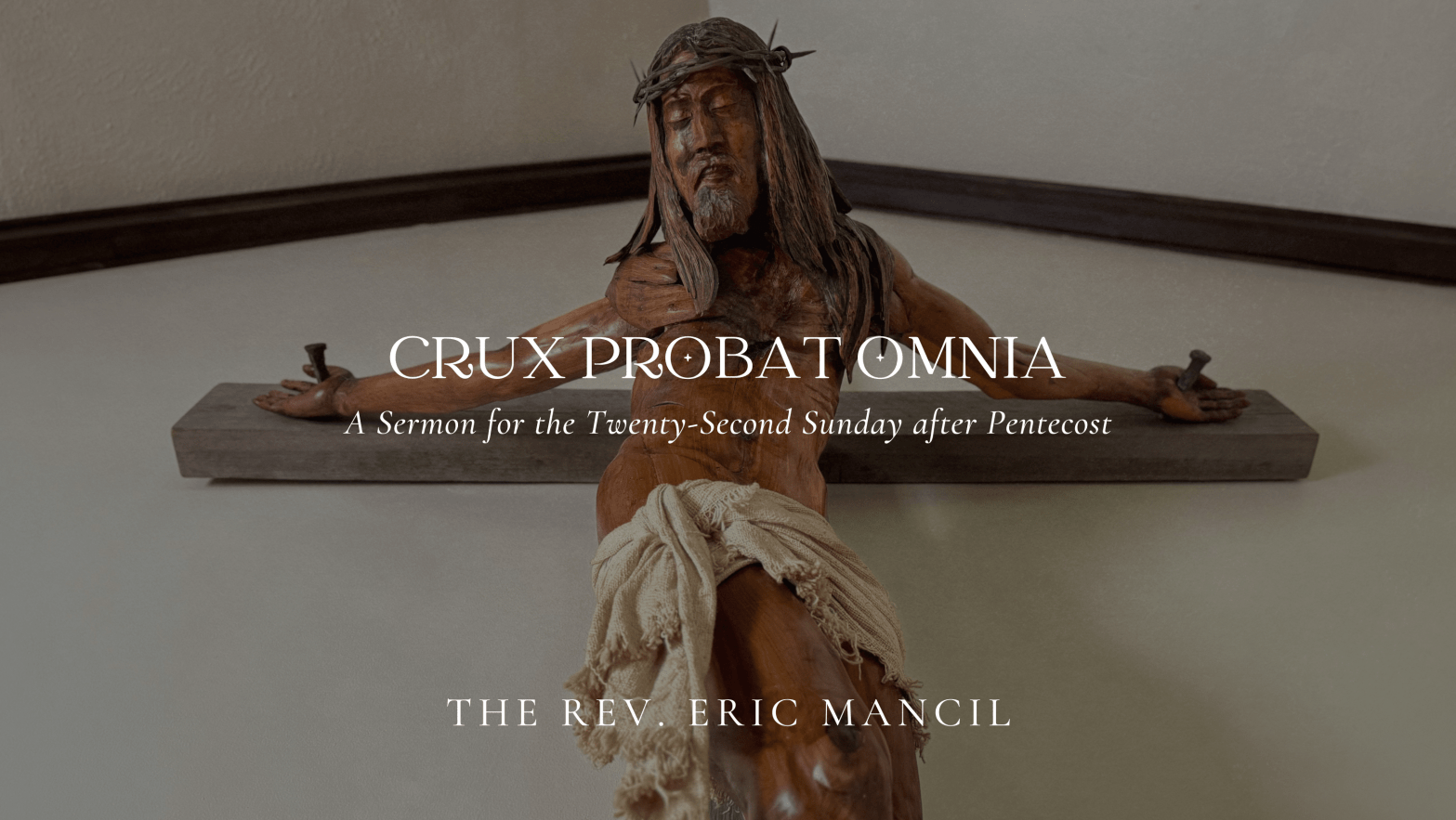
Crux Probat Omnia

A Sermon for the Twenty-Second Sunday after Pentecost (Proper 24, Year B)
October 20, 2024

Text: Mark 10:35-45

Now, O Lord, take my lips, and speak through them. Take our minds, and think through them. Take our hearts, and set them on fire. In the name of the Father, and of the Son, and of the Holy Spirit. Amen.

A couple of weeks ago, I drove down to Camp Beckwith for our annual Clergy Conference. Clergy Conference is basically an opportunity for all the clergy in the diocese—both priests and deacons—to come together for a few days of fellowship and learning.

It’s also a time for us to pray and worship together, which is something we rarely get to do since most of us are so busy in our own ministries across the diocese.

One of the things I value most about Clergy Conference is getting the opportunity to have conversations with people I don’t know very well, including some of our senior and retired clergy.

On the last day of the conference a couple of weeks ago, I had a nice conversation with a priest named Father Bob, who serves as the priest-in-charge at a small congregation down in Pensacola.

Judging by his age and demeanor, I could tell right away that he was a wise and experienced priest.

After we introduced ourselves, I shared with him that I was the rector at St. Mary’s in Andalusia.

His response right away was, “Oh, St. Mary’s! What a lovely church!”

He was obviously familiar with our parish in some way.

Then he asked me, “Do y’all still have that wooden sculpture of Jesus on the cross?”

I thought to myself, “Of all the things to be known for, I’m surprised he knows us because of that.”

So, I said, “Yes, sir. It’s hanging in one of the transepts of the church.”

Then, much to my surprise, he went on to share with me a little bit of the history of the sculpture.

He told me that it once belonged to Christ Episcopal Church—a large parish in Pensacola—but that some of the members of that parish didn’t want it hung in the church.

I guess, for them, it focused too much on the death of Jesus, which, in a way, is understandable.

After all, in the Episcopal Church, our theology is really centered more on the resurrection.

That’s why—in most Episcopal parishes—you’ll find an empty cross hanging above the altar rather than a crucifix.

So, since the people at Christ Church in Pensacola no longer wanted the sculpture, they decided to find a new home for it, which is how it ended up here at St. Mary’s.

And, I’m so glad it did.

Because, even though the passion and death of our Lord isn’t the focus of our theology and worship, it is a central part of the story.

As I’ve preached before, there would be no Easter without Good Friday.

There would be no joy of the resurrection without the pain and sacrifice of the cross.

It’s part of our story, as Christians.

The sculpture that hangs in our church isn’t just a fancy decoration.

It serves as a poignant reminder that, in order to follow Jesus, we have to be willing to walk the way of the Cross.

I’m reminded of that every time I see it—but especially on Wednesdays when we have our noon healing service in the transept and I’m standing behind the altar, facing the cross.

Every time we come to that point in the service where I break the bread during Communion and hold up the two halves of the bread—one in each hand—I see Jesus hanging on the cross, and suddenly, the simple truth of our faith becomes so vividly real for me once again.

As painful as it is to think about, Jesus is the “suffering servant,” the one who willingly gave his life as an offering and sacrifice for the world so that we might be redeemed and find eternal life with God.

And, as followers of Jesus, we’re called to walk in his footsteps—to take up our own cross and follow him.

Over the past couple of months in church, we’ve been reminded of this in some of our readings from the Gospel of Mark.

Five weeks ago, on September 15th, we heard Jesus ask his disciples in our Gospel reading, “Who do people say that I am?”

And they answered him, “John the Baptist; and others, Elijah; and still others, one of the prophets.”

“But who do you say that I am?” Jesus asked them.

Peter answered, “You are the Messiah.”

Then, he ordered his disciples not to tell anyone, and he began to teach them that the Son of Man must suffer and be rejected and killed and then, after three days, rise again.

And, he taught them that whoever wants to follow him must deny themselves, and take up their cross, and follow.

Then, in our Gospel reading four weeks ago, on September 22nd, we heard a second prediction that Jesus made about his death.

He told his disciples, “The Son of Man is to be betrayed into human hands, and they will kill him, and three days after being killed, he will rise again.”

But, the disciples still didn’t understand what Jesus was talking about.

They were far more concerned with worldly things, like arguing amongst themselves about which of them was the greatest.

Jesus told them, “Whoever wants to be first must be last of all and servant of all.”

And then finally, we have today’s lesson, which takes place right after Jesus makes a third and final prediction about his death.

If we back up a few verses before today’s reading, we learn that Jesus is traveling with his followers on the road to Jerusalem.

And he pulls the twelve disciples aside and says to them, “See, we are going up to Jerusalem, and the Son of Man will be handed over to the chief priests and the scribes, and they will condemn him to death; then they will hand him over to the Gentiles; they will mock him, and spit upon him, and flog him, and kill him; and after three days he will rise again.”

You would think that after three predictions about what’s going to happen, the disciples would finally “get it.”

You would think that, after all this time they’ve spent with Jesus, they would finally understand that he isn’t the ruler king they expected.

Jesus will not sit on an earthly throne and be worshiped and adored.

He won’t be rich or powerful.

He won’t be adorned with the finest clothes and fanciest jewelry, and he won’t be waited on by servants.

No, this king will be betrayed and looked upon with shame.

He will be mocked and spit upon.

He will suffer terrible pain and be hung on a cross to die.

And, in his death, he will be glorified by his Father in heaven.

When Jesus told his disciples that he would be killed and then rise again on the third day, it wasn’t just his way of preparing them for what was coming.

It was his way of teaching them that, in order to follow him, they’d have to be willing to give up any sense of pride or selfish ambition.

They’d have to be wiling to let go of any desire for worldly power and privilege in exchange for the joy and peace of God’s kingdom.

He said it this way: “…those who want to save their life will lose it, and those who lose their life for my sake, and for the sake of the gospel, will save it.”

In our Gospel lesson for today, James and John, two of Jesus’ closest friends, come to him as they’re traveling to Jerusalem.

And, they say to Jesus, “Teacher, we want you to do for us whatever we ask of you.”

Jesus responds, “What is it you want me to do for you?”

They say to him, “Grant us to sit, one at your right hand and one at your left, in your glory.”

Jesus doesn’t scold them or even tell them they’re being selfish by seeking special attention or a special place of honor.

He responds to their request by saying, “You do not know what you are asking.”

In other words, “You think you know, but you really have no idea.”

Jesus knows what lies ahead.

He knows what will happen when they eventually reach the walls of Jerusalem.

Although they’re completely serious about the request, James and John don’t really know what they’re doing when they ask Jesus for a place at his side, one on the right and one on the left.

Because Jesus won’t be glorified in a position of power or a place of privilege.

The place where Jesus will be glorified by God is on the hard wood of the cross.

Eventually, the other ten disciples learn about what James and John have been up to, and they get angry with the brothers for trying to seek special attention from Jesus.

So, Jesus calls them all together and says to them, “Whoever wishes to become great among you must be your servant, and whoever wishes to be first among you must be slave of all. For the Son of Man came not to be served but to serve, and to give his life a ransom for many.”

All you have to do is look up at that cross on the wall and be reminded.

Jesus came—not to be served—but to serve.

And, as his followers, we’re called to do the same—to seek out ways of being of service to others, especially the most vulnerable among us.

Jesus came—not to be worshiped and adored—but to bear witness to the truth of God’s love and to usher in God’s reign of peace and justice in the world.

And, as his followers, we’re called to do the same—to seek out ways of sharing God’s love with others and to work for the building up of God’s kingdom.

Jesus came—not to seek a special place of honor or privilege—but to teach us through his life, death, and resurrection that the way of the Cross is the path to abundant life with God.

In order for us to experience the joy and peace of God in our lives, we have to be willing to empty ourselves and lay down our lives for the sake of the Gospel.

As Christians, the Cross is the standard by which we measure all that we say and do.

If we’re ever in a situation where we have to stop and ask ourselves, “What would be the Christian thing be to do here,” all we have really need to do is consider the Cross.

In the words of the Protestant reformer, Martin Luther, Crux probat omnia, which is a Latin phrase, meaning, “The Cross is the test of everything.”

May we carry this phrase with us wherever God may send us, and may its words be written on our hearts. Amen.

Let Go

A Sermon for the Twenty-First Sunday after Pentecost (Proper 23, Year B)
October 13, 2024

Text: Mark 10:17-31

Now, O Lord, take my lips, and speak through them. Take our minds, and think through them. Take our hearts, and set them on fire. In the name of the Father, and of the Son, and of the Holy Spirit. Amen.

As most of you know, I go to the Blue Bird Coffee Company each week on Thursdays from about 9:00 in the morning until 10:00, doing something I like to call “Coffee with the Priest.”

It’s an opportunity for me to make myself available to anyone in the community who just needs someone to talk to or someone to pray with them.

Sometimes, I go, and I don’t have much interaction with anyone other than the staff at the coffee shop. So, I’ll sit and wait, and if no one shows up, I’ll use that time to work on a sermon or respond to some emails.

Sometimes, people reach out ahead of time and make plans to meet with me at the coffee shop for a one-on-one conversation.

And then, sometimes, I’ll have random encounters with complete strangers, which is exactly what happened to me this past Thursday.

I walked into the coffee shop like usual, put my sign out that says “Coffee with the Priest,” made a quick post on social media about being at the coffee shop, and then I stood in line to get a cup of coffee.

And, as I stood in line, I overheard the person in front of me—a man I had never seen before—talking with the cashier about how he and his family had to evacuate from Florida this past week due to the hurricane.

After he was done talking with the cashier, he got his coffee and went and sat down at a table.

And, then I got my coffee, and as I was walking back to my table, I saw the man again, and we struck up a conversation.

I was wearing my clergy collar at the time. So, he knew I was a minister of some kind, probably a Catholic priest.

And, he told me more about his situation.

He and his family had evacuated on Monday and found their way to Andalusia.

I asked him if they were able to find a hotel room nearby, and he told me that they were staying in a camper in a local RV park.

He also shared that, thankfully, none of his property had been severely damaged by the storm, and he was hopeful that they’d be able to return home soon.

I wished him well and I told him that, if there was anything they needed while they were here, our church was right down the road.

Then, I sat down at my table, which was right next to the man I was talking to.

And, after a few minutes, we started talking again.

This time it was about church.

He asked me if I was a Catholic priest, and I told him, “No, I’m an Episcopal priest.”

Then, he wanted to know the difference between Catholic and Episcopal. So, I started listing some of the differences and sharing with him some of the things I love most about the Episcopal Church.

I could tell he was genuinely curious, but I wasn’t quite sure why.

Somehow, in the midst of our conversation, he shared with me that he was a non-believer, and it sounded like a lot of that had to do with a bad history with the church and Christians trying to convert him to their way of thinking.

Judging from his tone, I got the feeling that his overall sense of Christianity is that it’s just a church full of people whose primary mission is to go out and convert everyone they meet.

And, as I sat and listened to the man’s story, I thought to myself, “I wish people like him knew that there are other types of Christians in the world.”

I wish more people knew that there are churches in this world—like our church, for example—that exist, not to try to convert people or to convince them to think or believe the way we do—but who work and strive to be examples of God’s love to those we meet and to spread the Good News of God in Christ with the world.

Jesus didn’t instruct the disciples to go out and convert the world to Christianity. He instructed them to go out and share the Good News of the Gospel—to show people through their words and deeds that the Kingdom of God has come near.

That’s why we’re here.

We do what we do—not for own benefit—but for the good of God’s Kingdom.

We do what we do—not to try and save people’s souls (as if we could if we wanted to), but to invite them into a deeper and more meaningful relationship with the God who loves them.

But, far too often, people who don’t know any different are convinced that they already know what our intentions are before ever getting the chance to know more about us.

They think they know who we are because of past experiences of church or second-hand knowledge from people who’ve had bad experiences.

Not that I blame them because there are plenty of Christians in this world who think it’s their mission to save people and convert them.

But, that’s not us.

In reality, there’s so much more to who we are and what we’re called to do as followers of Jesus.

As I was reflecting on my time with the man at the coffee shop, I thought about how all of us, in some way, get trapped and weighed down by our own pre-conceived ideas or notions about people who are different than we are.

Especially people who have different beliefs or ideas than we do.

I think a really good example of this today is the current political climate in our country, especially with the upcoming election.

It’s so easy for us get pulled into the idea that we have to dehumanize or look down upon those who have different beliefs and ideas than we do.

And, when we do that, we create walls of our own making—separating ourselves from those who think or believe differently than we do and possibly even making enemies out of those who are different.

But, that’s not what God calls us to do.

God calls us to break down the walls that divide and separate us.

God calls us to examine our lives and to think about those biases and prejudices that infect our hearts—those destructive ideas about other people that keep us from experiencing the abundant life that God wants for each of us.

God calls us to let go.

To let go of what we think we know about other people.

To let go of the idea that we have everyone perfectly figured out and grouped into a box that’s easily defined.

To let go of our need to look down upon those who think or believe differently than we do.

To let go of the idea that we’re right and everyone else is wrong.

Today’s Gospel lesson from Mark is all about letting go.

Letting go of those things in our lives—whether they’re spiritual or material—that are keeping us from experiencing the joy and peace of following Jesus.

In today’s reading, we hear the story of Jesus’ encounter with the rich man who comes to Jesus and asks him, “Good Teacher, what must I do to inherit eternal life?”

In other words, “What must I do to find joy and peace in God’s kingdom?”

Jesus looks at the man and basically tells him, “You already know what you need to do. Follow God’s Law.”

The man tells Jesus that he’s lived a good life and followed all of God’s commandments, even since his youth.

Then, we come to my favorite part of the story.

And, it’s so simple.

The author of Mark’s Gospel writes that Jesus looked at the man and loved him.

He didn’t judge the man.

He didn’t criticize him.

He loved him. The way I read that part of the story is that Jesus looked at the man and had compassion for him.

He thought he had done everything he was supposed to do up to that point in his life.

But, knowing the man better than he knows himself, Jesus tells him that there’s one more thing he has to do in order to receive the abundant life he seeks.

He says to the man, “Go, sell what you own, and give the money to the poor, and you will have treasure in heaven; then come, follow me.”

I can’t imagine the look of shock and disappointment that must have been on the man’s face when he heard Jesus’ instruction.

In the end, it’s too much of a burden for the rich man to bear.

He isn’t willing to let go of his wealth and possessions in order to follow Jesus.

So, he turns around and walks away.

Contrary to what some people believe about this lesson from Mark’s Gospel, it isn’t intended to cast judgment on the rich, and it doesn’t mean that there’s no room in God’s kingdom for wealthy people.

This story is about much more than money and wealth. It isn’t about what we own or how much we have.

It’s about our attachment to those things in our lives—the things we so desperately want to hold on to—that keep us from following Jesus.

The rich man in our Gospel lesson is so attached to his wealth and worldly possessions that he’s unable to see the grace that’s right in front of his eyes when Jesus offers it.

It was easier for him to turn around and walk away from Jesus than to give up that which he cared about the most.

The story of Jesus and his encounter with the rich man teaches us that, in order to receive the abundant life we seek, we have to be willing to let go of those worldly attachments in our lives—both material and spiritual—that cause us to lose sight of our need to follow Jesus.

This story can be applied to so many corners of our lives.

Because, truth be told, we can be attached to lots of things that can be a stumbling block in our lives.

Not just money and wealth.

But also our tight grip on anger and resentment toward those who’ve hurt us.

Not just material or physical possessions.

But also biases toward those who think or believe differently than we do.

Not just the things we can see, taste, and touch.

But also those intangible things that infect our hearts, like jealousy toward those who have more than we do or the feeling that we’re better or more deserving than anyone else.

Because, in the end, it’s not about us at all. It’s about God and what God is doing in us and through us to change the world.

God calls us to let go.

To let go, and let him be the center of our lives.

Amen.