
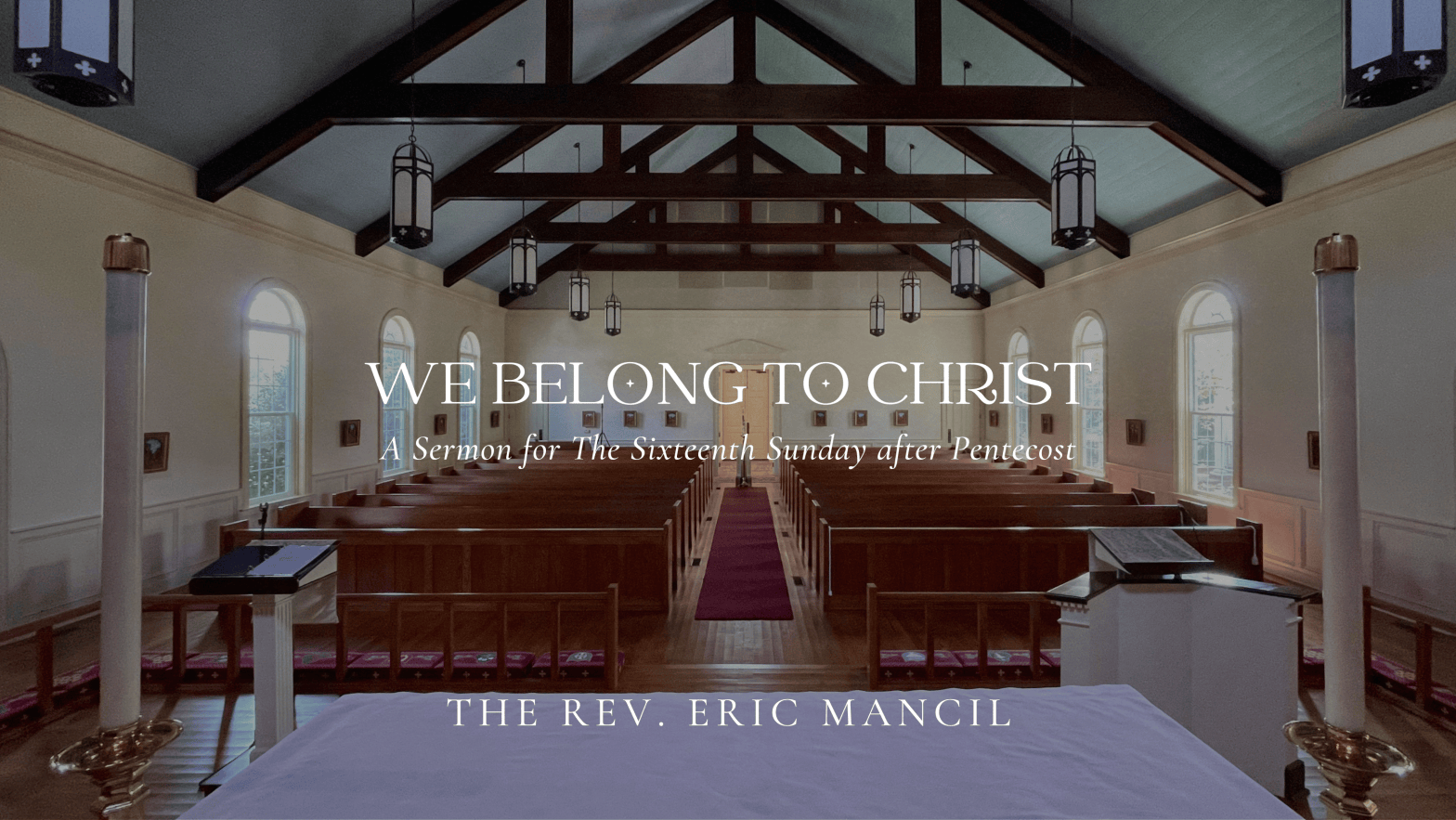
A Sermon for the Sixteenth Sunday after Pentecost (Proper 19, Year A)
September 13, 2026
Text: Romans 14:1-12
Now, O Lord, take my lips, and speak through them. Take our minds, and think through them. Take our hearts, and set them on fire. In the name of the Father, and of the Son, and of the Holy Spirit. Amen.
From Paul’s letter to the Romans: “If we live, we live to the Lord, and if we die, we die to the Lord; so then, whether we live or whether we die, we are the Lord’s.”
These words from Paul express something about what it means to be the Church. We don’t exist because we all think alike or have everything figured out. We exist because we belong to Christ—and because we belong to Christ, we belong to one another.
Many of you have heard at least some of the story of how I found my way into the Episcopal Church. But some of you haven’t.
And since today is Come and See Sunday, I wanted to share that story with you again—along with some of the things I love most about the Episcopal Church.
In my junior year of studying music at Auburn, a fellow member of the Auburn University Concert Choir told me that his church was looking for a bass to sing in the student choir, and he asked me if I knew anyone who might be interested.
It was an Episcopal church, and the members of the choir received a small stipend for singing each week during the service.
I had never even heard of the Episcopal Church. But earning a little extra money each week and getting connected with a church sounded appealing. So I told him I was interested.
Chelsea and I went together that first Sunday to St. Dunstan’s in Auburn.
I sang in the choir, and she sat in the congregation. And it turned out to be one of the best decisions we ever made.
The worship was very different. The prayers and hymns were unfamiliar, and there were moments during the service when everyone else seemed to know exactly what to do while I was completely lost.
But even then, there was something about the community that felt familiar. It felt like coming home.
The people of St. Dunstan’s showed a genuine love for one another. People from all backgrounds and walks of life were welcomed into the community.
We didn’t feel as though we had to understand everything or believe the same way as everyone else did.
They simply opened their arms and welcomed us in.
Week after week, we worshiped, broke bread together, and offered our prayers for one another and for the world.
St. Dunstan’s also taught me that Church isn’t just about what happens on Sunday morning. It’s where we are nourished by the sacraments, formed through our common life, and strengthened to follow Jesus in the world.
It’s also where I came to know my good friend and mentor, Father Wells, where I was baptized and later confirmed, and where the first seeds of my calling to ordained ministry were planted.
The people of St. Dunstan’s changed the course of my life, and I’ll always be grateful for the love and hospitality they showed us.
That experience shaped what I love about the Episcopal Church and what I hope people encounter here at St. Mary’s.
If you’re visiting with us today for the first time, welcome. You may not know what to expect. You may not know when to stand, sit, or kneel during worship, or even what you believe about God. And that’s okay.
Because the Church was never meant to be a place for people who know everything. It’s a community of people learning together what it means to follow Jesus.
That’s what our lesson from Romans this morning is all about.
Paul is describing the kind of community where people from very different backgrounds are learning how to cooperate and live together as one Church.
You have to remember that the early Church in Rome included both Jewish and Gentile Christians. Jewish Christians had been raised within the covenant traditions of Israel. Practices involving food and special days of observance were part of their cultural and religious identity and how they honored God.
Gentile Christians, on the other hand, had not grown up with those traditions, and many believed that life in Christ freed them from those practices.
Now these two different groups were trying to come together as one Church. They worshiped the same Lord but disagreed about what following Jesus should look like.
The problem was that those disagreements were starting to tear the Church apart. They were judging one another and beginning to believe that faithfulness required everyone else to see things exactly as they did.
So Paul writes, “Welcome those who are weak in faith, but not for the purpose of quarreling over opinions.”
Paul wasn’t saying that what they believe doesn’t matter. He wasn’t asking them to pretend their differences weren’t real. Instead, he reminds them that something deeper holds them together.
“Whether we live or whether we die,” Paul writes, “we are the Lord’s.”
We don’t have to agree about everything to belong to one another because, first of all, we belong to Christ.
That’s one of the things I’ve come to love most about the Episcopal Church.
There are many others—and since today is Come and See Sunday, I’d like to share some of those with you.
I love that there’s room here for questions.
We’re allowed to wrestle with our doubts without feeling shame or that we’re somehow being unfaithful. We can come to church without having to check our brains at the door. Our minds are gifts from God, and we believe that honest questions can lead us more deeply into faith.
I love that when we say “all are welcome,” we mean that ALL are welcome, with no exceptions. And not only that, but you’re invited to bring all of who you are.
God sees you, and God knows you. You don’t have to hide the complicated parts of your life or the parts that no one else understands. You can bring your faith and your doubts, your joys and your sorrows, your hopes and your fears. God meets us where we are—not where we pretend to be.
I love the beauty and reverence of our worship and the way our prayers connect us with something much greater than ourselves.
These prayers have carried generations of Christians through every season of life. Now they carry us. Our worship is rooted in ancient tradition, but it’s still very relevant to our lives. Each week, we gather to worship, and we bring with us our gratitude, our fears, and our hope for the world. All of it’s gathered into prayer.
I love that we can disagree and still worship together.
That doesn’t mean our disagreements don’t matter. It means we don’t have to agree on everything in order to belong. We don’t gather because we all think alike. We gather because we belong to Christ. We carry different experiences, opinions, and beliefs. But, we listen to the same Scriptures, speak the same prayers, and kneel at the same Altar. We find unity—not in thinking exactly alike—but in turning together toward God.
And I love that our faith is incarnational—which means embodied in the way we live and move and have our being.
Faith isn’t just about what we believe or what we express with our words. It’s about how we live. In worship, we stand, kneel, and sing together. We exchange the peace. We hold out our hands and receive the Body of Christ so that we can go into the world and become the Body of Christ.
The grace we receive here becomes food for the hungry, companionship for the lonely, care for those who are suffering, welcome for the stranger, and love for our neighbors. At the end of every service, we are sent out with words like, “Go in peace to love and serve the Lord.” It’s a reminder that, even though our worship has ended, our service continues.
Before we’re Episcopalians, before we’re members of St. Mary’s, before we agree or disagree about anything, we belong to Christ. And because we belong to Christ, we belong to one another.
The Episcopal Church isn’t perfect, and neither is St. Mary’s. Sometimes we fall short of our call to walk in love. But our failures don’t change who God is calling us to become.
Christian community gives us people who will pray with us when we can’t find the words, rejoice with us when life is good, and sit with us when life falls apart. It also gives us a place where our gifts can be discovered and offered for others.
That kind of belonging has the power to change the direction of a life. I know because it changed mine.
Years ago, I walked through the doors of an Episcopal church because someone invited me to sing in their choir. I had no idea where that small invitation would lead.
But Chelsea and I found people who welcomed us. We found room to wrestle with our doubts and ask questions. We found a way of worshipping God that spoke to our lives and a community that allowed us to belong while we were still finding our way.
Most importantly, through all of those things, we found Jesus.
And that’s what I hope every person finds here at St. Mary’s. If you’re visiting today—or if you’ve been coming for a while but still consider yourself new—you don’t need perfect faith, and you don’t need to have everything figured out. You’re invited to pray, ask questions, and discover alongside us what it means to follow Jesus.
And for those of us who already call St. Mary’s home, today is a reminder that welcome is more than just something we say.
It’s a way of life.
It means making room for people as someone once did for us—including those who are different than we are. It means listening before judging and inviting others to share in our worship, ministries, and common life together.
It means remembering that this community doesn’t belong to us.
It belongs to God, and we belong to Christ.
And anyone Christ brings through these doors is someone we’re called to receive with love.
That’s the Church I discovered all those years ago at St. Dunstan’s.
And that’s the Church I believe God is calling us to become more fully together.
Not a church with all the answers, but a church willing to ask honest questions.
Not a church where everyone agrees, but a church gathered around the same Lord.
Not a church filled with perfect people, but a church where we can experience the transforming love of God in Christ.
Here, we can bring all of who we are.
Here, we are nourished by the grace of God.
And from here, we are sent to embody that grace in the world.
So whoever you are and wherever you are on your journey with Christ, you are welcome.
There’s a place for you here at St. Mary’s.
Amen.
 The Rev. Eric Mancil