
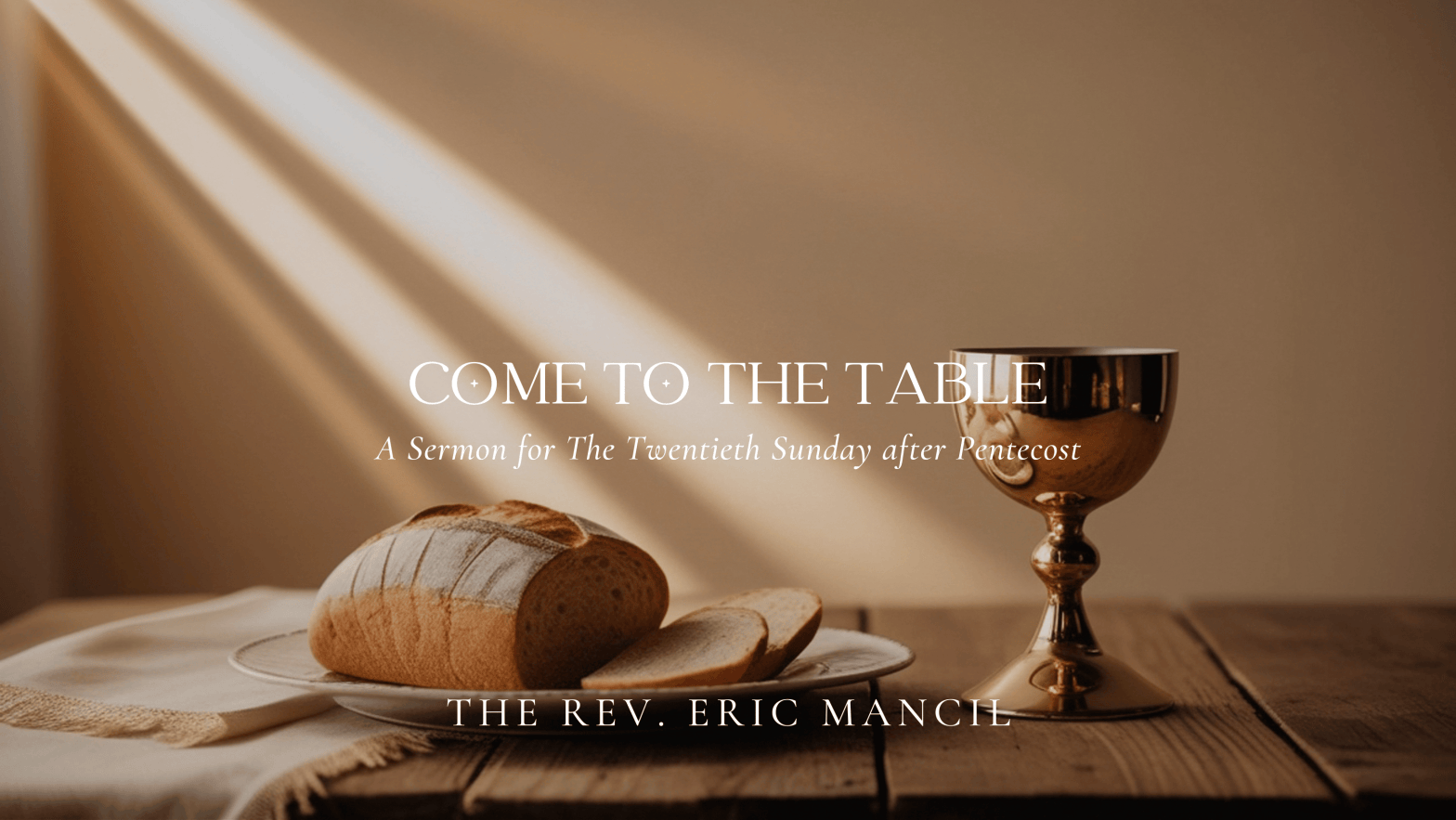
A Sermon for the Twentieth Sunday after Pentecost (Proper 23, Year A)
October 11, 2026
Text: Matthew 22:1-14
Now, O Lord, take my lips, and speak through them. Take our minds, and think through them. Take our hearts, and set them on fire. In the name of the Father, and of the Son, and of the Holy Spirit. Amen.
One of the vows I made at my ordination to the priesthood was to uphold the doctrine, discipline, and worship of the Episcopal Church. What that means is that, when it comes to planning worship, I tend to keep things pretty traditional.
That will come as no surprise to most of you!
Almost every part of our worship at St. Mary’s comes directly from The Book of Common Prayer or some other approved resource.
But, on occasion, I like to shake things up a little bit.
For example, while I was serving at my previous parish in Alabaster, one of the things I started doing was adding a special invitation right before the Eucharistic Prayer.
It was something I had seen done before at other churches. So, I decided to give it a try.
And people really liked it.
In fact, on more than one occasion, people who were new to the church made a point of coming up to me and telling me how much that part of the service meant to them.
Now, in the back of my mind, I was thinking, “Well, technically, I’m not really supposed to be doing this since it’s not in the Prayer Book.”
But I was glad they found it meaningful. And more than that, I was glad it made them feel more welcome. Because that was the whole reason I started doing it in the first place.
Each week, after the Table had been set and I stood at the altar preparing to lead the Eucharistic Prayer, I would speak these words to the congregation:
This is the Table, not of the Church, but of our Lord Jesus Christ.
It is made ready for those who love God and who want to love God more.
So, come, you who have much faith and you who have little.
You who have been here often and you who have not been for a long time or ever before.
You who have tried to follow and you who have failed.
Come, not because the Church invites you. It is our Lord Jesus who invites you to be known and fed here.
Now, I do have a confession to make.
The Bishop of Alabama at the time made her annual visit one Sunday, and I made sure she was aware of this extra part of the service so she would know what to expect.
But…I might’ve gotten in a little bit of trouble for it.
She wasn’t upset, exactly, but she did question me about it and wanted to know why I added something to the liturgy that wasn’t in the Prayer Book.
And my answer was pretty simple.
I wanted everyone in that church to know that, no matter where they were in their lives or what they were going through, there was a place for them at the Table.
I wanted them to know that they didn’t have to have everything figured out. They didn’t have to have perfect faith. They didn’t have to pretend to be something they weren’t.
Because the invitation wasn’t coming from me or even from the Church.
It was coming from Jesus.
Jesus was the one inviting them to come to the Table—to receive his grace and to take part in his life.
And I still believe that.
That invitation—to come to the Table, to take part in what God is doing in the world through Jesus—is really at the heart of what our Gospel lesson this morning is all about.
It picks up right after last week’s Gospel, where we heard the Parable of the Wicked Tenants.
Jesus has already entered Jerusalem. He’s already gone into the temple and upset the religious leaders.
He’s in the final days of his earthly life, and he’s challenging those who believe they already belong to God’s Kingdom to consider what it actually means to respond faithfully to God’s invitation.
So he tells them another parable.
It begins with a king who prepares a wedding banquet for his son. When everything is ready, he sends his servants to call those who’ve been invited.
But they refuse to come.
So, the king sends even more servants, and this time the response is even worse.
Some of the people who were invited make light of the invitation and continue to go about their daily work. Others mistreat and even kill the king’s servants.
The king becomes furious, and the story takes a violent turn. He sends his troops to destroy those responsible and burn their city.
But the banquet is still ready.
And the king still wants the wedding hall to be filled.
So, he sends his servants out into the streets with instructions to invite everyone they can find.
And that’s exactly what they do.
They gather everyone, both the good and the bad, until the wedding hall is filled with guests.
That’s an important detail.
These weren’t necessarily the people anyone would’ve expected to find at a royal banquet.
They hadn’t done anything special to deserve a place at the king’s table.
But the king invited them anyway.
I think that’s a wonderful image of God’s grace.
It’s open to everyone.
But then the story takes another turn.
When the king enters the banquet hall and sees all the guests, he notices a man who isn’t wearing a wedding garment—which was something that probably would’ve been expected at a royal wedding.
He asks him, “Friend, how did you get in here without a wedding robe?”
The man is speechless.
And the king orders him to be bound and thrown into the outer darkness.
That’s a pretty harsh ending to a story that began with such a wonderful invitation.
And I don’t think we should gloss over it. Actually, I think we should pay close attention.
It’s easy to hear the Parable of the Wedding Banquet and get overwhelmed by some of the details—especially toward the end of the story.
But, I don’t think Jesus is trying to scare us or intimidate us. And I don’t think the point of the story is that God is waiting for us to mess up or make a mistake so he can cast us out.
After all, the servants were told to invite everyone they could find— both the good and the bad.
The people at the wedding banquet weren’t there because they were perfect or because they had done anything to earn a place there.
They were there because the king wanted them the be there.
So, what are we supposed to make of this man without the wedding garment?
One possibility—and I think it’s a strong one—is that, throughout Scripture, clothing is often used as an image of the new life we’re called to live as followers of Jesus.
In his letter to the Colossians, Paul writes:
“As God’s chosen ones, holy and beloved, clothe yourselves with compassion, kindness, humility, meekness, and patience.”
And then he goes on to say, “Above all, clothe yourselves with love, which binds everything together in perfect harmony.”
I think that’s a helpful way to think about the wedding garment.
In fact, St. Augustine, one of the great theologians of the early Church, preached a sermon on this very parable in which he suggested that the wedding garment actually represents love.
Not being perfect all the time or having all the answers.
But love.
Maybe that’s what we’re supposed to understand about the man who showed up without a wedding robe.
He had accepted the king’s invitation. He had taken his place at the banquet. But he wasn’t prepared for what that invitation truly meant.
Because accepting God’s invitation means more than simply showing up at the banquet.
It means allowing ourselves to be transformed by the love of the One who invited us.
And that transformation isn’t something we can accomplish on our own. It’s something God works within us through grace as we learn to follow Jesus.
So if we take nothing else away from this parable, we should remember this: the Christian way of life isn’t passive.
When we promise to follow Jesus, we’re committing ourselves to a new way of life—a life shaped by compassion, kindness, forgiveness, humility, and, above all, love.
That love isn’t just something we talk about on Sunday mornings.
It shapes the way we care for one another and the way we participate in God’s work of healing and reconciliation in the world.
God doesn’t simply invite us to come to the Table to take up space.
God invites us to lay down our lives and be transformed in the process.
And I think that’s especially important for us to remember when we gather around this Table each Sunday.
When we come to the Eucharist, we’re doing more than simply remembering something Jesus did a long time ago.
We receive the grace of God that nourishes us and transforms us into the people God has called us to be.
St. Augustine, who I mentioned a moment ago, once preached a sermon about the Eucharist in which he reminded Christians that, when we receive the Body of Christ, we’re also being called to become what we receive.
Each of us belongs to the Body of Christ, and together, as the Church, we’re called to embody Christ’s presence in the world.
Every time we come to this Table, we’re reminded that the life of Christ is meant to shape our own lives—in the way we love, the way we serve, and the way we care for one another.
We don’t come just to receive something for ourselves.
We come because we need God’s grace to help us live more like Jesus.
God doesn’t just invite us to take a seat at the Table.
God invites us to share in his very life.
So, as we prepare to gather around this Table once again, I want you to hear those words one more time and take them to heart:
This is the Table, not of the Church, but of our Lord Jesus Christ.
It is made ready for those who love God and who want to love God more.
So, come, you who have much faith and you who have little.
You who have been here often and you who have not been for a long time or ever before.
You who have tried to follow and you who have failed.
Come, not because the Church invites you. It is our Lord Jesus who invites you to be known and fed here.
Amen.

