Sir, We Wish to See Jesus

A Sermon for the Feast of St. Mary the Virgin
Sunday, August 17, 2025

Text: Luke 1:46-66

Now, O Lord, take my lips, and speak through them. Take our minds, and think through them. Take our hearts, and set them on fire. In the name of the Father, and of the Son, and of the Holy Spirit. Amen.

Over the years, I’ve spent a lot of time reflecting on the sacred spaces where we gather to worship. Every church—every community of faith—has its own history and personality, shaped not just by the building itself but by the countless stories woven through its walls.

Take our church, for example.

St. Mary’s began on Second Avenue in Andalusia, just around the corner.

The original building was built in the late 1940s, and when the parish moved to this location and a new church was needed to accommodate more people, part of that old building was incorporated into the new design.

So, when you walk into the Library—just to my left—you’re actually standing in the very space where St. Mary’s parishioners worshiped long before this building ever existed.

Our churches tell stories—not just of where we’ve been, but of where God is leading us to go.

Some of these stories are easy to see in things like stained glass windows, altar tables, or pieces of art.

Others live quietly in small details you might miss unless you look closely.

One of my favorite examples of these small, hidden treasures can be found in many Episcopal churches.

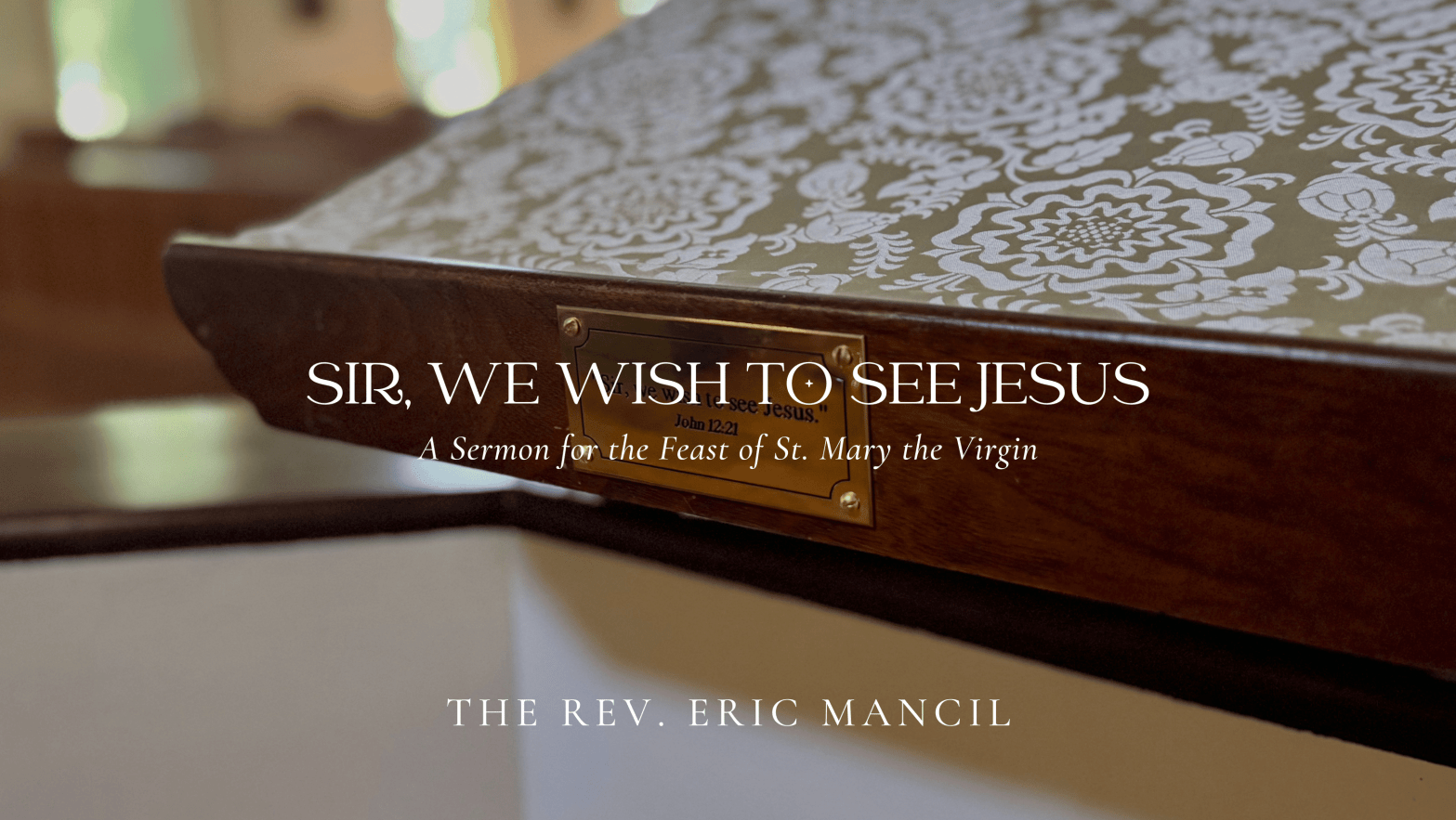
If you step behind the pulpit, you might just find a small, brass plaque with a short but powerful verse from John’s Gospel:

“Sir, we wish to see Jesus” (John 12:21).

Those words come from a moment when some Greeks—outsiders who were curious about Jesus—approached one of the disciples, and said, “We want to meet Jesus. We want to know who he really is.”

It’s such a simple request.

But it carries tremendous weight—even for us today.

These words capture the heart of what every person longs for at some point, especially those of us who come to church seeking a closer relationship with God.

We want to experience something real. Something true. Something holy.

To see Jesus is more than just looking back at a figure from history or hearing a story from two thousand years ago.

It’s to encounter the living presence of God, who loves us, knows us, and calls us into new life.

That short phrase—“Sir, we wish to see Jesus”—reminds us why we gather here to worship, week after week.

It’s not about tradition or routine or checking a box.

It’s about creating a space where people can come as they are, with questions, hopes, and even fears, and find Jesus waiting for them.

Well, I decided months ago that our pulpit needed one of those reminders—a small plaque that reads, “Sir, we wish to see Jesus.”

So, I went online and ordered one. And about a week later, I was standing right here with my screwdriver, nervously attaching it to the pulpit.

Now, I’ll be honest…

I didn’t exactly run it by the Altar Guild first. Which is risky, I know—because if the Holy Spirit moves something, the Altar Guild will move it right back.

But, since it was small and mostly out of sight, I figured I might get away with it… at least until now.

All joking aside, I’m so glad I did it.

Because, now, every time I stand behind this pulpit, I’m reminded of what my job really is.

It’s not to impress you.

It’s not to entertain you.

It’s not even to share my own opinions.

It’s to help you see Jesus.

To open up the Scriptures in a way that makes your heart say, “Yes, Lord, I see you.”

To tell the stories of God’s love so clearly that you leave this place, not just thinking about Jesus, but wanting to follow him more closely.

And here’s the thing—it’s not just the preacher’s job.

This calling belongs to all of us—every person in this room, whether you’ve been here for decades and worshiped in the old church on Second Avenue or just walked through our doors for the first time last week.

Each of us has the opportunity—and responsibility—to help someone else see Jesus.

Through our words.

Through acts of kindness and generosity.

Through listening when the world urges us to argue.

Through showing up when it would be easier to walk away.

Sometimes with words, sometimes with actions—but always as a witness to the love of God in Christ Jesus.

And if you want to know what that looks like, just take a look at the past week in our parish.

Since last Sunday…

A group of women met with our Daughters of the King chapter, committing to a time of prayer and discernment as they decide whether or not they’re being called to that ministry.

A group of men showed up early Monday to clean out a broken freezer in the kitchen, and while they were at it, they pressure washed all the floor mats.

I had some wonderful conversations with members about upcoming events like our Holiday Jubilee in December and our 5K in February.

We had a healing service on Wednesday at noon, where people came to ask for healing and wholeness, for themselves and for others.

Our Altar Guild quietly cared for the sanctuary, making sure everything was ready for today’s celebration.

The choir gathered on Wednesday night for rehearsal, lifting their voices to God and preparing beautiful music for weeks to come.

Members of the EYC gathered for prayer and Bible study at the local coffee shop.

On Friday, volunteers packed bags of food for those in need. And Saturday morning, many came back to serve a hot breakfast to our community.

That’s just one week.

And those are only the things I know about—there are countless acts of love and service happening quietly every day, without any recognition.

Just recently, I told my wife, “There’s a renewed spirit and energy in this place.” And I really believe it.

Our parish is alive and well, and we’re growing—not just in numbers but in our faith.

That’s not just something to feel good about; it’s something that matters deeply.

Why?

Because God needs it.

God needs this parish to be a light in the midst of the darkness.

The world around us is full of fear, hatred, and division.

It can feel overwhelming at times—the way people only seem to care about themselves or the way people cling to fear or forget how to listen and love.

But here, in this parish, we choose a better way.

We come together as a community of faith—not because we all look the same or agree on everything, but because we share something deeper.

We share a Table, where Christ not only meets us, but also draws us closer to one another.

We share a purpose—to live out God’s love in the world.

We share a hope, grounded not in our own strength but in the promise of resurrection.

Mary’s song, the Magnificat, which we heard in the Gospel today, captures this hope perfectly.

It’s a song of joy and surprise—because God does the unexpected.

He lifts up the lowly.

He fills the hungry with good things.

He scatters the proud.

God’s mercy overturns the powers of this world and sets a new kingdom in motion—one built on justice, peace, and love.

That song—the Magnificat—is not just Mary’s song.

It’s our song as well, and we’re singing it today.

We are a wonderfully diverse group of people, with many stories and backgrounds. And yet, despite our differences, we gather around the altar as one Body in Christ.

That unity is no small thing.

It’s a sign of the Holy Spirit at work.

God’s love calls us out of fear into courage. Out of division into community. Out of isolation into mission.

Together, we have the ability—each one of us—to show the world a better way.

And that’s the way of love.

So, as we celebrate today and remember Blessed Mary, who said to the angel, “Let it be to me according to your word,” may we also say “yes” to the call God places on each of our lives.

May we be a community of faith that welcomes all, loves without condition, and serves without expecting anything in return.

May we live out the hope of the Magnificat, opening our hearts to God’s transforming work in the world around us.

And, most of all, may we help others see Jesus—not just from this pulpit, but in our words, in our actions, and in the way we live as a community.

Because when the world sees Jesus in us, it catches a glimpse of God’s Kingdom breaking into the world—healing what is broken, binding up the wounded, and drawing all people to him.

And that, my friends, is not only the best way to honor Mary’s witness—it’s the very heart of our calling as followers of Jesus.

Amen.

The Barns We Build

A Sermon for the Eighth Sunday after Pentecost (Proper 13C)
August 3, 2025

Text: Luke 12: 13-21

Now, O Lord, take my lips, and speak through them. Take our minds, and think through them. Take our hearts, and set them on fire. In the name of the Father, and of the Son, and of the Holy Spirit. Amen.

A few weeks ago, I did something that may not seem like a big deal—but it’s had a profound impact on my life. I shared a little about it in the newsletter recently.

I decided to delete Facebook and Instagram from my phone.

Now, I didn’t delete my accounts. I can still log in from my computer if I need to, especially for church-related things. And I didn’t do it because I think social media is bad or wrong.

There’s a lot I really like about it—sweet family updates, funny videos, thoughtful reflections. Social media can be a real gift when it helps us stay connected to the people we love and care about.

But I removed the apps from my phone because I realized I was spending way too much time with my head down, staring at a screen.

It was automatic. Every quiet moment—waking up in the morning, standing in line at the store, waiting for the coffee to brew—I’d reach for my phone and open one of those apps without even thinking about it.

And it wasn’t just the time I was spending. It was also the weight of it all.

So much negativity. So much division. So much bad news.

And behind all of that, this constant, subtle pressure to compare my life to someone else’s. Their vacation, their success, their church, their home. I’d start to wonder if I was doing enough or if I even was enough.

Little by little, it started to wear on my spirit. I felt more anxious, more discouraged—like the world was too broken, and I was too small to make any difference.

So, I deleted the apps.

And what surprised me most was what happened after that.

I felt peace. I don’t mean just a little relief—but an overwhelming sense of peace and freedom. I felt less anxious. More clearheaded. More present. More like myself.

And I started to wonder: how much space had all that noise been taking up in my heart?

And—maybe more to the point—what was it all for?


That question—“what is all of this for?”—stopped me in my tracks. It’s the same question Jesus invites us to ask in today’s Gospel.

In our story from Luke, Jesus tells the crowd a parable about a rich man whose land produces an abundance of grain—so much that he runs out of room to store it all.

So, he comes up with a solution: tear down his old barns and build bigger ones. That way, he thinks, he’ll be safe and secure secure. He’ll have more than enough to just relax and enjoy life for years to come.

But just as he’s patting himself on the back, God speaks.

“You fool,” God says, “This very night your life will be demanded of you. And the things you’ve prepared—whose will they be?”

Then Jesus ends with this line: “So it is with those who store up treasures for themselves but are not rich toward God.”

In other words—it’s foolish to pour all our energy into securing and storing up things for ourselves, while ignoring the things that matter most to God.

Now, to be fair, the man in the parable isn’t portrayed as evil or cruel. He doesn’t hurt anyone. He doesn’t cheat or steal. He’s not greedy in the way we might expect.

But here’s the problem: he thinks his life can be secured by what he stores up.

He thinks he can protect himself from the unknown by building bigger barns.

In one way or another, we all do that.

We all build barns—not literal barns full of grain, but spiritual ones. Internal ones. Ways of trying to keep ourselves safe, in control, or just a little more secure.

Some of us build barns with money. Not because we’re selfish, but because we’re afraid. We think, “If I can just get a little more saved up, if I can stay a little more ahead, then I’ll be okay.”

There’s nothing wrong with planning or saving. But sometimes our barns become walls—walls that keep us from being generous, or trusting that God will provide.

Some of us build barns with busyness. We fill every hour of every day—work, school, errands, ballgames, meetings, care-taking. Even good and noble things, like volunteering at church.

But sometimes, busyness becomes a barn we hide in—a way to avoid the deeper parts of our hearts that are longing for rest or healing.

Some of us build barns out of achievements. We believe that if we’re successful enough, productive enough, capable enough—then we’ll be worthy of love.

But the bar keeps moving. There’s always something more to fix, more to prove, more to achieve.

Some of us build barns out of screens. We scroll endlessly. We compare our real lives to someone else’s highlight reel. We let the world shout at us through every device we own.

And instead of feeling connected, we feel lonelier. Instead of clarity, we feel overwhelmed. Instead of peace, we carry noise.

Some of us build barns out of grudges or regret. We store up old wounds like they’re treasure. We replay past mistakes over and over again.

And instead of offering those to God for healing, we box them up, tuck them away, and carry them around with us.

And some of us build barns out of worry. We worry about our children, our future, our health, our church, our world. Worry becomes the barn we live in—always bracing for what’s next, always trying to stay in control.

But here’s the hard truth about the barns we build:

None of them can hold what we really need.

They may give the illusion of security or success or comfort. But they can’t give us peace. They can’t give us joy. They can’t teach us how to love, or help us live the kind of life that God wants us to live.

Jesus tells this parable not to shame us—but to set us free.

To say: “Your life does not consist in the abundance of possessions.”

Your life—your real, meaningful, holy, God-given life—isn’t measured by what you accumulate or how well you perform.

It’s measured by how much room you make for the things that last:

Grace.

Gratitude.

Generosity.

Relationship.

Trust.

Love.

That’s what it means to be “rich toward God.”

To be rich toward God means we don’t store up everything for ourselves. We open our hands. We make space. We notice others. We trust that what we have—what we are—is already enough.

When I deleted those social media apps, I didn’t expect to feel so free.

But it was like tearing down a little barn I didn’t even know I’d built. A barn full of comparison, distraction, pressure, and fear.

And in the quiet that followed, I heard God’s voice more clearly. I started praying more. I noticed beauty around me. I felt more present. More grounded. More at peace.

I remembered: God isn’t interested in how much we collect or achieve.

God is interested in how much we love.

How much we trust.

How much we’re willing to be present—to others and to God.


Jesus ends his parable with a challenge—but also an invitation.

Tear down the barns that are holding you back.

Tear down the idea that you’re only as valuable as what you own, or what you do, or what you look like.

Tear down the busyness, the fear, the comparison, the distraction.

And make space for something better.

Because the truth is, none of us is guaranteed tomorrow.

Our lives are short, but they can be full.

Not full of noise or distractions. But full of God.

So today, maybe Jesus is inviting you to name one barn you’ve built.

Maybe it’s a schedule that’s too full.

Maybe it’s a grudge you’ve been holding on to for a long time.

Maybe it’s a voice in your head that tells you you’re not enough.

Or, maybe it’s a screen that’s keeping you distracted from your own life.

Whatever it is, name it—and tear it down.

Because on the other side of that barn, there is freedom.

There is peace.

And there is more life than you can imagine.

Not because of what you store up—but because of what God pours out.

Amen.

Lord, Teach Us To Pray

A Sermon for the Seventh Sunday after Pentecost (Proper 12C)
July 27, 2025

Text: Luke 11:1-13

Now, O Lord, take my lips, and speak through them. Take our minds, and think through them. Take our hearts, and set them on fire. In the name of the Father, and of the Son, and of the Holy Spirit. Amen.

If I were to ask you, “Why do you pray?” what would your answer be?

You might say, “I pray because, without it, my day just doesn’t feel complete.”

For many of us, our daily prayer time is the only time when we can pause—when we can be still and quiet and simply rest in the presence of God.

Maybe for you, prayer is a source of comfort and peace. A moment of calm in the middle of life’s noise. A way of stepping outside the busyness to reconnect with something deeper, something more holy.

Or maybe you’d say, “I pray because that’s how I was raised.”

If you grew up in the church, you probably had at least one Sunday School teacher—or parent or godparent—who taught you the importance of prayer. You learned the words, you memorized the prayers, and you’ve held onto that practice ever since.

Or, maybe you’d say, “I pray because I need something from God.”

That’s probably the most common response.

How many of us have poured out our hearts to God in prayer—naming our hopes, our needs, our fears—desperately wanting God to intervene?

I know I have.

Maybe you’re in one of those seasons right now.

Maybe you’re praying for that new job or big promotion coming up at work.

Maybe you’re praying about a situation that feels completely out of your control.

Or maybe—and this is where many of us find ourselves—you’re praying for healing, for yourself, or for someone you love.

Whatever it is, we pray because something inside us longs to believe that someone is listening.

So, let me ask again.

Why do you pray?

Have you ever thought about it before?

If you’ve sat through any of my confirmation classes, you know we talk about this a lot. Prayer is one of the most essential parts of who we are as Christians.

We talk about what prayer is, why it matters, and the many ways we can practice it.

Contemplative silence. Spoken prayers. Reading the Daily Office out of the Prayer Book.

There’s no single “right” way to pray—and different forms work for different people.

But here’s what I think matters most: not just how we pray, but why we pray.

Because if we’re not careful, prayer can become just a means to an end.

A way to get something we think we need.

We treat it like a transaction—put in the right words, get the right result.

But that’s not what prayer is for.

Of course, God wants to hear our needs. There’s nothing wrong with asking God for help, for guidance, or for healing.

But at the end of the day, prayer isn’t about changing God’s mind.

Prayer is about drawing close to the heart of God—about letting God shape us.

The Catechism in the back of The Book of Common Prayer puts it beautifully:

“Prayer is responding to God, by thought and by deeds, with or without words.”

Prayer is more than just words.

It’s more than silence.

It’s a response. A posture. A way of living.

When we begin to see prayer this way, then every moment—every task, every breath—becomes an opportunity to respond to God’s presence and grace.

Yes, we still name our needs before God.

But we also give thanks.

We rejoice in God’s goodness.

We seek forgiveness.

We offer ourselves in God’s service.

We lift up others in love.

And in all of it, we say not “My will be done,” but “Thy will be done.”

Jesus understood this.

In fact, the Gospel of Luke shows us more than any other Gospel just how central prayer was to Jesus’ life.

In Luke 3, as Jesus is being baptized by John at the River Jordan, Jesus prays as the Spirit descends upon him—an early sign of his connection to God through prayer.

In Luke 6, Jesus spends an entire evening in prayer before he calls his disciples together and chooses twelve of them to become apostles.

In the ninth chapter of Luke, Jesus is alone in prayer just before he asks his disciples, “Who do the crowds say that I am?” And Peter responds, “You are the Messiah of God.”

And later, in that same chapter, in the story of the Transfiguration, Jesus goes with Peter, James, and John to the top of a mountain to pray, and as he’s praying, the glory of God is revealed to the three apostles.

Prayer is essential for Jesus.

It’s not something he does once and a while, when he has a few extra minutes to spare.

It is the foundation of his entire life and ministry.

Every action—every decision—is rooted in prayer and his connection with the Father.

And the disciples noticed.

Which is why, at the beginning of our Gospel lesson for today, as Jesus is once again off by himself praying, one of the disciples comes to him and says, “Lord, teach us to pray, as John taught his disciples.”

Now remember, these were Jewish men, which means they grew up steeped in a long tradition of prayer and obedience to God.

They already knew how to pray.

They already knew the words and forms of prayer handed down to them from generation to generation.

But what they saw in Jesus was different.

They saw something real—something intimate.

What they wanted was to know how he prayed—how to have that same close, intimate relationship with the Father that he has.

So, Jesus said, “When you pray, say this…”

Father, hallowed be your name.
Your kingdom come.
Give us each day our daily bread.
And forgive us our sins,
for we ourselves forgive everyone indebted to us.
And do not bring us to the time of trial.

Luke’s version of the Lord’s Prayer is short and simple—much simpler than the version we read in Matthew’s Gospel and the one we use in worship on Sunday morning.

But, in it, we come to discover the true meaning and purpose of prayer for Jesus.

It’s not about us—not really.

It’s all about God.

It’s about what God is doing in us and through us.

It’s about God providing us with the things we need to be faithful in our calling.

It’s about surrender and trust.

It’s about aligning our hearts with God’s Kingdom.

And then, in the second half of our Gospel lesson, after giving his disciples the words of prayer, Jesus offers this promise:

“Ask, and it will be given you; search, and you will find; knock, and the door will be opened for you.”

And he doesn’t stop there.

He goes on to say that even flawed, human parents know how to give good gifts to their children. So, how much more will our loving God give the Holy Spirit to those who ask?

This is not a promise of instant results or a guarantee that things will always go our way.

This is an invitation to relationship.

A life of persistent, hopeful, faithful prayer.

Not because prayer changes God’s mind—but because it draws us closer to the heart of God.

When we ask, we open our hands to receive what God longs to give.

When we search, we draw closer to the one who is already seeking us.

When we knock, we trust that the door really will be opened.

So…

Why do you pray?

Maybe your answer today is different than it was before you came to church this morning.

Maybe prayer has felt more like a routine, or a last resort, or something you’re not even sure makes a difference.

And if that’s where you are, know that you’re not alone.

But, I hope you’ll remember this:

Prayer doesn’t have to be perfect.

It’s not a performance.

It’s not a test.

It’s not a ritual we do to prove our faithfulness.

It’s a relationship—a way of being with God that forms us, day by day, into the people God is calling us to be.

Jesus prayed constantly—not to change God’s mind, but because it kept him rooted in who he was.

And if Jesus needed that connection—that reminder, how much more do we?

So keep praying, friends.

Even when it feels dry or routine.

Even when you’re not sure what to say.

Even when you’re not sure God is listening.

Keep asking.

Keep seeking.

Keep knocking at the door.

And trust that the one who created you, who knows your heart, and who loves you more than you could ever imagine…will meet you there.

Amen.

The Kingdom Has Come Near

A Sermon for the Fourth Sunday after Pentecost (Proper 9C)
July 6, 2025

Text: Luke 10:1-11, 16-20

Now, O Lord, take my lips, and speak through them. Take our minds, and think through them. Take our hearts, and set them on fire. In the name of the Father, and of the Son, and of the Holy Spirit. Amen.

If you’ve heard me preach before, you probably know that I often talk about my experience of coming to the Episcopal Church for the first time when I was a student at Auburn.

And the reason I return to that story so often—even though it’s been over twenty years since I graduated—is because that experience changed my life. It was formational to who I am today—not just as a Christian or a priest, but as a husband and a father. My years at St. Dunstan’s in Auburn are a touchstone in my spiritual journey, filled with sacred memories that continue to shape me.

It’s where I first learned about the radical love and hospitality of Jesus—who calls us, first and foremost, to love and serve our neighbors as ourselves.

It’s where I learned that it’s okay if you don’t have all the answers figured out, or if you’re still trying to find your way. You can come to church with questions—even doubts—and still be a faithful Christian.

St. Dunstan’s is where I first learned that faith isn’t built through guilt or shame, or by trying to convince people to think and believe the same way. Faith is built through relationships—through trust, presence, and shared life together.

When I was new to the Episcopal Church, I wasn’t sure if I belonged. I didn’t know what I was doing in worship. I didn’t know the hymns. I had no idea how to use the Prayer Book, or when to sit, stand, or kneel during the service.

But I was curious. And thankfully, there were people all around me who were there to help.

At St. Dunstan’s, our Sunday services were held in the evening to make it easier for college students to attend. And every Sunday, during the announcements, our priest would invite everyone to stay for dinner afterward.

What a brilliant idea—to feed hungry college students! But it wasn’t just for students. We had newcomers like me, cradle Episcopalians, faculty members, older adults, and young children. It was a full expression of the church—a community of people from all walks of life gathered around a single table.

Father Wells always used to say, “Join us for dinner after the service. It’s only $2.00, and if you don’t have $2.00, then it’s free!” And he meant it.

Most Sundays, I had at least $2.00 to drop in the collection box. But even on the days I didn’t, no one said a word. They were just happy I was there.

As I became more involved, I started looking forward to those Sunday Suppers as much as I did the worship. Because it was around that dinner table where strangers became friends. Where we could be honest and open about what was on our minds and in our hearts. Where we shared our joys and our struggles.

It was around the dinner table that my faith in Jesus grew—just as it did at the Altar each week when we received Communion. Jesus was present in both: in the sacrament, yes—but also in the fellowship and the breaking of bread that followed.

I share this with you because I think we often make sharing the Gospel more complicated than it needs to be.

We think we have to have the right words, the right arguments, or the perfect explanation—as if it’s our job to convince people to follow Jesus.

But that’s not our calling.

Our call is not to convert people or to tell them they’re wrong and we’re right. Our call is not to make people think or believe the same way we do.

Our call is to share the Good News of God in Christ—to proclaim, in word and in action, that this Jesus who was crucified and risen has come to save us all and to reconcile us with God and with each other.

Our call is to show that the way of Jesus—the way of sacrificial love, humility, and peace—is the way that leads to abundant life.

And that kind of Gospel-sharing, that kind of love—it takes time. It takes presence. It takes relationships.

One of the best ways we can build those relationships is around a dinner table.

Because something holy happens when we share a meal.

The walls we build around ourselves begin to come down. Our guard drops. We listen more. We speak more honestly. And in that sacred space, we often discover that we have far more in common than we thought. We’re all just pilgrims on the journey, doing our best to live as God intended.


In our Gospel passage from Luke 10, Jesus is preparing to visit towns and villages on his way to Jerusalem. But instead of going alone, he sends seventy of his disciples ahead of him, two by two.

Now think about that.

Jesus could’ve done it all himself. He was going to those towns and villages anyway.

But instead, he sends ordinary people—disciples like you and me—ahead of him, to lay the groundwork, to prepare hearts, and to proclaim peace.

He warns them they’ll be vulnerable—“like sheep among wolves.” He tells them to carry no bag, no money, no sandals. The mission is simple. Show up. Be present. Offer peace.

“Go and meet people where they are,” Jesus says.

“Don’t go with an agenda.”

“Don’t expect to change minds or win arguments.”

“Just go and proclaim peace.”

“Go and receive the hospitality offered to you.”

“Eat what is placed before you.”

“Listen. Heal. Be present.”

“Let them know that the Kingdom of God has come near.”

And here’s the part that always strikes me—Jesus tells them that even if people reject you, even if they don’t want to listen, still say this:

“The Kingdom of God has come near.”


This passage from Luke flips the script on how we often think about mission and ministry.

We usually assume ministry is something we do for others—especially for those in need. But that’s not what’s happening here.

The disciples aren’t sent to “fix” or “serve” others. They’re sent to be in relationship with them. They’re sent to receive hospitality. To share life. To be present.

Jesus didn’t send them with a script. He didn’t tell them to win arguments or build churches or convert the masses.

He sent them to do something simpler—and much harder.

Offer peace. Receive welcome. Build relationships.

That’s Jesus’ model for evangelism. And it’s what we’re still called to do today.

You don’t have to be a priest to share the Gospel.

You don’t have to know the Bible backward and forward.

You don’t need to be an expert theologian or a master of church history.

You just have to show up. You have to care. You have to be willing to sit at the table and say, “You’re welcome here.”

That’s what I experienced all those years ago at St. Dunstan’s. I didn’t realize it then, but what I found around that table was the church at its best—the Gospel in action. Not because someone preached a powerful sermon, but because someone passed the bread. Because someone made room for me. Because someone said, “We’re glad you’re here.”

That’s how the Kingdom of God comes near.

That’s how lives are changed.

And I believe with all my heart that the Gospel is still best shared this way—not through coercion, not through debate, but through hospitality and hope.

Through good food and honest conversation.

Through laughter and vulnerability.

Through people who are willing to be sent out with nothing but the love of Christ and the courage to share it.

So let’s be that kind of church.

Let’s be a church that puts relationship before perfection.

Let’s be a church that values welcome over performance.

Let’s be a church that sees every table—whether it’s the Altar or the dinner table—as holy ground.

Because when we go into the world with peace, when we sit down with others and really listen, when we break bread together in Jesus’ name—he is already there.

“Whoever listens to you listens to me,” Jesus says. “The Kingdom of God has come near.”

It comes near when you bring a meal to someone who is grieving.

It comes near when you welcome someone the world has forgotten.

It comes near when you make space at your table—not just for food, but for belonging.

So go.

Be sent.

Not with fear, but with joy.

Go and share the love that changed your life with someone else.

Go and declare—not just with words, but with presence, peace, and open hearts: “The Kingdom of God has come near.”

Amen.

The Sin of Certainty

A Sermon for the Fifth Sunday of Easter
May 18, 2025

Text: Acts 11:1-18

Now, O Lord, take my lips, and speak through them. Take our minds, and think through them. Take our hearts, and set them on fire. In the name of the Father, and of the Son, and of the Holy Spirit. Amen.

If you’ve been following the news closely over the past couple of weeks, you’ve probably heard by now that there’s a new Pope—Pope Leo XIV, who is the first American-born citizen to ever hold the position.

Now…what that means for us, as Episcopalians, is that there’s a new Bishop of Rome in the Roman Catholic Church.

Although we certainly look to the Pope as an influential figure and spiritual leader in the Body of Christ, he doesn’t hold any authority over what we do in the Episcopal Church or in the worldwide, Anglican Communion.

And, as Anglicans, we don’t have any equivalent to the Pope.

We have bishops, and we have an Archbishop of Canterbury—who serves as the head of the Church of England and the spiritual head of the Anglican Communion, but even he doesn’t have the same level of authority or influence as the Pope does in the Roman Catholic Church.

Still…any time a new Pope is elected, it seems as though the entire world is sitting on the edge of their seats, waiting anxiously to see the white smoke appear from the roof of the Sistine Chapel.

Watching all of the news about the election of the new Pope reminded me of a movie Chelsea and I recently watched called, Conclave.

Has anyone else seen it?

I’m sure a few of you have.

It’s a brand new movie that just came out last year, and it’s based on a novel that was written back in 2016 by Robert Harris.

The film was nominated for several awards, including eight Academy Awards, which it won for Best Adapted Screenplay.

If you haven’t seen it yet, don’t worry.

I’m not going to spoil it for you in case you decide to watch it later.

But, I highly recommend it.

The story of Conclave takes place in Rome.

After the Pope dies of a heart attack, the College of Cardinals gathers in the Vatican to elect his successor.

The main character of the film is Cardinal Lawrence—the dean of the College of Cardinals, played by Ralph Fiennes.

He’s the one who’s responsible for making sure the conclave runs smoothly.

Toward the beginning of the story, we learn that there are four cardinals who’ve emerged as the most likely candidates to become the new Pope.

And, as the story progresses, we see each of these characters positioning themselves politically and strategizing to make sure their top choice is the one who’s elected.

They all come into the conclave with their own, personal agendas, and they’ve already decided who they think should be the next Pope.

They all think they have the right answers on how the Church should be run.

Scandals are uncovered in the process.

Secrets are revealed.

And, ultimately—after an unexpected tragedy—the one who’s finally elected to be the new Pope is the one who was least likely to be chosen.

There’s one scene in the movie that especially resonated with me, and it happens toward the beginning of the film, soon after the conclave begins.

During the opening mass, Cardinal Lawrence delivers a powerful homily to the rest of the cardinals, stressing the importance of doubt and mystery in the life of faith.

At one point, he says to the cardinals, “There is one sin I have come to fear above all else. Certainty.”

And he goes on to say, “Our faith is a living thing precisely because it walks hand in hand with doubt.”

“If there was only certainty and no doubt, there would be no mystery and therefore no need for faith.”

The cardinal’s homily in the movie is very similar to something the late Pope Francis once said in an interview, not long after he was elected to the papacy in 2013…

“If one has the answers to all the questions—that is the proof that God is not with him. . . . The great leaders of the people of God, like Moses, have always left room for doubt. You must leave room for the Lord, not for our certainties; we must be humble.”

I think this is an important lesson for us to remember.

“We must be humble.”

We’ve all had experiences of people in our lives who claimed to have all the answers figured out.

We‘ve all known people who claimed to know the will of God and to think they know what’s best—not leaving room for anyone else’s opinions or beliefs.

We’ve all known people—and churches—who’ve taught that if you don’t believe the same way they do or belong to their church, you’re wrong.

I’m convinced it’s one of the reasons why so many people have been driven away from any kind of organized religion and why so many people feel isolated from the Church.

It’s because of the sin of certainty.

It’s because of our tendency—as human beings—to try and fit God into a box of our own design and not allowing any room for the Holy Spirit to move in our lives of faith.

In the words of Cardinal Lawrence, “Our faith is a living thing.”

And, it’s a lifelong journey—filled with pitfalls, valleys, and mountains—that God has called us to walk.

We are pilgrims—trying to find our way on this journey of faith, but in order to do so, we have to leave room for God to lead us.

We must decrease so that he may increase.

A really good example of that can be found in our lesson today from the Book of Acts.

Peter has just returned to Jerusalem after visiting Caesarea and a man named Cornelius, who was a Roman officer and Gentile.

When Peter returned to Jerusalem, he was met by a group of concerned Christians who were there, who were also Jewish.

They asked him, “Why did you go to uncircumcised men and eat with them?”

In other words, “Why did you associate with the Gentiles?”

This was unheard of at the time.

Jews believed that, in order to stay pure, they could have no interaction with Gentiles.

So, Peter explained to them the situation…

He told them that, while he was away and praying in the city of Joppa, he had a vision sent from God.

Something like a large sheet came down from heaven, and it was filled with animals—four-footed animals, beasts of prey, reptiles, and birds of the air—all considered “unclean” according to Jewish law.

A voice from heaven told Peter, “Get up! Kill and eat!”

Peter replied, “By no means, Lord; for nothing profane or unclean has ever touched my mouth.”

A second time, the voice from heaven said to Peter, “What God has made clean, you must not call profane.”

This happened three times.

Then, everything was pulled up again to heaven.

Peter was amazed by what he saw and wondered what it all meant.

Then, three men appeared who were sent by a man named Cornelius to bring Peter back to his home in Caesarea.

The Spirit told Peter to go with them.

So, he and some others from Joppa accompanied the men back to Caesarea.

When they arrived at the house, Peter told Cornelius and the other Gentiles who were there all about Jesus, and as he was speaking, the Holy Spirit fell upon all of them.

And, Peter remembered something Jesus once said…

“John baptized with water, but you will be baptized with the Holy Spirit.”

Peter said to those concerned Christians in Jerusalem, “If God gave them the same gift that he gave us when we believed in the Lord Jesus Christ, who was I that I could hinder God?”

In other words, “If God gave those Gentiles the same gift he gave us, who was I to stand in God’s way?”

The people who heard this fell silent, and they began praising God, saying, “Then God has given even to the Gentiles the repentance that leads to life.”

This was a major turning point in the life of the early church.

Up to this point, most Christians believed that only Jews could follow Jesus.

But, because of the example of Peter and his willingness to go where the Spirit was leading him, he was able to break down those barriers and help people realize that Jesus wasn’t just for some people.

Jesus was sent to save us all.

From that point forward, the Gospel spread from a small group of Christians in Jerusalem to a worldwide faith—to people of all nations, cultures, and languages.

Our lesson this morning from Acts teaches us that God’s love is so much bigger than our traditions and pre-conceived ideas about who God is and who God calls us to love.

It teaches us that, when we’re willing to let go of certainty and the belief that we have all the answers figured out, God can use us as instruments of his love and mercy in the world.

There is a place for our questions and even our doubts, which can lead us to a deeper and more meaningful relationship with God.

There is a place for prayer and asking God to lead us and guide us, and to give us the strength we need to align our wills with his own.

Our job is not to stand in God’s way or to be a stumbling block to the Holy Spirit.

Our job is to follow where the Spirit is leading us, to let God use us as he will, and then have the grace and humility to get out of the way and let God be God.

Amen.

The Lord is My Shepherd

A Sermon for the Fourth Sunday of Easter (Year C)
May 11, 2025

Text: Psalm 23 and John 10:22-30

Now, O Lord, take my lips, and speak through them. Take our minds, and think through them. Take our hearts, and set them on fire. In the name of the Father, and of the Son, and of the Holy Spirit. Amen.

In my time as a priest, I’ve had to help plan a lot funerals. That may sound sad and depressing, but actually, it’s a great blessing for me to be able to share that special time with families who’ve just lost a loved one.

One of the first things I do when I meet with a family to plan a service of burial is ask them, “Which readings from Scripture would you like to include in the service?”

Thankfully, The Book of Common Prayer provides a list of appropriate readings to choose from, which makes the process a lot easier.

But, still, it can take some time, because most people want to choose what they feel is most appropriate for their loved one.

Nine times out of ten—when it comes to planning a funeral—there’s one lesson from Scripture that families always choose.

You can probably guess what it is.

It’s one of the lessons appointed for today.

And, that’s the Twenty-third Psalm.

It’s printed just about everywhere.

You can find it on bookmarks, coffee mugs, and just about any other gift you can imagine in a Christian bookstore.

You can find it on posters in just about any Sunday School classroom, usually with an image of Jesus gracefully walking through a pasture, carrying a sheep in his arms.

Even those who haven’t grown up in church are likely familiar with the opening words—probably from the King James Version of the Bible.

“The Lord is my shepherd. I shall not want.”

They may not be able to recite the whole thing, but there are parts of this beloved text that even the most unchurched people are familiar with.

Phrases like, “Yea, though I walk through the valley of the shadow of death, I will fear no evil…”

And “…thou anointest my head with oil; my cup runneth over.”

There’s a reason why families in mourning often choose Psalm 23 to be read at the funeral of their loved one.

And, there’s a reason why it’s become so engrained in popular culture that even those who don’t go to church or read the Bible are familiar with the words.

Because—in the simplest of terms—it speaks of who God is, and it speaks of the kind of love that God has for each of us.

A love that is personal and intimate.

A love that knows no bounds or limits.

When we hear those long-familiar words, “The Lord is my shepherd,” it brings us comfort and peace in a way that’s hard to describe—almost like being wrapped up in a warm blanket.

It reminds us that God is always with us—not only in the good times but also in those moments when it feels like we really are walking through the “valley of the shadow of death.”

The Twenty-third Psalm reassures us that—no matter where we go, no matter how far we fall away—God has taken us by the hand and will never leave us.

We are his forever.

There’s no doubt that Jews living in first-century Palestine would’ve been just as familiar with Psalm 23 as we are today.

The Psalms were part of the Hebrew Scriptures and were written centuries before the time of Jesus.

They were engrained in the hearts and minds of the people.

They were used in prayer and temple worship, similar to the way we use them in our own worship today.

Most Jews could recite Psalm 23 from memory in the same way that most of us can recite the Lord’s Prayer, which is probably one of the reasons why Jesus often used the images of sheep and shepherds in his teaching.

They were very familiar to the people.

In the tenth chapter of John’s Gospel, Jesus describes himself as the “Good Shepherd” who lays down his life for the sheep.

Every year on this day, the Fourth Sunday of Easter, we hear a lesson from the Gospel of John having to do with Jesus as the Good Shepherd.

In today’s lesson, Jesus is walking in the temple in Jerusalem during the Festival of the Dedication, which we know now as Hanukkah.

Some of the other Jews who are there for the festival gather around Jesus and ask him, “How long will you keep us in suspense? If you are the Messiah, tell us plainly.”

They want clarity from Jesus.

There’s no doubt they’ve heard of the miraculous things Jesus has done—like the Feeding of the Five Thousand or the healing of the man who was born blind.

And, there’s no doubt they’ve heard stories about his teachings and how he claims to be the Son of God.

But, he doesn’t fit their expectations of who the Messiah will be.

He’s not a military leader.

And, he doesn’t seek political power or wealth as an earthly king would.

He doesn’t quite fit the mold of what they expected in God’s Chosen One.

So, they want Jesus to tell them clearly whether or not he is the Messiah—the One whom God has sent to bring healing and restoration to the world.

Jesus looks at them and responds, “I have told you, and you do not believe.”

“The works that I do in my Father’s name testify to me, but you do not believe because you do not belong to my sheep.”

In other words, Jesus says to them, “I’ve clearly shown you who I am, but because of your hardness of heart, you refuse to believe.”

There’s a saying we sometimes use.

Maybe you’ve heard it before or even used it yourself.

It goes like this:

“When someone shows you who they are, believe them the first time.”

And, a similar saying goes like this:

“Actions speak louder than words.”

Now, a lot of times, we use these sayings in a negative way about people who have lost our trust or people who have hurt us in some way.

But, I think these sayings are true all the way around—both the good and the bad.

People show us who they really are—they reveal their true identity—in the way they live their lives and in the way they treat other people.

The same is true for Jesus.

If we really want to know who Jesus is—and, if we really want to know who God is and how God is calling us to live our lives—all we have to do is pay close attention to his life and ministry.

All we have to do is look at the life Jesus lived—what he taught and stood for—and what he gave his life for, and we’ll know who he is.

He is the Good Shepherd—the one who loves us and cares for us more than we can imagine, the one who provides for us all the days of our lives, the one who leads us—through the good times and the bad.

He is the one who restores us when we fall down, the one who comforts us in times of pain and sorrow.

He is the one who heals us—our Great Physician and only source of true healing and peace in our lives.

He is the one who saves us and promises to be with us forever.

King David—a pillar of ancient Israel and author of many of the Psalms, including Psalm 23, described it best—

The Lord is my shepherd; I shall not want.

He maketh me to lie down in green pastures: he leadeth me beside the still waters.

He restoreth my soul: he leadeth me in the paths of righteousness for his name’s sake.

Yea, though I walk through the valley of the shadow of death, I will fear no evil: for thou art with me; thy rod and thy staff they comfort me.

Thou preparest a table before me in the presence of mine enemies: thou anointest my head with oil; my cup runneth over.

Surely goodness and mercy shall follow me all the days of my life: and I will dwell in the house of the Lord for ever.

Amen.

Feed My Sheep

A Sermon for the Third Sunday of Easter (Year C)
May 4, 2025

Text: John 21:1-19

Now, O Lord, take my lips, and speak through them. Take our minds, and think through them. Take our hearts, and set them on fire. In the name of the Father, and of the Son, and of the Holy Spirit. Amen.

Have you ever felt like you turned your back on God? Have you ever had a moment when you realized how far you’ve fallen away and were unsure if God could ever forgive you?

Not just a little bit.

I’m talking about a time when you really messed up and felt like you let God down.

If so, you’re in good company.

Because I think all of us, at one time or another, have felt like that.

Maybe we promised to do something, and, for whatever reason, we didn’t do it.

Or, maybe the fire we once had for coming to church and being involved in ministry has fizzled out, and we no longer feel connected in the same way we used to.

Or, maybe the wellspring in our souls has dried up, and we no longer feel close to God and wonder if he’s even there.

If any of those sound familiar to you—know that aren’t alone.

We’ve all struggled with failure.

We’ve all fallen short of our call to walk in love as Christ taught us.

We’ve all experienced moments of doubt and uncertainty.

And, hopefully—for all of us—we’ve known what it means to be forgiven and restored.


A few years ago, after the worst of the pandemic was over, I found myself spiritually and emotionally exhausted.

I was serving at a small parish in Alabaster at the time—just outside of Birmingham.

The pressures of having to lead a church during COVID were heavy, but even harder than that was having to come back to church and pick up the pieces after it was over.

When things began to return to “normal” (if you could call it that), I realized that I wasn’t okay.

Something had changed.

I was exhausted all the time and frustrated that people weren’t come back to church, and I began to seriously question if God was still calling me to be a priest.

I was in the process of slowly burning out in my ministry.

I was still showing up to church when I needed to and leading services on Sunday mornings, but my spirit just wasn’t in it.

I felt like a failure.

I felt distant and dried up, and I finally came to realize that, if something didn’t change, I wasn’t going to make it as a priest.

In my prayers, I asked God to show me the way and to lead me where he would have me go.

As it turns out, the place where he was calling me to go was right back to where the story of my life began.

So, we moved back home to Andalusia, and we found a community at St. Mary’s that loved us and welcomed us in with open arms.

A community with a passion for service and outreach.

A community that takes very seriously our call to live and love like Jesus.

And, it was during that time when I found that fire again that I once had.

It was during that time when I realized that God wasn’t done with me yet—that God still had important work for me to do as a priest.


I want to take you back a couple of weeks to Good Friday.

If you were in church that day, you heard the story of our Lord’s Passion and death retold from John’s Gospel.

At the beginning of the story, after Jesus was arrested in the garden and taken away, Simon Peter and another disciple followed behind him.

They came to the courtyard of the high priest, which is where Jesus had been taken for questioning.

The other disciple—the one who was with Peter—was known to the high priest.

So, he was allowed to go in with Jesus while Peter had to stay outside.

The other disciple went out and spoke to the woman who was guarding the gate and convinced her to let Peter in.

The woman asked Peter, “Aren’t you one of this man’s disciples?”

Peter responded, “I am not.”

The servants and police who were standing in the courtyard had made a charcoal fire in order to stay warm.

Peter also stood with them next to the fire.

A little while later, after Jesus was questioned by the high priest, Simon Peter was still standing next to the fire in the courtyard.

The others who were there asked him, “Aren’t you one of his disciples?”

Peter denied it.

“Not me” he said.

Then, finally, one of the high priest’s servants, a relative of the man whose ear Peter had cut off in the garden, said, “Didn’t I see you in the garden with him?”

Again, Peter denied it, and at that moment, a rooster crowed.

Peter knew what he had done and immediately remembered what Jesus had said to him earlier that night.

“Before the rooster crows, you will deny me three times.”

That’s the last time we hear from Peter in John’s Gospel until after Jesus is raised from the dead.

But, Luke’s Gospel adds even more emotional weight to the story.

In Luke’s version, after Peter denies Jesus a third time, Jesus turns and looks at him, and he remembers what Jesus told him.

Luke’s version of the story also adds that Peter went out and wept bitterly.

He had failed as a disciple.

He had failed his friend and teacher.

How could Jesus ever forgive him?


Thankfully, Peter’s story doesn’t end there.

Later in John’s Gospel, in chapter 21—which is where our story picks up today—we learn that Jesus appears to his disciples one final time after his resurrection.

This time, Simon Peter—along with six others—are fishing along the Sea of Galilee.

They’ve been fishing all night long and haven’t caught a single fish.

Soon, after day break, Jesus appears on the beach, but they don’t recognize him at first.

He says to the disciples, “Good morning! Did you catch anything for breakfast?”

They tell him no.

So, he tells them to throw their net to the right side of the boat and see what happens.

They do as they’re told, and all of a sudden, there are so many fish in the net that they can’t pull it back in the boat.

At once, the beloved disciple recognizes Jesus and says to Simon Peter, “It is the Lord!”

Simon Peter wastes no time.

He puts his clothes back on, dives into the water, and swims to shore.

A little while later, the other disciples come in by boat, pulling the net full of fish behind them.

Jesus tells them to bring some of the fish they caught and join him on the beach for breakfast.

After breakfast, Peter is alone with Jesus on the beach.

It doesn’t say this in the Gospel, but in my holy imagination, he’s anxiously waiting to hear what Jesus will say.

This is the first time they’ve been alone together since the night when he turned away from Jesus.

He’s probably thinking to himself, “Will he be angry?”

“Will he be disappointed?”

Or, worst of all, “Will he be done with me?”

Jesus takes him aside and says, “Simon, son of John, do you love me more than these?”

Peter says, “Yes, Lord. You know that I love you.”

“Feed my lambs,” Jesus says.

A second time, Jesus says to Peter, “Simon, son of John, do you love me?”

And a second time, Peter responds, “Yes, Lord. You know that I love you.”

“Tend my sheep,” Jesus says.

A final time, Jesus says to Simon Peter, “Simon, son of John, do you love me?”

This time, Peter feels hurt.

Maybe it was because he desperately wanted Jesus to believe him.

Or, maybe it was because of the shame and guilt he felt from denying Jesus and abandoning him in his most desperate time of need.

He says to Jesus, “Lord, you know everything. You know that I love you.”

“Feed my sheep,” Jesus says.

Three times, Jesus asks, “Do you love me,” taking Peter right back to that night when he denied Jesus three times.

Three questions for three denials.

It’s not to scold him or make him feel worse about what he’s done.

It’s not to shame him or make him feel guilty.

It’s his way of bringing Peter back to life again.

In that moment, Jesus doesn’t just forgive Peter.

He does something far more miraculous.

He restores him.

And—even more than that—he reassures Peter that there is still a place for him.

Despite his failure, all is not lost.

This is why Jesus doesn’t just say, “I forgive you.”

He says, “Feed my sheep.”

In other words, “It’s time to get back to who you are and who you were called to be.”

Maybe, in that moment, Peter was taken even further back in his story with Jesus and reminded of the time when he and his brother, Andrew, were called to follow.

The very first time Jesus laid his eyes on Simon, he looked up and said, “You are Simon, son of John. From now on your name is Cephas.” (or Peter, which means “Rock”).

When we fall away from God, Jesus makes a way for us to come back.

When we fail God or fall short in our calling, Jesus doesn’t just forgive us. He restores us to fullness of life.

When we struggle with doubt and uncertainty—when we wonder whether or not God can still use us, despite our worst mistakes—Jesus is there to remind us of who we are and who we were called to be.

“Feed my sheep,” Jesus says.

It’s not just for Peter.

It’s for all of us.

It’s for all of us who have answered God’s call to follow and who need to be reminded of God’s grace and mercy.

It’s for all of us who need to be reminded that God isn’t done with us yet—that there’s still a place for us next to Jesus and much work still to be done.

Amen.

Victory

A Sermon for the Feast of the Resurrection: Easter Day
April 20, 2025

Texts: John 20:1-18 and 1 Corinthians 15:19-26

Now, O Lord, take my lips, and speak through them. Take our minds, and think through them. Take our hearts, and set them on fire. In the name of the Father, and of the Son, and of the Holy Spirit. Amen.

In the Episcopal Church, we have lots of beautiful and uplifting hymns we love to sing during the season of Easter as we celebrate the resurrection of our Lord.

One of my favorites has a refrain that goes like this:

“This is the feast of victory for our God. Alleluia, alleluia, alleluia!”

I love that word—Victory!

I think it perfectly sums up what Easter is really all about.

We celebrate this day because Christ is risen!

We celebrate this day because Christ endured the worst humanity could inflict upon him, and God glorified him and raised him up on the third day.

We celebrate this day because we who share in our Lord’s death and resurrection, through the waters of Baptism, have been made a new creation.

Death has been put to flight, and the death of our Savior has set us free.


Not long ago, I came across a story I wanted to share with you this morning.

I think you’ll appreciate it.

It was written by an Episcopal priest who used to love to share it on Easter morning.

The title of the story was, “The Shortest Easter Sermon Ever Preached.”

That sounds pretty good, doesn’t it?

It was about a bishop in the Church who used to visit the same parish every year on Easter Sunday.

I don’t know who the bishop was or the church he used to visit.

All I know is that it was somewhere in Pennsylvania.

One year, during the bishop’s visit, the time came for him to preach his Easter sermon.

So, he got up and walked over to the pulpit.

What he didn’t realize at the time was that, since his last visit, a sounding board had been installed above the pulpit.

Now, for those of you who don’t know, a sounding board is an ornate, wooden covering, that’s sometimes hung over a pulpit to project the preacher’s voice outward toward the congregation.

It’s kind of like a fancy roof over the pulpit. A lot of times you’ll find them in old, historic churches.

Well, the bishop went into the pulpit without realizing the new sounding board was there.

And, the worst part is that no one bothered to tell him, even though he stood well over six feet tall.

He stood in the pulpit and was ready to preach.

And the very first thing he did was thrust his hand into the air with his pointer finger extended and shouted, “Victory!”

Well, you can probably guess what happened next.

The bishop broke his finger on the sounding board.

Then, he fainted, and had to be carried out of the church.

And, that’s the story of the shortest Easter sermon ever preached.


It was one word.

“Victory!”

It’s a funny story.

But, I think it’s also kind of perfect.

Because, when you think about it, what else really needs to be said?

We’ve walked with Jesus over the past week through his suffering and death.

We’ve experienced the excitement of Palm Sunday—how Jesus entered the holy city of Jerusalem riding on the back of a donkey with crowds of people shouting “Hosanna” and laying their cloaks on the ground to make a way for Jesus.

We’ve experienced the last supper Jesus shared with his disciples—how he humbled himself and washed his disciples’ feet as a lowly servant, giving them an example of how they should love one another.

We’ve experienced the pain and agony of the cross—how Jesus was betrayed and deserted by his friends and how he willingly offered himself as a sacrifice for the sins of the whole world.

And, last night, during the Great Vigil of Easter, we celebrated the Passover of our Lord—how Jesus passed over from death into new life, opening up for all of us the way to eternal life with God.

So, I can think of no better word for us to use today—on this day of the Lord’s resurrection—than “victory.”

You and I are here today because of Christ’s victory.

We are reconciled with God and promised eternal life because of Christ’s victory.

We are bound together as one Body because of Christ’s victory.

In all that we say and do—in every word and action—we are called to live as a sign to the world of Christ’s victory.

Because we are Easter people.

We proclaim it every Sunday in the words of the Nicene Creed:

“For our sake he was crucified under Pontius Pilate;
he suffered death and was buried.
On the third day he rose again
in accordance with the Scriptures;
he ascended into heaven
and is seated at the right hand of the Father.”

And because we are Easter people—because of our Lord’s death on the cross and his glorious resurrection, we have no reason to ever live in fear again.

Because of Christ’s victory, death no longer has any dominion over us.

There is nothing—no power in heaven or on earth—that can ever separate us from the love of God in Christ Jesus.

The Lord has taken us by the hand and will never let us go.

We are his forever.

And yet—

Far too often, it’s so easy for us to fall into a lack of faith, even though we know what happens on the third day.

It’s the same story we hear every year on Easter Sunday.

We know that Christ Jesus rose victorious from the grave.

We know that sin and death have been defeated.

And yet, we spend so much of our time acting as though death has the final word.

We turn on the news, and all we hear are stories of doom and gloom.

The world is coming to an end, and there’s no hope for any of us.

We hear stories of wars and famine and people starving around the world, and we think to ourselves, “What hope do we possibly have?”

We hear stories of people in positions of power who use their influence and wealth—not for the good and welfare of others—but for their own, personal gain, and we wonder, “Where is the love?”

We hear stories of violence and oppression and people committing terrible acts of hatred against one another, and we ask ourselves, “Where is God?”

Well, I’ll tell you where God is.

He is here.

He is in the midst of his people.

He is with those who suffer.

He is with the hopeless and those who live in fear and uncertainty.

He is in the hearts of the faithful—with you, and me, and all those who call upon the name of our Lord Jesus Christ.

And, he’s called us to live—not for this present age—but for the life of the world to come.

To work—not for the kingdom of this world—but for the Kingdom of God, that God’s will may be done on earth at it is in heaven.

The apostle Paul said it this way in his first letter to the Corinthians:

“If for this life only we have hoped in Christ, we are of all people most to be pitied.

But in fact Christ has been raised from the dead, the first fruits of those who have died.

For since death came through a human being, the resurrection of the dead has also come through a human being; for as all die in Adam, so all will be made alive in Christ.”

My brothers and sisters, this is the feast of victory for our God.

It’s a day worth celebrating—a day that fills the hearts of those who believe with great joy and gladness.

But, it’s more than just a celebration.

It’s also a declaration to the world that the powers of sin and death have been defeated, once and for all.

Christ is risen, and love lives again.

Christ is risen, and we are redeemed.

In the end, it’s God who has the final word, and the final word is this—

Say it with me.

Victory!

Amen.

Via Dolorosa

A Homily for Good Friday
April 18, 2025

Text: John 18:1-19:42

I speak to you in the name of one God: the Father, the Son, and the Holy Spirit. Amen.

I want to share a story with you about a time when I was in my first year of ministry as a priest in northwest Texas. My family and I were living in Abilene at the time, where I served as curate at the Episcopal Church of the Heavenly Rest.

Not long after I began my ministry there, I was invited to attend a retreat for new clergy at a Catholic retreat center in San Angelo, which was about an hour and a half away from Abilene.

I was told that it would be a great way to meet other clergy from around the diocese and to learn some helpful things about how to get started in a new ministry.

The time came for the retreat.

So, I packed my bags and headed south for a few days.

It turned out to be exactly what I needed—a chance to get away for a while from the regular routine of parish ministry.

There was plenty of time for learning and asking questions.

But, more than that, it was an opportunity to simply rest in the presence of God without having to worry about any other responsibilities.

One day, during some free time, I decided to go for a walk outside and explore the surrounding area.

The campus was very beautiful and well-maintained.

It felt like an oasis of green in a part of the country that’s normally very dry and brown.

As I walked around for a bit, I eventually came to a long, winding pathway.

At first, I wasn’t sure where it would take me or how long it would take to walk the path.

But, I was curious to see where it led.

So, I decided to keep walking.

And, as I continued on, I quickly realized that the path was leading me toward a river that was close by.

I could hear the sound of the water getting louder as I continued to walk.

Then, I came upon something unexpected.

This wasn’t just a path to get down to the river.

This path was leading me to the Stations of the Cross.

The retreat center had their very own, outdoor Stations, depicting the final hours of Jesus’ life—similar to the fourteen stations we have hanging on the walls of our church.

For those of you who aren’t familiar with the Stations of the Cross, let me take a moment to explain.


The Stations of the Cross is an ancient, prayer practice which began centuries ago when pilgrims would travel to Jerusalem to walk the Via Dolorosa, “the way of sorrow”—the same path that Jesus walked on his way to Calvary.

Each of the fourteen stations represents a moment in Jesus’ suffering and death, and to this day, churches all over the world continue the practice of walking The Way of the Cross.

It’s especially meaningful during Lent and Holy Week.

Some churches have stations installed inside their buildings.

Some have outdoor stations.

But, the purpose is all the same—to walk with Jesus, to remember the sacrifice he made for all of us, and to remember that we, too, are called to take up our own cross and follow.

It’s a powerful and moving experience.

And, for those of you who are interested, tonight at 6:30, you’re welcome to come back to church and join us as we walk The Way of the Cross together.


I was surprised to discover the outdoor Stations on my retreat in Texas.

And, it wasn’t my intention to keep going and pray through each one.

But, since I had the time, I decided to keep going.

The only problem was that I somehow managed to find the end rather than the beginning.

I was at the fourteenth station—the one where Jesus is laid in the tomb.

So, I had a choice to make.

Do I try and find my way to the first station and start from the beginning?

Or, do I keep going in the direction I’m already headed?

I decided to be bold.

I kept going.

I walked from the fourteenth station to the thirteenth station—the one where Jesus is taken down from the cross.

Then, I walked from the thirteenth station to the twelfth—and so on.

I just kept walking and praying through each one of the stations—watching the events play out in reverse order.

As I moved further and further away from the twelfth station—the one where Jesus dies on the cross—a thought came to my mind that’s stayed with me ever since and led me to a deeper and more loving relationship with Jesus.

Jesus could’ve said “no.”

He could’ve easily walked away from all of it and spared himself the pain and humiliation he endured.

When faced with the agony in the Garden of Gethsemane—knowing that his time was soon coming to an end—Jesus could’ve handed that cup back to the Father and said, “This is too great of a burden for me to bear.”

When he was flogged and given a crown of thorns to wear by Roman soldiers, he could’ve said, “I’ve had enough,” and walked away.

When faced with Pilate’s interrogation—the one where Pilate questions him and tells him he has the power to release him or to crucify him, Jesus could’ve thrown his hands up and walked away.

Jesus could’ve walked away from all of it.

He was vulnerable to the same fear and pain and humiliation that all of us are.

And yet, he chose to keep walking.

He chose to endure all of it—for you and for me and for the whole world.

God didn’t force Jesus to go to the cross.

The choice was always his to make.

Jesus willingly sacrificed himself so that we might be reconciled with our Father in heaven.

He was obedient in his call to walk in love—even to the point of death.

He stretched out his arms of love on the hard wood of the cross so that the whole world might be drawn in.

That’s the reason why we take special care to observe this day.

It isn’t to be overwhelmed with feelings of guilt or shame—even though we’re all guilty of turning our backs on Jesus.

No, the true purpose of this day is to remember—to remember the sacrifice Jesus made so that we might be reconciled with God.

And, to remember that we’re part of the story as well.

As followers of the one who emptied himself and laid down his life for others, we’re called take up our own cross and do the same.

Just as it was for Jesus, it’s our choice to make.

Do we walk away from the path we’re called to follow?

Or, do we say “yes” and keep walking—trusting that, even in times of uncertainty and doubt—our “yes” will lead us to experience new and abundant life with God?

I want to close with a prayer that comes from the liturgy we’ll use tonight as we walk The Way of the Cross together. 

Let us pray:

Almighty and everliving God, in your tender love for the human race you sent your Son our Savior Jesus Christ to take upon him our nature, and to suffer death upon the cross, giving us the example of his great humility: Mercifully grant that we may walk in the way of his suffering, and also share in his resurrection; who lives and reigns for ever and ever. Amen.

The Lord Needs It

A Sermon for the Sunday of the Passion: Palm Sunday (Year C)
April 13, 2025

Text: Luke 19:28-40

I speak to you in the name of one God: Father, Son, and Holy Spirit. Amen.

Whenever I write a sermon for Palm Sunday, there are two things I try to keep in mind. Number 1: Keep it brief. The focus of our service on Palm Sunday should always be the reading of the Passion Gospel.

Every year, we hear the story of our Lord’s passion and death re-told from one of the three Synoptic Gospels—Matthew, Mark, or Luke.

At St. Mary’s, we hear it proclaimed in a very moving and dramatic way with members of the congregation reading different parts.

The story is powerful enough on its own, and there’s really not much more I need to say in a sermon.

So, I try my best to keep it short and to the point.

The second thing I try to do in my preaching on Palm Sunday is to stress the importance of Holy Week.

Palm Sunday marks the beginning of our journey through Holy Week.

And, it’s important that we take time out of our busy lives to walk through this week together as a community of faith, participating in as many services as we can—especially in the three days leading up to Easter.

I hope you’ll remember that as we leave church today and go about the week ahead.

This special time time between Palm Sunday and Easter is the single most important week for Christians around the world, and we’re called to observe it faithfully.

In our journey through Holy Week, we’re renewed in our faith and reminded of what it truly means to be a follower of Jesus Christ—the one who laid down his life for us, opening the way of salvation for all people.

So, as you’re thinking about the week ahead and how you’re going to spend your Holy Week, make plans now to come back to church on Maundy Thursday and Good Friday. 

Come back to church on Saturday night for the Great Vigil of Easter and help us celebrate the Passover of our Lord as we move move from the darkness of Good Friday to the joy of resurrected life.

I promise you won’t regret it.

But, what I can’t promise is that you won’t be changed in the process and come out on the other end of this week with an even greater and deeper love for Jesus.

Come back to church this week as often as you can.

Make it a priority for you and your family.

Embrace the mystery of Christ’s death and resurrection.

Because the truth, dear friends, is that it’s not just about Jesus and something that happened 2,000 years ago.

It’s also about you and me and this life we’re called to live in Christ, which leads me to the point I really want to make in my sermon for today.

And, to do that, I want to draw your attention to the passage from Luke’s Gospel that we heard outside in the Garden.

Think back to the story we heard earlier.

Jesus and his disciples are on their way to Jerusalem.

And, as they approach the towns of Bethphage and Bethany, near the Mount of Olives, Jesus sends two of his disciples ahead of the group to go and find a young colt that’s never been ridden.

He says to the two disciples, “Untie [the colt] and bring it here. If anyone asks you, ‘Why are you untying it?’ just say this, ‘The Lord needs it.’”

The disciples do as Jesus told them.

They walk ahead of the group, and when they arrive in the village, they find everything just as Jesus said they would, including the young colt.

As they’re untying it, the owners come out and ask them why they’re taking the colt.

They respond as Jesus instructed them.

“The Lord needs it.”

One thing I love about this passage from Luke is that it says something pretty remarkable about Jesus—something we don’t often consider.

Jesus asked for help.

He trusted his disciples to do what they were asked and shared his ministry with them.

But, even more than that, Jesus needed his disciples to help carry out God’s plan for salvation.

He couldn’t do it alone.

Luke’s account of the triumphant entry into Jerusalem involves both Jesus and his disciples.

His disciples are the ones who secure the colt that will bring him into the city.

His disciples are the ones who’ll throw their cloaks on top of the colt and place him on its back.

They’re the ones who will praise God joyfully as he approaches the city gates, saying, “Blessed is the king who comes in the name of the Lord!”

His disciples are the ones who will make a way for him to enter the holy city to complete his work of salvation on the cross.

I think there’s something incredibly powerful about that.

Presumably, Jesus could’ve done all of it himself.

He could’ve come among us as a mighty king and accomplished all he did without anyone else’s help.

But, that’s not what happened.

Instead, “he emptied himself,” as Paul writes in his letter to the Philippians, “taking the form of a slave, being born in human likeness.”

Jesus lowered himself and became vulnerable to the temptations and pain of this world and, by doing so, gave us a perfect example of humility and obedience to God.

His disciples played an important part in his journey.

And, just like they did when they made a way for Jesus to enter the city, we’re called—in our own time and place—to make a way for Jesus.

That’s what our journey from Palm Sunday to Easter is all about.

Not only recalling the story of Jesus’ death and resurrection —but also remembering who we are in the process and who we’re called to be.

We are the hands and feet of Jesus, and our ministry is one of service, just as Jesus came, not to be served but to serve others.

We are his Body, broken and poured out for the life of the world.

And he’s calling us, once again this Holy Week, to be renewed in our faith and to recommit ourselves to the work we’ve been given to do.

If you need to be reminded why, remember these words:

“The Lord needs it.”

Amen.