I Sing a Song of the Saints of God

A Sermon for the Feast of All Saints (Year B)
November 3, 2024

Text: John 11:32-44

Now, O Lord, take my lips, and speak through them. Take our minds, and think through them. Take our hearts, and set them on fire. In the name of the Father, and of the Son, and of the Holy Spirit. Amen.

There are several hymns in our hymnal that are especially appropriate for us to sing on All Saints’ Day—beautiful hymns such as the one that we sang at the beginning of our service this morning, “For all the saints, who from their labors rest.”

But, there’s one hymn that, for me, really gets to the heart of what this feast day is all about.

We sang it just a few minutes ago, and it begins like this:

I sing a song of the saints of God, patient and brave and true, who toiled and fought and lived and died for the Lord they loved and knew. And one was a doctor, and one was a queen, and one was a shepherdess on the green: they were all of them saints of God, and I mean, God helping, to be one too.

In the parish where I served in northwest Texas right out of seminary, we sang this hymn every time there was a baptism.

During the service, we would process to the baptismal font, which was close to the entrance of the church—similar to the way we do it here at St. Mary’s.

We would do the baptism, and when it was over, we would return to the front of the Nave.

And, as we did this, the congregation would sing, “I sing a song of the saints of God.”

It was such a beautiful tradition, and there’s a good reason why we did this.

The words of this particular hymn convey the simple truth that each one of us, by virtue of our baptism in Christ, is called to be a saint, to live a life worthy of the Gospel.

St. Paul wrote about this frequently in his letters to the earliest Christian communities.

In his letter to the Ephesians, for example, Paul writes, “I therefore, the prisoner in the Lord, beg you to lead a life worthy of the calling to which you have been called, with all humility and gentleness, with patience, bearing with one another in love, making every effort to maintain the unity of the Spirit in the bond of peace. There is one body and one Spirit, just as you were called to the one hope of your calling, one Lord, one faith, one baptism, one God and Father of all, who is above all and through all and in all.”

In the New Testament, the Greek word for “saint” is hagios, which literally means “holy” or “set apart.”

All of us, whether we realize or not, are counted among the saints and set apart to live our lives as Christ has taught us to live.

All Saints’ Day is a time for us celebrate and give thanks for all those who’ve come before us in the faith, guiding us with their wisdom and providing us with examples of holy living.

This is why it’s customary in many parishes on this day—including ours—to include in our prayers a list of the dearly departed, those who’ve come before us and who now rest in the eternal peace of God.

Some people refer to All Saints’ Day as the Church’s “memorial day,” but it’s actually a lot more than just a day of remembrance.

It’s also a time for us to consider how we might pattern our own lives on Jesus and live more fully into our sainthood.

To do this, I’d like for us to reflect for a moment on today’s Gospel reading from John.

This is a familiar story for many of us.

Most of the time, the part we remember the most—the part we tend to focus on—is the miracle Jesus performs at the end of the story when he goes to the tomb of his friend, Lazarus, calls for the people to roll away the stone at the entrance of the cave, and cries out with a loud voice, “Lazarus, come out!”

And, we all know how the story ends.

The dead man comes out of the cave, still wrapped up in bands of cloth, and Jesus tells the people who are standing near, “Unbind him, and let him go.”

The raising of Lazarus is Jesus’ way of demonstrating to the people that, for those who truly believe and put their faith in God, death will have no hold over us.

Our Christian faith teaches us that death isn’t the end, only the beginning of new life with God.

We belong to God.

Like the saints who’ve come before us, we are the Lord’s possession, and nothing—not even death—can separate us from the love of God in Christ Jesus.

We’re reminded of this every time there’s a baptism in church when the priest anoints the newly baptized with the oil of chrism while saying the words, “You are sealed by the Holy Spirit in Baptism and marked as Christ’s own forever.”

This is important for people of faith to remember—especially in times of adversity.

Because of our Lord’s sacrifice on the cross and his victory over the powers of sin and death, we have no reason to ever live in fear.

The victory is already won.

But, that doesn’t mean we can just sit on the sidelines and do whatever we want.

Because there’s still a lot of work left to do in the building up of God’s Kingdom, and as Christians, we’ve been called to do this work—to help restore God’s vision of a world redeemed in love where justice and peace exist for all people.

Which leads me to the part of today’s Gospel lesson that I really want us to focus on this morning.

I want us to back up a bit to the beginning of the passage and reflect for a moment about how Jesus responds to Mary and Martha, the sisters of Lazarus, who are grieving the loss of their brother.

We learn that, soon after Jesus arrives, Mary comes to him, kneels down at his feet, and says, “Lord, if you had been here, my brother would not have died.”

Her words must’ve felt like daggers to Jesus’ heart.

She’s heartbroken, and I think, at least to some degree, she’s angry and frustrated with Jesus and blames him for not coming sooner and preventing this terrible tragedy.

And, there are others who are standing around as well and watching all of this unfold between Mary and Jesus, and they also begin to weep.

I imagine it looks a lot like going to the funeral of a close friend or family member and seeing all of their loved ones standing close by and supporting each other in their grief.

Seeing how Mary and the others are overwhelmed with emotion, Jesus also begins to weep—not because he believes that Lazarus is gone for good but because he loves him, and he sees how much his family and friends loved him.

For me, the most inspiring part of the story is not so much the resurrection of Lazarus from the grave.

That part’s important, too.

But, the part of the story that really moves me and inspires me is the compassion Jesus demonstrates when he weeps right alongside those who are mourning.

It’s such a beautifully human moment for Jesus and the others.

And, it’s a wonderful reminder for all of us that, in the midst of the pain and agony of this human life, we have the ability to sit with each other when times are tough and help bear each other’s burdens and bring a little bit of comfort and peace to those who mourn.

We have the ability to share God’s love with those who are suffering by simply acknowledging their pain and letting them know they’re not alone.

This brings me back to what today is all about as we celebrate the lives of all the saints who’ve come before us and as we consider the kind of legacy we want to leave behind for future generations.

Personally speaking, I want to be the kind of saint—the kind of Christian—that models the love and compassion of Jesus by responding to God’s call and doing the work that needs to be done.

I want to be the kind of Christian that’s unafraid about what others might think when I sit with someone who’s grieving or someone who just needs a little extra love in their lives.

I want to be the kind of Christian that puts aside my own needs and concerns long enough to let others know that there’s at least one other person in this world who cares about them.

I want to be the kind of Christian that future generations in the church will sing about when they celebrate All Saints’ Day—not for my glory but for the glory of God.

And, truth be told, that’s what I hope for all of us gathered here today, that future generations will one day sing about us—

I sing a song of the saints of God, patient and brave and true, who toiled and fought and lived and died for the Lord they loved and knew. And one was a doctor, and one was a queen, and one was a shepherdess on the green: they were all of them saints of God, and I mean, God helping, to be one too.

Amen.

An Act of Faith

A Sermon for the Twenty-Third Sunday after Pentecost (Proper 25, Year B)
October 27, 2024

Text: Mark 10:46-52

Now, O Lord, take my lips, and speak through them. Take our minds, and think through them. Take our hearts, and set them on fire. In the name of the Father, and of the Son, and of the Holy Spirit. Amen.

Last week, I received an email from the American Red Cross. Before I even had a chance to open it, I figured it was probably just a thank you note for donating blood at the blood drive we had last month at St. Mary’s.

Well…I was right.

It was a thank you note for giving blood.

But, then I kept reading the message and realized that it was much more than just a simple thank you.

In the email, I was notified that, after making sure that all of our local needs for blood were met, my donation was sent to help a patient in need at Piedmont Henry Hospital in Stockbridge, Georgia.

Now, of course, I don’t know the name of the actual person who was helped by my donation.

But, I really appreciated the email.

Because sometimes, I don’t think we realize or give much thought to how impactful it is when we choose to give away something of ourselves without expecting anything in return.

When I give blood, for example, I don’t do it in exchange for something else.

And, I usually don’t give much thought to the individual person whose life may be saved because of my donation.

I just give.

And, I trust that the Red Cross—or whoever’s taking my blood—will take what I’ve given and use it in the best way they know how, by giving it to someone in need.

Sometimes, though, it’s nice to be reminded that our gifts—whatever those may be—are being used to help actual, real-life people.

It’s nice to be reminded that our gifts make a real difference in people’s lives, sometimes in ways that we may never know.

As I read that email and thought about how my donation impacted that one person’s life, it made me realize that we do the same thing in church right around this time of the year when we start talking about stewardship and the importance of giving to the church in the upcoming year.

One tool that we use at St. Mary’s when we start talking about stewardship and giving to the church is a narrative budget.

We used this for the first time last year in our stewardship campaign, and I thought it was very affective. So, we’re doing it again this year.

A narrative budget is different than a normal, line-item budget that you might see at a business meeting.

A narrative budget tells a story.

And, in our case, it tells a story about the life of our parish and how the money we give to the church is used to impact the lives of our parishioners and our community.

It’s about more than just dollars and cents on a page.

It’s a visible reminder that every dollar we give to the church goes to support our mission and ministries.

And, make no mistake about it, friends.

Our church does a whole lot, especially for the size of our parish.

When you open up this year’s narrative budget—which will be available soon— you’ll find a list of several different ministries that are supported by our parish.

Under the Children and Families category, you’ll see ministries like Children’s Chapel for our students in grades K-5, Vacation Bible School in the summer, Trunk or Treat (which we’re getting ready to do this afternoon), EYC for our youth in grades 6-12, and our Christmas Pageant (which we brought back last year and plan to do again).

Under the Formation category for ministry, you’ll see things listed like our Rector’s Bible Study on Wednesday mornings and our Rector’s Forum on Sundays. You’ll see special programs like Confirmation Class, Episcopal 101 for newcomers, and Wednesday night programs during the seasons of Advent and Lent.

Under the Outreach category, you’ll find ministries like our monthly Rice and Beans Ministry, Laundry Love, Jo’s Community Dinners for Thanksgiving and Christmas, and our annual Coat and Blanket Drive (which will begin next week).

For Community Life, you’ll see ministries like our Ministry Fair (which we had last month), Second Sunday potlucks, monthly Episcopal Church Women gatherings, and our weekly Cursillo Reunion Group.

Under the Worship category, you’ll see that there are multiple opportunities for worship and prayer offered at St. Mary’s throughout the year, which also include special services around Christmas and Easter.

This is just a partial list of all that goes on in our church.

There’s so much more.

And none of it would be possible without the generosity and commitment of our parishioners and the people who give to our parish.

Another thing you’ll read in this year’s narrative budget is that almost all of our income for the year comes from the gifts of our members and the friends of our parish who support us.

We receive no outside funding from the diocese or the national church or from anywhere else.

So, it’s up to all of us—working together and empowered by the Holy Spirit—to keep all of this going.

This is part of the work that God has called us to do as a community of faith.

To be good stewards of all the many gifts God has given us.

To give our time, our talents, and our money to support and grow our ministries for the building up of God’s kingdom.

This is the purpose of our annual stewardship campaign, which officially begins today.

Over the next month or so, we’ll be reflecting on the importance of showing our gratitude to God by practicing good stewardship and giving back to God that which God has already given us.

Each Sunday during our campaign, a member of our stewardship committee for this year will address the congregation for a few minutes and talk about the importance of giving.

All active members of our parish will receive a packet in the mail this week that will include several things, including: a letter from the stewardship committee, a copy of the narrative budget I mentioned earlier, a pledge card, information about proportional giving, and a small token of our appreciation for all that you do to support our parish.

All of this will lead up to the culmination of this year’s stewardship campaign on Sunday, November 24th, which we’re calling “Celebration Sunday.”

This will be the day to bring your completed pledge cards to church (if you haven’t turned them in already).

And, after we’ve collected all the pledge cards that morning, we’ll bring them to the altar during Communion and ask for God’s blessing to be upon them, a sign of our renewed commitment to serving Christ in this place.

So, that’s just a little bit of what to expect over the next few weeks.

And, I say all of that to say this:

Your gift, no matter the dollar amount, makes a difference.

Every one of you.

Your gift—your pledge—is important.

Because it’s about more than just dollars and cents.

Your pledge to the church is a sign of your love for God and for this parish.

And, it represents your commitment to making sure that all the good work we do here continues on for the sake of the Gospel.

To give, without expecting anything in return, is an act of faith.

Because we do so, trusting that our gifts will be used to accomplish something we believe in.

As I was reading our Gospel lesson for this week about the healing of blind Bartimaeus, I was struck by one, particular detail from the story.

If we look at the beginning of the passage, Jesus and his disciples are passing through Jericho on their way to Jerusalem.

A blind beggar named Bartimaeus hears that it’s Jesus who is passing through, and he cries out to him, “Jesus, Son of David, have mercy on me!”

Bartimaeus has already heard of Jesus and knows that he can heal him.

But, many of Jesus’ followers try to prevent him from disturbing Jesus by telling him to be quiet.

After all, why would Jesus care anything about a blind beggar on the street?

It certainly isn’t worth his time to stop and care for the man.

But, despite the crowd’s best efforts to silence him, Bartimaeus calls out even more loudly, “Son of David, have mercy on me!”

Jesus hears Bartimaeus cry out, and immediately, he stops walking and tells his followers to call the man over.

So, they say to Bartimaeus, “Take heart; get up, he is calling you.”

And this is the detail of the story that really stood out for me this week.

When Bartimaeus hears the invitation, he quickly springs up from where he’s sitting, throws off his cloak—probably the only thing he owns, and comes to Jesus.

“What do you want me to do for you?” Jesus asks.

 “My teacher, let me see again,” Bartimaeus pleads.

Jesus tells him, “Go; your faith has made you well,” and immediately, his sight is restored.

There’s something about that detail in the story—the reaction Bartimaeus has when Jesus invites him to come closer.

There’s a sense of longing and desperation in Bartimaeus.

It’s almost as if he’s been waiting for this moment his entire life.

He’s been waiting for so long to be seen and heard and cared for.

And, he believes with all his heart, that this Jesus is the one who can restore his sight and make him whole again.

When he springs up from where he’s sitting and throws off his cloak and comes to Jesus, it’s an act of faith.

He puts all of his trust in Jesus because he has nothing else to hold on to.

And, in the end, it’s his faith—his act of trusting in God’s goodness and mercy—that brings him the healing he desires.

Yes, the healing of blind Bartimaeus is a great display of God’s love and healing power working through Jesus.

But, it’s also a remarkable display of faith.

Because of his faith in Jesus, Bartimaues was finally able to experience the power of God’s healing presence in his life, in more ways than one.

This is a lesson for all of us, I think—especially during this season of stewardship.

We may not need to be healed in the same way as Bartimaeus was.

But, all of us are seeking a deeper and more meaningful relationship with God.

All of us want to know God more fully in our lives and to be transformed by the power of God’s love.

All of us want to be more faithful and more giving in our walk with Christ.

And, one way we can do this is by practicing good stewardship of all the many blessings God has given us and by being intentional about the ways we give of our time, our talents, and our treasure.

We can step out in faith, as Bartimaeus did, and put our whole trust in God, knowing that he is doing far more—in our lives and in the world around us—than we can ever hope for or imagine.

Amen.

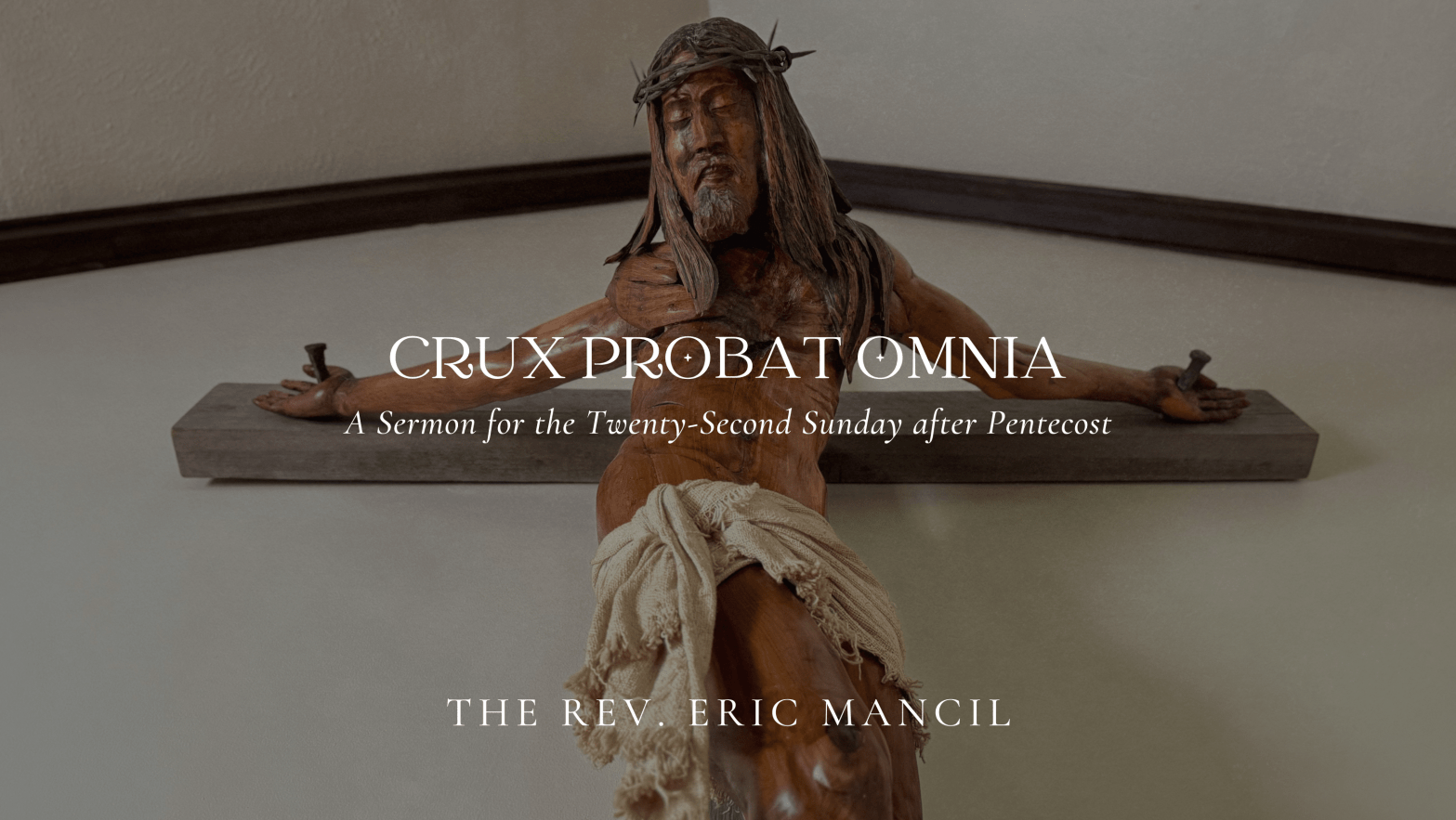
Crux Probat Omnia

A Sermon for the Twenty-Second Sunday after Pentecost (Proper 24, Year B)
October 20, 2024

Text: Mark 10:35-45

Now, O Lord, take my lips, and speak through them. Take our minds, and think through them. Take our hearts, and set them on fire. In the name of the Father, and of the Son, and of the Holy Spirit. Amen.

A couple of weeks ago, I drove down to Camp Beckwith for our annual Clergy Conference. Clergy Conference is basically an opportunity for all the clergy in the diocese—both priests and deacons—to come together for a few days of fellowship and learning.

It’s also a time for us to pray and worship together, which is something we rarely get to do since most of us are so busy in our own ministries across the diocese.

One of the things I value most about Clergy Conference is getting the opportunity to have conversations with people I don’t know very well, including some of our senior and retired clergy.

On the last day of the conference a couple of weeks ago, I had a nice conversation with a priest named Father Bob, who serves as the priest-in-charge at a small congregation down in Pensacola.

Judging by his age and demeanor, I could tell right away that he was a wise and experienced priest.

After we introduced ourselves, I shared with him that I was the rector at St. Mary’s in Andalusia.

His response right away was, “Oh, St. Mary’s! What a lovely church!”

He was obviously familiar with our parish in some way.

Then he asked me, “Do y’all still have that wooden sculpture of Jesus on the cross?”

I thought to myself, “Of all the things to be known for, I’m surprised he knows us because of that.”

So, I said, “Yes, sir. It’s hanging in one of the transepts of the church.”

Then, much to my surprise, he went on to share with me a little bit of the history of the sculpture.

He told me that it once belonged to Christ Episcopal Church—a large parish in Pensacola—but that some of the members of that parish didn’t want it hung in the church.

I guess, for them, it focused too much on the death of Jesus, which, in a way, is understandable.

After all, in the Episcopal Church, our theology is really centered more on the resurrection.

That’s why—in most Episcopal parishes—you’ll find an empty cross hanging above the altar rather than a crucifix.

So, since the people at Christ Church in Pensacola no longer wanted the sculpture, they decided to find a new home for it, which is how it ended up here at St. Mary’s.

And, I’m so glad it did.

Because, even though the passion and death of our Lord isn’t the focus of our theology and worship, it is a central part of the story.

As I’ve preached before, there would be no Easter without Good Friday.

There would be no joy of the resurrection without the pain and sacrifice of the cross.

It’s part of our story, as Christians.

The sculpture that hangs in our church isn’t just a fancy decoration.

It serves as a poignant reminder that, in order to follow Jesus, we have to be willing to walk the way of the Cross.

I’m reminded of that every time I see it—but especially on Wednesdays when we have our noon healing service in the transept and I’m standing behind the altar, facing the cross.

Every time we come to that point in the service where I break the bread during Communion and hold up the two halves of the bread—one in each hand—I see Jesus hanging on the cross, and suddenly, the simple truth of our faith becomes so vividly real for me once again.

As painful as it is to think about, Jesus is the “suffering servant,” the one who willingly gave his life as an offering and sacrifice for the world so that we might be redeemed and find eternal life with God.

And, as followers of Jesus, we’re called to walk in his footsteps—to take up our own cross and follow him.

Over the past couple of months in church, we’ve been reminded of this in some of our readings from the Gospel of Mark.

Five weeks ago, on September 15th, we heard Jesus ask his disciples in our Gospel reading, “Who do people say that I am?”

And they answered him, “John the Baptist; and others, Elijah; and still others, one of the prophets.”

“But who do you say that I am?” Jesus asked them.

Peter answered, “You are the Messiah.”

Then, he ordered his disciples not to tell anyone, and he began to teach them that the Son of Man must suffer and be rejected and killed and then, after three days, rise again.

And, he taught them that whoever wants to follow him must deny themselves, and take up their cross, and follow.

Then, in our Gospel reading four weeks ago, on September 22nd, we heard a second prediction that Jesus made about his death.

He told his disciples, “The Son of Man is to be betrayed into human hands, and they will kill him, and three days after being killed, he will rise again.”

But, the disciples still didn’t understand what Jesus was talking about.

They were far more concerned with worldly things, like arguing amongst themselves about which of them was the greatest.

Jesus told them, “Whoever wants to be first must be last of all and servant of all.”

And then finally, we have today’s lesson, which takes place right after Jesus makes a third and final prediction about his death.

If we back up a few verses before today’s reading, we learn that Jesus is traveling with his followers on the road to Jerusalem.

And he pulls the twelve disciples aside and says to them, “See, we are going up to Jerusalem, and the Son of Man will be handed over to the chief priests and the scribes, and they will condemn him to death; then they will hand him over to the Gentiles; they will mock him, and spit upon him, and flog him, and kill him; and after three days he will rise again.”

You would think that after three predictions about what’s going to happen, the disciples would finally “get it.”

You would think that, after all this time they’ve spent with Jesus, they would finally understand that he isn’t the ruler king they expected.

Jesus will not sit on an earthly throne and be worshiped and adored.

He won’t be rich or powerful.

He won’t be adorned with the finest clothes and fanciest jewelry, and he won’t be waited on by servants.

No, this king will be betrayed and looked upon with shame.

He will be mocked and spit upon.

He will suffer terrible pain and be hung on a cross to die.

And, in his death, he will be glorified by his Father in heaven.

When Jesus told his disciples that he would be killed and then rise again on the third day, it wasn’t just his way of preparing them for what was coming.

It was his way of teaching them that, in order to follow him, they’d have to be willing to give up any sense of pride or selfish ambition.

They’d have to be wiling to let go of any desire for worldly power and privilege in exchange for the joy and peace of God’s kingdom.

He said it this way: “…those who want to save their life will lose it, and those who lose their life for my sake, and for the sake of the gospel, will save it.”

In our Gospel lesson for today, James and John, two of Jesus’ closest friends, come to him as they’re traveling to Jerusalem.

And, they say to Jesus, “Teacher, we want you to do for us whatever we ask of you.”

Jesus responds, “What is it you want me to do for you?”

They say to him, “Grant us to sit, one at your right hand and one at your left, in your glory.”

Jesus doesn’t scold them or even tell them they’re being selfish by seeking special attention or a special place of honor.

He responds to their request by saying, “You do not know what you are asking.”

In other words, “You think you know, but you really have no idea.”

Jesus knows what lies ahead.

He knows what will happen when they eventually reach the walls of Jerusalem.

Although they’re completely serious about the request, James and John don’t really know what they’re doing when they ask Jesus for a place at his side, one on the right and one on the left.

Because Jesus won’t be glorified in a position of power or a place of privilege.

The place where Jesus will be glorified by God is on the hard wood of the cross.

Eventually, the other ten disciples learn about what James and John have been up to, and they get angry with the brothers for trying to seek special attention from Jesus.

So, Jesus calls them all together and says to them, “Whoever wishes to become great among you must be your servant, and whoever wishes to be first among you must be slave of all. For the Son of Man came not to be served but to serve, and to give his life a ransom for many.”

All you have to do is look up at that cross on the wall and be reminded.

Jesus came—not to be served—but to serve.

And, as his followers, we’re called to do the same—to seek out ways of being of service to others, especially the most vulnerable among us.

Jesus came—not to be worshiped and adored—but to bear witness to the truth of God’s love and to usher in God’s reign of peace and justice in the world.

And, as his followers, we’re called to do the same—to seek out ways of sharing God’s love with others and to work for the building up of God’s kingdom.

Jesus came—not to seek a special place of honor or privilege—but to teach us through his life, death, and resurrection that the way of the Cross is the path to abundant life with God.

In order for us to experience the joy and peace of God in our lives, we have to be willing to empty ourselves and lay down our lives for the sake of the Gospel.

As Christians, the Cross is the standard by which we measure all that we say and do.

If we’re ever in a situation where we have to stop and ask ourselves, “What would be the Christian thing be to do here,” all we have really need to do is consider the Cross.

In the words of the Protestant reformer, Martin Luther, Crux probat omnia, which is a Latin phrase, meaning, “The Cross is the test of everything.”

May we carry this phrase with us wherever God may send us, and may its words be written on our hearts. Amen.

Let Go

A Sermon for the Twenty-First Sunday after Pentecost (Proper 23, Year B)
October 13, 2024

Text: Mark 10:17-31

Now, O Lord, take my lips, and speak through them. Take our minds, and think through them. Take our hearts, and set them on fire. In the name of the Father, and of the Son, and of the Holy Spirit. Amen.

As most of you know, I go to the Blue Bird Coffee Company each week on Thursdays from about 9:00 in the morning until 10:00, doing something I like to call “Coffee with the Priest.”

It’s an opportunity for me to make myself available to anyone in the community who just needs someone to talk to or someone to pray with them.

Sometimes, I go, and I don’t have much interaction with anyone other than the staff at the coffee shop. So, I’ll sit and wait, and if no one shows up, I’ll use that time to work on a sermon or respond to some emails.

Sometimes, people reach out ahead of time and make plans to meet with me at the coffee shop for a one-on-one conversation.

And then, sometimes, I’ll have random encounters with complete strangers, which is exactly what happened to me this past Thursday.

I walked into the coffee shop like usual, put my sign out that says “Coffee with the Priest,” made a quick post on social media about being at the coffee shop, and then I stood in line to get a cup of coffee.

And, as I stood in line, I overheard the person in front of me—a man I had never seen before—talking with the cashier about how he and his family had to evacuate from Florida this past week due to the hurricane.

After he was done talking with the cashier, he got his coffee and went and sat down at a table.

And, then I got my coffee, and as I was walking back to my table, I saw the man again, and we struck up a conversation.

I was wearing my clergy collar at the time. So, he knew I was a minister of some kind, probably a Catholic priest.

And, he told me more about his situation.

He and his family had evacuated on Monday and found their way to Andalusia.

I asked him if they were able to find a hotel room nearby, and he told me that they were staying in a camper in a local RV park.

He also shared that, thankfully, none of his property had been severely damaged by the storm, and he was hopeful that they’d be able to return home soon.

I wished him well and I told him that, if there was anything they needed while they were here, our church was right down the road.

Then, I sat down at my table, which was right next to the man I was talking to.

And, after a few minutes, we started talking again.

This time it was about church.

He asked me if I was a Catholic priest, and I told him, “No, I’m an Episcopal priest.”

Then, he wanted to know the difference between Catholic and Episcopal. So, I started listing some of the differences and sharing with him some of the things I love most about the Episcopal Church.

I could tell he was genuinely curious, but I wasn’t quite sure why.

Somehow, in the midst of our conversation, he shared with me that he was a non-believer, and it sounded like a lot of that had to do with a bad history with the church and Christians trying to convert him to their way of thinking.

Judging from his tone, I got the feeling that his overall sense of Christianity is that it’s just a church full of people whose primary mission is to go out and convert everyone they meet.

And, as I sat and listened to the man’s story, I thought to myself, “I wish people like him knew that there are other types of Christians in the world.”

I wish more people knew that there are churches in this world—like our church, for example—that exist, not to try to convert people or to convince them to think or believe the way we do—but who work and strive to be examples of God’s love to those we meet and to spread the Good News of God in Christ with the world.

Jesus didn’t instruct the disciples to go out and convert the world to Christianity. He instructed them to go out and share the Good News of the Gospel—to show people through their words and deeds that the Kingdom of God has come near.

That’s why we’re here.

We do what we do—not for own benefit—but for the good of God’s Kingdom.

We do what we do—not to try and save people’s souls (as if we could if we wanted to), but to invite them into a deeper and more meaningful relationship with the God who loves them.

But, far too often, people who don’t know any different are convinced that they already know what our intentions are before ever getting the chance to know more about us.

They think they know who we are because of past experiences of church or second-hand knowledge from people who’ve had bad experiences.

Not that I blame them because there are plenty of Christians in this world who think it’s their mission to save people and convert them.

But, that’s not us.

In reality, there’s so much more to who we are and what we’re called to do as followers of Jesus.

As I was reflecting on my time with the man at the coffee shop, I thought about how all of us, in some way, get trapped and weighed down by our own pre-conceived ideas or notions about people who are different than we are.

Especially people who have different beliefs or ideas than we do.

I think a really good example of this today is the current political climate in our country, especially with the upcoming election.

It’s so easy for us get pulled into the idea that we have to dehumanize or look down upon those who have different beliefs and ideas than we do.

And, when we do that, we create walls of our own making—separating ourselves from those who think or believe differently than we do and possibly even making enemies out of those who are different.

But, that’s not what God calls us to do.

God calls us to break down the walls that divide and separate us.

God calls us to examine our lives and to think about those biases and prejudices that infect our hearts—those destructive ideas about other people that keep us from experiencing the abundant life that God wants for each of us.

God calls us to let go.

To let go of what we think we know about other people.

To let go of the idea that we have everyone perfectly figured out and grouped into a box that’s easily defined.

To let go of our need to look down upon those who think or believe differently than we do.

To let go of the idea that we’re right and everyone else is wrong.

Today’s Gospel lesson from Mark is all about letting go.

Letting go of those things in our lives—whether they’re spiritual or material—that are keeping us from experiencing the joy and peace of following Jesus.

In today’s reading, we hear the story of Jesus’ encounter with the rich man who comes to Jesus and asks him, “Good Teacher, what must I do to inherit eternal life?”

In other words, “What must I do to find joy and peace in God’s kingdom?”

Jesus looks at the man and basically tells him, “You already know what you need to do. Follow God’s Law.”

The man tells Jesus that he’s lived a good life and followed all of God’s commandments, even since his youth.

Then, we come to my favorite part of the story.

And, it’s so simple.

The author of Mark’s Gospel writes that Jesus looked at the man and loved him.

He didn’t judge the man.

He didn’t criticize him.

He loved him. The way I read that part of the story is that Jesus looked at the man and had compassion for him.

He thought he had done everything he was supposed to do up to that point in his life.

But, knowing the man better than he knows himself, Jesus tells him that there’s one more thing he has to do in order to receive the abundant life he seeks.

He says to the man, “Go, sell what you own, and give the money to the poor, and you will have treasure in heaven; then come, follow me.”

I can’t imagine the look of shock and disappointment that must have been on the man’s face when he heard Jesus’ instruction.

In the end, it’s too much of a burden for the rich man to bear.

He isn’t willing to let go of his wealth and possessions in order to follow Jesus.

So, he turns around and walks away.

Contrary to what some people believe about this lesson from Mark’s Gospel, it isn’t intended to cast judgment on the rich, and it doesn’t mean that there’s no room in God’s kingdom for wealthy people.

This story is about much more than money and wealth. It isn’t about what we own or how much we have.

It’s about our attachment to those things in our lives—the things we so desperately want to hold on to—that keep us from following Jesus.

The rich man in our Gospel lesson is so attached to his wealth and worldly possessions that he’s unable to see the grace that’s right in front of his eyes when Jesus offers it.

It was easier for him to turn around and walk away from Jesus than to give up that which he cared about the most.

The story of Jesus and his encounter with the rich man teaches us that, in order to receive the abundant life we seek, we have to be willing to let go of those worldly attachments in our lives—both material and spiritual—that cause us to lose sight of our need to follow Jesus.

This story can be applied to so many corners of our lives.

Because, truth be told, we can be attached to lots of things that can be a stumbling block in our lives.

Not just money and wealth.

But also our tight grip on anger and resentment toward those who’ve hurt us.

Not just material or physical possessions.

But also biases toward those who think or believe differently than we do.

Not just the things we can see, taste, and touch.

But also those intangible things that infect our hearts, like jealousy toward those who have more than we do or the feeling that we’re better or more deserving than anyone else.

Because, in the end, it’s not about us at all. It’s about God and what God is doing in us and through us to change the world.

God calls us to let go.

To let go, and let him be the center of our lives.

Amen.

Living With Open Hearts

A Sermon for the Twentieth Sunday after Pentecost (Proper 22, Year B)
October 6, 2024

Text: Mark 10:2-16

Now, O Lord, take my lips, and speak through them. Take our minds, and think through them. Take our hearts, and set them on fire. In the name of the Father, and of the Son, and of the Holy Spirit. Amen.

At the parish where I served before coming to St. Mary’s, there was a member of the church who was well-loved by everyone there. He was very faithful—the kind of parishioner who showed up to everything and was always willing to volunteer and serve.

You could count on him to be at worship almost every Sunday. He attended Sunday school regularly. He always showed up to special events, and he also served as the treasurer, making sure the church was in good financial order.

And, if I ever had to be out of town on Sundays, I could always count on him to lead Morning Prayer if I wasn’t able to find a supply priest to lead worship.

He loved God, and he loved his church very much.

Not long after I arrived, one thing I learned about this parishioner was that he was recently divorced and remarried.

In our time together, we didn’t talk a lot about what happened in his first marriage, but from the limited conversations we did have, I could tell that it wasn’t a good situation.

There was a lot of pain in his first marriage, and any time he talked about his divorce, his demeanor changed, almost as if there was this cloud of disappointment and failure that hung over his head.

And then, he would talk about his new wife and the life they shared together. She was also an active and beloved member of the parish.

And, when he shared the story of how they met and how quickly they fell in love and got married, he would light up again.

It was almost as if this life that he shared with his new wife had filled him with an overwhelming sense of joy and peace.

He and I became friends during my time there. We worked well together, and he was always supportive of me and my ministry.

One Sunday morning, about three years ago, the Gospel lesson for the day was the same passage we heard just a few moments ago from the Gospel of Mark.

Which included Jesus’ teaching on divorce.

Everything in the service that day went according to plan.

As usual, the lessons were read. The hymns were sung. I proclaimed the Gospel and preached a sermon, and we gathered around the Table for Holy Communion.

And, after the service was over, as I was greeting people at the door, my friend walked over to where I was standing with his head hung low and a look of sadness and disappointment on his face.

I could tell he was very upset about something.

So, I asked him, “What’s wrong? Is everything okay?”

He looked at me and shook his and said, “I guess I’m just living in adultery.”

At first, I was surprised by what he said.

I had hoped that, even though it was a difficult Gospel reading, he might’ve been at least a little comforted by my sermon that day.

But, then I thought about it for a moment and realized, “Of course he feels this way.”

How could anyone who was divorced and remarried hear today’s Gospel lesson and not immediately jump to the conclusion that they’re living in sin?

I didn’t know how to respond to my friend’s comment at the time, and, to be honest, I’m not sure if there was anything I could’ve said in that moment that would’ve made him feel any better.

So, he just kept walking, and he never mentioned it again.

But, my heart broke for him because I knew how upset he was.

As a preacher, today’s Gospel lesson is one that I dread every time it comes up in the readings, mostly because I know how painful it can be for those who hear it, especially those of us who’ve been personally affected by divorce, either in our own relationships or in the relationships of those closest to us.

It would be easy for us to simply gloss over today’s reading and disregard it altogether.

But, I think that would be a missed opportunity.

Because, behind Jesus’ teaching, there’s something very important for us to learn about the love of God and what God wants for us in our lives.

So, let’s talk about it.

If we look at the beginning of today’s passage, we learn that the Pharisees come to test Jesus. They want to expose him as a false teacher.

So, they ask him a challenging question. “Is it lawful for a man to divorce his wife?”

In the time of Jesus, the issue of divorce was hotly debated among religious leaders—including the Pharisees—and there were various ways of interpreting the law in Deuteronomy, which permitted men to issue certificates of divorce to their wives.

One school of thought—the more conservative view—was that men could divorce their wives but only in cases of adultery.

Another school of thought—the one most people agreed with—was that this law in Deuteronomy allowed men to divorce their wives for any reason at all, even trivial ones like burning a meal.

So, the predominant view of divorce at the time was that a man could dismiss his wife for any reason, leaving her vulnerable, ostracized from the rest of the community, and sometimes even poor and homeless.

Jesus was firmly against this teaching.

He says to the Pharisees, “Because of your hardness of heart Moses wrote this commandment for you.”

In other words, Moses wrote this law because of your stubbornness and refusal to live as God has commanded you to live.

Then, he goes on to quote the Book of Genesis, saying, “But from the beginning of creation, ‘God made them male and female.’

‘For this reason a man shall leave his father and mother and be joined to his wife, and the two shall become one flesh.’ So they are no longer two, but one flesh. Therefore what God has joined together, let no one separate.”

For Jesus, the Pharisees’ question about divorce really isn’t all that important. He doesn’t even take the time to answer their question.

Instead, he uses this moment as an opportunity to remind the Pharisees—and us—about the purpose for which God established the covenant of marriage.

Marriage is an outward and visible sign of God’s self-giving, sacrificial love.

When two people make the choice to live in the covenant of marriage, they make the choice to live no longer for themselves alone but also for each other.

And by continuing to live into this covenant, they become a visible sign for the world of the kind of love that God calls us to share with each other.

A love that is patient and kind.
A love that isn’t envious or boastful or arrogant or rude.
A love that isn’t irritable or resentful.
A love that doesn’t rejoice in wrongdoing but rejoices in the truth.
A love that bears all things, believes all things, hopes all things, endures all things. 

Friends, this is the Good News of our Gospel lesson for today.

When we make the choice to turn from our own selfish ways, when we choose to live not only for ourselves but also for others, we’re released from the weight of our own sinfulness and made free to live and love as God intended.

Marriage—when it works—is a gift of God’s grace, not only for the married couple, but for everyone who sees their love for each other in action.

Later, in the Gospel passage, Jesus is alone with his disciples.

And, they ask him to be clear about his teaching on the issue of divorce.

And this is where things get difficult. It’s probably the most difficult part of today’s lesson.

He says to his disciples that anyone who divorces his wife and marries another commits adultery, and any wife that divorces her husband and remarries also commits adultery.

This can be a hard teaching for many of us to accept, especially those of us who’ve remarried and now have a relationship that’s much more healthy and life-giving.

I want to acknowledge that because when we talk about divorce in the church, we have to do so with compassion and understanding, realizing that it’s not always an easy, “black or white” decision.

We know, through our own knowledge and understanding, that marriages come to an end for lots of different reasons.

Some marriages come to an end because of mistrust and fractured relationships that are beyond repair.

Some come to an end because of a history of violence or abuse.

Some come to an end after years of desperately trying to fix whatever’s broken, only to realize that the relationship that once existed is no longer there.

And the list goes on.

What we’ve also come to know and understand is that making painful decisions—like the decision to end a marriage—can actually lead to healing and restoration.

Letting go of things that are destructive in our lives, including failed marriages and broken relationships, can lead to new and abundant life, which is what God wants for all of us.

Now, don’t get me wrong.

I’m not saying that Jesus is an advocate for divorce.

On the contrary, Jesus takes marriage and divorce very seriously, and I believe he wants us to work hard to try and mend broken relationships.

God grieves right along with us when marriages fall apart.

But, I’m also convinced that God wants us to live full and healthy lives, which sometimes means letting go and moving on.

Contrary to what many people have been led to believe, this teaching of Jesus in today’s Gospel isn’t his way of condemning those who’ve been divorced and remarried.

It’s his way of saying that the covenant of marriage is sacred and should be protected, if at all possible, because it serves as a sign of something so much greater than ourselves.

If two people can make a marriage work and last—if two people can look past their own differences and live in peace and unity together and find joy in sharing their lives with one another—then maybe there’s hope in believing that God’s love can transcend our own differences and that we can live in peace and unity together and find joy in sharing our lives with one another.

But, to do so requires a softening of the heart, a willingness to open our hearts and share them with each other, even at the risk of being hurt in the process.

As C.S. Lewis once put it, to do otherwise—to keep our hearts to ourselves and protect ourselves from the possibility of being hurt—is the same as cutting ourselves off from God.

As Christians, our call is to live with open hearts because we’ve been empowered by the Holy Spirit in Baptism and given the responsibility of serving as instruments of God’s love in the world.

What you’ll eventually come to realize in the process—if you haven’t already—is that, by living with an open heart for others, we come to experience a joy and peace far greater than anything we could ever hope for or imagine.

A peace that surpasses all understanding.

A peace that can only be described as God’s grace.

Amen.

Live in Christ

A Sermon for the Eighteenth Sunday after Pentecost (Proper 20, Year B)
September 22, 2024

Text: Mark 9:30-37

Now, O Lord, take my lips, and speak through them. Take our minds, and think through them. Take our hearts, and set them on fire. In the name of the Father, and of the Son, and of the Holy Spirit. Amen.

A few years ago, while my family and I were on vacation down at the beach, I had the privilege of performing not one, but two baptisms in the Gulf of Mexico.

As a priest, every baptism I get to do is special, but these baptisms were especially important to me.

I got to baptize my younger sister, Haiden, and her daughter, Everly, who was only nine months old at the time.

It was a day I’ll always remember.

We woke up on Saturday morning, ate breakfast, and got ready to head to the beach for the service.

But, before we left the house, I had some time alone on the front porch with my sister to talk with her about the significance of baptism.

By the way, this is something I do with everyone who’s preparing for baptism—not just members of my family.

We sat down, and I asked my sister, “Why do you want to be baptized?”

I asked her this question, not only because I wanted her to think about it beforehand, but also because I was genuinely curious.

Neither of us grew up going to church regularly. So, I wanted to know what she was feeling. I wanted to hear, in her words, why it was important for her to be baptized.

I think she was a little surprised by my question. Judging from her reaction, I cold tell that she didn’t quite know what to say at first.

But, after a moment of thinking about it, she told me, “I want to be baptized so I can invite Jesus to live in my heart.”

It’s probably the same, exact reason that lots of people have made the choice to be baptized.

I looked at her and gave her a little nod, and I said, “That’s a great reason.”

But, then I continued on.

And, I told her that baptism is about more than just inviting Jesus into your heart.

When we’re baptized, we take on a new way of life, and we make a commitment to abide in God’s love.

To live, not just for ourselves—but also for others.

Yes, we’re cleansed of our sins through the waters of baptism.

But, even more important than that, we become living members of Christ’s Body, called to do the work of building up God’s Kingdom.

When we receive the sacrament of baptism, we make a place for Christ to live in us, but we also promise to live in Christ.

We make a vow to love and serve Christ in all persons, just as we ourselves have been loved and served by God.

She looked at me as I explained all of this, and I think she understood what I was talking about.

After our talk, we made our way down to the beach, and I couldn’t help but express my gratitude to God for giving me this amazing gift—to be able to welcome my sister and niece into the household of God and to share this beautiful moment with my family.

During the first part of the service, we gathered near the water to hear the reading of Scripture and for the presentation of the candidates.

Then, after the prayers, we moved closer to the water, where I stood ankle-deep in the Gulf and said the prayer of thanksgiving over the water.

In that moment, I was moved to tears.

I think it had a lot to do with where we were and what we were doing, but I think it also had a lot to do with the weight of those words and the understanding that the sacrament of baptism connects all of us with something so much greater than we often realize.

In that prayer of thanksgiving over the water, we’re reminded of our salvation history and how the same God who delivered the people of Israel out of their bondage in Egypt is the same God who grants us freedom and peace in our lives.

We’re reminded in that prayer that the same Spirit who moved over the waters of creation and was present at the baptism of Jesus is present with us, here and now, breathing into us new life and new possibilities.

I was so emotional that I barely made it through the entire prayer.

For a moment, I thought I was going to have to ask someone else to say the words for me.

But, I made it through. And Haiden and Everly were baptized that day, and there was great rejoicing in heaven as we added two new members to the Body of Christ.

After the administration of the water, I anointed each of them with the oil of chrism, saying the words, “You are sealed by the Holy Spirit in baptism and marked as Christ’s own forever.”

Then, we made our way back to the beach and shared the Body and Blood of Christ around a makeshift altar in the sand.

I wanted to share this story with you because I think it has a lot to do with what’s going on in our Gospel lesson for today.

Jesus is with his disciples.

And he tells them that the Son of Man is to be betrayed into human hands. He will be killed, and then three days later, he will rise again.

This isn’t the first time the disciples have heard a prediction like this.

If you were in church last week, you heard a similar prediction made by Jesus.

He told his disciples, “that the Son of Man must undergo great suffering, and be rejected by the elders, the chief priests, and the scribes, and be killed, and after three days rise again.”

If you recall from last week, Simon Peter was having none of it.

He took Jesus aside and began to rebuke him, but Jesus, being fully aware of his mission and what he came to accomplish in his ministry, rebuked Peter, saying, “Get behind me Satan! For you are setting your mind not on divine things but on human things.”

So, it’s no wonder that, in today’s Gospel reading, the disciples respond quite differently to Jesus after he tells them about what’s coming.

They say nothing.

They don’t understand what Jesus is talking about. If he’s the Messiah, how could he possibly be handed over and killed?

They probably thought to themselves, “If he dies, then all of this was for nothing.”

So, they don’t say a word.

They don’t question Jesus. They don’t ask him what it all means. They just pretend like it never happened and continue on.

As they continue traveling, Jesus overhears the disciples arguing about something, and when they come to the city of Capernaum, he asks them what they were arguing about.

Again, there’s silence.

Perhaps they were already aware of the fact that what they were arguing about was childish and unimportant.

They had been arguing amongst themselves about which of them was the greatest.

So, Jesus sat down and called them over and said to them, “Whoever wants to be first must be last of all and servant of all.”

Then, as a way showing them what it means to live as a servant, he places a little child in front of them, picks it up, and says, “Whoever welcomes one such child in my name welcomes me, and whoever welcomes me welcomes not me but the one who sent me.”

In Jesus’ time, children were considered among the lowest in society. They had very little worth except for the fact that they would eventually grow into adults who could contribute to the community.

So, for Jesus to use a little child as an example was his way of saying that we’re called to serve everyone—but especially the lowest and most vulnerable among us.

I was recently reminded of a favorite quote of mine from St. Augustine of Hippo, who once wrote, “You have made us for yourself, O Lord, and our hearts are restless until they rest in You.”

Isn’t that great?

Let me say that again.

“You have made us for yourself, O Lord, and our hearts are restless until they rest in You.”

Jesus doesn’t just want us to make a place for him in our hearts. It’s a wonderful thing to do, and it’s part of what it means to be a disciple.

But, most of all, Jesus wants us to rest in him—to abide in him.

To know that, no matter where we go or what we do, we belong to the Lord. We are a new creation, bathed in the waters of baptism, and empowered to live our lives as followers of Jesus.

What that means is that we don’t have to worry so much about being the greatest at anything—at least not according what the world says is great.

To be considered great in God’s kingdom, we don’t have to worry about whether or not we have more money or nicer things than the person next to us.

We don’t have to worry about being the most successful person at our jobs.

And, we don’t have to worry about being the most popular or influential person in our community.

It’s not that making money and being successful are inherently bad, but these worldly concerns can easily become distractions from what it is that we are truly called to do in our lives—what we’ve made a commitment to do.

To live in Christ, to abide in Christ—just as he lives and abides in us.

In all that we say and do—this should always be our first priority. 

To be considered great in God’s kingdom is actually pretty simple, and Jesus lays it out for us in today’s Gospel lesson in a way that’s easy to understand.

“Whoever wants to be first must be last of all and servant of all.”

Or, to put it another way—in a language that we Episcopalians are familiar with—If we want to be first in the kingdom of God, we must seek to serve Christ in all persons, loving our neighbors as ourselves.

It’s part of our Baptismal covenant—something we’ve all made a commitment to do.

To be great in God’s eyes means to live more fully in Christ, more fully into our lives as Christians. May God grant us the strength and wisdom we need to be faithful in our calling. Amen.

Homeless Jesus

A Sermon for the Seventeenth Sunday after Pentecost (Proper 19, Year B)
September 15, 2024

Text: Mark 8:27-38

Now, O Lord, take my lips, and speak through them. Take our minds, and think through them. Take our hearts, and set them on fire. In the name of the Father, and of the Son, and of the Holy Spirit. Amen.

Imagine, for a moment, that you’re taking a walk through what appears to be a very nice neighborhood. You’re walking down a sidewalk lined with tall, luscious trees and beautifully landscaped yards.

Judging from the appearance of the homes in this neighborhood and the people who live here, it’s probably made up of mostly middle to upper class families.

There’s no trash on the ground anywhere, and you imagine that it would be a grave sin to even consider going more than a couple of weeks without cutting the grass.

The appearance of this neighborhood is well-maintained, and you imagine that the residents who live here want to keep it that way.

After a few blocks of walking down the sidewalk, you come to what appears to be a church in the middle of this pristine neighborhood.

The church, like the neighborhood in which it resides, is beautiful.

The front yard is immaculate, enclosed with red, brick columns and a black, wrought iron fence.

You imagine that it must take a lot of work to maintain such a lovely appearance.

Upon further investigation, you discover that this church is an Episcopal Church, and as you continue walking by, you witness a very shocking sight, indeed—something out of of place and unexpected.

From a short distance, you see what appears to be a homeless person, covered up with a long blanket and sleeping on a park bench next to the church.

You ask yourself, “How did they get here? How could there be a homeless person sleeping here in the middle of this perfect neighborhood?”

You decide to move a little closer to see if there’s any way you can help. Maybe they need some food or a little bit of money.

So, you move closer, and as you approach the covered up person on the bench, you notice something strange about their feet—the only part of their body that isn’t covered up with the blanket.

You notice that each foot has a large, round scar in the center, and then it dawns on you. This isn’t just any homeless person.

These are the feet of Jesus.

In February of 2014—almost ten years ago—St. Alban’s Episcopal Church in Davidson, North Carolina, installed a bronze replica of Homeless Jesus, a sculpture that was originally designed and created by a Canadian artist named Timothy Schmalz.

The original sculpture was intended as a visual translation of the passage in the Book of Matthew, in which Jesus tells his disciples, “As you did it to one of the least of my brothers, you did it to me.”

The rector of the church at the time stated that the sculpture is “a good Bible lesson for those used to seeing Jesus depicted in traditional religious art as the Christ of glory, enthroned in finery.”

Well, as you can imagine, the church received mixed reactions from the community at first. Some people loved it. Others found it revolting.

One woman from the neighborhood actually called the police the first time she drove by because she thought it was an actual homeless person.

Another person wrote a letter to the church, claiming that the statue was creepy. 

Others felt that it was insulting to depict Jesus as a homeless person.

I have to admit that, when I first saw the pictures of Homeless Jesus, I didn’t quite know what to think.

On one hand, I found it to be incredibly powerful.

The sculpture serves as a vivid and poignant reminder that, in order to serve Jesus, we have to be willing to serve our others, especially the most vulnerable among us.

On the other hand, it challenged my perception of who Jesus is.

It made me realize that I’m not very comfortable with the idea of a Savior who sleeps on a park bench, covered up with an old, tattered blanket.

It made me realize that I don’t really know if I want a Savior with scars on his feet, reminding me that this Christian life to which we’re called is one that requires us to take up our own cross in order to follow Jesus.

Like Peter, in our lesson this morning from the Gospel of Mark, I don’t want to hear about Jesus having to go through great suffering and being rejected and killed.

No, I want a Savior who’ll reassure me that everything’s fine and under control—a Savior who’ll tell me that I can follow him without really having to do anything or give up anything in return.

I want the long-expected Messiah, the mighty king who will come and fix everything that’s wrong with the world.

If I’m being completely honest, I want a safe Jesus—a Jesus who’ll protect me from getting hurt and shelter me from any kind of suffering.

In other words, I don’t want Good Friday Jesus.

I want the resurrected Jesus.

The problem with that is that we don’t get to separate the two. We don’t get to skip over Good Friday and go straight to Easter.

We don’t get to look at the homeless Jesus lying asleep on the park bench and say, “That’s not my Jesus.”

Whether we like it or not, our Jesus is the one who lies covered up on the park bench, waiting for us to reach out in love.

Our Jesus is the one who suffers right alongside those on the margins of society.

Our Jesus is the one who goes to the cross, who is persecuted and killed, in order to teach us that the way of the cross is the path to eternal life with God.

N.T. Wright, once wrote, “Jesus’s call to follow him, to discover in the present time the habits of life which point forward to the coming kingdom and already, in a measure, share in its life, only makes sense when it is couched in the terms made famous by Dietrich Bonhoeffer: ‘Come and die.’

Jesus didn’t say, as do some modern evangelists, ‘God loves you and has a wonderful plan for your life.’ Nor did he say, ‘I accept you as you are, so you can now happily do whatever comes naturally.’

He said, ‘If you want to become my followers, deny yourself, take up your cross, and follow me.’”

Dear friends, God does love us more than we can imagine, and God does have a wonderful plan for our lives.

But, that plan doesn’t involve material things or worldly comforts, and it doesn’t involve freedom from suffering or passively waiting around for someone else to come along and do the work for us.

God’s plan is for us to participate in the building up of God’s Kingdom, to help bring healing and restoration to the world that God has made.

Jesus began this work in his ministry and sacrifice on the cross, and it’s the work that we’re called to continued as his disciples.

God loves us and accepts us as we are, but that doesn’t mean that God wants us to stay as we are.

As followers of Jesus, we believe that new life is always possible and that forgiveness and redemption are always within our reach.

This Christian life to which we’re called is a lifelong journey of transformation, but in order to experience the transformation that God wants for us, we have to be willing to let go of the things that are holding us back, including our false ideas and expectations of who Jesus is and what Jesus calls us to do.

My brothers and sisters in Christ, may we always hold on to the image of the homeless Jesus lying on a park bench, reminding us that his place—and our place—is with the poor, the sick, and the oppressed.

May we always hold on to the image of the scars on Jesus’s feet, reminding us that his journey to the cross is the journey we’re called to make as well.

And finally, may we always hold onto the words of St. John Chrysostom, a pillar of the early Christian church, who once wrote, “If you cannot find Christ in the beggar at the church door, you will not find Him in the chalice.”

Amen.

A Mother’s Plea

A Sermon for the Sixteenth Sunday after Pentecost (Proper 18, Year B)
September 8, 2024

Text: Mark 7:24-37

Now, O Lord, take my lips, and speak through them. Take our minds, and think through them. Take our hearts, and set them on fire. In the name of the Father, and of the Son, and of the Holy Spirit. Amen.

In January of 2019—about five and a half years ago—my family and I were living in Chelsea, Alabama—a small suburb of Birmingham. I was serving as the priest at a small, Episcopal church called St. Catherine’s while Chelsea was working as a nurse at a pediatric clinic in downtown Birmingham.

One night, as I was cooking dinner at home, Chelsea and the kids were in the backyard playing on the trampoline. Jude was seven years old at the time, and Sophie was nine.

I remember that it was dark outside and very cold.

All of a sudden, I heard Chelsea scream my name from outside. I had no idea what was happening, but as a parent, my mind immediately went to the worst case scenario.

Something’s happened to one of the kids.

I quickly went outside to see what was wrong, and I found Jude lying on the trampoline in terrible pain. Chelsea told me that they had been playing around and that Jude fell hard on the side of his left arm.

He didn’t fall off the trampoline. He just fell on the mat. So, at first, I didn’t think it was very serious.

We helped him down and took him inside where we could see his arm more clearly, and that’s when we knew it was much more serious than we thought.

Not to get too graphic, but Jude’s left arm looked like a limp noodle.

Being a nurse, Chelsea knew right away what we needed to do. So, we loaded everyone up in the car and drove to the emergency room at Children’s Hospital.

Even though it was a short trip, it was one of the longest thirty minutes of my life.

Jude handled it much better than I did.

I was a nervous wreck the whole way there. More than anything, I just wanted him to be okay and to get the help he needed as soon as possible.

When we arrived at the emergency room, we had to wait much longer than I had hoped, which added even more anxiety to the situation.

I expected Jude to be seen right away. But, instead, it was hurry up and wait.

Finally, we were seen by a nurse, who was able to give Jude some medicine for the pain, and we were taken back into a room and seen by a doctor.

They took some x-rays of Jude’s arm, and we were told that his arm was fractured completely, right above the elbow and that he was going to have surgery the following day.

Well…needless to say, that made matters even worse.

I was already worried about Jude’s broken arm, and now he was going to have to go through surgery. The surgeon told us he was going to have to use screws and rods to fix his broken arm.

As a parent, the last thing you want is for your child to have to go through something like that. To have a broken arm is one thing but to have to be put to sleep and go through a serious surgery is another thing entirely.

The next morning, we had to wait much longer than expected for Jude’s surgery.

But, finally, the time came. I said a prayer, and they took him back to the operating room. 

After a few hours, the doctor came back to the room and told us that everything went well with the surgery.

Chelsea and I could finally breathe a sigh of relief.

Jude was going to be okay. It was going to take a long time for him to recover and heal from the accident, but thankfully, everything was going to be okay.

I wanted to share this story with you because, as a parent, I know what it’s like to feel helpless and to want more than anything for your child to be healed.

I know what it feels like to anxiously sit and wait, wondering whether or not your child is going to be okay.

And, I know that, as a parent, there’s nothing I wouldn’t do to make sure my children got the help and care they needed if they were ever in harm’s way.

There’s a story in our Gospel lesson from this morning about a mother who’s trying to do the same thing.

She’s trying desperately to find help for her daughter, who’s been possessed by an unclean spirit—a demon that’s killing her.

The Gospel doesn’t give us any details about why or how this little girl came to have an unclean spirit. All we know for sure is that she’s in terrible danger.

Her mother’s probably tried everything she can think of to get her the help she needs, but so far, nothing has worked.

So, when news gets around that Jesus of Nazareth has come to town, she takes action. She’s heard of this man from Galilee who has the power to heal and cast out demons.

She goes and finds Jesus alone in a house, probably trying to find a quiet place where he can rest for a while.

She bows down at his feet, and begs him to cast the demon out of her daughter.

She knows it’s a lot to ask—especially with her being a Gentile and him being a Jew—but she’s desperate. And, she’ll do anything to get her daughter the help she needs.

What happens next in the story is pretty shocking.

Normally, we’d expect Jesus to have mercy and compassion for the woman right away and to say, “Of course I’ll help your daughter.”

But, that’s not what happens—at least not at first.

Instead of helping the woman, Jesus says to her, “Let the children be fed first, for it is not fair to take the children’s food and throw it to the dogs.”

This doesn’t sound like Jesus, does it?

It doesn’t sound like the Jesus we know and love—the Jesus we expect to read about in the Gospels who, up to this point in his ministry, has spent years preaching about the Kingdom of God and healing the sick and casting out demons.

The Jesus we know would never disrespect and talk down to this woman in such a dismissive way, especially when she’s already going through so much.

And yet, here we are.

We’re left wondering what to do with this passage from Scripture and what to do with this Jesus who seems anything but merciful and kind.

For centuries, Biblical scholars have wrestled with this text (and the one similar to it in the Gospel of Matthew), and there’ve been many attempts at trying to explain exactly what’s going on.

Some interpreters, for example, try to sugar coat it and insist that the Greek word for “dogs” is better translated, “puppies” and that it’s not really as derogatory as it sounds.

Some suggest that it was common in the time of Jesus for Gentiles to be referred to as “dogs” and that Jesus was simply using a phrase or a saying that wouldn’t have been out of the ordinary.

But, neither of these interpretations explain why Jesus was so dismissive to the woman.

And I think, for most of us, that’s the crux of the matter. The fact that Jesus so easily dismisses the mother’s request for help is what bothers us the most.

So, I want to offer a few words on what I think is really going on in this passage.

Jesus was a first century, Jewish man, who lived in a very particular time and culture and who experienced the harsh disdain that Jews at that time had for Gentiles—those who were non-Jewish.

Gentiles were often referred to as “dogs” because they were considered unclean and impure. For Jews at that time, even standing close to someone who was non-Jewish was to risk being made unclean.

Jews, on the other hand, were God’s chosen people—the people with whom God had an eternal covenant. God promised, in the fullness of time, that he would send the Messiah—the anointed one—to redeem Israel and usher in a new era of peace.

Jesus was perfectly aware of his mission from the very beginning and knew that the focus of his ministry had to be with his own people.

So, when he says to the woman, “Let the children be fed first…” he’s not saying it out of hatred or because he doesn’t think that the woman and her daughter deserve to be helped.

He’s saying it because he’s focused on the urgent matter at hand. He’s come to redeem the children of Israel, and for now, that’s his only mission.

The woman knows this.

Even as a Gentile, she knows the role of the Messiah and never questions Jesus or his priorities.

But, she’s persistent.

She knows Jesus has the power to relieve her daughter of this terrible burden.

So, she replies to him, “Sir, even the dogs under the table eat the children’s crumbs.”

I think it might’ve been her way of saying to Jesus that, even though his priority is to his own people—the children of Israel, maybe there’s enough of God’s grace for everyone.

And she’ll take even the smallest morsel—the smallest crumb—of God’s grace that he has to give for the sake of her daughter.

It’s an eye-opening moment for Jesus, and he comes to understand that maybe his ministry and his mission are much larger than he first realized.

In response to the mother’s plea, he shows mercy and compassion and immediately restores her daughter to fullness of life.

It’s a remarkable story, isn’t it?

And it’s one that gives us a lot to think about, especially when we stop to wonder who is and who isn’t worthy of God’s grace.

The focus of this story is not so much on the miracle that Jesus performed in healing the woman’s daughter.

It’s the fact that, despite his initial response and any preconceived ideas he might have had about this Gentile woman, he showed mercy and compassion.

Because of Jesus, we know that no one is beyond the limits of God’s grace, including those we might consider unclean or unworthy.

Because of Jesus, we know that the mercy and compassion of God are open to all people, not just a select few.

And, as followers of Jesus, we’re called to demonstrate this radical and abundant love in our own lives, wherever we go.

Because you never know who might need our help.

It’s why, in our Baptismal covenant, we promise “to strive for justice and peace among all people and to respect the dignity of every human being.”

Not just some.

All people.

Every human being.

Amen.

Break Our Hearts

A Sermon for the Fifteenth Sunday after Pentecost (Proper 17, Year B)
September 1, 2024

Text: Mark 7:1-8, 14-15, 21-23

Now, O Lord, take my lips, and speak through them. Take our minds, and think through them. Take our hearts, and set them on fire. In the name of the Father, and of the Son, and of the Holy Spirit. Amen.

As many of you know, our church recently started offering our Laundry Love Ministry again after a long pause during the pandemic.

For those of you who are new to St. Mary’s, Laundry Love is a ministry that was started several years back.

When it first started, the idea was that a few churches around town—including St. Mary’s—would come together once a month to offer free loads of laundry to anyone in our community who needed it.

The churches provided laundry detergent, dryer sheets, and coins to operate the machines.

Once the pandemic hit, Laundry Love became a thing of the past—until our church decided to bring it back this past June.

In the spring, Susan Stephens and I met with the owner of the laundromat down the road to discuss our plans. We made signs and put the word out to the community through the local radio station and social media.

We started collecting money at the church using the coin boxes that have Laundry Love printed on the front. And we even had laundry detergent and dryer sheets donated to us from another church.

There was so much excitement and enthusiasm from members of the community. Several people reached out to tell us how wonderful it was that we were bringing this ministry back.

Which is why I was surprised when another member of the community shared with me that they didn’t think the church should be doing Laundry Love at all.

Basically, this person’s comment was that the church doesn’t need to be spending money helping people with their laundry and that the kind of people who go to the laundromat are just going to go out and use the money they save to buy things they don’t need.

I have to admit I was kind of shocked when I heard it, and I didn’t really know how to respond. Nothing I could’ve said would’ve convinced this person otherwise.

I wasn’t angry or upset.

Mostly, I just felt sorry for the person I was talking to.

Because their heart was hardened to the truth of who Jesus really is and what Jesus calls us to do in our lives.

After giving it some thought, what I would love this person to know—and really what I want all of us to know—is that we don’t do Laundry Love (or any other ministry, for that matter) because we feel sorry for the people we help or think that they deserve a handout.

And, we don’t do it to make ourselves feel better.

We do it because we believe that God’s love has the power to transform lives and to heal the world.

We do it because we believe that God has called us to be instruments of his love and compassion in the world and that through us, others may come to know the love of God at work in their own lives.

It’s really as simple as that.

We do these things because we believe that even the smallest act of kindness and generosity—like helping someone pay for a load of laundry—might be a sign for others that God really is here and that God really does care about them.

A few weeks ago, at our last Laundry Love, I met a friendly, young lady who was fairly new to Andalusia. She had only been in town for about a year.

I told her who I was and where we were from and that it was Laundry Love day.

At first, she didn’t understand. So, I explained to her why we were there and how it all worked.

And, she was so surprised when I told her. The look on her face told me that she didn’t come to the laundromat that day expecting people to show up and help pay for her laundry.

In fact, she had already washed her clothes. So, I offered to help her get started with the dryers. She put her clothes in the machines. I put the money in and hit the start button.

After a few minutes, we continued talking, and after a while, I started to get the sense that something was weighing on her heart.

So, I asked her, “Is everything okay?” “Can I pray for you in some way?”

And, that’s when she shared with me that she had been in an abusive relationship and that she was just trying to get her life back on track.

I told her that I would pray for her.

And, in that moment, I could tell that she was sincerely thankful that we were there.

Friends, I truly believe that God guides us into people’s lives for a reason.

Sometimes, we don’t know why, and we may never know why. And, then there are some days, when it all comes into focus and we know exactly why we were sent.

It didn’t take much for us to be at Laundry Love that day.

A little soap. A few dryer sheets. A few rolls of quarters.

But, God took what we had to give and used it to bring a little bit of light to someone’s life who I think really needed it in that moment.

And I’m so thankful to have been part of it.

That’s why we do what we do. To be a small part of God’s plan to bring healing and restoration to the world.

In today’s Gospel lesson, Jesus is having a debate with some of the Pharisees and scribes from Jerusalem.

When they gather around Jesus, they notice that some of his disciples are eating without first washing their hands.

Now…for most of us, we wash our hands before a meal because we want to stay healthy. We don’t want to take the risk of getting sick by not washing our hands.

But, in Jesus’ time, washing your hands before a meal was something that Jews were expected to do, not for sanitary reasons (like we do today), but because the ritual of hand washing was such an important part of their tradition.

Many believed that if you ate food without washing your hands first, you would be considered unclean and unacceptable before God.

Israel’s religion included many laws about ritual purity and holiness, and many of those had to do with dietary restrictions.

A good example of this is Leviticus 11 where the Lord instructs Moses and Aaron to tell the people of Israel which animals are acceptable to eat. This is where the Jewish restrictions on eating pork and shellfish comes from. 

But, if you look closely at the Hebrew Scriptures, there was no law about washing your hands before eating.

This was a man-made tradition that emerged over time from a very loose interpretation of Exodus 30, which required temple priests to wash their hands and feet before ministering at the altar.

There was no actual law requiring Jews to wash their hands before eating. It was a “tradition of the elders,” something that was expected but not required.

So, when the Pharisees and scribes question Jesus about his disciples not washing their hands, they’re not accusing them of breaking God’s commandments.

They’re criticizing them for not living according to the tradition.

Well, Jesus doesn’t take very kindly to the criticism.

He responds by calling them hypocrites who are more concerned with upholding human traditions than actually living according to the commandments of God.

Then, he gathers a crowd of people around him and says, “Listen to me, all of you, and understand: there is nothing outside a person that by going in can defile, but the things that come out are what defile.”

It was Jesus’ way of saying that it’s not what we eat that makes us unclean. It’s what comes from our hearts and what comes out of our mouths that makes us unclean.

For Jesus, he’s not concerned with whether or not someone washes their hands before they eat or whether or not someone washes a piece of fruit from the market before they eat it.

His concern is what comes from the heart.

It’s what comes from the heart that defiles us and makes us unclean.

Jesus wants us to be healed and to be made whole, and he taught us that, in order to do that, we have to take a close look at our hearts.

Because the heart is where evil thoughts and intentions come from.

Jealousy, anger, resentment, hatred for those who aren’t like us, judgment toward others for their lifestyle choices and circumstances.

All of these are matters of the heart.

And when our hearts are hardened, it makes it really difficult for us to see how God is at work in our lives and in the lives of those around us.

The heart is the root of how we think, feel, and act.

This is what Jesus was concerned about—not what we put into our bodies—but what comes from our hearts.

Because he knew that in order for us to live as God has called us to live—in order to be faithful in our call to love and serve others—we have to allow the love of God to flow through us.

And the only way for that to happen is for us to allow those hard edges around our hearts to break open for those who are suffering.

To realize that, maybe, it isn’t our job to judge other people after all but to love them, despite their choices and circumstances in life.

To realize that, maybe, jealousy, anger, resentment, and hatred—those things that harden and infect our hearts—aren’t life-giving but life-draining.

God wants us to take a close look at our hearts and to think about the ways that we need to be healed.

Why?

Well, it’s not just for our sake.

It’s for the sake of the Gospel. Because in order to be faithful to God—in order to do the work that God has called us to do—our hearts have to be in the right place.

In the words of Mother Teresa, “May God break our hearts so deeply that the whole world falls in.”

Amen.

Second Sunday

A Sermon for the Patronal Feast of St. Mary the Virgin
August 11, 2024

Text: Luke 1:46-55

Now, O Lord, take my lips, and speak through them. Take our minds, and think through them. Take our hearts, and set them on fire. In the name of the Father, and of the Son, and of the Holy Spirit. Amen.

A few weeks ago, I received an unexpected gift from a long-time member of our parish. It happened after church one day when our dear friend, Pricey Best, came up to me in the Parish Hall during fellowship and said, “I have something I want you to have.”

She reached down and handed me a book with a picture of St. Mary’s on the cover and a bright, red binding. The title of the book was St. Mary’s Second Sunday, named after our long-standing tradition of hosting potluck lunches after church on the second Sunday of every month—a tradition that continues to this day.

St. Mary’s Second Sunday is a cookbook, filled with recipes from members of the parish. Pricey shared with me a little bit of the backstory. She was asked several years ago to help put this cookbook together so that the church could sell copies. So, she got to work and spent countless hours collecting, sorting, and organizing all the recipes that would be included in the book.

What made this gift extra special for me was that this was Pricey’s very own copy of the cookbook. If you turn to the inside cover, it even has her name printed at the top with a special word of thanks from the parish for all the work she did in putting it together.

Now…she didn’t know that I was going to share this with you today (and Pricey, I hope you’re not embarrassed). As I was thinking about St. Mary’s Day and the purpose of us taking the time to celebrate the feast of our patron saint, I started thinking about all the people in years past who have made this parish what it is today.

Some of those people are listed here…in the pages of this cookbook. Some are still with us. Some have moved away to other places. Some have passed into the nearer presence of God. 

When I received this special gift, I began flipping through the pages and seeing all the names listed next to the recipes. Some names I immediately recognized, and some I had never heard of, and as I continued flipping through the pages of the cookbook, what I eventually discovered is that the most important part wasn’t actually the recipes themselves.

It was what was included at the very beginning—a detailed history of St. Mary’s, beginning with a small but mighty group of Episcopalians in Covington Country during the 1920s who began meeting in each other’s homes for worship, long before St. Mary’s was ever established as an organized church and before the original church building was constructed on Second Avenue in 1947.

As I was reading the history, I came to realize something.

In the history of the church, St. Mary’s has been served by a number of clergy. Some were temporary, serving as supply priests or interim priests. Some were vicars, who served St. Mary’s when the church was still small enough to be considered a mission of the diocese. And, some were rectors, like me, who served St. Mary’s after the church grew and became recognized as a parish.

The one thing that’s remained consistent through the years is not the clergy. Because clergy come and go, depending on where they’re called by God to serve.

No, the one consistent thread that you can read about in the history of St. Mary’s is the people—the people, who, through the years have remained committed to loving and serving our neighbors as Christ has taught us.

This cookbook may not seem like much to some people.

But, to me, it’s a treasure. It represents the truth of who we are as a community of faith, rooted in the love and service of our Lord Jesus Christ, and It reminds me of something Michele Gerlach said in a meeting we had a few weeks ago.

“We are the church that feeds people.”

And, we feed people in more ways than one.

Sure, we love our Second Sunday potlucks and any time we get the chance to gather for good food and fellowship.

Yes, we’re a church who feeds people through ministries like our Rice and Beans Ministry and our community dinners on Thanksgiving and Christmas.

But, even more than that, we’re a church that feeds people’s souls by letting them know that there are people in this world who care about them and love them and by letting them know that there’s a place for them in our church. St. Mary’s is a place where all are welcome.

That may sound like a cliché or a platitude because of how often we say it.

But, it’s the truth.

At St. Mary’s, all are welcome, and I can’t tell you how incredibly important it is that we remain committed to that belief. Because, friends, we live in a world where people feel more divided, more isolated, and more alone than ever before.

We live in a world that’s so inwardly focused and self-consumed that we’ve forgotten what it means to be part of a community and to rely on each other for help.

That’s why our work as a parish is so important. We get to remind people through our ministries, through our words and actions and our presence in the wider community, that there’s still goodness in the world and that the love of God in Christ Jesus is still present and active in our lives in more ways than we can imagine.

Our Gospel lesson for today is one that’s familiar to many of us, especially those of us who are well acquainted with the Prayer Book and the tradition of praying the Daily Office.

Luke 1:46-55 is commonly referred to as the Magnificat, or the Song of Mary. In the Prayer Book, it’s one of the canticles that we read or sing during Morning and Evening Prayer.

It’s also the Gospel lesson appointed every year for the feast of St. Mary the Virgin, our patron saint. There are many passages in the Gospels that could’ve been used for the feast of St. Mary, but I think it’s especially appropriate that, on this day, we hear the  beautiful and poetic words of Mary’s Song.

But, to fully understand the significance and weight of this passage, we have to understand where it fits in the larger narrative of Luke’s Gospel.

Earlier in chapter one, Mary is visited by the angel Gabriel, who makes the surprise announcement that she will conceive and bear God’s only son. At first, she’s confused. She doesn’t understand how this will come to pass since she’s a virgin, and the angel tells her, “The Holy Spirit will come upon you, and the power of the Most High will overshadow you; therefore the child to be born will be holy; he will be called Son of God.”

Humbly, Mary agrees to do what the Lord has asked her to do.

Then, she goes and visits her relative, Elizabeth, who has also conceived a child, even though she is much older than Mary.

When Mary arrives at the home of Elizabeth and Zechariah, the child in Elizabeth’s womb leaps for joy when he hears Mary’s greeting!

Elizabeth tells Mary, “Blessed are you among women, and blessed is the fruit of your womb.”

And, in response to Elizabeth, Mary says,

“My soul magnifies the Lord,
and my spirit rejoices in God my Savior,

for he has looked with favor on the lowliness of his servant.
Surely, from now on all generations will call me blessed;

for the Mighty One has done great things for me,
and holy is his name.

His mercy is for those who fear him
from generation to generation.

He has shown strength with his arm;
he has scattered the proud in the thoughts of their hearts.

He has brought down the powerful from their thrones,
and lifted up the lowly;

he has filled the hungry with good things,
and sent the rich away empty.

He has helped his servant Israel,
in remembrance of his mercy,

according to the promise he made to our ancestors,
to Abraham and to his descendants forever.”

What stirred my imagination this week as I thought about these words in relation to our parish and our celebration of St. Mary’s Day was the fact that Mary isn’t just praising God for the good things he’s done for her.

It starts out that way. Mary begins by praising God for blessing her with this awesome responsibility of bringing Jesus into the world.

But, then it quickly changes, and Mary begins praising God, not only for the things he’s already done but for the things he will continue to do through her and the child she’s carrying.

She has so much confidence in God’s goodness and God’s faithfulness that she uses the past tense to refer to the things that God has promised to bring to fulfillment.

“He has scattered the proud…”

“He has brought down the powerful…and lifted up the lowly”

“He has filled the hungry with good things…”

These words aren’t referring to things God has already done but things that God is doing and will continue to do. Mary seems to instinctively know that the child in her womb will have the power to change the world.

Through this miraculous birth that God has planned and set into motion, God will bring redemption and healing to God’s people. Through Jesus, God will bring to fulfillment what God has always promised to do.

To restore heaven on earth.

This is the reason why we celebrate St. Mary’s Day. Yes, Mary is our patron saint, and yes, it’s good for us to celebrate our common life together as a church family.

But, mostly, we celebrate this day so that we can offer our thanks and praise to God, not only for the things God has already done through us and those who came before—but also for the things that God is doing and will continue to do.

God isn’t done with St. Mary’s. In fact, I’d say he’s only just begun.

So, on this St. Mary’s Day, as we begin a new program year and give thanks for God’s goodness and God’s faithfulness in our lives, let us recommit ourselves to the work that God has given us to do in our own time and place. Let us recommit ourselves to being “the church that feeds people,” not only their bodies but also their souls.

And, let us recommit ourselves to the work of sharing the Gospel of Jesus Christ through our words and actions, that the world around us may see and know the love of God at work in their own lives.

Amen.