Stick to the Script

A Sermon for the Feast of the Presentation
Sunday, February 2, 2025

Text: Luke 2:22-40

Now, O Lord, take my lips, and speak through them. Take our minds, and think through them. Take our hearts, and set them on fire. In the name of the Father, and of the Son, and of the Holy Spirit. Amen.

A couple of weeks ago, I came across a video that was posted on YouTube several years ago, featuring the popular songwriter and jazz musician, Jon Batiste.

The video was from a commencement address he delivered in May of 2017 at Salve Regina University in Newport, Rhode Island.

During his address, he shared a story with the audience—one that he had never shared before—about a time when his band started venturing out and playing at venues that were out of the ordinary.

They were used to playing in jazz clubs and music halls for people who were already huge fans of their music, and they wanted to reach out and introduce other audiences to it.

So, they started playing in different kinds of places like hip hop clubs and opening for rap artists.

As Jon describes it in the video, there was this one time they were playing in a new venue, and before the band even played their first note, the audience started booing and telling them to get off the stage and go home.

The band didn’t know what to do.

They started questioning themselves, wondering whether or not they needed to change what they were planning to do.

So, on the fly and without even rehearsing it first, they started to play a completely different set of music.

About five minutes in, Jon made a decision.

In his own words, he decided they were going to “stick to the script.”

And, they started playing the music they had always played, even through all the “boos.”

When the audience started booing louder, the band got louder, and they kept going back and forth until finally, one of the band members—who was playing the tambourine—accidentally knocked over one of the microphones.

There was feedback from the mic hitting the floor, and for the first time in twenty minutes, there was complete silence.

Everyone in the audience started looking around at each other, and then slowly, they all started clapping for the band.

And, in that moment, at a small dive bar in Philadelphia, Jon realized something very important.

In his speech, he looked directly at the graduating class and told them, “Don’t change who you are to fit the circumstances around you.”

Because at some point in your lives you’re going to be in a situation where the people around you don’t share your values.

When that happens, it’ll test your character, but on the other side of that test, you’ll become even stronger in your values and more confident in who you are.

I think there’s great wisdom in Jon’s speech.

And, over the last couple of weeks, I’ve been thinking a lot about what he said and how that applies to our Christian faith and life.

I’ve been thinking a lot lately about our identity as Christians.

In other words, “Who do we say we are as followers of Jesus, and what are the values we hold dear?”

I think these are really important questions to be asking ourselves right now.

Because, dear friends, we seem to be living in a time when people are questioning—perhaps more than ever before—what it means to be a Christian in the world.

And, there are a lot of people right now who seem to think they have all the answers figured out and that the only way to be a true Christian is to think and believe the same way they do.

Unfortunately, I think a lot of it has to do with the current political climate in our country.

People are more divided than ever.

We see it all around us—in the news, on social media, and even in the Church.

There are some who insist that the only way to be a faithful Christian is if you support a certain political party or vote for a particular candidate.

Our identity as Christians—who we say we are and what we believe—is being tested, and it’s up to us to decide how we’re going to respond.

Do we change who we are to fit the circumstances around us?

Or, do we “stick to the script” and remain faithful to who God is calling us to be as followers of Jesus?


Today is a special feast day in the life of the Church.

In the Prayer Book, it’s called “The Presentation of our Lord Jesus Christ in the Temple.” Or, you could just call it “The Feast of the Presentation.”

On this day, we remember the story from Luke’s Gospel about how Mary and Joseph brought the infant Jesus to the temple in Jerusalem to be presented before the Lord.

Jesus was Mary and Joseph’s first-born son, and so, it was expected that they would bring the baby to the temple to be presented, in accordance with Jewish law.

This was also the time when Mary would go through ritual of purification after giving birth to Jesus, which was also a requirement of the law.

The author of Luke’s Gospel tells us that there was a man in Jerusalem at the time named Simeon, who was a devout follower of God and who had great hope that God would one day redeem Israel by sending his Messiah to save them all.

Luke also tells us that it had been revealed to Simeon by the Holy Spirit that, because of his great faith in God, he would not die before first seeing the Lord’s Messiah.

When Mary and Joseph enter the temple with the infant Jesus, Simeon is already there. 

He walks over to the Holy Family and takes the baby into his arms.

In that moment, Simeon knows that God has fulfilled his promise, and he begins praising God, saying:

Master, now you are dismissing your servant in peace,
according to your word;

for my eyes have seen your salvation,
which you have prepared in the presence of all peoples,

a light for revelation to the Gentiles
and for glory to your people Israel.

If these words sound familiar to you it’s because we use them often in the Episcopal Church, especially in our services of Evening Prayer and Compline.

And, we prayed them earlier this morning at the beginning of the service.

These words are commonly known as “The Song of Simeon” or Nunc dimittis.

And, they speak of God’s great love and mercy for the whole world.

Simeon recognized the infant Jesus for who he truly was—

The long-awaited Messiah, the Anointed One, who will bring redemption and peace—not only to Israel—but to every nation and corner of the world.

He’ll be the One who, in the words of the Prophet Isaiah, will bring good news to the poor.

The One who will proclaim release to the captives and recovery of sight to the blind.

The One who will let the oppressed go free and proclaim the year of the Lord’s favor.

This Jesus—the only-begotten Son of God, who was born among us and who came to live and die as one of us—will be the One who saves us all.

Through his life and ministry, through his glorious death and resurrection, we who proclaim Jesus as our Lord and Savior have come to know who God is and what God has called us to do in our lives.


So, back to my questions from earlier about who we are as Christians.

It’s really quite simple.

We’re a people who not only invite Jesus into our hearts but also a people who strive to live in Christ.

In every thought, in every word, and action, we are called to make the love of God in Christ Jesus known to the world.

That’s who we are.

That’s our identity.

It’s not some political party or who we voted for in the last election.

It’s Jesus.

And, if we can be committed to holding on to that ideal—and not allowing outside influences to convince us otherwise, then maybe there’s a chance that we can make a real difference in the world around us.

Maybe there’s a chance that our church can be a symbol of unity, drawing people together rather than tearing people apart.

Maybe we can be a sign of hope for the world that all is not lost—that there’s still a place for mutual love and respect for each other, despite our differences.

I want to circle back to Jon Batiste for a moment and leave you with one final thought.

At the end of his commencement address, he encouraged the graduates to take some time to think about their purpose in life.

And, he left them with an exercise to do after graduation.

He told them, “After you leave here, take a piece of paper. Write down at the top, ‘This is who I am.’ And, then just start listing things.”

He told them it didn’t matter how different they were. Just start listing.

And, then start to think about how all of those things are connected.

He said, “That’s your integrity. When you make those connections, that’s who you are in its rawest sense.”

Then, he told them to take another sheet of paper and to write at the top, “These are my prayers. And think about who, what, and how you want to serve other people with that first list.”

If we were to take Jon’s advice and do this exercise on our own—as individuals, we would all have different lists because God has given each of us different gifts and talents and called us to serve in different ways.

But, in our shared life together as a church, we have one list.

One list of vows and responsibilities that unite as one Body in Christ, despite our differences.

One list that reminds us from time to time of who we are as Christians and what we’re called to.

One list of values that we all believe in, that shape who we are as a community of faith.

It’s called the Baptismal Covenant.

As Episcopalians, it’s our way of expressing our love for God and our commitment to follow Christ in all that we say and do.

And, I’m thankful for it.

I’m thankful that we belong to a church that recognizes the fact that we don’t all have to agree on everything in order to belong, that there’s a place for everyone at God’s Table.

And we really mean everyone.

I’m thankful that we belong to a church that not only preaches a message of God’s love and radical hospitality but that we also live it out in the ways we seek to love and serve Christ in all persons.

As I mentioned in the newsletter this past week, we belong to a church that makes room for seekers and skeptics alike, recognizing that the journey of faith is a life-long journey, one with hills and valleys, and that it’s okay to have questions and even doubts.

This is a church where you don’t have to have all the answers figured out.

(In fact, we prefer that you don’t.)

But know this.

As you wrestle with the hard questions and as you seek to discover more about what it means to be a Christian and how to follow Jesus in his way of love, you’ll have a community who will walk with you and support you every step of the way. Thanks be to God.

Amen.

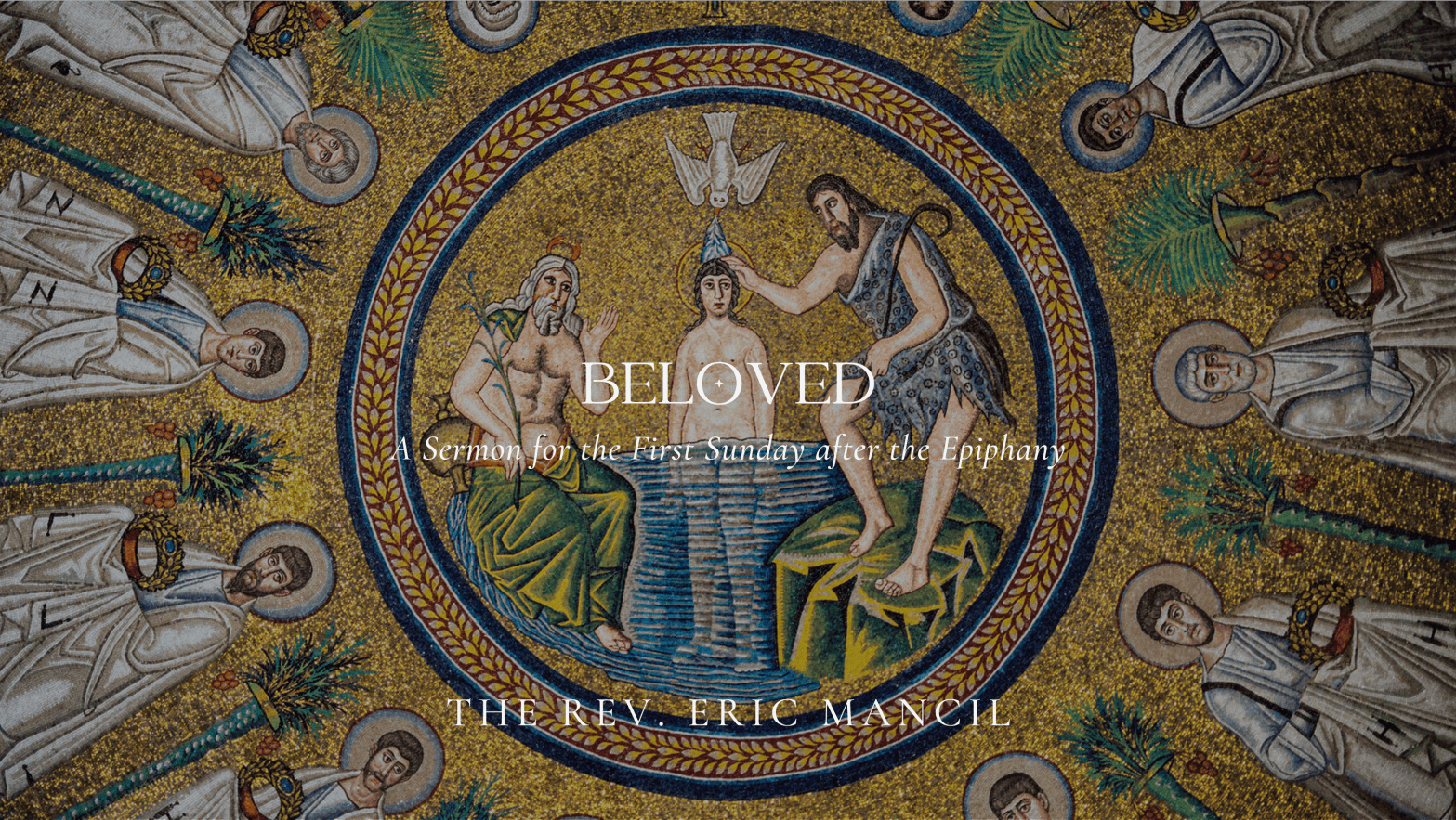
Beloved

A Sermon for the First Sunday after the Epiphany: The Baptism of our Lord
January 12, 2025

Text: Luke 3:15-17, 21-22

Now, O Lord, take my lips, and speak through them. Take our minds, and think through them. Take our hearts, and set them on fire. In the name of the Father, and of the Son, and of the Holy Spirit. Amen.

Many years ago, as I was discerning my call to the priesthood, I started to read a lot of books by different spiritual writers, mostly having to do with theology and what it means to be a priest in the Episcopal Church.

For me, one of the most influential writers was Archbishop Desmond Tutu.

Sadly, the archbishop passed away about three years ago at the age of ninety at his home in Cape Town, but his legacy continues on.

As many of you probably know, Desmond Tutu was an instrumental figure in the struggle to tear down the system of legalized racism in South Africa, known as apartheid, which finally came to an end in the early 1990s.

He was also an advocate for peaceful reconciliation in the years that followed.

Under the leadership of Nelson Mandela, Archbishop Tutu served as the chairman of the Truth and Reconciliation Commission, which was established in order to bring healing to the country and offer a way forward.

He was committed to the idea of restorative justice and believed that the only path to true peace and reconciliation—after decades of violence and oppression under apartheid—was by seeking the truth and offering forgiveness to those who were responsible.

Even though he’s no longer with us, I’m so thankful for the life and ministry of Desmond Tutu and for all he taught us about how to love others and offer mercy in the name of Jesus Christ.

Our former Presiding Bishop, Michael Curry, offered these words shortly after his death: “While on this earth, he sought to follow Jesus of Nazareth in God’s way of love and life. In so doing, he showed us how to live God’s dream as children of the one God and creator of all. So, even in our sorrow that he is no longer walking among us, we can thank God that he did.”

I’ll always remember Desmond Tutu as the first person who taught me, through his writing, that all of us—no matter who we are or what we’ve done or left undone—are completely and unconditionally loved by the God who created us.

We were loved into being and formed in the image and likeness of God.

In his book, Made for Goodness—which he co-authored with his daughter—the archbishop wrote, “From the time before eternity our God has awaited each birth with love and delight.”

“‘Before I formed you in the womb I knew you’ is the word of God to the Hebrew prophet Jeremiah. It is equally God’s word to each of us.”

“Before the ‘Let there be…’ of creation, before God breathed Adam’s first breath, God knew us and God loved us.”

“God loves each of us as though there were no one else in the world, as though there were only one person to love.”

“We are so precious to God that, as Jesus reminds us in the pages of Matthew’s Gospel, ‘even the hairs of your head are all counted.’”

It’s almost unimaginable, isn’t it, that God loves us so perfectly and so completely, without reservation or condition.

Our whole lives, we’ve been taught that, in order to succeed in life and be loved by others, we have to earn it.

We have to do certain things or behave a certain way or change our appearance in order to be loved and accepted by those around us.

But, not with God.

We are God’s beloved, God’s possession—loved from before time and forevermore.

In our lesson this morning from Isaiah, the prophet writes, “Thus says the Lord, he who created you, O Jacob, he who formed you, O Israel: Do not fear, for I have redeemed you; I have called you by name, you are mine.”

In other words, dear friends, God has claimed each of us as his own, and there’s nothing we can do or say that will ever change that.

Today is the First Sunday after the Epiphany, the day when we celebrate the Baptism of our Lord.

On this day, we recall the story of our Lord’s baptism at the River Jordan by John the Baptist.

It’s important that we take time to remember this part of Jesus’ life.

Not only does it signal the beginning of his public ministry, but I think it also helps us better understand the significance of baptism in our own lives and the role it plays in our journey with Christ.

In today’s Gospel reading, soon after Jesus receives the baptism of John, the heavens are opened and the Holy Spirit descends upon him in the form of a dove.

Then, Jesus hears a voice from heaven say to him, “You are my Son, the Beloved; with you I am well pleased.”

One way you could read this part of the lesson is that the voice from heaven is God’s response to what Jesus does when he goes to John for baptism.

After all, the voice from heaven doesn’t call out to Jesus until after he’s baptized.

But, I don’t read it that way.

I don’t see this passage as a response from God, as if God’s love for Jesus somehow depends upon whether or not he’s baptized.

I see it as an acknowledgement—a declaration from heaven—claiming Jesus as God’s own.

I see it as God’s way of saying to Jesus, “I’ve known you and loved you since before time, and I’ll continue to know you and love you forever.”

Jesus’ baptism is an acknowledgement of something that began long before he ever made the choice to be baptized.

We often think of Baptism as something we do in the Church that changes us in some way, and I think that’s true. Baptism is the sacrament of new birth.

In the water of Baptism, we are buried with Christ in his death. By it, we share in his resurrection. Through it, we are reborn by the Holy Spirit.

We are changed in the sense that the old way of sin and death has passed away and a new creation has been raised up.

But, in another sense, we’re the same as we always have been.

Since before time, we were known and loved by God.

Baptism is a way for us to acknowledge our belovedness and make the choice to live more fully into who God created us to be as God’s children.

This is why the liturgy for Baptism includes a series of questions and answers for those who are choosing to be baptized and why we join with them in renewing our own baptismal vows.

The vows and promises we make in baptism help guide us and keep us on track.

They remind us of who we are as the beloved of God.

They remind us, in the words of Desmond Tutu, that we were “made for goodness.”

In just a few moments, we’ll take some time to renew the solemn vows and promises of Holy Baptism.

As you say the words, think about that voice from heaven who spoke to Jesus, saying, “You are my Son, the Beloved; with you I am well pleased.”

That same voice continues to speak to each of us, calling us by name into a deeper and more meaningful relationship with God.

I’d like to close by sharing with you some final words from Desmond Tutu.

These words come from the last two pages of his book, Made for Goodness, and are written from the perspective of God, speaking to his beloved—

You are my child,
My beloved.
With you I am well pleased.
Stand beside me and see yourself,
Borrow my eyes so you can see perfectly.
When you look with my eyes then you will see
That the wrong you have done and the good left undone,
The words you have said that should not have been spoken,
The words you should have spoken but left unsaid,
The hurts you have caused,
The help you’ve not given
Are not the whole of the story of you.
You are not defined by what you did not achieve.
Your worth is not determined by success.
You were priceless before you drew your first breath,
Beautiful before dress or artifice,
Good at the core.

And now is time for unveiling
The goodness that is hidden behind the fear of failing.
You shout down your impulse to kindness in case it is shunned,
You suck in your smile,
You smother your laughter,
You hold back the hand that would help.
You crush your indignation
When you see people wronged or in pain
In case all you can do is not enough,
In case you cannot fix the fault,
In case you cannot soothe the searing,
In case you cannot make it right.
What does it matter if you do not make it right?
What does it matter if your efforts move no mountains?
It matters not at all.
It only matters that you live the truth of you.
It only matters that you push back the veil to let your goodness shine through.
It only matters that you live as I have made you.
It only matters that you are made for me,
Made like me,
Made for goodness.

Amen.

That’s What Christmas is All About, Charlie Brown

A Sermon for the Nativity of our Lord Jesus Christ
Tuesday, December 24, 2024

Text: Luke 2:1-20

Now, O Lord, take my lips, and speak through them. Take our minds, and think through them. Take our hearts, and set them on fire. In the name of the Father, and of the Son, and of the Holy Spirit. Amen.

This time of the year reminds me of my childhood. It reminds me of all the wonderful memories that I have from seasons long past and from growing up in a warm and loving family during the holidays.

It always brings me back to a time in my life when I looked forward to so many exciting things during the days and weeks leading up to Christmas, and now, as a father, I’m thankful that I get to share those same joys with my own children each year.

Things like decorating the Christmas tree with beautiful lights and ornaments, putting up Christmas decorations around the house, and getting to watch all of my favorite, must-see Christmas specials and movies on television.

In our family, we like to play a little game each year around Christmas time where we go around the dinner table and tell each other what our favorite Christmas movie is.

And, every year, when it’s my turn to answer, everyone already knows what I’m going to say. “My favorite Christmas movie has to be A Charlie Brown Christmas.”

Now, I know it’s technically not a movie. It has a total run-time of about twenty-five minutes. But, it’s my answer, and I’m sticking to it.

To me, it just isn’t Christmas until I hear those beautiful, jazz arrangements of some of my favorite Christmas songs and watch the story unfold as Charlie Brown seeks to discover the true meaning of Christmas while he and his friends work to prepare for the local Christmas play.

A Charlie Brown Christmas premiered on December 9, 1965, and it was the first animated special featuring characters from the Peanuts comic strip.

It’ll celebrate its sixtieth anniversary next December, and it continues to be a meaningful tradition during the holidays for so many people.

At the beginning of the story, Charlie Brown tells his friends that he’s sad and depressed and that he just doesn’t understand the meaning of Christmas.

He knows that the expectation for Christmastime is joy and happiness, but he also knows that there has to be something more to Christmas than fancy decorations and extravagant gifts, the things in which all of his friends—including his pal, Snoopy—are most excited about.

Charlie Brown’s friends just don’t understand why he’s so upset.

At one point, his best friend Linus says to him, “Charlie Brown, of all the Charlie Browns in the world, you are the ‘Charlie Browniest’.”

Later in the story, Charlie Brown and Linus are assigned the important task of finding the perfect Christmas tree for the Christmas play.

When they arrive at the Christmas tree lot, they’re overwhelmed with a multitude of bright and colorful choices, but ultimately, Charlie Brown chooses a sad, little evergreen with only a few needles hanging from the branches.

Linus says to him, “I don’t know, Charlie Brown. It doesn’t seem to fit the modern spirit.”

Charlie Brown replies, “We’ll decorate it, and it will be just right for our Christmas play. Besides, I think it needs me.”

When Charlie Brown and Linus return to the auditorium to show their friends the new Christmas tree, Charlie Brown is teased and called names for choosing the sad, little tree.

Instead of choosing the biggest and brightest tree, he chose the smallest and most vulnerable, the tree that nobody else wanted, the one that needed the most care.

In that moment, after being teased by his friends, Charlie Brown is ready to give up on Christmas altogether. He says, “Everything I do turns into a disaster. I guess I really don’t know what Christmas is all about.”

Then, he asks, “Isn’t there anyone who knows what Christmas is all about?”

And, this is when it gets really good.

Standing beside him, his friend, Linus, replies, “Sure, Charlie Brown. I can tell you what Christmas is all about.”

Linus walks to the center of the stage, holding his trusty blanket.

The lights in the auditorium dim, and under a single spotlight, he recites a portion of the Nativity story from the Gospel according to Luke, the same Gospel lesson we heard just a few moments ago.

Quoting from the King James version of the Bible, Linus says…

“And there were in the same country shepherds abiding in the field, keeping watch over their flock by night. And, lo, the angel of the Lord came upon them, and the glory of the Lord shone round about them: and they were sore afraid. And the angel said unto them, ‘Fear not: for, behold, I bring you good tidings of great joy, which shall be to all people. For unto you is born this day in the city of David a Saviour, which is Christ the Lord. And this shall be a sign unto you; Ye shall find the babe wrapped in swaddling clothes, lying in a manger.’ And suddenly there was with the angel a multitude of the heavenly host praising God, and saying, Glory to God in the highest, and on earth peace, good will toward men.”

It’s my favorite part of the whole thing.

If you watch this scene closely, you’ll notice that Linus does something unexpected.

When he says the words, “Fear not,” he drops his blanket to the ground.

Then, after the monologue is over, Linus picks up his blanket, walks back over to his friend, and says, “That’s what Christmas is all about, Charlie Brown.”

I love the symbolism of Linus dropping his blanket in the middle of the monologue.

Because, If you know anything about Linus, you know that he never goes anywhere without his trusty blanket.

It’s his most prized possession, his source of comfort and safety.

For Linus to drop his blanket as he’s reciting the story of Jesus’ birth is to send a message that Christmas is about more than presents under the tree and fancy decorations.

It’s about love overcoming fear and light overcoming the darkness.

You may not know this, but the decision to include this scene in A Charlie Brown Christmas was pretty controversial when it was written back in 1965.

The producers of the special suggested that it was too religious for national television, but Charles Schulz, the creator of the Peanuts comic strip, insisted that it be included.

In an early conversation about the scene, the producers told Schulz, “It’s very dangerous for us to start talking about religion now.”

Schulz simply responded, “If we don’t, who will?”

I think this is why A Charlie Brown Christmas is my all-time favorite.

Because it’s a little dangerous.

It takes risks and refuses to “play it safe” at a time when it would be much easier to simply tell a sweet, innocent Christmas story with no mention of Jesus whatsoever.

A Charlie Brown Christmas is bold and unexpected in its proclamation of the Gospel

While Charlie Brown and most of his friends are worried about things like presents and putting on the perfect Christmas play and finding the perfect Christmas tree, the character of Linus once again reminds us of why we celebrate this day in the first place.

You might say that, through Linus, God breaks into the story unexpectedly, similar to how he breaks into our own story of salvation—unexpectedly, being born of a human mother and living as one of us, fragile and vulnerable.

The story of Jesus’ birth is about God breaking into our story at a particular time and place in history in order to redeem us and lead us to the truth so that we may live the full and joyful lives that God intends for us.

It’s about God’s unending love for us and our call, as Christians, to share that love with the world.

It’s a timeless story that’s been handed down from generation to generation and one that continues with you and me, as members of the Body of Christ.

This was part of my children’s homily at the 3:00 service earlier today.

I reminded the children that Christmas isn’t just about something that happened a long time ago in a land far away from here.

It’s also a celebration of Jesus being born in each of us.

No matter where we go, we carry the light of Christ with us.

In every act of love and compassion, every time we share the story of God’s love with the world, Jesus is born anew.

So, as we celebrate the birth of the Christ-child on this Christmas Eve night, let us remember that, like Mary, we are called by God to carry Jesus with us and to be bearers of the Good News.

Let us remember that we are the hands and feet of Christ and that, through us, Jesus continues to be born and made known to the world.

Love itself has broken into our story so that we may learn a new way to live and serve as instruments of God’s love and compassion.

Let us be unafraid and unapologetic in our proclamation of the Gospel. In the words of Charles Schulz, “If we don’t, who will?” Amen.

A Tapestry of Lives

A Meditation for the Service for the Longest Night
Thursday, December 19, 2024

One of my favorite holiday traditions is receiving Christmas cards in the mail from friends and family.

I look forward to it every year, and I save every card we receive so that I can hold on to those memories.

It means a lot to me that someone would take the time to send a card and maybe even a brief message, letting us know how they’re doing and updating us with any major life changes that have happened recently.

Some of the cards we receive each year come from people we haven’t seen or even talked to in a very long time.

What’s nice about receiving a Christmas card is knowing that, even if we haven’t spoken much or seen each other in a while, we’re still a part of each other’s lives.

Last week, I received a card in the mail from two people who’ve meant a great deal to me and my family over the years—Father Wells, a retired Episcopal priest, and his wife, Leigh.

They live in Auburn, and unfortunately, we don’t get to see them very much.

But, we love them both dearly, and they’ll always hold a special place in our hearts.

When I opened the card they sent last week, I also found a letter they had written, and in their letter, they included some updates about their family, mostly about children and grandchildren and what they’ve been up to lately.

Names and ages, interests, hobbies, job changes…things like that.

And, on the other side of the letter, there was a poem, written by Leigh.

I read it to myself, and as soon as I had finished reading it, I knew that I had to share it with you tonight because I think it speaks so beautifully to the tone and purpose of this evening and why we set aside time during this week before Christmas to offer prayers—for ourselves and for others—who find this time of the year to be especially difficult and who may be looking for a little bit of light—or a glimmer of hope—in the midst of the darkness.

So, I sent a message to Leigh and asked her if it would be okay if I shared her poem with you tonight, and she said she would be honored.

I want to share it with you now.

And, I invite you to listen carefully to the words.

As you do, I pray they’ll give you a sense of peace in this season of the year that can often feel anything but peaceful.

As you listen to the words, maybe you’ll begin to ponder in your heart where God is leading you to go and how God is working to bring healing and wholeness to your life.

This poem is entitled, “Under the Christmas Star,” by Leigh Warren.


In the glow of festive lights, so warm and bright.
Amidst the quiet whispers of a winter’s night,
We find time for renewal, a gentle restart,
To mend our spirits and heal the heart.

For self-care is a gift we often neglect,
A promise to us, a bond to protect.
In the stillness of December, with snowflakes in the air,
We learn to embrace and tenderly care.

Divorce, a painful word, a story untold,
Of hearts once entwined, now separate and cold.
Yet in this season, there’s a glimmer of grace,
A chance to rebuild, to find a new place.

Teenagers growing, in the cusp of dreams,
Navigating life, with all its extremes.
Christmas brings hope, and lessons anew,
Guiding their steps as they learn and pursue.

Under the Christmas star, we gather and find,
A tapestry of lives, uniquely entwined.
In renewal, in self-care, in journeys apart,
We celebrate love, the soul of the heart.


When I read Leigh’s poem for the first time, what immediately caught my attention was one of the last lines she wrote:

“A tapestry of lives, uniquely entwined.”

It reminded me of the fact that, at any given moment, we’re all dealing with different struggles and different circumstances in our lives.

For many of us, Christmas is a time of great joy and celebration, and for others, this time of the year stirs up painful memories and reminders of things lost.

“A tapestry of lives, uniquely entwined.”

Some of us are busy decorating our homes for the holidays, planning parties, wrapping presents, and eagerly awaiting Christmas Day.

While others of us are just trying to survive the holidays and do our best to make it to the new year.

Whether we like it or not, Christmas comes around each year and meets us where we are.

Maybe we’ve had the best year we’ve had in a long time. Or, maybe we’re suffering due to the loss of a close friend or family member.

Maybe we’re celebrating a promotion or successful year at work. Or, maybe we’ve recently lost our job and we’re uncertain about what the future may hold.

Maybe we’re closer than ever with our spouse or significant other. Or, maybe we’re grieving over a failed marriage or fractured relationship that’s beyond repair.

Maybe we have exciting plans to celebrate the holidays with friends and family. Or, maybe we’re alone and the thought of celebrating Christmas this year makes us feel even lonelier.

No matter where you find yourself this Christmas, dear friends, know that you aren’t alone. 

Christmas will find you where you are, whether that’s in a good place or in a place where you’d rather not be.

But, no matter where you are, be comforted in knowing that you are loved and that, through Jesus, you’re never alone.

That’s the promise of Christmas.

God has come to dwell with us so that we never have to be alone again. The light has overcome the darkness, and even now, God is working to breathe into us new life.

Amen.

Joy in God’s Kingdom

A Sermon for the Third Sunday of Advent (Year C)
December 15, 2024

Text: Luke 3:7-18

Now, O Lord, take my lips, and speak through them. Take our minds, and think through them. Take our hearts, and set them on fire. In the name of the Father, and of the Son, and of the Holy Spirit. Amen.

This past Wednesday night, we had some unexpected visitors show up to church during our Advent supper and program. We were gathered in the Parish Hall where we had just finished eating our supper, and not longer after I began the program, I looked over my shoulder and noticed someone I had never seen before quietly come inside.

It was a young, Latino man who appeared to be no older than twenty-five.

He had a friendly smile on his face, and I could tell that he was looking for someone to talk to.

So, I stopped what I was doing, got up from my chair, and walked over to greet the man.

By the time I got to the front doors, there were more visitors.

A young woman, probably in her early twenties, carrying a small child who was wrapped up in a blanket, and three other young children who were probably anywhere from four to ten years old.

I asked the man, “How can we help you?”

He spoke very little English.

So, he used his phone to communicate with me.

He typed some words into a translator and showed me the message.

“Can you help us with some food and gas and a hotel room?”

My immediate thought was that this poor family has nowhere to go.

It’s 7:00 at night.

It’s freezing cold outside, and they have nothing.

So, I quickly scrambled and tried to come up with some ways to help.

I couldn’t give them food from the food pantry because they would have no way to cook it, even if they had a hotel room.

But, thankfully, we had some pizza left over from dinner. So, we packed up all the leftovers we had and gave it to them.

It wasn’t much, but at least it was something.

I couldn’t give them a check from my discretionary account because they would have no way to cash it.

But, thankfully, we had some money in the church office we had collected from the Holiday Jubilee last Saturday. So, I gave them enough to help with a hotel room and some gas for their car.

It wasn’t much, but at least it was something.

As they left, they were very grateful.

“God bless you,” they said, and “Merry Christmas.”

And they went on their way.

Later on that night, after the program was over and I had returned home for the evening, my mind drifted to that young family.

“Where did they end up?”

“Did they find a warm place to sleep for the night?”

I prayed that they would be okay.

And, I couldn’t help but think about my own life and circumstances and the fact that my family and I have so much to be thankful for.

We’ve never known what it feels like to be desperate for food.

We’ve never known what it feels like to be desperate for a warm place to sleep at night.

And, as a father, I’ve never known what it feels like to wonder if I’ll be able to provide basic necessities for my family.

The things I complain about not having are so trivial compared to what so many people live with on a daily basis.

It was a truly humbling experience.

And, I’m so thankful that our church was able to serve that young family in the way we did.

We were able to be the hands and feet of Christ for them.

And, they were able to be the hands and feet of Christ for us as well, reminding us in that moment that our call is to love and serve Christ in all persons, loving our neighbors as ourselves.


In my years as a priest, I’ve found that it’s very easy to become cynical when it comes to helping people in need.

I think it’s something we all struggle with, to be honest.

We encounter someone asking for help, and we immediately think to ourselves, “Do they really need help? Or, are they just looking for a handout?

And, what if they take the money I give them and go and use it do buy something they don’t really need?

People come to the church office almost daily asking for money to help with gas to get to a doctor’s visit or money to help pay the power bill that’s past due or money for a hotel room.

And, so the temptation I have to resist—and it’s really hard to resist at times—is to ask myself whether or not they really need to be helped.

Because, in most cases, there’s no way to know for sure.

And, to be honest, I’m not sure it’s our job to ask.

Maybe it’s our job to simply do what we can to help—trusting that God will see our good deeds of love and compassion as an act of faithfulness.

That’s not to say that we should allow ourselves to be taken advantage of or knowingly give money to someone who’s going to use it for the wrong reasons.

But, it is to say that sometimes, we have to take a leap of faith and trust that what we have to give will be used by God to fulfill his purposes.

The Christian mystic and author, Thomas Merton, said it this way: “Our job is to love others without stopping to inquire whether or not they are worthy. That is not our business and, in fact, it is nobody’s business. What we are asked to do is to love, and this love itself will render both ourselves and our neighbors worthy.”

I think what Thomas Merton was trying to say is that acts of love and compassion have the power to transform lives—not only the lives of those who receive that love but also the lives of those who share it.

Actually, I think it’s even more so for those who share it.

They say it’s better to give than to receive, and I believe that’s absolutely true.

Because something happens to us over time when we let go of the need to care only for ourselves and focus more of our energy and time on giving to others—especially those in need.

And the best word I can think of to describe it is joy.

There’s joy in living a life of service to others.

There’s joy in not needing to stop and wonder whether or not someone is worthy of God’s love.

There’s joy in knowing that God is able to use us as instruments of his love and compassion in the world, even in the smallest ways.


In my sermon last week, I talked a lot about the ministry of John the Baptist and his message of repentance.

I also talked about some common understandings we have about the word, “repentance.”

A lot of times, we think it means, “feeling bad for doing bad things” or needing to turn back toward God when we’ve lost our way.

And, while these can certainly be helpful understandings of the word, the actual meaning of “repentance” is to change one’s mind or point of view.

True repentance is less about feeling guilty about the things we’ve done or left undone and more about opening our minds to new ways of thinking.

Our Gospel lesson for this week is a direct continuation of our lesson from last week about John the Baptist and this crowd who comes to him for baptism.

His message to them is a call to repentance.

It’s a call to prepare a place for the one who is coming after him, a call to amend their lives and to open their minds to new ways of being in the world.

The people ask John, “What then must we do?”

“How do we bear fruits worthy of repentance?”

Or, an even better way of saying it might be this:

“How do we live as God is calling us to live?”

John doesn’t mix words.

In fact, he doesn’t hesitate in telling the people exactly what they need to do.

“If you have two coats, give one away.”

“Do the same with your food.”

To the tax collectors who came to be baptized and asked what they should do, he said, “No more extorting the people for more than they owe. Collect only what is required by law.”

To the Roman soldiers who came for baptism and asked what they should do, he said, “No more shakedowns. No more blackmail. And be content with your rations.”

John’s answer is simple.

Don’t be selfish.

Be fair and just.

Take care of one another, and do good.

As I was reading our lesson for today, one thing really stood out for me that I’ve never noticed before about these particular instructions John gives to the people when they ask him what they should do in order to bear fruit worthy of repentance.

Every single one of them is about how we’re called to treat other people.

We tend to think of repentance as turning away from things we consider sinful, as if it has nothing to do with anyone else.

But, John has other ideas.

John teaches us that, in order to bear fruit worthy of repentance—in order to live as God has intended us to live—we have to focus our lives on other people and the way we treat them.

It isn’t easy.

The easy thing to do is to focus only on ourselves.

But God, in God’s wisdom, has shown us the way to experience true joy and peace in our lives.

It can’t be bought or earned or received.

It can only be found in giving.

This is how we really celebrate Christmas.

This is how we prepare to welcome the Christ-child into our midst, by giving of ourselves and recommitting our lives to the work that God has called us to do.

Amen.

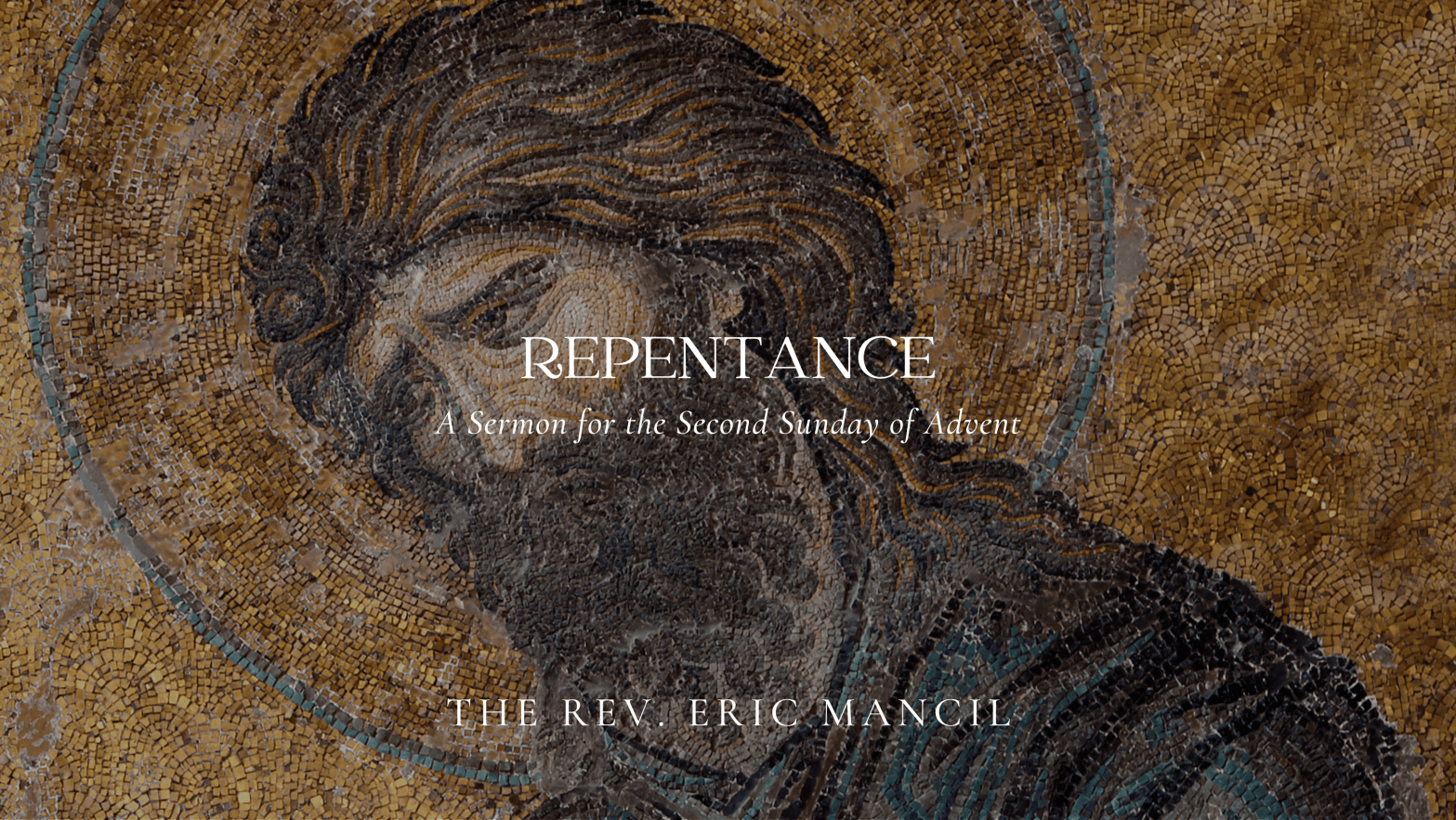
Repentance

A Sermon for the Second Sunday of Advent (Year C)
December 8, 2024

Text: Luke 3:1-6

Now, O Lord, take my lips, and speak through them. Take our minds, and think through them. Take our hearts, and set them on fire. In the name of the Father, and of the Son, and of the Holy Spirit. Amen.

One of the things I love most about the season of Advent is that we get to sing so many beautiful hymns each week. Some of my favorite hymns that we sing come from the Advent section of the hymnal.

This is one of the reasons why I decided that our Wednesday night Advent program for this year would focus on music.

And, before I continue on, I want to say that we had a wonderful time this past Wednesday, and I want to encourage you to come this Wednesday night, even if you weren’t able to make it last week.

We’d love to have you join us.

The hymns and carols of Advent have a lot to teach us about the significance of this season and why we spend four weeks preparing for the birth of our Savior and looking ahead to his return.

The popular Advent hymn, “O come, O come, Emmanuel,” for example, speaks to the expectancy of the one who will come to dwell with us, the one who is Emmanuel—“God with us.”

Or, my absolute favorite Advent hymn, “Lo! he comes, with clouds descending,” the eighteenth-century hymn by Charles Wesley, which looks beyond our present time to the second coming of Jesus at the end of the age.

There are so many others—hymns like “Comfort, comfort ye my people,” drawing from the prophecy of Isaiah, and “Prepare the way, O Zion,” which we sang just a few minutes ago.

We can learn a lot about the season of Advent and its significance simply by turning to the hymnal, by reading the words and singing the marvelous hymns that our tradition has to offer.

Many of these were featured last Sunday night in our service of Advent Lessons and Carols, which was put together by John Beasley and our choir. If you weren’t able to make it, you really missed out.

It was a beautiful service!

Another one of my favorite Advent hymns is “On Jordan’s bank the Baptist’s cry,” which we’ll sing later this morning at the end of the service.

It begins with the words, “On Jordan’s bank the Baptist’s cry announces that the Lord is nigh; awake and hearken, for he brings glad tidings of the King of kings.”

Did you know that this is one of the only hymns in our hymnal related to the life and ministry of John the Baptist? 

If you don’t believe me, open up a hymnal, and thumb through the Advent hymns.

There aren’t many at all related to John the Baptist, and it makes me wonder why that is—especially since John is such a central figure during the season of Advent.

Maybe the editors of the hymnal didn’t think it was necessary to include more than a couple of hymns about John.

Or, maybe his message of repentance make us all a little uncomfortable?

In today’s lesson from the Gospel of Luke, we encounter John the Baptist, who appears in the wilderness around the Jordan River and offers the people of Judea a baptism of repentance for the forgiveness of their sins.

His message to the people who have gathered is not a message of comfort or one that we would normally describe as “good news.”

He isn’t there to console them or to make them feel better about themselves.

His purpose is to prepare the way for Jesus, and he does this by proclaiming to the people that preparation begins with repentance.

He’s there to let the people know that the Savior they’ve been waiting for is coming into the world, and they need to be ready.

Repentance isn’t a word that we normally hear around this time of the year, is it?

No, during the days and weeks leading up to Christmas, our lives are typically consumed with making plans for the holidays.

We have Christmas parties to attend, gifts to wrap, and Christmas decorations to put up around the house—things that most of us consider to be fun and exciting!

We usually save words like “repentance” for the season of Lent as we prepare for Holy Week and Easter.

So, what place does repentance have during this season, and what does the message of John the Baptist have to teach us on this Second Sunday of Advent?

We know that John’s message must be an important part of the season because it shows up every year in our Sunday readings.

Whether we’re in Matthew, Mark, or Luke, John the Baptist shows up with his message of repentance, and in each version of the story, he says basically the same thing to the people who come to him for baptism.

“Repent, for the kingdom of heaven has drawn near. I am not the Messiah. I baptize you with water, but one who is coming who will baptize you with fire and the Holy Spirit.”

John’s message of repentance continues to speak to us today as we prepare, not only for our celebration of Christmas, but also as we look ahead to the day when Christ will come again.

As one author writes, “John demands that we get ready for Jesus.”

“Before we can bask in Christmas joy and the birth of a special baby, John forces us to examine ourselves and our world.”

If the season of Advent is meant to prepare us for the coming of Jesus, then it’s important for us to think about what repentance actually means because there’s a lot of misunderstanding when it comes to that word.

We often look at repentance in a negative way, don’t we?

We consider it a form of punishment or something we should try to avoid at all costs.

We think that, if you’re at a point in your life when you need to repent, then you must have done something pretty bad.

When many of us hear that word, we imagine street-corner preachers standing on their soapboxes, spewing angry messages at people as they walk by.

But, I want to suggest to you that repentance doesn’t have to be seen as something negative, and it doesn’t have to be seen as a form of punishment for doing something wrong.

And, this is important, because when we think of repentance as punishment, it’s easy for us to be overwhelmed with feelings of guilt and shame.

But, that’s not what God wants for us.

What God wants is for us to love others and to know that we’re loved, also.

I don’t believe God would call us to repent if it was meant to harm us or cause us to doubt our own self-worth.

When we read about John’s message of repentance and we hear the call of the prophets of the Hebrew Scriptures, we’re reminded of who we are as children of God and given an opportunity to return to the God who loves us more than we can possibly imagine.

Several years ago, just before our family moved from Texas back home to Alabama, I had the opportunity to attend my final convention in the Diocese of Northwest Texas.

The Bishop of the diocese delivered a thoughtful and inspiring message to those of us who were there.

During his address, he reminded me of something about repentance that I had once heard.

He said that we typically have two understandings of the word, “repent.”

In our culture, we tend to think of repentance as “feeling bad for doing bad things.”

And, in the Church, we tend to think that repentance is a call to conversion or a call to return to the Lord.

He told us that, while both of these understandings can be helpful, the actual meaning of the word, “repent,” in the original Greek means “to go beyond the mind” or to change one’s point of view.

The Bishop reminded us at the convention that Jesus uses parables and stories in his teaching that encourage us to go beyond the way we typically think or “to go beyond the mind” so that we can better understand what God is calling us to do in our lives.

But, how exactly do we do that?

How do we “go beyond the mind” and begin to change the way we think?

In his address, the Bishop suggested that we might begin by thinking about how we’re all connected.

He told us that, when we think about Jesus’ commandment to his disciples to “love your neighbor as yourself,” he’s not actually telling us to love our neighbors as much as ourselves but to love our neighbors as an extension of ourselves.

That’s what it means to “go beyond the mind” and into the mind of Christ.

To remember that we’re all connected and that we were created—not to care only for ourselves—but to love and serve each other.

When we think about repentance in this way, as a way of remembering that we’re all connected and called to love one another as an extension of ourselves, we can start to develop a much more helpful understanding of what repentance actually is.

It’s not something we should feel guilty about or something we should try to avoid doing at all costs.

When we recognize our need for it and allow ourselves to experience it, repentance can actually draw us into a deeper and more loving relationship with each other and with God.

So, as we continue to move through this Advent season and prepare for Christmas, let us remember the true meaning of the word “repentance,” and let us hold firmly to the message of John the Baptist and the prophets, who call us not to feel guilty about what we’ve done or left undone but to remember who we are and who we were created to be.

Amen.

Expect the Unexpected

A Sermon for the First Sunday of Advent (Year C)
December 1, 2024

Text: Luke 21:25-36

Now, O Lord, take my lips, and speak through them. Take our minds, and think through them. Take our hearts, and set them on fire. In the name of the Father, and of the Son, and of the Holy Spirit. Amen.

There’s a lesson that my father once taught me at a young age. In fact, he started drilling this lesson into my head right around the age of fifteen, when I first started learning how to drive a car.

Every time I went with him to practice driving, I would get into the driver’s seat, and he would get into the passenger’s seat.

And, once I backed out of the driveway and started driving, he would always tell me, “Eric, you have to always expect the unexpected.”

Of course, being a fifteen year old at the time, I didn’t pay much attention to what he said, and there might’ve been some occasional eye rolling going on.

But, every time we went driving together, he would always say the same thing, and to this day, he still says it from time to time.

“You have to always expect the unexpected.”

What I think he meant by that was that I always needed to be alert and on the lookout for sign of trouble because terrible things could happen behind the wheel of a car in a matter of seconds.

My father always told me that it wasn’t me that he was worried about.

It was other people—distracted drivers on the road—who may not see me coming or who may be too focused on other things when they should have their complete attention focused on driving.

I still remember my father’s lesson from when I was fifteen, and while I’ve certainly made my fair share of mistakes behind the wheel of a car, his lesson has stayed with me all these years.

I still do my best to “expect the unexpected,” knowing that my life and the lives of those around me could drastically change in a moment’s notice.

In the blink of an eye, life as we know it can change.

Sometimes these changes are good for us, and sometimes they’re not so good.

Sometimes, what we thought we knew about something—or someone—turns out to be completely wrong, and we’re caught off guard.

Sometimes, unexpected things happen to us, and we don’t know what do or how to move forward.

So, the wisdom of the phrase “expect the unexpected” can help us prepare for those moments when it feels like everything has changed and we have no control over what’s happening.

Over the years, I’ve come to understand how the wisdom of the phrase “expect the unexpected” can also be used in our relationship with God.

I think about my own life and the things that have happened to me and my family over the years, things that I never imagined or thought possible.

There are moments and experiences that I can point to and say with absolute certainty that the only explanation for them happening was because of God.

I think about my call to the priesthood and deciding one day that God was calling me and my family to go to seminary, to pick up and move nine hundred miles away from our home in south Alabama to northern Virginia.

In my experience, I’ve discovered that, when God calls us, it often happens in ways that are unexpected and beyond our understanding.

I also think about those moments in the Scriptures when God calls the most unlikely people to serve in the most extraordinary ways.

The Old Testament is filled with good examples—people like Moses, who wasn’t the natural-born leader you’d expect God to choose. But despite his limitations and mistakes, God called him to set his people free and lead them out of slavery in Egypt into the land of promise.

The New Testament is also filled with good examples of how God chooses the most unlikely people to serve in the most remarkable ways.

Some of them we encounter early on in the Gospels, in the story of Jesus’ birth.

People like Elizabeth, the mother of John the Baptist, who’s told that she will bear and give birth to a son, even at her old age.

And her much younger relative, Mary, who is visited by the angel Gabriel and told that she will bear and give birth to the Son of God.

The Scriptures, especially the ones we hear during the seasons of Advent and Christmas, are filled with examples of why we should always “expect the unexpected” when it comes to God and God’s plan for salvation.

In fact, if I could assign a tagline to the season of Advent, it would be “expect the unexpected.”

Expect that God is doing a new thing.

Expect that, even now, God is working to make all things new.

This was true two thousand years ago in a small town called Bethlehem.

And, it’s true for us today as well as we await the return of Christ.

God came into the world in this amazing, unexpected way by sending his only Son to be born of a human mother, to live and die as one of us, and to show us the way to everlasting life and peace with God.

Despite everything that could’ve gone wrong—despite the fear and uncertainty that Mary and Joseph likely felt in the days and weeks leading up to the birth of Jesus—despite all the odds stacked against them—nothing could stop the light from coming into the world.

Love came down from heaven on that first Christmas Day, and the world has been changed forever.

The seasons of Advent and Christmas invite us to contemplate the miracle of Christ’s birth, but these seasons of the Church year aren’t just about a single event that took place centuries ago.

They’re also about what God in Christ is doing now—in our own time and place—and what God is preparing us for in the future.

This is the reason why our Gospel lesson for this morning—on this First Sunday of Advent—looks ahead to the final coming of Christ.

Jesus is warning his disciples to stay alert—to keep awake and be prepared for the day of his return.

He tells them, “There will be signs in the sun, the moon, and the stars, and on the earth distress among nations confused by the roaring of the sea and the waves.

People will faint from fear and foreboding of what is coming upon the world, for the powers of the heavens will be shaken. Then they will see ‘the Son of Man coming in a cloud’ with power and great glory.”

From the description Jesus gives us, it sounds like something we should be afraid of, doesn’t it?

The picture Jesus paints doesn’t exactly stir comforting thoughts or emotions.

It sounds terrifying, to be honest.

Like, we want Jesus to come back, but maybe not too soon.

But, I don’t think Jesus said these things to scare us.

I think it was a wake-up call.

I think it was his way of saying to the disciples—and to us—that one day, everything as we know it now will fade away, and we need to be ready.

The Son of Man will return and finally bring to fulfillment God’s reign of peace on the earth.

The old heaven and the old earth will pass away, and a new creation will be born.

And, until that day comes, it’s our call, as Christians, to help make God’s Kingdom a reality.

So, our Gospel lesson this morning from Luke shouldn’t be read as a message of fear.

It’s actually a message of hope—hope that, one day, God’s plan of redemption will finally be fulfilled.

Jesus says it like this: “Now when these things begin to take place, stand up and raise your heads, because your redemption is drawing near.”

St. Bernard of Clairvaux, a French theologian and Benedictine monk who lived during the eleventh century, once wrote that there are actually three advents—or three comings of Christ.

In the first Advent, Christ came to us as a helpless child, born of a human mother, to usher in the Kingdom of God and to bring salvation to the world.

In the third and final Advent, Christ will come again and will bring to fulfillment God’s Kingdom. He will judge both the living and the dead, and his kingdom will have no end.

The second Advent of Christ is where we find ourselves now, in our own day and time and in every moment of our lives. Christ is present with us wherever we go, and we see Christ in every person we encounter.

If Bernard is right—and I like to think that he is—then we’re living in between the first and third Advents of Christ.

Our lives are the middle part—the second coming of Christ.

We have the ability, through our words and actions, to make the love of Christ present— here and now.

We have the ability to be the hands and feet of Christ in the world around us—to bring light to where there’s darkness—to bring hope where there’s despair.

And so, as we begin the season of Advent, let us draw close to Jesus and consider what God would have us do with the lives we’ve been given.

Because you never know where God will call us to go next.

But, we can trust that, wherever we’re called to go, God will be with us, and God will use us to help bring to fulfillment his plan of redemption.

Expect the unexpected.

Expect that God is doing a new thing.

Expect that, even now, God is working to make all things new.

Amen.

Citizens of God’s Kingdom

A Sermon for the Last Sunday after Pentecost (Proper 29, Year B)
The Baptism of Palmer Wrenn Spivey
November 24, 2024

Text: John 18:33-37

Now, O Lord, take my lips, and speak through them. Take our minds, and think through them. Take our hearts, and set them on fire. In the name of the Father, and of the Son, and of the Holy Spirit. Amen.

Last Wednesday, I attended an ordination at the Episcopal Church of the Nativity in Dothan, Alabama. Our good friend, Pam Christian, was being ordained as the newest priest in the Episcopal Church.

It was a beautiful ceremony.

The Bishop was there, of course, leading the service, and there were other clergy from around the diocese there as well, supporting Pam in her new role as a priest.

The music was absolutely stunning.

The choir sounded like angels from heaven.

And, of course, the part of the service where the Bishop laid his hands on Pam and prayed for the Holy Spirit to make her a priest in Christ’s Church was incredibly moving.

That part of the service always reminds me of my own ordination and the vows I took as a new priest almost ten years ago.

But, there was one other part of the service that really stood out to me, and it’s been on my mind ever since.

At the beginning of the service, there was an older member of the parish who got up to read the first lesson from the Book of Isaiah.

She had short, white hair.

She looked to be in her late seventies or early eighties, and she had to walk with a cane in order to make it up the steps to the lectern at the front of the church.

For a person her age, I expected her reading voice to be soft and maybe a little hard to understand.

But, that’s not at all what happened.

Instead, she made her way to the lectern, introduced the lesson like we normally do in church, and proceeded to deliver one of the the most animated and enthusiastic readings from Scripture that I’ve ever heard.

She read Isaiah 6:1-8, which is one of the customary readings appointed for an ordination.

This is the part where the prophet Isaiah describes his glorious vision of God sitting on a throne in the Temple, with six-winged seraphs flying high above him.

It sounded sort of like this:

“In the year that King Uzziah died, I saw the Lord sitting on a throne, high and lofty; and the hem of his robe filled the temple. Seraphs were in attendance above him; each had six wings: with two they covered their faces, and with two they covered their feet, and with two they flew. And one called to another and said:

‘Holy, holy, holy is the Lord of hosts;
the whole earth is full of his glory.’

The pivots on the thresholds shook at the voices of those who called, and the house filled with smoke. And I said: ‘Woe is me! I am lost, for I am a man of unclean lips, and I live among a people of unclean lips; yet my eyes have seen the King, the Lord of hosts!’

Then one of the seraphs flew to me, holding a live coal that had been taken from the altar with a pair of tongs. The seraph touched my mouth with it and said: ‘Now that this has touched your lips, your guilt has departed and your sin is blotted out.’

Then I heard the voice of the Lord saying, ‘Whom shall I send, and who will go for us?’”

And this is the part that really stood out for me—the very last line of the passage.

The woman read, with all the eagerness she could possibly muster—“Here I am! Send me!”

I couldn’t help but smile and be moved by the woman’s reading.

It was almost as if those were her words that she was reading at the end of the passage.

And you could tell that, without a doubt, she meant every single word.

This reading was personal.

She was called by God to serve, and her answer was, “Here I am! Send me!”

She didn’t preach a sermon that evening, but she might as well have.

Because I doubt there was a single person in the church that night that wasn’t inspired by her enthusiasm and deep love for God.

It made me wonder for a moment what kind of life this woman must have lived.

What inspired her to read that passage from Isaiah in such a Spirit-filled way?

Had she been baptized from a young age and raised up in the church?

Had she been taught to love and read the Scriptures as a young child.

Had she been brought up in a church family and supported by her parents and fellow Christians who taught her how to live as a follower of Jesus?

Had she spent her entire life devoted to the work of God, in her church and community?

Or, was she a new Christian and still on fire for God in such a way that only a new Christian can be?

I wanted to share this story with you because I think it’s a good example of how all of us—no matter who we are or where we come from—are called by God to live our lives in such a way that we inspire others with our love for God and our commitment to the Gospel of Jesus Christ.

We may not be called to inspire others through our public reading of Scripture, like the woman did last week at the ordination.

But, God calls each of us to serve in our own way and to be an example of his love in the world around us.

What we do with our lives—as individuals and as a church—really does matter.

It may not always feel like it.

Sometimes, it may feel like we’re wasting our time or not making a very big impact at all, but the things we do and say and the decisions we make—no matter how small—have the power to change peoples’ lives in ways that we may never know.

As Christians, what we do and say and the decisions we make matter to God.

Because, no matter where we go in our lives, God has the power to work through us and use us as instruments of his love and mercy.

All we have to do is be willing to show up for Jesus and then get out of the way.

God, working in us through the power of the Holy Spirit, will take care of the rest.

I see it all the time, not only in my ministry as a priest, but also in the work that goes on here in our parish.

I see it each month at Laundry Love and our Rice and Beans Ministry.

I see it in our Thanksgiving and Christmas dinners, which we’re getting ready to do again this year.

I see it in all the volunteers who’ve shown up over the past few weeks to make sausage rolls for our Holiday Jubilee.

We do so much as a church, but we don’t do it for ourselves.

We do it because of our love for God and because it’s what God calls us to do.

People tell me all the time how amazing it is that we do so much for our community.

But, then I stop and think to myself, “What else would God have us do? It’s what we’re here for!”

It’s what we were created for.

We’re here to love and serve others, to work for the building up of God’s kingdom on earth, and to let the whole world see and know that, through Jesus, all things are being made new.

It’s really that simple.

In our Gospel lesson this morning from John, which takes place not long after Jesus is arrested in Jerusalem and handed over to stand trial, the Roman governor, Pontius Pilate, interrogates him and asks him if he is indeed the King of the Jews.

Jesus doesn’t give Pilate a “yes” or “no” answer.

Instead, he says to Pilate, “You say that I am a king. For this I was born, and for this I came into the world, to testify to the truth. Everyone who belongs to the truth listens to my voice.”

Jesus has no concern about being an earthly king, as Pilate accuses him of being.

He has no desire to rule over anyone or to be worshiped and adored.

His purpose is clear and simple.

He came to “testify to the truth.”

He came to teach us how to live our lives as God has called us to live.

He came to show us how to love others as God loves us.

Jesus came, not to rule as a fierce king, but to tear down the walls that divide us and help us heal our broken relationship with God.

His kingdom is one of justice, mercy, and peace.

And, as Christians, God has called us to be citizens of that kingdom.

We’re reminded of that every time we have a baptism at church and every time we have the opportunity to renew our own baptismal vows.

In the sacrament of Baptism, we turn away from the old life of sin and death, and we’re made a new creation.

We promise to live no longer for ourselves alone but also for others, and God gives us the strength and wisdom we need by the power of the Holy Spirit to live as followers of Jesus.

In just a few moments, we’ll celebrate the sacrament of new birth as we welcome Palmer Wrenn Spivey as the newest member of the Body of Christ.

Together, with her parents and family, we’ll promise to lift her up and support her as she grows older in age and begins to explore her faith.

As a church family, we’ll promise to always be there for Palmer—to help guide her and nurture her and, when the time comes, to help her answer questions she may have about God and what it means to be a Christian.

And together, we’ll renew our own Baptismal Covenant with God—those same promises and vows we once made to turn toward Jesus.

Palmer is too young to understand what’s about to happen.

But, one day, she will.

One day, when she’s old enough, she’ll understand what it means to be baptized.

And, God willing, she’ll make the choice to be confirmed, to claim for herself those same promises and vows that were made for her today by those who love her.

She’ll be anointed with holy oil as a sign that she is sealed by the Holy Spirit in Baptism and marked as Christ’s own forever—a seal that will never disappear or fade away.

She’ll be welcomed as one of our own at St. Mary’s—a member of the Body of Christ and a citizen of God’s kingdom.

And, one day, when she gets real curious about all the beautiful, colorful banners hanging in the Parish Hall, she’ll find her’s hanging there as well, and she’ll know that she’s part of something so much bigger than just herself.

She’ll know that—above all else—she was loved into being by the God who created her and that she’ll always have a home here at St. Mary’s.

And, who knows?

Maybe one day, many years from now, she’ll find herself at an ordination, slowly making her way up to the lectern to read a lesson from Scripture, and inspiring another priest to write a sermon about what it means to live a life in service to God and God’s people.

Amen.

The Work of the Gospel

A Sermon for the Twenty-Sixth Sunday after Pentecost (Proper 28, Year B)
November 17, 2024

Text: Mark 13:1-8

Now, O Lord, take my lips, and speak through them. Take our minds, and think through them. Take our hearts, and set them on fire. In the name of the Father, and of the Son, and of the Holy Spirit. Amen.

I’ve had the good fortune of being able to visit some incredible places in my life. This probably won’t come as a surprise to any of you, but one of my favorite things to do when I get to visit a new place is to go and check out some of the local, historic churches, especially the cathedrals.

In the summer between my junior and senior years of college, the choir from Auburn University went on a tour of Eastern Europe, and while we were there, I spent a lot of my free time visiting some of the beautiful, Gothic cathedrals in places like Prague and Budapest.

When I visited New Orleans for the first time, I made sure to go and visit St. Louis Cathedral in Jackson Square and Christ Church, the Episcopal cathedral for the Diocese of Louisiana.

When I lived in Savannah for a year, one of my first places to visit downtown was the Cathedral Church of St. John the Baptist, not far from Lafayette Square.

I also made sure to check out plenty of the old, Episcopal churches as well, like Christ Episcopal Church, which was established in 1733 and nicknamed “the mother church of Georgia.”

And don’t get me started on the number of churches our family visited during my first year of seminary in northern Virginia.

We were overwhelmed with the number of Episcopal churches that were located just within a ten-mile radius, and we spent almost every Sunday during that first year of seminary visiting different parishes.

One of the reasons we did this was because I had to start thinking about where I wanted to do my parish internship during my last two years of seminary.

But, a slightly more selfish reason is because I’m a huge church nerd.

I love visiting new churches, learning about the history, experiencing different styles of worship, and getting to see all of the beautiful architecture.

One of my favorite places that I got to visit during seminary was the Cathedral Church of St. Peter and St. Paul, also known as the Washington National Cathedral.

It stands at 676 feet tall, making it the highest point in Washington, D.C., even taller than the Washington Monument.

It has a capacity of 4,000 people.

It’s the second largest cathedral in the United States and the sixth largest in the world.

When you see it from the outside for the first time in person, just the shear size and magnitude of the building is enough to stir your soul.

But then, when you walk in, and you see the intricate details carved in wood and stone and the walls of the Nave bathed in colorful light from the magnificent, stained glass windows, it’s nothing short of breathtaking.

And, you really do get the sense that this is a place that was built to the honor and glory of God.

If you’ve ever had the chance to visit yourself, you know exactly what I’m talking about, and if you’ve never been before, I hope you have the chance to go one day.

It really is spectacular.

Whenever I visit places like the National Cathedral and other grand, historic churches from around the world, I think about all the people who must have had a hand in creating such beautiful places of worship.

I think about all the time and effort and resources that must have gone in to creating such monumental structures and the amount of artistry and creativity used to create those sacred spaces where Christians have been worshiping for centuries.

It’s hard not to marvel at places like that.

On a much smaller scale, I think the same is true about our church.

In my opinion, we have one of the most beautiful churches in Andalusia.

Every time I walk into this building, I think about how truly blessed we all are to be able to worship here and offer our praise to God.

I’m inspired by the simple beauty of this space and reminded of those who’ve come before and worked so hard to make the dream of this church a reality.

As Episcopalians, we tend to find great meaning and value in sacred art and architecture.

We experience the divine through beautiful things that were made by human hands and offered to the glory of God—like churches and cathedrals, but also things like visual art and music.

We have a deep love and appreciation for all these things.

But, truth be told, sometimes we can take our love and appreciation for things like art and architecture a little too far.

Sometimes, it’s easy for us to forget that our Christian faith doesn’t call us to build fancy churches or admire beautiful pieces of art.

Our Christian faith—at its core—calls us to work for the building up of God’s kingdom on earth—to care for the widow and the orphan, to feed those who are hungry and clothe those who are naked, to welcome the stranger, and to visit those who are sick and in prison.

Out of all the things I just listed, not a single one requires a fancy building or a beautiful Nave or an organ or anything else we love about our worship.

All we really need is a willingness to show up and to be faithful to the work that God has called us to do as followers of Jesus.

Now, that’s not to say that our buildings and the things we love about worship aren’t important. They absolutely are. They draw our attention to God and remind us of who we are and what we’re called to do.

And, they provide us a place to worship God and be formed as disciples and to carry out our ministries.

But, they should never be the “be-all and end-all” of our faith.

Our focus should always be on the mission of God and the kingdom-building work of the Gospel.

Jesus warned his disciples about this at the beginning of our Gospel lesson for today, which takes place right after a long series of teachings in the temple in Jerusalem.

As Jesus is leaving the temple, one of his disciples looks up in great admiration and says to him, “Look, Teacher, what large stones and what large buildings!”

He’s in awe of the beauty and magnificence of the temple, which, for Jews at the time, was the center of their life and faith.

But, Jesus isn’t impressed.

The temple, although it looked beautiful and magnificent from the outside, had become corrupt due to the greed and selfishness of the religious leaders.

They had turned God’s house into a den of robbers, using it for their own personal gain.

So, Jesus responds to the man, “Do you see these great buildings? Not one stone will be left here upon another; all will be thrown down.”

Jesus knows that, one day, not only will the temple in Jerusalem be destroyed, but everything as we know it will pass away.

He knows that, one day, he will come again, and God will finally bring to fulfillment his kingdom on earth as it is in heaven.

Then, four of Jesus’ disciples, Peter, James, John, and Andrew, ask him privately, “Tell us, when will this be, and what will be the sign that all these things are about to be accomplished?”

Jesus doesn’t give them the answers they’re looking for.

Instead, he warns them that, once he’s gone, they’ll face many challenges and temptations as the Kingdom of God grows closer and closer to fulfillment.

There’ll be natural disasters, wars, and famines, Jesus says, and he warns them that they’ll be tempted in ways that may lead them away from God or distract them from the work they’ve been called to do as his disciples.

His warning to them is this: “Beware that no one leads you astray.”

In other words, “Keep your eyes open, and stay focused. There are temptations around every corner.”

Temptations come in all sorts of shapes and sizes, and they have the power to distract us and pull us away from doing the work that God has called us to do.

Sometimes, I think those of us in the church are especially vulnerable to temptations.

Because it’s easy for us to get distracted by things that go on here at church and to lose sight of the actual Gospel work that God is leading us to do outside the church walls.

It’s easy for us to pay special attention to the things that benefit us as a community of faith and forget that the place where we’re actually called to go is out in the world.

It’s easy for us to get caught up in the beauty of our worship and the magnificence of our church buildings and forget that all these things that we hold so dear—as beautiful as they are—are really just signposts, pointing us in the direction of God’s kingdom.

They offer us glimpses of heaven.

But, they only exist for a brief moment in time.

One day, all of this will be gone. It will whither and pass away like everything else around us.

One day, Jesus will return. Heaven and earth will become a new creation, and God’s kingdom will be brought to fulfillment.

No one knows when that day will come.

But, until it does, we’re called to keep our eyes open and to stay focused on our mission, which is to help bring healing to God’s creation and to restore all people to unity with God and each other in Christ.

That’s the real work of the Gospel.

And, above all else, it’s the work that God has given us to do as a people of faith, rooted in the love and ministry of Jesus Christ.

Amen.

The Widow’s Offering

A Sermon for the Twenty-Fifth Sunday after Pentecost (Proper 27, Year B)
November 10, 2024

Text: Mark 12:38-44

Now, O Lord, take my lips, and speak through them. Take our minds, and think through them. Take our hearts, and set them on fire. In the name of the Father, and of the Son, and of the Holy Spirit. Amen.

As a priest, I’ve had the pleasure of meeting so many wonderful and faithful people in the course of my ministry. And, as I’ve moved over the years and served in different parishes, I’ve carried all their stories with me wherever I go.

At the Church of the Holy Spirit in Alabaster, where I served before coming to St. Mary’s, there was a lovely couple named Mike and Judy.

They were the kind of parishioners you could always count on to be at worship on Sunday mornings and to get things done around the church that needed to be done.

And, they always greeted me at the end of the service with a big hug and told me how much they enjoyed my sermon that day.

Not long after I arrived at Holy Spirit, Judy pulled me aside one morning and shared with me the story of how she and Mike got started making the coffee every Sunday morning before the 8:30 service.

On one of their first Sundays at the church, they walked inside and discovered the priest making the coffee, and they thought to themselves, “He’s the priest! He shouldn’t be the one making the coffee!”

So, they walked up to him and offered to start making the coffee so that he could pay attention to other things that needed to get done before the service.

And week after week, year after year, they kept doing the same job. Even when we started coming back to in-person worship during the pandemic, Mike and Judy were there, ready to start making the coffee again.

That’s the kind of people they were.

Always ready to help, even in the smallest ways.

After about a year into my ministry at Holy Spirit, my family and I were on vacation during the summer.

One morning, I started receiving strange text messages from some of our parishioners.

They were asking me if I was the one who sent them an email asking for their help with money and gift cards to give to people in need.

Of course, I had no idea what they were talking about.

So, I quickly called around and tried to figure out what was going on.

And, what I discovered was that several members of the church had received an email from someone who was pretending to be me.

They had my name and my position at the church.

They had an email address that was very similar to my actual work email.

They even used a picture of me in the email, making it seem more believable.

They had all the things they needed to try and trick our parishioners into giving them what they wanted, which was personal information and money.

So, I called our secretary at the church and told her that we needed to get the word out to the parish as soon as possible so that no one became a victim of this terrible scam.

Thankfully, most of the people received the message in time and just deleted the fraudulent email.

But, that’s not what happened to Mike.

Mike didn’t receive the message in time, and he genuinely believed it was me asking him for money to help another person in need.

So, without even questioning it, he sent the person who was pretending to be me a thousand dollars.

When I found out, I was heartbroken.

And angry.

I was heartbroken for Mike and Judy because they lost so much, and I was angry at the person who had used by identity to take advantage of their goodness and generosity.

In the long-run, Mike and Judy would be fine. It was a lot of money but nothing that would cause too much of a hardship.

Mostly, I was just frustrated and upset by the fact that the person who scammed them was able to use their kindness against them.

The person who scammed them knew exactly what they were doing when they sent those emails out to the members of our parish.

When I got back home from vacation, I apologized to Mike and Judy.

Even though there was nothing I could do to stop it from happening, I felt so bad that this person—whoever they were—had been able to take advantage of them like they did.

Mike and Judy, of course, handled it with such grace.

And, they were much more forgiving than I would’ve been in their situation.

As infuriating as it was at the time, when I look back on what happened to Mike and Judy, I think it was a wonderful testimony to the kind of people they were—always thinking about others and looking for ways to help.

They legitimately believed that what they were doing was the right thing to do.

They believed that their priest was asking them for money to help another person in need, and they responded without even thinking about it.

Some may call them naive.

Some may call them foolish.

But, I think they were faithful.

Despite the fact that they didn’t actually help someone in need, their intentions were good, and they gave from their heart.

Faith means putting your whole trust into something you believe in—even when you might not be able to see it or understand it.

In the Gospel of John, Jesus said to Thomas soon after his resurrection, “Blessed are those who have not seen and yet have come to believe.”

Now, I don’t believe that God wants us to be harmed or deceived in any way because of our faith like Mike and Judy were.

But, I think there’s something to be said about having faith and putting our whole trust in God.

And, we have a good example of that this morning in our Gospel reading from Mark when we hear the story of the poor widow who comes to make her offering in the temple in Jerusalem.

In the time of Jesus, it was required of all adult Jews, twenty years and older, to come to Jerusalem each year and make an offering to the temple treasury.

These offerings would be used to maintain the operation of the temple and support its ministries.

The required amount was a half-shekel—a single coin—which is what most people brought to the temple for their offering.

The treasury—the place where these offerings would be made—was located in a part of the temple called the Court of Women, which was the only gathering place where all Jews, both men and women, could congregate.

When we read in the Gospels about Jesus teaching in the temple during the last week of his life, the Court of Women is likely where these teachings took place.

It was the only place where everyone could gather to hear Jesus speak.

It’s probably also the location where our Gospel lesson for this morning takes place.

Jesus is teaching in the temple.

And, he begins to criticize the scribes, saying, “Beware of the scribes, who like to walk around in long robes, and to be greeted with respect in the market-places, and to have the best seats in the synagogues and places of honour at banquets! They devour widows’ houses and for the sake of appearance say long prayers. They will receive the greater condemnation.”

The scribes were religious leaders in Jesus’ time who were well-educated in Jewish law and responsible for making copies of the scriptures.

They were also highly respected members of society.

Jesus criticizes them for only being concerned about personal gain and drawing attention to themselves, which was a clear misuse of their power and privilege as religious leaders.

Then, he sits down near the treasury and watches as all sorts of people come by, one by one, making their yearly offering to the temple.

He watches as rich people come by and put in large offerings.

And, then he sees a poor, old widow walk by, carrying what appears to be two small, copper coins.

These coins were called mites, or leptons. They were the smallest denomination of Jewish currency, and they were only worth about 1/64 of a Roman denarius, which was a day’s wage for a common worker.

Today, a mite would be the equivalent of about an eighth of a cent.

It wasn’t much.

But, it was all this poor widow had to offer.

Jesus watches as the woman comes into the treasury, puts in her two coins, and quietly walks away.

Because of who she is and her station in life, he’s probably the only one who notices the incredible sacrifice she just made.

He calls his disciples over and says to them, “Truly I tell you, this poor widow has put in more than all those who are contributing to the treasury. For all of them have contributed out of their abundance; but she out of her poverty has put in everything she had, all she had to live on.”

A closer translation to the Greek in this passage would be, “Out of her poverty, she’s given her whole life.”

She’s put her whole trust in God because it’s something she believes in.

By drawing attention to the widow’s offering, Jesus teaches us in this lesson that it’s not the amount we have to give that’s most important.

It’s the intention behind our offering that matters most to God.

Unlike the scribes, who are only concerned about themselves, what God wants most is for us to be faithful, for us to put our whole trust—our whole lives—in his hands.

I think it’s also worth mentioning here that God doesn’t expect us to give more than we’re able to give.

Some people use this story about the widow’s offering during stewardship season as a good example of how much money we should give to the church.

But, that’s not really the point of the story.

God knows we have to have money to buy the things we need.

God knows we have families to take care of and other financial obligations to fulfill.

God doesn’t expect us to give to the point where we sacrifice our well-being.

God wants us to be faithful, like the widow in our story who gave out of her poverty, trusting that her offering would be used to the glory of God.

God wants us to be faithful, like Mike and Judy, who I mentioned earlier, who gave their money because they believed they were helping someone who desperately needed it.

God wants us to be faithful, and what that means for each of us is something we have to work out between us and God.

At the end of the day, it’s not really about the amount of money we give or the amount of time we spend serving others.

Being faithful means showing our love for God and putting our whole trust in him.

Our offering, whatever that may be, represents our faith in God and our trust that God will take all that we have to give and use it to his honor and glory.

Amen.