
A Sermon for the Twenty-Second Sunday after Pentecost (Proper 25, Year A)
October 25, 2026
Text: Matthew 22:34-46
Now, O Lord, take my lips, and speak through them. Take our minds, and think through them. Take our hearts, and set them on fire. In the name of the Father, and of the Son, and of the Holy Spirit. Amen.
In today’s Gospel reading, we continue our journey through the twenty-second chapter of Matthew, which we’ve been hearing over the past few weeks.
Jesus is teaching in the Temple in Jerusalem when some Pharisees gather around him, and one of them, who’s a lawyer, asks him a question to test him.
“Teacher, which commandment in the law is the greatest?”
Jesus responds, “You shall love the Lord your God with all your heart, and with all your soul, and with all your mind. This is the greatest and first commandment.”
But then something unexpected happens.
Jesus continues.
“And a second is like it: You shall love your neighbor as yourself. On these two commandments hang all the law and the prophets.”
Now, this commandment to love your neighbor wasn’t anything new to the people listening to Jesus. Even in the earliest days of Judaism, God’s people were commanded to love their neighbors. It comes directly from the Hebrew Scriptures, and we heard it ourselves in our lesson this morning from Leviticus.
But what’s significant here is that Jesus presents these two commandments together. He wants us to understand that loving God and loving our neighbor are inseparable.
We can’t do one without the other.
To love God with all our heart, soul, and mind means that we must also love our neighbor as ourselves. And to love our neighbor is an outward expression of our love for God.
But so often, we try to separate these two things.
We think about loving God, and it’s easy to love God because God is so great! God loves us unconditionally. God is perfect. God showers us with so many blessings.
It’s easy to love God because God loves us so much.
But the second part of that commandment—the part about loving our neighbor—is where we tend to struggle the most.
Because our neighbors, as we all know, aren’t always so great.
Our neighbors don’t always love us unconditionally. Sometimes they don’t love us at all. Sometimes they treat us as enemies, or we treat them as enemies.
Our neighbors aren’t perfect. They make mistakes. They may even try to hurt us or take advantage of us.
Sometimes our neighbors seem to care only about themselves.
And so we ask ourselves: Why should we care about them? Why should we love our neighbors when they don’t treat us the same way?
And the answer is simple. Jesus lays it out perfectly clear in our Gospel this morning.
Because that’s what we’re called to do.
If we want to love God and follow the way of Jesus, then we have to be willing to love our neighbors as ourselves.
And I want to go a little further with that.
Because a lot of times, when we hear the commandment to love our neighbor as ourselves, we think it means loving our neighbors as much as we love ourselves.
But what I think Jesus is trying to say here is something even more challenging.
What if Jesus is calling us, not just to love our neighbors as much as we love ourselves, but to love our neighbors as an extension of ourselves—as people whose lives are deeply connected with our own?
We all share a common humanity. We are all beloved children of God, created in God’s image and likeness.
And that means we’re called to care for the well-being of all people. Not just those we like or agree with. Not just those who look like us, or think like us, or believe the same things we believe.
But all people.
A couple of weeks ago, not long after the hurricane made its way through the Gulf and hit the Florida Panhandle and parts of Alabama, I received a phone call from Bishop Russell.
I wasn’t surprised at all when he called.
As most of you know, last year the bishop made an arrangement with St. Mary’s and other parishes around the diocese to help us purchase a large barbecue trailer, with the agreement that we would keep it at the church and use it to feed people as we needed.
But if there was ever an emergency or natural disaster, the trailer could also be deployed to other parts of the diocese to help feed large groups of people.
So the Bishop called and asked if we would be willing to bring our barbecue trailer down to Milton, Florida, to grill hamburgers and hot dogs for people who had been affected by the storm.
And I immediately said yes.
Then I got to work rounding up people to go down there and help.
There was a lot of planning involved and quite a few logistics to work out, especially because this was the first time we’d done anything like this.
But we made it happen.
We purchased all the groceries we needed, thanks to the wonderful help of Terry Kyzar. We called on people in the parish and put together a team willing to make the trip.
And then, early Thursday morning, we loaded everything up and headed down to Milton.
As we drove through town, I was shocked by the amount of devastation the storm had caused.
There were trees blown down, debris scattered along the roads, traffic backed up with people trying to make their way through town, and utility trucks everywhere working to clear debris and restore power.
I don’t think I was fully prepared for the amount of devastation we encountered.
But as we made our way through town, I was especially thankful that the bishop had called us to come and do this work, because I could see just how much it was needed.
When we finally arrived at St. Mary’s in Milton, we were greeted by the priest and several parishioners, and we immediately got to work.
We fired up the grill and started cooking hamburgers while others worked inside the Parish Hall preparing food and assembling lunch bags.
Working alongside the parishioners in Milton, we got everything ready to distribute to people in the community who came by for a meal.
People came by from all walks of life. Some knew we were there and came specifically to get a meal. Others were completely surprised when we asked, “Would you like a free lunch?”
One thing I noticed from everyone was just grateful they were for us being there.
But there was something else that caught my attention that day.
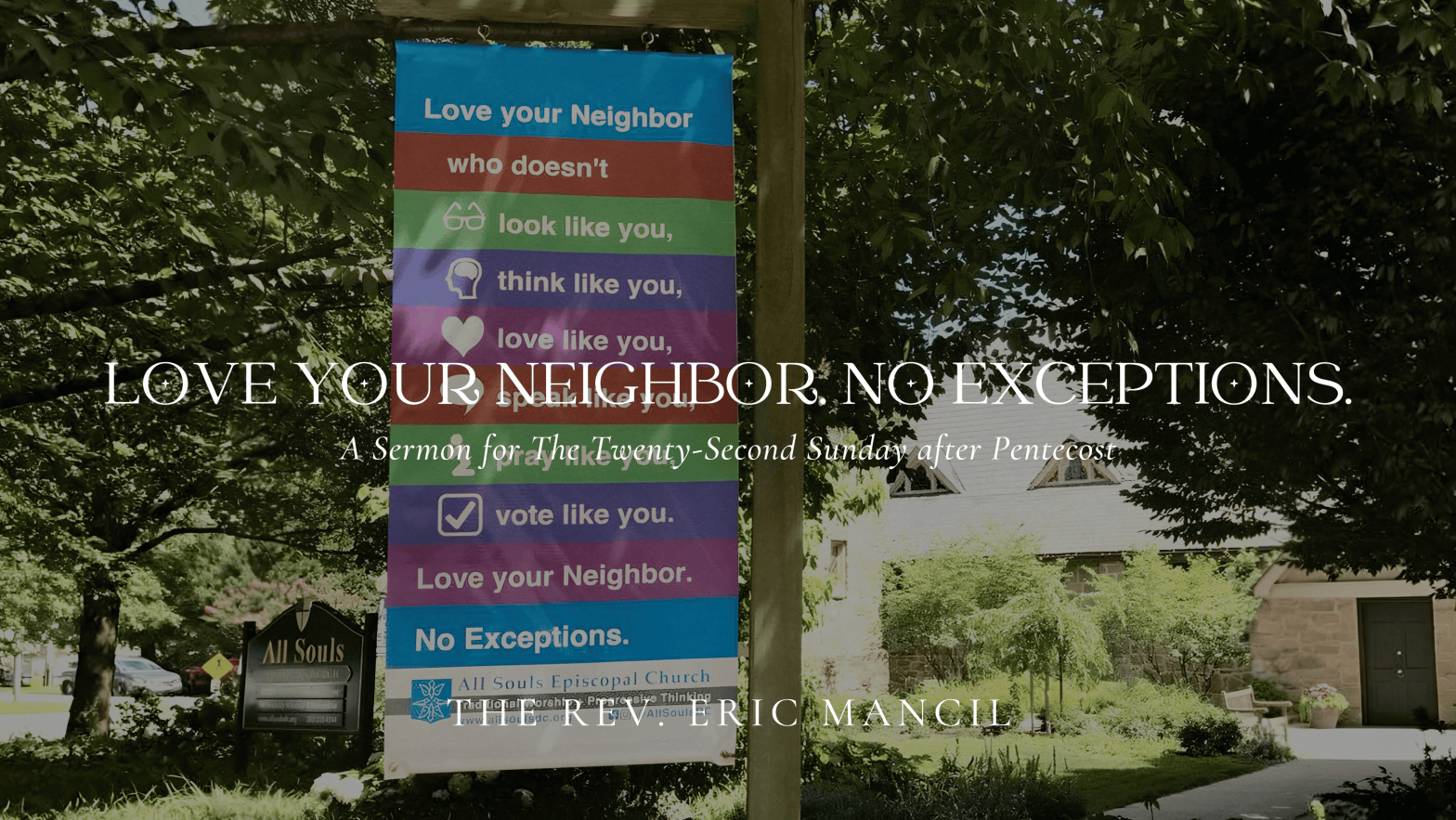
When I walked inside the Parish Hall at St. Mary’s, I noticed a banner standing in a corner of the room. It was a sign I’d seen before—one that a number of Episcopal churches have displayed over the years.
And it read:
Love Your Neighbor.
Love your neighbor who doesn’t look like you.
Love your neighbor who doesn’t think like you.
Love your neighbor who doesn’t love like you.
Love your neighbor who doesn’t speak like you.
Love your neighbor who doesn’t pray like you.
Love your neighbor who doesn’t vote like you.
Love your neighbor. No exceptions.
And when I saw that sign, I immediately thought about our Gospel lesson for this morning.
Because that’s the whole reason we were there.
We were loving our neighbors.
We were putting our faith into action.
We weren’t worried about who was there or showed up to receive a free meal.
We were simply there to share the love of Christ.
It was a long, hard day of work. But at the end of the day, I think all of us who made the trip were so grateful for the opportunity to serve.
And to put into practice the very commandment Jesus gives us in our Gospel lesson this morning.
I agree, by the way, with everything on that banner.
But for me, the part that stands out the most comes at the very end.
The part that reads, “Love your neighbor. No exceptions.”
Because when we think about loving our neighbors, we tend to focus mostly on those who are the easiest to love—the ones who look like us, think like us, believe like us, or vote like us.
But what about those who don’t?
If Jesus commands us to love our neighbors as ourselves, then we have to ask, “Who actually is our neighbor?”
Jesus answered that question in the Gospel of Luke when he shared the story of the Good Samaritan.
It’s a story most of us are very familiar with. And yet, the term Good Samaritan gets thrown around so casually these days that it’s begun to lose its deeper meaning.
A lot of times, when we hear the term Good Samaritan, we think of someone who’s simply done a good deed.
But if you look closely, the story of the Good Samaritan is about much more than someone doing a good deed for a stranger.
It’s a story about crossing boundaries.
In the parable Jesus tells, it’s a Samaritan who makes the decision to help the person in need.
The most unlikely person crosses the road and comes to the assistance of someone who desperately needs help.
It wasn’t the priest. It wasn’t the Levite.
It was the Samaritan—the most unlikely person.
You see, Jews and Samaritans had a long history of hostility and religious disagreement. Many Jews regarded Samaritans as outsiders and believed associating with them would make them unclean.
So, for Jesus to make a Samaritan the example of what it means to love our neighbor was a powerful challenge to his listeners.
Because Jesus was trying to convey something important about who our neighbor really is.
Our neighbors are those who are similar to us, but also those who are different.
Those we would normally associate with, and those we wouldn’t.
Those we agree with, and those we don’t.
Loving our neighbor requires us to cross those boundaries that we don’t like to cross because doing so makes us uncomfortable.
And there are plenty of boundaries dividing us today.
Some would have us believe that people who practice other religions or have different beliefs should not be trusted.
Others would have us believe that people who vote differently than we do should be treated as our enemies.
But Jesus doesn’t tell us to love only the people we agree with.
There’s a quote I’ve come across before that’s always stuck with me, and one that I return to often. I’m not sure who wrote it, but I think it’s a powerful reminder of what it means to love our neighbors.
And it goes like this:
“You will never look into the eyes of someone God does not love.”
It’s worth thinking about.
And it brings us back to this idea of loving God and loving our neighbors as ourselves, and how it’s impossible to do one without the other.
We belong to God, and we belong to one another.
Even those who are different from us.
Our lives are connected. We are wrapped up in each other’s lives, and we are called to care for the well-being of all people.
We don’t get to decide which of our neighbors are worthy of love.
Jesus has already made that decision and given us the commandment.
Love God. Love your neighbor.
No exceptions.
Amen.

