
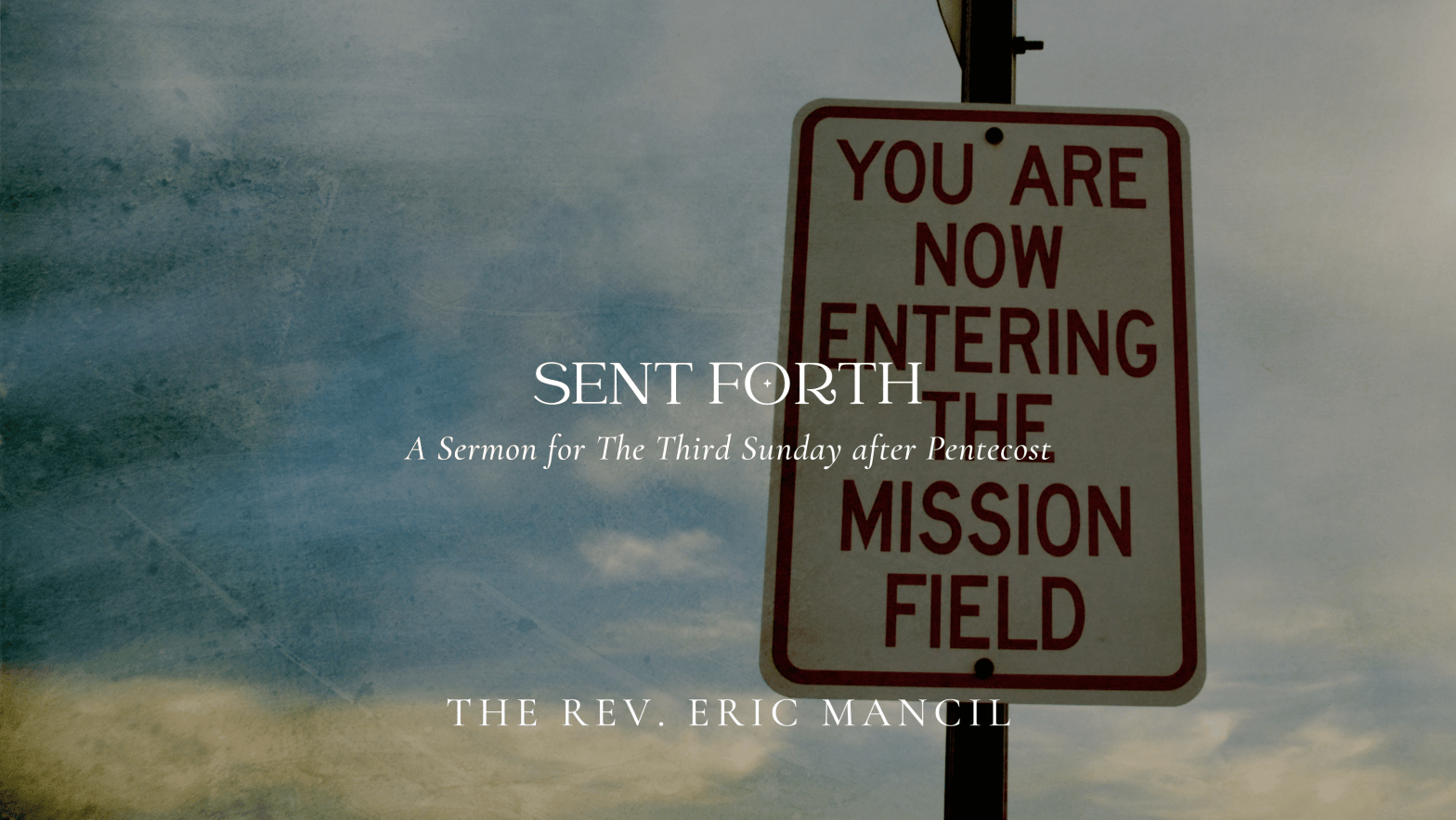
A Sermon for the Third Sunday after Pentecost (Proper 6, Year A)
June 14, 2026
Text: Matthew 9:35-10:8
Now, O Lord, take my lips, and speak through them. Take our minds, and think through them. Take our hearts, and set them on fire. In the name of the Father, and of the Son, and of the Holy Spirit. Amen.
Several years ago, while I was serving at my previous parish in Alabaster, I was contacted by a couple in the community who had heard about our Rice and Beans ministry, much like the one we have here at St. Mary’s.
They owned several laundromats in the area, and they wondered if our church might be interested in partnering with them in some way to help people in need.
I told them we would love to do that.
Their first idea was to give us laundry cards to put in our Rice and Beans bags, so when people came to receive food, they would also receive a laundry card that they could use at the laundromat to wash their clothes for free.
It was such a generous offer, and as the conversation continued, the idea began to grow.
They also suggested that we might partner together to begin a Laundry Love ministry. Once a month, members of the church would come to the laundromat, offering free loads of laundry to anyone in the community who needed it.
They would provide the machines. All we had to do was show up and bring dryer sheets and laundry detergent.
So that’s what we did.
And once we started, the ministry began to grow. More people started coming each month, and we had several members of the parish show up to help.
What began as a simple idea became a wonderful opportunity for the Church to show up in an ordinary place with compassion and generosity.
As I got to know this couple a little better, they started sharing stories about their faith.
And one of the things they told me was that at their church, there was a sign posted outside in the parking lot that you had to drive by as you were leaving. It was very simple.
It said, “You are now entering the mission field.”
“You are now entering the mission field.”
I love that image.
And I think it’s a helpful reminder for all of us, because far too often, church can almost feel like a means to an end.
We come to worship once a week. We sing the hymns. We say the prayers. We listen to the readings. We receive Communion. And then we go about the rest of our week not really thinking much about what happened on Sunday.
And if we’re not careful, we can begin to keep our faith separate from the rest of our everyday lives.
There’s church, and then there’s everything else.
There’s Sunday morning, and then there’s Monday through Saturday.
There’s what we believe in here, and there’s how we live out there.
But this was not Jesus’ idea of discipleship.
Jesus didn’t say to his disciples, “Come and worship me once a week.”
He didn’t say, “Come fulfill your church obligation and then get back to your real life.”
Jesus said, “Follow me.”
Now, of course, we love to worship. We gather here week after week to offer our praise and thanksgiving. We worship because God is worthy of our praise. We worship from a place of gratitude and love because of all the ways God has been faithful to us.
But worship is not the end of discipleship.
Worship forms us for discipleship.
We come here to be fed and nourished and reminded who we are and whose we are, so that we can then be sent back out into the world to live as followers of Jesus.
Our Gospel reading for today is a good example of what that looks like.
Matthew tells us that Jesus went about all the cities and villages, teaching in the synagogues, proclaiming the good news of the kingdom, and curing every disease and every sickness.
And then Matthew gives us this beautiful image.
“When Jesus saw the crowds, he had compassion for them, because they were harassed and helpless, like sheep without a shepherd.”
Jesus saw the crowds.
He saw people who were harassed and helpless.
People who were worn down.
People who were wounded and in need of healing.
And he had compassion for them.
The Greek word that Matthew uses here for compassion is splagchnizomai, which refers to the bowels or the inner organs, the deepest part of the body.
In other words, Jesus doesn’t just feel sorry for the people.
He has a visceral, gut-wrenching reaction when he sees their suffering.
He is moved from the very depths of his being.
And that compassion moves him to act.
Jesus says to his disciples, “The harvest is plentiful, but the laborers are few; therefore ask the Lord of the harvest to send out laborers into his harvest.”
It’s Jesus’ way of saying, “There’s a lot of important work to be done but very few who have the will or desire to do it.”
So Jesus summons the twelve disciples.
Matthew lists them each by name.
Jesus gives them authority to cast out unclean spirits and to cure every disease and every sickness.
And then he sends them out with these instructions:
“Go nowhere among the Gentiles, and enter no town of the Samaritans, but go rather to the lost sheep of the house of Israel. As you go, proclaim the good news, ‘The kingdom of heaven has come near.’ Cure the sick, raise the dead, cleanse the lepers, cast out demons.”
Jesus is on a mission to bring healing and wholeness to the people.
But instead of doing all the work himself, he shares that work with his disciples.
He shares his mission.
He shares his authority.
He sends them out to do the very things he’s been doing.
To proclaim good news.
To heal what is broken.
To confront the forces that diminish and destroy human life.
To go to those who are lost, wounded, and afraid, and announce by word and deed that the kingdom of heaven has come near.
And that’s where the Gospel meets us today, because this story is about more than just something Jesus did a long time ago.
Jesus commissions us to do the same in our own time and place. As followers of Jesus, we share in his ministry.
That’s really why the Church exists in the first place.
The Church doesn’t exist only for our own benefit.
The Church doesn’t exist just so we can have a beautiful place to worship or programs that meet our needs.
All of those things matter.
But they are not the end.
We gather here week after week to be fed and nourished so that we can then be sent out to do the work of healing God has given us to do.
Sometimes we do that in organized ways through the ministries of the Church—like feeding our neighbors through Rice and Beans or helping people wash their clothes at Laundry Love.
We do it when we visit the sick, care for the grieving, and offer hospitality to those who walk through our doors.
But more often than not, we’re called to be ministers in those ordinary, everyday places where we live most of our lives.
At work.
At school.
At the baseball field.
At the grocery store.
In conversations with friends.
In moments when someone is hurting and we have the opportunity to listen.
In moments when someone is lonely and we have the opportunity to notice.
Anytime we see a need that we can help fill, there’s an opportunity to participate in the healing work of Jesus.
This is the work of the Gospel.
We are sent out as missionaries.
When we hear the word missionary, it’s easy to imagine that mission work only happens somewhere else.
In another country or part of the world.
And certainly, God calls some people to that kind of mission work.
But first and foremost, I believe God calls us to share the Gospel right where we are.
In our own towns and communities.
In our own daily lives.
Because there’s plenty of work to do right here.
There are plenty of people in our own community who are hungry—not just physically but emotionally and spiritually as well.
There are people who feel overlooked and forgotten.
People who are lonely, anxious, and afraid.
People who have been cast out and told they are worthless.
There are people who have been made to believe they are unworthy of God’s love and have no place in the church.
And we have the opportunity, wherever God leads us, to help heal those wounds.
We have the opportunity, here and now, to be instruments of God’s healing and mercy.
To remind people that they are loved.
To remind them they are worthy of God’s love.
To offer forgiveness and hope to those who feel worthless and beyond redemption.
To proclaim, not only with our words but with our lives, that the kingdom of heaven has come near.
We may not have a sign in our parking lot that reads, “You are now entering the mission field.”
But we do have words that remind us of what we are called to do. We hear them every week in worship.
At the end of the service, after the closing hymn, we hear the words of the Dismissal.
“Go in peace to love and serve the Lord.”
It’s not just a nice way of saying the service is over.
It’s a re-commissioning.
It’s a reminder that the work of ministry—the work of discipleship—is not confined to this building.
It extends beyond our walls into a world that is desperate for good news—a world full of people who are harassed and helpless, like sheep without a shepherd.
A world that God longs to heal and make new.
So when we come to the end of today’s service—and every Sunday for that matter—may those words be planted in our hearts.
Go in peace to love and serve the Lord.
Go into your homes.
Go into your workplaces.
Go into your schools and neighborhoods.
Go into the ordinary places of your life with compassion and mercy.
And carry with you the Good News of God in Christ.
“The kingdom of heaven has come near.”
Amen.
 The Rev. Eric Mancil