
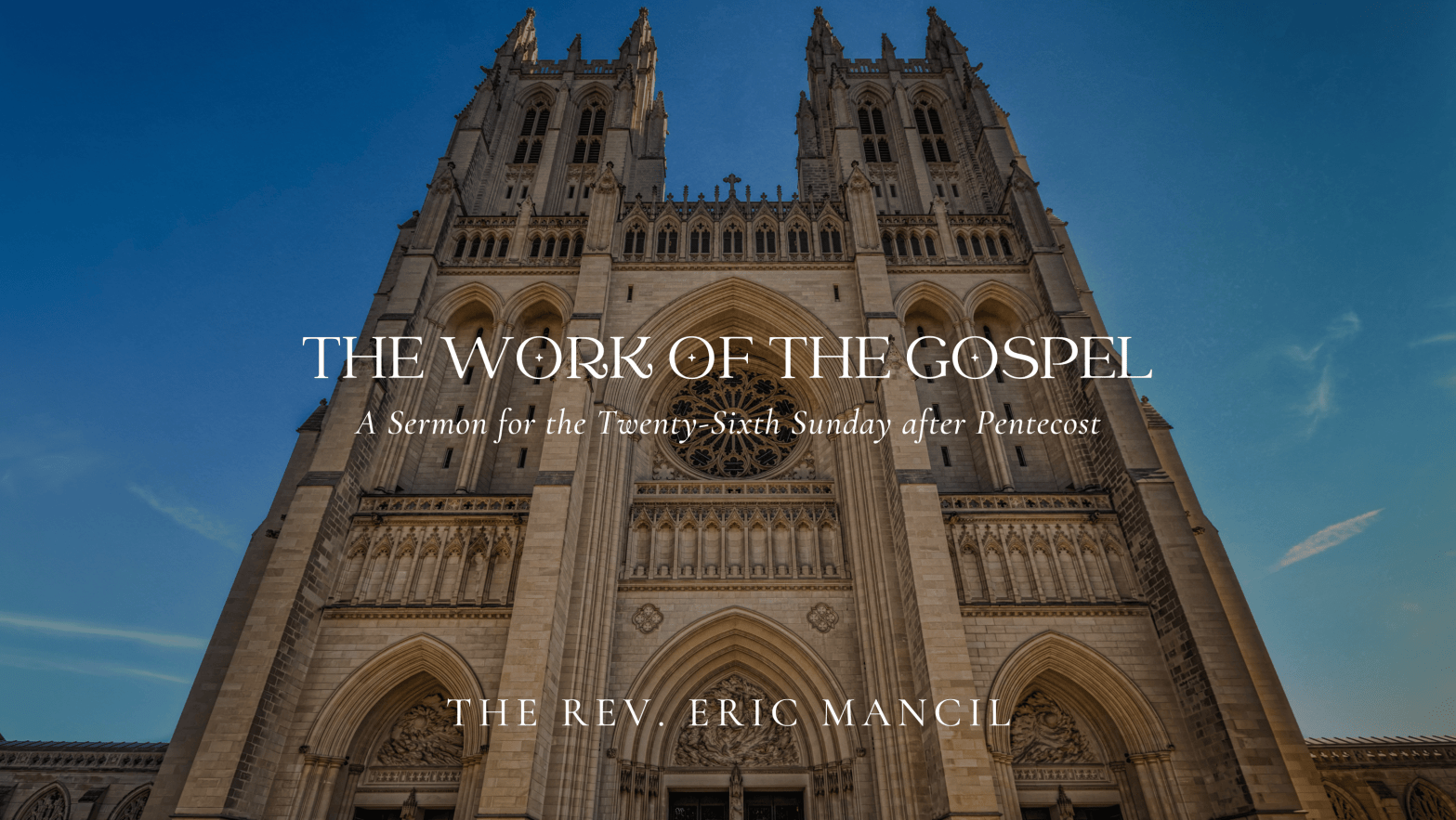
A Sermon for the Twenty-Sixth Sunday after Pentecost (Proper 28, Year B)
November 17, 2024
Text: Mark 13:1-8
Now, O Lord, take my lips, and speak through them. Take our minds, and think through them. Take our hearts, and set them on fire. In the name of the Father, and of the Son, and of the Holy Spirit. Amen.
I’ve had the good fortune of being able to visit some incredible places in my life. This probably won’t come as a surprise to any of you, but one of my favorite things to do when I get to visit a new place is to go and check out some of the local, historic churches, especially the cathedrals.
In the summer between my junior and senior years of college, the choir from Auburn University went on a tour of Eastern Europe, and while we were there, I spent a lot of my free time visiting some of the beautiful, Gothic cathedrals in places like Prague and Budapest.
When I visited New Orleans for the first time, I made sure to go and visit St. Louis Cathedral in Jackson Square and Christ Church, the Episcopal cathedral for the Diocese of Louisiana.
When I lived in Savannah for a year, one of my first places to visit downtown was the Cathedral Church of St. John the Baptist, not far from Lafayette Square.
I also made sure to check out plenty of the old, Episcopal churches as well, like Christ Episcopal Church, which was established in 1733 and nicknamed “the mother church of Georgia.”
And don’t get me started on the number of churches our family visited during my first year of seminary in northern Virginia.
We were overwhelmed with the number of Episcopal churches that were located just within a ten-mile radius, and we spent almost every Sunday during that first year of seminary visiting different parishes.
One of the reasons we did this was because I had to start thinking about where I wanted to do my parish internship during my last two years of seminary.
But, a slightly more selfish reason is because I’m a huge church nerd.
I love visiting new churches, learning about the history, experiencing different styles of worship, and getting to see all of the beautiful architecture.
One of my favorite places that I got to visit during seminary was the Cathedral Church of St. Peter and St. Paul, also known as the Washington National Cathedral.
It stands at 676 feet tall, making it the highest point in Washington, D.C., even taller than the Washington Monument.
It has a capacity of 4,000 people.
It’s the second largest cathedral in the United States and the sixth largest in the world.
When you see it from the outside for the first time in person, just the shear size and magnitude of the building is enough to stir your soul.
But then, when you walk in, and you see the intricate details carved in wood and stone and the walls of the Nave bathed in colorful light from the magnificent, stained glass windows, it’s nothing short of breathtaking.
And, you really do get the sense that this is a place that was built to the honor and glory of God.
If you’ve ever had the chance to visit yourself, you know exactly what I’m talking about, and if you’ve never been before, I hope you have the chance to go one day.
It really is spectacular.
Whenever I visit places like the National Cathedral and other grand, historic churches from around the world, I think about all the people who must have had a hand in creating such beautiful places of worship.
I think about all the time and effort and resources that must have gone in to creating such monumental structures and the amount of artistry and creativity used to create those sacred spaces where Christians have been worshiping for centuries.
It’s hard not to marvel at places like that.
On a much smaller scale, I think the same is true about our church.
In my opinion, we have one of the most beautiful churches in Andalusia.
Every time I walk into this building, I think about how truly blessed we all are to be able to worship here and offer our praise to God.
I’m inspired by the simple beauty of this space and reminded of those who’ve come before and worked so hard to make the dream of this church a reality.
As Episcopalians, we tend to find great meaning and value in sacred art and architecture.
We experience the divine through beautiful things that were made by human hands and offered to the glory of God—like churches and cathedrals, but also things like visual art and music.
We have a deep love and appreciation for all these things.
But, truth be told, sometimes we can take our love and appreciation for things like art and architecture a little too far.
Sometimes, it’s easy for us to forget that our Christian faith doesn’t call us to build fancy churches or admire beautiful pieces of art.
Our Christian faith—at its core—calls us to work for the building up of God’s kingdom on earth—to care for the widow and the orphan, to feed those who are hungry and clothe those who are naked, to welcome the stranger, and to visit those who are sick and in prison.
Out of all the things I just listed, not a single one requires a fancy building or a beautiful Nave or an organ or anything else we love about our worship.
All we really need is a willingness to show up and to be faithful to the work that God has called us to do as followers of Jesus.
Now, that’s not to say that our buildings and the things we love about worship aren’t important. They absolutely are. They draw our attention to God and remind us of who we are and what we’re called to do.
And, they provide us a place to worship God and be formed as disciples and to carry out our ministries.
But, they should never be the “be-all and end-all” of our faith.
Our focus should always be on the mission of God and the kingdom-building work of the Gospel.
Jesus warned his disciples about this at the beginning of our Gospel lesson for today, which takes place right after a long series of teachings in the temple in Jerusalem.
As Jesus is leaving the temple, one of his disciples looks up in great admiration and says to him, “Look, Teacher, what large stones and what large buildings!”
He’s in awe of the beauty and magnificence of the temple, which, for Jews at the time, was the center of their life and faith.
But, Jesus isn’t impressed.
The temple, although it looked beautiful and magnificent from the outside, had become corrupt due to the greed and selfishness of the religious leaders.
They had turned God’s house into a den of robbers, using it for their own personal gain.
So, Jesus responds to the man, “Do you see these great buildings? Not one stone will be left here upon another; all will be thrown down.”
Jesus knows that, one day, not only will the temple in Jerusalem be destroyed, but everything as we know it will pass away.
He knows that, one day, he will come again, and God will finally bring to fulfillment his kingdom on earth as it is in heaven.
Then, four of Jesus’ disciples, Peter, James, John, and Andrew, ask him privately, “Tell us, when will this be, and what will be the sign that all these things are about to be accomplished?”
Jesus doesn’t give them the answers they’re looking for.
Instead, he warns them that, once he’s gone, they’ll face many challenges and temptations as the Kingdom of God grows closer and closer to fulfillment.
There’ll be natural disasters, wars, and famines, Jesus says, and he warns them that they’ll be tempted in ways that may lead them away from God or distract them from the work they’ve been called to do as his disciples.
His warning to them is this: “Beware that no one leads you astray.”
In other words, “Keep your eyes open, and stay focused. There are temptations around every corner.”
Temptations come in all sorts of shapes and sizes, and they have the power to distract us and pull us away from doing the work that God has called us to do.
Sometimes, I think those of us in the church are especially vulnerable to temptations.
Because it’s easy for us to get distracted by things that go on here at church and to lose sight of the actual Gospel work that God is leading us to do outside the church walls.
It’s easy for us to pay special attention to the things that benefit us as a community of faith and forget that the place where we’re actually called to go is out in the world.
It’s easy for us to get caught up in the beauty of our worship and the magnificence of our church buildings and forget that all these things that we hold so dear—as beautiful as they are—are really just signposts, pointing us in the direction of God’s kingdom.
They offer us glimpses of heaven.
But, they only exist for a brief moment in time.
One day, all of this will be gone. It will whither and pass away like everything else around us.
One day, Jesus will return. Heaven and earth will become a new creation, and God’s kingdom will be brought to fulfillment.
No one knows when that day will come.
But, until it does, we’re called to keep our eyes open and to stay focused on our mission, which is to help bring healing to God’s creation and to restore all people to unity with God and each other in Christ.
That’s the real work of the Gospel.
And, above all else, it’s the work that God has given us to do as a people of faith, rooted in the love and ministry of Jesus Christ.
Amen.
 The Rev. Eric Mancil