
A Sermon for the Last Sunday after the Epiphany (Year B)
February 14, 2021
The Gospel: Mark 9:2-9
I speak to you this morning in the name of our loving, liberating, and life-giving God: Father, Son, and Holy Spirit. Amen.
I want to tell you about a time I heard God speak to me. No, I’m not talking about an actual voice from heaven, like the one that Jesus’ disciples heard in our Gospel lesson for this morning. I heard God speak to me as a deep longing in my soul—a longing that I ignored for a long time because I tried to convince myself that God wouldn’t call a person like me to be a priest in the Episcopal Church—a person like me, who grew up un-churched and was practically brand new to the faith; a person like me, who already spent years in college training to become a music teacher and never could’ve imagined doing anything else.
It was in the Fall of 2009, only a few months after Sophie was born. We were living in southeast Alabama at the time, in my hometown of Enterprise. I was working as a choral music teacher at the local junior high school. Chelsea was commuting back and forth from Dothan, working as a nurse in the labor and delivery unit at Southeast Alabama Medical Center.
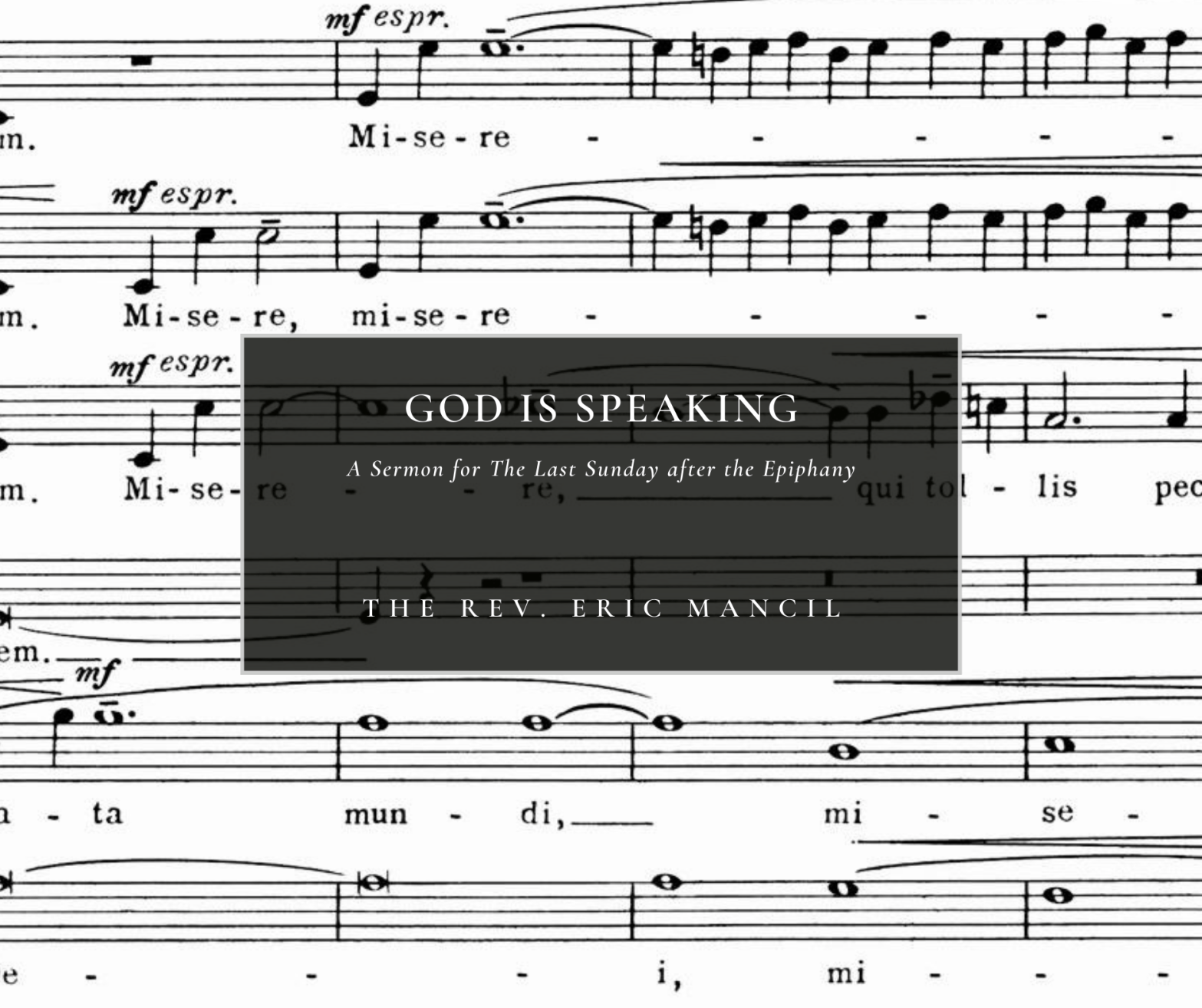
We had recently returned from Auburn, where Sophie was baptized at St. Dunstan’s by my dear friend, Father Wells. It was an ordinary weekday. I woke up and got ready to go to work, as I did each morning. I left the house and got into my car, completely unaware of what was about to happen. I cranked the ignition, and as soon as the engine came to life, I heard a song playing through the speakers. I knew in an instant what it was—a sacred piece of choral music, recorded by the Cambridge Singers. Samuel Barber’s setting of the Agnus Dei began playing, and all I could do was sit in my car, still parked in the driveway, and listen as the choir sang. The words were in Latin, but I knew the translation:
Agnus Dei, qui tollis peccata mundi, miserere nobis.
Lamb of God, you take away the sins of the world, have mercy upon us.
Agnus Dei, qui tollis peccata mundi, miserere nobis.
Lamb of God, you take away the sins of the world, have mercy upon us.
Agnus Dei, qui tollis peccata mundi, dona nobis pacem
Lamb of God, you take away the sins of the world, grant us peace.
Those who are familiar with The Book of Common Prayer will recognize these words. We say them often during the Eucharist in the part of the service where the priest lifts up the consecrated bread and breaks it in half, serving as a reminder not only of our Lord’s sacrifice on the cross but also as a reminder that we are the Body of Christ, broken and poured out for the life of the world.
That morning, back in 2009, as I sat in my driveway at home and heard the choir sing the words to the Agnus Dei, I wept. I wept, not because I was sad or upset but because I was finally coming to terms with the fact that I had ignored God’s call for too long. Warm streams of tears rolled down my face as I thought to myself, “What am I doing?” “God is calling, but I haven’t been listening.” If I’m being completely honest, I think I was too afraid to listen.
I heard God speak to me that morning in the deepest depths of my soul. God spoke and said, “You know what you need to do.” Finally, I was willing to listen and overcome my fear. Finally, I was able to accept the fact that I was being called to follow a different path. I was able to admit to myself that God was calling me to be a priest, something I couldn’t ignore any longer.
So, after that day, I reached out to my priest at the time, Mother Ede. The two of us sat down in her office, and I told her everything. I told her about how I began the discernment process for ordination back in 2007 but had to end it because of the new teaching job I took in Enterprise. I told her about my experience sitting in the driveway at home and how I knew that God was calling me to be a priest. She was so supportive of me and my sense of call, and the two of us began meeting regularly, setting me on a course that would change my life and the life of our family forever.
I wanted to share this story with you this morning because I think it has a lot to do with how God speaks to us in our lives. God speaks to us and reveals God’s self in ways that are often unexpected and unimaginable, like through a piece of music playing on the radio. I didn’t expect to wake up one morning and experience some divine revelation, but that’s exactly what happened. God spoke, and I listened.
It’s also what happened to Peter, James, and John in our Gospel lesson this morning in the story of Jesus’ transfiguration. The Gospel writer doesn’t provide us with many details, but I can imagine what must’ve been running through the disciples’ heads as they were led by Jesus to the top of a mountain, in the middle of nowhere. “Where in the world are we going,” they might’ve thought, “and, why is Jesus leaving the other disciples behind while we go off by ourselves?” They probably had a million questions with no idea what to expect. When they finally arrived at the top, they witnessed something beyond comprehension, something unimaginable. There was Jesus, standing before them with clothes that were “dazzling white.” The author of Mark’s Gospel uses the word “transfigured” to describe Jesus’ appearance, which means “changed” or “transformed” in some way. Not only that, but standing next to Jesus and talking with him were Moses and Elijah—prominent figures from the Hebrew Scriptures and pillars of the Jewish faith.
Can you imagine what that experience must’ve been like? Can you imagine how terrifying it must’ve been to witness something so spectacular and unexpected?
At the end of the story, a cloud descends upon all of them, and a voice from heaven proclaims, “This is my Son, the Beloved: listen to him!”
“Listen to him,” the voice cries out. God speaks, and the disciples listen.
We hear the story of Jesus’ transfiguration told every year on this day, on the Last Sunday after the Epiphany, as we prepare to move from one liturgical season to the next. Very soon, we will enter the holy season of Lent, a journey we’re invited to take with Christ each year, a time of intentional prayer and fasting, a time of preparation and repentance as we take a close look at our lives and think about ways that we might change in order to draw closer to God.
Prayer is one way for us to begin the work that the season of Lent invites us to do. The Prayer Book defines prayer as “responding to God, by thought and by deeds, with or without words.” I love that definition so much, especially the part where it talks about “responding to God.” So many of us struggle with the idea of prayer, especially when we think about it in terms of “talking to God” or trying to come up with the right words to say to God. But, if we take the Prayer Book’s definition of prayer to heart, then we come to realize that prayer doesn’t really begin with what we do or say. It actually begins with God. Let me say that again. Prayer begins with God. Our job is to listen out for what God is trying to say and then respond, “by thought and by deeds, with or without words.”
In my vocation as a priest, I’ve often been told, “I just don’t know if God is hearing my prayers,” as if there’s a question about whether or not God is listening to us.
But, what I’ve found is that our question shouldn’t be, “Is God listening?” We know and trust that God hears and answers our prayers. The question shouldn’t be, “Is God listening?” The question we should really be asking ourselves is, “Are we listening?” Are we listening to what God is trying to tell us? Or, are we too afraid to listen?
There are lots of reasons to be afraid because if there’s anything we know about what God calls us to do, we know that it probably has something to do with the cross. We know that it probably has something to do with living a sacrificial life, of giving up our selves in order to love and serve others. We know this because of Jesus and what Jesus goes through when he reaches Jerusalem.
There are reasons why we might be tempted to ignore what God is trying to tell us, but there’s also every reason to be fearless because we already know how the story unfolds. In the end, we know that love wins. The forces that seek to weigh us down and keep us separated from the God who loves us are defeated, once and for all. Listening to God and responding to God’s call isn’t always easy. We know there’ll be challenges and temptations along the way, but we also know that God is faithful and will never leave us to face those challenges and temptations alone.
As we prepare to move into the season of Lent and turn our focus toward Jesus’ journey to the cross, I invite you into a time of prayer, a time of holy listening. “Listen to him,” the voice from heaven told the disciples in our Gospel lesson for today. Listen to Jesus, and don’t be afraid. Open yourselves to the possibility that God is trying to speak to you in ways that are surprising and unexpected. Open yourselves to the possibility that God is calling you to try something new or something different than what you might’ve imagined. God is speaking to us. May we have the courage and wisdom to listen. Amen.
A video of this sermon is available below, beginning at the 16:53 mark.
 The Rev. Eric Mancil
Love the definition of prayer – especially the “with or without words” part, as I’m 1 of those who worry about having the right words to say & if God’s listening. Thanks Eric for the reassuring words.
LikeLike
You’re welcome, Sharon! I’m glad you found it helpful.
LikeLike