
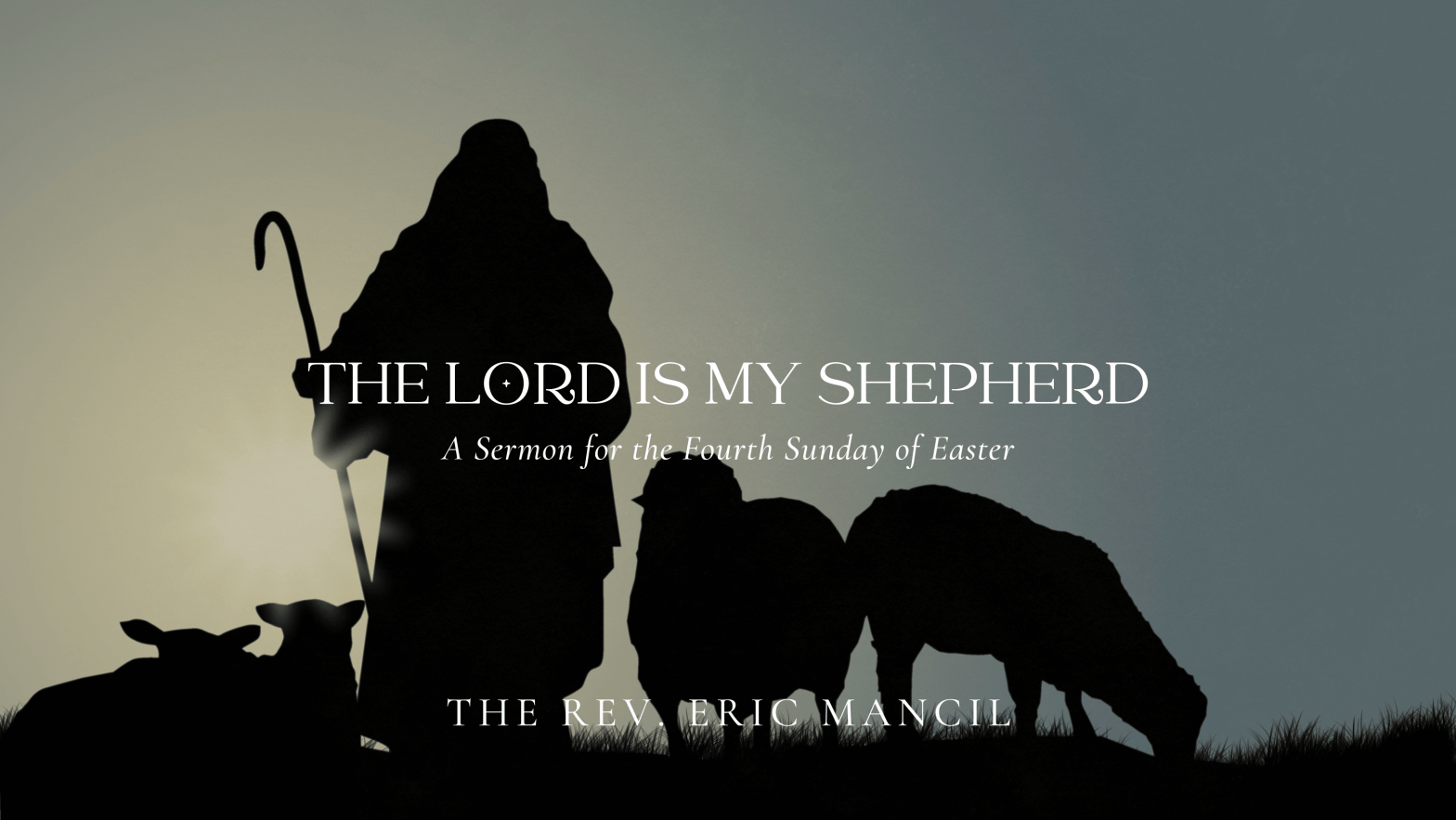
A Sermon for the Fourth Sunday of Easter (Year C)
May 11, 2025
Text: Psalm 23 and John 10:22-30
Now, O Lord, take my lips, and speak through them. Take our minds, and think through them. Take our hearts, and set them on fire. In the name of the Father, and of the Son, and of the Holy Spirit. Amen.
In my time as a priest, I’ve had to help plan a lot funerals. That may sound sad and depressing, but actually, it’s a great blessing for me to be able to share that special time with families who’ve just lost a loved one.
One of the first things I do when I meet with a family to plan a service of burial is ask them, “Which readings from Scripture would you like to include in the service?”
Thankfully, The Book of Common Prayer provides a list of appropriate readings to choose from, which makes the process a lot easier.
But, still, it can take some time, because most people want to choose what they feel is most appropriate for their loved one.
Nine times out of ten—when it comes to planning a funeral—there’s one lesson from Scripture that families always choose.
You can probably guess what it is.
It’s one of the lessons appointed for today.
And, that’s the Twenty-third Psalm.
It’s printed just about everywhere.
You can find it on bookmarks, coffee mugs, and just about any other gift you can imagine in a Christian bookstore.
You can find it on posters in just about any Sunday School classroom, usually with an image of Jesus gracefully walking through a pasture, carrying a sheep in his arms.
Even those who haven’t grown up in church are likely familiar with the opening words—probably from the King James Version of the Bible.
“The Lord is my shepherd. I shall not want.”
They may not be able to recite the whole thing, but there are parts of this beloved text that even the most unchurched people are familiar with.
Phrases like, “Yea, though I walk through the valley of the shadow of death, I will fear no evil…”
And “…thou anointest my head with oil; my cup runneth over.”
There’s a reason why families in mourning often choose Psalm 23 to be read at the funeral of their loved one.
And, there’s a reason why it’s become so engrained in popular culture that even those who don’t go to church or read the Bible are familiar with the words.
Because—in the simplest of terms—it speaks of who God is, and it speaks of the kind of love that God has for each of us.
A love that is personal and intimate.
A love that knows no bounds or limits.
When we hear those long-familiar words, “The Lord is my shepherd,” it brings us comfort and peace in a way that’s hard to describe—almost like being wrapped up in a warm blanket.
It reminds us that God is always with us—not only in the good times but also in those moments when it feels like we really are walking through the “valley of the shadow of death.”
The Twenty-third Psalm reassures us that—no matter where we go, no matter how far we fall away—God has taken us by the hand and will never leave us.
We are his forever.
There’s no doubt that Jews living in first-century Palestine would’ve been just as familiar with Psalm 23 as we are today.
The Psalms were part of the Hebrew Scriptures and were written centuries before the time of Jesus.
They were engrained in the hearts and minds of the people.
They were used in prayer and temple worship, similar to the way we use them in our own worship today.
Most Jews could recite Psalm 23 from memory in the same way that most of us can recite the Lord’s Prayer, which is probably one of the reasons why Jesus often used the images of sheep and shepherds in his teaching.
They were very familiar to the people.
In the tenth chapter of John’s Gospel, Jesus describes himself as the “Good Shepherd” who lays down his life for the sheep.
Every year on this day, the Fourth Sunday of Easter, we hear a lesson from the Gospel of John having to do with Jesus as the Good Shepherd.
In today’s lesson, Jesus is walking in the temple in Jerusalem during the Festival of the Dedication, which we know now as Hanukkah.
Some of the other Jews who are there for the festival gather around Jesus and ask him, “How long will you keep us in suspense? If you are the Messiah, tell us plainly.”
They want clarity from Jesus.
There’s no doubt they’ve heard of the miraculous things Jesus has done—like the Feeding of the Five Thousand or the healing of the man who was born blind.
And, there’s no doubt they’ve heard stories about his teachings and how he claims to be the Son of God.
But, he doesn’t fit their expectations of who the Messiah will be.
He’s not a military leader.
And, he doesn’t seek political power or wealth as an earthly king would.
He doesn’t quite fit the mold of what they expected in God’s Chosen One.
So, they want Jesus to tell them clearly whether or not he is the Messiah—the One whom God has sent to bring healing and restoration to the world.
Jesus looks at them and responds, “I have told you, and you do not believe.”
“The works that I do in my Father’s name testify to me, but you do not believe because you do not belong to my sheep.”
In other words, Jesus says to them, “I’ve clearly shown you who I am, but because of your hardness of heart, you refuse to believe.”
There’s a saying we sometimes use.
Maybe you’ve heard it before or even used it yourself.
It goes like this:
“When someone shows you who they are, believe them the first time.”
And, a similar saying goes like this:
“Actions speak louder than words.”
Now, a lot of times, we use these sayings in a negative way about people who have lost our trust or people who have hurt us in some way.
But, I think these sayings are true all the way around—both the good and the bad.
People show us who they really are—they reveal their true identity—in the way they live their lives and in the way they treat other people.
The same is true for Jesus.
If we really want to know who Jesus is—and, if we really want to know who God is and how God is calling us to live our lives—all we have to do is pay close attention to his life and ministry.
All we have to do is look at the life Jesus lived—what he taught and stood for—and what he gave his life for, and we’ll know who he is.
He is the Good Shepherd—the one who loves us and cares for us more than we can imagine, the one who provides for us all the days of our lives, the one who leads us—through the good times and the bad.
He is the one who restores us when we fall down, the one who comforts us in times of pain and sorrow.
He is the one who heals us—our Great Physician and only source of true healing and peace in our lives.
He is the one who saves us and promises to be with us forever.
King David—a pillar of ancient Israel and author of many of the Psalms, including Psalm 23, described it best—
The Lord is my shepherd; I shall not want.
He maketh me to lie down in green pastures: he leadeth me beside the still waters.
He restoreth my soul: he leadeth me in the paths of righteousness for his name’s sake.
Yea, though I walk through the valley of the shadow of death, I will fear no evil: for thou art with me; thy rod and thy staff they comfort me.
Thou preparest a table before me in the presence of mine enemies: thou anointest my head with oil; my cup runneth over.
Surely goodness and mercy shall follow me all the days of my life: and I will dwell in the house of the Lord for ever.
Amen.
 The Rev. Eric Mancil