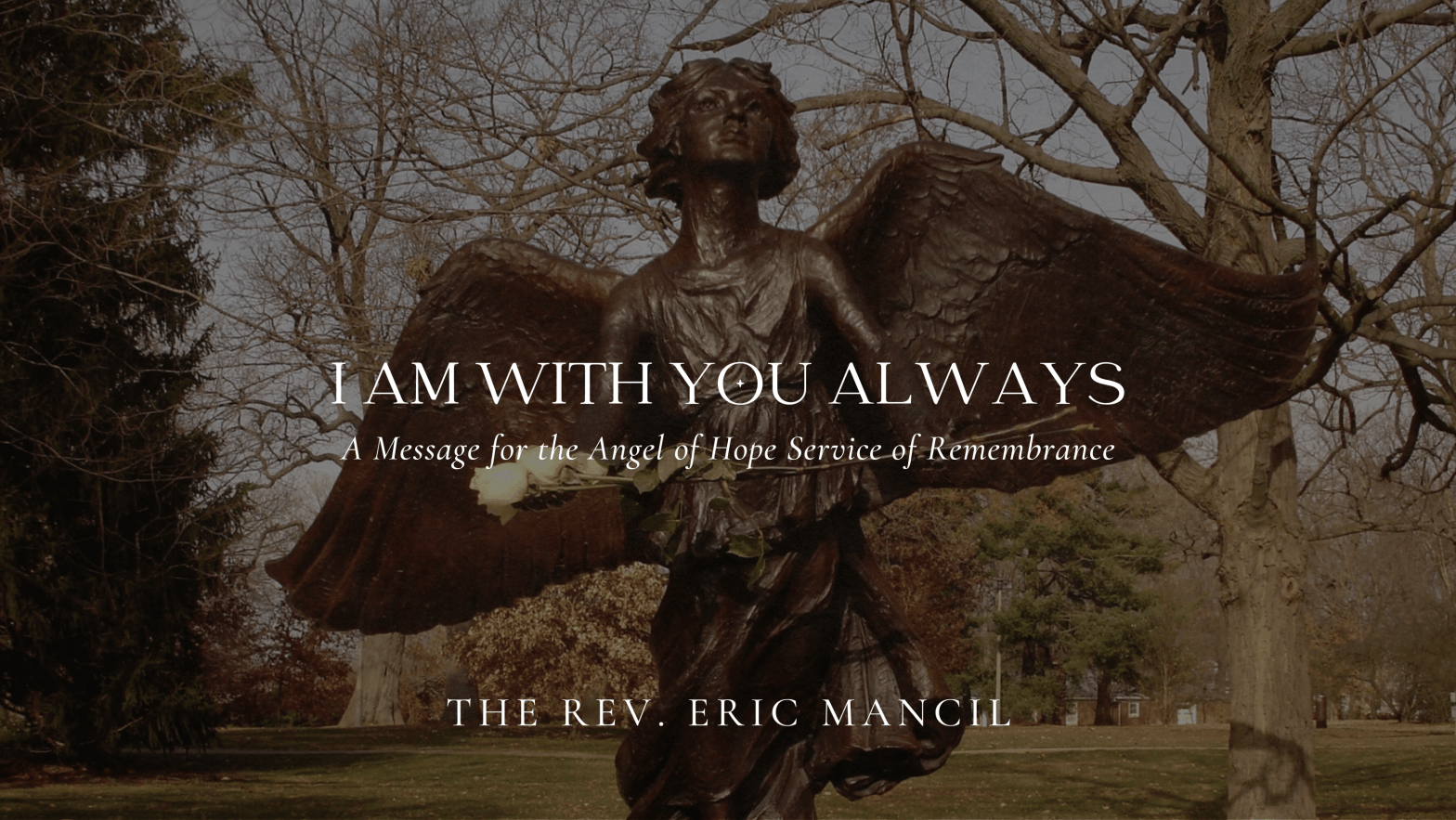
I Am With You Always

A Message for the Angel of Hope Service of Remembrance
Tuesday, December 2, 2025

Good evening, friends.

It’s an honor and a privilege to be with you tonight.

My name is Father Eric Mancil, and I serve as the rector of St. Mary’s Episcopal Church here in Andalusia.

I want to begin by offering my heartfelt thanks to Debbie Grimes and to the other officers for the Angel of Hope for inviting me to be part of this service of remembrance.

The work you do—the compassion you offer, the space you provide for those who grieve—matters deeply to families throughout Covington County. Thank you for making this night possible.

We gather here at the Angel of Hope because this is a sacred place.

Each of us comes here tonight with a story.

Each of us carries a name, a face, a memory that has shaped our life more deeply than words can describe.

Tonight, we gather because we know that love never ends.

And because grief—especially the grief of losing a child—doesn’t follow a timeline or conform to what the world expects of us.

This time of the year makes that especially clear.

As December begins, the world around us tells us we should be cheerful all the time and full of holiday joy.

Everywhere we turn, there are Christmas lights, decorations, music, and messages insisting that this season is all about celebration.

And yet—for so many who carry deep grief—this is the season that hurts the most.

The empty chair at the table, the tradition that feels incomplete, the memory that arrives without warning… all of these can take what is supposed to be a joyful time and make it heavy or too painful to bear.

And so tonight matters.

Tonight gives us permission to be honest.

Permission to feel what we feel.

Permission to acknowledge that grief doesn’t take a holiday break.

Here, in this sacred place, no one has to pretend.

No one has to hide their feelings or their questions.

No one has to put on the holiday mask the world expects. 

Tonight we simply come as we are—carrying all the love, all the longing, all the pain, and all the gratitude that come with remembering a child who will always be part of us.

As a pastor—and as a parent myself—I’ve walked with many people who’ve carried deep grief of all kinds.

And while I’ve never walked through the loss that many of you carry, I do know what it means to love a child with your whole heart.

I know the way a child becomes part of you, the way their life shapes your own.

And because of that, I can only begin to imagine the deep pain that comes with losing a son or daughter.

What I do know is that grief is not a problem to solve or something we should be expected to just “get over.”

Grief is love—love that still aches, love that still reaches, love that still remembers.

Some days that grief feels like a fresh wound.

Other days, it rests quietly in the background until a smell, or a song, or a moment brings it rushing back.

But in every case, grief becomes a companion we never asked for—one that walks with us day after day.

So, please hear me tonight when I say that there’s no right or wrong way to grieve.

There is no timetable.

There is no moment when you are “supposed” to just all of a sudden feel better.

Your grief is real.

Your journey is your own.

And for those who’ve lost a child, their life will always matter.

This Angel of Hope stands here for that very reason.

Her open arms, her outstretched wings, her quiet presence: they remind us that none of us grieve alone.

All around the world, more than 150 of these angels stand in communities just like this one, bearing witness to the truth that a parent’s love does not end with death.

This angel is not a symbol of a simple or shallow hope.

She represents a deeper kind of hope—the kind that rises even in sorrow, that reminds us love is never lost, and that assures us God will never leave us to face our pain alone.

As people of faith, we hold to a promise that sustains us: the promise that God is with us, even in our deepest pain.

Jesus never said we would not face sorrow or heartbreak.

He never said that life would be free from suffering.

What he did say—what he promised—is that we would never face those moments alone. “I am with you always,” he said.

Not just in the easy days, not just in the joyful days, but in the darkest nights and the heaviest hours.

Jesus knew grief.

He wept at the tomb of his friend, Lazarus.

He felt the sting of loss.

And because he knows grief from the inside, we can trust that he walks with us through ours—not to take the pain away, but to carry it with us, to lift us up when we fall, and to remind us that love is stronger than death itself.

In a few moments, many of you will come forward to place a flower at the Angel of Hope.

It is a simple act, but it carries such deep meaning.

It is a way of saying, “My child lived. My child was loved. My child is still loved.”

And through that love, their light continues—shining in your memories, in your stories, in the ways they shaped who you are.

And the hope we proclaim tonight, the hope of the Gospel, adds this: your child is held in the eternal embrace of God in a place where there is no pain, no fear, no suffering, only peace and love beyond our understanding.

Until that day when all things are made new and we’re reunited with those we love, God gives us the strength to keep going.

One breath at a time. One step at a time. One act of courage at a time.

My prayer for you tonight is that you feel surrounded by God’s love, upheld by this community, and filled—if even only for a moment—with a sense of peace.

You’re not alone. Not tonight. Not ever.

May the God who knows your story, who holds your tears, and who loves you and your child more than you can imagine, grant you comfort, strength, and hope—hope deep enough to carry you through the days ahead, and love strong enough to remind you that nothing, not even death, can separate us from the love of God in Christ Jesus.

Let us pray.

Holy and gracious God, tonight we lift before you the children we love and remember. We thank you for their lives, for the joy they brought us, for the ways they shaped our hearts and still shape them even now. Hold their families in your tender care. Surround them with your peace in moments of sorrow, your strength in moments of weakness, and your gentle presence when the weight of grief feels too heavy. Remind us that you are a God who walks with us—not to take away our pain, but to help us carry it, to lift us up when we fall, and to shine light into the darkness.

Bless each person gathered here tonight. Calm their anxious hearts, renew their courage, and fill them with a hope that lasts. And as we leave this place, help us to carry the love of our children with us—not as a burden, but as a sacred flame that continues to burn brightly. All this we pray in the name of the one who is our comfort and our hope, Jesus Christ our Lord. Amen.
Waiting with Hope

A Sermon for the First Sunday of Advent (Year A)
November 30, 2025

Text: Matthew 24:36-44

Now, O Lord, take my lips, and speak through them. Take our minds, and think through them. Take our hearts, and set them on fire. In the name of the Father, and of the Son, and of the Holy Spirit. Amen.

A few weeks ago, my family and I were in Auburn for the weekend. On our way out of town, heading back home, we decided to stop at Tiger Town and do a little shopping. And—much to my delight—we ended up at one of my favorite stores: World Market.

Has anyone ever been to World Market?

If you have, then you know—it’s one of those places filled with treasures from all over the world. Foods you’ve never heard of. Decorations from far-off places. Coffee, candy, and all kinds of kitchen gadgets you don’t really need but suddenly want.

It’s wonderful!

But my favorite time to go to World Market is around the holidays. That’s when the whole store lights up. There are beautiful Christmas ornaments everywhere, shelves full of Christmas cards, chocolates wrapped in shiny paper, and delicious things to nibble on and drink during the holidays.

And this time—as we were looking around—I noticed something else.

Rows and rows of Advent calendars.


Does everyone know what I mean by an Advent calendar? They’re those little boxes with numbered doors—one for each day in December—where you open a flap and find a tiny treat or surprise inside.

At World Market, you can find any kind of Advent calendar you can possibly imagine.

They have the fancy chocolate ones, of course. But they also have coffee Advent calendars. Tea Advent calendars. Hot sauce Advent calendars. They even have one for different kinds of jelly.

If you have a preference or hobby or a favorite snack, chances are they’ve figured out a way to put it behind twenty-four little perforated doors.

And as I walked around, looking at all these different calendars, I thought to myself, “You know, for a lot of people, this is what Advent is.” It’s just a fun way to count down the days to Christmas.

If you’ve ever bought one of those calendars, you know—they usually start on December 1 and go through Christmas Eve. One tiny window for each day, one tiny treat, one day closer to the big celebration.

And don’t get me wrong—there’s nothing bad about any of that. Advent calendars are fun. They’re a sweet way to mark the days—especially for children.

But for us, in the Church, Advent means so much more than just counting down the days until Christmas.

Yes, during Advent we are preparing—once again—to celebrate the birth of Jesus, and that’s an important part of the season.

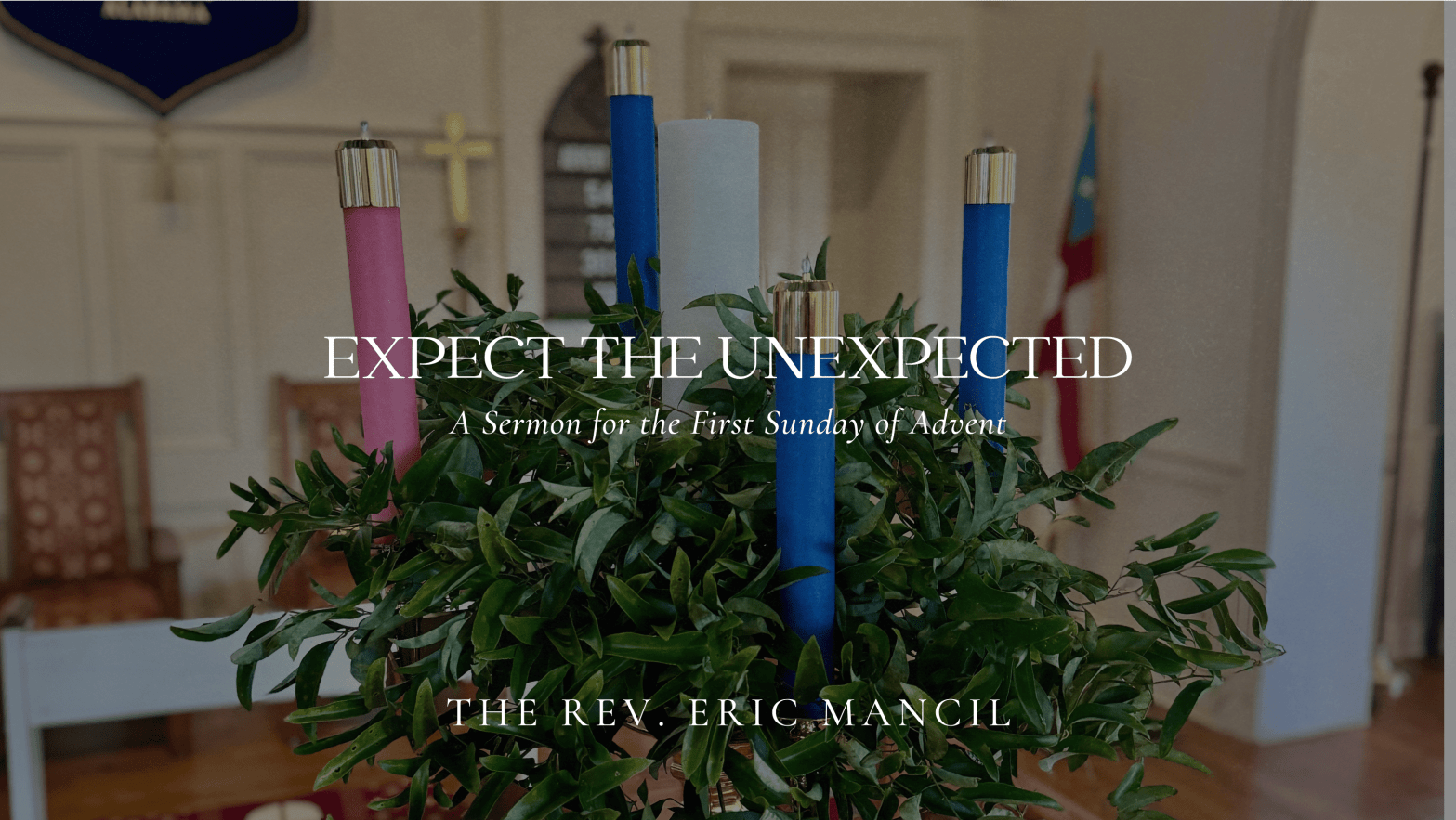
Every year we light the candles on the Advent wreath, sing the hymns, and hear the Scriptures retold because we need that reminder of God’s nearness and God’s peace.

But Advent is also a season of waiting in hopeful expectation for Christ to come again.

As much as we love the story of Mary and Joseph on their way to Bethlehem, Advent refuses to let us stay there.

It pulls our gaze forward—toward God’s promised future. A future where justice rolls down like waters, where peace is restored, and where every tear is wiped away.

I heard someone recently describe Advent with an old Catholic teaching that says the season is all about “the history, the mystery, and the majesty.”

I love that phrase.”History, mystery, and majesty.”

In history, we look back and remember the birth of Jesus in Bethlehem over two thousand years ago—God coming to dwell with us in human flesh.

In mystery, we recognize that Christ is with us even now, moving and working through his Body, the Church.

In majesty, we look ahead to the day when Christ will return in glory and make all things new.

And that framework helps us understand our Gospel reading this morning. Because today’s reading is not a countdown to Christmas.

It’s not Mary and Joseph. It’s not a sweet story about angels or shepherds keeping watch over their flock by night.

It’s Jesus pointing us toward the majesty—the promised day of his return.

This is a point in the Gospels where a lot of people start to get nervous.

Because Matthew 24 is one of those passages that’s been used, and sometimes misused, to stir up fear about the “end times.”

Some Christians have even used these verses—and others like it—to build up ideas about the “rapture”—this notion that some people will be swept up into heaven with Jesus while others are left behind.

It certainly paints a dramatic picture, and it’s become popular through novels, movies, and preachers online who claim to know the exact date when it will happen.

But here’s something important for us to remember:

This is not how Christians understood these passages for most of Church history.

The whole concept of a secret rapture is actually quite new.

It didn’t appear until the 1800s, when a preacher named John Nelson Darby proposed a new way of interpreting Scripture.

Before that, for nearly eighteen hundred years, no Christian theologian, bishop, or council taught anything like it.

It’s a very modern interpretation, not something rooted in historic Christian teaching, and it can distract us from the real message Jesus is giving us—not a message of fear or escape, but one of readiness and hope.

In our passage this morning from Matthew, Jesus isn’t trying to scare us.

He isn’t describing a secret evacuation plan where God rescues a few and abandons everyone else.

He’s telling us something far simpler—and far more hopeful: Be ready. Stay awake. Keep watch.

Because the Son of Man is coming to restore all things. And none of us knows the day or the hour.

Not even Jesus knows. Only the Father.

He’s calling us to live our lives in such a way that, whenever he does return, he finds us doing the work he’s given us to do.

The Gospel tells us to trust that Christ’s return is good news for the whole creation—not just some, but all. It will be a day of restoration—a day of healing and justice. Not a day to fear, but a day to hope for.

So, the question we should be asking in this passage is not, “How we do avoid being left behind?”

The real question is, “How do we live as people who are waiting for Christ’s return?”

How do we stay awake—not fearfully, but faithfully?

I think it has everything to do with our posture of waiting.

Christian waiting is not passive. It’s not sitting on our hands or looking for secret signs in the sky.

Christian waiting is active. It’s leaning forward with hope.


It’s living today as though Christ might come tomorrow—and wanting him to find us doing the work he’s given us to do.

And we already know what that work is, because we’re doing it all the time.

It’s everything we are called to do as the Body of Christ—

It’s caring for our neighbors through outreach ministries.

It’s feeding people through a warm meal on Thanksgiving Day.

It’s welcoming the stranger, or the person who thought there was no place for them in church.

It’s nurturing our children and youth through Christian formation.

It’s praying for one another—through good times and hard times.

It’s gathering for worship.

It’s caring for the sick and the grieving.

It’s serving with generosity and compassion.

It’s loving one another as Christ has loved us.

All of this—every single bit of it—is kingdom-building work. It’s our way of preparing for Christ’s return.

Not sitting back and waiting for Jesus to come and fix everything for us, but participating in God’s healing work right now.

It’s our way of saying, with our lives, “Come, Lord Jesus.”

Because Advent is not a season of fear.

It is a season of hope.

It’s about trusting that the darkness of this world will not have the final word.

It’s about believing that Christ is coming—not to destroy, but to heal. Not to abandon, but to restore. Not to frighten us, but to bring us into the fullness of God’s reign.

So as we enter this holy season of waiting—this season of history, mystery, and majesty—may we remember that Advent is far more than just a fun way to count down the days to Christmas.

It’s God’s call for us to wake up, to open our eyes, and to live in hopeful expectation.

It’s a season to look honestly at the darkness around us—and within us—and to hold fast to the light of Christ that no darkness can overcome.

It’s a call to live today in such a way that when Christ returns—whenever that may be—he finds us ready. Not because we predicted the hour, but because we lived with love.

So let us wait with joy.

Let us serve with purpose.

Let us hope with confidence.

For Christ has come,

Christ is with us now,

and Christ will come again.

Amen.

Expect the Unexpected

A Sermon for the First Sunday of Advent (Year C)
December 1, 2024

Text: Luke 21:25-36

Now, O Lord, take my lips, and speak through them. Take our minds, and think through them. Take our hearts, and set them on fire. In the name of the Father, and of the Son, and of the Holy Spirit. Amen.

There’s a lesson that my father once taught me at a young age. In fact, he started drilling this lesson into my head right around the age of fifteen, when I first started learning how to drive a car.

Every time I went with him to practice driving, I would get into the driver’s seat, and he would get into the passenger’s seat.

And, once I backed out of the driveway and started driving, he would always tell me, “Eric, you have to always expect the unexpected.”

Of course, being a fifteen year old at the time, I didn’t pay much attention to what he said, and there might’ve been some occasional eye rolling going on.

But, every time we went driving together, he would always say the same thing, and to this day, he still says it from time to time.

“You have to always expect the unexpected.”

What I think he meant by that was that I always needed to be alert and on the lookout for sign of trouble because terrible things could happen behind the wheel of a car in a matter of seconds.

My father always told me that it wasn’t me that he was worried about.

It was other people—distracted drivers on the road—who may not see me coming or who may be too focused on other things when they should have their complete attention focused on driving.

I still remember my father’s lesson from when I was fifteen, and while I’ve certainly made my fair share of mistakes behind the wheel of a car, his lesson has stayed with me all these years.

I still do my best to “expect the unexpected,” knowing that my life and the lives of those around me could drastically change in a moment’s notice.

In the blink of an eye, life as we know it can change.

Sometimes these changes are good for us, and sometimes they’re not so good.

Sometimes, what we thought we knew about something—or someone—turns out to be completely wrong, and we’re caught off guard.

Sometimes, unexpected things happen to us, and we don’t know what do or how to move forward.

So, the wisdom of the phrase “expect the unexpected” can help us prepare for those moments when it feels like everything has changed and we have no control over what’s happening.

Over the years, I’ve come to understand how the wisdom of the phrase “expect the unexpected” can also be used in our relationship with God.

I think about my own life and the things that have happened to me and my family over the years, things that I never imagined or thought possible.

There are moments and experiences that I can point to and say with absolute certainty that the only explanation for them happening was because of God.

I think about my call to the priesthood and deciding one day that God was calling me and my family to go to seminary, to pick up and move nine hundred miles away from our home in south Alabama to northern Virginia.

In my experience, I’ve discovered that, when God calls us, it often happens in ways that are unexpected and beyond our understanding.

I also think about those moments in the Scriptures when God calls the most unlikely people to serve in the most extraordinary ways.

The Old Testament is filled with good examples—people like Moses, who wasn’t the natural-born leader you’d expect God to choose. But despite his limitations and mistakes, God called him to set his people free and lead them out of slavery in Egypt into the land of promise.

The New Testament is also filled with good examples of how God chooses the most unlikely people to serve in the most remarkable ways.

Some of them we encounter early on in the Gospels, in the story of Jesus’ birth.

People like Elizabeth, the mother of John the Baptist, who’s told that she will bear and give birth to a son, even at her old age.

And her much younger relative, Mary, who is visited by the angel Gabriel and told that she will bear and give birth to the Son of God.

The Scriptures, especially the ones we hear during the seasons of Advent and Christmas, are filled with examples of why we should always “expect the unexpected” when it comes to God and God’s plan for salvation.

In fact, if I could assign a tagline to the season of Advent, it would be “expect the unexpected.”

Expect that God is doing a new thing.

Expect that, even now, God is working to make all things new.

This was true two thousand years ago in a small town called Bethlehem.

And, it’s true for us today as well as we await the return of Christ.

God came into the world in this amazing, unexpected way by sending his only Son to be born of a human mother, to live and die as one of us, and to show us the way to everlasting life and peace with God.

Despite everything that could’ve gone wrong—despite the fear and uncertainty that Mary and Joseph likely felt in the days and weeks leading up to the birth of Jesus—despite all the odds stacked against them—nothing could stop the light from coming into the world.

Love came down from heaven on that first Christmas Day, and the world has been changed forever.

The seasons of Advent and Christmas invite us to contemplate the miracle of Christ’s birth, but these seasons of the Church year aren’t just about a single event that took place centuries ago.

They’re also about what God in Christ is doing now—in our own time and place—and what God is preparing us for in the future.

This is the reason why our Gospel lesson for this morning—on this First Sunday of Advent—looks ahead to the final coming of Christ.

Jesus is warning his disciples to stay alert—to keep awake and be prepared for the day of his return.

He tells them, “There will be signs in the sun, the moon, and the stars, and on the earth distress among nations confused by the roaring of the sea and the waves.

People will faint from fear and foreboding of what is coming upon the world, for the powers of the heavens will be shaken. Then they will see ‘the Son of Man coming in a cloud’ with power and great glory.”

From the description Jesus gives us, it sounds like something we should be afraid of, doesn’t it?

The picture Jesus paints doesn’t exactly stir comforting thoughts or emotions.

It sounds terrifying, to be honest.

Like, we want Jesus to come back, but maybe not too soon.

But, I don’t think Jesus said these things to scare us.

I think it was a wake-up call.

I think it was his way of saying to the disciples—and to us—that one day, everything as we know it now will fade away, and we need to be ready.

The Son of Man will return and finally bring to fulfillment God’s reign of peace on the earth.

The old heaven and the old earth will pass away, and a new creation will be born.

And, until that day comes, it’s our call, as Christians, to help make God’s Kingdom a reality.

So, our Gospel lesson this morning from Luke shouldn’t be read as a message of fear.

It’s actually a message of hope—hope that, one day, God’s plan of redemption will finally be fulfilled.

Jesus says it like this: “Now when these things begin to take place, stand up and raise your heads, because your redemption is drawing near.”

St. Bernard of Clairvaux, a French theologian and Benedictine monk who lived during the eleventh century, once wrote that there are actually three advents—or three comings of Christ.

In the first Advent, Christ came to us as a helpless child, born of a human mother, to usher in the Kingdom of God and to bring salvation to the world.

In the third and final Advent, Christ will come again and will bring to fulfillment God’s Kingdom. He will judge both the living and the dead, and his kingdom will have no end.

The second Advent of Christ is where we find ourselves now, in our own day and time and in every moment of our lives. Christ is present with us wherever we go, and we see Christ in every person we encounter.

If Bernard is right—and I like to think that he is—then we’re living in between the first and third Advents of Christ.

Our lives are the middle part—the second coming of Christ.

We have the ability, through our words and actions, to make the love of Christ present— here and now.

We have the ability to be the hands and feet of Christ in the world around us—to bring light to where there’s darkness—to bring hope where there’s despair.

And so, as we begin the season of Advent, let us draw close to Jesus and consider what God would have us do with the lives we’ve been given.

Because you never know where God will call us to go next.

But, we can trust that, wherever we’re called to go, God will be with us, and God will use us to help bring to fulfillment his plan of redemption.

Expect the unexpected.

Expect that God is doing a new thing.

Expect that, even now, God is working to make all things new.

Amen.