Walk Humbly

A Sermon for the Fourth Sunday after the Epiphany (Year A)
February 1, 2026

Texts: Micah 6:1-8; 1 Corinthians 1:18-31; Matthew 5:1-12

Now, O Lord, take my lips, and speak through them. Take our minds, and think through them. Take our hearts, and set them on fire. In the name of the Father, and of the Son, and of the Holy Spirit. Amen.

Sometimes the readings we hear in church feel kind of random, don’t they? We find them interesting and meaningful, but sometimes it’s a stretch to figure out how God is speaking to us through them.

They can feel like words meant for another time and place, and we have to work a little harder to connect them to what’s actually going on in our lives right now.

And then there are Sundays like this one—where the readings practically reach out and grab us. They don’t feel distant or random at all.

They feel close. Maybe uncomfortably close—naming the tension, the fear, and the longing we’re living with right now, and inviting us to hear what God might be trying to say in the midst of it all.

Let’s start with our lesson this morning from Micah.

Micah was a prophet who lived eight hundred years before Christ, speaking to the people of Judah during a time of political unrest and social breakdown.

On the surface, things looked fine. People were worshiping. The rituals were being followed. The outward signs of faith were all there.

But underneath it all, something was deeply wrong.

The powerful were taking advantage of the weak. Justice depended on who you were and how much influence you had. Trust between people had eroded. And many were wondering whether God had abandoned them—or whether they had wandered away from God without even noticing.

Micah doesn’t spend much time arguing. He asks a simple question that cuts straight to the heart:

What does the Lord require of you?

The answer is simple, but it isn’t easy.

Do justice.

Love kindness.

Walk humbly with your God.

I think that last phrase really matters.

Walk humbly.

Not stand proudly. Not needing to have the perfect answer to every question. Not needing to be right while someone else is wrong.

Just walking—step by step—aware that we don’t see the whole picture and trusting that we need God’s guidance along the way.

Micah is reminding the people—and us—that faithfulness isn’t about saying the right things or performing the right rituals.

It’s about how we live.

It’s about how we treat others. How we carry ourselves through uncertain times.

Then, in our second reading, we hear from Paul, writing to the church in Corinth.

This was a divided church.

People were arguing about leaders and loyalties.

Everyone was convinced they were right.

Paul doesn’t deny the disagreements are real. But, he refuses to let them define the church.

Instead, he points them to the cross.

God’s wisdom, Paul says, doesn’t look like winning arguments or gaining power. It looks like self-giving, sacrificial love. It looks foolish to the world—but it’s the way God brings us to eternal life.

And then we come to our Gospel lesson this morning from Matthew, which takes place not long after he calls his first disciples.

Jesus begins his public ministry by climbing a mountain, sitting down with his disciples, and speaking to a crowd of ordinary people.

He doesn’t start with a list of instructions or warnings.

He starts with blessing.

Blessed are the poor in spirit.
Blessed are those who mourn.
Blessed are the meek.

In other words, blessed are the people who feel overwhelmed, grieving, unsure, and worn down.

Friends, I can’t think of a more fitting passage of Scripture for us today.

Because we’re living in a time right now when many people feel exactly that way.

There is unrest in our country.

Real fear. Real grief.

We see violence in the news. We hear stories that leave us shaken. We feel the strain in our communities and in our conversations.

And even when events happen far away—like what’s been happening in Minnesota—they affect us. We feel it in our bodies. It weighs heavily on our souls.

Some people are grieving deeply.

Some are afraid.

Some are angry.

Some are confused and trying to figure out how to be faithful to God right now.

And some are simply tired.

In a moment like this, it can feel risky to say anything out loud.

Any word can sound like choosing sides or being “too political.”

But the church’s calling isn’t to stay silent all the time—or to stir things up for the sake of it.

Our calling is to tell the truth about the world God loves and to listen carefully for where the Spirit is leading us.

And this is where one line from the Beatitudes really matters:

“Blessed are those who hunger and thirst for righteousness.”

That hunger—that longing for things to be made right—is something many of us feel.

We want the world to be a safer and kinder place. We want peace. We want all people to be treated with dignity and respect. We want truth to matter. We want harm to stop.

That longing can show up in lots of ways.

It can sound like grief. Or frustration. Or determination. Or even weariness.

In the Bible, righteousness isn’t about being morally superior or having all the answers. It’s about living in right relationship—with God, with one another, and with the world God loves.

To hunger and thirst for righteousness is to care deeply about how people are treated and to refuse to accept injustice as “just the way things are”.

Jesus doesn’t shame that longing.

He blesses it.

And he promises that it won’t be wasted.

Then Jesus adds another word that may be even harder for us to hear right now:

“Blessed are the peacemakers.”

Not people who avoid conflict.
Not people who pretend everything is fine.
Peacemakers.

Peacemaking can be slow work.

It requires patience.

It means staying present when it would be easier to walk away.

It means speaking honestly without cruelty and listening without immediately trying to defend ourselves.

In a world that constantly pushes us to choose sides, peacemakers choose not to be driven by fear or anger, but to stay grounded in love and faithfulness.

Earlier this week, our Bishop shared a message with the Diocese, acknowledging how heavy this moment feels and how unsure many people are about what faithfulness looks like right now.

If you haven’t had a chance to watch the video or read the Bishop’s message, I encourage you to do so.

He reminded us that prayer is not passive.

Prayer is how we listen to God.

It’s how God shapes our hearts.

It’s how we find the courage to take the next faithful step—even when we don’t see the whole path ahead.

Prayer prepares us to speak and act with love.

And that feels right to me, especially in a time like this.

Jesus doesn’t promise that following him will make life easier.

But he does promise that God is present—especially with those who mourn, with those who hunger and thirst for what’s right, and with those who work for peace.

So maybe the invitation for us today is simple.

Walk humbly with your God.

Pay attention to the hunger you feel for what’s right.

Pray—not to escape the world, but to let God open our hearts so that love might flow through us.

And trust that, even now, God is working to make all things new.

May we be a people who take Jesus seriously.

May we refuse to let fear or despair have the final word.

And may we be guided—day by day—not by anger, but by love.

Let us pray:

Gracious and loving God, we come before you this morning carrying many things in our hearts. We bring you the weight of this moment—the unrest we see around us, the fear and anxiety we feel within us, the grief borne by families and communities whose lives have been forever changed.

Be near to those who mourn. Comfort those who grieve sudden loss. Hold close those who are afraid for their safety, their future, or their loved ones. Be especially present with those who feel unseen, unheard, or forgotten.

We pray for our nation in this troubled time. Where anger is loud, teach us to listen. Where fear has taken root, plant courage and compassion. Where truth has been distorted or dismissed, guide us back to what is honest and life-giving.

Give wisdom to those who hold authority and responsibility. Grant humility to leaders, restraint to those with power, and a shared commitment to justice, dignity, and peace.

We pray for your Church, called to bear witness to your love in a divided world. Keep us from despair. Guard us against dehumanizing one another. Teach us how to speak with truth and gentleness, how to listen with patience, and how to walk humbly with you.

Shape us into peacemakers—not passive, not silent, but faithful, courageous, and rooted in love.

We pray for all who hunger and thirst for righteousness. For those longing for things to be made right. For those working quietly for healing, reconciliation, and hope. For those unsure of their next step, waiting for clarity.

Meet that hunger, O God. Fill it not with certainty, but with wisdom. Not with haste, but with courage. Not with fear, but with love.

Strengthen us by your Spirit to trust that you are at work even now—in grief and in hope, in uncertainty and in faithfulness. Embolden us, O God, not by fear or anger, but by love shaped through prayer, humility, and faithful action. All this we ask in the name of Jesus Christ, the Prince of Peace and the One who calls us all children of God.

Amen.

Andrew’s Witness

A Sermon for the Second Sunday after the Epiphany (Year A)
Service of Installation for the Brotherhood of St. Andrew
January 18, 2026

Text: John 1:29-42

Now, O Lord, take my lips, and speak through them. Take our minds, and think through them. Take our hearts, and set them on fire. In the name of the Father, and of the Son, and of the Holy Spirit. Amen.

Have you ever had something happen to you that was so exciting that you just had to share it with someone? Maybe it was a trip you took to a place you had never been before. Or maybe it was a delicious meal at a new restaurant or a movie you recently watched that moved you. Or maybe it was an experience that changed your life in some way or opened your eyes to new ideas and new perspectives.

And after it was all said and done, you just couldn’t wait to share it with someone—anyone—maybe a close friend or family member or even a simple post on your Facebook page.

I’ve had plenty of experiences like that before—some big, some small—and as I was reflecting on my sermon for this week, I came to realize that the most life-changing experiences of my life—the ones I’ve wanted to share with the most people—all have to do with camp.

Whether it was attending a Cursillo weekend or leading a week-long summer camp program down at Camp Beckwith for a bunch of kids, those are the experiences that come to mind first.

Those are the ones where I come home renewed and energized and excited to share stories about what happened and why it was so meaningful.

We’ve all had moments and experiences like that.

We’ve all experienced things that bring us so much joy that it’s hard to keep it to ourselves.

And I think—at least at some level—it’s because we have this basic, human instinct to share things about ourselves with other people—especially those things that excite us.

When you think about it, it makes perfect sense.

God created us for relationship, and one of the best ways we can build relationships with other people is by sharing with them the things that bring us the most joy—the things that matter to us most.

I want us to hold on to that idea because I think it has a lot to do with today’s Gospel lesson and the call of the first disciples.

Today’s reading comes from the first chapter of John’s Gospel.

Now, John doesn’t begin his Gospel with the story of Jesus’ birth, like it does in Matthew and Luke.

It begins with a beautiful, poetic prologue—and speaks of Jesus as the Word of God which came down from heaven to be a light for the whole world—the True Light that no darkness can overcome.

And from there, John 1 quickly moves to the introduction of John the Baptist, the one who was sent by God as a witness to testify to the Light so that all might believe through him.

And that’s where our reading picks up today.

Today’s lesson begins, not with Jesus at the center, but with John the Baptist standing at the Jordan River.

There’s a large crowd gathered around him.

People have come from far and wide to hear him preach, to confess their sins, and to be baptized.

There’s a sense of urgency in his message—a sense that something new is about to happen.

And yet, for all the attention to be focused on him, he’s very clear about one thing: it’s not about him.

Again and again, John the Baptist tells the crowd that he’s been called by God to be a witness. His only purpose is to draw everyone’s focus toward another—toward the one who is coming after him.

And then one day, Jesus walks by.

John sees him approaching and says the words that set everything else in motion: “Here is the Lamb of God who takes away the sin of the world.”

With that simple declaration, the attention turns toward Jesus. John steps back so that Jesus can step forward and begin his ministry.

Two of John’s disciples hear what he says, and instead of staying where they are, they decide to follow Jesus.

They walk behind him, unsure of what they’re looking for, but captivated none the less.

Then, Jesus turns and asks a simple question.

“What are you looking for?”

And instead of answering Jesus, they ask him, “Rabbi, where are you staying?”

Jesus doesn’t offer any explanation.

He simply says, “Come and see.”

One of those disciples is Andrew.

John doesn’t tell us exactly why Andrew and the other disciple decided to follow Jesus.

The Gospel gives us no explanation—only the sense that something amazing must have happened in their encounter with Jesus that changed their lives forever.

Because what’s the very first thing Andrew does after meeting Jesus? 

He goes and finds his brother, Simon, and brings him to meet Jesus.

Andrew doesn’t keep the Good News to himself.

He shares it.

He invites his brother to come and see for himself this amazing thing that’s happened.

Andrew serves as an example for all of us of how we’re called to share the Gospel.

We don’t have to try and sell it.

We don’t have to persuade anyone or try to convince them with prepared speeches.

All we have to do is extend the invitation.

“Come and see.”

Come and see for yourself the love of Jesus and how following him will change your life.

It’s the example of Andrew that I want to lift up today—not only because it’s in our lesson from John but also because this morning, we’re celebrating the birth of a new ministry at St. Mary’s—the Brotherhood of St. Andrew.

And I thought I might take a few minutes this morning to share with you a little bit about this new ministry and how it all began.

On November 30, 1883–The Feast of St. Andrew—a small group of young men gathered at St. James Church in Chicago.

They gathered, not to start a new group or to launch a movement, but to simply pray together and study Scripture.

Most of them were teenagers, around seventeen years old. They weren’t priests. They weren’t church leaders. They were young men, trying to figure out what it means to follow Jesus in the world around them.

They believed that the work of evangelism—the work of inviting others into a relationship with Jesus—belonged not just to clergy and missionaries, but to all Christians.

Their vision was simple. They didn’t use fancy programs or strategies. They relied on relationships. They prayed together. They studied the Bible together, and they invited others to join them.

In other words, they followed the example of Andrew.

And something remarkable happened.

That small group of men who gathered for prayer and Bible study quickly grew. Within just a few years, other groups started forming across the country.

Young men and boys gathered in churches, homes, and meeting halls to pray, study the Bible, and encourage one another in faith. They took seriously the idea that the way they live their lives—their words and actions—should point others toward Christ.

Within a decade, this movement had spread beyond the United States into other countries like England, Japan, and even China. What began as a handful of teenagers praying together on St. Andrew’s Day became an international movement of Christian witness and discipleship.

By 1908, the movement was formally incorporated by an act of the United States Congress and signed into law by President Theodore Roosevelt. It read: “The sole object of said corporation shall be the spread of Christ’s Kingdom among men.”

That movement came to be known as the Brotherhood of St. Andrew—named not after a renowned preacher or theologian, but after a disciple whose quiet faith was lived out by inviting others to experience the love of God in Christ Jesus.

That legacy continues today at St. Mary’s as we begin a new chapter of the Brotherhood and install our first members.

Today, we’re affirming a new call to ministry:

A call to prayer.

A call to service.

A call to grow deeper in faith and discipleship.

And a call to live lives that faithfully and authentically point others toward Jesus.

Our new Brothers aren’t being called to be perfect.

They’re being invited to follow Jesus more deeply—and to help create a space where others can follow him, too.

Like Andrew, they’re being called to trust that faith grows, not through pressure or fear, but through relationship. That Christ is revealed not only through words, but through lives shaped by love, humility, and service.

And the truth is, dear friends, is that this calling is not just for the Brothers of St. Andrew.

It’s for all of us.

All of us have people in our lives—family members, friends, neighbors, coworkers—people who know us well enough to know what matters to us most. People who are watching the way we go about our lives to see how faith shapes the way we live.

We may not be called to stand in a pulpit or lead a Bible study.

We might not think of ourselves as evangelists.

But we can live our lives open and honest enough that others become curious.

Curious enough to ask questions about where we find such joy and peace in our lives.

Curious enough to wonder why this Jesus is so important and how he’s changed our lives forever.

In the words of that old, beloved hymn:

“If you cannot preach like Peter and you cannot pray like Paul, just tell the love of Jesus, how he died to save us all.”

All it takes is one simple invitation.

“Come and see.”

Amen.

Righteous Joseph

A Sermon for the Second Sunday after Christmas Day (Year A)
January 4, 2026

Text: Matthew 2: 13-15, 19-23

Now, O Lord, take my lips, and speak through them. Take our minds, and think through them. Take our hearts, and set them on fire. In the name of the Father, and of the Son, and of the Holy Spirit. Amen.

One of the quiet gifts of the Christmas season is the story of Joseph. He doesn’t say very much. He never gives a speech. He doesn’t ask questions out loud.

And yet, without Joseph’s faithfulness—without his willingness to listen and respond to God’s call—the story of Jesus’ birth unfolds very differently.

The author of Matthew calls Joseph righteous.

But his righteousness isn’t the same as certainty or control. It doesn’t mean having all the answers or knowing how everything will turn out.

It looks like paying attention. Like someone who listens carefully for God’s voice and is willing to act—even when it disrupts his plans and changes the life he thought he was going to have.

Joseph’s righteousness is quiet and steady.

But it’s also costly.

From the very beginning, Joseph is asked to set aside what he wants in order to care for Mary and the child entrusted to him.

Think back to the Gospel we heard a couple weeks ago on the Fourth Sunday of Advent.

At the beginning of Matthew’s version of the Christmas story, Joseph has learned that Mary is pregnant, and he knows the child is not his.

But Matthew also tells us that he’s righteous—and unwilling to expose Mary to public disgrace.

He considers dismissing her quietly—a path that seems reasonable given the circumstances and the expectations of his community.

It would’ve been a way for him to step back and find his way out of a difficult and confusing situation—a plan that would allow him to protect Mary and preserve his own reputation at the same time.

But before Joseph acts on what seems reasonable, God steps in.

In a dream, an angel says to him, “Do not be afraid to take Mary as your wife, for the child conceived in her is from the Holy Spirit.”

Joseph is asked to trust in something he doesn’t understand and to place his life at the service of what God is doing.

That moment sets the pattern for everything that follows.

Joseph wakes up from the dream, and he does what the angel of the Lord commanded him.

He doesn’t fully understand.

But he responds.

That’s what righteousness looks like in Matthew’s Gospel—not perfection or certainty, but listening and responding to God.

In today’s Gospel, we see the same pattern—but the tone shifts in a dramatic way.

The wise men—who we’ll hear about in a couple of days on the Feast of the Epiphany—have just left the Holy Family.

Their visit, which was meant to honor a newborn king, has also stirred up fear and violence.

Word has reached Herod that a child has been born who is called King. 

And Herod, whose power is built on fear and force, responds the only way a tyrant knows how—with cruelty.

So Joseph receives another dream.

Matthew tells us that an angel appears and warns him to take the child and his mother and flee to the land of Egypt.

As one author wrote, this dream may not have been comforting or reassuring.

It may have been closer to a nightmare.

Perhaps Joseph was shown what was about to happen in Bethlehem.

Perhaps he sensed that staying would place Mary and the child in terrible danger.

Perhaps the dream carried not peace, but urgency—the kind that wakes you from sleep and leaves your heart racing.

Get up. Take the child and his mother, and leave as fast as you can.

Joseph isn’t told how long the danger will last.

He isn’t told what life in Egypt will look like.

He isn’t promised comfort or certainty.

Once again, Joseph is asked to leave behind what he knows and to trust that God is speaking even when the message is frightening and unclear.

And once again, Joseph listens.

Matthew tells us that he gets up in the middle of the night, takes the child and his mother, and leaves Bethlehem.

He does what the angel of the Lord commands him. He moves before questions can settle in. He moves because it’s what God asks him to do.

And because Joseph listens, the child lives.

Not long after, the Church remembers what happens next.

Every year, on December 28, we commemorate the Holy Innocents—the children of Bethlehem who didn’t escape Herod’s cruelty, whose lives were taken by violence beyond their parents’ control.

Their story is one we’d rather skip past, especially during the season of Christmas. And yet Matthew refuses to let us look away.

Matthew’s version of the Christmas story brings into focus a hard truth: even in the midst of Christmas joy, Jesus is born into a dark world. A world where fear still drives evil and cruelty. A world where the innocent still suffer and those who cling to power will sometimes do unspeakable things to protect it.

The story of the Holy Innocents reminds us that the brokenness of the world is not confined to the past.

The names and faces may change, but evil still exists.

And so does God’s response—not through revenge or violence, but through presence and faithfulness and the quiet, courageous protection of life whenever it’s threatened.

Joseph’s obedience doesn’t erase the tragedy of the Holy Innocents.

But it becomes part of God’s response to the darkness.

God doesn’t overcome Herod with force.

God saves a child through the faithfulness of one man.

And that matters—even for us today.

Christmas is the season when the True Light is revealed to the world.

“The light shines in the darkness, and the darkness does not overcome it.”

But Matthew reminds us that the Light doesn’t erase the darkness all at once. Instead, the Light enters it. The Light moves through it. The Light is carried forward—often quietly and at great cost.

Joseph doesn’t just bear witness to the Light.

He responds to it and shapes his life around it.

And for those of us who’ve been baptized, that same Light burns deep within us. It calls us to live differently in the world, to order our lives around love, trust, and faithfulness, even when that faithfulness leads us to places we don’t fully understand.

That call feels timely as we stand at the beginning of a new year.

2025 has come and gone. And as our Bishop recently reminded us in his Christmas Eve message, “What’s been done has been done. Let it be.”

The beginning of a new year is a time when many of us naturally reflect on where we’ve been and where we’re going.

We look back on joys and losses, on things that went as planned and things that didn’t.

And we look ahead to the new year—thinking about what we want to change, what we want to do better, and what we hope the next year will hold.

Many of us make New Year’s resolutions. We set goals. We imagine a better version of ourselves.

And those can be good and meaningful practices.

But perhaps the deeper question for us this year is not simply, “What do I want to accomplish?”

Perhaps the deeper question is, “How is God calling me to live more faithfully?”

What is God asking me to listen to right now, in this chapter of my life?

What is God asking me to protect?

What has God placed before me that I didn’t choose, but can’t ignore?

Like Joseph, we may not be given the whole picture. We may not know exactly where faithfulness will lead. We may not be promised comfort or clarity.

But we can trust that responding in love is never wasted.

Joseph didn’t know everything.

But he listened.

And time and again—when the angel spoke and the path ahead was unclear—Joseph did what God asked him to do.

That’s what righteousness looks like.

As we move into this new year, may we learn from Joseph’s quiet courage. May we listen for God’s voice—not only when it comforts us, but also when it‘s the loving thing to do. And may we have the faith to respond, shaping our lives around the True Light that’s been revealed to us in the babe lying in the manger.

Amen.

In Those Days

A Sermon for the Nativity of our Lord Jesus Christ
Wednesday, December 24, 2025

Gracious and loving God,
we thank you for this holy night
and for the gift of your Son, Jesus.
As we gather to celebrate his birth,
open our hearts to your peace,
fill us with your hope,
and remind us of your love for the world.
Be present with us now,
and draw us closer to you and to one another,
through Jesus Christ our Lord.
Amen.

Christmas Eve has a way of pulling us back in time. Each year, we gather to worship on this night. We hear a familiar story—the same one we heard just a few moments ago from Luke’s Gospel. We sing familiar songs—the ones we look forward to singing all year long. We remember something that happened long ago, in a far-off place.

And if we’re not careful, Christmas can start to feel like something we simply look back on—a beautiful story from the past, treasured and retold, but safely contained in history.

But the truth is, dear friends, Christmas isn’t just something that happened a long time ago.

It’s something that keeps happening. Christ continues to be born among us. Jesus continues to be present.

God continues to break into our lives—often in ways that are quiet and unexpected—right in the middle of real human experience.

I’ve been reminded of that recently in my own ministry as a priest, and tonight, I want share with you a few examples of that—a few stories about how God has been working through my life and the life of this church.


Earlier this month—at the beginning of December—I was invited to be the guest speaker at a service of remembrance for the Angel of Hope.

For those of you who don’t know, the Angel of Hope is a bronze statue here in Andalusia, dedicated to the memory of deceased children in Covington County.

It’s located downtown near Robinson Park, and each year in December there’s a service of remembrance for families in our community who’ve lost a child.

I had never been to the service before, and I didn’t really know what to expect. So, when I was invited to speak, I prepared what I hoped were the right words, a message that might offer some measure of comfort.

That night, the weather was too cold to gather outside by the statue where the service is normally held. So instead, we gathered in a small room inside the Adult Activity Center.

Families filled the room.

And once the service began, it became clear that this gathering mattered deeply to those who were there.

It was a place where people could remember their loved ones without pretending everything was okay.

A place where they could grieve without feeling embarrassed or having to explain why they were there.

A place where no one rushed them through their pain.

I offered a message, and we made it through the rest of the service.

And what stayed with me most from that experience was the sense of community and genuine care that people had for each other.

People sitting next to each other, side by side.

Holding space for one another.

Allowing grief—and even healing—to take place.

And in that small room, in the midst of heavy and tender hearts, Christ was present—not as an easy answer or a quick fix, but as comfort and compassion. As Emmanuel—God with us.

Christ was being born there.


A week before that, at the end of November, we gathered at the church for Joe’s Community Dinner for Thanksgiving.

Many of you know this ministry well.

Every year we offer a hot meal to anyone in our community who needs it—those who want to eat with us in the Parish Hall, or take a plate to go, or have a meal delivered.

It’s one of the ways we try to extend the hospitality of Christ beyond these walls—and we’ll do the same tomorrow morning on Christmas Day.

What you may not know is that sometimes the phone calls we receive from people asking for delivery come with stories.

A couple of weeks before Thanksgiving, one woman called the church office asking to receive a meal delivered to her home, and I had the chance to talk with her for a few minutes.

She told me how important this meal was to her.

I could hear in her voice just how much it meant when she said how thankful she was for St. Mary’s—because without it, she wouldn’t have had a Thanksgiving meal at all.

It was a simple thing.

A hot meal. A quick delivery.

And yet, for her, it meant so much.

It meant connection.

It meant being remembered.

In that phone call and in that shared meal, Christ was present—quietly, humbly, without any special attention.

Christ was being born there.


Then just last week, we were at Laundry Love, down the street at the laundromat.

On the third Thursday of each month, a few of us from the church show up with laundry detergent, dryer sheets, and rolls of quarters, and we help people get started with their laundry.

It may not seem like much.

It’s small, simple, and easy to overlook.

But it’s one more way we can share the love of Christ with our neighbors—especially those who need it most.

That night, I met a couple I hadn’t met before. They seemed kind, but clearly struggling.

I introduced myself, told them I was the priest at St. Mary’s, and explained why we were there. They had already washed their clothes, but I offered to help them get started with the dryers.

After the dryer began to run, the woman came up to me and asked if I would pray for her.

And right there, in the middle of the laundromat, we stopped and prayed. When I was done, she smiled, thanked me, and walked away.

Not long after that, the man came up and asked me the same question.

“Will you pray for me?”

I asked him if there was anything specific he’d like for me to pray for, and he shared with me that he was having a difficult time in his relationship and that he had done some things he wasn’t proud of.

He asked me if I would pray for God to forgive him.

So I took his hands, and we prayed—right there between the washers and dryers. When we finished, he smiled, thanked me, and walked away.

Looking back on that night, what stayed with me most wasn’t the prayer, but the ministry of presence—and the gift of being able to stop and listen and stand with someone in a moment of need.

In that laundromat, Christ was present in mercy, in forgiveness, and grace.

Not in a sanctuary or church, but an ordinary place.

Christ was being born there, too.


I wanted to share these stories with you because they remind us that Christmas isn’t just something we remember—it’s something we continue to live.

The story of Jesus’ birth doesn’t begin with “once upon a time,” like a fairy tale.

It begins with three simple words:

“In those days…”

In those days, a decree went out from the emperor of Rome that everyone should be registered.

In those days, Mary and Joseph made the long journey from Nazareth to Bethlehem.

In those days, she gave birth to her firstborn son and named him Jesus.

In those days…

A particular time and place.

With real people and real hardships.

Jesus wasn’t born in a perfect world.

He was born into a world just as it was—crowded and uncertain, vulnerable and weary.

God didn’t wait for the right moment.

God didn’t wait for peace and stability.

God stepped in, and gave us the most precious gift.

That’s the miracle of Christmas.

God shows up in the midst of real life and real circumstances.

Jesus was born in those days—but the story didn’t end there.

Christmas continues whenever Christ is made present through love, compassion, and forgiveness—whenever we show up for one another and make room for God to work through us.

Which is why it matters, now more than ever, that we continue to do the work that God has called us to do as the Church—by showing up in the lives of those around us and making the love of Christ known in the world.

The late theologian and spiritual writer, Howard Thurman, once wrote that when the song of the angels is stilled and the star in the sky is gone, the work of Christmas begins…

to find the lost,
to heal the broken,
to feed the hungry,
to release the prisoner,
to rebuild the nations,
to bring peace among others,
to make music in the heart.

That’s how Christmas keeps happening.

In those days, God came among us as a child.

And even now, God still comes—through acts of compassion and generosity, through presence and the love we share with others.

You don’t have to travel to Bethlehem to witness Christmas.

You can see it whenever a grieving parent is loved and cared for.

Whenever the needs of the most vulnerable are met with kindness and generosity.

Whenever words of forgiveness are spoken.

Whenever someone is reminded they’re not alone.

In those days, God came among us.

And in these days, God is still with us.

And that’s the good news of Christmas.

Amen.

Look Again

A Sermon for the Third Sunday of Advent (Year A)
December 14, 2025

Text: Matthew 11:2-11

Now, O Lord, take my lips, and speak through them. Take our minds, and think through them. Take our hearts, and set them on fire. In the name of the Father, and of the Son, and of the Holy Spirit. Amen.

Chelsea and I were sitting on the couch the other day, trying to pick out a Christmas movie to watch. And you know how that goes—you keep scrolling through all the channels, thinking, surely we’re going to find something good to watch.

And before you know it, you’ve spent more time choosing a movie than it would have taken to actually watch one.

Then I remembered a movie I’d been meaning to watch for a while called The Best Christmas Pageant Ever.

It’s a relatively new film—only about a year old—but it’s based on a much older and well-loved book by Barbara Robinson.

The book was written back in the 1970s, and Robinson once said it was inspired by her own experiences watching children—real, imperfect children—show up in church pageants and somehow reveal the heart of the Christmas story in ways adults often missed.

She wasn’t trying to write a sweet Christmas story. She was trying to tell the truth about how God tends to work: not always through the polished and prepared, but often through the unexpected.

So Chelsea and I finally watched it. And I have to say—it really is a good movie. If you’re looking for something meaningful to watch this season with your family, I highly recommend it.

If you know the story, you remember the Herdmans.

They’re a group of brothers and sisters who come from a rough home life and have a reputation for being loud, rough around the edges, and unpredictable. They don’t follow the rules at school. Kids are afraid to be around them. And when people see them coming, they tend to turn and walk the other way.

So when the Herdmans wander into church one Sunday and announce that they want to be in the annual Christmas pageant—and not just be in it, but take all the main roles—the congregation doesn’t quite know what to do.

They start to panic.

They worry the pageant will be ruined.

They worry it won’t be reverent enough, that something sacred will be turned into a mockery.

And if we’re honest with ourselves, we understand that reaction, don’t we? Because most of us carry clear expectations about how things should look and feel—especially around Christmas.

But then something unexpected happens.

For the first time in their lives, the Herdmans hear the Christmas story. They don’t just listen to it—they really hear it.

Not the cleaned-up, familiar version, but the real one. A story about a young mother and father far from home with no one to help them. A baby born in a stable because there was no room for them anywhere else. A family with nowhere to go. A powerful king threatened by a child.

And the Herdmans are stunned.

They can’t believe Mary and Joseph had no help.

They can’t believe Jesus was born among animals.

They can’t believe Herod wanted to kill the baby.

And they respond with this raw, honest emotion that catches everyone off guard. They feel the weight and danger of the story—the vulnerability of it. And as the church watches these children react, something begins to change.

The pageant becomes more than just a performance.

The story comes alive.

And Christmas becomes real again.

By the end of the movie, the very children everyone expected to ruin the Christmas pageant end up helping the whole congregation see Christmas again with fresh eyes.

Grace shows up where no one was looking.

God works through the people no one expected.

And sitting there watching the movie, I was moved to tears, because it was such a beautiful reminder that God often uses people we least expect to show us the truth of God’s love.

That’s what today’s Gospel lesson is all about—learning to look again at how God is working, even when it doesn’t fit our expectations.

John was someone who had very clear expectations about how God was supposed to work.

Just last week, we heard him preaching about fire and judgment—about axes at the root of the trees and a winnowing fork in hand—proclaiming a Messiah who would come in great power and set everything right.

And John didn’t just talk about that vision—he lived it. He spoke truth to power. He confronted injustice. He called people, even rulers and religious leaders, to repentance.

Eventually, that courage landed him in prison.

John was arrested because he confronted King Herod about his unlawful marriage to his brother’s wife. It was a prophetic word spoken to someone who didn’t want to hear it.

And like so many truth-tellers before him, John paid the price. He was bound, locked away, and silenced so he wouldn’t cause any more trouble.

That’s where our story picks up today.

John is sitting in a prison cell, and he starts hearing reports about what Jesus has been up to.

Jesus is healing people.

He’s restoring lives and lifting up the poor and the oppressed.

He’s preaching mercy, not judgment.

And it doesn’t line up with what John expected.

So John sends his disciples to Jesus with a question:

“Are you the one who is to come, or should we wait for another?”

In other words, “Jesus, you’re not what I expected. Are you really the Messiah?”

Jesus doesn’t scold John.

He doesn’t shame him for doubting or tell him to try harder or believe more.

Instead, Jesus tells John’s disciples to go back and report what they hear and see.

The blind receive their sight.
The lame walk.
The lepers are cleansed.
The deaf hear.
The dead are raised.
And the poor have good news brought to them.

And for those who knew the Scriptures—as John certainly did—those words would have sounded very familiar, echoing the promises of the prophet Isaiah about the day when God would come to heal the blind, restore the broken, and bring good news to the poor.

Jesus is saying to John, “Look again.”

Look again at what God is doing.
Look again at how the Kingdom is breaking in.
Look again—because God is at work, even if it doesn’t look the way you imagined.

Jesus isn’t telling John he was wrong to hope for something more. He’s helping him see the bigger picture. He’s helping him see that the Kingdom doesn’t come in the way he imagined—not through force or spectacle, but through healing, mercy, and a love that reaches people where they are.

He’s inviting John to open his eyes to the quiet ways the Kingdom of God is already breaking in.

“Look again,” Jesus says.

Not because John has failed, but because God is doing more than he imagined.

And Jesus invites us to do the same.

Because even though we don’t like to admit it, we’re often a lot like those people in the movie who doubted the Herdmans.

We’re quick to decide who belongs and who doesn’t. We assume we know who God can use and how God is supposed to show up.

But God has a way of surprising us, showing up through people and in places we never would have chosen.

So, Jesus tells us to look again.

Because if we don’t, we risk missing Christ altogether.

The season of Advent isn’t just about waiting for Jesus to come again and make all things new. It’s about learning to recognize Christ in the present.

And if we’re locked into narrow expectations—about who God can use and where God can work—we may walk right past Jesus without even knowing it.

We look again because Christ often comes quietly—because grace shows up in unexpected people.

We look again because God’s Kingdom breaks in at the margins—among the poor, the hurting, the overlooked, the ones who don’t fit in.

If Advent is about preparing for Christ to come again, then it’s also about preparing our eyes and our hearts to recognize him when he does.

If this season is about working toward the fulfillment of God’s Kingdom, then we have to learn to see the world as God sees it—to notice the broken corners of the world that are aching for healing and restoration.

So maybe this Advent, Jesus is saying to us what he said to John: “Look again.”

Look again at the people you’ve written off as unholy or undesirable or unredeemable.

Look again at the places you’ve given up on.

Look again at your own life and the quiet ways God may be at work.

Because when we look again—with openness and humility—we may discover that Christ has been with us all along—healing, restoring, and making all things new.

Amen.

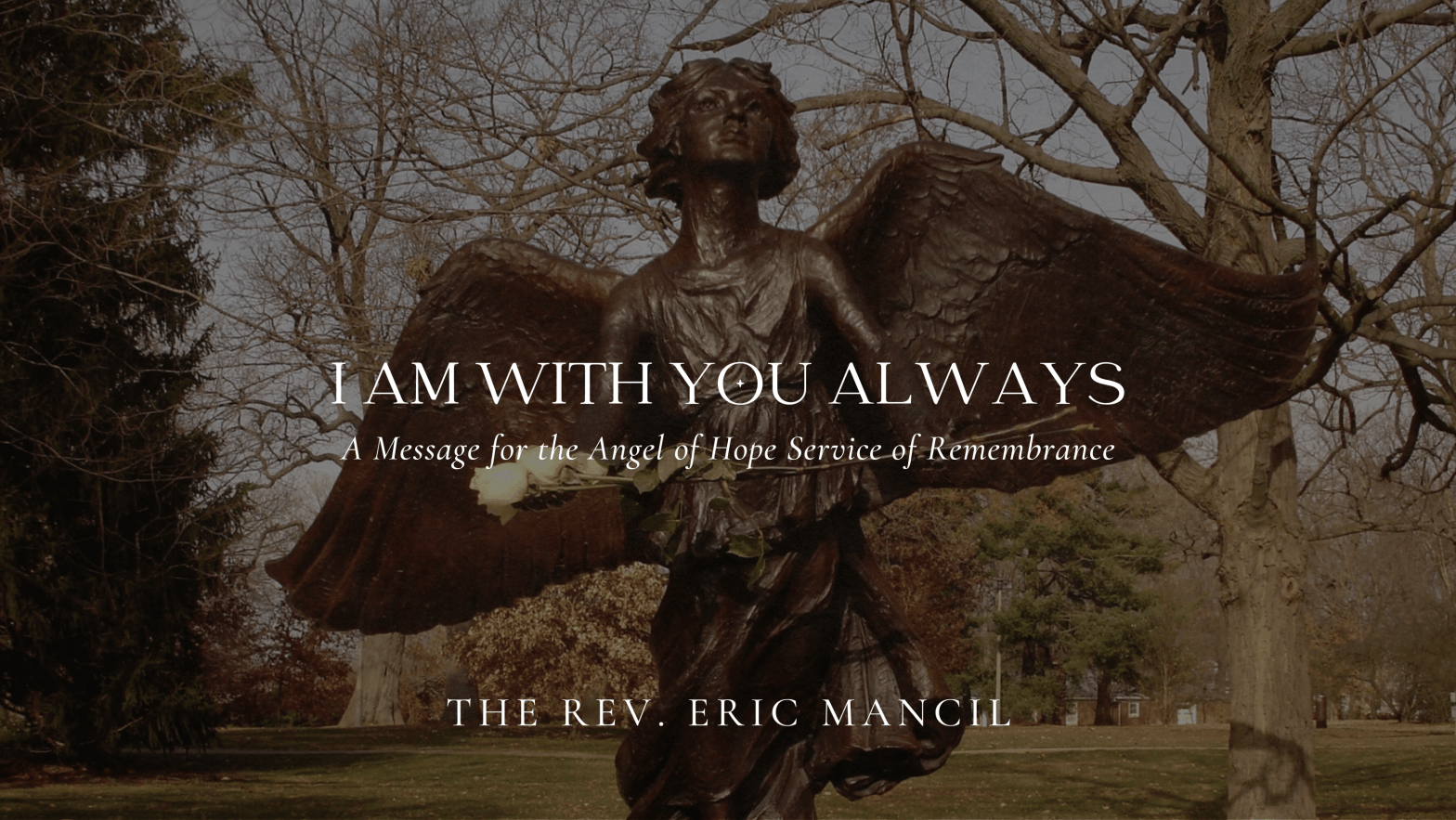
I Am With You Always

A Message for the Angel of Hope Service of Remembrance
Tuesday, December 2, 2025

Good evening, friends.

It’s an honor and a privilege to be with you tonight.

My name is Father Eric Mancil, and I serve as the rector of St. Mary’s Episcopal Church here in Andalusia.

I want to begin by offering my heartfelt thanks to Debbie Grimes and to the other officers for the Angel of Hope for inviting me to be part of this service of remembrance.

The work you do—the compassion you offer, the space you provide for those who grieve—matters deeply to families throughout Covington County. Thank you for making this night possible.

We gather here at the Angel of Hope because this is a sacred place.

Each of us comes here tonight with a story.

Each of us carries a name, a face, a memory that has shaped our life more deeply than words can describe.

Tonight, we gather because we know that love never ends.

And because grief—especially the grief of losing a child—doesn’t follow a timeline or conform to what the world expects of us.

This time of the year makes that especially clear.

As December begins, the world around us tells us we should be cheerful all the time and full of holiday joy.

Everywhere we turn, there are Christmas lights, decorations, music, and messages insisting that this season is all about celebration.

And yet—for so many who carry deep grief—this is the season that hurts the most.

The empty chair at the table, the tradition that feels incomplete, the memory that arrives without warning… all of these can take what is supposed to be a joyful time and make it heavy or too painful to bear.

And so tonight matters.

Tonight gives us permission to be honest.

Permission to feel what we feel.

Permission to acknowledge that grief doesn’t take a holiday break.

Here, in this sacred place, no one has to pretend.

No one has to hide their feelings or their questions.

No one has to put on the holiday mask the world expects. 

Tonight we simply come as we are—carrying all the love, all the longing, all the pain, and all the gratitude that come with remembering a child who will always be part of us.

As a pastor—and as a parent myself—I’ve walked with many people who’ve carried deep grief of all kinds.

And while I’ve never walked through the loss that many of you carry, I do know what it means to love a child with your whole heart.

I know the way a child becomes part of you, the way their life shapes your own.

And because of that, I can only begin to imagine the deep pain that comes with losing a son or daughter.

What I do know is that grief is not a problem to solve or something we should be expected to just “get over.”

Grief is love—love that still aches, love that still reaches, love that still remembers.

Some days that grief feels like a fresh wound.

Other days, it rests quietly in the background until a smell, or a song, or a moment brings it rushing back.

But in every case, grief becomes a companion we never asked for—one that walks with us day after day.

So, please hear me tonight when I say that there’s no right or wrong way to grieve.

There is no timetable.

There is no moment when you are “supposed” to just all of a sudden feel better.

Your grief is real.

Your journey is your own.

And for those who’ve lost a child, their life will always matter.

This Angel of Hope stands here for that very reason.

Her open arms, her outstretched wings, her quiet presence: they remind us that none of us grieve alone.

All around the world, more than 150 of these angels stand in communities just like this one, bearing witness to the truth that a parent’s love does not end with death.

This angel is not a symbol of a simple or shallow hope.

She represents a deeper kind of hope—the kind that rises even in sorrow, that reminds us love is never lost, and that assures us God will never leave us to face our pain alone.

As people of faith, we hold to a promise that sustains us: the promise that God is with us, even in our deepest pain.

Jesus never said we would not face sorrow or heartbreak.

He never said that life would be free from suffering.

What he did say—what he promised—is that we would never face those moments alone. “I am with you always,” he said.

Not just in the easy days, not just in the joyful days, but in the darkest nights and the heaviest hours.

Jesus knew grief.

He wept at the tomb of his friend, Lazarus.

He felt the sting of loss.

And because he knows grief from the inside, we can trust that he walks with us through ours—not to take the pain away, but to carry it with us, to lift us up when we fall, and to remind us that love is stronger than death itself.

In a few moments, many of you will come forward to place a flower at the Angel of Hope.

It is a simple act, but it carries such deep meaning.

It is a way of saying, “My child lived. My child was loved. My child is still loved.”

And through that love, their light continues—shining in your memories, in your stories, in the ways they shaped who you are.

And the hope we proclaim tonight, the hope of the Gospel, adds this: your child is held in the eternal embrace of God in a place where there is no pain, no fear, no suffering, only peace and love beyond our understanding.

Until that day when all things are made new and we’re reunited with those we love, God gives us the strength to keep going.

One breath at a time. One step at a time. One act of courage at a time.

My prayer for you tonight is that you feel surrounded by God’s love, upheld by this community, and filled—if even only for a moment—with a sense of peace.

You’re not alone. Not tonight. Not ever.

May the God who knows your story, who holds your tears, and who loves you and your child more than you can imagine, grant you comfort, strength, and hope—hope deep enough to carry you through the days ahead, and love strong enough to remind you that nothing, not even death, can separate us from the love of God in Christ Jesus.

Let us pray.

Holy and gracious God, tonight we lift before you the children we love and remember. We thank you for their lives, for the joy they brought us, for the ways they shaped our hearts and still shape them even now. Hold their families in your tender care. Surround them with your peace in moments of sorrow, your strength in moments of weakness, and your gentle presence when the weight of grief feels too heavy. Remind us that you are a God who walks with us—not to take away our pain, but to help us carry it, to lift us up when we fall, and to shine light into the darkness.

Bless each person gathered here tonight. Calm their anxious hearts, renew their courage, and fill them with a hope that lasts. And as we leave this place, help us to carry the love of our children with us—not as a burden, but as a sacred flame that continues to burn brightly. All this we pray in the name of the one who is our comfort and our hope, Jesus Christ our Lord. Amen.

Waiting with Hope

A Sermon for the First Sunday of Advent (Year A)
November 30, 2025

Text: Matthew 24:36-44

Now, O Lord, take my lips, and speak through them. Take our minds, and think through them. Take our hearts, and set them on fire. In the name of the Father, and of the Son, and of the Holy Spirit. Amen.

A few weeks ago, my family and I were in Auburn for the weekend. On our way out of town, heading back home, we decided to stop at Tiger Town and do a little shopping. And—much to my delight—we ended up at one of my favorite stores: World Market.

Has anyone ever been to World Market?

If you have, then you know—it’s one of those places filled with treasures from all over the world. Foods you’ve never heard of. Decorations from far-off places. Coffee, candy, and all kinds of kitchen gadgets you don’t really need but suddenly want.

It’s wonderful!

But my favorite time to go to World Market is around the holidays. That’s when the whole store lights up. There are beautiful Christmas ornaments everywhere, shelves full of Christmas cards, chocolates wrapped in shiny paper, and delicious things to nibble on and drink during the holidays.

And this time—as we were looking around—I noticed something else.

Rows and rows of Advent calendars.


Does everyone know what I mean by an Advent calendar? They’re those little boxes with numbered doors—one for each day in December—where you open a flap and find a tiny treat or surprise inside.

At World Market, you can find any kind of Advent calendar you can possibly imagine.

They have the fancy chocolate ones, of course. But they also have coffee Advent calendars. Tea Advent calendars. Hot sauce Advent calendars. They even have one for different kinds of jelly.

If you have a preference or hobby or a favorite snack, chances are they’ve figured out a way to put it behind twenty-four little perforated doors.

And as I walked around, looking at all these different calendars, I thought to myself, “You know, for a lot of people, this is what Advent is.” It’s just a fun way to count down the days to Christmas.

If you’ve ever bought one of those calendars, you know—they usually start on December 1 and go through Christmas Eve. One tiny window for each day, one tiny treat, one day closer to the big celebration.

And don’t get me wrong—there’s nothing bad about any of that. Advent calendars are fun. They’re a sweet way to mark the days—especially for children.

But for us, in the Church, Advent means so much more than just counting down the days until Christmas.

Yes, during Advent we are preparing—once again—to celebrate the birth of Jesus, and that’s an important part of the season.

Every year we light the candles on the Advent wreath, sing the hymns, and hear the Scriptures retold because we need that reminder of God’s nearness and God’s peace.

But Advent is also a season of waiting in hopeful expectation for Christ to come again.

As much as we love the story of Mary and Joseph on their way to Bethlehem, Advent refuses to let us stay there.

It pulls our gaze forward—toward God’s promised future. A future where justice rolls down like waters, where peace is restored, and where every tear is wiped away.

I heard someone recently describe Advent with an old Catholic teaching that says the season is all about “the history, the mystery, and the majesty.”

I love that phrase.”History, mystery, and majesty.”

In history, we look back and remember the birth of Jesus in Bethlehem over two thousand years ago—God coming to dwell with us in human flesh.

In mystery, we recognize that Christ is with us even now, moving and working through his Body, the Church.

In majesty, we look ahead to the day when Christ will return in glory and make all things new.

And that framework helps us understand our Gospel reading this morning. Because today’s reading is not a countdown to Christmas.

It’s not Mary and Joseph. It’s not a sweet story about angels or shepherds keeping watch over their flock by night.

It’s Jesus pointing us toward the majesty—the promised day of his return.

This is a point in the Gospels where a lot of people start to get nervous.

Because Matthew 24 is one of those passages that’s been used, and sometimes misused, to stir up fear about the “end times.”

Some Christians have even used these verses—and others like it—to build up ideas about the “rapture”—this notion that some people will be swept up into heaven with Jesus while others are left behind.

It certainly paints a dramatic picture, and it’s become popular through novels, movies, and preachers online who claim to know the exact date when it will happen.

But here’s something important for us to remember:

This is not how Christians understood these passages for most of Church history.

The whole concept of a secret rapture is actually quite new.

It didn’t appear until the 1800s, when a preacher named John Nelson Darby proposed a new way of interpreting Scripture.

Before that, for nearly eighteen hundred years, no Christian theologian, bishop, or council taught anything like it.

It’s a very modern interpretation, not something rooted in historic Christian teaching, and it can distract us from the real message Jesus is giving us—not a message of fear or escape, but one of readiness and hope.

In our passage this morning from Matthew, Jesus isn’t trying to scare us.

He isn’t describing a secret evacuation plan where God rescues a few and abandons everyone else.

He’s telling us something far simpler—and far more hopeful: Be ready. Stay awake. Keep watch.

Because the Son of Man is coming to restore all things. And none of us knows the day or the hour.

Not even Jesus knows. Only the Father.

He’s calling us to live our lives in such a way that, whenever he does return, he finds us doing the work he’s given us to do.

The Gospel tells us to trust that Christ’s return is good news for the whole creation—not just some, but all. It will be a day of restoration—a day of healing and justice. Not a day to fear, but a day to hope for.

So, the question we should be asking in this passage is not, “How we do avoid being left behind?”

The real question is, “How do we live as people who are waiting for Christ’s return?”

How do we stay awake—not fearfully, but faithfully?

I think it has everything to do with our posture of waiting.

Christian waiting is not passive. It’s not sitting on our hands or looking for secret signs in the sky.

Christian waiting is active. It’s leaning forward with hope.


It’s living today as though Christ might come tomorrow—and wanting him to find us doing the work he’s given us to do.

And we already know what that work is, because we’re doing it all the time.

It’s everything we are called to do as the Body of Christ—

It’s caring for our neighbors through outreach ministries.

It’s feeding people through a warm meal on Thanksgiving Day.

It’s welcoming the stranger, or the person who thought there was no place for them in church.

It’s nurturing our children and youth through Christian formation.

It’s praying for one another—through good times and hard times.

It’s gathering for worship.

It’s caring for the sick and the grieving.

It’s serving with generosity and compassion.

It’s loving one another as Christ has loved us.

All of this—every single bit of it—is kingdom-building work. It’s our way of preparing for Christ’s return.

Not sitting back and waiting for Jesus to come and fix everything for us, but participating in God’s healing work right now.

It’s our way of saying, with our lives, “Come, Lord Jesus.”

Because Advent is not a season of fear.

It is a season of hope.

It’s about trusting that the darkness of this world will not have the final word.

It’s about believing that Christ is coming—not to destroy, but to heal. Not to abandon, but to restore. Not to frighten us, but to bring us into the fullness of God’s reign.

So as we enter this holy season of waiting—this season of history, mystery, and majesty—may we remember that Advent is far more than just a fun way to count down the days to Christmas.

It’s God’s call for us to wake up, to open our eyes, and to live in hopeful expectation.

It’s a season to look honestly at the darkness around us—and within us—and to hold fast to the light of Christ that no darkness can overcome.

It’s a call to live today in such a way that when Christ returns—whenever that may be—he finds us ready. Not because we predicted the hour, but because we lived with love.

So let us wait with joy.

Let us serve with purpose.

Let us hope with confidence.

For Christ has come,

Christ is with us now,

and Christ will come again.

Amen.

Faith Without Fear

A Sermon for the Twenty-second Sunday after Pentecost (Proper 27C)
November 9, 2025

Text: Luke 20:27-38

Now, O Lord, take my lips, and speak through them. Take our minds, and think through them. Take our hearts, and set them on fire. In the name of the Father, and of the Son, and of the Holy Spirit. Amen.

This past week, my family and I went to the Peanut Festival in Dothan. It’s been several years since we’ve been to the Peanut Festival, and we had a wonderful time! I love a good fair!

When I go to the fair, I feel like a kid again. There’s just something about it—the lights, the sounds, the smell of kettle corn and funnel cakes in the air. It just makes me happy.

And I love all the rides! Chelsea doesn’t like that part as much as I do, but I always have a great time.

After we rode a few rides and ate some dinner, we decided to explore some of the exhibit halls for a bit—just to take a break from all the noise and look around. We always enjoy seeing the arts and crafts displays and all the booths from local vendors and businesses.

As we walked through one of the exhibit walls, tucked between two other displays, I noticed a local church booth.

They were there handing out brochures and trying to get people to stop and learn more about their church, which seems harmless enough, doesn’t it?

It’s not exactly my favorite kind of evangelism, but I understood what they were trying to do.

What caught my eye, though, was this enormous sign right in the middle of their display.

It said, in big, bold letters: “Are you 25%, 75%, or 100% sure you’re going to heaven?”

Now, we’ve all seen signs or billboards like that before, haven’t we?

Needless to say, we didn’t stop to talk, and I doubt many others did either.

That sign has stuck stuck with me over the past week.

Because it says a lot about the kind of message that so many people have grown up hearing from the Church—that faith is about certainty, that it’s about being 100% sure you’re going to heaven when you die. As if faith is some kind of test you have to pass in order to be “saved” by God.

And underneath that kind of message, whether we realize it or not, there’s this image of a God that’s distant and angry and quick to punish—a God who’s keeping score, just waiting for us to mess up.

That kind of faith can make people live in fear.

Fear of being wrong all the time. Fear of not believing the right way. Fear of not being a good enough Christian.

And for a lot of us, that’s the kind of faith we grew up with—one focused almost entirely on fear and what happens when we die, instead of how God is calling us to live our lives right now.

Heaven was the goal, and fear was the motivator.

Now, I’m not saying all of this to be overly critical about that church at the Peanut Festival or any other church that preaches a similar message. I’m sure they were good people, just doing what they felt called to do.

But, the problem with that kind of message they’re sending out is that fear and love can’t grow in the same soil.

A faith built on fear can only stand for so long before it crumbles, which is why I believe a lot of people have walked away from the Church—not because they’ve stopped believing in God, but because they can’t find God in the kind of fear-based religion they were given.

Fear makes us desperate for certainty—desperate to have all the answers figured out.

Love invites us to experience the mystery of God.

Fear says, “You’d better get it right, or else!”

Love says, “Even when you get it wrong, you still belong to God.”

I think that’s what Jesus is trying to show us in today’s Gospel lesson from Luke.

In our story this morning, Jesus is approached by a group of Sadducees—religious leaders from a sect of Judaism who didn’t believe in things like the afterlife or the resurrection.

They followed the Law of Moses to the letter and rejected anything they couldn’t see or prove.

For them, this life was all there was.

When you died, that was it. Your only chance at living on was through your family name and the legacy you left behind.

Their hope was rooted only in things they could see and control—things like power, wealth, and reputation.

So, they come to Jesus with a strange question—more like a riddle—about a woman who marries seven brothers, one after another, each dying before she has children.

And they ask him, “In the resurrection, whose wife will she be?”

Now, they’re not asking because they’re curious.

They’re asking because they want to make Jesus sound foolish.

You can almost hear the tone in their voices. “See, Jesus? The resurrection doesn’t make sense. You can’t possibly believe this is true.”

But, Jesus refuses to play along.

He doesn’t try to explain to them what heaven looks like or offer any simple answers.

Instead, he tells them that the life of the resurrection isn’t just a continuation of what we already know—it’s something entirely new and different.

“The people of this age marry and are given in marriage,” Jesus says, “but those who are considered worthy of the resurrection neither marry nor are given in marriage. Indeed, they cannot die anymore, because they are like angels and are children of God.”

Now, I want to pause here for a moment, because sometimes people hear this passage and worry that Jesus is saying that marriage doesn’t matter.

But that’s not what he means at all.

Marriage is one of the most sacred and beautiful ways we can learn what God’s love looks like.

It teaches us about commitment, sacrifice, and humility.

What Jesus is saying here is that in the resurrection, even our deepest and most important human relationships—including marriage—will be transformed.

The love that holds two people together in the covenant of marriage will be made complete in the life of the world to come.

In the resurrection, God’s perfect love will bind everyone together.

The Sadducees are asking the wrong kind of question. They want certainty. They want Jesus to explain what heaven looks like in ways they can understand.

But, Jesus wants them to see that the life of God—and the life of the resurrection—can’t be explained in human terms or contained by logic. They’re a mystery.

The Sadducees want control.


esus invites them to put their trust in God.

And that’s the real difference here.

The Sadducees’ version of faith left no room for mystery.

But, with Jesus, faith is all about the mystery of God

 It’s full of wonder, hope, and the promise that God’s love and life are stronger than death.

Faith isn’t about certainty. It’s about putting our trust in God.

It’s not about having all the answers. It’s about putting our hope in the one who does—the one who created us and promised to never leave us.

And when we live that way—when we really put our trust in God —something beautiful happens in the process.

The fear that once ruled over our lives starts to lose its grip.

The need to always prove ourselves gives way to joy and peace.

Because a faith rooted in love knows that God isn’t sitting up in heaven looking for reasons to punish us.

God wants to redeem us.

As our bishop often says, “Your life is not a test to get into heaven.”

God isn’t keeping score.

God is faithful.

God doesn’t wait for us to have it all together before offering grace.

God meets us right where we are—in our questions, in our doubts, in our confusion—and says, “You are my beloved.”

That’s what Jesus shows us, again and again.

Even when we lose our way, God’s mercy never runs out.

And when we start to really believe that—when we trust that God’s deepest desire is not to condemn us but to redeem us—we are set free.

Free to stop living in fear.

Free to stop worrying about whether we’re “100% sure.”

Free to enjoy this life—the one God has already given us—as a precious gift.

Now, that doesn’t mean we stop caring about how we live.

It doesn’t mean we stop growing in our faith or trying to do better when we fall short.

But, it does mean that we live out of love, not fear.

Because God doesn’t want us to spend our lives anxious and guilt-ridden.

God wants us to live lives full of joy, and peace, and gratitude—lives that reflect the goodness of the one who made us and called us good from the very beginning.

Faith will always be a mystery.

And that’s okay.

Because the heart of that mystery is love—a love stronger than death and deeper than our fears, a love that goes beyond anything we could ever ask for or imagine.

So, maybe the next time we see a sign asking if we’re 100% sure we’re going to heaven”—or something like it—we can smile and say, “I don’t know, but I am 100% sure that God loves me and will never let me go.”

Amen.

The Courage to Say Yes

A Sermon for the Feast of All Saints (Year C)
The Baptism of Ella Grace O’Neill
Sunday, November 2, 2025

Texts: Ephesians: 1:11-23 and Luke 6:20-31

Now, O Lord, take my lips, and speak through them. Take our minds, and think through them. Take our hearts, and set them on fire. In the name of the Father, and of the Son, and of the Holy Spirit. Amen.

Today is one of my favorite Sundays of the entire year—All Saints Sunday. It’s one of the Church’s high holy days, a day that shines with great joy and thanksgiving.

On this day, we give thanks for the lives of all the saints—not just the ones we know by name, or the ones etched in stained glass or included in the Church calendar—but for that great cloud of witnesses who’ve gone before us, and for those sitting right here among us.

And if that weren’t enough reason to celebrate, this morning we also get to baptize Ella Grace O’Neill—to mark her with the sign of the cross, to seal her as Christ’s own forever, and to welcome her into the communion of saints.

It doesn’t get much better than that.

When we think of saints, we often imagine holy people from long ago—the kind of people whose stories we read about in Scripture or church history books. People like St. Francis of Assisi, the one who preached to animals; or St. Mary, the mother of our Lord; or St. Peter, who was one of Jesus’ closest friends and trusted disciples.

But the saints aren’t just those who lived heroic lives of faith. 

They’re the ones, as Frederick Buechner once wrote, “whose lives are windows through which the love of God shines.”

The saints are people who, in small and ordinary ways, make room for God’s grace to shine in the darkness—through acts of kindness, through courage, through compassion.

And sometimes, the saints are people who open their hearts to love in ways that are both costly and unexpected.

Some of you already know the story of how Ella—Hope and Willis’s niece—came to live with them last year, but in case you don’t, I want to share a little bit of that story with you.

I asked Hope earlier this week if I could tell part of their story, and she graciously said yes.

Last year around this time, Hope and Willis found themselves in a situation they never expected.

Ella’s mother had already asked if they’d be willing to take her in once she was born. So, they prayed about it, talked it over, and tried to imagine what that kind of change would mean for their family.

And then, suddenly, everything changed.

Ella was born a little earlier than expected, and because of the circumstances of her birth, Hope got a call—the kind of call that doesn’t give you much time to think, only to act.

Hope and her mother went to the hospital.

And when they learned that Ella needed someone to take her home soon—someone who could love her, protect her, and give her a safe place to live—Hope and Willis said yes.

It wasn’t an easy yes.

And yet, if you asked Hope today, she’d tell you there was really only one answer. She might even say that anyone would’ve done the same.

But, we all know that’s not true.

It takes courage—and a deep trust in God—to let love interrupt your life like that. To say yes when it would be so much easier to say, “No, that’s someone else’s responsibility.”

What Hope and Willis did was more than a decision; it was grace in action. It was love made real. It meant rearranging their home, their routines, and their plans for the future.

But that’s how love works sometimes.

It rarely follows our plans and often shows up in the most unexpected ways.

Hope and Willis didn’t say yes for recognition or praise. They said yes because they knew it was the right thing to do.

And because they said yes, Ella is thriving today. She just celebrated her first birthday last week.

She has a place where she belongs and a family who loves her and cares for her.

And I can’t think of a more beautiful image for All Saints Sunday than that—an act of love that embodies the very heart of the Gospel: opening your life so that someone else can have a place to belong.

In our Gospel lesson this morning, we hear Luke’s version of the Beatitudes. Jesus speaks a word of blessing—not to the rich or the powerful, but to the poor and the hungry, to those who mourn and weep.

“Blessed are you,” he says, “when you are poor, for yours is the kingdom of God.”

“Blessed are you who weep now, for you will laugh.”

It’s one of those passages from Luke that turns everything upside down. Jesus shows us what the kingdom of God really looks like—a world where the last are first, the lowly are lifted up, and love is stronger than death.

And then he goes on to say something even more challenging:

“Love your enemies, do good to those who hate you, bless those who curse you, pray for those who abuse you…Give to everyone who begs from you…and do to others as you would have them do to you.”

In other words, love—even when it costs you something.

That’s the kind of love that defines the saints.

It’s not neat or simple. It’s the love that shows up, time and again—the love that sacrifices, forgives, and endures.

That’s the kind of love that’s been shown to Ella through Hope and Willis, through Willow and Rosemary, through their family and friends, and through this community of faith that now promises to help raise her in the knowledge and love of the Lord.

In just a few minutes, we’ll gather around the baptismal font and welcome Ella into the household of God.

We’ll pour water over her head and say the words that have been said for generations:

“I baptize you in the Name of the Father, and of the Son, and of the Holy Spirit.”

Then we’ll make the sign of the cross and say, “Ella, you are sealed by the Holy Spirit in Baptism and marked as Christ’s own forever.”

What that means is that she’ll never be alone.

No matter what happens in her life—no matter where she goes or what she faces—she will always belong to God.

That’s exactly what Paul reminds us in Ephesians: that in Christ “we have obtained an inheritance,” and that we “were marked with the seal of the promised Holy Spirit.”

Baptism is that seal—the outward and visible sign that we belong to God and share in that inheritance with all the saints.

Paul prays that we may know “the hope to which God has called us” and “the riches of his glorious inheritance among the saints.”

That hope, that inheritance, that love—it’s what we celebrate today in Ella’s baptism.

And that’s not just true for her. It’s true for all of us.

Baptism is God’s promise that we are loved, called, and claimed as Christ’s own—not because we earned it, but because we’re God’s beloved children.

Every one of us, by virtue of our baptism, belongs to the communion of saints—that great cloud of witnesses that stretches across time and space, earth and heaven.

When we talk about the communion of saints, it’s not something abstract or far away. It’s right here—in the people who pray for you, who show up when you’re sick, who cook meals, who sit with you in grief, and who laugh with you in joy.

It’s in people like you and me, like Hope and Willis—the ones who quietly say yes when love calls.

The saints are all around us—sometimes sitting right next to us, even if we don’t see it.

As we celebrate Ella’s baptism this morning, we’re reminded that sainthood isn’t reserved for the extraordinary few.

It’s the calling of every Christian—to live with love, mercy, and faithfulness, even when we stumble along the way.

The saints we remember today in our prayers were not perfect people. They were people who, in their own way, said yes to God’s call.

And so are we.

Each of us has the opportunity, every day, to be a saint in someone else’s life—to make room for others, to forgive, to serve, to listen, and to say yes to God.

Today, as we welcome Ella into this family of faith, we celebrate not only her baptism but the love that made it possible—the love of her family, the love of this church, and above all, the love of God that binds us all together.

On this All Saints Sunday, we remember that saints are not just those whose names fill our history books.

They’re ordinary people who said yes to love.

Today, we see that love in Hope and Willis and their family.

We celebrate that love in Ella Grace.

And we remember that this love is also our calling.

May the God who has claimed us in baptism give us grace to walk as saints—to make room where the world closes doors, to love even when it costs us something, and to shine with the light of Christ wherever we go.

Amen.

Do Not Lose Heart

A Sermon for the Nineteenth Sunday after Pentecost (Proper 24C)
October 19, 2025

Text: Luke 18:1-8

Now, O Lord, take my lips, and speak through them. Take our minds, and think through them. Take our hearts, and set them on fire. In the name of the Father, and of the Son, and of the Holy Spirit. Amen.

Last weekend, our family went up to Auburn to celebrate Jude’s 14th birthday, and even though the football game didn’t turn out how we hoped, we had a great time visiting with family.

On Sunday morning, Chelsea and I went to worship at St. Dunstan’s—the church that meant so much to us during our college years.

It’s also the church where I was confirmed, where Chelsea and I were married, and where both of our kids were baptized.

It’s the place where I first learned what it meant to belong to a community of faith and where I began to understand that church is more than just a building—it’s a family.

On Sunday morning, when we walked through those big red doors of the church, I was immediately taken back and struck by how alive everything felt.

People were laughing and greeting one another at the door, and when we stepped into the nave, nearly every seat was filled.

The choir was singing with such joy, and you could feel the Holy Spirit moving in that place and a sense that people were genuinely glad to be there.

It hasn’t always been easy, though.

There was a time when there was a lot of uncertainty about the future of St. Dunstan’s—especially a few years ago, when the Bishop of Alabama made the decision to change it from a student chapel to a parish church.

When that happened, the congregation had to learn how to sustain itself financially without the ongoing support of the diocese.

After the former priest retired, they went for a long stretch without a rector.

Finances were extremely tight.

And people wondered whether or not they could keep the doors open.

It was a difficult and uncertain time for that little church.

But through it all, there was always a faithful group of people—some of the same faces I saw last weekend—who refused to give up.

They kept showing up to church. They prayed. They served.

They believed that God still had work for them to do.

And because of their persistence—because of their faithfulness—St. Dunstan’s didn’t just survive.

It has grown and flourished.

When I stood there in that familiar place last Sunday—surrounded by all those people—I couldn’t help but think, “This is what faithfulness looks like.”

For a hundred years, St. Dunstan’s has been rooted in downtown Auburn. And because of the faithfulness of the people there—and the grace of God—it’ll continue to be a place of welcome and hospitality, a place where all are invited to experience the love of God in Christ Jesus for years to come.

Thinking about St. Dunstan’s reminded me so much of our own story here at St. Mary’s.

When I arrived a few years ago, I heard stories about our own season of uncertainty—especially during the pandemic and that long period of transition before I was called to be your rector.

Attendance was down.

People were tired.

There were questions about the future.

But just like those faithful parishioners at St. Dunstan’s, there were people here who refused to give up.

Because they believed in this parish.

They believed in its mission and the work that God was calling us to do, not only for ourselves but for the good of our community.

And because of their persistence, St. Mary’s has not only survived—it too has grown and flourished, and we continue to serve our community in beautiful ways that glorify God and share the love of Christ with others.

So, the word I want us to focus on today—the word I want us to hold on to—is persistence.

In our Gospel reading from Luke, Jesus tells a story about persistence—a story about not giving up, even though that would be the easy thing to do.

There are two characters in this story—a widow and an unjust judge.

The widow keeps coming to the judge, day after day, pleading for justice.

We don’t know exactly why.

Jesus doesn’t give us any details about the widow and her desire for justice, but we do know that she had no power of her own.

In the time of Jesus, widows were among the most vulnerable members of society.

They had no legal standing, no influence, no money to bribe a judge or hire a lawyer.

And yet this widow refuses to be silent.

She keeps coming to the judge, asking for justice. She won’t take “no” for an answer.

And finally, the judge—who doesn’t fear God or care about anyone else—gives in, not because he suddenly wants to do the right thing, but because he’s worn down by this persistent widow.

Now…it’s easy to misunderstand this parable.

At first, it almost sounds like Jesus is saying that if we just keep pestering God and praying hard enough, God will eventually give us what we want—like the judge in our story.

But, that’s not what Jesus is saying here.

He isn’t comparing God to the unjust judge—he’s actually showing the contrast between them.

Jesus says, if even a corrupt and uncaring judge can eventually be moved to act, how much more will a loving and faithful God hear and respond to the prayers of his people?

The point Jesus is trying to make is that we don’t have to wear God down with our prayers.

We don’t have to worry about whether or not God is listening.

God is faithful.

Our persistence in prayer doesn’t change God’s heart.

It changes ours.

It teaches us to put out trust in God—to trust that God’s timing is better than our own and that, even when God feels silent, it doesn’t mean he’s left us.

God is there, even in those moments when it’s hard to see clearly what God is doing.

Luke tells us at the beginning of our lesson that Jesus shared this story “so that we might always pray and not lose heart.”

That’s important for us to remember.

Because when life feels uncertain and we start to lose hope, prayer is what keeps us grounded in the love of God, who promises to be with us through it all.

But, there are times when that kind of faith is hard to hold onto, and many of you know exactly what I’m talking about.

Maybe you’ve been in a long season of grief after the loss of someone you love and you wonder if the pain will ever end.

Maybe you’ve been in a season of disappointment or failure when plans have fallen through, when prayers seem to go unanswered, when the future feels unclear.

Maybe you’ve struggled with doubt, wondering if God is really listening, or even real.

Those are the moments when it’s hardest to pray.

But they’re also the moments when prayer matters most.

Because prayer isn’t about getting the results we want. It’s about staying in relationship with the one who loves us.

When we keep praying—even when the words feel empty—we’re putting our trust in God.

We’re saying, “God, I still believe you’re here and that you love us more than we can imagine.”

That’s what it means to “pray always and not lose heart.”

It’s a kind of faith that isn’t flashy or dramatic. It’s steady, enduring, sometimes quiet, but always faithful.

That’s what I was reminded of at St. Dunstan’s last weekend, and it’s what I see here at St. Mary’s.

Churches go through seasons, just like people do.

There are times of abundance and times of uncertainty.

There are times when everything feels exciting and alive and times when we wonder what the future holds.

But what sustains us through those seasons isn’t programs or budgets or the number of people in the pews.

It’s faith.

It’s the persistent faith of people who keep showing up, day after day, month after month, year after year—

Those who show up when it would be so much easier to stay home.

Those who serve, even when they’re tired;

Those who give, even when times are tight;

Those who love, even when it’s hard.

Faith like that changes a church, and it can change the world.

God honors that persistence, and he works through it, even when we don’t see it happening in the moment.

The story of St. Dunstan’s—and our story here at St. Mary’s—are living testimonies to that truth.

Sometimes we think of faith as something that has to be big or heroic.

But most of the time, faith looks a lot more like the persistent widow in Jesus’ story.

It looks like showing up one more time to pray.

It looks like offering forgiveness one more time.

It looks like serving one more meal at Rice and Beans, or making one more visit to someone in need, or offering one more word of hope when you’re not sure it’ll make a difference.

That’s the kind of faith Jesus calls us to—a faith that holds on to hope, even when the answers to our prayers don’t come quickly or the outcome isn’t what we hoped for.

God is with us in the long seasons of waiting. God hears the prayers we barely manage to whisper. God holds us when our strength runs out.

Maybe today, you find yourself in a season of uncertainty.

Maybe you’ve been praying for something for a long time—for healing, for reconciliation, or even for a clear sense of purpose—and you find yourself tired and frustrated.

Maybe you’ve wondered if faith even matters anymore.

If that’s where you are, remember this—

God hasn’t forgotten you.

God isn’t distant or uncaring like the judge in our story.

God is closer than your next breath.

So, keep praying.

Keep showing up.

And keep trusting that the one who created you and loves you beyond all measure is still at work in your life and will never let you go.

Amen.