Look Again

A Sermon for the Third Sunday of Advent (Year A)
December 14, 2025

Text: Matthew 11:2-11

Now, O Lord, take my lips, and speak through them. Take our minds, and think through them. Take our hearts, and set them on fire. In the name of the Father, and of the Son, and of the Holy Spirit. Amen.

Chelsea and I were sitting on the couch the other day, trying to pick out a Christmas movie to watch. And you know how that goes—you keep scrolling through all the channels, thinking, surely we’re going to find something good to watch.

And before you know it, you’ve spent more time choosing a movie than it would have taken to actually watch one.

Then I remembered a movie I’d been meaning to watch for a while called The Best Christmas Pageant Ever.

It’s a relatively new film—only about a year old—but it’s based on a much older and well-loved book by Barbara Robinson.

The book was written back in the 1970s, and Robinson once said it was inspired by her own experiences watching children—real, imperfect children—show up in church pageants and somehow reveal the heart of the Christmas story in ways adults often missed.

She wasn’t trying to write a sweet Christmas story. She was trying to tell the truth about how God tends to work: not always through the polished and prepared, but often through the unexpected.

So Chelsea and I finally watched it. And I have to say—it really is a good movie. If you’re looking for something meaningful to watch this season with your family, I highly recommend it.

If you know the story, you remember the Herdmans.

They’re a group of brothers and sisters who come from a rough home life and have a reputation for being loud, rough around the edges, and unpredictable. They don’t follow the rules at school. Kids are afraid to be around them. And when people see them coming, they tend to turn and walk the other way.

So when the Herdmans wander into church one Sunday and announce that they want to be in the annual Christmas pageant—and not just be in it, but take all the main roles—the congregation doesn’t quite know what to do.

They start to panic.

They worry the pageant will be ruined.

They worry it won’t be reverent enough, that something sacred will be turned into a mockery.

And if we’re honest with ourselves, we understand that reaction, don’t we? Because most of us carry clear expectations about how things should look and feel—especially around Christmas.

But then something unexpected happens.

For the first time in their lives, the Herdmans hear the Christmas story. They don’t just listen to it—they really hear it.

Not the cleaned-up, familiar version, but the real one. A story about a young mother and father far from home with no one to help them. A baby born in a stable because there was no room for them anywhere else. A family with nowhere to go. A powerful king threatened by a child.

And the Herdmans are stunned.

They can’t believe Mary and Joseph had no help.

They can’t believe Jesus was born among animals.

They can’t believe Herod wanted to kill the baby.

And they respond with this raw, honest emotion that catches everyone off guard. They feel the weight and danger of the story—the vulnerability of it. And as the church watches these children react, something begins to change.

The pageant becomes more than just a performance.

The story comes alive.

And Christmas becomes real again.

By the end of the movie, the very children everyone expected to ruin the Christmas pageant end up helping the whole congregation see Christmas again with fresh eyes.

Grace shows up where no one was looking.

God works through the people no one expected.

And sitting there watching the movie, I was moved to tears, because it was such a beautiful reminder that God often uses people we least expect to show us the truth of God’s love.

That’s what today’s Gospel lesson is all about—learning to look again at how God is working, even when it doesn’t fit our expectations.

John was someone who had very clear expectations about how God was supposed to work.

Just last week, we heard him preaching about fire and judgment—about axes at the root of the trees and a winnowing fork in hand—proclaiming a Messiah who would come in great power and set everything right.

And John didn’t just talk about that vision—he lived it. He spoke truth to power. He confronted injustice. He called people, even rulers and religious leaders, to repentance.

Eventually, that courage landed him in prison.

John was arrested because he confronted King Herod about his unlawful marriage to his brother’s wife. It was a prophetic word spoken to someone who didn’t want to hear it.

And like so many truth-tellers before him, John paid the price. He was bound, locked away, and silenced so he wouldn’t cause any more trouble.

That’s where our story picks up today.

John is sitting in a prison cell, and he starts hearing reports about what Jesus has been up to.

Jesus is healing people.

He’s restoring lives and lifting up the poor and the oppressed.

He’s preaching mercy, not judgment.

And it doesn’t line up with what John expected.

So John sends his disciples to Jesus with a question:

“Are you the one who is to come, or should we wait for another?”

In other words, “Jesus, you’re not what I expected. Are you really the Messiah?”

Jesus doesn’t scold John.

He doesn’t shame him for doubting or tell him to try harder or believe more.

Instead, Jesus tells John’s disciples to go back and report what they hear and see.

The blind receive their sight.
The lame walk.
The lepers are cleansed.
The deaf hear.
The dead are raised.
And the poor have good news brought to them.

And for those who knew the Scriptures—as John certainly did—those words would have sounded very familiar, echoing the promises of the prophet Isaiah about the day when God would come to heal the blind, restore the broken, and bring good news to the poor.

Jesus is saying to John, “Look again.”

Look again at what God is doing.
Look again at how the Kingdom is breaking in.
Look again—because God is at work, even if it doesn’t look the way you imagined.

Jesus isn’t telling John he was wrong to hope for something more. He’s helping him see the bigger picture. He’s helping him see that the Kingdom doesn’t come in the way he imagined—not through force or spectacle, but through healing, mercy, and a love that reaches people where they are.

He’s inviting John to open his eyes to the quiet ways the Kingdom of God is already breaking in.

“Look again,” Jesus says.

Not because John has failed, but because God is doing more than he imagined.

And Jesus invites us to do the same.

Because even though we don’t like to admit it, we’re often a lot like those people in the movie who doubted the Herdmans.

We’re quick to decide who belongs and who doesn’t. We assume we know who God can use and how God is supposed to show up.

But God has a way of surprising us, showing up through people and in places we never would have chosen.

So, Jesus tells us to look again.

Because if we don’t, we risk missing Christ altogether.

The season of Advent isn’t just about waiting for Jesus to come again and make all things new. It’s about learning to recognize Christ in the present.

And if we’re locked into narrow expectations—about who God can use and where God can work—we may walk right past Jesus without even knowing it.

We look again because Christ often comes quietly—because grace shows up in unexpected people.

We look again because God’s Kingdom breaks in at the margins—among the poor, the hurting, the overlooked, the ones who don’t fit in.

If Advent is about preparing for Christ to come again, then it’s also about preparing our eyes and our hearts to recognize him when he does.

If this season is about working toward the fulfillment of God’s Kingdom, then we have to learn to see the world as God sees it—to notice the broken corners of the world that are aching for healing and restoration.

So maybe this Advent, Jesus is saying to us what he said to John: “Look again.”

Look again at the people you’ve written off as unholy or undesirable or unredeemable.

Look again at the places you’ve given up on.

Look again at your own life and the quiet ways God may be at work.

Because when we look again—with openness and humility—we may discover that Christ has been with us all along—healing, restoring, and making all things new.

Amen.

Waiting with Hope

A Sermon for the First Sunday of Advent (Year A)
November 30, 2025

Text: Matthew 24:36-44

Now, O Lord, take my lips, and speak through them. Take our minds, and think through them. Take our hearts, and set them on fire. In the name of the Father, and of the Son, and of the Holy Spirit. Amen.

A few weeks ago, my family and I were in Auburn for the weekend. On our way out of town, heading back home, we decided to stop at Tiger Town and do a little shopping. And—much to my delight—we ended up at one of my favorite stores: World Market.

Has anyone ever been to World Market?

If you have, then you know—it’s one of those places filled with treasures from all over the world. Foods you’ve never heard of. Decorations from far-off places. Coffee, candy, and all kinds of kitchen gadgets you don’t really need but suddenly want.

It’s wonderful!

But my favorite time to go to World Market is around the holidays. That’s when the whole store lights up. There are beautiful Christmas ornaments everywhere, shelves full of Christmas cards, chocolates wrapped in shiny paper, and delicious things to nibble on and drink during the holidays.

And this time—as we were looking around—I noticed something else.

Rows and rows of Advent calendars.


Does everyone know what I mean by an Advent calendar? They’re those little boxes with numbered doors—one for each day in December—where you open a flap and find a tiny treat or surprise inside.

At World Market, you can find any kind of Advent calendar you can possibly imagine.

They have the fancy chocolate ones, of course. But they also have coffee Advent calendars. Tea Advent calendars. Hot sauce Advent calendars. They even have one for different kinds of jelly.

If you have a preference or hobby or a favorite snack, chances are they’ve figured out a way to put it behind twenty-four little perforated doors.

And as I walked around, looking at all these different calendars, I thought to myself, “You know, for a lot of people, this is what Advent is.” It’s just a fun way to count down the days to Christmas.

If you’ve ever bought one of those calendars, you know—they usually start on December 1 and go through Christmas Eve. One tiny window for each day, one tiny treat, one day closer to the big celebration.

And don’t get me wrong—there’s nothing bad about any of that. Advent calendars are fun. They’re a sweet way to mark the days—especially for children.

But for us, in the Church, Advent means so much more than just counting down the days until Christmas.

Yes, during Advent we are preparing—once again—to celebrate the birth of Jesus, and that’s an important part of the season.

Every year we light the candles on the Advent wreath, sing the hymns, and hear the Scriptures retold because we need that reminder of God’s nearness and God’s peace.

But Advent is also a season of waiting in hopeful expectation for Christ to come again.

As much as we love the story of Mary and Joseph on their way to Bethlehem, Advent refuses to let us stay there.

It pulls our gaze forward—toward God’s promised future. A future where justice rolls down like waters, where peace is restored, and where every tear is wiped away.

I heard someone recently describe Advent with an old Catholic teaching that says the season is all about “the history, the mystery, and the majesty.”

I love that phrase.”History, mystery, and majesty.”

In history, we look back and remember the birth of Jesus in Bethlehem over two thousand years ago—God coming to dwell with us in human flesh.

In mystery, we recognize that Christ is with us even now, moving and working through his Body, the Church.

In majesty, we look ahead to the day when Christ will return in glory and make all things new.

And that framework helps us understand our Gospel reading this morning. Because today’s reading is not a countdown to Christmas.

It’s not Mary and Joseph. It’s not a sweet story about angels or shepherds keeping watch over their flock by night.

It’s Jesus pointing us toward the majesty—the promised day of his return.

This is a point in the Gospels where a lot of people start to get nervous.

Because Matthew 24 is one of those passages that’s been used, and sometimes misused, to stir up fear about the “end times.”

Some Christians have even used these verses—and others like it—to build up ideas about the “rapture”—this notion that some people will be swept up into heaven with Jesus while others are left behind.

It certainly paints a dramatic picture, and it’s become popular through novels, movies, and preachers online who claim to know the exact date when it will happen.

But here’s something important for us to remember:

This is not how Christians understood these passages for most of Church history.

The whole concept of a secret rapture is actually quite new.

It didn’t appear until the 1800s, when a preacher named John Nelson Darby proposed a new way of interpreting Scripture.

Before that, for nearly eighteen hundred years, no Christian theologian, bishop, or council taught anything like it.

It’s a very modern interpretation, not something rooted in historic Christian teaching, and it can distract us from the real message Jesus is giving us—not a message of fear or escape, but one of readiness and hope.

In our passage this morning from Matthew, Jesus isn’t trying to scare us.

He isn’t describing a secret evacuation plan where God rescues a few and abandons everyone else.

He’s telling us something far simpler—and far more hopeful: Be ready. Stay awake. Keep watch.

Because the Son of Man is coming to restore all things. And none of us knows the day or the hour.

Not even Jesus knows. Only the Father.

He’s calling us to live our lives in such a way that, whenever he does return, he finds us doing the work he’s given us to do.

The Gospel tells us to trust that Christ’s return is good news for the whole creation—not just some, but all. It will be a day of restoration—a day of healing and justice. Not a day to fear, but a day to hope for.

So, the question we should be asking in this passage is not, “How we do avoid being left behind?”

The real question is, “How do we live as people who are waiting for Christ’s return?”

How do we stay awake—not fearfully, but faithfully?

I think it has everything to do with our posture of waiting.

Christian waiting is not passive. It’s not sitting on our hands or looking for secret signs in the sky.

Christian waiting is active. It’s leaning forward with hope.


It’s living today as though Christ might come tomorrow—and wanting him to find us doing the work he’s given us to do.

And we already know what that work is, because we’re doing it all the time.

It’s everything we are called to do as the Body of Christ—

It’s caring for our neighbors through outreach ministries.

It’s feeding people through a warm meal on Thanksgiving Day.

It’s welcoming the stranger, or the person who thought there was no place for them in church.

It’s nurturing our children and youth through Christian formation.

It’s praying for one another—through good times and hard times.

It’s gathering for worship.

It’s caring for the sick and the grieving.

It’s serving with generosity and compassion.

It’s loving one another as Christ has loved us.

All of this—every single bit of it—is kingdom-building work. It’s our way of preparing for Christ’s return.

Not sitting back and waiting for Jesus to come and fix everything for us, but participating in God’s healing work right now.

It’s our way of saying, with our lives, “Come, Lord Jesus.”

Because Advent is not a season of fear.

It is a season of hope.

It’s about trusting that the darkness of this world will not have the final word.

It’s about believing that Christ is coming—not to destroy, but to heal. Not to abandon, but to restore. Not to frighten us, but to bring us into the fullness of God’s reign.

So as we enter this holy season of waiting—this season of history, mystery, and majesty—may we remember that Advent is far more than just a fun way to count down the days to Christmas.

It’s God’s call for us to wake up, to open our eyes, and to live in hopeful expectation.

It’s a season to look honestly at the darkness around us—and within us—and to hold fast to the light of Christ that no darkness can overcome.

It’s a call to live today in such a way that when Christ returns—whenever that may be—he finds us ready. Not because we predicted the hour, but because we lived with love.

So let us wait with joy.

Let us serve with purpose.

Let us hope with confidence.

For Christ has come,

Christ is with us now,

and Christ will come again.

Amen.

That’s What Christmas is All About, Charlie Brown

A Sermon for the Nativity of our Lord Jesus Christ
Tuesday, December 24, 2024

Text: Luke 2:1-20

Now, O Lord, take my lips, and speak through them. Take our minds, and think through them. Take our hearts, and set them on fire. In the name of the Father, and of the Son, and of the Holy Spirit. Amen.

This time of the year reminds me of my childhood. It reminds me of all the wonderful memories that I have from seasons long past and from growing up in a warm and loving family during the holidays.

It always brings me back to a time in my life when I looked forward to so many exciting things during the days and weeks leading up to Christmas, and now, as a father, I’m thankful that I get to share those same joys with my own children each year.

Things like decorating the Christmas tree with beautiful lights and ornaments, putting up Christmas decorations around the house, and getting to watch all of my favorite, must-see Christmas specials and movies on television.

In our family, we like to play a little game each year around Christmas time where we go around the dinner table and tell each other what our favorite Christmas movie is.

And, every year, when it’s my turn to answer, everyone already knows what I’m going to say. “My favorite Christmas movie has to be A Charlie Brown Christmas.”

Now, I know it’s technically not a movie. It has a total run-time of about twenty-five minutes. But, it’s my answer, and I’m sticking to it.

To me, it just isn’t Christmas until I hear those beautiful, jazz arrangements of some of my favorite Christmas songs and watch the story unfold as Charlie Brown seeks to discover the true meaning of Christmas while he and his friends work to prepare for the local Christmas play.

A Charlie Brown Christmas premiered on December 9, 1965, and it was the first animated special featuring characters from the Peanuts comic strip.

It’ll celebrate its sixtieth anniversary next December, and it continues to be a meaningful tradition during the holidays for so many people.

At the beginning of the story, Charlie Brown tells his friends that he’s sad and depressed and that he just doesn’t understand the meaning of Christmas.

He knows that the expectation for Christmastime is joy and happiness, but he also knows that there has to be something more to Christmas than fancy decorations and extravagant gifts, the things in which all of his friends—including his pal, Snoopy—are most excited about.

Charlie Brown’s friends just don’t understand why he’s so upset.

At one point, his best friend Linus says to him, “Charlie Brown, of all the Charlie Browns in the world, you are the ‘Charlie Browniest’.”

Later in the story, Charlie Brown and Linus are assigned the important task of finding the perfect Christmas tree for the Christmas play.

When they arrive at the Christmas tree lot, they’re overwhelmed with a multitude of bright and colorful choices, but ultimately, Charlie Brown chooses a sad, little evergreen with only a few needles hanging from the branches.

Linus says to him, “I don’t know, Charlie Brown. It doesn’t seem to fit the modern spirit.”

Charlie Brown replies, “We’ll decorate it, and it will be just right for our Christmas play. Besides, I think it needs me.”

When Charlie Brown and Linus return to the auditorium to show their friends the new Christmas tree, Charlie Brown is teased and called names for choosing the sad, little tree.

Instead of choosing the biggest and brightest tree, he chose the smallest and most vulnerable, the tree that nobody else wanted, the one that needed the most care.

In that moment, after being teased by his friends, Charlie Brown is ready to give up on Christmas altogether. He says, “Everything I do turns into a disaster. I guess I really don’t know what Christmas is all about.”

Then, he asks, “Isn’t there anyone who knows what Christmas is all about?”

And, this is when it gets really good.

Standing beside him, his friend, Linus, replies, “Sure, Charlie Brown. I can tell you what Christmas is all about.”

Linus walks to the center of the stage, holding his trusty blanket.

The lights in the auditorium dim, and under a single spotlight, he recites a portion of the Nativity story from the Gospel according to Luke, the same Gospel lesson we heard just a few moments ago.

Quoting from the King James version of the Bible, Linus says…

“And there were in the same country shepherds abiding in the field, keeping watch over their flock by night. And, lo, the angel of the Lord came upon them, and the glory of the Lord shone round about them: and they were sore afraid. And the angel said unto them, ‘Fear not: for, behold, I bring you good tidings of great joy, which shall be to all people. For unto you is born this day in the city of David a Saviour, which is Christ the Lord. And this shall be a sign unto you; Ye shall find the babe wrapped in swaddling clothes, lying in a manger.’ And suddenly there was with the angel a multitude of the heavenly host praising God, and saying, Glory to God in the highest, and on earth peace, good will toward men.”

It’s my favorite part of the whole thing.

If you watch this scene closely, you’ll notice that Linus does something unexpected.

When he says the words, “Fear not,” he drops his blanket to the ground.

Then, after the monologue is over, Linus picks up his blanket, walks back over to his friend, and says, “That’s what Christmas is all about, Charlie Brown.”

I love the symbolism of Linus dropping his blanket in the middle of the monologue.

Because, If you know anything about Linus, you know that he never goes anywhere without his trusty blanket.

It’s his most prized possession, his source of comfort and safety.

For Linus to drop his blanket as he’s reciting the story of Jesus’ birth is to send a message that Christmas is about more than presents under the tree and fancy decorations.

It’s about love overcoming fear and light overcoming the darkness.

You may not know this, but the decision to include this scene in A Charlie Brown Christmas was pretty controversial when it was written back in 1965.

The producers of the special suggested that it was too religious for national television, but Charles Schulz, the creator of the Peanuts comic strip, insisted that it be included.

In an early conversation about the scene, the producers told Schulz, “It’s very dangerous for us to start talking about religion now.”

Schulz simply responded, “If we don’t, who will?”

I think this is why A Charlie Brown Christmas is my all-time favorite.

Because it’s a little dangerous.

It takes risks and refuses to “play it safe” at a time when it would be much easier to simply tell a sweet, innocent Christmas story with no mention of Jesus whatsoever.

A Charlie Brown Christmas is bold and unexpected in its proclamation of the Gospel

While Charlie Brown and most of his friends are worried about things like presents and putting on the perfect Christmas play and finding the perfect Christmas tree, the character of Linus once again reminds us of why we celebrate this day in the first place.

You might say that, through Linus, God breaks into the story unexpectedly, similar to how he breaks into our own story of salvation—unexpectedly, being born of a human mother and living as one of us, fragile and vulnerable.

The story of Jesus’ birth is about God breaking into our story at a particular time and place in history in order to redeem us and lead us to the truth so that we may live the full and joyful lives that God intends for us.

It’s about God’s unending love for us and our call, as Christians, to share that love with the world.

It’s a timeless story that’s been handed down from generation to generation and one that continues with you and me, as members of the Body of Christ.

This was part of my children’s homily at the 3:00 service earlier today.

I reminded the children that Christmas isn’t just about something that happened a long time ago in a land far away from here.

It’s also a celebration of Jesus being born in each of us.

No matter where we go, we carry the light of Christ with us.

In every act of love and compassion, every time we share the story of God’s love with the world, Jesus is born anew.

So, as we celebrate the birth of the Christ-child on this Christmas Eve night, let us remember that, like Mary, we are called by God to carry Jesus with us and to be bearers of the Good News.

Let us remember that we are the hands and feet of Christ and that, through us, Jesus continues to be born and made known to the world.

Love itself has broken into our story so that we may learn a new way to live and serve as instruments of God’s love and compassion.

Let us be unafraid and unapologetic in our proclamation of the Gospel. In the words of Charles Schulz, “If we don’t, who will?” Amen.

A Tapestry of Lives

A Meditation for the Service for the Longest Night
Thursday, December 19, 2024

One of my favorite holiday traditions is receiving Christmas cards in the mail from friends and family.

I look forward to it every year, and I save every card we receive so that I can hold on to those memories.

It means a lot to me that someone would take the time to send a card and maybe even a brief message, letting us know how they’re doing and updating us with any major life changes that have happened recently.

Some of the cards we receive each year come from people we haven’t seen or even talked to in a very long time.

What’s nice about receiving a Christmas card is knowing that, even if we haven’t spoken much or seen each other in a while, we’re still a part of each other’s lives.

Last week, I received a card in the mail from two people who’ve meant a great deal to me and my family over the years—Father Wells, a retired Episcopal priest, and his wife, Leigh.

They live in Auburn, and unfortunately, we don’t get to see them very much.

But, we love them both dearly, and they’ll always hold a special place in our hearts.

When I opened the card they sent last week, I also found a letter they had written, and in their letter, they included some updates about their family, mostly about children and grandchildren and what they’ve been up to lately.

Names and ages, interests, hobbies, job changes…things like that.

And, on the other side of the letter, there was a poem, written by Leigh.

I read it to myself, and as soon as I had finished reading it, I knew that I had to share it with you tonight because I think it speaks so beautifully to the tone and purpose of this evening and why we set aside time during this week before Christmas to offer prayers—for ourselves and for others—who find this time of the year to be especially difficult and who may be looking for a little bit of light—or a glimmer of hope—in the midst of the darkness.

So, I sent a message to Leigh and asked her if it would be okay if I shared her poem with you tonight, and she said she would be honored.

I want to share it with you now.

And, I invite you to listen carefully to the words.

As you do, I pray they’ll give you a sense of peace in this season of the year that can often feel anything but peaceful.

As you listen to the words, maybe you’ll begin to ponder in your heart where God is leading you to go and how God is working to bring healing and wholeness to your life.

This poem is entitled, “Under the Christmas Star,” by Leigh Warren.


In the glow of festive lights, so warm and bright.
Amidst the quiet whispers of a winter’s night,
We find time for renewal, a gentle restart,
To mend our spirits and heal the heart.

For self-care is a gift we often neglect,
A promise to us, a bond to protect.
In the stillness of December, with snowflakes in the air,
We learn to embrace and tenderly care.

Divorce, a painful word, a story untold,
Of hearts once entwined, now separate and cold.
Yet in this season, there’s a glimmer of grace,
A chance to rebuild, to find a new place.

Teenagers growing, in the cusp of dreams,
Navigating life, with all its extremes.
Christmas brings hope, and lessons anew,
Guiding their steps as they learn and pursue.

Under the Christmas star, we gather and find,
A tapestry of lives, uniquely entwined.
In renewal, in self-care, in journeys apart,
We celebrate love, the soul of the heart.


When I read Leigh’s poem for the first time, what immediately caught my attention was one of the last lines she wrote:

“A tapestry of lives, uniquely entwined.”

It reminded me of the fact that, at any given moment, we’re all dealing with different struggles and different circumstances in our lives.

For many of us, Christmas is a time of great joy and celebration, and for others, this time of the year stirs up painful memories and reminders of things lost.

“A tapestry of lives, uniquely entwined.”

Some of us are busy decorating our homes for the holidays, planning parties, wrapping presents, and eagerly awaiting Christmas Day.

While others of us are just trying to survive the holidays and do our best to make it to the new year.

Whether we like it or not, Christmas comes around each year and meets us where we are.

Maybe we’ve had the best year we’ve had in a long time. Or, maybe we’re suffering due to the loss of a close friend or family member.

Maybe we’re celebrating a promotion or successful year at work. Or, maybe we’ve recently lost our job and we’re uncertain about what the future may hold.

Maybe we’re closer than ever with our spouse or significant other. Or, maybe we’re grieving over a failed marriage or fractured relationship that’s beyond repair.

Maybe we have exciting plans to celebrate the holidays with friends and family. Or, maybe we’re alone and the thought of celebrating Christmas this year makes us feel even lonelier.

No matter where you find yourself this Christmas, dear friends, know that you aren’t alone. 

Christmas will find you where you are, whether that’s in a good place or in a place where you’d rather not be.

But, no matter where you are, be comforted in knowing that you are loved and that, through Jesus, you’re never alone.

That’s the promise of Christmas.

God has come to dwell with us so that we never have to be alone again. The light has overcome the darkness, and even now, God is working to breathe into us new life.

Amen.

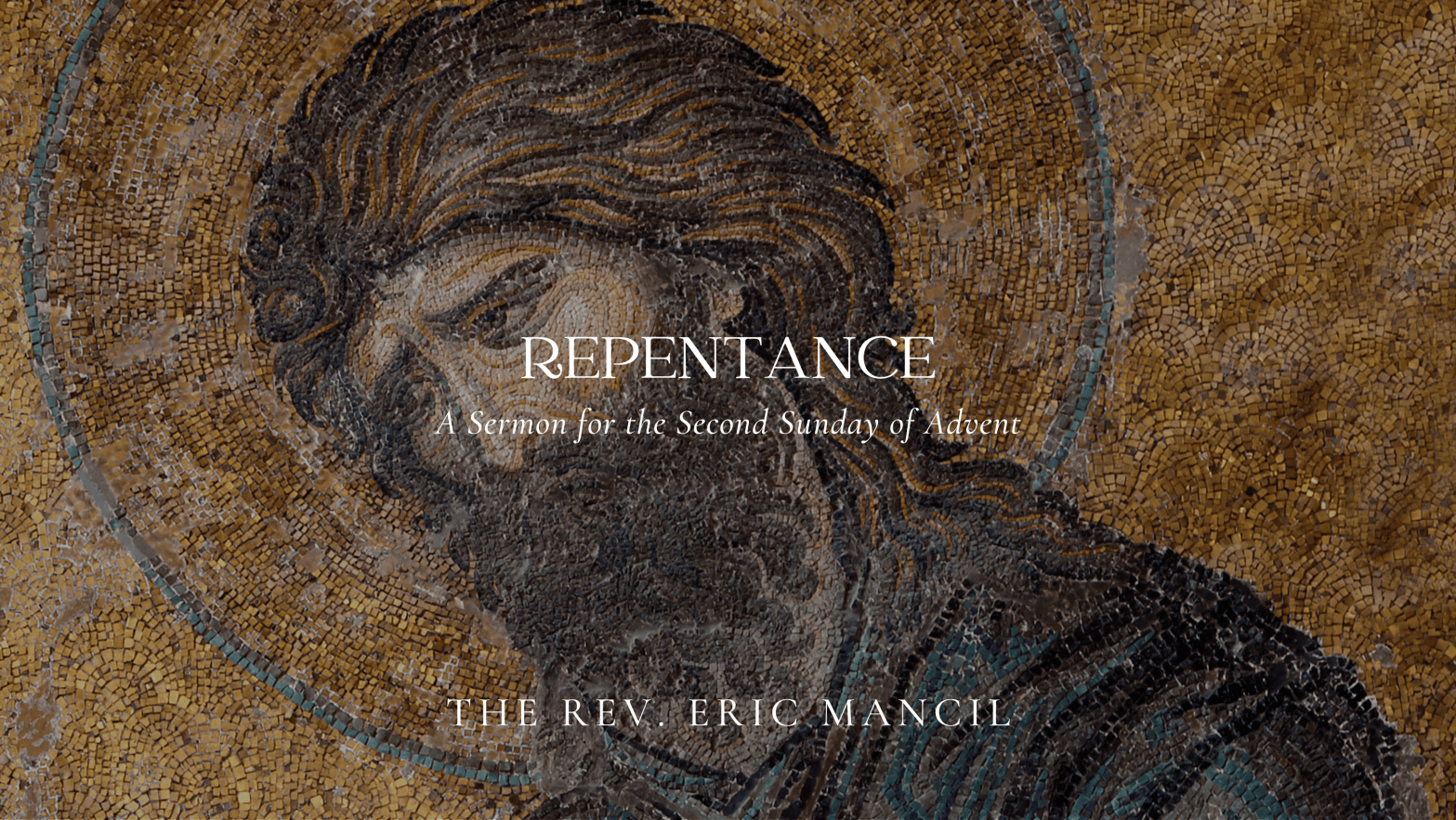
Repentance

A Sermon for the Second Sunday of Advent (Year C)
December 8, 2024

Text: Luke 3:1-6

Now, O Lord, take my lips, and speak through them. Take our minds, and think through them. Take our hearts, and set them on fire. In the name of the Father, and of the Son, and of the Holy Spirit. Amen.

One of the things I love most about the season of Advent is that we get to sing so many beautiful hymns each week. Some of my favorite hymns that we sing come from the Advent section of the hymnal.

This is one of the reasons why I decided that our Wednesday night Advent program for this year would focus on music.

And, before I continue on, I want to say that we had a wonderful time this past Wednesday, and I want to encourage you to come this Wednesday night, even if you weren’t able to make it last week.

We’d love to have you join us.

The hymns and carols of Advent have a lot to teach us about the significance of this season and why we spend four weeks preparing for the birth of our Savior and looking ahead to his return.

The popular Advent hymn, “O come, O come, Emmanuel,” for example, speaks to the expectancy of the one who will come to dwell with us, the one who is Emmanuel—“God with us.”

Or, my absolute favorite Advent hymn, “Lo! he comes, with clouds descending,” the eighteenth-century hymn by Charles Wesley, which looks beyond our present time to the second coming of Jesus at the end of the age.

There are so many others—hymns like “Comfort, comfort ye my people,” drawing from the prophecy of Isaiah, and “Prepare the way, O Zion,” which we sang just a few minutes ago.

We can learn a lot about the season of Advent and its significance simply by turning to the hymnal, by reading the words and singing the marvelous hymns that our tradition has to offer.

Many of these were featured last Sunday night in our service of Advent Lessons and Carols, which was put together by John Beasley and our choir. If you weren’t able to make it, you really missed out.

It was a beautiful service!

Another one of my favorite Advent hymns is “On Jordan’s bank the Baptist’s cry,” which we’ll sing later this morning at the end of the service.

It begins with the words, “On Jordan’s bank the Baptist’s cry announces that the Lord is nigh; awake and hearken, for he brings glad tidings of the King of kings.”

Did you know that this is one of the only hymns in our hymnal related to the life and ministry of John the Baptist? 

If you don’t believe me, open up a hymnal, and thumb through the Advent hymns.

There aren’t many at all related to John the Baptist, and it makes me wonder why that is—especially since John is such a central figure during the season of Advent.

Maybe the editors of the hymnal didn’t think it was necessary to include more than a couple of hymns about John.

Or, maybe his message of repentance make us all a little uncomfortable?

In today’s lesson from the Gospel of Luke, we encounter John the Baptist, who appears in the wilderness around the Jordan River and offers the people of Judea a baptism of repentance for the forgiveness of their sins.

His message to the people who have gathered is not a message of comfort or one that we would normally describe as “good news.”

He isn’t there to console them or to make them feel better about themselves.

His purpose is to prepare the way for Jesus, and he does this by proclaiming to the people that preparation begins with repentance.

He’s there to let the people know that the Savior they’ve been waiting for is coming into the world, and they need to be ready.

Repentance isn’t a word that we normally hear around this time of the year, is it?

No, during the days and weeks leading up to Christmas, our lives are typically consumed with making plans for the holidays.

We have Christmas parties to attend, gifts to wrap, and Christmas decorations to put up around the house—things that most of us consider to be fun and exciting!

We usually save words like “repentance” for the season of Lent as we prepare for Holy Week and Easter.

So, what place does repentance have during this season, and what does the message of John the Baptist have to teach us on this Second Sunday of Advent?

We know that John’s message must be an important part of the season because it shows up every year in our Sunday readings.

Whether we’re in Matthew, Mark, or Luke, John the Baptist shows up with his message of repentance, and in each version of the story, he says basically the same thing to the people who come to him for baptism.

“Repent, for the kingdom of heaven has drawn near. I am not the Messiah. I baptize you with water, but one who is coming who will baptize you with fire and the Holy Spirit.”

John’s message of repentance continues to speak to us today as we prepare, not only for our celebration of Christmas, but also as we look ahead to the day when Christ will come again.

As one author writes, “John demands that we get ready for Jesus.”

“Before we can bask in Christmas joy and the birth of a special baby, John forces us to examine ourselves and our world.”

If the season of Advent is meant to prepare us for the coming of Jesus, then it’s important for us to think about what repentance actually means because there’s a lot of misunderstanding when it comes to that word.

We often look at repentance in a negative way, don’t we?

We consider it a form of punishment or something we should try to avoid at all costs.

We think that, if you’re at a point in your life when you need to repent, then you must have done something pretty bad.

When many of us hear that word, we imagine street-corner preachers standing on their soapboxes, spewing angry messages at people as they walk by.

But, I want to suggest to you that repentance doesn’t have to be seen as something negative, and it doesn’t have to be seen as a form of punishment for doing something wrong.

And, this is important, because when we think of repentance as punishment, it’s easy for us to be overwhelmed with feelings of guilt and shame.

But, that’s not what God wants for us.

What God wants is for us to love others and to know that we’re loved, also.

I don’t believe God would call us to repent if it was meant to harm us or cause us to doubt our own self-worth.

When we read about John’s message of repentance and we hear the call of the prophets of the Hebrew Scriptures, we’re reminded of who we are as children of God and given an opportunity to return to the God who loves us more than we can possibly imagine.

Several years ago, just before our family moved from Texas back home to Alabama, I had the opportunity to attend my final convention in the Diocese of Northwest Texas.

The Bishop of the diocese delivered a thoughtful and inspiring message to those of us who were there.

During his address, he reminded me of something about repentance that I had once heard.

He said that we typically have two understandings of the word, “repent.”

In our culture, we tend to think of repentance as “feeling bad for doing bad things.”

And, in the Church, we tend to think that repentance is a call to conversion or a call to return to the Lord.

He told us that, while both of these understandings can be helpful, the actual meaning of the word, “repent,” in the original Greek means “to go beyond the mind” or to change one’s point of view.

The Bishop reminded us at the convention that Jesus uses parables and stories in his teaching that encourage us to go beyond the way we typically think or “to go beyond the mind” so that we can better understand what God is calling us to do in our lives.

But, how exactly do we do that?

How do we “go beyond the mind” and begin to change the way we think?

In his address, the Bishop suggested that we might begin by thinking about how we’re all connected.

He told us that, when we think about Jesus’ commandment to his disciples to “love your neighbor as yourself,” he’s not actually telling us to love our neighbors as much as ourselves but to love our neighbors as an extension of ourselves.

That’s what it means to “go beyond the mind” and into the mind of Christ.

To remember that we’re all connected and that we were created—not to care only for ourselves—but to love and serve each other.

When we think about repentance in this way, as a way of remembering that we’re all connected and called to love one another as an extension of ourselves, we can start to develop a much more helpful understanding of what repentance actually is.

It’s not something we should feel guilty about or something we should try to avoid doing at all costs.

When we recognize our need for it and allow ourselves to experience it, repentance can actually draw us into a deeper and more loving relationship with each other and with God.

So, as we continue to move through this Advent season and prepare for Christmas, let us remember the true meaning of the word “repentance,” and let us hold firmly to the message of John the Baptist and the prophets, who call us not to feel guilty about what we’ve done or left undone but to remember who we are and who we were created to be.

Amen.

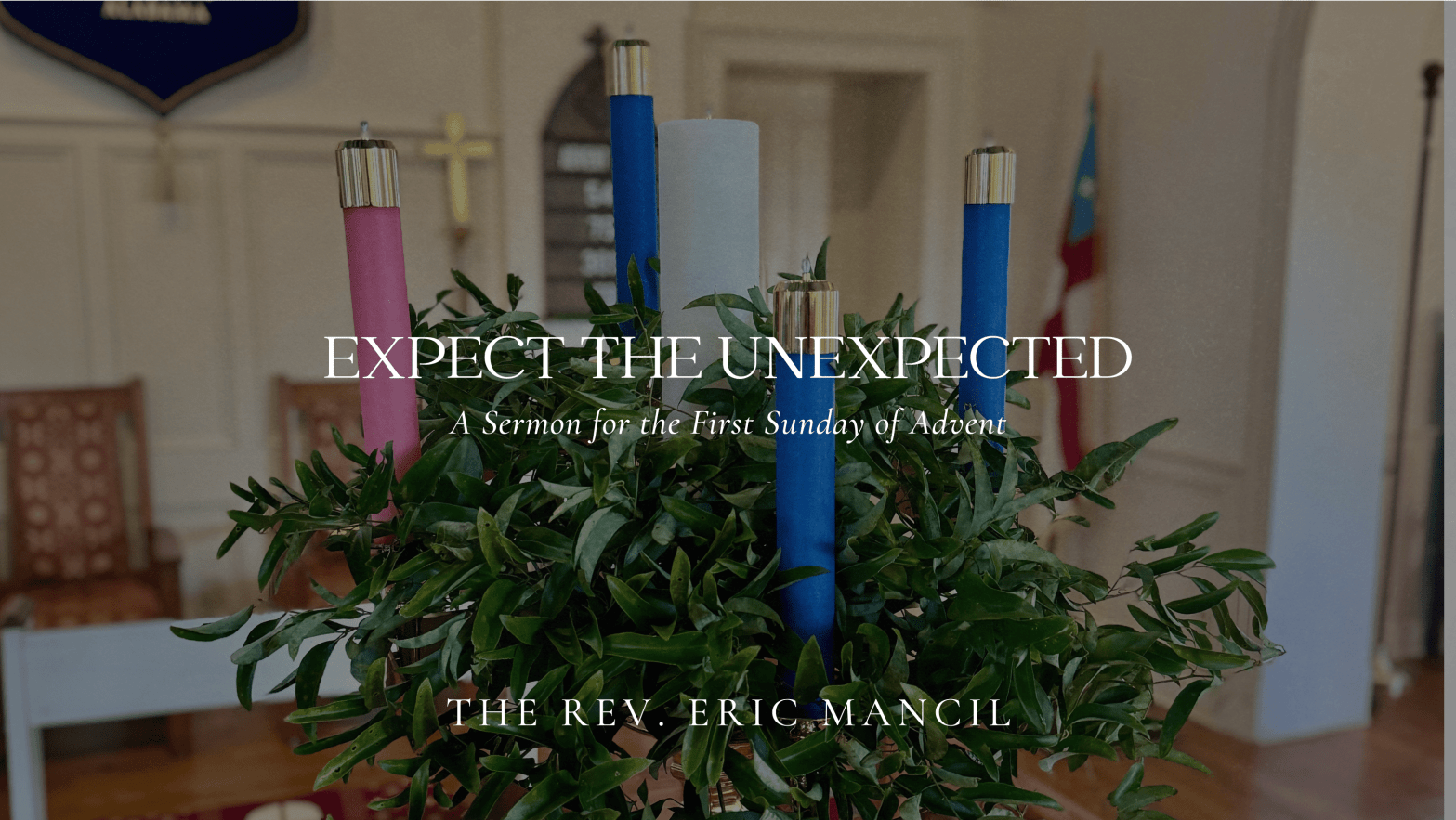
Expect the Unexpected

A Sermon for the First Sunday of Advent (Year C)
December 1, 2024

Text: Luke 21:25-36

Now, O Lord, take my lips, and speak through them. Take our minds, and think through them. Take our hearts, and set them on fire. In the name of the Father, and of the Son, and of the Holy Spirit. Amen.

There’s a lesson that my father once taught me at a young age. In fact, he started drilling this lesson into my head right around the age of fifteen, when I first started learning how to drive a car.

Every time I went with him to practice driving, I would get into the driver’s seat, and he would get into the passenger’s seat.

And, once I backed out of the driveway and started driving, he would always tell me, “Eric, you have to always expect the unexpected.”

Of course, being a fifteen year old at the time, I didn’t pay much attention to what he said, and there might’ve been some occasional eye rolling going on.

But, every time we went driving together, he would always say the same thing, and to this day, he still says it from time to time.

“You have to always expect the unexpected.”

What I think he meant by that was that I always needed to be alert and on the lookout for sign of trouble because terrible things could happen behind the wheel of a car in a matter of seconds.

My father always told me that it wasn’t me that he was worried about.

It was other people—distracted drivers on the road—who may not see me coming or who may be too focused on other things when they should have their complete attention focused on driving.

I still remember my father’s lesson from when I was fifteen, and while I’ve certainly made my fair share of mistakes behind the wheel of a car, his lesson has stayed with me all these years.

I still do my best to “expect the unexpected,” knowing that my life and the lives of those around me could drastically change in a moment’s notice.

In the blink of an eye, life as we know it can change.

Sometimes these changes are good for us, and sometimes they’re not so good.

Sometimes, what we thought we knew about something—or someone—turns out to be completely wrong, and we’re caught off guard.

Sometimes, unexpected things happen to us, and we don’t know what do or how to move forward.

So, the wisdom of the phrase “expect the unexpected” can help us prepare for those moments when it feels like everything has changed and we have no control over what’s happening.

Over the years, I’ve come to understand how the wisdom of the phrase “expect the unexpected” can also be used in our relationship with God.

I think about my own life and the things that have happened to me and my family over the years, things that I never imagined or thought possible.

There are moments and experiences that I can point to and say with absolute certainty that the only explanation for them happening was because of God.

I think about my call to the priesthood and deciding one day that God was calling me and my family to go to seminary, to pick up and move nine hundred miles away from our home in south Alabama to northern Virginia.

In my experience, I’ve discovered that, when God calls us, it often happens in ways that are unexpected and beyond our understanding.

I also think about those moments in the Scriptures when God calls the most unlikely people to serve in the most extraordinary ways.

The Old Testament is filled with good examples—people like Moses, who wasn’t the natural-born leader you’d expect God to choose. But despite his limitations and mistakes, God called him to set his people free and lead them out of slavery in Egypt into the land of promise.

The New Testament is also filled with good examples of how God chooses the most unlikely people to serve in the most remarkable ways.

Some of them we encounter early on in the Gospels, in the story of Jesus’ birth.

People like Elizabeth, the mother of John the Baptist, who’s told that she will bear and give birth to a son, even at her old age.

And her much younger relative, Mary, who is visited by the angel Gabriel and told that she will bear and give birth to the Son of God.

The Scriptures, especially the ones we hear during the seasons of Advent and Christmas, are filled with examples of why we should always “expect the unexpected” when it comes to God and God’s plan for salvation.

In fact, if I could assign a tagline to the season of Advent, it would be “expect the unexpected.”

Expect that God is doing a new thing.

Expect that, even now, God is working to make all things new.

This was true two thousand years ago in a small town called Bethlehem.

And, it’s true for us today as well as we await the return of Christ.

God came into the world in this amazing, unexpected way by sending his only Son to be born of a human mother, to live and die as one of us, and to show us the way to everlasting life and peace with God.

Despite everything that could’ve gone wrong—despite the fear and uncertainty that Mary and Joseph likely felt in the days and weeks leading up to the birth of Jesus—despite all the odds stacked against them—nothing could stop the light from coming into the world.

Love came down from heaven on that first Christmas Day, and the world has been changed forever.

The seasons of Advent and Christmas invite us to contemplate the miracle of Christ’s birth, but these seasons of the Church year aren’t just about a single event that took place centuries ago.

They’re also about what God in Christ is doing now—in our own time and place—and what God is preparing us for in the future.

This is the reason why our Gospel lesson for this morning—on this First Sunday of Advent—looks ahead to the final coming of Christ.

Jesus is warning his disciples to stay alert—to keep awake and be prepared for the day of his return.

He tells them, “There will be signs in the sun, the moon, and the stars, and on the earth distress among nations confused by the roaring of the sea and the waves.

People will faint from fear and foreboding of what is coming upon the world, for the powers of the heavens will be shaken. Then they will see ‘the Son of Man coming in a cloud’ with power and great glory.”

From the description Jesus gives us, it sounds like something we should be afraid of, doesn’t it?

The picture Jesus paints doesn’t exactly stir comforting thoughts or emotions.

It sounds terrifying, to be honest.

Like, we want Jesus to come back, but maybe not too soon.

But, I don’t think Jesus said these things to scare us.

I think it was a wake-up call.

I think it was his way of saying to the disciples—and to us—that one day, everything as we know it now will fade away, and we need to be ready.

The Son of Man will return and finally bring to fulfillment God’s reign of peace on the earth.

The old heaven and the old earth will pass away, and a new creation will be born.

And, until that day comes, it’s our call, as Christians, to help make God’s Kingdom a reality.

So, our Gospel lesson this morning from Luke shouldn’t be read as a message of fear.

It’s actually a message of hope—hope that, one day, God’s plan of redemption will finally be fulfilled.

Jesus says it like this: “Now when these things begin to take place, stand up and raise your heads, because your redemption is drawing near.”

St. Bernard of Clairvaux, a French theologian and Benedictine monk who lived during the eleventh century, once wrote that there are actually three advents—or three comings of Christ.

In the first Advent, Christ came to us as a helpless child, born of a human mother, to usher in the Kingdom of God and to bring salvation to the world.

In the third and final Advent, Christ will come again and will bring to fulfillment God’s Kingdom. He will judge both the living and the dead, and his kingdom will have no end.

The second Advent of Christ is where we find ourselves now, in our own day and time and in every moment of our lives. Christ is present with us wherever we go, and we see Christ in every person we encounter.

If Bernard is right—and I like to think that he is—then we’re living in between the first and third Advents of Christ.

Our lives are the middle part—the second coming of Christ.

We have the ability, through our words and actions, to make the love of Christ present— here and now.

We have the ability to be the hands and feet of Christ in the world around us—to bring light to where there’s darkness—to bring hope where there’s despair.

And so, as we begin the season of Advent, let us draw close to Jesus and consider what God would have us do with the lives we’ve been given.

Because you never know where God will call us to go next.

But, we can trust that, wherever we’re called to go, God will be with us, and God will use us to help bring to fulfillment his plan of redemption.

Expect the unexpected.

Expect that God is doing a new thing.

Expect that, even now, God is working to make all things new.

Amen.