Citizens of God’s Kingdom

A Sermon for the Last Sunday after Pentecost (Proper 29, Year B)
The Baptism of Palmer Wrenn Spivey
November 24, 2024

Text: John 18:33-37

Now, O Lord, take my lips, and speak through them. Take our minds, and think through them. Take our hearts, and set them on fire. In the name of the Father, and of the Son, and of the Holy Spirit. Amen.

Last Wednesday, I attended an ordination at the Episcopal Church of the Nativity in Dothan, Alabama. Our good friend, Pam Christian, was being ordained as the newest priest in the Episcopal Church.

It was a beautiful ceremony.

The Bishop was there, of course, leading the service, and there were other clergy from around the diocese there as well, supporting Pam in her new role as a priest.

The music was absolutely stunning.

The choir sounded like angels from heaven.

And, of course, the part of the service where the Bishop laid his hands on Pam and prayed for the Holy Spirit to make her a priest in Christ’s Church was incredibly moving.

That part of the service always reminds me of my own ordination and the vows I took as a new priest almost ten years ago.

But, there was one other part of the service that really stood out to me, and it’s been on my mind ever since.

At the beginning of the service, there was an older member of the parish who got up to read the first lesson from the Book of Isaiah.

She had short, white hair.

She looked to be in her late seventies or early eighties, and she had to walk with a cane in order to make it up the steps to the lectern at the front of the church.

For a person her age, I expected her reading voice to be soft and maybe a little hard to understand.

But, that’s not at all what happened.

Instead, she made her way to the lectern, introduced the lesson like we normally do in church, and proceeded to deliver one of the the most animated and enthusiastic readings from Scripture that I’ve ever heard.

She read Isaiah 6:1-8, which is one of the customary readings appointed for an ordination.

This is the part where the prophet Isaiah describes his glorious vision of God sitting on a throne in the Temple, with six-winged seraphs flying high above him.

It sounded sort of like this:

“In the year that King Uzziah died, I saw the Lord sitting on a throne, high and lofty; and the hem of his robe filled the temple. Seraphs were in attendance above him; each had six wings: with two they covered their faces, and with two they covered their feet, and with two they flew. And one called to another and said:

‘Holy, holy, holy is the Lord of hosts;
the whole earth is full of his glory.’

The pivots on the thresholds shook at the voices of those who called, and the house filled with smoke. And I said: ‘Woe is me! I am lost, for I am a man of unclean lips, and I live among a people of unclean lips; yet my eyes have seen the King, the Lord of hosts!’

Then one of the seraphs flew to me, holding a live coal that had been taken from the altar with a pair of tongs. The seraph touched my mouth with it and said: ‘Now that this has touched your lips, your guilt has departed and your sin is blotted out.’

Then I heard the voice of the Lord saying, ‘Whom shall I send, and who will go for us?’”

And this is the part that really stood out for me—the very last line of the passage.

The woman read, with all the eagerness she could possibly muster—“Here I am! Send me!”

I couldn’t help but smile and be moved by the woman’s reading.

It was almost as if those were her words that she was reading at the end of the passage.

And you could tell that, without a doubt, she meant every single word.

This reading was personal.

She was called by God to serve, and her answer was, “Here I am! Send me!”

She didn’t preach a sermon that evening, but she might as well have.

Because I doubt there was a single person in the church that night that wasn’t inspired by her enthusiasm and deep love for God.

It made me wonder for a moment what kind of life this woman must have lived.

What inspired her to read that passage from Isaiah in such a Spirit-filled way?

Had she been baptized from a young age and raised up in the church?

Had she been taught to love and read the Scriptures as a young child.

Had she been brought up in a church family and supported by her parents and fellow Christians who taught her how to live as a follower of Jesus?

Had she spent her entire life devoted to the work of God, in her church and community?

Or, was she a new Christian and still on fire for God in such a way that only a new Christian can be?

I wanted to share this story with you because I think it’s a good example of how all of us—no matter who we are or where we come from—are called by God to live our lives in such a way that we inspire others with our love for God and our commitment to the Gospel of Jesus Christ.

We may not be called to inspire others through our public reading of Scripture, like the woman did last week at the ordination.

But, God calls each of us to serve in our own way and to be an example of his love in the world around us.

What we do with our lives—as individuals and as a church—really does matter.

It may not always feel like it.

Sometimes, it may feel like we’re wasting our time or not making a very big impact at all, but the things we do and say and the decisions we make—no matter how small—have the power to change peoples’ lives in ways that we may never know.

As Christians, what we do and say and the decisions we make matter to God.

Because, no matter where we go in our lives, God has the power to work through us and use us as instruments of his love and mercy.

All we have to do is be willing to show up for Jesus and then get out of the way.

God, working in us through the power of the Holy Spirit, will take care of the rest.

I see it all the time, not only in my ministry as a priest, but also in the work that goes on here in our parish.

I see it each month at Laundry Love and our Rice and Beans Ministry.

I see it in our Thanksgiving and Christmas dinners, which we’re getting ready to do again this year.

I see it in all the volunteers who’ve shown up over the past few weeks to make sausage rolls for our Holiday Jubilee.

We do so much as a church, but we don’t do it for ourselves.

We do it because of our love for God and because it’s what God calls us to do.

People tell me all the time how amazing it is that we do so much for our community.

But, then I stop and think to myself, “What else would God have us do? It’s what we’re here for!”

It’s what we were created for.

We’re here to love and serve others, to work for the building up of God’s kingdom on earth, and to let the whole world see and know that, through Jesus, all things are being made new.

It’s really that simple.

In our Gospel lesson this morning from John, which takes place not long after Jesus is arrested in Jerusalem and handed over to stand trial, the Roman governor, Pontius Pilate, interrogates him and asks him if he is indeed the King of the Jews.

Jesus doesn’t give Pilate a “yes” or “no” answer.

Instead, he says to Pilate, “You say that I am a king. For this I was born, and for this I came into the world, to testify to the truth. Everyone who belongs to the truth listens to my voice.”

Jesus has no concern about being an earthly king, as Pilate accuses him of being.

He has no desire to rule over anyone or to be worshiped and adored.

His purpose is clear and simple.

He came to “testify to the truth.”

He came to teach us how to live our lives as God has called us to live.

He came to show us how to love others as God loves us.

Jesus came, not to rule as a fierce king, but to tear down the walls that divide us and help us heal our broken relationship with God.

His kingdom is one of justice, mercy, and peace.

And, as Christians, God has called us to be citizens of that kingdom.

We’re reminded of that every time we have a baptism at church and every time we have the opportunity to renew our own baptismal vows.

In the sacrament of Baptism, we turn away from the old life of sin and death, and we’re made a new creation.

We promise to live no longer for ourselves alone but also for others, and God gives us the strength and wisdom we need by the power of the Holy Spirit to live as followers of Jesus.

In just a few moments, we’ll celebrate the sacrament of new birth as we welcome Palmer Wrenn Spivey as the newest member of the Body of Christ.

Together, with her parents and family, we’ll promise to lift her up and support her as she grows older in age and begins to explore her faith.

As a church family, we’ll promise to always be there for Palmer—to help guide her and nurture her and, when the time comes, to help her answer questions she may have about God and what it means to be a Christian.

And together, we’ll renew our own Baptismal Covenant with God—those same promises and vows we once made to turn toward Jesus.

Palmer is too young to understand what’s about to happen.

But, one day, she will.

One day, when she’s old enough, she’ll understand what it means to be baptized.

And, God willing, she’ll make the choice to be confirmed, to claim for herself those same promises and vows that were made for her today by those who love her.

She’ll be anointed with holy oil as a sign that she is sealed by the Holy Spirit in Baptism and marked as Christ’s own forever—a seal that will never disappear or fade away.

She’ll be welcomed as one of our own at St. Mary’s—a member of the Body of Christ and a citizen of God’s kingdom.

And, one day, when she gets real curious about all the beautiful, colorful banners hanging in the Parish Hall, she’ll find her’s hanging there as well, and she’ll know that she’s part of something so much bigger than just herself.

She’ll know that—above all else—she was loved into being by the God who created her and that she’ll always have a home here at St. Mary’s.

And, who knows?

Maybe one day, many years from now, she’ll find herself at an ordination, slowly making her way up to the lectern to read a lesson from Scripture, and inspiring another priest to write a sermon about what it means to live a life in service to God and God’s people.

Amen.

The Widow’s Offering

A Sermon for the Twenty-Fifth Sunday after Pentecost (Proper 27, Year B)
November 10, 2024

Text: Mark 12:38-44

Now, O Lord, take my lips, and speak through them. Take our minds, and think through them. Take our hearts, and set them on fire. In the name of the Father, and of the Son, and of the Holy Spirit. Amen.

As a priest, I’ve had the pleasure of meeting so many wonderful and faithful people in the course of my ministry. And, as I’ve moved over the years and served in different parishes, I’ve carried all their stories with me wherever I go.

At the Church of the Holy Spirit in Alabaster, where I served before coming to St. Mary’s, there was a lovely couple named Mike and Judy.

They were the kind of parishioners you could always count on to be at worship on Sunday mornings and to get things done around the church that needed to be done.

And, they always greeted me at the end of the service with a big hug and told me how much they enjoyed my sermon that day.

Not long after I arrived at Holy Spirit, Judy pulled me aside one morning and shared with me the story of how she and Mike got started making the coffee every Sunday morning before the 8:30 service.

On one of their first Sundays at the church, they walked inside and discovered the priest making the coffee, and they thought to themselves, “He’s the priest! He shouldn’t be the one making the coffee!”

So, they walked up to him and offered to start making the coffee so that he could pay attention to other things that needed to get done before the service.

And week after week, year after year, they kept doing the same job. Even when we started coming back to in-person worship during the pandemic, Mike and Judy were there, ready to start making the coffee again.

That’s the kind of people they were.

Always ready to help, even in the smallest ways.

After about a year into my ministry at Holy Spirit, my family and I were on vacation during the summer.

One morning, I started receiving strange text messages from some of our parishioners.

They were asking me if I was the one who sent them an email asking for their help with money and gift cards to give to people in need.

Of course, I had no idea what they were talking about.

So, I quickly called around and tried to figure out what was going on.

And, what I discovered was that several members of the church had received an email from someone who was pretending to be me.

They had my name and my position at the church.

They had an email address that was very similar to my actual work email.

They even used a picture of me in the email, making it seem more believable.

They had all the things they needed to try and trick our parishioners into giving them what they wanted, which was personal information and money.

So, I called our secretary at the church and told her that we needed to get the word out to the parish as soon as possible so that no one became a victim of this terrible scam.

Thankfully, most of the people received the message in time and just deleted the fraudulent email.

But, that’s not what happened to Mike.

Mike didn’t receive the message in time, and he genuinely believed it was me asking him for money to help another person in need.

So, without even questioning it, he sent the person who was pretending to be me a thousand dollars.

When I found out, I was heartbroken.

And angry.

I was heartbroken for Mike and Judy because they lost so much, and I was angry at the person who had used by identity to take advantage of their goodness and generosity.

In the long-run, Mike and Judy would be fine. It was a lot of money but nothing that would cause too much of a hardship.

Mostly, I was just frustrated and upset by the fact that the person who scammed them was able to use their kindness against them.

The person who scammed them knew exactly what they were doing when they sent those emails out to the members of our parish.

When I got back home from vacation, I apologized to Mike and Judy.

Even though there was nothing I could do to stop it from happening, I felt so bad that this person—whoever they were—had been able to take advantage of them like they did.

Mike and Judy, of course, handled it with such grace.

And, they were much more forgiving than I would’ve been in their situation.

As infuriating as it was at the time, when I look back on what happened to Mike and Judy, I think it was a wonderful testimony to the kind of people they were—always thinking about others and looking for ways to help.

They legitimately believed that what they were doing was the right thing to do.

They believed that their priest was asking them for money to help another person in need, and they responded without even thinking about it.

Some may call them naive.

Some may call them foolish.

But, I think they were faithful.

Despite the fact that they didn’t actually help someone in need, their intentions were good, and they gave from their heart.

Faith means putting your whole trust into something you believe in—even when you might not be able to see it or understand it.

In the Gospel of John, Jesus said to Thomas soon after his resurrection, “Blessed are those who have not seen and yet have come to believe.”

Now, I don’t believe that God wants us to be harmed or deceived in any way because of our faith like Mike and Judy were.

But, I think there’s something to be said about having faith and putting our whole trust in God.

And, we have a good example of that this morning in our Gospel reading from Mark when we hear the story of the poor widow who comes to make her offering in the temple in Jerusalem.

In the time of Jesus, it was required of all adult Jews, twenty years and older, to come to Jerusalem each year and make an offering to the temple treasury.

These offerings would be used to maintain the operation of the temple and support its ministries.

The required amount was a half-shekel—a single coin—which is what most people brought to the temple for their offering.

The treasury—the place where these offerings would be made—was located in a part of the temple called the Court of Women, which was the only gathering place where all Jews, both men and women, could congregate.

When we read in the Gospels about Jesus teaching in the temple during the last week of his life, the Court of Women is likely where these teachings took place.

It was the only place where everyone could gather to hear Jesus speak.

It’s probably also the location where our Gospel lesson for this morning takes place.

Jesus is teaching in the temple.

And, he begins to criticize the scribes, saying, “Beware of the scribes, who like to walk around in long robes, and to be greeted with respect in the market-places, and to have the best seats in the synagogues and places of honour at banquets! They devour widows’ houses and for the sake of appearance say long prayers. They will receive the greater condemnation.”

The scribes were religious leaders in Jesus’ time who were well-educated in Jewish law and responsible for making copies of the scriptures.

They were also highly respected members of society.

Jesus criticizes them for only being concerned about personal gain and drawing attention to themselves, which was a clear misuse of their power and privilege as religious leaders.

Then, he sits down near the treasury and watches as all sorts of people come by, one by one, making their yearly offering to the temple.

He watches as rich people come by and put in large offerings.

And, then he sees a poor, old widow walk by, carrying what appears to be two small, copper coins.

These coins were called mites, or leptons. They were the smallest denomination of Jewish currency, and they were only worth about 1/64 of a Roman denarius, which was a day’s wage for a common worker.

Today, a mite would be the equivalent of about an eighth of a cent.

It wasn’t much.

But, it was all this poor widow had to offer.

Jesus watches as the woman comes into the treasury, puts in her two coins, and quietly walks away.

Because of who she is and her station in life, he’s probably the only one who notices the incredible sacrifice she just made.

He calls his disciples over and says to them, “Truly I tell you, this poor widow has put in more than all those who are contributing to the treasury. For all of them have contributed out of their abundance; but she out of her poverty has put in everything she had, all she had to live on.”

A closer translation to the Greek in this passage would be, “Out of her poverty, she’s given her whole life.”

She’s put her whole trust in God because it’s something she believes in.

By drawing attention to the widow’s offering, Jesus teaches us in this lesson that it’s not the amount we have to give that’s most important.

It’s the intention behind our offering that matters most to God.

Unlike the scribes, who are only concerned about themselves, what God wants most is for us to be faithful, for us to put our whole trust—our whole lives—in his hands.

I think it’s also worth mentioning here that God doesn’t expect us to give more than we’re able to give.

Some people use this story about the widow’s offering during stewardship season as a good example of how much money we should give to the church.

But, that’s not really the point of the story.

God knows we have to have money to buy the things we need.

God knows we have families to take care of and other financial obligations to fulfill.

God doesn’t expect us to give to the point where we sacrifice our well-being.

God wants us to be faithful, like the widow in our story who gave out of her poverty, trusting that her offering would be used to the glory of God.

God wants us to be faithful, like Mike and Judy, who I mentioned earlier, who gave their money because they believed they were helping someone who desperately needed it.

God wants us to be faithful, and what that means for each of us is something we have to work out between us and God.

At the end of the day, it’s not really about the amount of money we give or the amount of time we spend serving others.

Being faithful means showing our love for God and putting our whole trust in him.

Our offering, whatever that may be, represents our faith in God and our trust that God will take all that we have to give and use it to his honor and glory.

Amen.

I Sing a Song of the Saints of God

A Sermon for the Feast of All Saints (Year B)
November 3, 2024

Text: John 11:32-44

Now, O Lord, take my lips, and speak through them. Take our minds, and think through them. Take our hearts, and set them on fire. In the name of the Father, and of the Son, and of the Holy Spirit. Amen.

There are several hymns in our hymnal that are especially appropriate for us to sing on All Saints’ Day—beautiful hymns such as the one that we sang at the beginning of our service this morning, “For all the saints, who from their labors rest.”

But, there’s one hymn that, for me, really gets to the heart of what this feast day is all about.

We sang it just a few minutes ago, and it begins like this:

I sing a song of the saints of God, patient and brave and true, who toiled and fought and lived and died for the Lord they loved and knew. And one was a doctor, and one was a queen, and one was a shepherdess on the green: they were all of them saints of God, and I mean, God helping, to be one too.

In the parish where I served in northwest Texas right out of seminary, we sang this hymn every time there was a baptism.

During the service, we would process to the baptismal font, which was close to the entrance of the church—similar to the way we do it here at St. Mary’s.

We would do the baptism, and when it was over, we would return to the front of the Nave.

And, as we did this, the congregation would sing, “I sing a song of the saints of God.”

It was such a beautiful tradition, and there’s a good reason why we did this.

The words of this particular hymn convey the simple truth that each one of us, by virtue of our baptism in Christ, is called to be a saint, to live a life worthy of the Gospel.

St. Paul wrote about this frequently in his letters to the earliest Christian communities.

In his letter to the Ephesians, for example, Paul writes, “I therefore, the prisoner in the Lord, beg you to lead a life worthy of the calling to which you have been called, with all humility and gentleness, with patience, bearing with one another in love, making every effort to maintain the unity of the Spirit in the bond of peace. There is one body and one Spirit, just as you were called to the one hope of your calling, one Lord, one faith, one baptism, one God and Father of all, who is above all and through all and in all.”

In the New Testament, the Greek word for “saint” is hagios, which literally means “holy” or “set apart.”

All of us, whether we realize or not, are counted among the saints and set apart to live our lives as Christ has taught us to live.

All Saints’ Day is a time for us celebrate and give thanks for all those who’ve come before us in the faith, guiding us with their wisdom and providing us with examples of holy living.

This is why it’s customary in many parishes on this day—including ours—to include in our prayers a list of the dearly departed, those who’ve come before us and who now rest in the eternal peace of God.

Some people refer to All Saints’ Day as the Church’s “memorial day,” but it’s actually a lot more than just a day of remembrance.

It’s also a time for us to consider how we might pattern our own lives on Jesus and live more fully into our sainthood.

To do this, I’d like for us to reflect for a moment on today’s Gospel reading from John.

This is a familiar story for many of us.

Most of the time, the part we remember the most—the part we tend to focus on—is the miracle Jesus performs at the end of the story when he goes to the tomb of his friend, Lazarus, calls for the people to roll away the stone at the entrance of the cave, and cries out with a loud voice, “Lazarus, come out!”

And, we all know how the story ends.

The dead man comes out of the cave, still wrapped up in bands of cloth, and Jesus tells the people who are standing near, “Unbind him, and let him go.”

The raising of Lazarus is Jesus’ way of demonstrating to the people that, for those who truly believe and put their faith in God, death will have no hold over us.

Our Christian faith teaches us that death isn’t the end, only the beginning of new life with God.

We belong to God.

Like the saints who’ve come before us, we are the Lord’s possession, and nothing—not even death—can separate us from the love of God in Christ Jesus.

We’re reminded of this every time there’s a baptism in church when the priest anoints the newly baptized with the oil of chrism while saying the words, “You are sealed by the Holy Spirit in Baptism and marked as Christ’s own forever.”

This is important for people of faith to remember—especially in times of adversity.

Because of our Lord’s sacrifice on the cross and his victory over the powers of sin and death, we have no reason to ever live in fear.

The victory is already won.

But, that doesn’t mean we can just sit on the sidelines and do whatever we want.

Because there’s still a lot of work left to do in the building up of God’s Kingdom, and as Christians, we’ve been called to do this work—to help restore God’s vision of a world redeemed in love where justice and peace exist for all people.

Which leads me to the part of today’s Gospel lesson that I really want us to focus on this morning.

I want us to back up a bit to the beginning of the passage and reflect for a moment about how Jesus responds to Mary and Martha, the sisters of Lazarus, who are grieving the loss of their brother.

We learn that, soon after Jesus arrives, Mary comes to him, kneels down at his feet, and says, “Lord, if you had been here, my brother would not have died.”

Her words must’ve felt like daggers to Jesus’ heart.

She’s heartbroken, and I think, at least to some degree, she’s angry and frustrated with Jesus and blames him for not coming sooner and preventing this terrible tragedy.

And, there are others who are standing around as well and watching all of this unfold between Mary and Jesus, and they also begin to weep.

I imagine it looks a lot like going to the funeral of a close friend or family member and seeing all of their loved ones standing close by and supporting each other in their grief.

Seeing how Mary and the others are overwhelmed with emotion, Jesus also begins to weep—not because he believes that Lazarus is gone for good but because he loves him, and he sees how much his family and friends loved him.

For me, the most inspiring part of the story is not so much the resurrection of Lazarus from the grave.

That part’s important, too.

But, the part of the story that really moves me and inspires me is the compassion Jesus demonstrates when he weeps right alongside those who are mourning.

It’s such a beautifully human moment for Jesus and the others.

And, it’s a wonderful reminder for all of us that, in the midst of the pain and agony of this human life, we have the ability to sit with each other when times are tough and help bear each other’s burdens and bring a little bit of comfort and peace to those who mourn.

We have the ability to share God’s love with those who are suffering by simply acknowledging their pain and letting them know they’re not alone.

This brings me back to what today is all about as we celebrate the lives of all the saints who’ve come before us and as we consider the kind of legacy we want to leave behind for future generations.

Personally speaking, I want to be the kind of saint—the kind of Christian—that models the love and compassion of Jesus by responding to God’s call and doing the work that needs to be done.

I want to be the kind of Christian that’s unafraid about what others might think when I sit with someone who’s grieving or someone who just needs a little extra love in their lives.

I want to be the kind of Christian that puts aside my own needs and concerns long enough to let others know that there’s at least one other person in this world who cares about them.

I want to be the kind of Christian that future generations in the church will sing about when they celebrate All Saints’ Day—not for my glory but for the glory of God.

And, truth be told, that’s what I hope for all of us gathered here today, that future generations will one day sing about us—

I sing a song of the saints of God, patient and brave and true, who toiled and fought and lived and died for the Lord they loved and knew. And one was a doctor, and one was a queen, and one was a shepherdess on the green: they were all of them saints of God, and I mean, God helping, to be one too.

Amen.

Crux Probat Omnia

A Sermon for the Twenty-Second Sunday after Pentecost (Proper 24, Year B)
October 20, 2024

Text: Mark 10:35-45

Now, O Lord, take my lips, and speak through them. Take our minds, and think through them. Take our hearts, and set them on fire. In the name of the Father, and of the Son, and of the Holy Spirit. Amen.

A couple of weeks ago, I drove down to Camp Beckwith for our annual Clergy Conference. Clergy Conference is basically an opportunity for all the clergy in the diocese—both priests and deacons—to come together for a few days of fellowship and learning.

It’s also a time for us to pray and worship together, which is something we rarely get to do since most of us are so busy in our own ministries across the diocese.

One of the things I value most about Clergy Conference is getting the opportunity to have conversations with people I don’t know very well, including some of our senior and retired clergy.

On the last day of the conference a couple of weeks ago, I had a nice conversation with a priest named Father Bob, who serves as the priest-in-charge at a small congregation down in Pensacola.

Judging by his age and demeanor, I could tell right away that he was a wise and experienced priest.

After we introduced ourselves, I shared with him that I was the rector at St. Mary’s in Andalusia.

His response right away was, “Oh, St. Mary’s! What a lovely church!”

He was obviously familiar with our parish in some way.

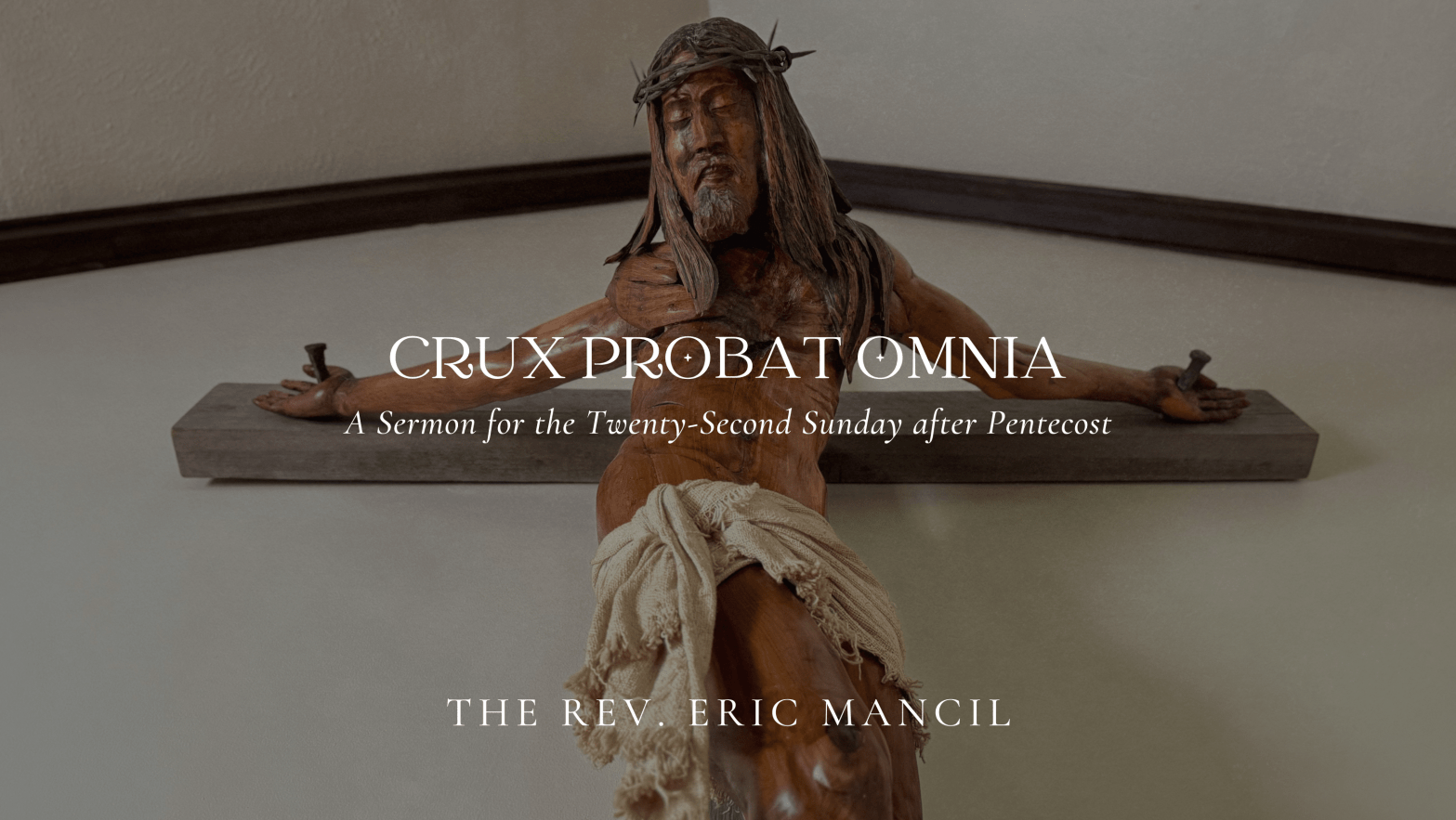
Then he asked me, “Do y’all still have that wooden sculpture of Jesus on the cross?”

I thought to myself, “Of all the things to be known for, I’m surprised he knows us because of that.”

So, I said, “Yes, sir. It’s hanging in one of the transepts of the church.”

Then, much to my surprise, he went on to share with me a little bit of the history of the sculpture.

He told me that it once belonged to Christ Episcopal Church—a large parish in Pensacola—but that some of the members of that parish didn’t want it hung in the church.

I guess, for them, it focused too much on the death of Jesus, which, in a way, is understandable.

After all, in the Episcopal Church, our theology is really centered more on the resurrection.

That’s why—in most Episcopal parishes—you’ll find an empty cross hanging above the altar rather than a crucifix.

So, since the people at Christ Church in Pensacola no longer wanted the sculpture, they decided to find a new home for it, which is how it ended up here at St. Mary’s.

And, I’m so glad it did.

Because, even though the passion and death of our Lord isn’t the focus of our theology and worship, it is a central part of the story.

As I’ve preached before, there would be no Easter without Good Friday.

There would be no joy of the resurrection without the pain and sacrifice of the cross.

It’s part of our story, as Christians.

The sculpture that hangs in our church isn’t just a fancy decoration.

It serves as a poignant reminder that, in order to follow Jesus, we have to be willing to walk the way of the Cross.

I’m reminded of that every time I see it—but especially on Wednesdays when we have our noon healing service in the transept and I’m standing behind the altar, facing the cross.

Every time we come to that point in the service where I break the bread during Communion and hold up the two halves of the bread—one in each hand—I see Jesus hanging on the cross, and suddenly, the simple truth of our faith becomes so vividly real for me once again.

As painful as it is to think about, Jesus is the “suffering servant,” the one who willingly gave his life as an offering and sacrifice for the world so that we might be redeemed and find eternal life with God.

And, as followers of Jesus, we’re called to walk in his footsteps—to take up our own cross and follow him.

Over the past couple of months in church, we’ve been reminded of this in some of our readings from the Gospel of Mark.

Five weeks ago, on September 15th, we heard Jesus ask his disciples in our Gospel reading, “Who do people say that I am?”

And they answered him, “John the Baptist; and others, Elijah; and still others, one of the prophets.”

“But who do you say that I am?” Jesus asked them.

Peter answered, “You are the Messiah.”

Then, he ordered his disciples not to tell anyone, and he began to teach them that the Son of Man must suffer and be rejected and killed and then, after three days, rise again.

And, he taught them that whoever wants to follow him must deny themselves, and take up their cross, and follow.

Then, in our Gospel reading four weeks ago, on September 22nd, we heard a second prediction that Jesus made about his death.

He told his disciples, “The Son of Man is to be betrayed into human hands, and they will kill him, and three days after being killed, he will rise again.”

But, the disciples still didn’t understand what Jesus was talking about.

They were far more concerned with worldly things, like arguing amongst themselves about which of them was the greatest.

Jesus told them, “Whoever wants to be first must be last of all and servant of all.”

And then finally, we have today’s lesson, which takes place right after Jesus makes a third and final prediction about his death.

If we back up a few verses before today’s reading, we learn that Jesus is traveling with his followers on the road to Jerusalem.

And he pulls the twelve disciples aside and says to them, “See, we are going up to Jerusalem, and the Son of Man will be handed over to the chief priests and the scribes, and they will condemn him to death; then they will hand him over to the Gentiles; they will mock him, and spit upon him, and flog him, and kill him; and after three days he will rise again.”

You would think that after three predictions about what’s going to happen, the disciples would finally “get it.”

You would think that, after all this time they’ve spent with Jesus, they would finally understand that he isn’t the ruler king they expected.

Jesus will not sit on an earthly throne and be worshiped and adored.

He won’t be rich or powerful.

He won’t be adorned with the finest clothes and fanciest jewelry, and he won’t be waited on by servants.

No, this king will be betrayed and looked upon with shame.

He will be mocked and spit upon.

He will suffer terrible pain and be hung on a cross to die.

And, in his death, he will be glorified by his Father in heaven.

When Jesus told his disciples that he would be killed and then rise again on the third day, it wasn’t just his way of preparing them for what was coming.

It was his way of teaching them that, in order to follow him, they’d have to be willing to give up any sense of pride or selfish ambition.

They’d have to be wiling to let go of any desire for worldly power and privilege in exchange for the joy and peace of God’s kingdom.

He said it this way: “…those who want to save their life will lose it, and those who lose their life for my sake, and for the sake of the gospel, will save it.”

In our Gospel lesson for today, James and John, two of Jesus’ closest friends, come to him as they’re traveling to Jerusalem.

And, they say to Jesus, “Teacher, we want you to do for us whatever we ask of you.”

Jesus responds, “What is it you want me to do for you?”

They say to him, “Grant us to sit, one at your right hand and one at your left, in your glory.”

Jesus doesn’t scold them or even tell them they’re being selfish by seeking special attention or a special place of honor.

He responds to their request by saying, “You do not know what you are asking.”

In other words, “You think you know, but you really have no idea.”

Jesus knows what lies ahead.

He knows what will happen when they eventually reach the walls of Jerusalem.

Although they’re completely serious about the request, James and John don’t really know what they’re doing when they ask Jesus for a place at his side, one on the right and one on the left.

Because Jesus won’t be glorified in a position of power or a place of privilege.

The place where Jesus will be glorified by God is on the hard wood of the cross.

Eventually, the other ten disciples learn about what James and John have been up to, and they get angry with the brothers for trying to seek special attention from Jesus.

So, Jesus calls them all together and says to them, “Whoever wishes to become great among you must be your servant, and whoever wishes to be first among you must be slave of all. For the Son of Man came not to be served but to serve, and to give his life a ransom for many.”

All you have to do is look up at that cross on the wall and be reminded.

Jesus came—not to be served—but to serve.

And, as his followers, we’re called to do the same—to seek out ways of being of service to others, especially the most vulnerable among us.

Jesus came—not to be worshiped and adored—but to bear witness to the truth of God’s love and to usher in God’s reign of peace and justice in the world.

And, as his followers, we’re called to do the same—to seek out ways of sharing God’s love with others and to work for the building up of God’s kingdom.

Jesus came—not to seek a special place of honor or privilege—but to teach us through his life, death, and resurrection that the way of the Cross is the path to abundant life with God.

In order for us to experience the joy and peace of God in our lives, we have to be willing to empty ourselves and lay down our lives for the sake of the Gospel.

As Christians, the Cross is the standard by which we measure all that we say and do.

If we’re ever in a situation where we have to stop and ask ourselves, “What would be the Christian thing be to do here,” all we have really need to do is consider the Cross.

In the words of the Protestant reformer, Martin Luther, Crux probat omnia, which is a Latin phrase, meaning, “The Cross is the test of everything.”

May we carry this phrase with us wherever God may send us, and may its words be written on our hearts. Amen.

Let Go

A Sermon for the Twenty-First Sunday after Pentecost (Proper 23, Year B)
October 13, 2024

Text: Mark 10:17-31

Now, O Lord, take my lips, and speak through them. Take our minds, and think through them. Take our hearts, and set them on fire. In the name of the Father, and of the Son, and of the Holy Spirit. Amen.

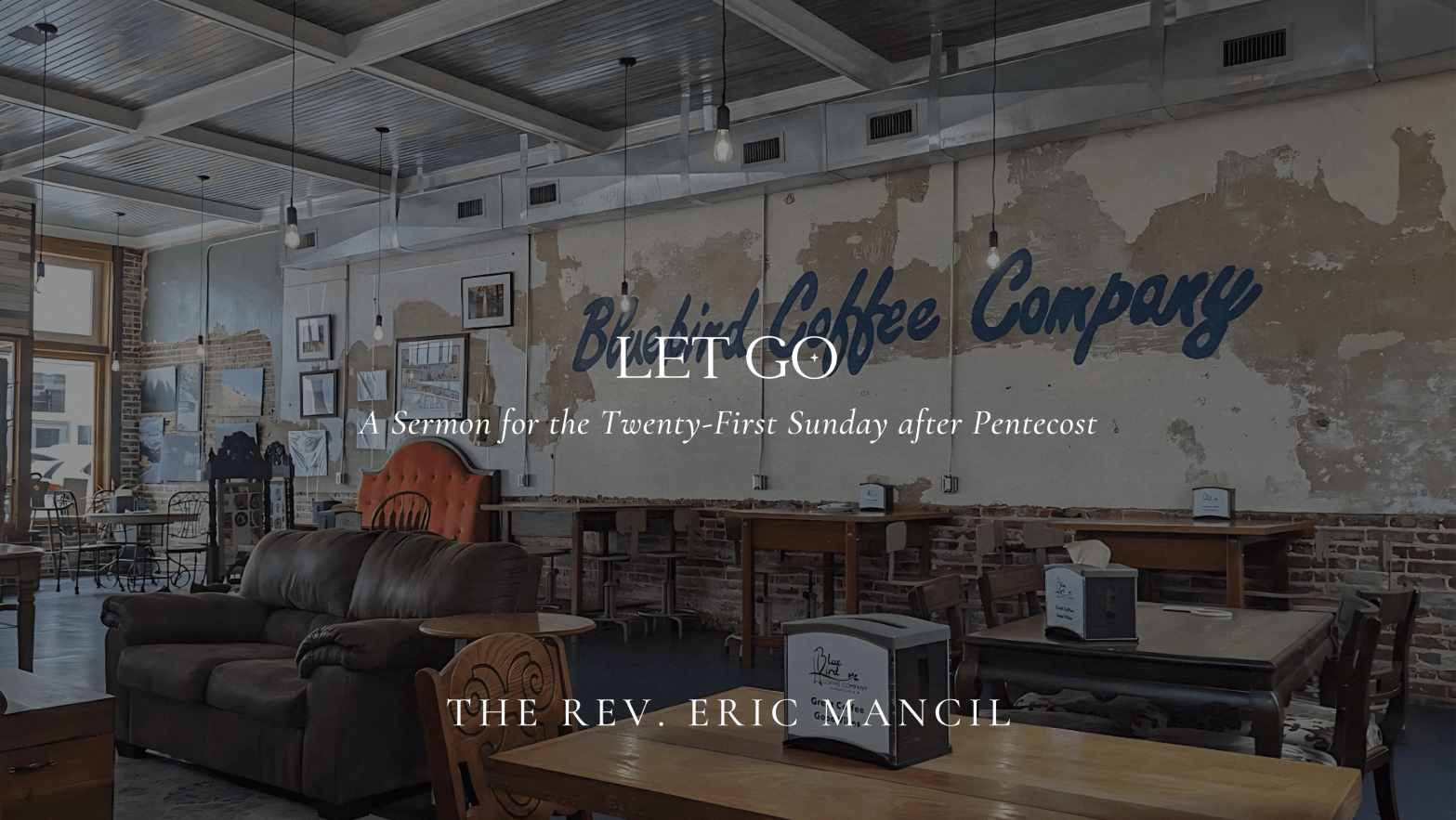
As most of you know, I go to the Blue Bird Coffee Company each week on Thursdays from about 9:00 in the morning until 10:00, doing something I like to call “Coffee with the Priest.”

It’s an opportunity for me to make myself available to anyone in the community who just needs someone to talk to or someone to pray with them.

Sometimes, I go, and I don’t have much interaction with anyone other than the staff at the coffee shop. So, I’ll sit and wait, and if no one shows up, I’ll use that time to work on a sermon or respond to some emails.

Sometimes, people reach out ahead of time and make plans to meet with me at the coffee shop for a one-on-one conversation.

And then, sometimes, I’ll have random encounters with complete strangers, which is exactly what happened to me this past Thursday.

I walked into the coffee shop like usual, put my sign out that says “Coffee with the Priest,” made a quick post on social media about being at the coffee shop, and then I stood in line to get a cup of coffee.

And, as I stood in line, I overheard the person in front of me—a man I had never seen before—talking with the cashier about how he and his family had to evacuate from Florida this past week due to the hurricane.

After he was done talking with the cashier, he got his coffee and went and sat down at a table.

And, then I got my coffee, and as I was walking back to my table, I saw the man again, and we struck up a conversation.

I was wearing my clergy collar at the time. So, he knew I was a minister of some kind, probably a Catholic priest.

And, he told me more about his situation.

He and his family had evacuated on Monday and found their way to Andalusia.

I asked him if they were able to find a hotel room nearby, and he told me that they were staying in a camper in a local RV park.

He also shared that, thankfully, none of his property had been severely damaged by the storm, and he was hopeful that they’d be able to return home soon.

I wished him well and I told him that, if there was anything they needed while they were here, our church was right down the road.

Then, I sat down at my table, which was right next to the man I was talking to.

And, after a few minutes, we started talking again.

This time it was about church.

He asked me if I was a Catholic priest, and I told him, “No, I’m an Episcopal priest.”

Then, he wanted to know the difference between Catholic and Episcopal. So, I started listing some of the differences and sharing with him some of the things I love most about the Episcopal Church.

I could tell he was genuinely curious, but I wasn’t quite sure why.

Somehow, in the midst of our conversation, he shared with me that he was a non-believer, and it sounded like a lot of that had to do with a bad history with the church and Christians trying to convert him to their way of thinking.

Judging from his tone, I got the feeling that his overall sense of Christianity is that it’s just a church full of people whose primary mission is to go out and convert everyone they meet.

And, as I sat and listened to the man’s story, I thought to myself, “I wish people like him knew that there are other types of Christians in the world.”

I wish more people knew that there are churches in this world—like our church, for example—that exist, not to try to convert people or to convince them to think or believe the way we do—but who work and strive to be examples of God’s love to those we meet and to spread the Good News of God in Christ with the world.

Jesus didn’t instruct the disciples to go out and convert the world to Christianity. He instructed them to go out and share the Good News of the Gospel—to show people through their words and deeds that the Kingdom of God has come near.

That’s why we’re here.

We do what we do—not for own benefit—but for the good of God’s Kingdom.

We do what we do—not to try and save people’s souls (as if we could if we wanted to), but to invite them into a deeper and more meaningful relationship with the God who loves them.

But, far too often, people who don’t know any different are convinced that they already know what our intentions are before ever getting the chance to know more about us.

They think they know who we are because of past experiences of church or second-hand knowledge from people who’ve had bad experiences.

Not that I blame them because there are plenty of Christians in this world who think it’s their mission to save people and convert them.

But, that’s not us.

In reality, there’s so much more to who we are and what we’re called to do as followers of Jesus.

As I was reflecting on my time with the man at the coffee shop, I thought about how all of us, in some way, get trapped and weighed down by our own pre-conceived ideas or notions about people who are different than we are.

Especially people who have different beliefs or ideas than we do.

I think a really good example of this today is the current political climate in our country, especially with the upcoming election.

It’s so easy for us get pulled into the idea that we have to dehumanize or look down upon those who have different beliefs and ideas than we do.

And, when we do that, we create walls of our own making—separating ourselves from those who think or believe differently than we do and possibly even making enemies out of those who are different.

But, that’s not what God calls us to do.

God calls us to break down the walls that divide and separate us.

God calls us to examine our lives and to think about those biases and prejudices that infect our hearts—those destructive ideas about other people that keep us from experiencing the abundant life that God wants for each of us.

God calls us to let go.

To let go of what we think we know about other people.

To let go of the idea that we have everyone perfectly figured out and grouped into a box that’s easily defined.

To let go of our need to look down upon those who think or believe differently than we do.

To let go of the idea that we’re right and everyone else is wrong.

Today’s Gospel lesson from Mark is all about letting go.

Letting go of those things in our lives—whether they’re spiritual or material—that are keeping us from experiencing the joy and peace of following Jesus.

In today’s reading, we hear the story of Jesus’ encounter with the rich man who comes to Jesus and asks him, “Good Teacher, what must I do to inherit eternal life?”

In other words, “What must I do to find joy and peace in God’s kingdom?”

Jesus looks at the man and basically tells him, “You already know what you need to do. Follow God’s Law.”

The man tells Jesus that he’s lived a good life and followed all of God’s commandments, even since his youth.

Then, we come to my favorite part of the story.

And, it’s so simple.

The author of Mark’s Gospel writes that Jesus looked at the man and loved him.

He didn’t judge the man.

He didn’t criticize him.

He loved him. The way I read that part of the story is that Jesus looked at the man and had compassion for him.

He thought he had done everything he was supposed to do up to that point in his life.

But, knowing the man better than he knows himself, Jesus tells him that there’s one more thing he has to do in order to receive the abundant life he seeks.

He says to the man, “Go, sell what you own, and give the money to the poor, and you will have treasure in heaven; then come, follow me.”

I can’t imagine the look of shock and disappointment that must have been on the man’s face when he heard Jesus’ instruction.

In the end, it’s too much of a burden for the rich man to bear.

He isn’t willing to let go of his wealth and possessions in order to follow Jesus.

So, he turns around and walks away.

Contrary to what some people believe about this lesson from Mark’s Gospel, it isn’t intended to cast judgment on the rich, and it doesn’t mean that there’s no room in God’s kingdom for wealthy people.

This story is about much more than money and wealth. It isn’t about what we own or how much we have.

It’s about our attachment to those things in our lives—the things we so desperately want to hold on to—that keep us from following Jesus.

The rich man in our Gospel lesson is so attached to his wealth and worldly possessions that he’s unable to see the grace that’s right in front of his eyes when Jesus offers it.

It was easier for him to turn around and walk away from Jesus than to give up that which he cared about the most.

The story of Jesus and his encounter with the rich man teaches us that, in order to receive the abundant life we seek, we have to be willing to let go of those worldly attachments in our lives—both material and spiritual—that cause us to lose sight of our need to follow Jesus.

This story can be applied to so many corners of our lives.

Because, truth be told, we can be attached to lots of things that can be a stumbling block in our lives.

Not just money and wealth.

But also our tight grip on anger and resentment toward those who’ve hurt us.

Not just material or physical possessions.

But also biases toward those who think or believe differently than we do.

Not just the things we can see, taste, and touch.

But also those intangible things that infect our hearts, like jealousy toward those who have more than we do or the feeling that we’re better or more deserving than anyone else.

Because, in the end, it’s not about us at all. It’s about God and what God is doing in us and through us to change the world.

God calls us to let go.

To let go, and let him be the center of our lives.

Amen.