The Courage to Say Yes

A Sermon for the Feast of All Saints (Year C)
The Baptism of Ella Grace O’Neill
Sunday, November 2, 2025

Texts: Ephesians: 1:11-23 and Luke 6:20-31

Now, O Lord, take my lips, and speak through them. Take our minds, and think through them. Take our hearts, and set them on fire. In the name of the Father, and of the Son, and of the Holy Spirit. Amen.

Today is one of my favorite Sundays of the entire year—All Saints Sunday. It’s one of the Church’s high holy days, a day that shines with great joy and thanksgiving.

On this day, we give thanks for the lives of all the saints—not just the ones we know by name, or the ones etched in stained glass or included in the Church calendar—but for that great cloud of witnesses who’ve gone before us, and for those sitting right here among us.

And if that weren’t enough reason to celebrate, this morning we also get to baptize Ella Grace O’Neill—to mark her with the sign of the cross, to seal her as Christ’s own forever, and to welcome her into the communion of saints.

It doesn’t get much better than that.

When we think of saints, we often imagine holy people from long ago—the kind of people whose stories we read about in Scripture or church history books. People like St. Francis of Assisi, the one who preached to animals; or St. Mary, the mother of our Lord; or St. Peter, who was one of Jesus’ closest friends and trusted disciples.

But the saints aren’t just those who lived heroic lives of faith. 

They’re the ones, as Frederick Buechner once wrote, “whose lives are windows through which the love of God shines.”

The saints are people who, in small and ordinary ways, make room for God’s grace to shine in the darkness—through acts of kindness, through courage, through compassion.

And sometimes, the saints are people who open their hearts to love in ways that are both costly and unexpected.

Some of you already know the story of how Ella—Hope and Willis’s niece—came to live with them last year, but in case you don’t, I want to share a little bit of that story with you.

I asked Hope earlier this week if I could tell part of their story, and she graciously said yes.

Last year around this time, Hope and Willis found themselves in a situation they never expected.

Ella’s mother had already asked if they’d be willing to take her in once she was born. So, they prayed about it, talked it over, and tried to imagine what that kind of change would mean for their family.

And then, suddenly, everything changed.

Ella was born a little earlier than expected, and because of the circumstances of her birth, Hope got a call—the kind of call that doesn’t give you much time to think, only to act.

Hope and her mother went to the hospital.

And when they learned that Ella needed someone to take her home soon—someone who could love her, protect her, and give her a safe place to live—Hope and Willis said yes.

It wasn’t an easy yes.

And yet, if you asked Hope today, she’d tell you there was really only one answer. She might even say that anyone would’ve done the same.

But, we all know that’s not true.

It takes courage—and a deep trust in God—to let love interrupt your life like that. To say yes when it would be so much easier to say, “No, that’s someone else’s responsibility.”

What Hope and Willis did was more than a decision; it was grace in action. It was love made real. It meant rearranging their home, their routines, and their plans for the future.

But that’s how love works sometimes.

It rarely follows our plans and often shows up in the most unexpected ways.

Hope and Willis didn’t say yes for recognition or praise. They said yes because they knew it was the right thing to do.

And because they said yes, Ella is thriving today. She just celebrated her first birthday last week.

She has a place where she belongs and a family who loves her and cares for her.

And I can’t think of a more beautiful image for All Saints Sunday than that—an act of love that embodies the very heart of the Gospel: opening your life so that someone else can have a place to belong.

In our Gospel lesson this morning, we hear Luke’s version of the Beatitudes. Jesus speaks a word of blessing—not to the rich or the powerful, but to the poor and the hungry, to those who mourn and weep.

“Blessed are you,” he says, “when you are poor, for yours is the kingdom of God.”

“Blessed are you who weep now, for you will laugh.”

It’s one of those passages from Luke that turns everything upside down. Jesus shows us what the kingdom of God really looks like—a world where the last are first, the lowly are lifted up, and love is stronger than death.

And then he goes on to say something even more challenging:

“Love your enemies, do good to those who hate you, bless those who curse you, pray for those who abuse you…Give to everyone who begs from you…and do to others as you would have them do to you.”

In other words, love—even when it costs you something.

That’s the kind of love that defines the saints.

It’s not neat or simple. It’s the love that shows up, time and again—the love that sacrifices, forgives, and endures.

That’s the kind of love that’s been shown to Ella through Hope and Willis, through Willow and Rosemary, through their family and friends, and through this community of faith that now promises to help raise her in the knowledge and love of the Lord.

In just a few minutes, we’ll gather around the baptismal font and welcome Ella into the household of God.

We’ll pour water over her head and say the words that have been said for generations:

“I baptize you in the Name of the Father, and of the Son, and of the Holy Spirit.”

Then we’ll make the sign of the cross and say, “Ella, you are sealed by the Holy Spirit in Baptism and marked as Christ’s own forever.”

What that means is that she’ll never be alone.

No matter what happens in her life—no matter where she goes or what she faces—she will always belong to God.

That’s exactly what Paul reminds us in Ephesians: that in Christ “we have obtained an inheritance,” and that we “were marked with the seal of the promised Holy Spirit.”

Baptism is that seal—the outward and visible sign that we belong to God and share in that inheritance with all the saints.

Paul prays that we may know “the hope to which God has called us” and “the riches of his glorious inheritance among the saints.”

That hope, that inheritance, that love—it’s what we celebrate today in Ella’s baptism.

And that’s not just true for her. It’s true for all of us.

Baptism is God’s promise that we are loved, called, and claimed as Christ’s own—not because we earned it, but because we’re God’s beloved children.

Every one of us, by virtue of our baptism, belongs to the communion of saints—that great cloud of witnesses that stretches across time and space, earth and heaven.

When we talk about the communion of saints, it’s not something abstract or far away. It’s right here—in the people who pray for you, who show up when you’re sick, who cook meals, who sit with you in grief, and who laugh with you in joy.

It’s in people like you and me, like Hope and Willis—the ones who quietly say yes when love calls.

The saints are all around us—sometimes sitting right next to us, even if we don’t see it.

As we celebrate Ella’s baptism this morning, we’re reminded that sainthood isn’t reserved for the extraordinary few.

It’s the calling of every Christian—to live with love, mercy, and faithfulness, even when we stumble along the way.

The saints we remember today in our prayers were not perfect people. They were people who, in their own way, said yes to God’s call.

And so are we.

Each of us has the opportunity, every day, to be a saint in someone else’s life—to make room for others, to forgive, to serve, to listen, and to say yes to God.

Today, as we welcome Ella into this family of faith, we celebrate not only her baptism but the love that made it possible—the love of her family, the love of this church, and above all, the love of God that binds us all together.

On this All Saints Sunday, we remember that saints are not just those whose names fill our history books.

They’re ordinary people who said yes to love.

Today, we see that love in Hope and Willis and their family.

We celebrate that love in Ella Grace.

And we remember that this love is also our calling.

May the God who has claimed us in baptism give us grace to walk as saints—to make room where the world closes doors, to love even when it costs us something, and to shine with the light of Christ wherever we go.

Amen.
Reckless Love

A Sermon for the Fourteenth Sunday after Pentecost (Proper 19C)
The Baptism of Serena Grace Walker
September 14, 2025

Text: Luke 15:1-10

Now, O Lord, take my lips, and speak through them. Take our minds, and think through them. Take our hearts, and set them on fire. In the name of the Father, and of the Son, and of the Holy Spirit. Amen.

This morning, I want to start with a song. Now, I’ll admit, I’m usually a traditionalist when it comes to church music. Give me a hymn from the 1982 Hymnal and I’m perfectly happy!

But every once in a while, I discover a newer song that captures a truth of the Gospel in such a powerful way that I can’t help but be moved by it.

For me, one of those songs is Reckless Love by Cory Asbury.

Some of you have probably heard it before, especially if you’re a fan of contemporary Christian music.

The chorus describes God’s love as overwhelming and never-ending, a love that pursues us and never gives up, a love that tears down walls and breaks through barriers to bring us home.

It goes like this:

Oh, the overwhelming, never-ending, reckless love of God.
Oh, it chases me down, fights ‘til I’m found, leaves the ninety-nine.
I couldn’t earn it, I don’t deserve it, still You give Yourself away.
Oh, the overwhelming, never-ending, reckless love of God.

Whenever I hear that song, I can’t help but think of the parable of Jesus we heard in our Gospel lesson this morning from Luke—the story of the shepherd who leaves the ninety-nine sheep behind in order to go and find the one that is lost.

It’s one of the simplest parables Jesus tells, and yet it’s also one of the most profound. 

A shepherd notices that one of his sheep is missing. Ninety-nine are still safe, but one is lost. 

And instead of being content with what remains, the shepherd goes out into the wilderness to search for the lost sheep. 

He doesn’t shrug his shoulders and say, “Well, at least most of the flock is okay.” He doesn’t write off the missing one as if it doesn’t matter. No—he goes, and he searches.

And when he finds that one lost sheep, he doesn’t punish it or drive it back with a stick. He lifts it onto his shoulders and carries it back home, rejoicing.

That’s what God’s love is like. 

It’s reckless, in the best sense of the word. 

Not careless, but extravagant. Unrelenting. Willing to go to any length to find us and bring us back home again.

And that’s the kind of love we celebrate today as we gather to baptize Serena Walker into the household of God and welcome her as the newest member of the Body of Christ.

Baptism is the beginning of our walk with Jesus. It’s the sign and seal of God’s reckless, relentless love.

In baptism, God does for us what the shepherd does for the lost sheep: God finds us, names us, claims us as his own, and carries us home.

It’s important for us to remember that in baptism, we don’t make God love us any more than he already does. God already loves us more than we can possibly imagine. 

What we do in baptism is recognize that love, respond to it, and commit ourselves to walk in it.

Baptism is deeply personal—it marks the beginning of our life in Christ. But it’s also communal—it binds us into the Body of Christ, the family of God. 

That’s why we celebrate the sacrament of Baptism as a church family and not in a private ceremony.

Here at St. Mary’s, we make the joy of baptism visible through our tradition of creating a banner for every person who is baptized or confirmed.

Each banner is unique, just as each of us is uniquely made by God. We hang them all in the Parish Hall, where they serve as a reminder that we belong not only to God, but also to one another.

When you look around and see those banners together, you see more than just fabric and color—you see a community stitched together in love.

And today, Serena’s banner will be added to that collection, a lasting sign that her life and her story are now woven into the story of this church and this family of faith.

Serena first came to St. Mary’s a couple of years ago as a junior in high school. At first, she was a little shy and a little unsure about this place called the Episcopal Church. 

She didn’t quite know what she would find here, or whether or not she would fit in. 

But over time, she discovered that she had a place here. 

She joined our choir as a choral scholar, and her voice became a gift to our worship. 

She found in this community a place where she could grow, ask questions, and feel at home.

Earlier this week, we met to talk about baptism, and one of the things Serena told me was how much this church has meant to her over the past two years. 

She said that one of the things she appreciates most about our parish is that we don’t judge others. 

Here, she found a faith community where she could be herself and feel welcomed, exactly how God made her.

A few weeks ago, at the end of choir practice, she came up to me and said, “Father Eric, before I leave for college, I want to be baptized.” 

Well…as you might imagine I went home that night with the biggest smile on my face, almost moved to tears, thanking God for this wonderful blessing. 

Thanking God for bringing Serena to us, even if it was only for a short time. Thanking God for being present in her life and opening her heart to the movement of the Spirit.

Next month, she’ll head west to Los Angeles to begin her college education, and when she leaves, she’ll carry this new identity with her into the next chapter of her life—child of God, marked as Christ’s own forever.

Serena’s decision to be baptized before she leaves for college is her way of saying yes to God’s love. 

But it’s also a reminder for all of us. 

Baptism isn’t just about one person’s story—it’s about the whole Church. Every baptism is a chance for us to remember who we are, and to renew the promises we made at the font.

Because baptism isn’t just about what God has done—it’s also about what comes next. 

It equips us to walk into the future with faith. It anchors us in God’s love no matter where life takes us.

And this is why baptism matters—not just for Serena, but for all of us.

No matter where we find ourselves in life—no matter what hardships we face—God never walks away. 

God is always with us. 

Given the week we’ve just lived through as a nation, I really needed that reminder.

I needed to be reminded this week of God’s relentless love—a love that seeks us out when we’re lost and brings us back home again.

On Wednesday night, I sat down at the dinner table with my kids, and like many of you, I felt the weight of the news from the day.

Earlier that day, we learned of the tragic death of a well-known public figure. Regardless of his politics or opinions—or whether or not you agreed with him—he was a child of God, a husband and a father, leaving behind a grieving family.

We also learned that there had been another school shooting, this time at a high school in Colorado, leaving two students critically injured and the person responsible dead.

Two tragic reminders of how fragile life is and how deeply our world is broken.

As we talked about it, I told the kids that sometimes the world feels like a dark and lonely place.

There are days when it seems like hope is slipping away, especially when we see all the ways people hurt one another.

We live in a time when even small disagreements can quickly turn into anger and division.

And this isn’t just an “us” versus “them” problem.

It’s not a matter of politics, or religion, or any one group.

It’s a “we” problem. We, as a society, have forgotten how to see the image of God in one another.

Until we recognize that we’re all responsible for the divisions, the anger, the violence, and the hostility, we’ll keep passing the blame back and forth and nothing will ever change.

We’ve stopped listening to each other.

We’ve stopped assuming the best in one another.

And too often, we’ve forgotten that even those we disagree with—even those who frustrate us or threaten us—are still children of God.

But here’s the Good News:

Yes, the darkness of our world is real, but it will never have the final word.

Just like the shepherd in Jesus’ story, God comes searching.

God finds us. God carries us home.

The waters of baptism remind us that God’s love is stronger than hate, stronger than violence, stronger even than death.

When we step into those waters, we step into the light that no darkness can overcome.

That’s why our faith matters so much.

Because in baptism, we’re reminded that there’s another way.

Baptism calls us out of the cycle of hostility and blame and into the way of Jesus—a way marked by mercy, forgiveness, and love.

Baptism reminds us that we’re not defined by the brokenness of the world, but by the love of God.

Baptism tells us that in the midst of darkness, we belong to the light.

Baptism calls us to live not for ourselves alone, but for Christ, who died and rose again.

And so today is not just a celebration for Serena.

It’s a reminder to all of us who have already been baptized.

The way of Jesus—the way of love—calls us to live differently.

When the world says, “hate your enemies,” Jesus says, “love your enemies and pray for them.”

When the world says, “hold tightly to what you have,” Jesus says, “give freely.”

When the world says, “you are what you achieve,” Jesus says, “you are God’s beloved, and nothing can ever change that.”

Today we remember what a gift baptism is—God’s promise of new life and relentless, reckless love.

Serena, in just a few moments, you’ll join us in the waters of baptism, and you’ll rise again—renewed and reborn, a new creation in Christ.

You’ll be marked with the sign of the cross and sealed as Christ’s own forever.

And as we see you claim this promise of new life, all of us will be called back to our own baptism—to remember that we too are children of the light, sent into the world to shine with Christ’s love.

We rejoice with you on this day.

We give thanks for your courage, your faith, and the future God has in store for you.

And we entrust you to the Good Shepherd—the one who seeks, the one who saves, and the one who rejoices over you with love that will never let you go.

Amen.

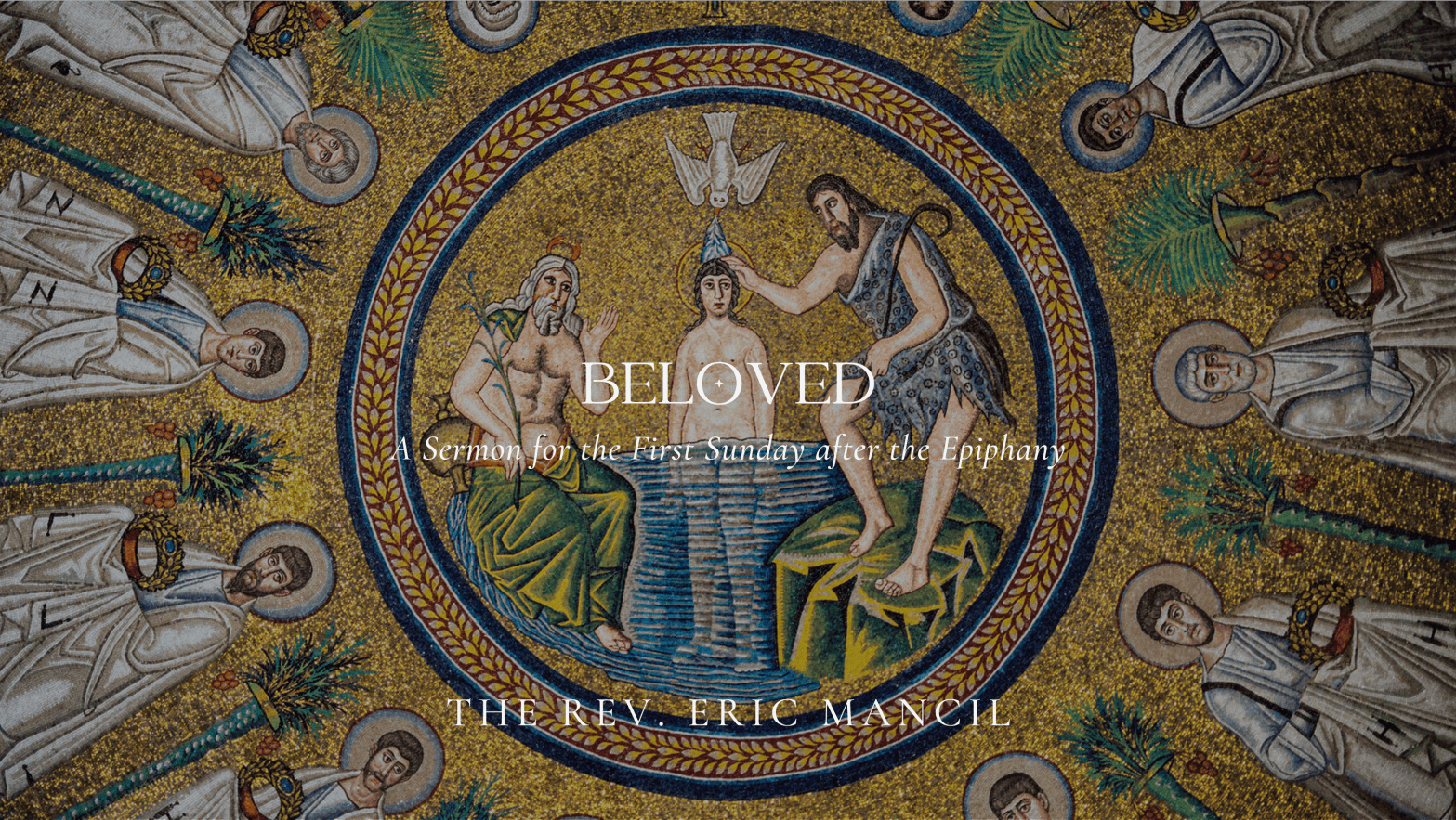
Beloved

A Sermon for the First Sunday after the Epiphany: The Baptism of our Lord
January 12, 2025

Text: Luke 3:15-17, 21-22

Now, O Lord, take my lips, and speak through them. Take our minds, and think through them. Take our hearts, and set them on fire. In the name of the Father, and of the Son, and of the Holy Spirit. Amen.

Many years ago, as I was discerning my call to the priesthood, I started to read a lot of books by different spiritual writers, mostly having to do with theology and what it means to be a priest in the Episcopal Church.

For me, one of the most influential writers was Archbishop Desmond Tutu.

Sadly, the archbishop passed away about three years ago at the age of ninety at his home in Cape Town, but his legacy continues on.

As many of you probably know, Desmond Tutu was an instrumental figure in the struggle to tear down the system of legalized racism in South Africa, known as apartheid, which finally came to an end in the early 1990s.

He was also an advocate for peaceful reconciliation in the years that followed.

Under the leadership of Nelson Mandela, Archbishop Tutu served as the chairman of the Truth and Reconciliation Commission, which was established in order to bring healing to the country and offer a way forward.

He was committed to the idea of restorative justice and believed that the only path to true peace and reconciliation—after decades of violence and oppression under apartheid—was by seeking the truth and offering forgiveness to those who were responsible.

Even though he’s no longer with us, I’m so thankful for the life and ministry of Desmond Tutu and for all he taught us about how to love others and offer mercy in the name of Jesus Christ.

Our former Presiding Bishop, Michael Curry, offered these words shortly after his death: “While on this earth, he sought to follow Jesus of Nazareth in God’s way of love and life. In so doing, he showed us how to live God’s dream as children of the one God and creator of all. So, even in our sorrow that he is no longer walking among us, we can thank God that he did.”

I’ll always remember Desmond Tutu as the first person who taught me, through his writing, that all of us—no matter who we are or what we’ve done or left undone—are completely and unconditionally loved by the God who created us.

We were loved into being and formed in the image and likeness of God.

In his book, Made for Goodness—which he co-authored with his daughter—the archbishop wrote, “From the time before eternity our God has awaited each birth with love and delight.”

“‘Before I formed you in the womb I knew you’ is the word of God to the Hebrew prophet Jeremiah. It is equally God’s word to each of us.”

“Before the ‘Let there be…’ of creation, before God breathed Adam’s first breath, God knew us and God loved us.”

“God loves each of us as though there were no one else in the world, as though there were only one person to love.”

“We are so precious to God that, as Jesus reminds us in the pages of Matthew’s Gospel, ‘even the hairs of your head are all counted.’”

It’s almost unimaginable, isn’t it, that God loves us so perfectly and so completely, without reservation or condition.

Our whole lives, we’ve been taught that, in order to succeed in life and be loved by others, we have to earn it.

We have to do certain things or behave a certain way or change our appearance in order to be loved and accepted by those around us.

But, not with God.

We are God’s beloved, God’s possession—loved from before time and forevermore.

In our lesson this morning from Isaiah, the prophet writes, “Thus says the Lord, he who created you, O Jacob, he who formed you, O Israel: Do not fear, for I have redeemed you; I have called you by name, you are mine.”

In other words, dear friends, God has claimed each of us as his own, and there’s nothing we can do or say that will ever change that.

Today is the First Sunday after the Epiphany, the day when we celebrate the Baptism of our Lord.

On this day, we recall the story of our Lord’s baptism at the River Jordan by John the Baptist.

It’s important that we take time to remember this part of Jesus’ life.

Not only does it signal the beginning of his public ministry, but I think it also helps us better understand the significance of baptism in our own lives and the role it plays in our journey with Christ.

In today’s Gospel reading, soon after Jesus receives the baptism of John, the heavens are opened and the Holy Spirit descends upon him in the form of a dove.

Then, Jesus hears a voice from heaven say to him, “You are my Son, the Beloved; with you I am well pleased.”

One way you could read this part of the lesson is that the voice from heaven is God’s response to what Jesus does when he goes to John for baptism.

After all, the voice from heaven doesn’t call out to Jesus until after he’s baptized.

But, I don’t read it that way.

I don’t see this passage as a response from God, as if God’s love for Jesus somehow depends upon whether or not he’s baptized.

I see it as an acknowledgement—a declaration from heaven—claiming Jesus as God’s own.

I see it as God’s way of saying to Jesus, “I’ve known you and loved you since before time, and I’ll continue to know you and love you forever.”

Jesus’ baptism is an acknowledgement of something that began long before he ever made the choice to be baptized.

We often think of Baptism as something we do in the Church that changes us in some way, and I think that’s true. Baptism is the sacrament of new birth.

In the water of Baptism, we are buried with Christ in his death. By it, we share in his resurrection. Through it, we are reborn by the Holy Spirit.

We are changed in the sense that the old way of sin and death has passed away and a new creation has been raised up.

But, in another sense, we’re the same as we always have been.

Since before time, we were known and loved by God.

Baptism is a way for us to acknowledge our belovedness and make the choice to live more fully into who God created us to be as God’s children.

This is why the liturgy for Baptism includes a series of questions and answers for those who are choosing to be baptized and why we join with them in renewing our own baptismal vows.

The vows and promises we make in baptism help guide us and keep us on track.

They remind us of who we are as the beloved of God.

They remind us, in the words of Desmond Tutu, that we were “made for goodness.”

In just a few moments, we’ll take some time to renew the solemn vows and promises of Holy Baptism.

As you say the words, think about that voice from heaven who spoke to Jesus, saying, “You are my Son, the Beloved; with you I am well pleased.”

That same voice continues to speak to each of us, calling us by name into a deeper and more meaningful relationship with God.

I’d like to close by sharing with you some final words from Desmond Tutu.

These words come from the last two pages of his book, Made for Goodness, and are written from the perspective of God, speaking to his beloved—

You are my child,
My beloved.
With you I am well pleased.
Stand beside me and see yourself,
Borrow my eyes so you can see perfectly.
When you look with my eyes then you will see
That the wrong you have done and the good left undone,
The words you have said that should not have been spoken,
The words you should have spoken but left unsaid,
The hurts you have caused,
The help you’ve not given
Are not the whole of the story of you.
You are not defined by what you did not achieve.
Your worth is not determined by success.
You were priceless before you drew your first breath,
Beautiful before dress or artifice,
Good at the core.

And now is time for unveiling
The goodness that is hidden behind the fear of failing.
You shout down your impulse to kindness in case it is shunned,
You suck in your smile,
You smother your laughter,
You hold back the hand that would help.
You crush your indignation
When you see people wronged or in pain
In case all you can do is not enough,
In case you cannot fix the fault,
In case you cannot soothe the searing,
In case you cannot make it right.
What does it matter if you do not make it right?
What does it matter if your efforts move no mountains?
It matters not at all.
It only matters that you live the truth of you.
It only matters that you push back the veil to let your goodness shine through.
It only matters that you live as I have made you.
It only matters that you are made for me,
Made like me,
Made for goodness.

Amen.

I Sing a Song of the Saints of God

A Sermon for the Feast of All Saints (Year B)
November 3, 2024

Text: John 11:32-44

Now, O Lord, take my lips, and speak through them. Take our minds, and think through them. Take our hearts, and set them on fire. In the name of the Father, and of the Son, and of the Holy Spirit. Amen.

There are several hymns in our hymnal that are especially appropriate for us to sing on All Saints’ Day—beautiful hymns such as the one that we sang at the beginning of our service this morning, “For all the saints, who from their labors rest.”

But, there’s one hymn that, for me, really gets to the heart of what this feast day is all about.

We sang it just a few minutes ago, and it begins like this:

I sing a song of the saints of God, patient and brave and true, who toiled and fought and lived and died for the Lord they loved and knew. And one was a doctor, and one was a queen, and one was a shepherdess on the green: they were all of them saints of God, and I mean, God helping, to be one too.

In the parish where I served in northwest Texas right out of seminary, we sang this hymn every time there was a baptism.

During the service, we would process to the baptismal font, which was close to the entrance of the church—similar to the way we do it here at St. Mary’s.

We would do the baptism, and when it was over, we would return to the front of the Nave.

And, as we did this, the congregation would sing, “I sing a song of the saints of God.”

It was such a beautiful tradition, and there’s a good reason why we did this.

The words of this particular hymn convey the simple truth that each one of us, by virtue of our baptism in Christ, is called to be a saint, to live a life worthy of the Gospel.

St. Paul wrote about this frequently in his letters to the earliest Christian communities.

In his letter to the Ephesians, for example, Paul writes, “I therefore, the prisoner in the Lord, beg you to lead a life worthy of the calling to which you have been called, with all humility and gentleness, with patience, bearing with one another in love, making every effort to maintain the unity of the Spirit in the bond of peace. There is one body and one Spirit, just as you were called to the one hope of your calling, one Lord, one faith, one baptism, one God and Father of all, who is above all and through all and in all.”

In the New Testament, the Greek word for “saint” is hagios, which literally means “holy” or “set apart.”

All of us, whether we realize or not, are counted among the saints and set apart to live our lives as Christ has taught us to live.

All Saints’ Day is a time for us celebrate and give thanks for all those who’ve come before us in the faith, guiding us with their wisdom and providing us with examples of holy living.

This is why it’s customary in many parishes on this day—including ours—to include in our prayers a list of the dearly departed, those who’ve come before us and who now rest in the eternal peace of God.

Some people refer to All Saints’ Day as the Church’s “memorial day,” but it’s actually a lot more than just a day of remembrance.

It’s also a time for us to consider how we might pattern our own lives on Jesus and live more fully into our sainthood.

To do this, I’d like for us to reflect for a moment on today’s Gospel reading from John.

This is a familiar story for many of us.

Most of the time, the part we remember the most—the part we tend to focus on—is the miracle Jesus performs at the end of the story when he goes to the tomb of his friend, Lazarus, calls for the people to roll away the stone at the entrance of the cave, and cries out with a loud voice, “Lazarus, come out!”

And, we all know how the story ends.

The dead man comes out of the cave, still wrapped up in bands of cloth, and Jesus tells the people who are standing near, “Unbind him, and let him go.”

The raising of Lazarus is Jesus’ way of demonstrating to the people that, for those who truly believe and put their faith in God, death will have no hold over us.

Our Christian faith teaches us that death isn’t the end, only the beginning of new life with God.

We belong to God.

Like the saints who’ve come before us, we are the Lord’s possession, and nothing—not even death—can separate us from the love of God in Christ Jesus.

We’re reminded of this every time there’s a baptism in church when the priest anoints the newly baptized with the oil of chrism while saying the words, “You are sealed by the Holy Spirit in Baptism and marked as Christ’s own forever.”

This is important for people of faith to remember—especially in times of adversity.

Because of our Lord’s sacrifice on the cross and his victory over the powers of sin and death, we have no reason to ever live in fear.

The victory is already won.

But, that doesn’t mean we can just sit on the sidelines and do whatever we want.

Because there’s still a lot of work left to do in the building up of God’s Kingdom, and as Christians, we’ve been called to do this work—to help restore God’s vision of a world redeemed in love where justice and peace exist for all people.

Which leads me to the part of today’s Gospel lesson that I really want us to focus on this morning.

I want us to back up a bit to the beginning of the passage and reflect for a moment about how Jesus responds to Mary and Martha, the sisters of Lazarus, who are grieving the loss of their brother.

We learn that, soon after Jesus arrives, Mary comes to him, kneels down at his feet, and says, “Lord, if you had been here, my brother would not have died.”

Her words must’ve felt like daggers to Jesus’ heart.

She’s heartbroken, and I think, at least to some degree, she’s angry and frustrated with Jesus and blames him for not coming sooner and preventing this terrible tragedy.

And, there are others who are standing around as well and watching all of this unfold between Mary and Jesus, and they also begin to weep.

I imagine it looks a lot like going to the funeral of a close friend or family member and seeing all of their loved ones standing close by and supporting each other in their grief.

Seeing how Mary and the others are overwhelmed with emotion, Jesus also begins to weep—not because he believes that Lazarus is gone for good but because he loves him, and he sees how much his family and friends loved him.

For me, the most inspiring part of the story is not so much the resurrection of Lazarus from the grave.

That part’s important, too.

But, the part of the story that really moves me and inspires me is the compassion Jesus demonstrates when he weeps right alongside those who are mourning.

It’s such a beautifully human moment for Jesus and the others.

And, it’s a wonderful reminder for all of us that, in the midst of the pain and agony of this human life, we have the ability to sit with each other when times are tough and help bear each other’s burdens and bring a little bit of comfort and peace to those who mourn.

We have the ability to share God’s love with those who are suffering by simply acknowledging their pain and letting them know they’re not alone.

This brings me back to what today is all about as we celebrate the lives of all the saints who’ve come before us and as we consider the kind of legacy we want to leave behind for future generations.

Personally speaking, I want to be the kind of saint—the kind of Christian—that models the love and compassion of Jesus by responding to God’s call and doing the work that needs to be done.

I want to be the kind of Christian that’s unafraid about what others might think when I sit with someone who’s grieving or someone who just needs a little extra love in their lives.

I want to be the kind of Christian that puts aside my own needs and concerns long enough to let others know that there’s at least one other person in this world who cares about them.

I want to be the kind of Christian that future generations in the church will sing about when they celebrate All Saints’ Day—not for my glory but for the glory of God.

And, truth be told, that’s what I hope for all of us gathered here today, that future generations will one day sing about us—

I sing a song of the saints of God, patient and brave and true, who toiled and fought and lived and died for the Lord they loved and knew. And one was a doctor, and one was a queen, and one was a shepherdess on the green: they were all of them saints of God, and I mean, God helping, to be one too.

Amen.