

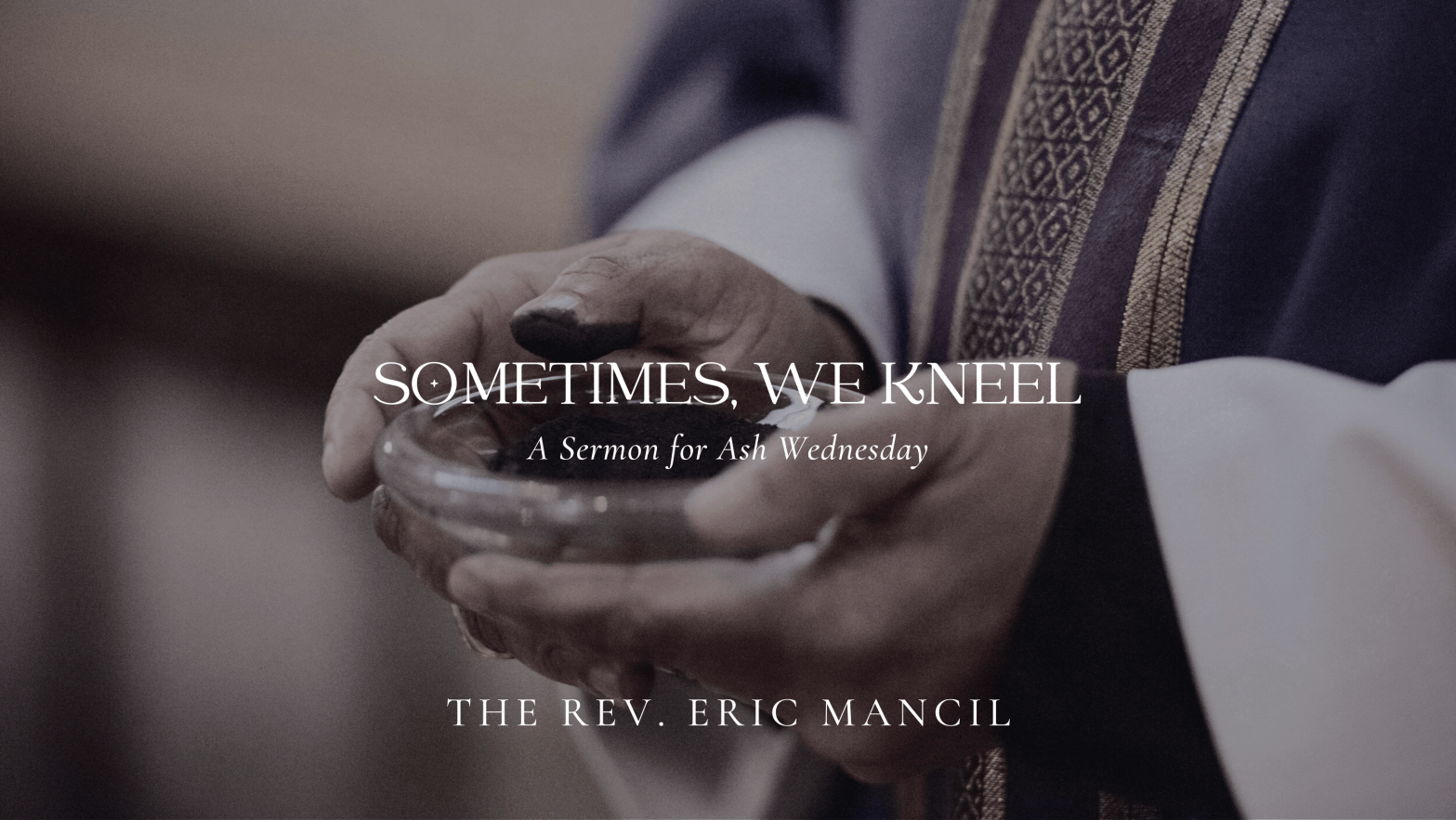
A Sermon for Ash Wednesday
February 18, 2026
Texts: Joel 2:1-2,12-17; 2 Corinthians 5:20b-6:10; Matthew 6:1-6; 16-21
Now, O Lord, take my lips, and speak through them. Take our minds, and think through them. Take our hearts, and set them on fire. In the name of the Father, and of the Son, and of the Holy Spirit. Amen.
Today, we begin the season of Lent in the most honest way the Church knows how. Not with a checklist of things to do or a special program that will make us better Christians.
We begin by telling the truth.
We begin our journey through Lent with a cross of ashes on our foreheads.
We come to the altar with open hearts and hear words that have been passed down from generation to generation: “Remember that you are dust, and to dust you shall return.”
That sentence can sound harsh if we hear it the wrong way.
It can almost sound like God is angry with us and standing over us with his arms crossed, reminding us of all the ways we’ve messed up.
But Ash Wednesday isn’t a time for shame or punishment.
It’s a time for compassion and mercy.
The ashes don’t tell us we’re worthless.
They tell us the truth of who we are.
We are fragile.
Our lives are short.
We can’t control or fix everything.
And we were never meant to carry the weight of the world alone.
The ashes are the Church’s way of saying, “Let’s take a look at where we are and be honest with ourselves.”
Let’s stop pretending everything’s okay.
And instead—just for a moment—let’s stand in the presence of God with nothing to prove.
That’s why Lent begins here—on Ash Wednesday.
Because if we don’t begin with truth, it’s easy for Lent to become just another self-improvement project—another season where we try harder to prove ourselves worthy of God’s love and end up either proud or disappointed.
But God isn’t asking for us to prove ourselves.
God is asking for our hearts.
In the readings appointed for this day, we hear the same message repeated again and again—come home to God.
The prophet Joel says it this way: “Return to the Lord your God, for he is gracious and merciful.”
Paul writes to the church in Corinth, “We entreat you on behalf of Christ, be reconciled to God.”
And in Matthew’s Gospel, Jesus warns us against turning faith into a performance and invites us to come home to God through prayer, fasting, and acts of generosity.
Not “get your act together.” Not “try harder.”
But come home to God.
Lent isn’t a competition or a test we’re trying to pass.
It’s a time for us to turn back.
And to do that—to come home to God—we have to be willing to take stock of our lives.
To tell the truth about where we are.
To be honest about the ways we’ve turned away from God.
Because the truth is, most of us are walking around with heaviness in our hearts and burdens we don’t want to carry.
Unhealthy habits that have changed us.
Old resentments we hold on to and refuse to let go.
Worries that keep us up at night.
Ways of coping with life that numb us instead of making us whole.
Patterns in our relationships that keep us from being fully present.
Lives that are so busy and full of noise and obligations that we’ve stopped making God a priority—and started squeezing God into whatever time is left.
That’s probably the one I struggle with the most.
Ash Wednesday invites us to wake up and pay attention.
Not because God wants to shame us but because God wants to set us free from what’s weighing us down.
Now, when a lot of us hear the word “Lent,” we immediately think: “What am I giving up this year?”
Maybe chocolate.
Or sweets.
Or soft drinks.
Or social media.
Or something else we enjoy.
And sometimes giving something up can be a helpful practice.
It can open our eyes and help us see those material comforts we’ve leaned on to try and fill the empty spaces in our hearts.
And giving up something for a while can also open up more time and space for prayer.
But, I want to offer you another way to think about Lent this year—because it might be what some of us need to hear the most.
I recently came across a story by an Anglican priest, and she wrote about a time in her life when she honestly didn’t know what to give up for Lent.
Life was hard.
She had just had her first child.
She was exhausted all the time. Her body was still recovering from pregnancy, and life was out of control.
She said it felt like her life already involved plenty of sacrifice—like she had already “given up enough.”
So she did what a lot of us do when we’re trying to be faithful and we’re not sure what to do next.
She went and talked to her priest.
And he listened.
And he said something that may surprise you.
“You don’t need to give anything up,” he said. “Your whole life is Lent right now.”
In other words—life is already asking a lot from you.
You’re already carrying enough.
You’re already learning self-denial in ways you didn’t choose.
And then, instead of giving her one more burden to carry, he gave her an invitation—to make space in her life to be restored and renewed by God.
To take up what he called a “practice of pleasure”—not to escape from life but as a holy discipline: intentionally receiving small, life-giving gifts with gratitude.
So that year, during Lent, she started walking to her favorite coffee shop once a week to sit down with a hot drink and a novel—something simple and quiet—to help her feel alive again.
When I read that story, it made me wonder if Lent isn’t just about, “What do I need to give up?”
Maybe it’s also about, “What do I need to receive?”
“What do I need in order to come home to God?”
Because here’s something we often forget: joy is not the opposite of repentance.
Repentance, at its heart, means turning—turning away from what holds us back toward the one who brings us life.
And sometimes the thing that holds us back isn’t chocolate or screen time.
Sometimes it’s the constant pressure of life.
The constant noise.
The constant self-doubt.
The constant feeling that we’re not enough.
Sometimes what we really need to turn away from is the lie that God only meets us when we’re successful or have everything together, when, in fact, God also meets us in stillness, in beauty, in times of rest and quiet, in moments of gratitude, and in the simple joy of being loved.
So today, I want to offer you an invitation—similar to the one I mentioned earlier.
What if this Lent, instead of focusing on “giving something up” you focused on making space for God?
Maybe it’s an hour a day.
Or maybe it’s thirty minutes.
Or maybe it’s an hour a few times a week.
What would that look like for you?
What would it look like to set aside time for God each week during Lent?
I’m not talking about giving God the leftovers. I’m talking about giving God the priority.
Maybe it’s sitting in a chair with no phone or any other distraction and simply praying, “Lord, have mercy.”
Maybe it’s a walk on the nature trail at LBW, paying attention to the beauty of God’s creation.
And who knows? You might even see your priest along the way.
Maybe it’s coming into church when it’s quiet and sitting in a pew all by yourself.
Maybe it’s reading a psalm or some other verse of Scripture—not to study it, but to listen for God’s voice.
Maybe it’s playing music, working with your hands, cooking a meal with gratitude, calling someone you love, or watching the sunset—anything that helps you find new life as God’s beloved.
And then let that space become a meeting place with God.
The season of Lent is all about restoring and renewing our relationship with God.
It’s about making room to be honest with God.
To listen.
To return.
To be healed.
And to be made new.
And yes—Lent is a time for us to take stock of our lives. It asks us to name what needs to change, to face what we’ve done and left undone.
But it also reminds us that God is compassionate and merciful, waiting for us to come back home.
When we come to the altar to receive ashes, we’re not coming to show how holy we are. We come forward as human beings—dust and breath—marked with the sign of the cross.
The ashes remind us that life is short.
But the cross reminds us that love is stronger than death and that we are God’s beloved.
So come as you are.
And as we begin this holy season, let us consider a Lent that’s more than just giving things up for the sake of suffering.
Instead, let us draw closer to God and be intentional about making room for God in our lives—no matter what that looks like—where God can meet us with mercy and compassion and the joy of being made new.
Amen.
 The Rev. Eric Mancil