
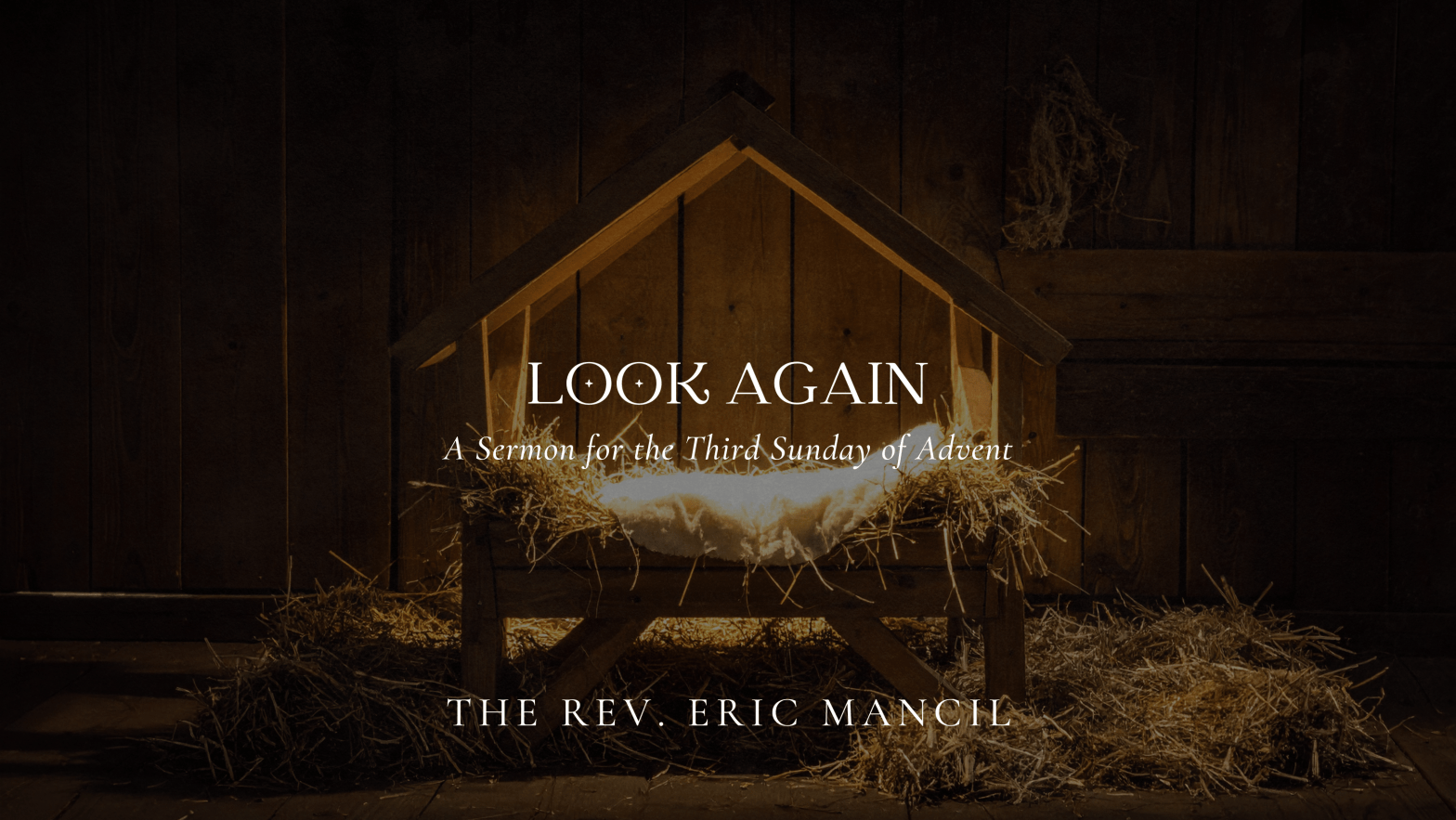
A Sermon for the Third Sunday of Advent (Year A)
December 14, 2025
Text: Matthew 11:2-11
Now, O Lord, take my lips, and speak through them. Take our minds, and think through them. Take our hearts, and set them on fire. In the name of the Father, and of the Son, and of the Holy Spirit. Amen.
Chelsea and I were sitting on the couch the other day, trying to pick out a Christmas movie to watch. And you know how that goes—you keep scrolling through all the channels, thinking, surely we’re going to find something good to watch.
And before you know it, you’ve spent more time choosing a movie than it would have taken to actually watch one.
Then I remembered a movie I’d been meaning to watch for a while called The Best Christmas Pageant Ever.
It’s a relatively new film—only about a year old—but it’s based on a much older and well-loved book by Barbara Robinson.
The book was written back in the 1970s, and Robinson once said it was inspired by her own experiences watching children—real, imperfect children—show up in church pageants and somehow reveal the heart of the Christmas story in ways adults often missed.
She wasn’t trying to write a sweet Christmas story. She was trying to tell the truth about how God tends to work: not always through the polished and prepared, but often through the unexpected.
So Chelsea and I finally watched it. And I have to say—it really is a good movie. If you’re looking for something meaningful to watch this season with your family, I highly recommend it.
If you know the story, you remember the Herdmans.
They’re a group of brothers and sisters who come from a rough home life and have a reputation for being loud, rough around the edges, and unpredictable. They don’t follow the rules at school. Kids are afraid to be around them. And when people see them coming, they tend to turn and walk the other way.
So when the Herdmans wander into church one Sunday and announce that they want to be in the annual Christmas pageant—and not just be in it, but take all the main roles—the congregation doesn’t quite know what to do.
They start to panic.
They worry the pageant will be ruined.
They worry it won’t be reverent enough, that something sacred will be turned into a mockery.
And if we’re honest with ourselves, we understand that reaction, don’t we? Because most of us carry clear expectations about how things should look and feel—especially around Christmas.
But then something unexpected happens.
For the first time in their lives, the Herdmans hear the Christmas story. They don’t just listen to it—they really hear it.
Not the cleaned-up, familiar version, but the real one. A story about a young mother and father far from home with no one to help them. A baby born in a stable because there was no room for them anywhere else. A family with nowhere to go. A powerful king threatened by a child.
And the Herdmans are stunned.
They can’t believe Mary and Joseph had no help.
They can’t believe Jesus was born among animals.
They can’t believe Herod wanted to kill the baby.
And they respond with this raw, honest emotion that catches everyone off guard. They feel the weight and danger of the story—the vulnerability of it. And as the church watches these children react, something begins to change.
The pageant becomes more than just a performance.
The story comes alive.
And Christmas becomes real again.
By the end of the movie, the very children everyone expected to ruin the Christmas pageant end up helping the whole congregation see Christmas again with fresh eyes.
Grace shows up where no one was looking.
God works through the people no one expected.
And sitting there watching the movie, I was moved to tears, because it was such a beautiful reminder that God often uses people we least expect to show us the truth of God’s love.
That’s what today’s Gospel lesson is all about—learning to look again at how God is working, even when it doesn’t fit our expectations.
John was someone who had very clear expectations about how God was supposed to work.
Just last week, we heard him preaching about fire and judgment—about axes at the root of the trees and a winnowing fork in hand—proclaiming a Messiah who would come in great power and set everything right.
And John didn’t just talk about that vision—he lived it. He spoke truth to power. He confronted injustice. He called people, even rulers and religious leaders, to repentance.
Eventually, that courage landed him in prison.
John was arrested because he confronted King Herod about his unlawful marriage to his brother’s wife. It was a prophetic word spoken to someone who didn’t want to hear it.
And like so many truth-tellers before him, John paid the price. He was bound, locked away, and silenced so he wouldn’t cause any more trouble.
That’s where our story picks up today.
John is sitting in a prison cell, and he starts hearing reports about what Jesus has been up to.
Jesus is healing people.
He’s restoring lives and lifting up the poor and the oppressed.
He’s preaching mercy, not judgment.
And it doesn’t line up with what John expected.
So John sends his disciples to Jesus with a question:
“Are you the one who is to come, or should we wait for another?”
In other words, “Jesus, you’re not what I expected. Are you really the Messiah?”
Jesus doesn’t scold John.
He doesn’t shame him for doubting or tell him to try harder or believe more.
Instead, Jesus tells John’s disciples to go back and report what they hear and see.
The blind receive their sight.
The lame walk.
The lepers are cleansed.
The deaf hear.
The dead are raised.
And the poor have good news brought to them.
And for those who knew the Scriptures—as John certainly did—those words would have sounded very familiar, echoing the promises of the prophet Isaiah about the day when God would come to heal the blind, restore the broken, and bring good news to the poor.
Jesus is saying to John, “Look again.”
Look again at what God is doing.
Look again at how the Kingdom is breaking in.
Look again—because God is at work, even if it doesn’t look the way you imagined.
Jesus isn’t telling John he was wrong to hope for something more. He’s helping him see the bigger picture. He’s helping him see that the Kingdom doesn’t come in the way he imagined—not through force or spectacle, but through healing, mercy, and a love that reaches people where they are.
He’s inviting John to open his eyes to the quiet ways the Kingdom of God is already breaking in.
“Look again,” Jesus says.
Not because John has failed, but because God is doing more than he imagined.
And Jesus invites us to do the same.
Because even though we don’t like to admit it, we’re often a lot like those people in the movie who doubted the Herdmans.
We’re quick to decide who belongs and who doesn’t. We assume we know who God can use and how God is supposed to show up.
But God has a way of surprising us, showing up through people and in places we never would have chosen.
So, Jesus tells us to look again.
Because if we don’t, we risk missing Christ altogether.
The season of Advent isn’t just about waiting for Jesus to come again and make all things new. It’s about learning to recognize Christ in the present.
And if we’re locked into narrow expectations—about who God can use and where God can work—we may walk right past Jesus without even knowing it.
We look again because Christ often comes quietly—because grace shows up in unexpected people.
We look again because God’s Kingdom breaks in at the margins—among the poor, the hurting, the overlooked, the ones who don’t fit in.
If Advent is about preparing for Christ to come again, then it’s also about preparing our eyes and our hearts to recognize him when he does.
If this season is about working toward the fulfillment of God’s Kingdom, then we have to learn to see the world as God sees it—to notice the broken corners of the world that are aching for healing and restoration.
So maybe this Advent, Jesus is saying to us what he said to John: “Look again.”
Look again at the people you’ve written off as unholy or undesirable or unredeemable.
Look again at the places you’ve given up on.
Look again at your own life and the quiet ways God may be at work.
Because when we look again—with openness and humility—we may discover that Christ has been with us all along—healing, restoring, and making all things new.
Amen.
 The Rev. Eric Mancil