I Am With You Always

A Message for the Angel of Hope Service of Remembrance
Tuesday, December 2, 2025

Good evening, friends.

It’s an honor and a privilege to be with you tonight.

My name is Father Eric Mancil, and I serve as the rector of St. Mary’s Episcopal Church here in Andalusia.

I want to begin by offering my heartfelt thanks to Debbie Grimes and to the other officers for the Angel of Hope for inviting me to be part of this service of remembrance.

The work you do—the compassion you offer, the space you provide for those who grieve—matters deeply to families throughout Covington County. Thank you for making this night possible.

We gather here at the Angel of Hope because this is a sacred place.

Each of us comes here tonight with a story.

Each of us carries a name, a face, a memory that has shaped our life more deeply than words can describe.

Tonight, we gather because we know that love never ends.

And because grief—especially the grief of losing a child—doesn’t follow a timeline or conform to what the world expects of us.

This time of the year makes that especially clear.

As December begins, the world around us tells us we should be cheerful all the time and full of holiday joy.

Everywhere we turn, there are Christmas lights, decorations, music, and messages insisting that this season is all about celebration.

And yet—for so many who carry deep grief—this is the season that hurts the most.

The empty chair at the table, the tradition that feels incomplete, the memory that arrives without warning… all of these can take what is supposed to be a joyful time and make it heavy or too painful to bear.

And so tonight matters.

Tonight gives us permission to be honest.

Permission to feel what we feel.

Permission to acknowledge that grief doesn’t take a holiday break.

Here, in this sacred place, no one has to pretend.

No one has to hide their feelings or their questions.

No one has to put on the holiday mask the world expects. 

Tonight we simply come as we are—carrying all the love, all the longing, all the pain, and all the gratitude that come with remembering a child who will always be part of us.

As a pastor—and as a parent myself—I’ve walked with many people who’ve carried deep grief of all kinds.

And while I’ve never walked through the loss that many of you carry, I do know what it means to love a child with your whole heart.

I know the way a child becomes part of you, the way their life shapes your own.

And because of that, I can only begin to imagine the deep pain that comes with losing a son or daughter.

What I do know is that grief is not a problem to solve or something we should be expected to just “get over.”

Grief is love—love that still aches, love that still reaches, love that still remembers.

Some days that grief feels like a fresh wound.

Other days, it rests quietly in the background until a smell, or a song, or a moment brings it rushing back.

But in every case, grief becomes a companion we never asked for—one that walks with us day after day.

So, please hear me tonight when I say that there’s no right or wrong way to grieve.

There is no timetable.

There is no moment when you are “supposed” to just all of a sudden feel better.

Your grief is real.

Your journey is your own.

And for those who’ve lost a child, their life will always matter.

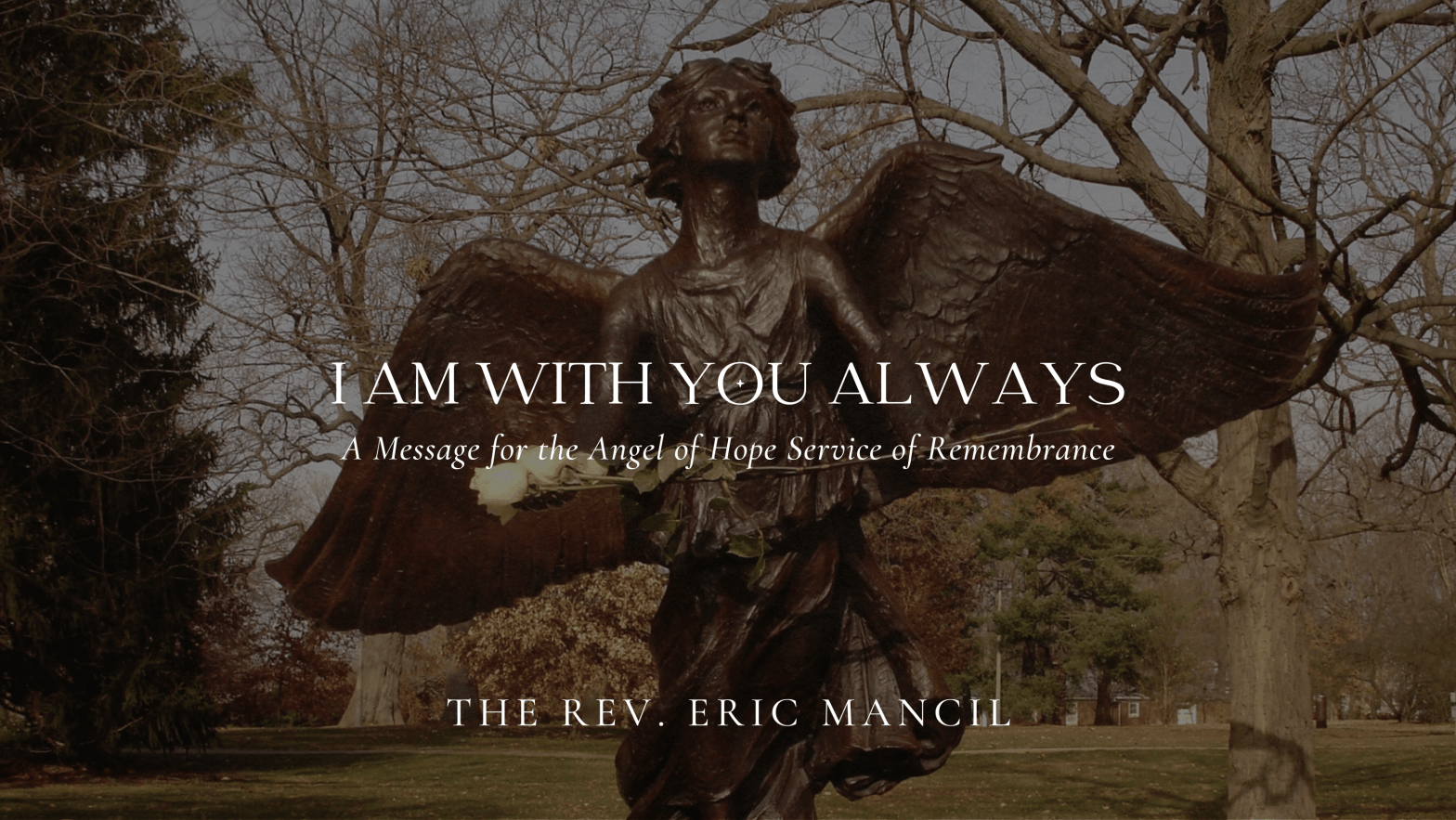
This Angel of Hope stands here for that very reason.

Her open arms, her outstretched wings, her quiet presence: they remind us that none of us grieve alone.

All around the world, more than 150 of these angels stand in communities just like this one, bearing witness to the truth that a parent’s love does not end with death.

This angel is not a symbol of a simple or shallow hope.

She represents a deeper kind of hope—the kind that rises even in sorrow, that reminds us love is never lost, and that assures us God will never leave us to face our pain alone.

As people of faith, we hold to a promise that sustains us: the promise that God is with us, even in our deepest pain.

Jesus never said we would not face sorrow or heartbreak.

He never said that life would be free from suffering.

What he did say—what he promised—is that we would never face those moments alone. “I am with you always,” he said.

Not just in the easy days, not just in the joyful days, but in the darkest nights and the heaviest hours.

Jesus knew grief.

He wept at the tomb of his friend, Lazarus.

He felt the sting of loss.

And because he knows grief from the inside, we can trust that he walks with us through ours—not to take the pain away, but to carry it with us, to lift us up when we fall, and to remind us that love is stronger than death itself.

In a few moments, many of you will come forward to place a flower at the Angel of Hope.

It is a simple act, but it carries such deep meaning.

It is a way of saying, “My child lived. My child was loved. My child is still loved.”

And through that love, their light continues—shining in your memories, in your stories, in the ways they shaped who you are.

And the hope we proclaim tonight, the hope of the Gospel, adds this: your child is held in the eternal embrace of God in a place where there is no pain, no fear, no suffering, only peace and love beyond our understanding.

Until that day when all things are made new and we’re reunited with those we love, God gives us the strength to keep going.

One breath at a time. One step at a time. One act of courage at a time.

My prayer for you tonight is that you feel surrounded by God’s love, upheld by this community, and filled—if even only for a moment—with a sense of peace.

You’re not alone. Not tonight. Not ever.

May the God who knows your story, who holds your tears, and who loves you and your child more than you can imagine, grant you comfort, strength, and hope—hope deep enough to carry you through the days ahead, and love strong enough to remind you that nothing, not even death, can separate us from the love of God in Christ Jesus.

Let us pray.

Holy and gracious God, tonight we lift before you the children we love and remember. We thank you for their lives, for the joy they brought us, for the ways they shaped our hearts and still shape them even now. Hold their families in your tender care. Surround them with your peace in moments of sorrow, your strength in moments of weakness, and your gentle presence when the weight of grief feels too heavy. Remind us that you are a God who walks with us—not to take away our pain, but to help us carry it, to lift us up when we fall, and to shine light into the darkness.

Bless each person gathered here tonight. Calm their anxious hearts, renew their courage, and fill them with a hope that lasts. And as we leave this place, help us to carry the love of our children with us—not as a burden, but as a sacred flame that continues to burn brightly. All this we pray in the name of the one who is our comfort and our hope, Jesus Christ our Lord. Amen.

The Widow’s Offering

A Sermon for the Twenty-Fifth Sunday after Pentecost (Proper 27, Year B)
November 10, 2024

Text: Mark 12:38-44

Now, O Lord, take my lips, and speak through them. Take our minds, and think through them. Take our hearts, and set them on fire. In the name of the Father, and of the Son, and of the Holy Spirit. Amen.

As a priest, I’ve had the pleasure of meeting so many wonderful and faithful people in the course of my ministry. And, as I’ve moved over the years and served in different parishes, I’ve carried all their stories with me wherever I go.

At the Church of the Holy Spirit in Alabaster, where I served before coming to St. Mary’s, there was a lovely couple named Mike and Judy.

They were the kind of parishioners you could always count on to be at worship on Sunday mornings and to get things done around the church that needed to be done.

And, they always greeted me at the end of the service with a big hug and told me how much they enjoyed my sermon that day.

Not long after I arrived at Holy Spirit, Judy pulled me aside one morning and shared with me the story of how she and Mike got started making the coffee every Sunday morning before the 8:30 service.

On one of their first Sundays at the church, they walked inside and discovered the priest making the coffee, and they thought to themselves, “He’s the priest! He shouldn’t be the one making the coffee!”

So, they walked up to him and offered to start making the coffee so that he could pay attention to other things that needed to get done before the service.

And week after week, year after year, they kept doing the same job. Even when we started coming back to in-person worship during the pandemic, Mike and Judy were there, ready to start making the coffee again.

That’s the kind of people they were.

Always ready to help, even in the smallest ways.

After about a year into my ministry at Holy Spirit, my family and I were on vacation during the summer.

One morning, I started receiving strange text messages from some of our parishioners.

They were asking me if I was the one who sent them an email asking for their help with money and gift cards to give to people in need.

Of course, I had no idea what they were talking about.

So, I quickly called around and tried to figure out what was going on.

And, what I discovered was that several members of the church had received an email from someone who was pretending to be me.

They had my name and my position at the church.

They had an email address that was very similar to my actual work email.

They even used a picture of me in the email, making it seem more believable.

They had all the things they needed to try and trick our parishioners into giving them what they wanted, which was personal information and money.

So, I called our secretary at the church and told her that we needed to get the word out to the parish as soon as possible so that no one became a victim of this terrible scam.

Thankfully, most of the people received the message in time and just deleted the fraudulent email.

But, that’s not what happened to Mike.

Mike didn’t receive the message in time, and he genuinely believed it was me asking him for money to help another person in need.

So, without even questioning it, he sent the person who was pretending to be me a thousand dollars.

When I found out, I was heartbroken.

And angry.

I was heartbroken for Mike and Judy because they lost so much, and I was angry at the person who had used by identity to take advantage of their goodness and generosity.

In the long-run, Mike and Judy would be fine. It was a lot of money but nothing that would cause too much of a hardship.

Mostly, I was just frustrated and upset by the fact that the person who scammed them was able to use their kindness against them.

The person who scammed them knew exactly what they were doing when they sent those emails out to the members of our parish.

When I got back home from vacation, I apologized to Mike and Judy.

Even though there was nothing I could do to stop it from happening, I felt so bad that this person—whoever they were—had been able to take advantage of them like they did.

Mike and Judy, of course, handled it with such grace.

And, they were much more forgiving than I would’ve been in their situation.

As infuriating as it was at the time, when I look back on what happened to Mike and Judy, I think it was a wonderful testimony to the kind of people they were—always thinking about others and looking for ways to help.

They legitimately believed that what they were doing was the right thing to do.

They believed that their priest was asking them for money to help another person in need, and they responded without even thinking about it.

Some may call them naive.

Some may call them foolish.

But, I think they were faithful.

Despite the fact that they didn’t actually help someone in need, their intentions were good, and they gave from their heart.

Faith means putting your whole trust into something you believe in—even when you might not be able to see it or understand it.

In the Gospel of John, Jesus said to Thomas soon after his resurrection, “Blessed are those who have not seen and yet have come to believe.”

Now, I don’t believe that God wants us to be harmed or deceived in any way because of our faith like Mike and Judy were.

But, I think there’s something to be said about having faith and putting our whole trust in God.

And, we have a good example of that this morning in our Gospel reading from Mark when we hear the story of the poor widow who comes to make her offering in the temple in Jerusalem.

In the time of Jesus, it was required of all adult Jews, twenty years and older, to come to Jerusalem each year and make an offering to the temple treasury.

These offerings would be used to maintain the operation of the temple and support its ministries.

The required amount was a half-shekel—a single coin—which is what most people brought to the temple for their offering.

The treasury—the place where these offerings would be made—was located in a part of the temple called the Court of Women, which was the only gathering place where all Jews, both men and women, could congregate.

When we read in the Gospels about Jesus teaching in the temple during the last week of his life, the Court of Women is likely where these teachings took place.

It was the only place where everyone could gather to hear Jesus speak.

It’s probably also the location where our Gospel lesson for this morning takes place.

Jesus is teaching in the temple.

And, he begins to criticize the scribes, saying, “Beware of the scribes, who like to walk around in long robes, and to be greeted with respect in the market-places, and to have the best seats in the synagogues and places of honour at banquets! They devour widows’ houses and for the sake of appearance say long prayers. They will receive the greater condemnation.”

The scribes were religious leaders in Jesus’ time who were well-educated in Jewish law and responsible for making copies of the scriptures.

They were also highly respected members of society.

Jesus criticizes them for only being concerned about personal gain and drawing attention to themselves, which was a clear misuse of their power and privilege as religious leaders.

Then, he sits down near the treasury and watches as all sorts of people come by, one by one, making their yearly offering to the temple.

He watches as rich people come by and put in large offerings.

And, then he sees a poor, old widow walk by, carrying what appears to be two small, copper coins.

These coins were called mites, or leptons. They were the smallest denomination of Jewish currency, and they were only worth about 1/64 of a Roman denarius, which was a day’s wage for a common worker.

Today, a mite would be the equivalent of about an eighth of a cent.

It wasn’t much.

But, it was all this poor widow had to offer.

Jesus watches as the woman comes into the treasury, puts in her two coins, and quietly walks away.

Because of who she is and her station in life, he’s probably the only one who notices the incredible sacrifice she just made.

He calls his disciples over and says to them, “Truly I tell you, this poor widow has put in more than all those who are contributing to the treasury. For all of them have contributed out of their abundance; but she out of her poverty has put in everything she had, all she had to live on.”

A closer translation to the Greek in this passage would be, “Out of her poverty, she’s given her whole life.”

She’s put her whole trust in God because it’s something she believes in.

By drawing attention to the widow’s offering, Jesus teaches us in this lesson that it’s not the amount we have to give that’s most important.

It’s the intention behind our offering that matters most to God.

Unlike the scribes, who are only concerned about themselves, what God wants most is for us to be faithful, for us to put our whole trust—our whole lives—in his hands.

I think it’s also worth mentioning here that God doesn’t expect us to give more than we’re able to give.

Some people use this story about the widow’s offering during stewardship season as a good example of how much money we should give to the church.

But, that’s not really the point of the story.

God knows we have to have money to buy the things we need.

God knows we have families to take care of and other financial obligations to fulfill.

God doesn’t expect us to give to the point where we sacrifice our well-being.

God wants us to be faithful, like the widow in our story who gave out of her poverty, trusting that her offering would be used to the glory of God.

God wants us to be faithful, like Mike and Judy, who I mentioned earlier, who gave their money because they believed they were helping someone who desperately needed it.

God wants us to be faithful, and what that means for each of us is something we have to work out between us and God.

At the end of the day, it’s not really about the amount of money we give or the amount of time we spend serving others.

Being faithful means showing our love for God and putting our whole trust in him.

Our offering, whatever that may be, represents our faith in God and our trust that God will take all that we have to give and use it to his honor and glory.

Amen.

Christ the King

A Sermon for the Last Sunday after Pentecost (Proper 29, Year A)
November 26, 2023
The Baptism of Sibylle Marie Hamilton

Text: Matthew 25:31-46

Now, O Lord, take my lips, and speak through them. Take our minds, and think through them. Take our hearts, and set them on fire. In the name of the Father, and of the Son, and of the Holy Spirit. Amen.

I subscribe to a series of daily meditations from the brothers at the Society of St. John the Evangelist, an Anglican monastery located in Cambridge, Massachusetts. Every morning, when I wake up and check my email, I find a short meditation written by one of the brothers at SSJE. Over the past several years, they’ve become part of my morning routine, something I look forward to reading each day.

All of them are good, but occasionally, I come upon one that’s especially meaningful—one that sticks with me for a long time.

A few years ago, I came upon a meditation simply titled “Citizenship,” and I want to share it with you today because I think it has something important to teach us about what it means for Christ to be our King. Today, after all, is the Last Sunday after Pentecost, also known as Christ the King Sunday—the day when we remember that our true allegiance, as Christians, is to the Kingdom of God.

In his meditation, one of the brothers wrote, “We live in a world where Me is king. But our citizenship is not of this world. We are citizens of another country, whose king is a servant, whose orb is a towel, whose scepter a wash basin, whose crown is humility, and whose motto is service. As citizens and subjects of that kingdom, we cannot swear ultimate allegiance in any other way than taking up our towels, holding our basins, and getting down on our knees.”

As I read the brother’s meditation, I was struck by the contrast he made between those traditional symbols of royalty—the orb, the scepter, and the crown—and the symbols that we often associate with the servant ministry of Christ—the towel, the wash basin, and the washing of feet. It reminded me that, as Christians, we are called to be in the world but not of the world. Our citizenship is in God’s Kingdom, and our one true king is Jesus Christ, the one who emptied himself and lived and died as one of us to show us the path to abundant life with God.

Jesus gave his life to show us that mercy and forgiveness matter more than power and prestige, that love and service to others matter more than our own selfish ambitions. We are first and foremost citizens of God’s Kingdom, and we’re called to walk in the way of our King, to take up our own cross and follow him.

In recent years, one of my favorite television shows has been The Crown on Netflix. If you haven’t seen The Crown yet, I highly recommend it. The show traces the life and reign of Queen Elizabeth II, beginning with her wedding to Prince Philip in 1947.

The first season depicts the struggles that Elizabeth experienced soon after the death of her father, King George VI, in 1952. After her father died, Elizabeth quickly ascended to the throne and was later crowned in a coronation ceremony at Westminster Abbey on June 2, 1953.

My favorite episode of The Crown is the one where we witness the coronation of the Queen with all of its pageantry and mystery. We witness Elizabeth accept the Coronation Oath and the Archbishop of Canterbury anoint her with holy oil. We witness her being crowned with the Crown of St. Edward as the choir sings “Zadok the Priest,” the traditional coronation anthem. And, in one of the final moments of the episode, we see the newly crowned Queen processing down the aisle, carrying the orb and scepter—the traditional symbols of the monarchy.

I was interested to learn that, according to tradition, the Sovereign’s Orb is a symbol of Godly power. It’s in the shape of a globe with a cross on top, which represents “Christ’s dominion over all the world.” During the coronation ceremony, it’s presented to the Sovereign after they put on the Imperial Robe. The orb is brought from the altar by the Dean of Westminster and given to the Archbishop of Canterbury to place in the Monarch’s right hand.

The Sovereign’s Scepter is actually one of two scepters used in the coronation ceremony. According to tradition, the scepter is a symbol of the Sovereign’s worldly power. During the ceremony, it’s placed in the left hand of the Monarch by the Archbishop of Canterbury.

As I was watching the episode with the Queen’s coronation, I noticed a lot of similarities between the symbols and traditions of the coronation ceremony and the symbols and traditions we associate with the sacrament of Baptism.

Do we not accept our own Coronation Oath in the covenant that we make with God in baptism?

Are we not anointed with holy oil in Baptism as a symbol of the unbreakable bond that we share with Christ?

Are we not crowned in Baptism through the Church’s invitation to join with Christ in his eternal priesthood?

These symbols and traditions matter because they connect us with something far greater than ourselves and remind us that we’ve been called to follow a particular way of life, a way that doesn’t include orbs and scepters but one that does include towels and wash basins.

Like the monarchy, the Church, as we know it today, is a human institution. We aren’t perfect. We have good days, and we have bad days. On our worst days, we care only for ourselves. On our best days, we remember that the real reason we exist is for the benefit of those on the outside, those who are hungry to hear the Good News we have to share with the world. The mission of the Church is to work for the building up of God’s Kingdom, “to restore all people to unity with God and each other in Christ.”

Our call as Christians is to follow Jesus into a life of humble service, to care for those whom the world has rejected. Jesus said it this way in our Gospel lesson for this morning:

“Come, you that are blessed by my Father, inherit the kingdom prepared for you from the foundation of the world; for I was hungry and you gave me food, I was thirsty and you gave me something to drink, I was a stranger and you welcomed me, I was naked and you gave me clothing, I was sick and you took care of me, I was in prison and you visited me.”

This is one of the last things Jesus said to his disciples. In just a couple of days from when this passage take place, Jesus will be betrayed and handed over to be crucified. So, I think it’s reasonable to assume that we should take these words to heart. Of all the things Jesus could’ve said to his disciples with the time he had left, he said this:

Feed the hungry.
Give drink to the thirsty.
Welcome the stranger.
Clothe the naked.
Take care of the sick.
And visit those who are in prison.

One day, Jesus will return to judge both the living and the dead, and on that day, we won’t be judged by the amount of money or influence we gained in this life.

We won’t be judged by how successful we were in our jobs or how many friends we had or how popular we were.

And, we won’t be judged by how many Bible verses we memorized or whether or not we had perfect attendance at church.

We will be judged by how we cared for the “least of these.”

Jesus said it himself in our Gospel lesson for today—not to scare us into doing these things—but to help us understand that, in order to experience the abundant life God desires for us, we must be willing to lay down our lives and follow in his way.

The way of Jesus—the way of self-giving, sacrificial love—is the path to eternal life with God. The way of “capital M Me”—the way of selfishness and self-service—is the path that leads us away from God.

God has given us the freedom to choose which path we will follow. Will we choose to serve only ourselves? Or, will we turn and follow Jesus?

The Church has a way for us to answer those questions, and it’s called the sacrament of Holy Baptism. When we make the choice to follow Christ—or, in some cases, when our parents and godparents make that choice on our behalf—we make solemn promises and vows before God and the Church to turn from the way of sin and death to the way of everlasting life with God. We are buried with Christ in his death and raised to newness of life through his resurrection.

In just a few moments, we’ll celebrate the sacrament of new life as we welcome Sibylle Marie Hamilton into the Body of Christ, and with her and her parents and godparents, we’ll renew our own Baptismal Covenant with God—those same promises and vows we once made to turn toward Jesus.

Sibylle doesn’t realize it now, but she’s about to be baptized into a royal priesthood of believers—not one with orbs and scepters but one with towels and wash basins. Promises and vows will be made on her behalf to follow Christ with the hope that one day, she’ll grow into a mature life of faith and make the decision for herself to be confirmed, to renew those same promises and vows that were made for her today.

She will be anointed with holy oil as a sign that she is sealed by the Holy Spirit in Baptism and marked as Christ’s own forever. Nothing can ever change that.

And, she will be welcomed as one of our own—a member of the Body of Christ. It will be our responsibility—along with her parents and godparents—to help guide her in the Christian life and faith, to lift her up when she falls, and to always be a loving and supportive presence in her life.

Because, dear friends, Baptism isn’t just about the person being baptized. It’s about all of us, working together, to proclaim Christ as our King, to let the world see and know that his Kingdom will reign forever. Amen.