God Shows Up

A Sermon for the Eleventh Sunday after Pentecost (Proper 14, Year A)
August 13, 2023

Text: Matthew 14:22-33

Now, O Lord, take my lips, and speak through them. Take our minds, and think through them. Take our hearts, and set them on fire. In the name of the Father, and of the Son, and of the Holy Spirit. Amen.

There’s an old story that preachers love to tell—one that some of you may have heard before. It’s been around for a long time, and there’ve been many versions of it told. But, it basically goes like this…

Once upon a time, there was a terrible storm that came through a small town, and the downpour quickly turned into a flood. As the waters rose, a local preacher knelt down in prayer on the church porch, surrounded by water. As he looked around, he noticed that many people from around town were trying to evacuate by boat.

One of them came up to the preacher in a canoe and said, “You better get in, Preacher. The waters are rising fast, and if you wait too much longer, you might not make it.”

“No,” said the Preacher.” “I have faith in the Lord. He will save me from the flood.”

The man in the canoe shook is head and paddled away.

Still, the waters rose even higher, and the Preacher decided he better climb up on the balcony of the church. By this time, he was wringing his hands in supplication when another person from the town came by on a motorboat.

“Come on, Preacher! We need to get you out of here. The levee’s gonna break any minute, and if you wait too much longer, you might not make it.”

Once again, the Preacher was unshaken. “I’m not going anywhere,” he said. “The Lord will save me from the flood.”

“Suit yourself,” said the man in the motorboat, as he continued on his way.

Not much longer after that, the levee broke, and the flood rushed over the church until only the steeple remained above the water. The Preacher climbed up to the very top, clinging to the cross, when, all of a sudden, a helicopter descended out of the clouds, and a state trooper called down to him through a megaphone.

“Grab the ladder, Preacher! This is your last chance!”

But, once again, the Preacher insisted that the Lord would deliver him from the flood. So, the pilot took off to go and save as many people as he could.

Well…as you might’ve guessed, the Preacher drowned and went to heaven.

When he arrived, he went and spoke with God and asked the Almighty, “Lord, I had unwavering faith in you. Why didn’t you deliver me from the flood?”

God shook his head and told the Preacher, “What more did you want from me? I sent you a canoe, a motorboat, and a helicopter.”

It’s a funny story, isn’t it?

I just love it—not only because of the humor—but also because there’s a lot truth in it. I think this story has something to teach us about God and the way God has a tendency of showing up in our lives in ways that are surprising and unexpected.

The Preacher in the story is convinced that God is going to somehow reach down from heaven, pick him up, and deliver him safely from the flood. But, what he fails to realize—over and over again—is that God isn’t just waiting around up in heaven, choosing whether or not to intervene. God is already there, working in the lives of the people who are trying to save him.

The Preacher can’t see it, though, because he already has his mind made up about how God is supposed to respond. He believes, without a doubt, that if he has enough faith, God will save him from the flood with his mighty power.

In my experience as a priest, I’ve met a lot of people who fall into the same line of thinking as the Preacher in our story—people who are convinced that, if they have enough faith, God will reach out and save them in some miraculous way.

Now, I’m not saying that miracles don’t happen. I believe miracles happen every day, sometimes in ways that are beyond our ability to comprehend. But, I also believe that God is God and that God has the power to act in whatever way God chooses.

And, probably more times than not, the way God chooses to show up in our lives is through other people whom God has empowered and called to serve. A really good example of this in recent memory is the way people reached out and served others during the pandemic, especially those who worked on the frontlines—nurses, doctors, other healthcare professionals, and those who worked so hard to control the spread of the virus.

God didn’t reach down one day and magically put an end to the pandemic. But, that doesn’t mean it was any less of a miracle.

There’s no doubt in my mind that God was at work through it all. God never left us or abandoned us to suffer through it alone. God was there, directing us and giving us the strength to carry on.

Because that’s what God does. God shows up—sometimes in ways that we least expect.

Our lesson today from the Gospel of Matthew is another good example of how God tends to show up in our lives in unexpected ways. It’s a story that most of us are very familiar with. Even those with little knowledge of the Bible have likely heard the story of Jesus walking on the water.

It takes place right after the feeding of the five thousand. After the crowd has been fed, Jesus immediately tells his disciples to get into the boat and cross over to the other side of the Sea of Galilee. Then, he dismisses the crowd of people and goes up to the mountain to pray.


When evening comes, the wind gets stronger and starts battering the boat and tossing it from side to side, carrying it far from land. This continues throughout the night.

When morning finally comes, the disciples see something strange approaching on the water. They don’t know what or who it is. It could be Jesus, but they aren’t sure. So, they cry out in fear, “It is a ghost!” But, Jesus reassures them, saying, “Take heart, it is I; do not be afraid.”

Despite all they’ve seen Jesus do up to this point in his ministry, they still don’t believe it could be him, walking on the water.

Peter says, “Lord, if it is you, command me to come to you on the water.”

“Come,” Jesus says.

Peter gets out of the boat and steps on the water, slowly making his way toward Jesus. But, then he becomes frightened because of the strong wind and begins to sink into the water.

He cries out, “Lord, save me!”

Jesus grabs him by the hand and lifts him up. “You of little faith, why did you doubt?” Jesus asks. When they both return to the boat, the wind dies down and all the disciples worship Jesus, saying, “Truly you are the Son of God.”

One of the things I love most about this story is that it serves as a reminder to all of us that, when we put our faith in God, God will be there to lift us up when we fall down. It doesn’t matter where we are in our lives or what kind of storms we may be going through. God will always be there, ready to reach out and lift us back up again.

He is our constant help in times of trouble, and I don’t know about you, but it brings me great comfort in knowing that.

Another thing I love about the story of Jesus walking on the water is that it challenges us to open our minds to new possibilities about God and God’s saving power in our lives. Peter and the other disciples doubted that the figure on the water was Jesus, coming to save them from the violent storm. It wasn’t until Jesus rescued Peter from the water and came into the boat that they truly believed.

God has the power to work in our lives in ways that we may never see coming—like the Preacher in our story from earlier. His preconceived ideas about God blinded him to the truth. The miracle he was waiting for was right in front of him the whole time.

And, I have a sneaky suspicion that if we were to look around ourselves, we too might see miracles unfolding around us all the time, especially in those moments when we feel lost or afraid.

Because that’s what God does. God shows up—sometimes in ways that we least expect. Amen.

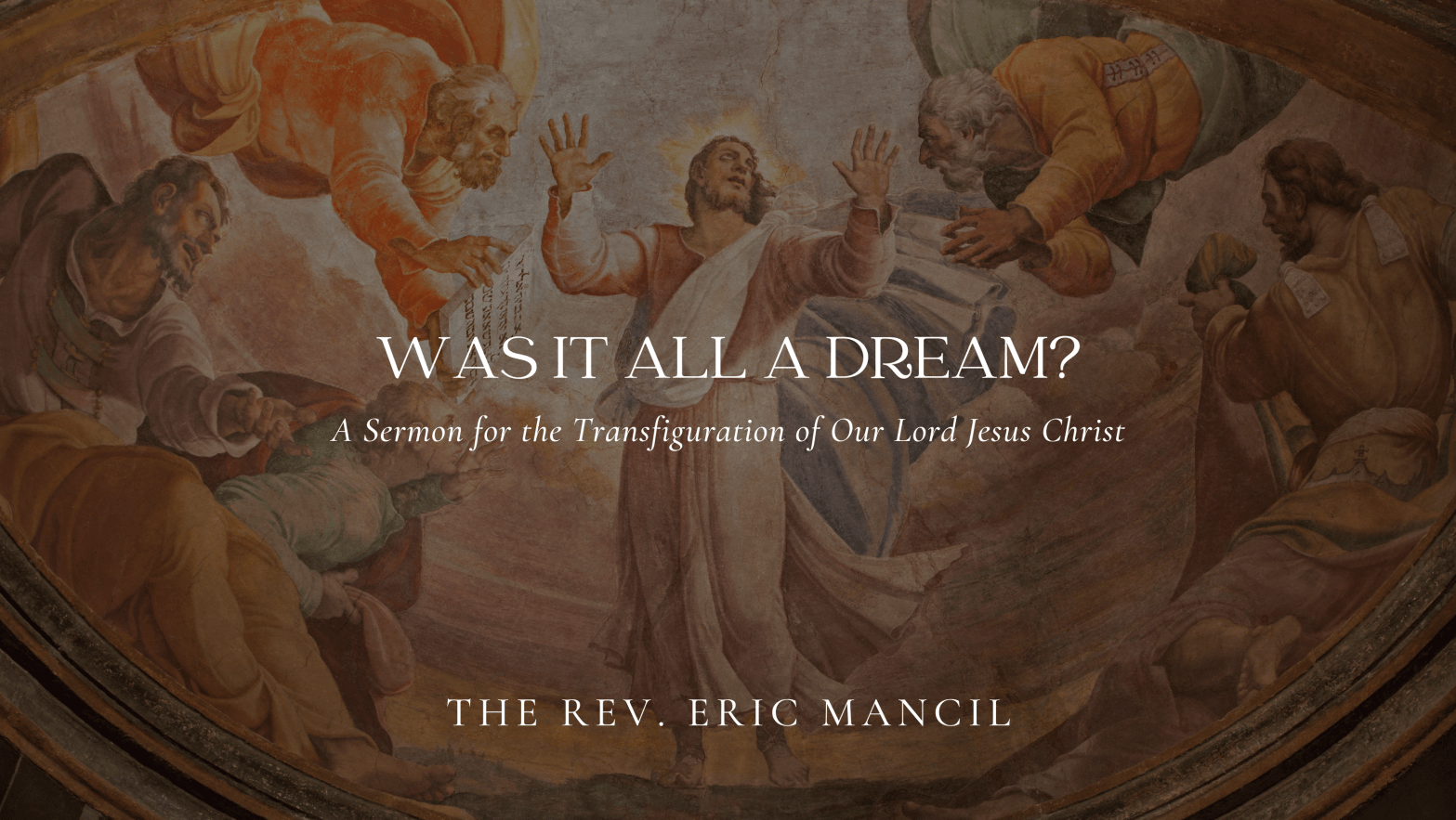
Was It All a Dream?

A Sermon for the Transfiguration of Our Lord Jesus Christ
August 6, 2023

Text: Luke 9:28-36

Now, O Lord, take my lips, and speak through them. Take our minds, and think through them. Take our hearts, and set them on fire. In the name of the Father, and of the Son, and of the Holy Spirit. Amen.

As a young child, one of my favorite movies was the beloved classic, The Wizard of Oz. I loved it so much that my grandparents even had it recorded on an old video cassette so I could watch it when we came to visit or spend the night.

Any time it came on television, I would stop what I was doing, sit down, and watch it as it retold the story of Dorothy Gale and her adventure in the magical Land of Oz.

There’s so much to love about the movie and so many reasons why it’s still considered a classic after eighty-four years. There’s the music, including the timeless song, “Somewhere Over the Rainbow.” There’s the story, which featured so many wonderful and larger-than-life characters, including Dorothy’s new friends—the Scarecrow, the Tin Man, and the Cowardly Lion—and of course the main villain—the dreaded Wicked Witch of the West. And, there’s the heart-warming finale to the film, reminding us that there’s really no place like home.

My favorite part of the movie, though, comes at the end of the first act. Dorothy has run away from home to protect her dog, Toto, from being taken away and euthanized. She runs into Professor Marvel, a crackpot fortune-teller who tells Dorothy to return home quickly because her aunt is heartbroken. Just as she’s returning home a tornado approaches the farm, and Dorothy and Toto are unable to get into the storm shelter. So, they go inside the house to take cover.

I think we all remember what happens next. Dorothy is knocked unconscious from the violence of the storm. The tornado lifts the house off the ground and it begins to spin in the air. Dorothy wakes up and notices some strange things through the window.

And, when the house finally lands, she walks out of her bedroom and opens the front door.

What she witnesses in that moment is unlike anything she’s ever seen before. It’s like stepping into a dream—out of black-and-white and into color. She doesn’t know where she is or how she got there, but she knows it isn’t home. And, after walking around and exploring for a bit, she says to Toto, “I have a feeling we’re not in Kansas anymore.”

As I was reading and reflecting on our Gospel lesson for this morning, I thought about this moment in The Wizard of Oz when Dorothy sees the Land of Oz for the very first time.

I thought about how incredibly awesome and terrifying it must have been for the three disciples in our Gospel reading—Peter, James, and John—to follow Jesus up the holy mountain and to see his appearance suddenly change from what they’ve always known to what must have seemed like a dream.

The author of Luke’s Gospel doesn’t give us many details about the experience. All we know for sure is that the appearance of Jesus’ face changed and that his clothes became dazzling white. Other translations of the passage describe the appearance of his clothes to be as bright as a flash of lightning.

And, as he’s praying, suddenly, two men appear with Jesus—Moses and Elijah—two prominent figures of the Jewish faith. They begin talking with Jesus about his “departure,” which he’ll  soon accomplish in Jerusalem.

The disciples are so mesmerized by what they’re seeing that they don’t really know what to do or how to respond. So, Peter says the first thing that comes to mind. “Master, it is good for us to be here; let us make three dwellings, one for you, one for Moses, and one for Elijah.”

Just then, a cloud overshadows the disciples and they become terrified. And, they hear a voice from heaven say to them, “This is my Son, my Chosen; listen to him!”

After the voice speaks, the disciples find Jesus alone, standing by himself.

“Was it all a dream?” they might’ve asked themselves. “Or, did we just witness a miracle?”

Historically, artists have depicted the Transfiguration of Jesus with even more amazing details than Luke provides. Many paintings and icons, for example, depict Jesus floating high above the mountain-top with his entire body bathed in glorious light—like something out of a movie.

And, in Matthew’s version of the story, Jesus says to his disciples, “Tell no one about the vision until after the Son of Man has been raised from the dead.”

Did it really happen? Or, was it all a dream?

Whether or not the disciples thought it was a dream, it must’ve been an incredible experience—one that surely changed their lives forever. Peter even refers to the experience in his second epistle, which we heard earlier this morning.

For them—and for us—the Transfiguration confirms that Jesus really is God’s Son. He is the one whom the Father sent to redeem and save us all. He is the one who came into the world to bring to fulfillment all the Law and the prophets. He is the Messiah, the Lord.

But, this Messiah—this King—won’t reveal God’s glory through acts of strength and worldly power. He’ll reveal God’s glory on another hilltop, outside of Jerusalem, as he willingly goes to the cross to suffer and die on our behalf.

The story of the Transfiguration is one that a lot of preachers struggle to preach about because it’s not really about anything Jesus says or does. In fact, Jesus doesn’t say a word in today’s Gospel reading. There is no teaching, no parable. And, Jesus doesn’t cast out demons or perform any kind of miraculous healing.

No, this story isn’t about something Jesus does. It’s about something that God does through Jesus so that the disciples who witness it—and future generations—will come to know and believe the truth about who Jesus really is.


In theological terms, the Transfiguration is a theophany—a visible manifestation of God to humankind—not unlike the experience Moses has when God appears to him on Mount Sinai and gives him the Ten Commandments.

We could spend all our lives trying to figure out how and why the Transfiguration happened. We could spend all our lives trying to understand the mystery.

But, in doing so, we might risk missing out on the central truth of the story and taking away from it what God has intended.

And the central truth is this: Jesus really is the Son of God, and as his disciples, we are called to follow and listen to him.

Did it really happen? Or, was it all a dream? Who can really tell?

And, more than that, does it really matter?

Did Dorothy really travel to a magical land in The Wizard of Oz? Or, was it all a dream? Who can really tell?

And, more than that, does it really matter?

In the end, all that really matters is that she’s back at home, right where she’s supposed to be, surrounded by her friends and family with a renewed sense of thankfulness, which is better than anything she could’ve ever asked for or imagined.

The same is true for us in our Gospel lesson for this morning. All that really matters is what we’re left with at the end of the story and what God has revealed to us to be true. Jesus is exactly who we believe he is, which is better than anything we could ever ask for or imagine. Amen.

Radical Hospitality

A Sermon for the Fifth Sunday after Pentecost (Proper 8A)
July 2, 2023

Text: Matthew 10:40-42

Now, O Lord, take my lips, and speak through them. Take our minds, and think through them. Take our hearts, and set them on fire. In the name of the Father, and of the Son, and of the Holy Spirit. Amen.

Several years ago, in June of 2014, our Presiding Bishop, Michael Curry, was featured in a short video that was put together by a group called The Society of Scholar-Priests. It was part of a video series entitled, “New Tracts for our Times,” which was intended to be a series of educational videos for those who are interested in learning more about the Episcopal Church and what we believe. 

The topic for Bishop Curry’s video was the Holy Eucharist, and at the beginning of the video, he shared a wonderful story—one that he also shared in a book he wrote, entitled, “Crazy Christians.”

The story basically goes like this:

There was an African American woman who became an Episcopalian in the 1940s. She met a young man who was in seminary and licensed to preach in the Baptist church, and they began dating. One Sunday, she invited the young man to go to church with her.

He had never been to an Episcopal church before. Everything was new—the Prayer Book, the liturgy, the prayers, the chanting. Having grown up in the Baptist tradition, everything was different.

The people were different, too.

When the young woman and man showed up to church that Sunday, they were among only a few black people in the congregation.

You have to remember that this was in the 1940s when segregation was still very much the law of the land. As Bishop Curry puts it, “The armed forces had not yet been integrated. Brown vs. the Board of Education had not taken place, and, it was long before the Montgomery bus boycott. Martin Luther King, Jr. was still in seminary.”

This gives you an idea of the time period we’re talking about.

When the time for Communion came, the woman went up to the Altar to receive the bread and  the wine. She was the only black person to go up to receive.

Since the young man was Baptist, he didn’t feel comfortable receiving Communion. So, instead, he sat in his pew and watched closely to see what would happen.

Because he noticed that everyone who went up to receive was not only taking the bread but also drinking from the same cup.

He waited to see what would happen when the priest came to the woman because he had never seen white people and black people drink from the same cup, or from the same water fountain.

So, the priest came to each person kneeling at the Altar rail, distributing the bread and saying, “The Body of Christ, the bread of heaven. “The Body of Christ, the bread of heaven.”

Then, the priest came by with the chalice. “The Blood of our Lord Jesus Christ, which was given for thee, preserve thy body and soul unto everlasting life. Drink this in remembrance that Christ’s blood was shed for thee, and be thankful.”

And he came to the black woman kneeling at the rail.

“The Blood of our Lord Jesus Christ, which was given for the thee, preserve thy body and soul unto everlasting life…”

In case you haven’t figured it out yet, the two people in Bishop Curry’s story were his parents.

And when his father told him the story, he would always say, “That’s what brought me to the Episcopal Church. Any church in which black folks and white folks drink out of the same cup knows something about a gospel that I want to be a part of.”

That’s a powerful story, isn’t it?

Of course, I don’t tell it nearly as well as Bishop Curry. So, if you want to go back and watch the video, you can still find it on YouTube.

But, the reason I wanted to share it with you today is because I think it has something to do with what Jesus talks about in our Gospel lesson this morning from Matthew, which is actually the culmination of a long discourse that began two Sundays ago when Jesus named the twelve apostles and empowered them to go forth into neighboring towns and villages, proclaiming the good news that “the kingdom of heaven has come near.”

He told them that as they go forth, they’ll encounter opposition and persecution from those who refuse to hear the good news, those who consider him—and anyone who follows him—the enemy.

He told his disciples not to have any fear, for God will be with them wherever they go. He told them they are more precious to God than they can possibly imagine and that anyone who wants to experience abundant life with God must take up their own cross and follow him.

And then, in our Gospel lesson for today, Jesus concludes this long series of instructions by telling his apostles, “Whoever welcomes you, welcomes me, and whoever welcomes me, welcomes the one who sent me.”

There are a couple of ways we could interpret this verse.

On one hand, it could be seen as Jesus’ way of further preparing his disciples for the mission that lies ahead. He knows that, once they’re sent out to share the message he’s given them, some people will reject them, and some people will receive them.

And for those who receive them, it will be the same as if they received Christ himself. This isn’t something Jesus invented, by the way. It actually falls in line with the Jewish law of shaliah, which basically states that the one who is sent on behalf of another represents the full presence of the one who sends.

The Greek equivalent to the Hebrew word shaliah is apostolos, which is translated in English as “apostle.” Jesus’ mission, then, for the twelve apostles is not only to be sent out but also to fully represent Jesus in his ministry.

The same is true for us today. When we go forth into the world, we do so as apostles—as a people sent forth to proclaim the Good News and to fully represent Christ to those we meet.

Another way to look at this verse from Matthew—and this is really what I want us to focus on today—is that it speaks to the importance of showing hospitality to the strangers in our midst—especially those who are most vulnerable.

And I think this is why the story I shared earlier about Bishop Curry’s parents is so captivating.

The church they attended that Sunday morning, many years ago, could’ve easily overlooked them and ignored them because of the color of their skin. They could’ve treated them as outsiders, refusing to allow them to enter the church or approach the Altar rail.

But, they didn’t.

Despite the racial and cultural expectations of the time, despite the controversy it could’ve stirred and the hardships it could’ve caused, that church welcomed them in and invited them to fully participate in their worship.

Now, I don’t know what happened after church that day. I don’t know if they were greeted during coffee hour or if anyone spoke to them on the way back to their car that morning.

But, for that brief time during worship, they were seen as equals and shown the love and dignity they deserved as children of God.

Welcoming the stranger and showing the radical hospitality that Jesus calls us to share with all of our brothers and sisters is sometimes more challenging than we’re willing to admit.

Because when we open ourselves to the possibility of welcoming people who are different than we are—people who look different or act different or have different beliefs than we do—we risk alienating and even offending others who may not see the same way as we do.

Practicing the radical hospitality of Jesus requires a whole lot of trust in God, and it requires vulnerability and a willingness to come out of our comfort zones in order to welcome those whom the world would rather overlook and ignore.

But, I also think that, sometimes, we make it harder than it needs to be to welcome the strangers in our midst.

Sometimes, we get so overwhelmed with the needs and concerns of the world that we forget that even the smallest act of kindness—like saying, “all are welcome at the Lord’s Table—can be a life-changing moment. Jesus says, in our Gospel lesson this morning that “whoever gives even a cup of cold water to one of these little ones in the name of a disciple—truly none of these will lose their reward.”

It doesn’t have to take an act of heroic courage or epic proportions to show kindness to a stranger. All it takes is a willingness to be open.

A willingness to be open to the possibility that we may not know as much as we think we know.

A willingness to be open to the power of the Holy Spirit moving in us and through us.

And a willingness to be open to the fact that God is truly present when we welcome others in the name of Christ.

Amen.

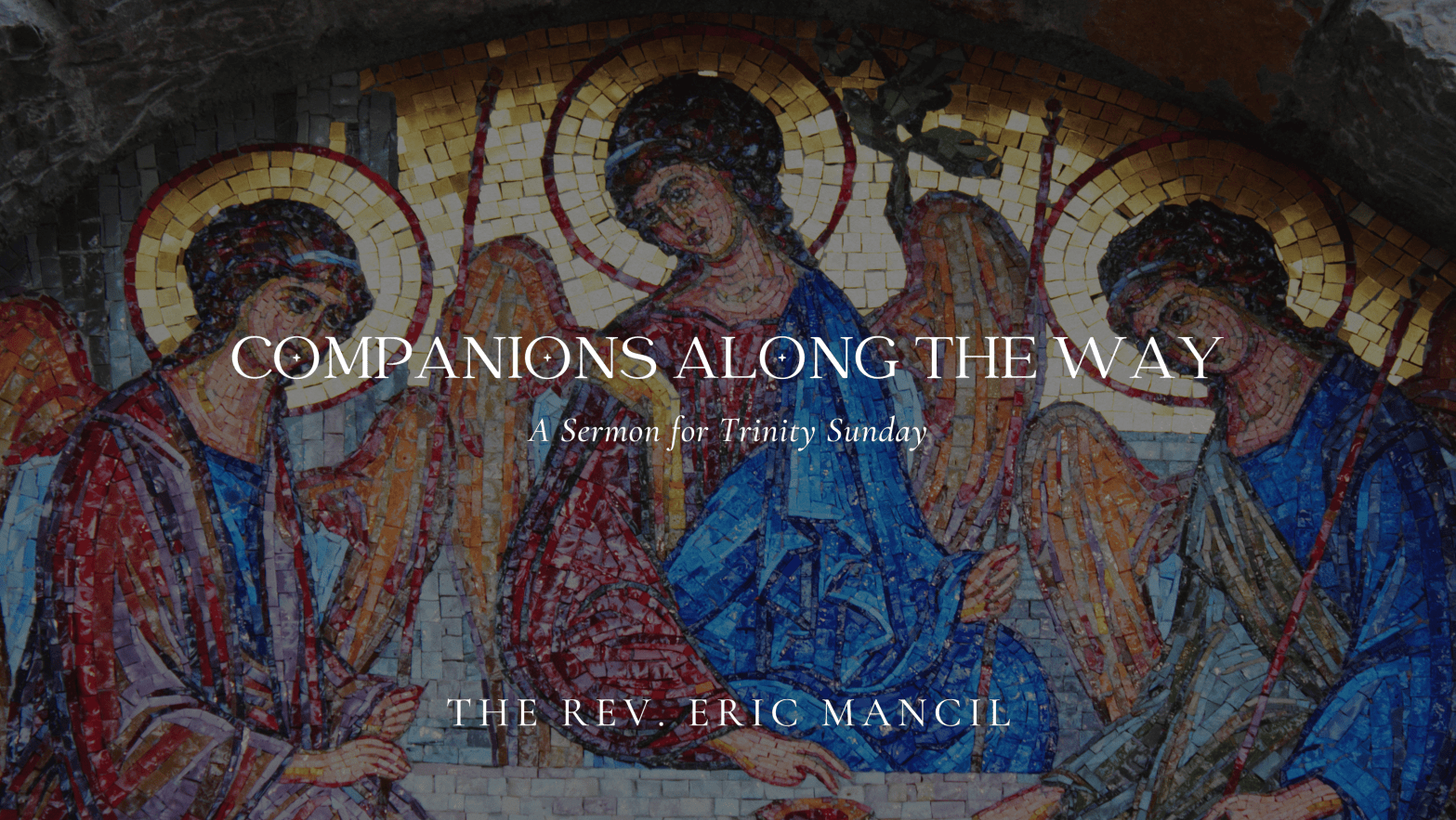
Companions Along the Way

A Sermon for the First Sunday after Pentecost: Trinity Sunday
June 4, 2023

Text: Matthew 28:16-20

Now, O Lord, take my lips, and speak through them. Take our minds, and think through them. Take our hearts, and set them on fire. In the name of the Father, and of the Son, and of the Holy Spirit. Amen.

One day, a few years back, I was having lunch with a friend of mine who was also serving as a priest in the Birmingham area at the time.

Somehow, the topic of preaching came up, and I shared with him that I was preaching the following Sunday, which happened to be Trinity Sunday. Well, you might guess what his first response was.

“Oh, wow! Trinity Sunday! I’m so glad I avoided that one!”

In case you don’t know, some priests try to avoid preaching on Trinity Sunday, if at all possible. Many of us try to avoid it like the Plague. Rectors of large parishes will assign the task to their associates. Some priests will just happen to “be away” on Trinity Sunday or they’ll arrange for a guest preacher to preach that day.

All joking aside, the reason why preachers love to avoid preaching on this day is because the doctrine of the Trinity—our uniquely Christian belief that God is three-in-one and one-in-three—is a mystery to all of us.

It’s a mystery that escapes our ability to comprehend and fully express in words. That doesn’t mean we haven’t tried, though. We use words like “Father, Son, and Holy Spirit,” even though we know that God isn’t a particular gender. God is God.

We use beautiful, descriptive words like “Creator, Redeemer, and Sustainer,” even though we know that the fullness of God is much more than just the ways in which God is at work in our lives.

Yes, God continues to create, redeem, and sustain us. Yes, God is “Father, Son, and Holy Spirit.” But, God is also so much more. The words we use to express the mystery of the Trinity are really just our best efforts to explain the unexplainable.

Using the language of music, one of my favorite Christian poets describes the Trinity as “three notes resounding from a single tone.” If you know anything about music, you know how preposterous that sounds. It’s impossible for three notes to resound from a single tone, just like it’s impossible for God to be three-in-one and one-in-three.

Or, is it? 

Personally, I’m happy to be preaching this morning. I’m happy to be sharing with you my thoughts about the Trinity because, from my perspective, it isn’t very helpful for us to try and explain the unexplainable with complicated, theological terms.

And, it isn’t helpful for us to use dated analogies or metaphors to try and explain the mystery. To me, it’s much more helpful to think about how the doctrine of the Trinity impacts us as Christians and what it can teach us about ourselves and our relationships with God and each other.

What I think the Trinity has to teach us most is that God values relationships.

I really do believe that God calls us to live our lives in community with each other and that, above all else, it’s how we’re called to live as Christian people. Not alone or isolated, but with each other.

Several years back, when I was serving as the priest at St. Catherine’s Episcopal Church in Chelsea, I led an Inquirers Class for those who were new to the church and those who just wanted to come and participate.

Some of you may know this about me already, especially if you attended the “Episcopal 101” class that I led a few weeks back, but one of my favorite things to do as a priest is to teach others about the Episcopal Church. I love it! It’s such a privilege for me to get to share the things I love most about our church with those who are brand new and seeking a new church home.

Well, during our Inquirers Class at St. Catherine’s, there was a woman who was new to the parish. Her name was Barbara, and at the time, she had only recently begun attending services. I told her that we were about to start a class for newcomers, and she was so excited to start attending.

So, we had our first class. And, it’s my practice during the first session of an Inquirers Class to begin by going around table and asking everyone to introduce themselves and share a little bit about why they decided to participate.

So, we went around the table, and everyone told us their name and where they were from and what drew them to the Inquirers Class.

When we came to Barbara, she introduced herself. And, then she gave a very simple response to why she was there. She said, “I’m here because I can’t do this alone.” That’s all she said. “I can’t do this alone.”

Her response has stuck with me all these years, and I think it’s because it’s absolutely true for all of us. We can’t do this alone—this Christian life, this work that we’ve been called to do as followers of Jesus. We can’t do it alone because sometimes the weight is too much to bear for one person.

We need each other, especially in those times when following Jesus seems especially difficult and we just need someone else to lift us up and encourage us to carry on.

We need each other in those moments when life hits us with something unexpected, like the death of a loved one or the loss of a job or an illness or injury.

We weren’t made to live in isolation. God created us to live in community with each other because that is God’s nature, and we’ve been called to draw others into the life of the community as well.

In our Gospel lesson this morning from Matthew, which takes place at the very end of the Gospel, the resurrected Jesus is gathered with his disciples on the top of a mountain in Galilee. And, he gives them one final instruction: “Go therefore and make disciples of all nations, baptizing them in the name of the Father and of the Son and of the Holy Spirit, and teaching them to obey everything that I have commanded you. And remember, I am with you always, to the end of the age.”

This passage from Matthew, commonly known as the Great Commission, could be interpreted in a number of ways. On the surface, it almost sounds like Jesus is telling the disciples to go out and just start baptizing as many people as they can, as if converting people to Christianity is the most important thing.

Now, it’s true. Part of our call is to share the Gospel. But, I don’t think Jesus wants us to be terribly concerned about going out and finding people to fill the pews on Sunday mornings.

Because anyone can fill a pew.

No, I think what Jesus is really saying in our Gospel lesson this morning is that he wants us to make disciples. He wants us to go out and share this life of Christian discipleship with others, drawing them into the community of faith with us.

Why? Because God is three-in-one and one-in-three. God values relationships, and we were created to share this life together.

We can’t do the work of following Jesus alone. We need others to be our companions along the Way. We need the community to walk with us in our journeys of faith and to lift us up and support us when we fall down. We can’t do it alone, no matter how hard we try.

Sometimes—and this is a challenge for many of us—that also means allowing others to take care of us when we need help, even if we’d rather do it ourselves.

Trinity Sunday isn’t the time for us to explain the unexplainable mystery of the Triune God. It’s a time for us to celebrate unity in the midst of diversity and diversity in the midst of unity. It’s a time for us to remember the importance of building relationships and living together in community, despite our differences.

Our God is a relational God, always at work in our lives in more ways than we can count, and as God’s children, we were created to live in the same way, to live in relationship with each other and to work together in the building up of God’s Kingdom. Amen.

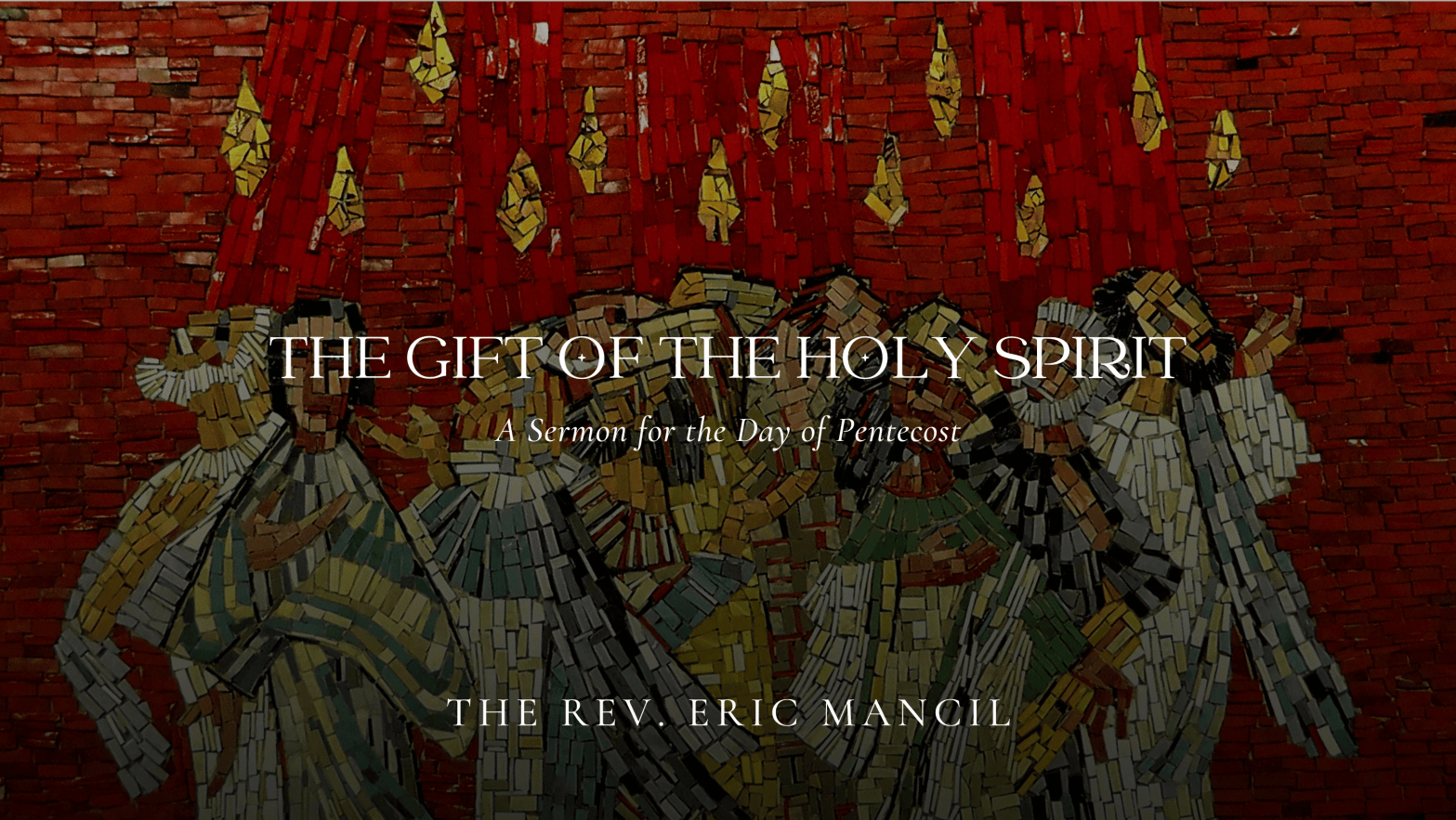
The Gift of the Holy Spirit

A Sermon for the Day of Pentecost (Year A)
May 28, 2023

Text: Acts 2:1-21

Now, O Lord, take my lips, and speak through them. Take our minds, and think through them. Take our hearts, and set them on fire. In the name of the Father, and of the Son, and of the Holy Spirit. Amen.

“In the last days it will be, God declares, that I will pour out my Spirit upon all flesh, and your sons and your daughters shall prophesy, and your young men shall see visions, and your old men shall dream dreams.”

These are the words of the prophet Joel, spoken by Peter on the first Day of Pentecost.

As Episcopalians, we often describe the Day of Pentecost as the birthday of the Church. Some of us celebrate each year by wearing red to our worship services. Many parishes have festive parties and decorate their parish halls and churches with red balloons and streamers. Some even have a birthday cake decorated with tongues of fire or doves representing the Holy Spirit.

I think all of these are wonderful ways to celebrate such an important day in the life of the Church. After all, the Day of Pentecost is the last day of the Easter season and one of the seven principal feasts of the Church year, ranking right up there with Christmas and Easter.

But, Pentecost is also a day for us to give thanks for the gift of the Holy Spirit in our lives—the Advocate, the Comforter—who continues to lead us and guide us in our journeys of faith and to give us the strength we need to persevere in our calling.

In the fourteenth chapter of John’s Gospel, Jesus makes a promise to his disciples. He tells them that, after he’s gone to be with the Father, he will ask the Father to send them another Advocate to be with them always. Each year, on the Day of Pentecost, the Church remembers the fulfillment of that promise.

On this day, we remember the story as it’s told in the Book of Acts—that great day when the Holy Spirit descended upon the disciples in Jerusalem with tongues of fire, empowering them to preach the Gospel and carry out the mission of the Church.

The story of the first Day of Pentecost is a wonderful reminder of the transforming power of the Holy Spirit.

Think about it for a moment.

Think about the disciples in our story this morning from Acts and how far they’ve come since the events of Holy Week and Easter.

Think back to that moment in the story when Jesus was arrested and handed over to suffering and death. If you’ll recall, most of his disciples scattered and went into hiding, fearful that they would suffer the same fate as their teacher.

They were scared and alone, and even after Jesus was crucified and his body was laid in the tomb, they remained in hiding, unsure of what would happen next.

In the first chapter of Acts, the author writes that, after Jesus’ suffering and resurrection from the dead, he appeared to his disciples over the course of forty days, giving them proof of his return and continuing to teach them about the Kingdom of God.

And, before he ascended into heaven, Jesus instructed his disciples to remain in Jerusalem and to wait for the coming of the Holy Spirit.

When the Day of Pentecost finally arrives, it’s a turning point for the disciples of Jesus.

No longer are they able to hide in fear behind closed doors and keep the story of Jesus to themselves. No longer are they instructed to remain quiet about the things they’ve seen and heard.

No, Pentecost is the day when everything changes, the day when the followers of Jesus are empowered by the Holy Spirit and compelled to preach the Good News of God in Christ to all the world. The prophet Joel foretold this when he wrote, “I will pour out my Spirit upon all flesh, and your sons and your daughters shall prophesy.”

My friends, the same is true for us today.

When we’re empowered by the Spirit of God—which all of us are—we’re compelled to go forth into the world to proclaim the love of God in Christ Jesus.

When we’re empowered by the Spirit of God—which all of us are—we’re compelled to speak the truth in love, and when we’re faithful to our calling, nothing will be able to stand in our way.

The same is true now as it was in the time of the first disciples. The Day of Pentecost is a public declaration of faith. It’s a reminder that this Good News of Jesus that we’ve been given must be shared with the world. We simply can’t keep it to ourselves.

It’s been a little over five years since millions of people from all over the world tuned in to watch the Royal Wedding of Prince Harry of Wales and Meghan Markle.

As most of you probably know, our Presiding Bishop, Michael Curry, was invited to be the guest preacher during the ceremony, and for those of you who’ve seen it, I think we can all agree that England wasn’t ready for the fiery sermon that Bishop Curry delivered!

In my opinion, the second best thing about the Bishop’s sermon, other than the message he gave, was seeing the looks of surprise on people’s faces as they watched in shock and bewilderment!

It looked a bit like what I imagine people’s reactions must’ve been on the first Day of Pentecost as they witnessed the disciples preaching the Gospel in their native language.

If you haven’t seen the video of the Bishop’s sermon, I highly encourage you to go and watch it.

In typical fashion, Bishop Curry preached with passion and charisma. He spoke of the transformative love of Jesus, inviting the people to consider what the world might look like if we let love guide our words and actions.

In the words of Bishop Curry, “Love is not selfish or self-centered. Love can be sacrificial, and in so doing, become redemptive. That way of unselfish, sacrificial, redemptive love changes lives. And it can change this world.”

A few days ago, I went back and watched the Bishop’s sermon again on YouTube, as I do from time to time, and I noticed that, since May of 2018, the video has been viewed over 1.3 million times. 1.3 million! Talk about a public declaration of faith.

In my mind, it was truly a Pentecost moment. There’s a reason why so many people from around the world were touched by the Bishop’s message.

And I think it’s because people are hungry for Good News. People want and need a message of hope, reminding them of the love of God—the love that binds all of us together as God’s children.

Imagine how many lives have been touched by the Bishop’s message. Imagine how many people have said, “This is what the Church should be preaching—a message of love and compassion and forgiveness.” Imagine how many hearts and minds have been changed about the Church, an institution that’s often been criticized for being only concerned with itself, and with good reason. Imagine how many people have thought to themselves, “Maybe there is a place for me in the Church after all.”

Now imagine what we can do in our own corner of God’s Kingdom.

Imagine what we can do as the Episcopal Church in Andalusia, Alabama. We may not be able to preach like Michael Curry and we may not be able to reach over a million people on YouTube, but there’s still so much we can do, right here in our own community.

We’re only limited by our drive and our imaginations. The Spirit of God is present in and among us, ready to teach us and guide us with God’s wisdom if we’ll only open our hearts and minds to listen for God’s voice.

On this Day of Pentecost, as the Church celebrates and gives thanks for the gift of the Holy Spirit, let us be bold and unafraid in our proclamation of the Gospel and work to make God’s Kingdom a reality.

Like the first disciples, let us step out in faith and declare to the world that the way of Jesus— the way of sacrificial, self-giving love—has the power to change lives and the power to transform this world. In the words of an ancient hymn from the eighth century: “O Holy Spirit, by whose breath, life rises vibrant out of death; come to create, renew, inspire; come, kindle in our hearts your fire.” Amen.

People of the Way

A Sermon for the Fifth Sunday of Easter (Year A)
May 7, 2023

Text: John 14:1-14

Now, O Lord, take my lips, and speak through them. Take our minds, and think through them. Take our hearts, and set them on fire. In the name of the Father, and of the Son, and of the Holy Spirit. Amen.

This past Friday, I discovered some devastating news. Some time around 2:00 am, on Thursday, May 4th—just a few days ago—someone broke into St. Andrew’s Episcopal Church in Amarillo, Texas, and vandalized their sacred space.

When I saw the name and location of the church, my heart sank, not only because I once served as a priest in that part of the country but also because a friend of mine now serves as the rector of St. Andrew’s.

As soon as I heard the news, I reached out to him to offer my support and prayers.

The details of what happened were heart-breaking.

Whoever was responsible entered through the front door of the church and proceeded to cause as much damage as they could, intentionally targeting holy objects for desecration.

They destroyed the beautiful tapestry on the altar and carved holes into the altar table.

They broke the processional cross in half and left the top half laying on the altar.

They shattered the glass vases behind the altar and left all the flowers scattered on the floor.

They knocked the door off the tabernacle—one of the most sacred parts of any Episcopal church, where consecrated bread and wine are kept for administering Holy Communion to those who are sick or homebound.

And even worse, they dumped all of the consecrated hosts onto the floor.

The most damaged part of the church was the baptismal font—the place where we welcome new Christians into the Body of Christ and mark them as Christ’s own forever—a beautiful sign of God’s love for us.

The perpetrators poured all the blessed water out of the font and shattered pieces of the stone structure, intentionally targeting the carvings of saints.

Sadly, these kinds of attacks on places of worship happen far too often. St. Andrew’s in Amarillo is just one example of the kind of hate being directed toward worshiping communities all the time and in places all across the country.

The shooting at St. Stephen’s in Birmingham last June is another good example.

And, it’s not just Christian communities being attacked. It’s communities of all faiths who are being targeted.

I don’t know why, other than the fact that we live in a broken world full of broken people who sometimes do terrible things in order to hurt others.

As I read the news of what happened at St. Andrew’s, I thought to myself, “As a priest, how would I respond if something like that happened here at St. Mary’s?” “What words of comfort would I have to give, and how would I encourage you to keep going?”

Well, I hope I would have the wisdom and grace to respond the way my friend did.

On Thursday evening—the same day as the attack—my friend, the rector of St. Andrew’s, stood up and addressed the congregation during a prayer service that was held at the church.

And as he was speaking, he reminded the people of who they were as followers of Jesus—as people of the Way.

“We are a people who gather,” he told them. “We are a people who pray together. We are a people who love each other and the world. No exceptions. No matter the person, no matter the situation, the day or the difficulty, we choose love. Always. We choose love. Hard day. It’s a weird world, but love always wins. Not because we are so great or because we are so lovable, but because God is love. That’s why love wins.”

I wanted to share this with you today, not to make you feel scared or angry or hopeless about the world, but to remind you that, no matter what happens to us in our lives—as individuals and as a community of faith—God is always with us.

And the reason why God is always with us—why God has promised to never leave us—is because God loves us more than we can possibly imagine.

It’s true.

No matter where we go or what we do, through the good times and the bad, God is always near.

And we know this is true because of Jesus—the one who came to live as one of us and to show us the path to abundant life with God. Through the life, death, and resurrection of Jesus, we know who God is, and we know how God calls us to live our lives as people of the Way.

Our Gospel lesson this morning takes place on the night before Jesus died. It’s from a section of John’s Gospel commonly referred to as the Farewell Discourse.

Jesus is with his disciples in the Upper Room. He’s shared with them a final meal. He’s washed their feet. He’s given them a new commandment to live by.

And, he’s told them that he’ll only be with them a little while longer and that where he’s going, they cannot come.

The disciples are deeply grieved in spirit because they desperately want to stay with Jesus.

So he says to them, “Do not let your hearts be troubled. Believe in God, believe also in me. In my Father’s house, there are many dwelling-places. If it were not so, would I have told you that I go to prepare a place for you? And if I go to prepare a place for you, I will come again and take you to myself, so that where I am, there you may be also.”

These are words of hope and comfort for a group of disciples who’ve already started to mourn the loss of their friend and teacher. In his compassion, Jesus reassures them and promises that he will always be with them.

This passage from John is one that’s often used during funerals and memorial services in the Episcopal Church, and rightfully so. They are comfortable words, and they offer grieving families and friends the reassurance that, no matter where we go—whether we live or die—there’s nothing in heaven or on earth that can separate us from God.

But, this passage offers us more than just words of comfort and reassurance. It also reminds us of who we are and how we’re called to live. We are people of the Way, and Jesus has set for us an example to live by.

When Jesus says to Thomas, “I am the way, and the truth, and the life,” he’s not talking about the way to get to heaven or what happens to us when we die. He’s saying, “If you want to know how to follow God, follow my way. If you want to know the truth of who God is, listen to my voice. If you want to know the path to abundant life with God, look at my life and my example and do likewise.”

Many of you already know this, but this passage from John—especially the part when Jesus says, “No one comes to the Father except through me”—is often used as a way to exclude non-Christians or to use fear as a means of getting people to follow Jesus.

But, if we read this passage in the larger context and think about what’s going on at the time with Jesus and his disciples, it really has nothing to do with who’s in and who’s out, and it has nothing to do with who’s going to heaven and who’s not.

At the heart of this passage is a promise.

And the promise is this. No matter where we go or what do, God is already there.

When people hurt us or when unexpected things happen and it feels like our lives are falling apart, God is already there, ready to pick up the pieces and bring us healing and wholeness.

When it feels like we’ve lost our way and we don’t know where to turn, God is already there, ready to forgive us and lead us back home again.

When it feels like the world is against us and all hope is lost, God is already there, ready to bring us strength and courage to carry on and to remind us of who we are.

We aren’t people of the world because we know there’s nothing in this world that can bring us the abundant life that God wants to share with us. We are people of the Way.

And the way is Jesus. Amen.

Eucharistia

A Sermon for the Third Sunday of Easter (Year A)
April 23, 2023

Text: Luke 24:13-35

Now, O Lord, take my lips, and speak through them. Take our minds, and think through them. Take our hearts, and set them on fire. In the name of the Father, and of the Son, and of the Holy Spirit. Amen.

Several years ago, before I went to seminary, I came across a short video online that was posted by an Episcopal priest. The title of the video was “Eucharistia.” If that name sounds familiar, that’s because Eucharistia is where the word “Eucharist” comes from. It’s a Greek word, which means, “thanksgiving.”

What the priest created was basically a video meditation about the significance of the Eucharist and its place in our lives as followers of Jesus.

It featured a small group of people, including a priest and several lay people, gathered together in a large, open room. Among them was a shy, young woman—a stranger to the group—who was reluctant to participate at first but eventually came to realize that what was happening around her was so important that she had to be part of it.

One thing that made the video so interesting was that it was shot as a silent film. So, the only thing you could hear was a bit of music playing in the background. The story was told through actions and gestures rather than dialogue.

At the beginning of the video, the group sat in a circle on the wooden floor as they watched the priest prepare a place in the center for the Eucharist to be celebrated.

On a square piece of white cloth, the priest placed a ceramic chalice filled with red wine, a plate with a loaf of bread, and something else, something unexpected—a wrinkly, folded up newspaper.

My first thought was, “Ok. I get why the bread and wine are there, but what’s going on with the newspaper? What’s that for?”

Finally, the Eucharistic prayer began. The priest held up the plate with the loaf of bread. Then, she lifted up the chalice of wine, and even though I couldn’t hear the words that were being spoken, I was familiar enough with the prayer that I could understand what was going on. 

After the prayer, the bread was broken and passed from person to person, each one having the opportunity to share the Sacrament with the next person in the circle.

Then, the chalice was passed around in the same way. One by one, each person took a sip of wine and passed it on to the next person in the circle.

After everyone had received the bread and wine, something different happened—something we normally don’t do when we celebrate the Eucharist.

The priest took the folded up newspaper, tore a piece of it off, and passed it to the next person. Likewise, the rest of the group did the same. The newspaper was passed from person to person, each one having the opportunity to tear off a piece and read it.

At first, it took me a moment to understand what was happening and why it was important.

And, then it clicked.

The newspaper symbolized the group’s connection to the outside world and the work that all of us are called to do as followers of Jesus. As they read their torn-off pieces of newspaper, you could sense that the boundaries of the circle were fading away.

For the group on the video, the newspaper served as an important reminder that what we do when we’re gathered around the Altar is about much more than just a single act of worship.

The Eucharist is not about serving ourselves. It’s about serving our Lord Jesus, the one who continues to send us out, beyond the walls of the church.

In the Eucharist, we come to the Altar, not only to be fed with the Body and Blood of Christ, but also to offer ourselves as living bread so that others may come to know the love of God through us.

Our lives are filled with countless opportunities to be Eucharist for others—to be the hands and feet of Christ in a world that’s hungry for the Good News we have to share—that God in Christ has indeed been risen and that salvation has come to the whole world.

There are a lot of stories about feeding and being fed in the Gospels.

There’s the Feeding of the Five Thousand—a story that’s familiar to most us and one that appears in all four Gospels.

There’s the Institution of the Lord’s Supper, where Jesus shared a final meal with his disciples on the night before he died and instructed them to continue breaking the bread and sharing the cup.

And then, there’s our Gospel lesson for today, which takes place on the day of the Lord’s resurrection. Two of Jesus’ disciples are traveling along the road to Emmaus—a small village about seven miles from Jerusalem—discussing the events that just took place. As they’re walking along, they encounter someone who appears to be a stranger.

They begin talking with the man, unaware that it’s the risen Lord, and sharing with him their fears and disappointments after Jesus was crucified.

They had hoped that he was the Messiah—the one who would come to redeem Israel and set them free from Roman oppression. They’ve heard rumors of his resurrection, but they haven’t seen it for themselves.

Then Jesus, beginning with Moses and the prophets, begins interpreting to them the Scriptures about himself.

As they approach the village, the two disciples invite Jesus to stay with them because it’s getting dark outside and unsafe to travel. Jesus agrees, and when they come inside, they share a meal together around the dinner table.

At the table, Jesus takes the bread. Jesus blesses the bread. Jesus breaks the bread, and then he shares it with the two disciples.

And in that moment, they finally realize the truth. Jesus was with them all along. The man they assumed was a complete stranger turned out to be the risen Christ.

Jesus was made known to them in the breaking of the bread. He never once told them who he was. It was in the breaking of the bread that their eyes were opened to the truth.

So, it should come as no surprise to anyone that our central act of worship in the Episcopal Church takes place around a table where bread and wine are shared. It’s in this sacred meal—in the breaking of the bread—where we discover the risen Christ and the true meaning of what it means to be a follower of Jesus.

We take ordinary bread and wine, the fruits of our labor, created by human hands from the gifts God has given us in creation.

We acknowledge God’s goodness and pray for God to bless the bread and wine that they may become for us spiritual food.

We break the bread and pour out the wine so they may be shared among us.

And finally, we give these gifts back to God. By receiving the holy mysteries of Christ’s Body and Blood in the Eucharist, we become that which we receive—the Body of Christ, broken and poured out for the life of the world.

We take the bread and wine.

We bless it.

We break it.

And we give it.

And we do these things, not only for our own sake, but for the sake of others.

St. Augustine of Hippo, who lived during the fourth and fifth centuries, put it this way in a sermon he once wrote about the Holy Eucharist: “One of the deep truths of Christian faith is that through our participation in the sacraments (particularly Baptism and Eucharist), we are transformed into the Body of Christ, given for the world.”

This is the way Christians have been worshiping for centuries. 

And we continue that tradition today.

Every time we come to the Altar to receive Communion, we should be reminded that it isn’t just about us. It’s about reconnecting with God and being strengthened and nourished in our faith so that we can be instruments of God’s grace in the world around us.

Just as Jesus made himself known to his disciples in the breaking of the bread, Jesus continues to make himself known to us, and we continue to make Jesus known to the world when we go forth from this place.

Eucharist isn’t just a nice thing we do on Sunday mornings, and it isn’t just a symbolic meal or a way for us to retell the story, week after week.

It’s our pattern for living. Take. Bless. Break. And give.

If we can remember that, then there’s nothing we can’t do for the good of God’s Kingdom. Amen.

Christ is Risen

A Sermon for the Sunday of the Resurrection: Easter Day
April 9, 2023

Text: John 20:1-18

Now, O Lord, take my lips, and speak through them. Take our minds, and think through them. Take our hearts, and set them on fire. In the name of the Father, and of the Son, and of the Holy Spirit. Amen.

“I have seen the Lord!” These are the first words spoken by Mary Magdalene to the disciples soon after she discovers the risen Christ and runs to tell them the wonderful news.

“I have seen the Lord,” she says.

You can imagine the excitement in her voice when she announces to the disciples that Jesus has returned. Jesus—their friend and master who was crucified—has triumphed over death and risen from the grave.

But, if we back up a bit in our Gospel lesson for today, Mary Magdalene’s first encounter with the risen Christ isn’t very exciting.

In fact, she doesn’t even recognize Jesus at first. She sees and talks with a man who she assumes must be the gardener. Now, I don’t really know why she assumes that Jesus is the gardener, and the Scriptures don’t really provide us with any other details.

All we know is that, when Mary turns from the two angels sitting in the empty tomb, she sees a man standing in the garden. The man asks Mary, “Woman, why are you weeping? Whom are you looking for?”

Assuming that the man has done something with Jesus’ body, Mary says to him anxiously, “Sir, if you have carried him away, tell me where you have laid him, and I will take him away.”

Mary’s love for Jesus is strong. It’s obvious in the way she cares for him, even after his death.

As readers of John’s Gospel, the author has given us a special insight into the story.

Unlike Mary Magdalene, we don’t have to guess the identity of the man in the garden. We already know that it’s the resurrected Jesus, and so it’s no surprise to us at all when Mary finally discovers the truth.

Like the Good Shepherd who calls out to his sheep, Jesus calls out to Mary by name, and in that moment, she knows exactly who he is.

“Mary!” Jesus says.

She turns at once and, in Hebrew, responds, “Rabbouni!” which means, “master.” For Mary, this wasn’t just a title of respect for Jesus but also a term of endearment. This was the man who welcomed her into the sheepfold, the one claimed her as one of his own.

For the author of John’s Gospel, the point of this Easter story isn’t to prove that Jesus died and rose from the tomb.

As Christians, we already know this and believe it to be true. No, the point of this Easter story is that, when Christ calls us by name, like Mary Magdalene, we are changed forever.

When Christ calls us by name, we are claimed as his own and drawn into a new way of life—a resurrected life.

In the Church, we have a way of celebrating this new way of life and welcoming new Christians into the Body of Christ. We call it the sacrament of Holy Baptism—which is the sacrament of new birth.

Since the earliest days of the Church, Christians have been using the time leading up to Easter—the forty days of Lent—as a time of preparation for those seeking to be baptized.

So, there really is no better time to be baptized than Easter.

And, for those of us who’ve already been baptized, Easter is also a good time to remember the vows we made in our Baptism. And that’s exactly what we did last night at St. Mary’s during the Great Vigil of Easter.

Last night, after we heard stories told from the Hebrew Scriptures, recounting the history of our salvation, we recommitted ourselves to the work of the Gospel by renewing our own baptismal covenant.

We vowed, with God’s help, to continue in the apostles’ teaching and fellowship, in the breaking of the bread, and in the prayers.

We vowed, with God’s help, to persevere in resisting evil and to repent and return to the Lord when we fall short of our calling.

We vowed, with God’s help, to proclaim by word and example the Good News of God in Christ.

We vowed, with God’s help, to seek and serve Christ in all persons, loving our neighbors as ourselves.

And finally, we vowed, with God’s help, to strive for justice and peace among all people and to respect the dignity of every human being.

Through the waters of Baptism, we are buried with Christ in his death and raised to newness of life in his resurrection. We are sealed by the Holy Spirit in Baptism and marked as Christ’s own forever.

Nothing can ever change that.

Like Mary Magdalene in our Gospel lesson for today, Jesus calls each of us by name, and we are his. In my opinion, this is the real miracle of Easter. Of course, we love to hear the story of the resurrection on that first Easter Day, and we rightfully should. But, the real miracle, dear friends, is what Easter means for us and for all who believe in Christ.

Through his sacrifice on the cross and his glorious resurrection, Jesus has opened for us the way to life and peace with God. Sin and death no longer have dominion over us. It is no longer we who live but Christ who lives in us. 

In a sermon that she once wrote, Barbara Brown Taylor once described Easter as “the unnatural truth.”

She wrote, “To expect a sealed tomb and find one filled with angels, to hunt the past and discover the future, to seek a corpse and find the risen Lord—-none of this is natural. Death is natural. Loss is natural. Grief is natural. But those stones have been rolled away this happy morning, to reveal the highly unnatural truth. By the light of this day, God has planted a seed of life in us that cannot be killed, and if we can remember that then there is nothing we cannot do: move mountains, banish fear, love our enemies, change the world.”

My brothers and sisters in Christ, we are resurrection people, and it’s our call to live as resurrection people, transformed and made new for the work of sharing the Good News of God in Christ with the world.

The Easter proclamation, “Alleluia, Christ is risen,” isn’t just something we say on Easter to make ourselves feel better, and it isn’t simply a reminder of an event that happened long ago.

It’s our proclamation to the world that what was once cast down has been raised up. The dead live again. There is victory for those who believe. The same is true today as it was yesterday and forever more. Christ is risen. The Lord is risen indeed! Amen.

Hope for the World

A Homily for The Great Vigil of Easter
April 8, 2023

Text: Romans 6:3-11

Let none fear death, for the death of the Savior has set us free. Christ is risen and the demons have fallen. Christ is risen and the angels rejoice. In the name of the Father, and of the Son, and of the Holy Spirit. Amen.

I would be lying if I told you that I had some deep, theological insight into the mysteries of Holy Week and the events of our Lord’s Passion, death, and resurrection.

The truth is that the words I have to offer are really just a feeble attempt to make sense of something far greater and more powerful than we can possibly imagine.

Which is why I’m so thankful for the Prayer Book and the liturgies of Holy Week that help us better understand the meaning and significance of this special time in the life of the Church.

The liturgies of Holy Week—including Maundy Thursday, Good Friday, and the Great Vigil of Easter—preach themselves in a very profound way, not only through the words we speak and the hymns we sing but also through the experience of walking with Christ from the Upper Room on the night before he died, to the cross on Good Friday, and finally to the tomb, where he was laid to rest, awaiting the day of resurrection.

Think about all we’ve experienced with Jesus over the past three days—

The washing of feet on Maundy Thursday, reminding us of our Lord’s commandment to love and serve others.

The Bread and Wine of the Eucharist, reminding us that we are the Body of Christ, broken and poured out for the life of the world.

The Stripping of the Altar, reminding us that our Lord was betrayed and handed over to suffering and death.

The crown of thorns, reminding us of the suffering servant who went to the cross on our behalf.

The hard wood of the Cross, reminding us that Jesus died so that we may be forgiven and reconciled with God.

The newly kindled fire, reminding us that not even death could contain Jesus.

The water of Baptism, reminding us that we have been buried with Christ in his death and raised to newness of life.

And the first, “Alleluia,” our great Easter proclamation, reminding us that death has been defeated once and for all and that Christ has indeed risen from the grave.

All of these are outward and visible signs that the Holy Spirit is at work, stirring up in us that which the world cannot give—a hope that can no longer be contained.

On this night, we celebrate the Passover of the Lord.

“This is the night, when all who believe in Christ are delivered from the gloom of sin, and are restored to grace and holiness of life.”

“This is the night, when Christ broke the bonds of death and hell, and rose victorious from the grave.”

“This is the night,” according to one author, “that is like day, the dawn of reconciliation, peace, and the forgiveness of sin.”

This is the night, when we are once again reminded that not even the shadow of death can separate us from the love of God and that darkness always gives way to the light.

In the sixteenth chapter of John’s Gospel, just before Jesus is betrayed and arrested, he tells his disciples that he’ll be with them only a little while longer and that they’ll soon grieve and mourn for him.

Knowing that his time is short, Jesus says to them, “Very truly I tell you, you will weep and mourn while the world rejoices. You will grieve, but your grief will turn to joy. A woman giving birth to a child has pain because her time has come; but when her baby is born she forgets the anguish because of her joy that a child is born into the world. So with you: Now is your time of grief, but I will see you again and you will rejoice, and no one will take away your joy.”

“Now is your time of grief,” Jesus says, “but I will see you again and you will rejoice…”

Rejoice. It’s the first word of the ancient Easter hymn, the Exsultet, proclaimed each year at the beginning of the Great Vigil of Easter.

“Rejoice now, heavenly hosts and choirs of angels…”

“Rejoice and sing now, all the round earth…”

“Rejoice and be glad now, Mother Church…”

Rejoice is the word we use to proclaim that death and sin no longer have dominion over us and that grief and suffering have given way to joy.

That’s what this night is all about.

But, it’s important for us to remember that the joy of Easter isn’t a cure for the brokenness of our world, and it isn’t a goal to reach, as if everything else we’ve experienced during Holy Week is simply an obstacle to overcome.

In other words, we can’t forget everything we went through to get to this night because the life of a Christian—and the work we’re called to do—is full of both Good Friday moments and Easter moments.

As Christians, we’re baptized into the death and resurrection of Jesus.

St. Paul said it this way in his letter to the Romans:

“Do you not know that all of us who have been baptized into Christ Jesus were baptized into his death? Therefore we have been buried with him by baptism into death, so that, just as Christ was raised from the dead by the glory of the Father, so we too might walk in newness of life. For if we have been united with him in a death like his, we will certainly be united with him in a resurrection like his.”

What this means is that we’re continually called to die to self and to love others as Christ loved us—with the same self-giving, sacrificial love he demonstrated on the cross.

And in the process of dying to self and following the example of Jesus, we grow more and more into the full stature of Christ and experience the resurrected life that God desires for each of us.

The Lord needs us.

Because, even in the midst of our Easter joy, the world continues to revolve, and people continue to suffer, looking for signs of God’s light and God’s love in the midst of the darkness.

The Lord needs us to carry the light of Christ with us wherever we go.


The great joy that we experience at Easter is hope for the world—a sign that all is not lost, that God is still present in our lives, working in us and through us.

Our great joy at Easter is the hope that, in the fullness of time, God’s dream of heaven on earth will finally be fulfilled.

But, until that day comes, let us continue to serve God by offering ourselves as instruments of God’s love and mercy to this broken and suffering world, and let us rejoice without ceasing in the saving work of God in Christ. Amen.

Love Always Leaves a Mark

A Homily for Good Friday
April 7, 2023

Text: John 18:1-19:42

Loving God, on this most solemn day in the life of the Church, we ask you to be gentle with us and to show us your love and mercy. Help us, we pray, as we bear witness to the events of our Lord’s suffering and death and as we contemplate their meaning for our lives. And then use us, we pray, as instruments of your healing in this broken and sinful world. In the Name of the Father, and of the Son, and of the Holy Spirit. Amen.

Several years ago, Chelsea and I went to the movie theater to see a wonderful film. Some of you may have seen it before. It’s called The Shack, and it was based on a book by William Paul Young. If you haven’t seen it, I highly recommend it to you.

The main character in the film is a man named Mack who suffers a terrible loss early on in the movie when his daughter, Missy, is abducted and killed.

Several months after the tragedy, Mack receives a strange note in his mailbox, inviting him to go to “the shack,” the place where police discovered evidence of his daughter’s murder.

At first, he’s hesitant to go, thinking that it might it be some cruel joke. But, eventually, he decides to go, and when he arrives, he discovers that God is waiting for him.

In The Shack, God appears to Mack as three different people—each representing a different part of the Trinity. God the Father, or “Papa,” as he’s called in the movie, appears to Mack as an African American woman played by Octavia Spencer.

God the Son appears as “Jesus,” a young, Jewish carpenter, with olive skin and dark hair, and God the Holy Spirit appears as “Sarayu,” a young Asian woman.

There are so many memorable scenes in The Shack, but there’s one in particular that moves me to tears every time I watch it.

It occurs early on in the film, after Mack meets Papa, Jesus, and Sarayu for the first time. Papa invites Mack to come inside the house and help her make bread for supper.

And after some time, while they’re working in the kitchen, Papa tells Mack that she knows there’s this great divide between them because of what happened to his daughter.

She tells Mack that she wants to heal the broken relationship between them.

But Mack is angry. He tells Papa that she abandoned him and his daughter when they needed her the most. He tells her that she must have a bad habit of turning her back on those whom she supposedly loves, including Jesus.

“He said it himself,” Mack says, “My God, my God, why hast thou forsaken me?”

Then, Papa looks at Mack and shakes her head.

“No, Mack,” Papa says, “you misunderstand the mystery.”

Then, she takes his hands in hers and shows him the scars on her wrists. She says to Mack, “Don’t ever think that what my son chose to do didn’t cost us both dearly. Love always leaves a mark. We were there together. I never left him. I never left you. I never left Missy.”

Now, The Shack is just a made-up story. It’s a wonderful story, but it’s a work of fiction, based on the ideas and imagination of one person.

But, to me, this scene between Mack and Papa and the conversation they have serves as a beautiful illustration of the kind of love that God has for each of us and the kind of love that Jesus demonstrated on the cross.

It’s a powerful scene, and I love that line toward the end that Papa says to Mack.

“Love always leaves a mark.”

And, I think it’s absolutely true.

Think about it for a moment. Think about all the great loves you’ve known in your life and how they’ve impacted you. The love of a child. The love of a husband or a wife or a significant other. The love of a parent. The love of a close friend or family member.


We wouldn’t be who we are today without the people in our lives who’ve loved us and touched us in some way.

Because love always leaves a mark.

True love—when it’s self-giving and sacrificial—leaves behind an impression that marks us and changes us forever.

And there’s never been a truer love than the love of Jesus, who endured the worst that humanity could inflict upon him and laid down his life on our behalf so that we might be forgiven and reconciled with God.

It’s why we call this day Good Friday.

It’s not because of the suffering Jesus endured.

It’s what God was able to accomplish through the suffering. An instrument of pain and death has become for us the instrument of our salvation.

If Palm Sunday invites us to contemplate the shock and scandal of the cross, Good Friday invites us to contemplate the healing power of the cross—that through our Lord’s Passion and death, he conquered death and opened up for us the way to eternal life with God.

God didn’t force Jesus to go to the cross, and I don’t believe that it was God’s will for Jesus to suffer and die the way that he did.

God sent Jesus to teach us a better and more loving way to live and to save us from the power of sin and death, and despite the pain and suffering it caused him, he never strayed from the path that God called him to walk.

Jesus chose to go to the cross for you and for me so that we might never be alone again, and because of that great act of love, we have been changed forever. Death has been defeated forever. We have been marked as Christ’s own forever.

Because love always leaves a mark. Amen.