God is Speaking

A Sermon for the Last Sunday after the Epiphany (Year B)
February 14, 2021

The Gospel: Mark 9:2-9

I speak to you this morning in the name of our loving, liberating, and life-giving God: Father, Son, and Holy Spirit. Amen.

I want to tell you about a time I heard God speak to me. No, I’m not talking about an actual voice from heaven, like the one that Jesus’ disciples heard in our Gospel lesson for this morning. I heard God speak to me as a deep longing in my soul—a longing that I ignored for a long time because I tried to convince myself that God wouldn’t call a person like me to be a priest in the Episcopal Church—a person like me, who grew up un-churched and was practically brand new to the faith; a person like me, who already spent years in college training to become a music teacher and never could’ve imagined doing anything else.

It was in the Fall of 2009, only a few months after Sophie was born. We were living in southeast Alabama at the time, in my hometown of Enterprise. I was working as a choral music teacher at the local junior high school. Chelsea was commuting back and forth from Dothan, working as a nurse in the labor and delivery unit at Southeast Alabama Medical Center.

We had recently returned from Auburn, where Sophie was baptized at St. Dunstan’s by my dear friend, Father Wells. It was an ordinary weekday. I woke up and got ready to go to work, as I did each morning. I left the house and got into my car, completely unaware of what was about to happen. I cranked the ignition, and as soon as the engine came to life, I heard a song playing through the speakers. I knew in an instant what it was—a sacred piece of choral music, recorded by the Cambridge Singers. Samuel Barber’s setting of the Agnus Dei began playing, and all I could do was sit in my car, still parked in the driveway, and listen as the choir sang. The words were in Latin, but I knew the translation:

Agnus Dei, qui tollis peccata mundi, miserere nobis.
Lamb of God, you take away the sins of the world, have mercy upon us.

Agnus Dei, qui tollis peccata mundi, miserere nobis.
Lamb of God, you take away the sins of the world, have mercy upon us.

Agnus Dei, qui tollis peccata mundi, dona nobis pacem
Lamb of God, you take away the sins of the world, grant us peace.

Those who are familiar with The Book of Common Prayer will recognize these words. We say them often during the Eucharist in the part of the service where the priest lifts up the consecrated bread and breaks it in half, serving as a reminder not only of our Lord’s sacrifice on the cross but also as a reminder that we are the Body of Christ, broken and poured out for the life of the world.

That morning, back in 2009, as I sat in my driveway at home and heard the choir sing the words to the Agnus Dei, I wept. I wept, not because I was sad or upset but because I was finally coming to terms with the fact that I had ignored God’s call for too long. Warm streams of tears rolled down my face as I thought to myself, “What am I doing?” “God is calling, but I haven’t been listening.” If I’m being completely honest, I think I was too afraid to listen.

I heard God speak to me that morning in the deepest depths of my soul. God spoke and said, “You know what you need to do.” Finally, I was willing to listen and overcome my fear. Finally, I was able to accept the fact that I was being called to follow a different path. I was able to admit to myself that God was calling me to be a priest, something I couldn’t ignore any longer.

So, after that day, I reached out to my priest at the time, Mother Ede. The two of us sat down in her office, and I told her everything. I told her about how I began the discernment process for ordination back in 2007 but had to end it because of the new teaching job I took in Enterprise. I told her about my experience sitting in the driveway at home and how I knew that God was calling me to be a priest. She was so supportive of me and my sense of call, and the two of us began meeting regularly, setting me on a course that would change my life and the life of our family forever.

I wanted to share this story with you this morning because I think it has a lot to do with how God speaks to us in our lives. God speaks to us and reveals God’s self in ways that are often unexpected and unimaginable, like through a piece of music playing on the radio. I didn’t expect to wake up one morning and experience some divine revelation, but that’s exactly what happened. God spoke, and I listened.

It’s also what happened to Peter, James, and John in our Gospel lesson this morning in the story of Jesus’ transfiguration. The Gospel writer doesn’t provide us with many details, but I can imagine what must’ve been running through the disciples’ heads as they were led by Jesus to the top of a mountain, in the middle of nowhere. “Where in the world are we going,” they might’ve thought, “and, why is Jesus leaving the other disciples behind while we go off by ourselves?” They probably had a million questions with no idea what to expect. When they finally arrived at the top, they witnessed something beyond comprehension, something unimaginable. There was Jesus, standing before them with clothes that were “dazzling white.” The author of Mark’s Gospel uses the word “transfigured” to describe Jesus’ appearance, which means “changed” or “transformed” in some way. Not only that, but standing next to Jesus and talking with him were Moses and Elijah—prominent figures from the Hebrew Scriptures and pillars of the Jewish faith.

Can you imagine what that experience must’ve been like? Can you imagine how terrifying it must’ve been to witness something so spectacular and unexpected?

At the end of the story, a cloud descends upon all of them, and a voice from heaven proclaims, “This is my Son, the Beloved: listen to him!”

“Listen to him,” the voice cries out. God speaks, and the disciples listen.

We hear the story of Jesus’ transfiguration told every year on this day, on the Last Sunday after the Epiphany, as we prepare to move from one liturgical season to the next. Very soon, we will enter the holy season of Lent, a journey we’re invited to take with Christ each year, a time of intentional prayer and fasting, a time of preparation and repentance as we take a close look at our lives and think about ways that we might change in order to draw closer to God.

Prayer is one way for us to begin the work that the season of Lent invites us to do. The Prayer Book defines prayer as “responding to God, by thought and by deeds, with or without words.” I love that definition so much, especially the part where it talks about “responding to God.” So many of us struggle with the idea of prayer, especially when we think about it in terms of “talking to God” or trying to come up with the right words to say to God. But, if we take the Prayer Book’s definition of prayer to heart, then we come to realize that prayer doesn’t really begin with what we do or say. It actually begins with God. Let me say that again. Prayer begins with God. Our job is to listen out for what God is trying to say and then respond, “by thought and by deeds, with or without words.”

In my vocation as a priest, I’ve often been told, “I just don’t know if God is hearing my prayers,” as if there’s a question about whether or not God is listening to us.

But, what I’ve found is that our question shouldn’t be, “Is God listening?” We know and trust that God hears and answers our prayers. The question shouldn’t be, “Is God listening?” The question we should really be asking ourselves is, “Are we listening?” Are we listening to what God is trying to tell us? Or, are we too afraid to listen?

There are lots of reasons to be afraid because if there’s anything we know about what God calls us to do, we know that it probably has something to do with the cross. We know that it probably has something to do with living a sacrificial life, of giving up our selves in order to love and serve others. We know this because of Jesus and what Jesus goes through when he reaches Jerusalem.

There are reasons why we might be tempted to ignore what God is trying to tell us, but there’s also every reason to be fearless because we already know how the story unfolds. In the end, we know that love wins. The forces that seek to weigh us down and keep us separated from the God who loves us are defeated, once and for all. Listening to God and responding to God’s call isn’t always easy. We know there’ll be challenges and temptations along the way, but we also know that God is faithful and will never leave us to face those challenges and temptations alone.

As we prepare to move into the season of Lent and turn our focus toward Jesus’ journey to the cross, I invite you into a time of prayer, a time of holy listening. “Listen to him,” the voice from heaven told the disciples in our Gospel lesson for today. Listen to Jesus, and don’t be afraid. Open yourselves to the possibility that God is trying to speak to you in ways that are surprising and unexpected. Open yourselves to the possibility that God is calling you to try something new or something different than what you might’ve imagined. God is speaking to us. May we have the courage and wisdom to listen. Amen.


A video of this sermon is available below, beginning at the 16:53 mark.
An Embodied Faith

A Sermon for the Fifth Sunday after the Epiphany (Year B)
February 7, 2021

The Gospel: Mark 1:29-39

I speak to you this morning in the name of our loving, liberating, and life-giving God: Father, Son, and Holy Spirit. Amen.

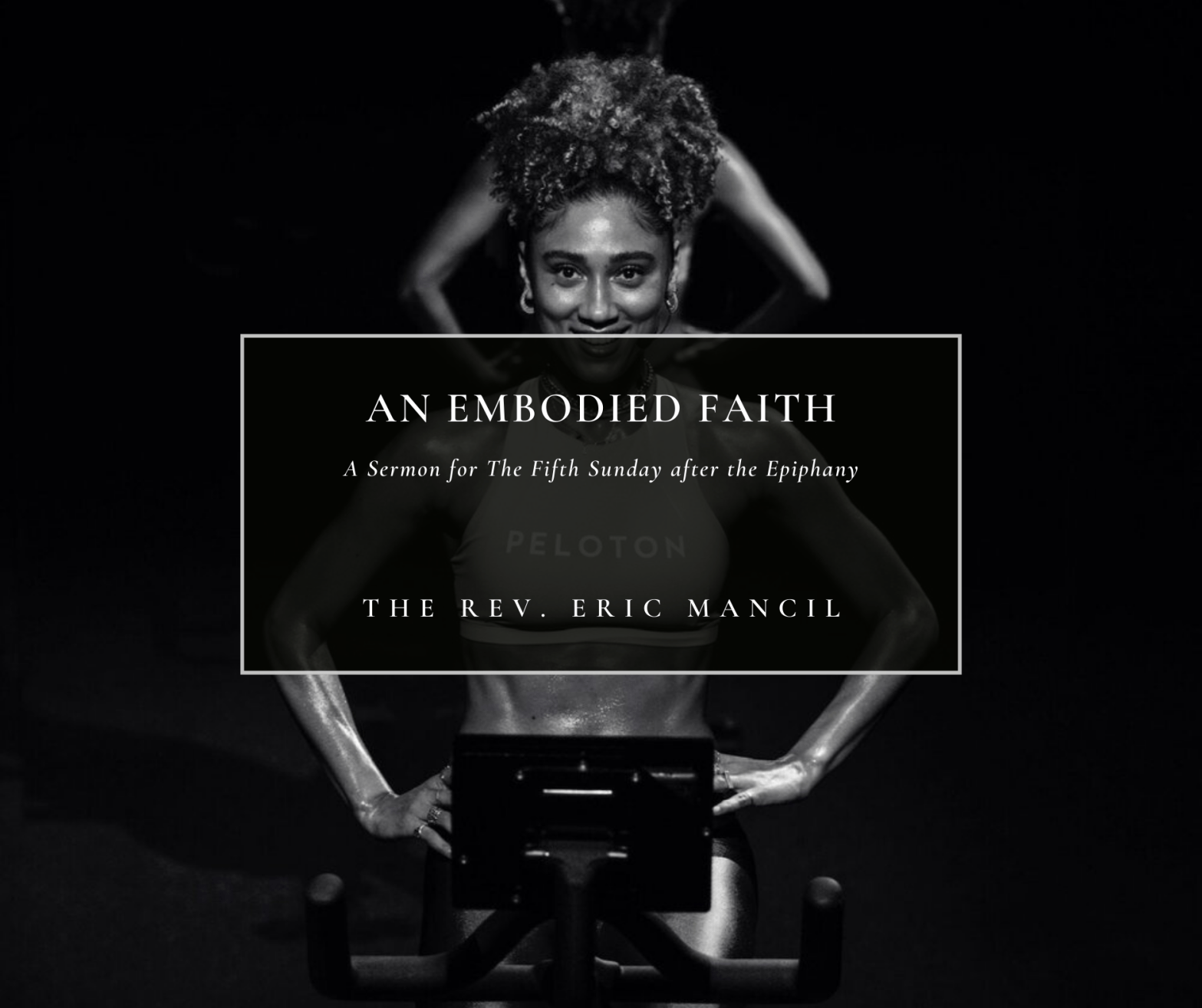
Several months ago, Chelsea and I decided to invest in our physical fitness by purchasing one of those fancy Peloton bikes that you see advertised on television from time to time. You know, the kind where you can participate in a live spin class without having to go to a gym—the kind with an instructor on the other side of the screen, pushing you to keep moving your legs and adding more and more resistance. Now, I promise that my sermon for today isn’t an endorsement for Peloton or an attempt to convince you to go out and purchase an exercise bike.

But, I do want to share something with you that was recently shared with me by one of my favorite Peloton instructors—Ally Love.

Ally offers a weekly class on Sunday mornings called “Sundays with Love.” I would describe it as a blend of physical fitness, inspiring music, and spiritual reflection. There’s a physical component—the map that Ally has designed for the ride, with moments of intense cardio as well as moments of active recovery. But, there’s also a spiritual component—a virtue that Ally has chosen to talk about during the course of the ride. These virtues change from week to week and have included everything from gratitude and patience to selflessness and compassion. As a spiritual leader, I’m thankful for these weekly opportunities because it gives me a chance to simply be present without having to be the person who’s front and center. These classes aren’t a replacement for church, but I find them to be very meaningful.

During a class a couple of weeks ago, Ally chose to talk about an important virtue, one that actually comes up quite frequently in the Scriptures: joyfulness. What I appreciated most about the class was that Ally took the time to distinguish the difference between joyfulness and happiness, words that many of us often use interchangeably. But, there’s a difference. Happiness can change from moment to moment and usually depends on external things beyond our control. Joyfulness, on the other hand, is something that we have the ability to choose for ourselves, something we can only attain by being present to the needs of others. Keep in mind that “Sundays with Love” isn’t advertised as a “Christian” spin class.All are welcome. But, anyone who has read the Gospels and is familiar with the teachings of Jesus will immediately pick up on some of the similarities.

Ally even incorporates stories into her classes, similar to how Jesus incorporates stories—or parables—into his teaching to illustrate an important lesson about the Kingdom of God.

In her class from a couple of weeks ago, Ally shared a story about an old woman who, one day, received a letter in the mail from God. In the letter, God simply wrote, “I’m going to show up later at your house.”

The woman thought to herself, “God’s coming to my house? I don’t have anything to feed him! What do I do?” She was worried and started freaking out!

She didn’t have a lot of money, but she scrounged around the house and eventually found five coins.

She took her money to the market and said, “You know what? I’m going to buy as much as I can with these five coins. We’re going to have a feast because God is coming over!” So, she buys as much as she can afford and begins the journey back home.

On the way, she walks by two strangers, a man and his wife. They stop the woman, and say, “Ma’am we’re hungry. We have no food. Can you help us?”

The old woman was stuck and had a difficult decision to make. She knows she has to feed God because he’s showing up soon to her house. So, she looks at the couple and says, “I’m sorry. I can’t help you. This is all I have, and I have an important guest coming over soon.”

The couple said, “It’s okay. Thank you for stopping.”

The old woman stepped away, and two seconds later, she stopped in her tracks. She turned around and gave the couple all the food she had. She also noticed that the man’s wife looked cold and remembered that she had an extra coat at home. So, she unbuttoned her coat and gave it to the wife.

The woman continued on her way home stressed out, thinking to herself, “God is coming over, and I have nothing to feed him!”

Finally, she arrives back home and starts straightening up a bit and cleaning her house. She takes what little food she already had and puts it on the table for her special guest.

Just then, there’s a knock at the door. “A letter for you, ma’am,” says the person at the door. She takes the letter, opens it up, and reads the message.

“Dear friend, it was great to see you today. Thank you for stopping and feeding me. Love, God.”

When I heard Ally share her story—her parable—I knew that I would have to share it with you. It’s such a simple story but one that beautifully illustrates the love of God that we’re called to share with all people—especially the most vulnerable among us. Jesus said, “Come, you that are blessed by my Father, inherit the kingdom prepared for you from the foundation of the world; for I was hungry and you gave me food, I was thirsty and you gave me something to drink, I was a stranger and you welcomed me, I was naked and you gave me clothing, I was sick and you took care of me, I was in prison and you visited me.” 

This faith to which we are called, as Christians, is an embodied faith. What I mean by that is that it’s a faith that we practice—not by standing by and waiting for others to do the work or waiting for God to magically show up and do the work for us—but by showing up ourselves and serving those whom the world would rather forget. The hungry and thirsty have been entrusted into our care. The stranger and the naked have been entrusted into our care. The sick and those in prison have been entrusted into our care.

In our lesson today from Mark’s Gospel, which takes place immediately following the events in last week’s lesson, Jesus goes to the house of Simon and his brother, Andrew, to visit Simon’s mother-in-law, who is sick and lying in bed with a fever. Jesus goes to the woman’s side, takes her hand, and lifts her up, and immediately, the fever subsides and the woman is healed.

What strikes me most about this story is the fact that Jesus doesn’t ask or expect Simon to bring his mother-in-law to where he is. After hearing of her illness, Jesus doesn’t wait around. He goes to be by her side. He holds her hand in his and comforts her in her weakness. Presumably, Jesus could’ve healed the woman from anywhere, but that wasn’t good enough. He made the choice to go and be with her in person.

This faith to which we are called, as followers of the one who healed Simon’s mother-in-law, along with so many others, is an embodied faith. Like Jesus—and like the old woman in our story from earlier—we’re called to show up in person, to offer comfort and healing whenever we can—especially to the most vulnerable among us. There’s power in our willingness to be physically present to the needs of others. It’s one of the ways we live out our calling as baptized Christians.

And it’s really difficult when we’re unable to fulfill this part of our call because of reasons that are beyond our control.

Over the past year, during this time of pandemic, we’ve been limited in the ways we’re able to show up for people, at least physically. As a parish, we’ve been limited to having worship online without the ability to see each other’s faces or “pass the peace” with a hug or handshake or even receive the Eucharist. We haven’t been able to sit next to each other to enjoy a meal or conversation. We haven’t been able to do the things we’ve grown accustomed to—the things that we rely on to keep us connected as a faith community.

As individuals, we’ve been limited as well during this time of social distancing. Friends and extended families haven’t been able to gather as much as they would like. Our children have experienced a year in school like no other, often being restricted to distance learning. Many of our friends have had to say goodbye to loved ones over the telephone, which is so heartbreaking to even think about.

What I’m trying to get at here is that we haven’t been able to show up for each other or to care for one another in the ways that we feel called to do. We haven’t been able to embody our faith in the ways we would like, and it really hurts. It hurts because it causes us to feel disconnected from those we love.

Our challenge, at least for the time being, is to continue doing all we can, to be intentional about showing up in ways that might not be ideal but ways that still demonstrate the love of God in Christ Jesus, the love that Jesus demonstrates in the Gospels. We can do this in a number of ways: by showing up online and participating in worship when we can’t be together in person; by reaching out and calling or texting a friend or family member who you haven’t spoken to in a while; by offering to cook and drop off a meal to someone who’s sick; by reminding people that they’re loved. The possibilities are endless. 

There are still ways we can embody our faith, even when we can’t be physically present, but it requires us to be intentional. We have to make the choice to show up for others. Otherwise, it won’t ever happen. I invite you and encourage you to think about ways you can show up for others as this pandemic continues. Embody your faith. Remember that Jesus doesn’t wait for those who are sick to come to him. He shows up at their bedside. Amen.


A video of this sermon is available below, beginning at the 17:25 mark.

Jesus Goes Viral

A Sermon for the Fourth Sunday after the Epiphany (Year B)
January 31, 2021

The Gospel: Mark 1:21-28

I speak to you this morning in the name of our loving, liberating, and life-giving God: Father, Son, and Holy Spirit. Amen.

Last week, during the presidential inauguration, the world heard from an impressive, young lady named Amanda Gorman, who is the nation’s first-ever youth poet laureate and the youngest person to ever read a poem at a presidential inauguration.

In an interview she gave after the inauguration, she shared that she began working on the poem weeks before the event but then later changed the poem’s wording to reflect the tragic events that took place in our nation’s capital on January 6th. In an article published by The Washington Post, she said, “My hope is that my poem will represent a moment of unity for our country” and “with my words, I’ll be able to speak to a new chapter and era for our nation.”

In the hours and days following the inauguration, Amanda went viral. Pictures and quotes from her performance at the inauguration began popping up all over social media. Almost instantly, everyone knew who Amanda Gorman was, and more importantly, they loved what she had to say. Even our Presiding Bishop, Michael Curry, took notice of Amanda and her poem and included part of it in his most recent address to the House of Bishops.

It doesn’t matter whether or not you voted for President Biden in the election. It doesn’t matter whether you consider yourself a Republican or a Democrat or anything in between. Amanda’s words, in that moment, were offered as a balm of healing for our country. Her words were offered as a source of comfort and hope to a divided nation at a time when we need them most. She didn’t seek to alienate anyone or to point fingers. Her hope was to help make “e pluribus unum” a reality, the motto of the United States of America, “Out of many, one.”

As I was reading our Gospel lesson for today, I was reminded of Amanda’s performance at the inauguration and the overwhelming sense of encouragement I felt as I watched this twenty-two year old, African American woman offer her words to the rest of the country.  Jesus, in today’s Gospel lesson, offers the same sense of hope and encouragement in his words to the people of Capernaum. The author of Mark’s Gospel isn’t specific on exactly what Jesus says, but from the reading, we know that the people were “astounded at his teaching.” Mark literally uses the word “astounded” as a way to describe the people’s reaction to Jesus’ words. Here is a man, probably no more than thirty years old, at the beginning of his ministry. It’s likely that he has no formal training as a rabbi. He has no position of authority and no right to get up in the middle of the synagogue and begin teaching. And yet, that’s exactly what he does. He defies expectations, and even more than that, Jesus demonstrates for the people that his ministry, his way of love, will be a source of healing for all people. After he’s done teaching, a man whom the Gospel writer refers to as “a man with an unclean spirit” comes up to Jesus and says, “What have you to do with us, Jesus of Nazareth? Have you come to destroy us? I know who you are, the Holy One of God.” Jesus rebukes the unclean spirit and says, “Be silent, and come out of him.” At once, the man who was tormented by the unclean spirit is healed and restored to fullness of life.

Once again, the people are astounded by Jesus, but this time, they’re astounded for a different reason. They look around and say to one another, “He commands even the unclean spirits, and they obey him.” There’s something different about this man.

Well, word travels fast, and almost overnight, everyone in the region of Galilee knows who this Jesus is. You might say that Jesus goes viral.

Why do you suppose that happened? Why do you think that news traveled so quickly about this young man from Nazareth who taught with authority and had the power to heal the man with an unclean spirit?

I think it’s because most people have a built-in desire to be inspired and hopeful. I think it’s also because most people want to share with others the things that inspire them and give them hope. Think about social media, for example. Now, I know there’s a lot of negativity and misinformation on Twitter and Facebook and other websites, but I find that most people, regardless of their political or even religious beliefs, tend to share things that they find comforting and meaningful, things that might bring a sense of comfort and peace to others.

Perhaps that’s the reason why news traveled so fast about Jesus and his ministry of teaching and healing. People want to inspired and hopeful.

Perhaps that’s also the reason why news traveled so fast about Amanda Gorman and her poem at the inauguration. People want to be inspired and hopeful.

The Gospel of Jesus—the Good News of God in Christ—is both inspirational and hopeful. It speaks of death being defeated, once and for all, of darkness having no dominion over the light. It speaks of unclean spirits being cast out, of the sick being healed, and of the blind being restored to fullness of sight. It speaks of the old heaven and earth passing away and a new creation coming to fulfillment, one where heaven and earth will be joined together for all time. It speaks of self-giving, sacrificial love as the only way to enjoy fullness of life with the God who made us. Not hate. Not resentment. Not fear. Love is the only way.

And this Gospel, this way of Jesus, is ours to proclaim. As members of the Body of Christ, we’ve been called to proclaim it by word and deed, wherever the Spirit may lead us. And, not only have we been called. We’ve been given authority as well.

A little later in the Gospel of Mark, in the third chapter, we hear the story of Jesus appointing the twelve apostles to join him in his ministry and to be sent out to proclaim the Good News and to have authority to cast out demons.

So, you see, like Jesus in the synagogue in Capernaum and like those first disciples of Jesus, who were sent out and given authority to cast out demons, we’ve been given authority to bring healing to the world through the proclamation of the Gospel and to cast out unclean spirits in whatever form they may take. Some that come to mind include: the sin of racism and white supremacy. Violence and prejudice toward our LGTBQ brothers and sisters. Unfair treatment of those who live on the margins—the poor, the homeless, and the hungry; those with different religious beliefs and backgrounds; and those who come to us seeking refuge from violence and oppression in other parts of the world.

My friends, unclean spirits come in a variety of shapes and sizes.

“Be silent, and come out of him,” Jesus says to the unclean spirit in our Gospel lesson for today.

What will our words of healing be? What words and actions will we use to cast out the unclean spirits of our own time and bring healing to the world?

Prayer without action isn’t enough. Yes, we need to say our prayers, but even more importantly, we need to live them. A couple of years ago, as I was attending an evangelism conference sponsored by the Episcopal Church, I heard our Presiding Bishop say these words: “Sometimes when we’re faced with tragedy and heartbreak, we’re tempted to say, ‘All we can do is pray.’ But, that’s not true. You have a heart. Use it. You have a heart that has the ability to break open. Let it. Let it break open, and allow the love of Jesus to flow through it.”

I leave you with these last few lines from the inaugural poem, “The Hill We Climb,” by Amanda Gorman.

When day comes we step out of the shade,
aflame and unafraid,
the new dawn blooms as we free it.
For there is always light,
if only we’re brave enough to see it.
If only we’re brave enough to be it.

Amen.


A video of this sermon is available below, beginning at the 16:00 mark.