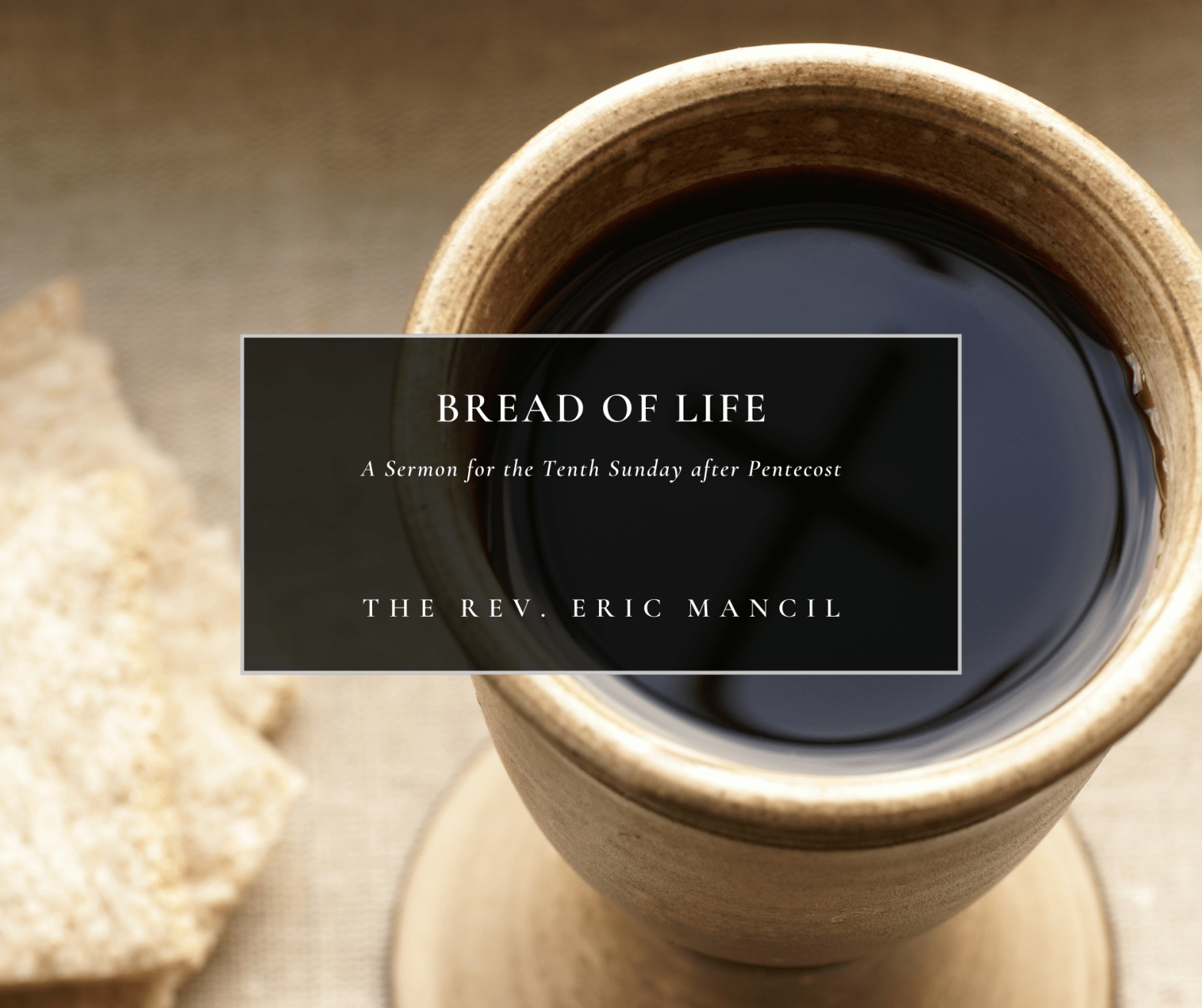
Bread of Life

A Sermon for the Tenth Sunday after Pentecost (Proper 13, Year B)
August 1, 2021

Text: Ephesians 4:1-16, John 6:24-35

I speak to you in the name of our loving, liberating, and life-giving God: Father, Son, and Holy Spirit. Amen.

From Paul’s letter to the Ephesians: “I therefore, the prisoner in the Lord, beg you to lead a life worthy of the calling to which you have been called, with all humility and gentleness, with patience, bearing with one another in love, making every effort to maintain the unity of the Spirit in the bond of peace.”

“I beg you, “ the author writes, “to lead a life worthy of the calling to which you have been called.”

I love these words. To me, they convey a sense of Christian responsibility and urgency, and they remind us that this life to which we’ve been called, as followers of Jesus, is built upon a foundation of compassion and human decency. As Christians, the way we treat our brothers and sisters really does matter. We have the ability, through our words and actions, to be examples of God’s love to those we meet in our everyday lives, and the author of Ephesians uses specific words to describe how we’re called to speak and act—words like humility and gentleness, patience and love.

I think there’s something else, though—something more to be discovered from this text. To me, these words from Ephesians also seem to suggest that our calling is actually a gift from God. Have you ever considered that before? Have you ever thought of your call to follow Jesus as a gift from God? We tend to think of God’s call as something that’s extended to everyone, and that’s true. All of us are called to live lives worthy of the Gospel, and God gives each of us the freedom to choose whether or not to respond to that call. 

But, I’m not sure that we give enough thought to the fact that God’s call is actually a gift, extended to us in love. Perhaps, that’s because responding to God’s call is sometimes quite difficult, especially when it requires us to give up things in our lives that we so desperately want to cling to. Sometimes, God’s call feels more like a curse than a blessing. I’ll be the first to admit that I’ve felt like that a lot over the past year and a half as we’ve been called upon, time and again, to do things like wear masks and socially distance ourselves in order to keep others safe and healthy and to prevent further spread of the coronavirus. Even now, we’re being called upon, once again, to wear masks indoors as the number of cases goes back up, and we’re faced with the question that we’ve been asking ourselves over and over again since last March. “When will this all be over?”

So, yes, sometimes God’s call to love others feels more like a curse than a blessing. Sometimes, the burdens we’re called to bear for the sake of others seem just too heavy.

What do we do, then, when we feel as though we’ve reached our limit? How do we lead lives worthy of our calling when we’re too tired to carry on? Where do we go when we need a renewed sense of hope and reassurance?

Well, I have some thoughts about that, but first, I want to share with you a story.

Several years ago, when I was serving as one of the priests on staff at my first parish in Texas, we put on a Vacation Bible School program called, “Abundant Life,” which was inspired by the work of Episcopal Relief and Development. You may have heard me talk about ERD in the past. Basically, it’s an organization of the Episcopal Church that works to alleviate poverty, hunger, and the spread of disease in countries all around the world.

The goal for our Vacation Bible School program that summer was to offer children the opportunity to consider the many ways that God calls us to be good stewards of creation. So, we talked about God’s gifts of water, soil, seeds, and animals and how all of these gifts impact our relationship with the earth. We listened to stories from Holy Scripture. We planted flower seeds in clay pots that the children decorated themselves. We played games and sang songs, and we had a wonderful time doing it all.

On the last evening of VBS, during the closing Eucharist, I explained to the children how the fruits of the earth that we receive from God can be used to create things that nourish us, such as bread.  

Holding a large bowl full of flour, I asked the children, “Who knows what this is?”

Many of them already knew what it was.

They shouted out, “Flour!”  Then, I passed the bowl around so they could feel the flour in between their fingers, and as I passed it, I asked them, “What kinds of things can we make with flour?”

Well, as you can imagine, I received some pretty colorful responses.

Without hesitating, one child raised their hand and shouted out, “Cake!”

Another shouted out, “Bread!”

Another shouted, “Cookies!”

And then, my favorite response of all, “Peanut Butter Balls!” Well, I don’t exactly know what peanut butter balls are, but they sound wonderful.

The children continued passing the bowl of flour around, and when the last child in the group had a chance to touch the flour, I said, “Yes, we can make lots of things with flour, and like someone already mentioned, we can make bread.”

Then, I walked back to the Altar table that we had set up in the Parish Hall. I held up several flat, round loaves of bread that I had baked the day before, and I explained to the children that we can use bread in different ways. It tastes good, and we use it to nourish our bodies. But, we also use it during communion at church because it’s a sign for us that God loves us and that Jesus is here with us when we receive the bread and the wine.

I told them, “When we receive the bread and wine in communion, we carry Jesus with us wherever we go so that we may love others as Jesus taught us to love.”

“In what ways does Jesus teach us to love others?” I asked them.

Then, I read a passage from the Gospel of Matthew, a children’s version. “The Kingdom is yours,” I said. “Come. When I was hungry, you fed me. When I was thirsty, you gave me a drink of water. You welcomed me when I didn’t know anyone. When I needed clothing, you gave me some. You took care of me when I was sick and visited me in prison.”

“That is how we love like Jesus wants us to love,” I told the children. “We love by taking care of other people, especially those who have less than we do, those who have no one else to care for them.”

I’ve been a priest for a little over six years, and in that time, I’ve experienced moments of grace that are beyond anything I could’ve expected or imagined. One of those moments was getting to celebrate the Eucharist at the end of Vacation Bible School one summer with thirty children gathered around a makeshift Altar table. I believe children instinctively know what’s going on when we receive the Body and Blood of Christ in the Eucharist. They may not be able to articulate it, but they know something special is happening. They may not seem overly interested in what’s going on, but the Holy Spirit is present. God shows up when we gather at the Table, even when the chaos of chattering children might convince us otherwise.

But, God does more than show up.

God uses simple things like bread and wine to show us how to live as Jesus lived. God uses bread and wine to form us into the Body of Christ and to give us the spiritual food we need to continue the journey.

So, back to my questions from before.

What do we do when we feel tired and hopeless? How do we continue on when we feel like there’s no more fuel for the fire? For us, in this time of pandemic, how do we hold on to what we know is true?

I think the answer can be found in our lesson today from John’s Gospel when Jesus says to the crowd, “I am the bread of life. Whoever comes to me will never be hungry, and whoever believes in me will never be thirsty.”

When we feel lost or afraid, we hold on to Jesus. When we feel like we have nothing left to hold on to, we come to the Table to be fed. We remember that there’s nothing in this world, nothing other than Jesus, that can fill us with what we truly need for the life to which we’ve been called.

It’s the reason why the Eucharist is seen as our principal act of worship in the Episcopal Church and why it lies at the center of everything we do as a community of faith.

The abundant life to which we’re called by God is one of self-giving, sacrificial love and a commitment to serve God’s people. But, Lord knows, it isn’t easy, and we can’t go about this work alone. We need to be strengthened and renewed in our walk with Christ. We need Jesus to be present in our lives and to fill us with that spiritual food which only he can provide.

As I was preparing my sermon for this morning, I was reminded of the words of invitation to communion from the Iona Community, which we use each Sunday here at Holy Spirit before the Great Thanksgiving. Listen to these words. Carry them with you, and remember them, especially in those moments when it feels like all hope is lost.

“This is the table, not of the Church but of Jesus Christ. It is made ready for those who love God and who want to love God more. So come, you who have much faith and you who have little; you who have been here often and you who have not been for a long time or ever before; you who have tried to follow and you who have failed. Come, not because the Church invites you; it is Christ who invites you to be known and fed here.”

Amen.


A video of this sermon is available below, beginning at the 21:30 mark.

Sabbath

A Sermon for the Eighth Sunday after Pentecost (Proper 11, Year B)
July 18, 2021

Text: Mark 6:30-34, 53-56

I speak to you in the name of our loving, liberating, and life-giving God: Father, Son, and Holy Spirit. Amen.

From the Gospel of Mark: Jesus said to his disciples, “Come away to a deserted place all by yourselves and rest a while.” For many were coming and going, and they had no leisure even to eat. And they went away in the boat to a deserted place by themselves.

I have a really hard time with allowing myself to rest. I rarely take time off from doing work. In fact, the thought of being still and doing nothing actually causes me to stress out. Over the years, I’ve gotten better at allowing myself to rest, but even now, it’s a struggle.

Do you have this problem? Do you have a hard time allowing yourself time for rest?

What I’ve discovered is that, even when I have the time to rest, I manage to find ways to avoid it at all cost. My mind won’t allow me to escape from the endless list of things that must be done. The worst part is that I justify avoiding rest by using the same excuse that so many of us use, time and time again. “I just have too much to do.”

I have too much to do to stop and rest now.

Is this something that you struggle with?

Several years ago, I came across an interesting article online, entitled, “Busy is a Sickness.”  Drawing from a survey conducted by the American Psychological Association, the author of the article suggested that most Americans recognize the need to reduce the amount of stress in their lives but that they’re too busy to address the problem. According to the article, there are two forms of busyness that cause stress. There’s “busyness without control.” This is the type of busyness that’s created for us. It’s the working poor, those who are forced to work multiple jobs to make ends meet, that often suffer from this type of busyness the most. Then, there’s the type of stress that most of us experience on a daily basis, “busyness with control.” This is the type of busyness that we create for ourselves. In other words, it’s “self-created stress.”

The interesting thing about “self-created stress” is that it often feels like something that we can’t live without. Our society teaches us that busyness leads to success, and we convince ourselves that if we’re not constantly working or doing something productive, we’re being lazy or wasting valuable time.

I’m very familiar with this type of stress, and if you’re like me, you wear it like a badge of honor as if being constantly busy is something to be proud of. But, I can assure you that it isn’t.

The problem with this way of thinking is that we need time to rest from our labors. We need moments of escape from the busyness of our everyday lives in order to be renewed and restored. These moments are important. They provide us with the opportunity to reconnect with who God created us to be and to find relief from the burden of stress that so many of us bear.

Rest is a gift given to us by God in creation. It’s also something that God expects us to do.

Think about the story from the Book of Exodus of Moses receiving the Ten Commandments. God says to Moses, “Remember the sabbath day, and keep it holy. Six days you shall labor and do all your work. But the seventh day is a sabbath to the LORD your God; you shall not do any work–you, your son or your daughter, your male or female slave, your livestock, or the alien resident in your towns. For in six days the LORD made heaven and earth, the sea, and all that is in them, but rested the seventh day; therefore the LORD blessed the sabbath day and consecrated it.”

So, rest isn’t just a gift. It’s also a commandment—part of our covenant with the God who created us.

At the beginning of the Book of Genesis, after the creation of the heavens and the earth and their entire multitude, God completed God’s work of creation on the seventh day.

And what did God create?

God created menuha.  

In English, the word menuha means, “rest,” but in Hebrew, this word means much more than simply withdrawing from physical labor. According to Rabbi Abraham Heschel, menuha is the same as “happiness and stillness, as peace and harmony.” Menuha is the “essence of good life” and the word used to describe the life of the world to come.

On the seventh day, God consecrated the Sabbath and created menuha. God created time for us to be still in God’s presence and to enjoy the lives that we’ve been given.

Imagine what it would be like if we recognized this time as a precious gift and not just something we do if we get around to it. What if we took the time to stop what we’re doing in order to stop and simply enjoy the gift of being alive?

What would that look like for you?

Sabbath time is sacred time. It’s time for renewing the body and refreshing the soul. It’s difficult to define and will look different for most people. Perhaps, the most helpful way for us to describe what our Sabbath time looks like is to identify what it doesn’t look like. We may be unable to say what our Sabbath will be, but we can certainly say what our Sabbath won’t be. For you, Sabbath time might be time away from checking e-mail or taking work-related telephone calls. Maybe it’s time away from the noise of the television or the constant need to update your Facebook status. Sabbath time might also be time away from the endless list of chores that need to be done around the house. Sabbath time, dear friends, is time to avoid those things that cause us to be distracted from rest. According to one author, sabbath is a “sanctuary in time” set apart for us to experience the fullness of God’s love.

In the midst of our relentlessly busy lives, we can’t expect Sabbath time to happen without being intentional. It requires discipline. It’s our responsibility to set aside the time that we need and to make the necessary preparations. No one is going to do it for us. The full Sabbath day remains a strict act of observance in the Jewish faith tradition. Of course, it would be wonderful if we all had the freedom to observe an entire day of Sabbath rest, but for many, it’s practically impossible. The daily demands of work and other obligations tend to interrupt our days. So, it’s up to us to set aside the time we need when we’re able, even if it’s only for a half a day or a few hours here and there. We need that time each week, time to retreat briefly from the stresses of our responsibilities and obligations.

I particularly love the part in today’s lesson from the Gospel of Mark when Jesus says to his disciples, “Come away to a deserted place all by yourselves and rest a while.” There are several instances in the Gospels when Jesus retreated—either alone or with his friends—to rest from the daily demands of his public ministry. To me, it means that Jesus recognized the need for rest, and he had the wisdom to take the time he needed in order to be renewed and restored. He recognized that, in order to continue on in his ministry and to be able to offer compassion and healing to those who came to him for help, he needed to take time to care for himself. He needed to practice self-care, which is something we all need to learn.

During these summer months, as our time during this season after Pentecost continues, I invite you to consider taking more time to practice self-care, more time to escape from the busyness of your everyday lives and to simply rest in the palm of God’s hand. I encourage you to be intentional about making time to be still in the presence of God and to live the abundant life that God has called you to live. Amen.


A video of this sermon is available below, beginning at the 20:30 mark.

Lean on Me

A Sermon for the Second Sunday after Pentecost (Proper 5, Year B)
June 6, 2021

Text: Mark 3:20-35

I speak to you in the name of our loving, liberating, and life-giving God: Father, Son, and Holy Spirit. Amen.

This past Tuesday, Jude and I drove to Camp McDowell to pick up Sophie after her five-day session of summer camp. Of course, she had a blast, and when I asked her if she missed us, she said, “No, not even a little bit!” When we got in the car to go home, the first thing I said was, “Tell me everything!” “What was your favorite activity?” “What was your favorite meal?” “How many new friends did you make?” “What was the program like?” I asked her so many questions, and she was happy to answer them. Then, as we were on our way home, I told her how happy it made me that she loved camp as much as I do. I told her that it meant a lot to me to be able to share with her this amazing place that’s been so important to me in my life.

Those who know me well know that one of my absolute favorite places on earth is Camp McDowell—our beloved camp and conference center here in the Diocese of Alabama. I like to describe it to others as the “heart” of our diocese, because that’s really what it is. It’s a place where we can all go to be recharged and renewed in our walk with Christ,  a place where we can all go to get reacquainted with God and to feel a sense of connection with other people. It takes about an hour and twenty minutes to drive one way from Alabaster to Camp McDowell, but that doesn’t really bother me at all. Every chance I get, I’m off to camp, because it holds such a special place in my heart, as it does for so many others.

There’s a reason why Camp McDowell is nicknamed “God’s Backyard,” and all you have to do is spend a little time there to figure out why. Of course, people go there to enjoy the natural beauty of God’s creation. You can go swimming in one of the swimming pools or canoeing in Clear Creek. You can take a hike along the path that leads to the tall, white cross, across the creek from Lower Camp. Or, you can just sit in one of the rocking chairs on the porch in front of Epps Hall while reading a book or enjoying a cup of coffee. All of those things are wonderful and reasons enough to go to camp. But, I would dare to say that the real reason why people like me go to camp every chance they get—why people love it so much—is because camp is a place where you can go and feel loved and accepted by everyone you meet, no matter who you are or where you come from. Camp McDowell is a place that strives every day to demonstrate the radical love and hospitality of Jesus. It’s probably stated best in their mission statement—“to show the way the world could be through worship, learning, rest, and play in the beauty of God’s Backyard.”

I love that statement—“to show the way the world could be.” Every time I come home from camp, I think about those words, wondering to myself, “Why can’t every day be like camp?” Why can’t we love and accept others exactly the way they are every day? Why can’t we leave the worries of the world behind us and just focus on loving each other and enjoying the beauty of God’s creation every day? Wouldn’t the world be a better place? I think it would.

Why can’t every day be like camp? Well, the short answer is, “I think it can be.” We can choose to live every day with the spirit of camp—and the love of Jesus—in our hearts. When we go to camp and return home, we can carry a little bit of camp with us wherever we go. We can remember what it was like while we were there, and we can live our lives in such a way to show others “the way the world could be.” In a sense, going to camp is a lot like showing up to church on Sunday mornings. We come to be surrounded by those who love us and support us, those who remind us that we’re not alone. We come for strength and renewal, not only for ourselves, but also for the life of the world. We come to be strengthened and renewed in the way of Jesus so that we may go forth from this place and proclaim the Good News of God in Christ to a world that desperately needs to hear it, to people who desperately need to hear that they’re perfectly and unconditionally loved by the God who created them, no matter what.

At their best, that’s what places like Camp McDowell do. They form us and provide us with what we need to live in the world as followers of Jesus.

One of my favorite songs from camp, which Sophie reminded me of when I picked her up on Tuesday, is the song, “Lean on Me,” which was actually written in 1972 by the singer/songwriter, Bill Withers, who passed away last year. I’m sure most of us have heard it countless times. The first verse goes like this. Feel free to join in…

Sometimes in our lives
We all have pain
We all have sorrow
But if we are wise
We know that there’s always tomorrow
Lean on me
When you’re not strong
And I’ll be your friend
I’ll help you carry on…
For it won’t be long
Till I’m gonna need somebody to lean on.

Actually, I think this song is perfect for camp, because when you’re there, you really do feel like part of one, big family, full of people you can lean on in those moments when you’re feeling lost or afraid. I think this is the kind of family that Jesus is speaking of at the end of our lesson this morning from the Gospel of Mark when he asks the crowd, rhetorically, “Who are my mother and my brothers?” Then, looking around at those who were siting next to him, Jesus says, “Here are my mother and my brothers! Whoever does the will of God is my brother and sister and mother.”

I don’t think this statement was Jesus’ way of saying that our human families are unimportant or that we shouldn’t care about the relationships we have with our actual family members. I believe Jesus loved his family very much, despite their inability to understand him at times and their attempt to silence him when people started calling him crazy for preaching about the Kingdom of God.

When Jesus says to the crowd, “Whoever does the will of God is my brother and sister and mother,” I think it’s his way of saying that we also have a spiritual family—a family that anyone can belong to, no matter what you look like or where you come from or who you love, a family where all who want to love and serve God are embraced and welcomed with open arms.

That’s what I think of when I think of places like Camp McDowell. It’s also what I think of when I think about our parish. One of the first things I fell in love with here at Holy Spirit was our commitment to diversity and our willingness to accept people into our family of faith exactly the way God made them. Our work continues on, my friends. There are still corners of the world—even in our own community—where people are disregarded and told they are “less than” because of the color of their skin or who they choose to be in a loving relationship with. We have the ability to be the hands and feet of Christ to those whom the world would rather toss aside and forget. We have the ability “to show the way the world could be” through our words of love and acceptance. This has been on my mind a lot lately, especially since we’re now in the month of June, the time when our LGBTQ brothers and sisters celebrate Pride Month.

And, just to be clear, in case I haven’t already, if you’re a long-time member of this parish or visiting for the first time, this priest loves you and accepts you for who you are, no matter what. I’ll be your priest. But, I’ll also be your brother or your son or your father. I’ll welcome you into our family of faith with loving and open arms.

And, more importantly, I’d venture to say that there are many others sitting here in front of me today who would say the exact same thing.

In the words of the late Bill Withers,

Lean on me
When you’re not strong
And I’ll be your friend
I’ll help you carry on…
For it won’t be long
Till I’m gonna need somebody to lean on.

Amen.


A video of this sermon is available below, beginning at the 19:05 mark.

God is God, and We Aren’t

A Sermon for the First Sunday after Pentecost: Trinity Sunday (Year B)
May 30, 2021

Test: Isaiah 6:1-8

I speak to you in the name of our loving, liberating, and life-giving God: Father, Son, and Holy Spirit. Amen.

Several years ago, when I was in my first year of seminary, there was a video that started circulating around on Facebook right around St. Patrick’s Day entitled, “St. Patrick’s Bad Analogies.” Has anyone ever seen it?

The video—which became quite popular among those of us studying to be priests—features two, cartoon Irishmen having a serious, theological conversation with a talking icon of St. Patrick. That’s right. You heard me correctly. They were having a conversation with an icon—you know, those images of saints we often hang on our walls and use in our prayers. If that’s hard to imagine, you’ll just have to trust me and then go and watch the video later. It’s still available on YouTube, by the way.

I would describe the video as “serious” because the two Irishmen throw out a lot of technical, theological language that no one really understands, but “serious” may be too generous of a word to describe it.  It’s actually a really funny video. It’s also a little “off-color” at times, but it’s used to illustrate an important point about the Trinity—our fundamental belief, as Christians, that God co-exists in three persons—traditionally expressed as Father, Son, and Holy Spirit.

Legend has it that, many years ago, St. Patrick used a shamrock, or three-leaf clover, to illustrate the doctrine of the Trinity when he was first introducing Christianity to the people of Ireland. So, it makes perfect sense that the creators of this video would use a conversation between two cartoon Irishmen and a talking icon of St. Patrick, holding a three-leaf clover, to convey the deep, theological mystery that is the Holy Trinity.

If you’ll indulge me for a moment, I want to share with you the short conversation that these three characters have in the video. Don’t worry, though. I’ll leave out the “off-color” parts.

At the beginning, the two Irishmen—in their thickest Irish brogues, which I won’t attempt to recreate for you today—say to Patrick, “Okay, Patrick. Tell us a little more about this Trinity thing. But remember that we’re simple people without your fancy education and books and learnin’, and we’re hearing about all of this for the first time. So, try to keep it simple. Okay, Patrick?”

“Sure,” Patrick says, “there are three persons of the Trinity: the Father, the Son, and the Holy Spirit. Yet, there is only one God.”

The two Irishmen give Patrick a blank stare.

Then, one of the says, “Don’t get what you’re saying, Patrick.” The other says, “Not picking up what you’re laying down here, Patrick.” “Could you use an analogy, Patrick?”

“Sure,” Patrick says. “The Trinity is like, uh, water and how you can find water in three different forms: liquid, ice, and vapor.”

Another blank stare.

Then, one of the Irishmen yells, “That’s Modalism, Patrick!”

“What?” Patrick asks.

“Modalism. An ancient heresy confessed by teachers such as Noetus and Sabellius, which espouses that God is not three distinct persons but that he merely reveals himself in three distinct forms. This heresy was clearly condemned in Canon 1 of the First Council of Constantinople in 381 AD and those who confess it cannot rightly be considered part of the Church catholic. Come on, Patrick!” “Yeah, get it together, Patrick!”

“Okay,” Patrick says, “then the Trinity is like the sun in the sky where you have the star, and the light, and the heat.”

“Oh, Patrick,” one of the men says. “Come on, Patrick,” the other one says. “That’s Arianism, Patrick!”

“Arianism?” Patrick asks.

“Yes, Arianism, Patrick. A theology which states that Christ and the Holy Spirit are creations of the Father and not one in nature with him—exactly like how light and heat are not the star itself but are merely creations of the star. That’s a bad analogy, Patrick!” “You’re the worst, Patrick!”

“Alright! Sorry,” Patrick says. “The Trinity is like, uh, this three-leaf clover here.”

“I’m gonna stop you right there, Patrick,” one of the Irishmen says. “You’re about to confess Partialism.”

“Partialism?” Patrick asks.

“Yes, Partialism. A heresy which asserts that the Father, Son, and Holy Spirit are not distinct persons of the Godhead but are different parts of God, each composing one-third of the divine.”

“And who confesses the heresy of Partialism?” Patrick asks.

“The first season of the cartoon program, Voltron, where five robot lion cars merge together to form one giant, robot samurai. Obviously!”

“I’ve never heard of Voltron,” Patrick says.

“Of course you haven’t. It’s not going to exist for another fifteen hundred years, now Patrick.” “Yeah, get with the program, Patrick!” “I mean, really, Patrick!”

“Alright, I’ll try again,” Patrick says. “The Trinity is like how the same man can be a husband, and a father, and an employer.”

“Modalism again!” one of the men yells.

“Alright! Then, it’s like the three layers of an apple.”

“Partialism revisited!”

“Fine!” Patrick yells. “The Trinity is a mystery which cannot be comprehended by human reason but is understood only through faith and is best confessed in the words of the Athanasian Creed, which states that we worship one God in Trinity and Trinity in Unity, neither confusing the persons nor dividing the substance, that we are compelled by the Christian truth to confess that each distinct person is God and Lord and that the deity of the Father, the Son, and the Holy Spirit is one, equal in glory, co-equal in majesty.”

Another blank stare.

“Well, why didn’t you just say that, Patrick?” “Yeah, quit beatin’ around the bush, Patrick!”

I never get tired of watching that video. As funny as it is, it really does a great job at illustrating an important truth. And here it is: God is God, and we aren’t.

As much as we may try, there are limits to our human ability to understand the divine nature of God. All you have to do is look back and read centuries worth of Church history to know that theologians and leaders of the church have spent lifetimes trying to explain the unexplainable through fancy doctrines and theological debates. These debates have caused bloodshed over the years and huge rifts in the Church, probably the greatest and most significant being the Great Schism of the eleventh century, which led to the split of the Western and Eastern churches. One of the chief, theological disputes that led to the split had to do with the doctrine of the Trinity and whether or not the Holy Spirit was sent by the Father alone or by the Father and the Son. In theological terms, this is known as the Filioque clause, the part of the Nicene Creed where we say, “We believe in the Holy Spirit, the Lord, the giver of life, who proceeds from the Father and the Son.” In the Eastern Orthodox tradition, the words, “and the Son” are omitted because they believe that the Spirit was sent only by God the Father.

You may not realize it, but every time you come to church and say that part of the Nicene Creed, you’re actually participating in a theological debate that’s been going on for centuries. It may not matter to you all that much, but I think it’s a good example of how our differences of opinion and understanding can lead us to build up walls that separate us from each other.

Now, I’m not suggesting that the work of theology is unimportant. Theology literally means, “faith seeking understanding.” It’s the way we go about trying to put into words what we believe to be true about God.

But, what I am suggesting is that our theology—our particular set of beliefs about God—always needs to be met, first and foremost, with the knowledge that God is God, and we aren’t. There are simply some things that we’ll never understand, at least not on this side of heaven. There are simply some things that will always be a holy mystery—like the mystery of the Trinity, which we celebrate on this day, the First Sunday after Pentecost. 

One of the most beautiful gifts of our Anglican heritage is a willingness to embrace and hold on to the mysteries of God and God’s relationship with us. It’s one of the first things I fell in love with when I discovered the Episcopal Church—knowing that it was okay for some things to remain a mystery, knowing that it was okay to have questions and even doubts about God and knowing that not every question could easily be answered with a simple, “black and white” response. Coming to those realizations and knowing that I didn’t have to check my brain at the door when I walked into the church was a game-changer for me, as it is for so many people who find their way here.

I like to tell people who aren’t very familiar with the Episcopal Church that Episcopalians are much more comfortable with asking questions than providing answers. I think there’s a lot of truth in that, and personally, I find it very comforting.

Over the years, it’s allowed me to experience the divine with a sense of wonder and awe, a freedom and peace of being able to simply sit in the presence of God and experience God’s love and tender care without needing to have the answer to every question figured out. It’s what I imagine when I think of our passage today from the Book of Isaiah when the prophet describes his vision of the Lord, sitting on a throne in heaven, with angels surrounding him on every side, singing “Holy, holy, holy is the Lord of hosts; the whole earth is full of his glory.” If we can gather anything from this passage about the true nature of God, we know that God isn’t primarily concerned about our particular set of beliefs or our feeble attempts at being able to explain the mysteries of God. God is concerned about us and our willingness to respond to God’s call. Later in the passage, after Isaiah is forgiven of his sins, the Lord says to him, “Whom shall I send, and who will go for us?” Isaiah responds, “Here am I; send me!”

No matter how hard we try, God will not be contained in a box of our own creation. God will not be conformed to what we happen to personally believe about God. God will not be limited to what we can and can’t express with our fancy words and doctrines. God is God, and we aren’t. And, thankfully, God is in the habit of surprising us in the most beautiful ways imaginable, if we’re willing to be open to the mystery and willing to respond to God’s call. Amen.


A video of this sermon is available below, beginning at the 21:37 mark.

Now What?

A Sermon for the Feast of the Ascension
Thursday, May 13, 2021

Text: Acts 1:1-11

I speak to you in the name of our loving, liberating, and life-giving God: Father, Son, and Holy Spirit. Amen.

“While he was going and they were gazing up toward heaven, suddenly two men in white robes stood by them. They said, “Men of Galilee, why do you stand looking up toward heaven? This Jesus, who has been taken up from you into heaven, will come in the same way you saw him go into heaven.”

This morning, I tuned in online to watch the live-streamed broadcast of the 198th Commencement of the Virginia Theological Seminary—the seminary where I graduated from six years ago.

At one time, I knew a lot of people at VTS, both faculty and students. Now, there are only a handful of faculty members that I still know, and all of the students that I knew as a seminarian have graduated and gone on to serve the wider church. The main reason I decided to tune in this morning was to listen to the commencement speaker—our own Presiding Bishop, The Most Rev. Michael Curry. I can say confidently that I’ll drop pretty much anything I’m doing to listen to Bishop Curry speak or preach. I quote him often in my own sermons, not only because he has such insightful things to say, but also because he loves Jesus. You can tell that he loves Jesus by the way he preaches the Gospel, both in his sermons and in the way he lives his life. I was surprised to learn this morning that this was Bishop Curry’s first public appearance since the beginning of the pandemic. It speaks a lot to who he is as a bishop and leader of the Church that he chose to make his first public appearance at a commencement service for graduating seminarians.

Bishop Curry’s central message in his address to the graduates this morning was this: As we begin to emerge from this pandemic, the Church needs you, the Class of 2021, to show us the way. The Church needs you to help us remember that we aren’t just another institution. We are the Jesus Movement in the 21st century.

Watching the commencement service and listening to the Presiding Bishop speak reminded me of my own commencement service six years ago. It was a time of joy and celebration, but it was also bittersweet as my fellow classmates and I prepared to say “goodbye” to the place we called home for three years. Of course, things were very different six years ago. For one, we were able to graduate inside the seminary chapel and sit right next to each other during the service. This morning’s graduates had an outdoor commencement service with everyone spread out on the front lawn and wearing masks. Six years ago, we were preparing to leave the seminary community, at least somewhat prepared for what was to come in our own ministries in the Church. This morning’s graduates are going back into the world and discovering a Church that’s been rocked over the past year by a global pandemic and changed in drastic ways. Like all of us, they’ll be called upon to do ministry in ways that they never could’ve imagined before answering the call to go to seminary and become priests in the Episcopal Church.

Commencement ceremonies and other occasions like it can be quite scary, can’t they? One moment, you’re studying to be a priest—going to class, participating in daily worship, and doing field education at a nearby parish. The next moment, you’re graduating from seminary and asking yourself, “Now what?” I remember having that same feeling on the day of my graduation. “Now what?” I had already received my first call to ordained ministry at a large parish in northwest Texas. So, I knew where our family was moving after seminary. But, if I’m being totally honest, I didn’t know what to expect. We were moving to a brand new place in a part of the country where we had never lived. All I had to take with me into my first call as a priest was what the seminary had equipped me with—some knowledge and some experience—and the comfort of knowing that I was carrying with me God’s blessing into my ministry.

In our lesson this evening from the Acts of the Apostles, the disciples experience something very similar to a commencement service as they bear witness to the ascension of our Lord Jesus into heaven. One moment, the risen Christ is with them, encouraging them and giving them his final instructions for after he’s gone. The next moment, he’s being lifted up to join his Father in heaven. One moment, they’re being comforted by the physical presence of their friend and teacher. The next moment, he’s gone.

Like the experience of graduating from seminary or reaching some other important milestone and time of transition, I imagine the experience was bittersweet for the disciples. On one hand, they experienced the joy and amazement of seeing Jesus being lifted up and ascending into heaven, but on the other hand, they were likely left with that terrifying question that all of us ask ourselves when one chapter ends and a new one begins: “Now what?”

Jesus is gone. What do we do now?

In the story from Acts, we learn that, following Jesus’ ascension, two men in white robes—which we can assume were angels—appeared and stood near the disciples. The angels said to them, “Men of Galilee, why do you stand looking up toward heaven? This Jesus, who has been taken up from you into heaven, will come in the same way as you saw him go into heaven.”

In other words, “Don’t waste your time looking to the past and expecting it to be like before. It’s time to get to work. It’s time to put to use everything Jesus has equipped you with for the building up of God’s Kingdom, trusting that the blessing of God will be with you wherever you go.”

The ascension of Jesus provides us with a place to focus our attention when we’re feeling lost and afraid. We look up toward heaven, the place where Jesus is seated next to the Father, interceding on our behalf, and we also look for that day when Jesus will come again. But, as Christians, the ascension of Jesus also beckons us to keep moving forward, not to stand still, because there’s still plenty of work to be done before Jesus returns. We’ve been empowered and entrusted to show people the way to Jesus. As the Presiding Bishop stated in his commencement address this morning at VTS, the Church to which we belong isn’t just another institution. It is the Jesus Movement in the 21st century, and it needs all of us. So, don’t stand still. Let’s get to work in showing the people of this world the Way of Love, which is the way of Jesus. Amen.


A video of this sermon is available below, beginning at the 18:32 mark.

True Joy

A Sermon for the Sixth Sunday of Easter (Year B)
May 9, 2021

Text: John 15:9-17

I speak to you in the name of our loving, liberating, and life-giving God: Father, Son, and Holy Spirit. Amen.

“As the Father has loved me, so I have loved you; abide in my love. If you keep my commandments, you will abide in my love, just as I have kept my Father’s commandments and abide in his love. I have said these things to you so that my joy may be in you, and that your joy may be complete.”

I’m convinced that joy—true joy—is a spiritual discipline—something that takes a lot of practice over time and something that requires us to make a conscious effort every single day of our lives. The great Christian writer, Henri Nouwen, once wrote, “Joy does not simply happen to us. We have to choose joy and keep choosing it every day. It is a choice based on the knowledge that we belong to God and have found in God our refuge and our safety and that nothing, not even death, can take God away from us.”

When Jesus says to his disciples in our Gospel lesson today, “I have said these things to you so that my joy may be in you, and that your joy may be complete,” what he’s really trying to say is that it’s up to them to choose whether or not to follow the path that he’s prepared for them to walk. Jesus has left the choice in their hands. “Keep my commandments,” he says. “If you keep my commandments, you will abide in my love, just as I have kept my Father’s commandments and abide in his love.”

True joy—the kind of joy that Jesus promises us—can’t be bought from a store, and it won’t be found by accumulating wealth or worldly success. True joy can only be found by being faithful to God and following God’s commandment to love and serve others. Joy is different than happiness. Happiness comes and goes, depending on what kind of day you’re having. You can be happy one moment and sad the next. Joy, on the other hand, happens over time, and it’s sustained in our willingness to respond to God’s call. It’s something we choose for ourselves. No one else can choose it for us.

Several months ago, I started reading in the news about a new television show called Ted Lasso. At first, I didn’t pay much attention to it because we didn’t have access to the streaming service that you needed to watch it. It was only available on a service called Apple TV+. After some time passed, we decided to give the service a try, and I began watching Ted Lasso since so many people were talking about how good it was. I’ll admit that it didn’t really seem like a show I would be very interested in. All I knew was that it was a comedy about a college football coach from Kansas who travels to England to begin coaching for a professional soccer team.

I watched the first episode, and I was hooked immediately.

What I found so captivating about the show was the main character, Ted Lasso, played by Jason Sudeikis.  Some of you may know him best from his work as an actor on Saturday Night Live, but he’s been in several movies as well.

Let me tell you about the character of Ted Lasso. He’s upbeat and eternally optimistic. He has a silly, almost childlike, demeanor, and he’s genuinely kind to everyone he meets—even complete strangers. At the beginning of the show, Ted has no idea what he’s walking in to when he’s hired to be the head coach of a professional soccer team. He doesn’t know anything about the sport—the rules or the terminology. He doesn’t know anything about the new country he’s living in. And yet, despite all of this, he remains optimistic and hopeful—almost too optimistic and hopeful to be believed.

As I continued watching the show, I expected at any moment for the character to suddenly change—for the show to reveal to the audience that Ted Lasso wasn’t really who we thought he was all along.

But, what’s interesting about it is that never happened.

Coach Ted was the same lovable, kind, optimistic character from the beginning of the season to the final episode. Now, that doesn’t mean that his life was perfect or that he didn’t make any mistakes along the way. As the season progresses, we learn that he’s actually going through a very difficult transition in his life with his family, who lives back in the United States. We also learn that he was hired for this new position under false pretense. The owner of the team—a woman who was dealing with troubles in her own life—hired him with the hope that he would fail, part of an attempt to get back at someone who hurt her.

So, despite all of his admirable qualities, Ted Lasso isn’t perfect, and he doesn’t have the perfect life.

In fact, he has lots of reasons to simply give up and go back home to Kansas. He has lots of reasons to be angry and upset over the circumstances in his life. He could easily allow all the pressures he’s dealing with—both professionally and personally—to get the best of him. But, he doesn’t, and I think a lot of that has to do with the fact that Ted doesn’t spend his life trying to achieve greatness for himself or trying to impress anyone. He just wants to do what’s right, and for him, that means caring for others and spending his time trying to build others up. That’s where his joy comes from—not from trying to get more for himself—but from giving more of himself to others.

An example of this comes toward the end of the season when he eventually discovers the secret plan of the team owner—the one who hired him to fail and did everything she could to sabotage his efforts along the way. At the end of one episode, she walks into Ted’s office and admits what she’s done. She tells him that he was part of her plan for revenge from the very beginning, and she asks for his forgiveness. He listens to what she has to say, and then—rather than getting angry and storming out of the office—he walks over to her and gives her a hug and tells her, “I think if you care about someone and you got a little love in your heart, there ain’t nothin’ you can’t get through together.” Ted could’ve easily refused her apology and held on to bitterness and hate, but instead, he allowed love to be his guide. He made the choice to forgive her for what she had done. He chose joy.

Ted Lasso isn’t a Christian television show, at least not in the most obvious ways. I don’t think Jesus is mentioned even once throughout the entire season. But, that doesn’t mean that it has nothing to say about the Gospel and how we’re called to live our lives as followers of Jesus.

Jesus teaches us that true joy begins, not with fear or hate, but with love in our hearts, and we express that love by giving up our selves for others. Like the character of Ted Lasso, we have the ability to choose joy, not by living only for ourselves, but by living for those who need our love and our care, for those who need to be lifted up and encouraged. “This is my commandment,” Jesus said, “that you love one another as I have loved you. No one has greater love than this, to lay down one’s life for one’s friends.” As our journey through this Easter season continues, let us abide in God’s love and look for opportunities to live, not only for ourselves, but for others so that we might come to know the joy that God desires for us in our lives and so that our joy may be complete. Amen.


A video of this sermon is available below, beginning at the 14:00 mark.

Spiritual Companionship

A Sermon for the Fifth Sunday of Easter (Year B)
May 2, 2021

Text: Acts 8:26-40

I speak to you in the name of our loving, liberating, and life-giving God: Father, Son, and Holy Spirit. Amen.

From the Acts of the Apostles: “As they were going along the road, they came to some water; and the eunuch said, ‘Look, here is water! What is to prevent me from being baptized?’ He commanded the chariot to stop, and both of them, Philip and the eunuch, went down into the water, and Philip baptized him. When they came up out of the water, the Spirit of the Lord snatched Philip away; the eunuch saw him no more, and went on his way rejoicing.”

The story of Philip and the Ethiopian eunuch is one of my favorite stories from the Book of Acts. Every time I come across it, I’m inspired by Philip’s faithfulness in proclaiming the Good News of Jesus to a complete stranger, someone who had never heard the Gospel. It’s important to point out that the eunuch was on his way home from Jerusalem and reading from the prophet Isaiah, which means that he was probably a convert to the Jewish faith. Upon joining the man on his journey home, Philip took the time to help open up the Scriptures for him. I’m also inspired by Philip’s sense of urgency in the story. When this unnamed stranger from another land asks Philip, “What is to prevent me from being baptized,” Philip doesn’t hesitate. Upon seeing a body of water, the eunuch orders the chariot to stop, and Philip baptizes the man, right there on the spot.

I’ve read this story countless times, but as I was reading it this past week, I noticed a detail that I had never noticed before. The author of Acts makes it very clear that both of these men—Philip and the eunuch—go down in the water together. The author could’ve easily omitted this detail and simply wrote, “Philip got out of the chariot and baptized him.” But, no. This detail is too important to leave out. The author wants us to know that Philip didn’t just baptize the man. He went with him. He accompanied him, side by side, down into the water. Philip became a companion to someone who was brand new to the Christian faith, someone who needed guidance and compassion as he began his walk with Jesus. I imagine Philip taking the man’s hand in his own or wrapping his arm around the man’s shoulder as they both waded in the water until about waist-deep. I imagine Philip scooping up water with both hands and pouring it over the man’s head, saying the same words that so many of us have heard countless times: “I baptize you in the name of the Father, and of the Son, and of the Holy Spirit.”

This story from Acts reminds me so much of my own experience of baptism, which I’m fortunate enough to remember since it happened when I was a student in college. It was the beginning of my senior year at Auburn. Chelsea and I had been attending St. Dunstan’s—the Episcopal campus ministry at Auburn—for about a year, where I served as a member of the student choir. About a week before the annual, Labor Day beach retreat to Fort Morgan, AL, Father Wells, the priest at St. Dunstan’s, discovered that I had never been baptized. So, he approached me one evening after worship and asked, “Would you like to be baptized at the beach retreat?” Without even thinking about it first, I said, “Yes. Yes, I would love to be baptized.”

As time approached for the beach retreat, I grew more and more excited. Not to sound overly dramatic, but it was almost as if something was awakening inside of me that I had never experienced before, as if I was coming alive for the first time in my life and discovering who I was truly created to be. If you’ve ever had an experience like this in your life, you probably know exactly what I’m talking about.

The day of my baptism finally arrived, and all I could feel was an overwhelming sense of anticipation and joy as I was surrounded by my new church family. It was a bright, sunny morning at the beach, not a cloud in sight. The sun reflected off the emerald green waters of the Gulf of Mexico. We began the service on the beach with only  a small table for the bread and wine of Communion set up near the water. We sang songs. We listened to the Scriptures being read. And, when it came time for the Baptism, all of us waded out into the water together, carrying tattered, old copies of the Prayer Book. I was surrounded by love on every side with fellow church members forming a circle around me and Father Wells.

On that day, I was received into the Body of Christ and marked as Christ’s own forever, setting me on a path that I never could’ve imagined for myself. It’s been sixteen years since I received the sacrament of Baptism, and now I’m serving as a priest in the Episcopal Church. A lot of people have been with me and supported me in my journey with Christ up to this point, but I don’t think I would be standing here preaching to you today if it weren’t for Father Wells and the community at St. Dunstan’s. They’re the ones who first welcomed me into the Church, who spread their arms wide and embraced me and said, “You belong here.” They’re the ones who walked with me, side by side, down into the water all those years ago, and I’ll hold onto that sacred memory for as long as I live.

There are people in our lives we can point to who have served as spiritual companions in our journey with Christ, people who not only invited us in and welcomed us as one of their own, but people who also took the time to walk the journey with us, at least part of the way. We can look back in our lives and identify these people because they’re the ones who gave up their time to be with us and show us the path we’re being called to follow, the ones who listened when we needed someone to talk to, the ones who offered us a shoulder to cry on when we felt lost or afraid. They’re the people who didn’t leave us to figure things out on our own, the ones who took us by the hand and wrapped their arms around our shoulders and joined us in our walk with Jesus. These are the people who showed us what it truly means to live in community with our brothers and sisters in Christ.

Can you point to people like that in your life? If you can, be thankful. Be thankful for those people who’ve crossed your path and shown you what the love of God looks like.

And, I want you to know, dear friends, that if you’re new or visiting our parish for the first time, you can find companionship here. Holy Spirit is a place where you can belong, a place where you’ll be loved and accepted for exactly who God created you to be.

As Christians, one of the greatest gifts we can give to another person is the gift of spiritual companionship—of not only telling them they’re loved by God and accepted for who they are but also taking the time to walk side by side with them and letting them know they’re not alone in their walk with Jesus. Speaking from personal experience, I can tell you that this kind of love—the radical love and welcome of Jesus—is life-changing. Like Philip, in our lesson today from Acts, part of our call, as followers of Jesus, is to be ready for wherever the Spirit may lead us. We never know who will cross our path or for how long, but we can be assured that the Spirit is leading us somewhere—often to places and people we least expect. May we be ready and willing to listen for where the Spirit is leading us, and may we have the strength and courage to respond faithfully. Amen.


A video of this sermon is available below, beginning at the 16:56 mark.

Our Model for Ministry

A Sermon for the Fourth Sunday of Easter (Year B)
April 25, 2021

I speak to you in the name of our loving, liberating, and life-giving God: Father, Son, and Holy Spirit. Amen.

Back in January, Episcopalians from all across the Diocese of Alabama joined together online to watch and celebrate the investiture of our new diocesan bishop, The Rt. Rev. Glenda Curry (or “Bishop G” as she likes to be called). Now, you may be wondering, “What exactly does that mean?” Well, in the Episcopal Church, when a new bishop is elected to serve as the head of a diocese, like Bishop G was in January of last year, he or she is first ordained and consecrated to the episcopate, which is just a fancy word for “office of bishop.” Bishop G was ordained and consecrated as a bishop last June and immediately began serving in the diocese as Bishop Coadjutor, which basically means “bishop-in-waiting.” She served in this role until Bishop Sloan’s retirement this past December.

When a current bishop retires, a new bishop takes over, which is the purpose of having an investiture. It’s a ceremonial “passing of the torch” and an opportunity for the Church to ask God’s blessing upon the ministry of the new bishop, who’s been called to lead and offer guidance and care to the entire diocese. It’s a huge weight and responsibility.

Part of the investiture ceremony of a new diocesan bishop is the handing over of the bishop’s crozier, or pastoral staff. This is one of the many symbols associated with the office of bishop. It symbolizes the bishop’s authority as chief priest and pastor of the diocese. If you look at it closely, you’ll notice that it has a very particular shape. The bottom end of the staff is straight and narrow, like a walking stick, but the other end of the staff is curved, almost like the top half of a question mark. You probably know where I’m going with all of this. The bishop’s crozier is actually a shepherd’s crook, which makes the bishop a shepherd and the diocese his or her flock.

When we came to the passing of the crozier during Bishop G’s investiture, Bishop Sloan handed her the staff and said, “On behalf of the people and clergy of the Diocese of Alabama, I give into your hands this pastoral staff. May Christ, the Good Shepherd, uphold you and sustain you as you carry it in his name.” It marked the beginning of her ministry as our new leader—our new shepherd—and was a beautiful moment to witness.

Being a shepherd isn’t an easy job. And, it isn’t a very glamorous job, either.

In Jesus’ time, shepherds pretty much kept to themselves and were seen as very low on the social ladder. Their primary job was to keep watch over their flock and to get them safely to wherever they needed to go. It was dangerous work. Shepherds had to protect their sheep from thieves, robbers, and wild animals, and this is one of the reasons why they carried a shepherd’s crook with them wherever they went. The straight, narrow end of the staff could be used to protect the flock.

The other end of the staff—the curved end—was used to gather the sheep and lead them to wherever the shepherd wanted them to go. Contrary to popular belief, sheep aren’t dumb animals. They can’t be pushed or prodded from behind to get them to go where you want them to go. They have to be led by someone they trust, someone whose voice they recognize. The shepherd goes ahead of the flock and calls to the sheep. This is why Jesus says to the Pharisees in our lesson today from John’s Gospel, “I am the good shepherd. I know my own and my own know me, just as the Father knows me and I know the Father.” When Jesus calls, we know his voice and follow because we love him and put our trust in him. He is the Good Shepherd, the one who leads us and guides us in our lives.

Today is the Fourth Sunday of Easter, also known as “Good Shepherd Sunday.” Each year, on this day, we hear a lesson from John’s Gospel having to do with Jesus as the Good Shepherd—the one who lays down his life for the sheep. On this day, we also hear one of the most popular psalms read during the service—the Twenty-Third Psalm, which begins with the familiar words, “The Lord is my shepherd; I shall not be in want. He makes me lie down in green pastures and leads me beside still waters.” This is the psalm we go to when we think about Jesus as the Good Shepherd. He’s the one who comforts us when we’re lonely and afraid, the one who loves us and cares for us when we’re suffering or in pain. Jesus is also the one who leads us, the one who goes ahead of the flock and guides us to where he would have us go.

Sometimes, I think we forget that part of Jesus’ role as the Good Shepherd. Yes, Jesus comforts us and loves us, but Jesus is also there to lead us and guide us. Sometimes, that includes to places where we don’t want to go or places that challenge us to come out of our comfort zones. I can think of lots of examples in my life when I was perfectly happy and comfortable doing what I was alrighty doing only to have Jesus come along and say, “Follow me.”

It’s no wonder, then, why Jesus, the Good Shepherd, is also our model for ministry in the Church and why people like Bishop G and other ministers are called and entrusted to be shepherds. It isn’t easy or glamorous work, by any means, but it is work that’s necessary in the building up of God’s Kingdom. We need shepherds who are willing minister in Christ’s name, who are willing to go ahead of the flock and guide us, even to places where we may not want to go. We need pastors who are willing to sit with us when we’re hurting or in pain, but we also need pastors who are willing to help us get back on track when we’ve gone astray from the rest of the flock, to help us remember what the voice of the Good Shepherd sounds like.

Now, this is the point in my sermon when I tell you that you don’t have to carry a bishop’s crozier or wear fancy vestments or a white collar to be a shepherd or a pastor. All of us who share in the baptism of Jesus are called to be pastors. The water of Baptism is our investiture. All of us are called to share the love of God in Christ with those who are suffering or in need. All of us are called to help lead the flock of Christ. Bishops help by serving as the chief shepherd of the diocese. Priests help lead by serving as pastors of individual parishes, and deacons help by serving as pastors in the parish as well as in the wider community. But, you don’t have to be ordained to be a pastor. All of us are called to be pastors in some way. All of us are called to look toward Jesus as our perfect example of what true ministry looks like. My prayer for all of us is that  our wills may align with that of the Good Shepherd, that we may look to Jesus, not only for guidance and leadership, but also as an example for what our own ministries might look like in the Church. May we, who share in the ministry of the Good Shepherd, be prepared not only to be guided to places that challenge us but also to lead others there as well, trusting that the way of Jesus will always bring us to greener pastures. Amen.


A video of this sermon is available below, beginning at the 17:35 mark.

You Are Witnesses

A Sermon for the Third Sunday of Easter (Year B)
April 18, 2021

Text: Luke 24:36b-48

I speak to you in the name of our loving, liberating, and life-giving God: Father, Son, and Holy Spirit. Amen.

In Luke’s account of the resurrection story, the risen Jesus appears to his disciples and shows them the marks of the nails in his hands and feet, similar to the account we heard last week in our lesson from John’s Gospel. He wants them to know, without a shadow of a doubt, that he’s truly been raised from the dead. Jesus says to them, “Thus it is written, that the Messiah is to suffer and to rise from the dead on the third day, and that repentance and forgiveness of sins is to be proclaimed in his name to all nations, beginning from Jerusalem. You are witnesses of these things.”

“You are witnesses,” Jesus says.

Why do you think Jesus said this to his disciples? I mean, it seems rather obvious, doesn’t it? Of course they’re witnesses. They’ve seen and heard everything. They’ve been with Jesus and traveled with him since the very beginning of his ministry, through the best of times and worst of times. They’ve seen Jesus heal the sick, restore sight to the blind, and minister to those in need. They’ve heard him preach and share stories about the Kingdom of God and struggled to uncover their meanings. They’ve been his closest friends and allies.

So, of course, they’re witnesses.

Did he think they would somehow forget everything they’ve seen and heard over the past three years?Did he think they would forget the night before he died, that he was betrayed and handed over to the authorities and later crucified on a Roman cross? Did he think they would somehow forget the miracle of his resurrection?  “You are witnesses,” Jesus says. Why do you think he would take the time to point out something so obvious?

Well, I don’t think it was merely an observation, and I don’t think he said it because he was afraid that they would forget everything they’ve witnessed.

When we hear the word “witness” used in our everyday lives, we typically think about people who are called upon to tell the truth, don’t we? We think about people who are called upon to share their experience of a particular event or situation. In legal proceedings, for example, witnesses take an oath, vowing to testify truthfully so that justice may be served. When there’s a car accident or a crime scene, witnesses are frequently called upon by the police to explain the situation with the hope that their testimony will help uncover the truth of what happened. Witnesses share what they’ve seen and heard, and I think this is why Jesus, in Luke’s Gospel, tells his disciples, “You are witnesses.” 

It isn’t merely an observation. It’s a declaration—a calling from Jesus.

Jesus calls his disciples witnesses because he wants them to do something with what they’ve seen and heard. He doesn’t want them to keep it a secret. He wants them to go out and share this amazing story with the whole world—everything they’ve witnessed. He wants them to share the Good News that, through his sacrifice on the cross and resurrection, darkness has given way to the light and the forces of sin and death have been defeated forever. He wants them to share the truth of the resurrection that salvation has come to the world and that new life is always possible.

Friends, as followers of Jesus Christ, this is the message of hope we’ve been given to share with the world. New life is always possible.

Just as he called his disciples, Jesus calls us to do the same—to continue sharing what we know to be true about the Gospel, to continue bearing witness to the redeeming power of God’s love. If we believe the story to be true, that Jesus died to save us all and to proclaim victory over death, then we have every reason to share this Good News—the Best News—with anyone who will hear it.

But, in order to do this—in order to be witnesses for Christ—we have to be prepared and unafraid to share the story of Jesus wherever the Spirit may lead us. And, we have to be prepared and unafraid to share our story—our truth—as well. It’s the most important testimony we can give. When we’re honest about how God’s love has transformed our lives, nothing is more powerful.

About four years ago, I attended my first diocesan convention here in the Diocese of Alabama. It was held at the civic center in downtown Birmingham. The theme of the convention that year was, “Why Jesus? Telling the Compelling Story of God’s Love.” As you can imagine, we talked a lot about evangelism and the importance of being able to share the Good News of God in Christ with people who may have never heard it before or people who have been wounded by the Church or hurt by a particular set of beliefs about God.

During the convention, a priest in the diocese stood up and shared a story about evangelism. In her story, the priest shared that she had recently been invited by a couple with a newborn baby to come over to their home for a gathering of friends and perform a blessing for the baby. The priest already knew this couple, and she knew they weren’t regular church-goers. So, she took some time to explain to them what would be included in the blessing. Everything was great, accept for one minor detail. The parents looked at the priest and said, “We like a lot of what you’re going to say. We like that idea of praying for courage and strength, for kindness and wisdom. We’re on board with that. There’s this one part we have a problem with. It’s all this Jesus language. If you could just figure out how to take Jesus out of this, we’d be really comfortable because we find Jesus, religious talk, absolutely alienating.”

The priest then shared that, rather than getting upset by what the couple asked her to do, she took some time and talked to them about Jesus, and she asked them to talk to her about Jesus.

As I listened to the story about the parents with the new baby, I realized that we have important work to do as evangelists in the Episcopal Church. We have important work to do in bearing witness to the Gospel. We have important work to do in sharing our story with others, in sharing how we’ve come to know the love of God through our faith in Jesus Christ.

I think you’ll probably agree with me that it isn’t easy to talk about our faith, especially when the general perception of Christianity is that we’re a church full of hypocrites. I mean, how many times have we heard news of some influential pastor or church leader who was caught laundering money or who admitted to an adulterous affair? How many times have we heard news of churches advocating for public policies that would discriminate against or hurt those on the margins? How many times have we heard news of churches turning their backs on those who needed them the most?

And how many times have we thought to ourselves, “If that’s what Christianity is about, then maybe I’m not a Christian at all.” I’d be lying to you if I said I never had those thoughts as well.

But, the examples I just listed have nothing to do with Jesus. Jesus is our light and our salvation. Jesus is the one we call Lord and Teacher, the one we look to for guidance and direction in our lives. Through his life, death, and resurrection, we’ve come to know who God is and what God calls us to do.

Jesus doesn’t alienate others because they look different or act different.
He welcomes them with open arms.

Jesus doesn’t discriminate against those on the margins.
He loves them and says to them, “You are blessed.”

Jesus doesn’t turn his back to those in need.
He shows compassion and mercy, and he cares for them.

For these reasons and for so many others, the story of Jesus needs to be shared with the world. No, it isn’t easy to talk about our faith, especially when the Church has been responsible for so much pain and heartbreak, but the Gospel of Jesus—the truth of who Jesus really is—is too important not to share. Our story, the story of how Jesus has transformed our lives, is too important not to share.

At the convention four years ago, after the priest was done sharing her evangelism story about the couple with the new baby, she led all of the convention delegates through a short, spiritual exercise. She asked each of us to take a few minutes to come up with something called an “elevator speech.” For those of you who aren’t familiar with this concept, it’s very simple. In the business world, an “elevator speech” is a one to two-minute pitch that an entrepreneur has prepared in case the opportunity ever arises to present it to a business owner or investor. The intention of an “elevator speech” isn’t to sell something right away but to leave the business owner or investor with something to think about later.

So, our task, as convention delegates that year, was to come up with an “elevator speech” for Jesus. The point of the exercise wasn’t to come up with a way to change someone’s mind or point-of-view or to convince someone that they need to join our church. The point was to come up with a clear and simple way for us to talk about our faith in Jesus. The point was for us to come up with a way to tell our story and to invite others to join us in this life-giving faith that we all share.

Jesus calls all of us to be witnesses, but in order to do that, we have to be prepared and unafraid to tell the truth of what we’ve seen and heard. We have to be prepared and unafraid to go out and proclaim to the world that, through Christ, new life is always possible.

If you were to take a few minutes to come up with your own “elevator speech” for Jesus, what would you say? How has your faith in Jesus changed you? How has Jesus brought you from death into new life?

Amen.


A video of this sermon is available below, beginning at the 15:25 mark.

Faithful Thomas

A Sermon for The Second Sunday of Easter (Year B)
April 11, 2021

Text: John 20:19-31

I speak to you in the name of our loving, liberating, and life-giving God: Father, Son, and Holy Spirit. Amen.

It’s been one week since Easter Sunday. One week since we celebrated the glorious resurrection of our Lord Jesus Christ with Easter hymns and shouts of “Alleluia.” One week since our children came up to the front of the church during the 10:30 service to “flower the cross,” signifying our Lord’s victory over death. It’s been one week since we marked the occasion with a children’s Easter egg hunt on the front lawn of the church and enjoyed the beautiful, springtime weather that God provided for us.

It’s been one week since we did all these things, but in a way, it already seems like a distant memory. Holy Week and Easter have come and gone, and now we’re back to life as usual.

And yet, if you look at the front of your bulletin for today, you’ll notice at the top where it says, “The Second Sunday of Easter.” In the Episcopal Church, Easter isn’t just one day of joy and celebration. It’s actually an entire season of the Church year, beginning on Easter Day and lasting all the way through the Day of Pentecost. We get to celebrate our Lord’s resurrection, not just for one day but for fifty days. While grocery stores have already marked down their bags of Easter candy and department stores have already put up their Easter decorations and started preparing for the next major holiday, here we are, still basking in the joy of Easter. The world around us has already moved on, but the Church has only just begun.

We know that there are still important parts of the story to hear and lessons to learn. We know that the story of that first Easter morning didn’t end with Mary Magdalene discovering the empty tomb of Jesus. It was only the beginning.

Today’s lesson from the Gospel according to John picks up right where we left off last Sunday. In the evening, on the day of resurrection, the risen Jesus mysteriously appears to his disciples for the first time. Despite the doors of the house being locked where the disciples have gathered, Jesus appears, and he says to his friends, “Peace be with you.” As evidence that he’s truly returned, Jesus shows them the mark of the nails in his hands and the side of his body, where he was pierced, and he says to them once again, “Peace be with you.” These are comforting and familiar words to us as Episcopalians. I’m a little surprised that the disciples didn’t respond to Jesus by saying, “And also with you.”

After he says this, Jesus wastes no time. In that same moment, he commissions his disciples to go forth into the world, proclaiming the Good News, saying to them, “As the Father has sent me, so I send you.” Then, he empowers them to do this work with the Holy Spirit by breathing on them and saying, “Receive the Holy Spirit. If you forgive the sins of any, they are forgiven them; if you retain the sins of any, they are retained.”

All of the disciples are there, accept one—Thomas, who was called the Twin. For some unknown reason, Thomas isn’t with the rest of the disciples when Jesus first appears. He shows up later and has to be told what happened by the other disciples. At first, Thomas is skeptical and doesn’t believe them. He says, “Unless I see the mark of the nails in his hands, and put my finger in the mark of the nails and my hand in his side, I will not believe.” Because of his reluctance to believe on word alone, history has given Thomas the unfortunate nickname, “Doubting Thomas.” Of course, we know how this part of the story ends. Jesus appears to the disciples again a week later, and this time, Thomas is with them. This time, Thomas sees for himself the risen Christ and declares to him, “My Lord and my God.”

Yes, it’s unfortunate that history has given Thomas the nickname, “Doubting Thomas,” as if questioning the truth of the resurrection, based on word alone, was such a terrible mistake. Can we really blame Thomas for wanting to see for himself what the other disciples witnessed firsthand? Can we honestly say that we wouldn’t have done the same thing if we were in his position? Think about it for a moment. How many times in our own lives have we believed something that was “too good to be true” only to be let down later. Usually, if something is “too good to be true,” it probably isn’t true at all. We have to see it to believe it.

In my opinion, what many of us perceive as Thomas’ lack of faith isn’t actually a lack of faith. It’s a holy curiosity. It’s a longing and desire to see for himself this miraculous turn in the story. It’s a longing and desire to see for himself if what was once dead can truly be raised up again, if what was lost can once again be found. Curiosity is an attribute that Thomas demonstrates in other parts of the Gospel as well.

Think back to that part of the story when Jesus was with his disciples on the night before he was crucified. Among many things, he told them that he was going to prepare a place for them. He said, “You know the way to the place where I am going.” Curious about what Jesus told them, Thomas said, “Lord, we do not know where you are going. How can we know the way?” Jesus replied, “I am the way, and the truth, and the life. No one comes to the Father except through me. If you know me, you will know my Father also. From now on you do know him and have seen him.”

I imagine that, when Thomas saw the risen Christ for the first time, he recalled what Jesus had told them. “If you know me, you will know my Father also. From now on you do know him and have seen him.” Perhaps it was this memory that inspired Thomas to say to Jesus, “My Lord and my God.” Perhaps it was this memory, combined with the experience of seeing Jesus again with his own eyes, that gave Thomas the strength and courage he needed to go forth into the world to spread the Gospel.

Like Thomas, we need those moments of grace to sustain us in our lives in Christ. We need to witness with our own eyes those outward and visible signs of new life and resurrection. They give us strength and courage. They inspire us and motivate us to continue our walk with Jesus. Without them, it can be easy to forget why we were called in the first place. Without them, it can be easy to forget the importance of our calling. There’s so much darkness in the world around us. We see it every day in the news, from stories of racial injustice and violence to stories of mass shootings and political corruption. We need to witness those moments of new life and resurrection to remind us that God’s Kingdom is still worth fighting for. We need those moments to remind us of the bold proclamation we make as Easter people: Christ is risen, and death is defeated, once and for all!

It isn’t wrong to look for signs of new life and resurrection. If we open our eyes, we can see examples springing up all around us, like last Saturday at the Great Vigil of Easter, when we baptized Evey Thibodeau and welcomed her as the newest member of the Body of Christ. It isn’t wrong to ask questions or to explore God’s creation with a sense of holy curiosity. In fact, I would say it’s the exact opposite. It’s good for us. It’s a sign of hope for what’s to come, a sign of faithfulness. Perhaps, then, we should petition to change Thomas’ nickname to “Faithful Thomas” rather than “Doubting Thomas.”

Just because we can no longer see the risen Christ as he revealed himself to the disciples doesn’t mean that we can’t see signs of Easter. They’re everywhere, all around us, if we’ll only take the time to open our eyes and look. The story of Jesus’ resurrection didn’t end at the conclusion of the Gospels. It continues through us—through our willingness to look for the risen Christ and to serve as the hands and feet of Christ in the world. Amen.


A video of this sermon is available below, beginning at the 16:40 mark.