A Tapestry of Lives

A Meditation for the Service for the Longest Night
Thursday, December 19, 2024

One of my favorite holiday traditions is receiving Christmas cards in the mail from friends and family.

I look forward to it every year, and I save every card we receive so that I can hold on to those memories.

It means a lot to me that someone would take the time to send a card and maybe even a brief message, letting us know how they’re doing and updating us with any major life changes that have happened recently.

Some of the cards we receive each year come from people we haven’t seen or even talked to in a very long time.

What’s nice about receiving a Christmas card is knowing that, even if we haven’t spoken much or seen each other in a while, we’re still a part of each other’s lives.

Last week, I received a card in the mail from two people who’ve meant a great deal to me and my family over the years—Father Wells, a retired Episcopal priest, and his wife, Leigh.

They live in Auburn, and unfortunately, we don’t get to see them very much.

But, we love them both dearly, and they’ll always hold a special place in our hearts.

When I opened the card they sent last week, I also found a letter they had written, and in their letter, they included some updates about their family, mostly about children and grandchildren and what they’ve been up to lately.

Names and ages, interests, hobbies, job changes…things like that.

And, on the other side of the letter, there was a poem, written by Leigh.

I read it to myself, and as soon as I had finished reading it, I knew that I had to share it with you tonight because I think it speaks so beautifully to the tone and purpose of this evening and why we set aside time during this week before Christmas to offer prayers—for ourselves and for others—who find this time of the year to be especially difficult and who may be looking for a little bit of light—or a glimmer of hope—in the midst of the darkness.

So, I sent a message to Leigh and asked her if it would be okay if I shared her poem with you tonight, and she said she would be honored.

I want to share it with you now.

And, I invite you to listen carefully to the words.

As you do, I pray they’ll give you a sense of peace in this season of the year that can often feel anything but peaceful.

As you listen to the words, maybe you’ll begin to ponder in your heart where God is leading you to go and how God is working to bring healing and wholeness to your life.

This poem is entitled, “Under the Christmas Star,” by Leigh Warren.


In the glow of festive lights, so warm and bright.
Amidst the quiet whispers of a winter’s night,
We find time for renewal, a gentle restart,
To mend our spirits and heal the heart.

For self-care is a gift we often neglect,
A promise to us, a bond to protect.
In the stillness of December, with snowflakes in the air,
We learn to embrace and tenderly care.

Divorce, a painful word, a story untold,
Of hearts once entwined, now separate and cold.
Yet in this season, there’s a glimmer of grace,
A chance to rebuild, to find a new place.

Teenagers growing, in the cusp of dreams,
Navigating life, with all its extremes.
Christmas brings hope, and lessons anew,
Guiding their steps as they learn and pursue.

Under the Christmas star, we gather and find,
A tapestry of lives, uniquely entwined.
In renewal, in self-care, in journeys apart,
We celebrate love, the soul of the heart.


When I read Leigh’s poem for the first time, what immediately caught my attention was one of the last lines she wrote:

“A tapestry of lives, uniquely entwined.”

It reminded me of the fact that, at any given moment, we’re all dealing with different struggles and different circumstances in our lives.

For many of us, Christmas is a time of great joy and celebration, and for others, this time of the year stirs up painful memories and reminders of things lost.

“A tapestry of lives, uniquely entwined.”

Some of us are busy decorating our homes for the holidays, planning parties, wrapping presents, and eagerly awaiting Christmas Day.

While others of us are just trying to survive the holidays and do our best to make it to the new year.

Whether we like it or not, Christmas comes around each year and meets us where we are.

Maybe we’ve had the best year we’ve had in a long time. Or, maybe we’re suffering due to the loss of a close friend or family member.

Maybe we’re celebrating a promotion or successful year at work. Or, maybe we’ve recently lost our job and we’re uncertain about what the future may hold.

Maybe we’re closer than ever with our spouse or significant other. Or, maybe we’re grieving over a failed marriage or fractured relationship that’s beyond repair.

Maybe we have exciting plans to celebrate the holidays with friends and family. Or, maybe we’re alone and the thought of celebrating Christmas this year makes us feel even lonelier.

No matter where you find yourself this Christmas, dear friends, know that you aren’t alone. 

Christmas will find you where you are, whether that’s in a good place or in a place where you’d rather not be.

But, no matter where you are, be comforted in knowing that you are loved and that, through Jesus, you’re never alone.

That’s the promise of Christmas.

God has come to dwell with us so that we never have to be alone again. The light has overcome the darkness, and even now, God is working to breathe into us new life.

Amen.

Joy Comes in the Morning

A Meditation for the Service for the Longest Night
Thursday, December 21, 2023

There’s a verse from one of the psalms that I want to share with you tonight. It’s one that I come back to often in my role as a parish priest, especially in those moments when people that I care for are going through a difficult time in their lives and they feel like all hope is lost.

It’s a short verse, but I’ve found that it has a lasting impact. It comes from the thirtieth psalm, and it goes like this: “Weeping may spend the night, but joy comes in the morning.”

Let me say it again, and really listen to the words this time and take them to heart. “Weeping may spend the night, but joy comes in the morning.”

These words were written by a human author centuries ago, but they convey a divine promise. There will be moments in our lives when we experience heartbreak and pain like we’ve never felt before, and those feelings may lead to anger, fear, and resentment. There will be moments in our lives when we feel like we have no idea where we’re going or how to carry on.

And in those moments, God’s promise to us is this. There’s no where we can go—no distance too great—where God isn’t already there, waiting to hold us and to fill our hearts with that peace which only he can provide. There’s no pain too great—no amount of suffering—that God can’t heal. God has the power to take our wounds, to collect the broken pieces of our lives and to bring us healing and wholeness.

Now, that doesn’t mean that God promises to magically fix everything that’s wrong or to take away our pain, but it does mean that God will never leave us to carry our burdens alone. God is always near, and when we suffer, God suffers right along with us.

If you’re here tonight, maybe you’re going through a difficult time yourself right now or know someone else who is. Or, maybe this time of the year stirs up painful memories of lost loved ones or strained relationships. Or, maybe you’re simply burned out from all the stress that often comes with the holiday season.

No matter the reason, I’m glad you’re here. It’s good for us to be here tonight, to worship and pray together, and to take time to offer the burdens we’re carrying to the God who loves us.

On this winter solstice—on this shortest day and longest night of the year—rest in the knowledge that joy comes in the morning. Tomorrow, the days will begin to lengthen once again—a sign for us that the light always overcomes the darkness. As people of faith we know this is true because of God’s love for us in sending Jesus—the light of the world—to come among us and to lead us out of darkness and into the light.

I want to leave you with a blessing that was written a few years ago by an author and pastor named Jan Richardson, entitled “A Blessing for the Longest Night.”

All throughout these months
as the shadows
have lengthened,
this blessing has been
gathering itself,
making ready,
preparing for
this night.

It has practiced
walking in the dark,
traveling with
its eyes closed,
feeling its way
by memory
by touch
by the pull of the moon
even as it wanes.

So believe me
when I tell you
this blessing will
reach you
even if you
have not light enough
to read it;
it will find you
even though you cannot
see it coming.

You will know
the moment of its
arriving
by your release
of the breath
you have held
so long;
a loosening
of the clenching
in your hands,
of the clutch
around your heart;
a thinning
of the darkness
that had drawn itself
around you.

This blessing
does not mean
to take the night away
but it knows
its hidden roads,
knows the resting spots
along the path,
knows what it means
to travel
in the company
of a friend.

So when
this blessing comes,
take its hand.
Get up.
Set out on the road
you cannot see.

This is the night
when you can trust
that any direction
you go,
you will be walking
toward the dawn.

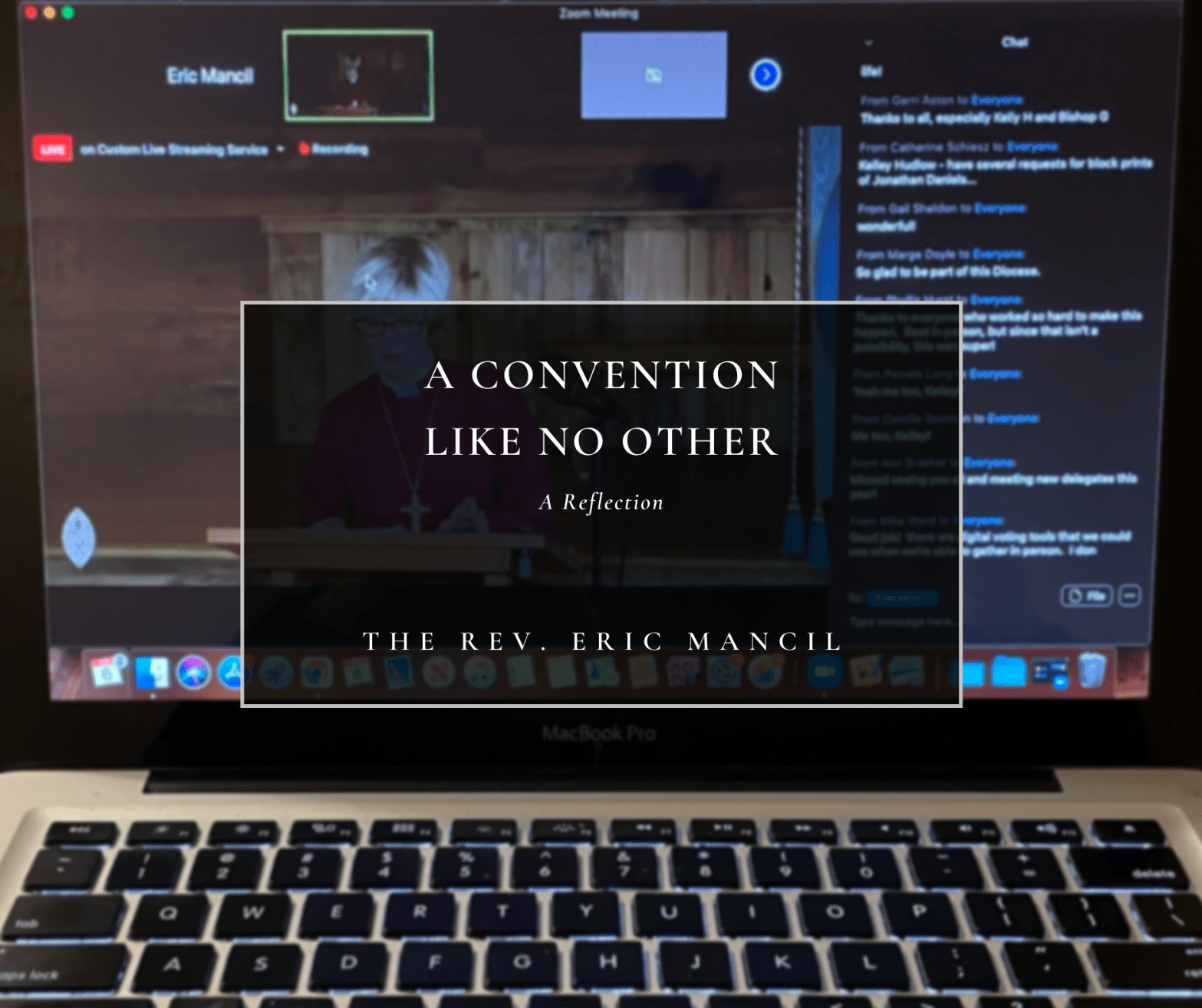
A Convention Like No Other

This past weekend, the Episcopal Diocese of Alabama hosted its 190th diocesan convention at “Wonderful, Wonderful, Camp McDowell”. For those of you who aren’t familiar with the structure and governance of the Episcopal Church, a diocese is basically a district of churches under the guidance and oversight of a bishop (which is where the term “Episcopal” comes from). Most of the time, dioceses are grouped into geographical areas, such as the Diocese of Alabama, which is made up of parishes and worshiping communities from about the top two-thirds of our state (the bottom third falls under the Diocese of the Central Gulf Coast, a different diocese with a different bishop).

According to the canons of the Episcopal Church (a canon is a fancy word for “law”), every diocese is required to meet annually in order to conduct the business of the Church, which is exactly what we, as delegates from each parish and worshiping community, gathered to do this past weekend.

Only this was a convention like no other. Because of limitations in our ability to gather safely due to COVID-19, it was decided that our annual convention in 2021 would be conducted virtually. Unfortunately, this is a decision that many dioceses have had to make this year in order to keep each other safe and to prevent the spread of the virus.

So, on Saturday morning, rather than gathering as a convention in “the Doug” (our nickname for Carpenter Hall at Camp McDowell), about 350 of us logged onto Zoom and took part in the convention from the comfort of our own homes.

I have to admit that, as far as the business side of convention is concerned, I certainly didn’t mind the convenience of being able to log in on my computer and participate virtually. It made the experience simpler and faster (especially when it came time to vote for those nominated to serve on various committees).

But, what I missed this year was the sense of connection. Sure, we could see each other’s faces on the computer screen, but it’s not the same as sitting next to fellow delegates in the convention hall or enjoying a meal with a friend you haven’t seen in a long time or sitting by a fire with a glass of bourbon in hand (we are Episcopalians after all). There are just some things that can’t be replaced with a computer or smart phone. To that end, our diocesan convention this year was fine for what it was, and I greatly appreciate everyone on the Bishop’s staff who worked so hard to put it together. But, I’m looking forward to next year when we can all (hopefully) be back together again in person because diocesan convention is more than just a list of business items that need to be checked off each year. Convention serves as a reminder that we are always connected as the Body of Christ and that we never go about the work of spreading the Gospel alone.

Let’s be honest. Sometimes, the work of the church can feel lonely, especially if you belong to a smaller parish where it’s easy to feel isolated, but when you have the opportunity to gather with so many others who share your convictions and love for Jesus, it’s hard not to be inspired to continue on and return home with a renewed sense of purpose. That’s the real reason I love going to convention. The business part is fine. I know that it’s an important and necessary part of our life as a Church. But, the real reason why I show up each year and love going to convention is the people—the conversations that are shared with friends, old and new, and the relationships that are formed and strengthened as a result. In my opinion, nothing is more valuable than that.