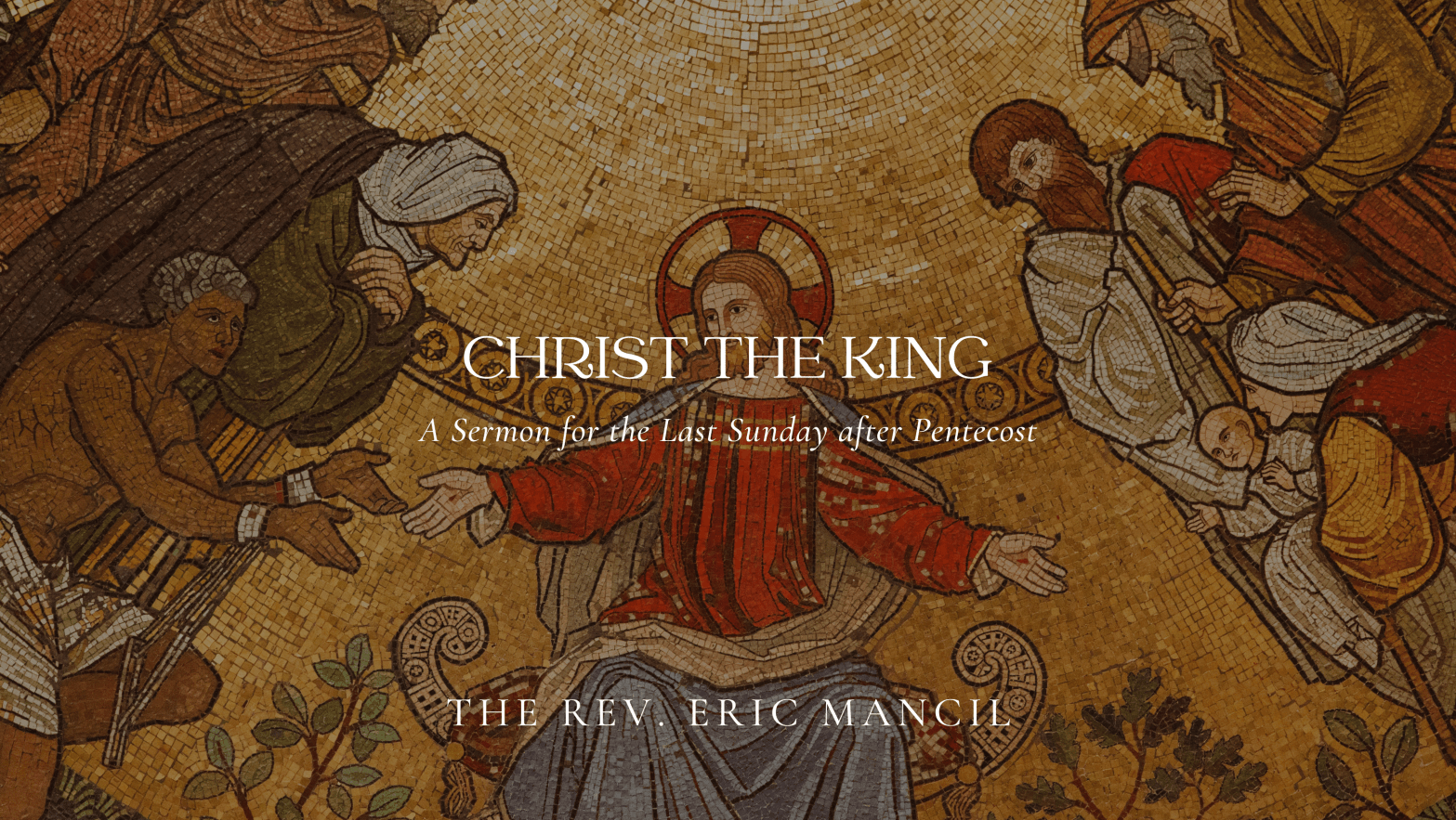
Christ the King

A Sermon for the Last Sunday after Pentecost (Proper 29, Year A)
November 26, 2023
The Baptism of Sibylle Marie Hamilton

Text: Matthew 25:31-46

Now, O Lord, take my lips, and speak through them. Take our minds, and think through them. Take our hearts, and set them on fire. In the name of the Father, and of the Son, and of the Holy Spirit. Amen.

I subscribe to a series of daily meditations from the brothers at the Society of St. John the Evangelist, an Anglican monastery located in Cambridge, Massachusetts. Every morning, when I wake up and check my email, I find a short meditation written by one of the brothers at SSJE. Over the past several years, they’ve become part of my morning routine, something I look forward to reading each day.

All of them are good, but occasionally, I come upon one that’s especially meaningful—one that sticks with me for a long time.

A few years ago, I came upon a meditation simply titled “Citizenship,” and I want to share it with you today because I think it has something important to teach us about what it means for Christ to be our King. Today, after all, is the Last Sunday after Pentecost, also known as Christ the King Sunday—the day when we remember that our true allegiance, as Christians, is to the Kingdom of God.

In his meditation, one of the brothers wrote, “We live in a world where Me is king. But our citizenship is not of this world. We are citizens of another country, whose king is a servant, whose orb is a towel, whose scepter a wash basin, whose crown is humility, and whose motto is service. As citizens and subjects of that kingdom, we cannot swear ultimate allegiance in any other way than taking up our towels, holding our basins, and getting down on our knees.”

As I read the brother’s meditation, I was struck by the contrast he made between those traditional symbols of royalty—the orb, the scepter, and the crown—and the symbols that we often associate with the servant ministry of Christ—the towel, the wash basin, and the washing of feet. It reminded me that, as Christians, we are called to be in the world but not of the world. Our citizenship is in God’s Kingdom, and our one true king is Jesus Christ, the one who emptied himself and lived and died as one of us to show us the path to abundant life with God.

Jesus gave his life to show us that mercy and forgiveness matter more than power and prestige, that love and service to others matter more than our own selfish ambitions. We are first and foremost citizens of God’s Kingdom, and we’re called to walk in the way of our King, to take up our own cross and follow him.

In recent years, one of my favorite television shows has been The Crown on Netflix. If you haven’t seen The Crown yet, I highly recommend it. The show traces the life and reign of Queen Elizabeth II, beginning with her wedding to Prince Philip in 1947.

The first season depicts the struggles that Elizabeth experienced soon after the death of her father, King George VI, in 1952. After her father died, Elizabeth quickly ascended to the throne and was later crowned in a coronation ceremony at Westminster Abbey on June 2, 1953.

My favorite episode of The Crown is the one where we witness the coronation of the Queen with all of its pageantry and mystery. We witness Elizabeth accept the Coronation Oath and the Archbishop of Canterbury anoint her with holy oil. We witness her being crowned with the Crown of St. Edward as the choir sings “Zadok the Priest,” the traditional coronation anthem. And, in one of the final moments of the episode, we see the newly crowned Queen processing down the aisle, carrying the orb and scepter—the traditional symbols of the monarchy.

I was interested to learn that, according to tradition, the Sovereign’s Orb is a symbol of Godly power. It’s in the shape of a globe with a cross on top, which represents “Christ’s dominion over all the world.” During the coronation ceremony, it’s presented to the Sovereign after they put on the Imperial Robe. The orb is brought from the altar by the Dean of Westminster and given to the Archbishop of Canterbury to place in the Monarch’s right hand.

The Sovereign’s Scepter is actually one of two scepters used in the coronation ceremony. According to tradition, the scepter is a symbol of the Sovereign’s worldly power. During the ceremony, it’s placed in the left hand of the Monarch by the Archbishop of Canterbury.

As I was watching the episode with the Queen’s coronation, I noticed a lot of similarities between the symbols and traditions of the coronation ceremony and the symbols and traditions we associate with the sacrament of Baptism.

Do we not accept our own Coronation Oath in the covenant that we make with God in baptism?

Are we not anointed with holy oil in Baptism as a symbol of the unbreakable bond that we share with Christ?

Are we not crowned in Baptism through the Church’s invitation to join with Christ in his eternal priesthood?

These symbols and traditions matter because they connect us with something far greater than ourselves and remind us that we’ve been called to follow a particular way of life, a way that doesn’t include orbs and scepters but one that does include towels and wash basins.

Like the monarchy, the Church, as we know it today, is a human institution. We aren’t perfect. We have good days, and we have bad days. On our worst days, we care only for ourselves. On our best days, we remember that the real reason we exist is for the benefit of those on the outside, those who are hungry to hear the Good News we have to share with the world. The mission of the Church is to work for the building up of God’s Kingdom, “to restore all people to unity with God and each other in Christ.”

Our call as Christians is to follow Jesus into a life of humble service, to care for those whom the world has rejected. Jesus said it this way in our Gospel lesson for this morning:

“Come, you that are blessed by my Father, inherit the kingdom prepared for you from the foundation of the world; for I was hungry and you gave me food, I was thirsty and you gave me something to drink, I was a stranger and you welcomed me, I was naked and you gave me clothing, I was sick and you took care of me, I was in prison and you visited me.”

This is one of the last things Jesus said to his disciples. In just a couple of days from when this passage take place, Jesus will be betrayed and handed over to be crucified. So, I think it’s reasonable to assume that we should take these words to heart. Of all the things Jesus could’ve said to his disciples with the time he had left, he said this:

Feed the hungry.
Give drink to the thirsty.
Welcome the stranger.
Clothe the naked.
Take care of the sick.
And visit those who are in prison.

One day, Jesus will return to judge both the living and the dead, and on that day, we won’t be judged by the amount of money or influence we gained in this life.

We won’t be judged by how successful we were in our jobs or how many friends we had or how popular we were.

And, we won’t be judged by how many Bible verses we memorized or whether or not we had perfect attendance at church.

We will be judged by how we cared for the “least of these.”

Jesus said it himself in our Gospel lesson for today—not to scare us into doing these things—but to help us understand that, in order to experience the abundant life God desires for us, we must be willing to lay down our lives and follow in his way.

The way of Jesus—the way of self-giving, sacrificial love—is the path to eternal life with God. The way of “capital M Me”—the way of selfishness and self-service—is the path that leads us away from God.

God has given us the freedom to choose which path we will follow. Will we choose to serve only ourselves? Or, will we turn and follow Jesus?

The Church has a way for us to answer those questions, and it’s called the sacrament of Holy Baptism. When we make the choice to follow Christ—or, in some cases, when our parents and godparents make that choice on our behalf—we make solemn promises and vows before God and the Church to turn from the way of sin and death to the way of everlasting life with God. We are buried with Christ in his death and raised to newness of life through his resurrection.

In just a few moments, we’ll celebrate the sacrament of new life as we welcome Sibylle Marie Hamilton into the Body of Christ, and with her and her parents and godparents, we’ll renew our own Baptismal Covenant with God—those same promises and vows we once made to turn toward Jesus.

Sibylle doesn’t realize it now, but she’s about to be baptized into a royal priesthood of believers—not one with orbs and scepters but one with towels and wash basins. Promises and vows will be made on her behalf to follow Christ with the hope that one day, she’ll grow into a mature life of faith and make the decision for herself to be confirmed, to renew those same promises and vows that were made for her today.

She will be anointed with holy oil as a sign that she is sealed by the Holy Spirit in Baptism and marked as Christ’s own forever. Nothing can ever change that.

And, she will be welcomed as one of our own—a member of the Body of Christ. It will be our responsibility—along with her parents and godparents—to help guide her in the Christian life and faith, to lift her up when she falls, and to always be a loving and supportive presence in her life.

Because, dear friends, Baptism isn’t just about the person being baptized. It’s about all of us, working together, to proclaim Christ as our King, to let the world see and know that his Kingdom will reign forever. Amen.

Who Lives, Who Dies, Who Tells Your Story?

A Sermon for the Feast of All Saints (Year A)
November 5, 2023

Text: Matthew 5:1-12

Now, O Lord, take my lips, and speak through them. Take our minds, and think through them. Take our hearts, and set them on fire. In the name of the Father, and of the Son, and of the Holy Spirit. Amen.

“Who lives? Who dies? Who tells your story?”

If you’re familiar with the world of musical theater, you probably recognize this popular refrain. It comes from one of my favorite musicals—one that’s become incredibly popular over the past eight years since it debuted on Broadway in the summer of 2015. Of course, I’m talking about the Tony Award-winning musical, Hamilton, which was written and composed by Lin-Manuel Miranda.

For those of you who are unfamiliar with it, Hamilton tells the story of Alexander Hamilton, one of the founding fathers of our country, the first Secretary of the Treasury, and the creator of our national banking system. The show begins with Hamilton’s arrival in the British colonies only a few years before the start of the Revolutionary War and spans his entire life, culminating in his famous duel with Aaron Burr.

Now, unfortunately, I’ve never had the opportunity to see Hamilton in person, but I’m very familiar with the music. I can’t tell you how many times our family has listened to the original cast recording! It’s unique and unlike any other musical that’s ever been written. The story is told not only through dialogue but also through an interesting blend of hip-hop and rap and various other styles of music, opening up the world of musical theater to a whole new generation. Once you hear it for the first time, it’s hard to stop listening!

But, for me, what makes Hamilton even more compelling than the music is one of the central themes of the show—a theme found throughout the Scriptures as well: we all live; we all die; and our story continues through the people we know and love, the people who carry us with them in their hearts long after we’re gone.

At the end of the Gospel of Matthew, we see a good example of this in the Great Commission, which takes place not long after Jesus’ death and resurrection. Jesus meets his disciples on top of a mountain in Galilee, and as he’s preparing to leave them and ascend to the Father, he says, “All authority in heaven and on earth has been given to me. Go therefore and make disciples of all nations, baptizing them in the name of the Father and of the Son and of the Holy Spirit,and teaching them to obey everything that I have commanded you. And remember, I am with you always, to the end of the age.”

In his final moments with them, Jesus empowers his disciples to continue the mission he began, giving them the courage and strength they need to carry on and continue telling the story so that future generations will come to know who he is.

The final act in the musical, Hamilton, also captures this idea that we continue to “live on” through those who come after us. You see, the finale of Hamilton isn’t told from the perspective of the main character but through his wife, Eliza Hamilton, who shares with the audience all of the many things that she’s able to accomplish in her life after the death of her husband.

She keeps his legacy alive by sharing his story with future generations and by continuing to do important work in her own life. In the final moment of the show, the company sings the refrain, “Who lives? Who dies? Who tells your story,” encouraging the audience to ponder these questions as they leave the theater.

So, today, dear friends, I ask you to consider these same questions. “Who lives? Who dies? Who tells your story?” What stories do you want future generations in the Church to tell about you? What kind of legacy do you want to leave behind?

It’s good for us to consider these questions as we celebrate the Feast of All Saints and give thanks for all those who’ve come before us in the faith, guiding us with their wisdom and providing us with examples of holy living.

Some people refer to All Saints’ Day as the Church’s “memorial day,” but it’s actually a lot more than that. It’s also a time for us to consider how we might pattern our lives on Jesus and live more fully into our own sainthood.

We have special days throughout the Church year when we commemorate the lives of individual saints, well-known figures like the apostles, Peter and Paul; Mary, our patron saint; and Francis of Assisi; but All Saints’ Day is the day when we commemorate the lives of ordinary saints, people like you and me who’ve committed ourselves to living a particular way of life—the way of Jesus—which calls us to live with open hearts so that God’s love may flow through us and be made known to others.

The saints who’ve come before us have important stories to share. Some of those stories are about falling short and struggling to remain faithful. Some of them are about sacrifice and self-giving. In the past ten months, since I began serving as your Rector, I’ve heard lots of stories about the saints of St. Mary’s—people like George Proctor and Tammy Portemont and Kathy Kyzar, just to name a few. A lot of them have banners hanging in the Parish Hall next door, reminding us of the lives they lived and the legacy they left behind.

We also have important stories to share, stories that will surely be told long after our time on earth has come to an end and our banners continue to hang in the Parish Hall of this church.

Our lives are unique to us as individuals because of the stories we have to tell, and yet, as Christians, we’re also part of a single, ongoing narrative, one that began long ago with Jesus and the first disciples and one that will continue for generations to come. When we commit ourselves to Christ through the sacrament of Baptism, we add our own, individual stories to that ongoing narrative.

And, even though we all lead different lives and we all have different gifts to share, we’re joined together by that central story—the story of Jesus—the one who lived and died and rose again, the one who calls us to share in his death and resurrection through the sacrament of new birth.

Our Gospel lesson for this morning from Matthew—commonly known as the Beatitudes—offers those of us who have committed our lives to Christ words of comfort and reassurance as we continue to work for the building up of God’s Kingdom.

Jesus says to the crowd, “Blessed are the poor in spirit, for theirs is the kingdom of heaven.” “Blessed are those who mourn, for they will be comforted.” “Blessed are the meek, for they will inherit the earth.” “Blessed are those who hunger and thirst for righteousness…” “Blessed are the merciful…” “Blessed are the pure in heart…” “Blessed are the peacemakers….” “Blessed are those who are persecuted for righteousness’ sake…” “Blessed are you when people revile you and persecute you…”

Now, notice what Jesus doesn’t say (even though we like to pretend he does).

Jesus doesn’t say, “Blessed are you who have everything figured out in your lives.” He doesn’t say, “Blessed are you who have perfect faith in God all the time and never doubt.” And, he doesn’t say, “Blessed are you who do everything perfectly.”

The life of a saint isn’t about being perfect. Being set apart and called by God doesn’t mean that we have to have all the answers figured out or that we aren’t allowed to make any mistakes. Actually, I think it means quite the opposite.

Being a saint is about having the humility to realize that we don’t have all the answers and that we desperately need a savior to lead us and guide us to the truth.

It’s about being willing to show up for Jesus and to be transformed by the power of God’s love so that we can go out and change the world, even when the going gets tough. It’s about sowing seeds for God’s Kingdom so that future generations will be willing and able to continue in our footsteps.

In just a few moments, we’ll once again recommit our lives to the work of Jesus as we renew our baptismal vows, and as we do, let us remember the saints who’ve gone before us and consider how God is calling us to continue their legacy of sharing the Good News of God in Christ with the world. Amen.

Turn Toward Jesus

A Sermon for the Eighteenth Sunday after Pentecost (Proper 21, Year A)
October 1, 2023

Text: Matthew 21:23-32

Now, O Lord, take my lips, and speak through them. Take our minds, and think through them. Take our hearts, and set them on fire. In the name of the Father, and of the Son, and of the Holy Spirit. Amen.

Several years ago, in September of 2016, a video was released online featuring our Presiding Bishop, Michael Curry. This was only about a year after he was elected to serve as Presiding Bishop, and it was before the world knew him as the charismatic bishop who preached at the wedding of Prince Harry and Meghan Markle.

In the video, Bishop Curry talks about the Jesus Movement. Now, this should come as no surprise to any of you who have heard our Presiding Bishop speak or deliver a sermon. He loves to talk about the Jesus Movement!

For the past eight years, everyone in the Episcopal Church has been talking about it. In fact, the phrase has become so popular among Episcopalians that it’s even shown up in our merchandise. Yes! You, too, can buy a bumper sticker that says, “We are the Episcopal Branch of the Jesus Movement.” 

But what, exactly, is the Jesus Movement?

We use that phase a lot, but I think it’s important that we talk about what it really means. In Bishop Curry’s video, he paints us a picture of what the Jesus Movement is by reflecting on an important moment that happens every week in our Sunday worship.

Slowly walking in the midst of the noise and busyness of Manhattan, the Bishop describes that moment in our liturgy when we stand and sing praises to God as we prepare our hearts and minds to receive God’s Word through the reading of the Gospel.

We stand, and we sing. The Gospel Book is held high as the procession moves from the Altar to the center of the Nave where the words and teachings of Jesus will be read in the midst of the people. And, as all of this is happening, everyone in the congregation turns in order to see the place where the Gospel will be proclaimed.

Quite literally, we turn toward Jesus, and in that moment, according to Bishop Curry, “the Church has become the Jesus Movement, with life re-oriented around the teachings of Jesus and around his very spirit— teachings and a spirit that embody the love of God in our lives and in this world.”

I love Bishop Curry’s message in the video, and I recommend that you go online and watch it for yourselves. It’s very short—only about four minutes long. All you have to do is go to YouTube and search for “Jesus Movement…Michael Curry.” You’ll be glad you did.

Often, when we hear the word, “movement,” we think about a group of people working together to make some kind of change happen in the world or a campaign focused on matters of equality or social justice. I think about the Civil Rights Movement of the 1950s or the movement for women’s voting rights in the early part of the twentieth century.

But, that’s not the kind of movement Bishop Curry is talking about. It’s not a rally for social or political change. It’s a movement that’s been going on for thousands of years, a movement of the heart that we, as members of the Body of Christ, have been called to continue and share with the world in our own time and place.

The Jesus Movement is what happens when the people of God stand up and re-orient themselves toward the Gospel. It’s the path we’ve been called to walk as followers of Christ.

In the Episcopal Church, the way we worship prepares us for the work that God has given us to do when we leave this place. So, there’s a reason why we stand and turn our bodies to face the place of the Gospel. Not only is it a sign of reverence for the words of Jesus, but it’s also preparing us to stand and turn toward Jesus in our everyday lives and to get back on track in those times when we’ve fallen short of our call.

In the language of the Church, we have a special word for when we turn or re-orient ourselves toward Jesus, and it’s one that we don’t use lightly. We call it repentance. Repentance is what happens when we turn away from the things that are weighing us down or holding us back in our relationship with God and turn back toward Christ.

And, it’s not something we do once or twice in our lives. It’s an ongoing, life-long series of  mistakes and failures, of falling down and asking for forgiveness, of confessing our sins and making changes in our lives that will bring us closer to God. Thankfully, our God is a god of grace and mercy, and we’re given opportunities in our lives for true repentance, to turn from death to newness of life.

I think this is the point Jesus is trying to make in our lesson today from Matthew’s Gospel.

There are two parts to this Gospel reading. In the first part, the chief priests and elders of the people come to Jesus while he’s teaching in the temple and question his authority. This happens not long after Jesus arrives in Jerusalem along with his disciples. They ask Jesus, “By what authority are you doing these things, and who gave you this authority?”

Well, Jesus knows exactly what these religious leaders are up to. They’re trying to trap him into a corner and publicly discredit him. If he claims his own authority, he’ll be seen as a fraud and false teacher. And, if he claims that his authority comes from God, he’ll be accused of blasphemy. It’s a dangerous situation for Jesus.

So, rather than playing the game of the chief priests and elders, Jesus turns the tables and asks them a question. “Did the baptism of John come from heaven, or was it of human origin?”

The religious leaders begin arguing amongst themselves, carefully weighing each option. They finally decide that there’s no good answer that won’t expose them to public scrutiny. If they answer, “from heaven,” the people will ask why they didn’t believe in John the Baptist. And, if they say, “of human origin,” the people who regarded John as a prophet will revolt. Their only concern in all of this is maintaining their authority and status among the people.

So, rather than answering the question, they say to Jesus, “We do not know.”

Then, Jesus tells them a parable about a father and his two sons. In the parable, the father asks both sons to go and work in the vineyard. The first son initially refuses his father’s request. But, after some time, he changes his mind and goes to work.

The second son immediately agrees to do as the father has asked but later decides not to go. Jesus asks the chief priests and elders, “Which of the two did the will of his father?”

Without hesitation, they respond, “The first.” Jesus then says to them, “Truly I tell you, the tax collectors and the prostitutes are going into the kingdom of God ahead of you. For John came to you in the way of righteousness and you did not believe him, but the tax collectors and prostitutes believed him; and even after you saw it, you did not change your minds and believe him.”

The nineteenth-century Danish theologian, Søren Kierkegaard, once wrote a spiritual reflection on this parable entitled, “Under the Spell of Good Intentions.”

In his reflection, Kierkegaard suggests that the most important lesson from the parable is not how to distinguish the difference between what is and what isn’t God’s will but to learn the importance of being faithful to the vows we make before God.

Kierkegaard writes, “The good intention, the ‘Yes,’ taken in vain, the unfulfilled promise leaves a residue of despair, of dejection. We do not praise the son who said, ‘No,’ but we need to learn from the gospel how dangerous it is to say, ‘Lord, I will.’”

The son in the parable, who quickly responded, “I go, sir,” and later rejected the will of his father, and the chief priests and elders, who turned away from God when they refused to accept the teachings of John the Baptist, are examples of how quickly our good intentions and unfulfilled promises can cause us to turn our backs on God.

The Good News, though, is that God grants us the ability to change our minds—like the other son in the parable who first said, “No,” and later changed his mind and did what his father asked. 

God grants us the ability to turn back when we’ve lost our way—to repent when we’ve fallen short. God knows that all of us are going to make mistakes from time to time, but even in those moments when we’re unfaithful, God is there. God isn’t done with us yet. There is mercy and forgiveness, and God is always ready to welcome us back home again. Amen.

There’s Always Grace

A Sermon for the Sixteenth Sunday after Pentecost (Proper 19, Year A)
September 17, 2023

Text: Matthew 18:21-35

Now, O Lord, take my lips, and speak through them. Take our minds, and think through them. Take our hearts, and set them on fire. In the name of the Father, and of the Son, and of the Holy Spirit. Amen.

Several years ago, when I was in my last year of seminary, I had the opportunity to take a class from a retired bishop named Mark Dyer. Bishop Mark, as we called him, was a beloved member of the seminary community, and any time he offered a class, students would jump at the opportunity to take it.

One of his favorite things to do in class was to tell stories from his his experience as a bishop in the Episcopal Church, and there’s one that I remember fondly.

It was a story about a prominent bishop within the Anglican Communion who was once invited to celebrate the Eucharist by the rector of a church.

Happily, the bishop accepted the rector’s invitation, but he had one stipulation. He told the rector that he would need a private room before the service began in order to prepare, and of course, the rector agreed to the bishop’s request.

The day of the service arrived, and when it was time for the service to begin, the rector of the church looked around and suddenly realized that the bishop was nowhere to be found.

So, he quickly went to the bishop’s room, and when he opened the door, he found the bishop lying face down on the floor with his arms stretched out on both sides. In the language of the Church, we call this “lying prostrate.” It’s a sign of humility and respect for God.

The rector told the bishop that he needed to hurry in order to make it back to the church in time for the service, but the bishop refused to go. “I’m sorry,”  he told the rector, “but you’re going to have to find someone else to celebrate the Eucharist. I have been hurt so deeply by someone that I can’t forgive him, and if I can’t forgive him, then I can’t celebrate the Eucharist.”

And that was the end of Bishop Mark’s story.

The point he was trying to make to the class was that, as Christians, we are a people who are called to seek forgiveness and reconciliation—not only for ourselves but also for the sake of the Church. When we don’t seek peace—when we don’t work to restore and mend broken relationships—it affects all of us.

This is why we take the act of confession seriously and why we practice it every week in worship. Before we share in the sacred meal, we must first be at peace with our brothers and sisters in Christ. 

This was the point I think Jesus was trying to make in our Gospel lesson from last week when he gave his disciples a list of instructions on what to do when conflict arises in the church—when one member of the church sins against another.

What it all boils down to is this: when another member of the church hurts you, don’t bottle it up or pretend it never happened. Don’t go to other people and talk about that person behind their back. Don’t retaliate against them.

Instead, go and seek peace with the one who hurt you. Hold them accountable for their words and actions, and let them know what they’ve done. By doing so, we can begin to heal and hopefully be reconciled with the one who hurt us.

In today’s Gospel lesson, Jesus has even more to say about forgiveness.

Peter goes to Jesus and asks him, “Lord, if another member of the church sins against me, how often should I forgive? As many as seven times?” Jesus responds, “Not seven times, but, I tell you, seventy-seven times.”

You’ve got to love Peter. He thinks he’s impressing Jesus by suggesting such a large number. Forgiving someone seven times would’ve been seen as going above and beyond what was expected at the time.

But, Jesus shakes his head at Peter’s question, and says, “Not seven times, but, I tell you, seventy-seven times.” Some translations of the text say, “Not seven times, but, I tell, you seventy times seven.” What Jesus is getting at is that our willingness to forgive shouldn’t be limited to a specific number. 

And then, to drive the point even further, Jesus tells a story—this one about a king who forgives the entire debt of one of his slaves. This wasn’t just some ordinary debt. This was a debt beyond imagining—one that never could’ve been repaid in his lifetime. In the time of Jesus, it would’ve taken a common laborer 200,000 years to pay off the slave’s debt to the king. In his mercy, the king releases the slave and forgives his entire debt.

Well, not too much later, that same slave comes upon another slave who owes him money—100 denarii (the equivalent of 100 days’ wages)—and rather than forgiving the man’s debt, as he himself was forgiven, he has him thrown in prison until he’s able to repay him.

Word gets back to the king, and he isn’t too happy about the news. He summons the slave and tells him, “You wicked slave! I forgave you all that debt because you pleaded with me. Should you not have had mercy on your fellow slave, as I had mercy on you?” In his anger, he hands the slave over to be tortured until he repays the entire debt.

Now…before you jump to any conclusions about this parable, I want to say this. The king in our story is not a metaphor for God.

And, the reason why I want to make that clear is because the God we worship, the God in whom we put all of our faith and trust, is not a transactional God. He doesn’t grant us mercy and forgiveness because of what we do, and he doesn’t punish us because of what we don’t do.

Our God is a god of grace and mercy, and he’s given us these gifts—not because we’ve earned them or deserve them—but because God loves us and wants us to be restored to fullness of life. God is always ready and willing to forgive us, and his mercy is everlasting.

And because of that, we too should be willing to forgive. That’s the point of the parable in today’s Gospel reading and what Jesus is trying to teach us. Because God has forgiven us and continues to forgive us when we fall short, we too should be willing to extend that same mercy to those who sin against us.

I know it isn’t easy.

There’ve been moments in my own life when I was so deeply hurt by another person that I was unsure of whether or not I would ever be able to forgive them. At one point or another, we’ve all felt like this.

We’ve all experienced deep grief and pain from people who’ve sinned against us, and often, the people who’ve hurt us the most are the one’s we least expect to hurt us. In moments like that, how do we begin to forgive? How do we seek peace with people who’ve hurt us so badly?

Well, I wish there was an easy answer. But, the truth is that forgiveness—like with most things that are difficult—takes a lot of time and patience. It doesn’t happen overnight, especially when we’ve been hurt so deeply. And, it takes practice—sometimes much more than we really want to give.

The alternative to forgiveness would be to allow the pain and hurt we’ve experienced to consume us and cause us to become bitter and resentful. And, when that happens over a long period of time, we begin to lose sight of who we are and who God has created us to be.

Forgiveness isn’t just about the person who’s caused us harm. It’s also about us and the freedom that comes with letting go of the anger and hurt we’ve kept bottled up inside. 

So, we keep practicing forgiveness, and then, when we fail, we get back up and try again. And, we keep practicing forgiveness until it becomes a little bit easier each time. Sometimes, it’s a long process—much longer than we would like—and even when we think we’ve totally forgiven someone for something they did a long time ago, those feelings of anger and resentment come rushing back, and we find ourselves in need of forgiving again.

This is hard work, but it’s also important work.

So, while we’re at it, we should also remember to be gentle with ourselves in the process. God knows we aren’t perfect and that we’re striving each day to live more faithfully as he’s called us to live. And, God knows that we’re going to fail and that there will be moments when our hearts are just too broken to be able to forgive and begin to heal. And, in those moments, there’s always grace.

Thanks be to God. Amen.

Where Were You?

A Sermon for the Fifteenth Sunday after Pentecost (Proper 18, Year A)
September 10, 2023

Text: Romans 13:8-14

Now, O Lord, take my lips, and speak through them. Take our minds, and think through them. Take our hearts, and set them on fire. In the name of the Father, and of the Son, and of the Holy Spirit. Amen.

Where were you on 9/11? It’s been almost twenty-two years since that terrible day back in September of 2001, but in some ways, it seems like only yesterday.

Like with most traumatic events we experience in our lives, we can still remember vivid details of that day. I remember exactly where I was when I first heard the news that the World Trade Center had been hit. At first, people assumed that it was a small, personal aircraft. It wasn’t until later in the morning, after the second tower had been hit, that we realized the truth of what was happening. Our country was under attack.

I was living with my grandparents in Andalusia at the time, and I had just started my first semester at LBW. That Tuesday morning, I got up and got ready to go to my first class of the day, and as I walked the into main education building, I noticed, as I walked by each classroom, that people were gathered close together around the television.

At first, I thought to myself, “What in the world is going on?” “Why is everyone starting at the TV?” It wasn’t until I got to my classroom that I learned the news.

Well…needless to say, we didn’t get much accomplished that day in any of my classes. We just kept watching the news, staring in disbelief and waiting to see what would happen next.

I remember other details of that day as well.

I remember sitting on the stage of the auditorium in the Dixon Center at LBW, praying that we would be safe in our little corner of the world. Looking back on that day, it seems silly to think that Andalusia would’ve been the target of a terrorist attack, but at the time, the fear was real. The people responsible for 9/11 had accomplished their goal. People everywhere were scared for their lives.

I remember going home that day from class and hugging my grandmother for a lot longer than I normally did. She gave the best hugs.

I remember calling my mother and just weeping—not only for all of the people who had died in the attacks—but also out of fear for our country. What was going to happen next? Will there be more attacks and more innocent lives lost? Does this mean we’re going to war? There were so many questions that day and so little answers.

I remember being glued to the television for the rest of the day and night, watching the news and waiting to see the latest headlines and updates. Life as we knew it came to a standstill, and all we could do was watch and pray.

Where were you on 9/11?

We all have stories from that day and vivid memories we’ll carry with us, probably for the rest of our lives—memories of people scared and suffering, wondering, “Where is God?”

But, there are other memories of that day I’ll carry with me as well. Images of heroes who, instead of running away from danger, ran toward it. Images of first responders—police officers, firefighters, paramedics, and probably so many others we don’t even know about—who risked their own safety and well-being in order to help those in need.

Many of them made the ultimate sacrifice that day, giving their lives in the service others, and each year on the anniversary of 9/11—which we’ll commemorate tomorrow—we pause to remember their bravery, to remember how, in the midst of darkness, their heroic acts of service served as a beacon of hope for the world and an example of love overcoming hate, of light overcoming the darkness.

Just a few days after 9/11, the late Rev. Billy Graham, in a prayer service at the National Cathedral in Washington, D.C., had this to say: “The lesson of this event is not only about the mystery of iniquity and evil, but second, it’s a lesson about our need for each other. What an example New York and Washington have been to the world these past few days! None of us will forget the pictures of our courageous firefighters and police, or the hundreds of people standing patiently in line to donate blood.”

It’s true.

Even though 9/11 will forever be remembered as a tragic day in the life of our nation—and the world—I also see it as a sign that, even when all hope seems lost, God is there, working to restore and build up that which has been lost and torn down.

God never abandoned us on that terrible day. God was there, present in the brave men and women who showed up in the midst of the chaos and confusion, the pain and the suffering.

As so, it’s good for us, as a church, to remember their sacrifice and offer our thanks to God for their willingness to serve others.

And it’s good for us to remember and give thanks to God for all first responders everywhere, for those who serve in ways that we may never understand or hear about, for those who work while others sleep, for those who put themselves in harm’s way to be a force for good in the world when others seek to do harm.

That’s the purpose of this day, which we’re calling “First Responders Sunday.” This is not a church-wide feast day in the Episcopal Church or a special day of remembrance. This is something that we, as a parish at St. Mary’s, have decided to do to show our appreciation for those who serve our community and to ask for God’s blessing to be upon them in their work.

As I was preparing for my sermon this past week and reading the lessons appointed for today, there was one verse in particular that I thought was especially appropriate, and it comes from our lesson from St. Paul’s letter to the Romans.

Paul writes, “The commandments, ‘You shall not commit adultery; You shall not murder; You shall not steal; You shall not covet’; and any other commandment, are summed up in this word, ‘Love your neighbor as yourself.’”

These aren’t Paul’s words. These are the words of Jesus.

Paul, in this instance, is merely pointing others to them and reminding the church in Rome that the truest form of love—the love that God calls us to share with others—isn’t an emotion or a feeling, not that those are bad things.

True love is an act of service. Loving one’s neighbor as one’s self means putting the needs and concerns of that person before our own. Love is self-giving and sacrificial, never selfish.

And, this is what Paul means when he goes on to write, “put on the Lord Jesus Christ.”

As Christians, in all that we say and do, in the way we treat friends and strangers alike, we are to “put on the Lord Jesus.” We are to clothe ourselves in the love of God and imitate Christ in walking the way of the Cross, trusting that God will be with us wherever our journey may lead.

On this day, we give special thanks for our brothers and sisters who put themselves in harm’s way every day in order to serve and protect others. We give thanks for those who’ve laid down their lives while serving in the line of duty. And, we look to all of them as an example of what it means to love as Christ has called us to love. We may not all be called to serve as police officers, firefighters, or paramedics, but we are called to a life of service through our faith in Christ Jesus, who said to his disciples, “This is my commandment, that you love one another as I have loved you. No one has greater love than this, to lay down one’s life for one’s friends.” Amen.

God Shows Up

A Sermon for the Eleventh Sunday after Pentecost (Proper 14, Year A)
August 13, 2023

Text: Matthew 14:22-33

Now, O Lord, take my lips, and speak through them. Take our minds, and think through them. Take our hearts, and set them on fire. In the name of the Father, and of the Son, and of the Holy Spirit. Amen.

There’s an old story that preachers love to tell—one that some of you may have heard before. It’s been around for a long time, and there’ve been many versions of it told. But, it basically goes like this…

Once upon a time, there was a terrible storm that came through a small town, and the downpour quickly turned into a flood. As the waters rose, a local preacher knelt down in prayer on the church porch, surrounded by water. As he looked around, he noticed that many people from around town were trying to evacuate by boat.

One of them came up to the preacher in a canoe and said, “You better get in, Preacher. The waters are rising fast, and if you wait too much longer, you might not make it.”

“No,” said the Preacher.” “I have faith in the Lord. He will save me from the flood.”

The man in the canoe shook is head and paddled away.

Still, the waters rose even higher, and the Preacher decided he better climb up on the balcony of the church. By this time, he was wringing his hands in supplication when another person from the town came by on a motorboat.

“Come on, Preacher! We need to get you out of here. The levee’s gonna break any minute, and if you wait too much longer, you might not make it.”

Once again, the Preacher was unshaken. “I’m not going anywhere,” he said. “The Lord will save me from the flood.”

“Suit yourself,” said the man in the motorboat, as he continued on his way.

Not much longer after that, the levee broke, and the flood rushed over the church until only the steeple remained above the water. The Preacher climbed up to the very top, clinging to the cross, when, all of a sudden, a helicopter descended out of the clouds, and a state trooper called down to him through a megaphone.

“Grab the ladder, Preacher! This is your last chance!”

But, once again, the Preacher insisted that the Lord would deliver him from the flood. So, the pilot took off to go and save as many people as he could.

Well…as you might’ve guessed, the Preacher drowned and went to heaven.

When he arrived, he went and spoke with God and asked the Almighty, “Lord, I had unwavering faith in you. Why didn’t you deliver me from the flood?”

God shook his head and told the Preacher, “What more did you want from me? I sent you a canoe, a motorboat, and a helicopter.”

It’s a funny story, isn’t it?

I just love it—not only because of the humor—but also because there’s a lot truth in it. I think this story has something to teach us about God and the way God has a tendency of showing up in our lives in ways that are surprising and unexpected.

The Preacher in the story is convinced that God is going to somehow reach down from heaven, pick him up, and deliver him safely from the flood. But, what he fails to realize—over and over again—is that God isn’t just waiting around up in heaven, choosing whether or not to intervene. God is already there, working in the lives of the people who are trying to save him.

The Preacher can’t see it, though, because he already has his mind made up about how God is supposed to respond. He believes, without a doubt, that if he has enough faith, God will save him from the flood with his mighty power.

In my experience as a priest, I’ve met a lot of people who fall into the same line of thinking as the Preacher in our story—people who are convinced that, if they have enough faith, God will reach out and save them in some miraculous way.

Now, I’m not saying that miracles don’t happen. I believe miracles happen every day, sometimes in ways that are beyond our ability to comprehend. But, I also believe that God is God and that God has the power to act in whatever way God chooses.

And, probably more times than not, the way God chooses to show up in our lives is through other people whom God has empowered and called to serve. A really good example of this in recent memory is the way people reached out and served others during the pandemic, especially those who worked on the frontlines—nurses, doctors, other healthcare professionals, and those who worked so hard to control the spread of the virus.

God didn’t reach down one day and magically put an end to the pandemic. But, that doesn’t mean it was any less of a miracle.

There’s no doubt in my mind that God was at work through it all. God never left us or abandoned us to suffer through it alone. God was there, directing us and giving us the strength to carry on.

Because that’s what God does. God shows up—sometimes in ways that we least expect.

Our lesson today from the Gospel of Matthew is another good example of how God tends to show up in our lives in unexpected ways. It’s a story that most of us are very familiar with. Even those with little knowledge of the Bible have likely heard the story of Jesus walking on the water.

It takes place right after the feeding of the five thousand. After the crowd has been fed, Jesus immediately tells his disciples to get into the boat and cross over to the other side of the Sea of Galilee. Then, he dismisses the crowd of people and goes up to the mountain to pray.


When evening comes, the wind gets stronger and starts battering the boat and tossing it from side to side, carrying it far from land. This continues throughout the night.

When morning finally comes, the disciples see something strange approaching on the water. They don’t know what or who it is. It could be Jesus, but they aren’t sure. So, they cry out in fear, “It is a ghost!” But, Jesus reassures them, saying, “Take heart, it is I; do not be afraid.”

Despite all they’ve seen Jesus do up to this point in his ministry, they still don’t believe it could be him, walking on the water.

Peter says, “Lord, if it is you, command me to come to you on the water.”

“Come,” Jesus says.

Peter gets out of the boat and steps on the water, slowly making his way toward Jesus. But, then he becomes frightened because of the strong wind and begins to sink into the water.

He cries out, “Lord, save me!”

Jesus grabs him by the hand and lifts him up. “You of little faith, why did you doubt?” Jesus asks. When they both return to the boat, the wind dies down and all the disciples worship Jesus, saying, “Truly you are the Son of God.”

One of the things I love most about this story is that it serves as a reminder to all of us that, when we put our faith in God, God will be there to lift us up when we fall down. It doesn’t matter where we are in our lives or what kind of storms we may be going through. God will always be there, ready to reach out and lift us back up again.

He is our constant help in times of trouble, and I don’t know about you, but it brings me great comfort in knowing that.

Another thing I love about the story of Jesus walking on the water is that it challenges us to open our minds to new possibilities about God and God’s saving power in our lives. Peter and the other disciples doubted that the figure on the water was Jesus, coming to save them from the violent storm. It wasn’t until Jesus rescued Peter from the water and came into the boat that they truly believed.

God has the power to work in our lives in ways that we may never see coming—like the Preacher in our story from earlier. His preconceived ideas about God blinded him to the truth. The miracle he was waiting for was right in front of him the whole time.

And, I have a sneaky suspicion that if we were to look around ourselves, we too might see miracles unfolding around us all the time, especially in those moments when we feel lost or afraid.

Because that’s what God does. God shows up—sometimes in ways that we least expect. Amen.

Was It All a Dream?

A Sermon for the Transfiguration of Our Lord Jesus Christ
August 6, 2023

Text: Luke 9:28-36

Now, O Lord, take my lips, and speak through them. Take our minds, and think through them. Take our hearts, and set them on fire. In the name of the Father, and of the Son, and of the Holy Spirit. Amen.

As a young child, one of my favorite movies was the beloved classic, The Wizard of Oz. I loved it so much that my grandparents even had it recorded on an old video cassette so I could watch it when we came to visit or spend the night.

Any time it came on television, I would stop what I was doing, sit down, and watch it as it retold the story of Dorothy Gale and her adventure in the magical Land of Oz.

There’s so much to love about the movie and so many reasons why it’s still considered a classic after eighty-four years. There’s the music, including the timeless song, “Somewhere Over the Rainbow.” There’s the story, which featured so many wonderful and larger-than-life characters, including Dorothy’s new friends—the Scarecrow, the Tin Man, and the Cowardly Lion—and of course the main villain—the dreaded Wicked Witch of the West. And, there’s the heart-warming finale to the film, reminding us that there’s really no place like home.

My favorite part of the movie, though, comes at the end of the first act. Dorothy has run away from home to protect her dog, Toto, from being taken away and euthanized. She runs into Professor Marvel, a crackpot fortune-teller who tells Dorothy to return home quickly because her aunt is heartbroken. Just as she’s returning home a tornado approaches the farm, and Dorothy and Toto are unable to get into the storm shelter. So, they go inside the house to take cover.

I think we all remember what happens next. Dorothy is knocked unconscious from the violence of the storm. The tornado lifts the house off the ground and it begins to spin in the air. Dorothy wakes up and notices some strange things through the window.

And, when the house finally lands, she walks out of her bedroom and opens the front door.

What she witnesses in that moment is unlike anything she’s ever seen before. It’s like stepping into a dream—out of black-and-white and into color. She doesn’t know where she is or how she got there, but she knows it isn’t home. And, after walking around and exploring for a bit, she says to Toto, “I have a feeling we’re not in Kansas anymore.”

As I was reading and reflecting on our Gospel lesson for this morning, I thought about this moment in The Wizard of Oz when Dorothy sees the Land of Oz for the very first time.

I thought about how incredibly awesome and terrifying it must have been for the three disciples in our Gospel reading—Peter, James, and John—to follow Jesus up the holy mountain and to see his appearance suddenly change from what they’ve always known to what must have seemed like a dream.

The author of Luke’s Gospel doesn’t give us many details about the experience. All we know for sure is that the appearance of Jesus’ face changed and that his clothes became dazzling white. Other translations of the passage describe the appearance of his clothes to be as bright as a flash of lightning.

And, as he’s praying, suddenly, two men appear with Jesus—Moses and Elijah—two prominent figures of the Jewish faith. They begin talking with Jesus about his “departure,” which he’ll  soon accomplish in Jerusalem.

The disciples are so mesmerized by what they’re seeing that they don’t really know what to do or how to respond. So, Peter says the first thing that comes to mind. “Master, it is good for us to be here; let us make three dwellings, one for you, one for Moses, and one for Elijah.”

Just then, a cloud overshadows the disciples and they become terrified. And, they hear a voice from heaven say to them, “This is my Son, my Chosen; listen to him!”

After the voice speaks, the disciples find Jesus alone, standing by himself.

“Was it all a dream?” they might’ve asked themselves. “Or, did we just witness a miracle?”

Historically, artists have depicted the Transfiguration of Jesus with even more amazing details than Luke provides. Many paintings and icons, for example, depict Jesus floating high above the mountain-top with his entire body bathed in glorious light—like something out of a movie.

And, in Matthew’s version of the story, Jesus says to his disciples, “Tell no one about the vision until after the Son of Man has been raised from the dead.”

Did it really happen? Or, was it all a dream?

Whether or not the disciples thought it was a dream, it must’ve been an incredible experience—one that surely changed their lives forever. Peter even refers to the experience in his second epistle, which we heard earlier this morning.

For them—and for us—the Transfiguration confirms that Jesus really is God’s Son. He is the one whom the Father sent to redeem and save us all. He is the one who came into the world to bring to fulfillment all the Law and the prophets. He is the Messiah, the Lord.

But, this Messiah—this King—won’t reveal God’s glory through acts of strength and worldly power. He’ll reveal God’s glory on another hilltop, outside of Jerusalem, as he willingly goes to the cross to suffer and die on our behalf.

The story of the Transfiguration is one that a lot of preachers struggle to preach about because it’s not really about anything Jesus says or does. In fact, Jesus doesn’t say a word in today’s Gospel reading. There is no teaching, no parable. And, Jesus doesn’t cast out demons or perform any kind of miraculous healing.

No, this story isn’t about something Jesus does. It’s about something that God does through Jesus so that the disciples who witness it—and future generations—will come to know and believe the truth about who Jesus really is.


In theological terms, the Transfiguration is a theophany—a visible manifestation of God to humankind—not unlike the experience Moses has when God appears to him on Mount Sinai and gives him the Ten Commandments.

We could spend all our lives trying to figure out how and why the Transfiguration happened. We could spend all our lives trying to understand the mystery.

But, in doing so, we might risk missing out on the central truth of the story and taking away from it what God has intended.

And the central truth is this: Jesus really is the Son of God, and as his disciples, we are called to follow and listen to him.

Did it really happen? Or, was it all a dream? Who can really tell?

And, more than that, does it really matter?

Did Dorothy really travel to a magical land in The Wizard of Oz? Or, was it all a dream? Who can really tell?

And, more than that, does it really matter?

In the end, all that really matters is that she’s back at home, right where she’s supposed to be, surrounded by her friends and family with a renewed sense of thankfulness, which is better than anything she could’ve ever asked for or imagined.

The same is true for us in our Gospel lesson for this morning. All that really matters is what we’re left with at the end of the story and what God has revealed to us to be true. Jesus is exactly who we believe he is, which is better than anything we could ever ask for or imagine. Amen.

Radical Hospitality

A Sermon for the Fifth Sunday after Pentecost (Proper 8A)
July 2, 2023

Text: Matthew 10:40-42

Now, O Lord, take my lips, and speak through them. Take our minds, and think through them. Take our hearts, and set them on fire. In the name of the Father, and of the Son, and of the Holy Spirit. Amen.

Several years ago, in June of 2014, our Presiding Bishop, Michael Curry, was featured in a short video that was put together by a group called The Society of Scholar-Priests. It was part of a video series entitled, “New Tracts for our Times,” which was intended to be a series of educational videos for those who are interested in learning more about the Episcopal Church and what we believe. 

The topic for Bishop Curry’s video was the Holy Eucharist, and at the beginning of the video, he shared a wonderful story—one that he also shared in a book he wrote, entitled, “Crazy Christians.”

The story basically goes like this:

There was an African American woman who became an Episcopalian in the 1940s. She met a young man who was in seminary and licensed to preach in the Baptist church, and they began dating. One Sunday, she invited the young man to go to church with her.

He had never been to an Episcopal church before. Everything was new—the Prayer Book, the liturgy, the prayers, the chanting. Having grown up in the Baptist tradition, everything was different.

The people were different, too.

When the young woman and man showed up to church that Sunday, they were among only a few black people in the congregation.

You have to remember that this was in the 1940s when segregation was still very much the law of the land. As Bishop Curry puts it, “The armed forces had not yet been integrated. Brown vs. the Board of Education had not taken place, and, it was long before the Montgomery bus boycott. Martin Luther King, Jr. was still in seminary.”

This gives you an idea of the time period we’re talking about.

When the time for Communion came, the woman went up to the Altar to receive the bread and  the wine. She was the only black person to go up to receive.

Since the young man was Baptist, he didn’t feel comfortable receiving Communion. So, instead, he sat in his pew and watched closely to see what would happen.

Because he noticed that everyone who went up to receive was not only taking the bread but also drinking from the same cup.

He waited to see what would happen when the priest came to the woman because he had never seen white people and black people drink from the same cup, or from the same water fountain.

So, the priest came to each person kneeling at the Altar rail, distributing the bread and saying, “The Body of Christ, the bread of heaven. “The Body of Christ, the bread of heaven.”

Then, the priest came by with the chalice. “The Blood of our Lord Jesus Christ, which was given for thee, preserve thy body and soul unto everlasting life. Drink this in remembrance that Christ’s blood was shed for thee, and be thankful.”

And he came to the black woman kneeling at the rail.

“The Blood of our Lord Jesus Christ, which was given for the thee, preserve thy body and soul unto everlasting life…”

In case you haven’t figured it out yet, the two people in Bishop Curry’s story were his parents.

And when his father told him the story, he would always say, “That’s what brought me to the Episcopal Church. Any church in which black folks and white folks drink out of the same cup knows something about a gospel that I want to be a part of.”

That’s a powerful story, isn’t it?

Of course, I don’t tell it nearly as well as Bishop Curry. So, if you want to go back and watch the video, you can still find it on YouTube.

But, the reason I wanted to share it with you today is because I think it has something to do with what Jesus talks about in our Gospel lesson this morning from Matthew, which is actually the culmination of a long discourse that began two Sundays ago when Jesus named the twelve apostles and empowered them to go forth into neighboring towns and villages, proclaiming the good news that “the kingdom of heaven has come near.”

He told them that as they go forth, they’ll encounter opposition and persecution from those who refuse to hear the good news, those who consider him—and anyone who follows him—the enemy.

He told his disciples not to have any fear, for God will be with them wherever they go. He told them they are more precious to God than they can possibly imagine and that anyone who wants to experience abundant life with God must take up their own cross and follow him.

And then, in our Gospel lesson for today, Jesus concludes this long series of instructions by telling his apostles, “Whoever welcomes you, welcomes me, and whoever welcomes me, welcomes the one who sent me.”

There are a couple of ways we could interpret this verse.

On one hand, it could be seen as Jesus’ way of further preparing his disciples for the mission that lies ahead. He knows that, once they’re sent out to share the message he’s given them, some people will reject them, and some people will receive them.

And for those who receive them, it will be the same as if they received Christ himself. This isn’t something Jesus invented, by the way. It actually falls in line with the Jewish law of shaliah, which basically states that the one who is sent on behalf of another represents the full presence of the one who sends.

The Greek equivalent to the Hebrew word shaliah is apostolos, which is translated in English as “apostle.” Jesus’ mission, then, for the twelve apostles is not only to be sent out but also to fully represent Jesus in his ministry.

The same is true for us today. When we go forth into the world, we do so as apostles—as a people sent forth to proclaim the Good News and to fully represent Christ to those we meet.

Another way to look at this verse from Matthew—and this is really what I want us to focus on today—is that it speaks to the importance of showing hospitality to the strangers in our midst—especially those who are most vulnerable.

And I think this is why the story I shared earlier about Bishop Curry’s parents is so captivating.

The church they attended that Sunday morning, many years ago, could’ve easily overlooked them and ignored them because of the color of their skin. They could’ve treated them as outsiders, refusing to allow them to enter the church or approach the Altar rail.

But, they didn’t.

Despite the racial and cultural expectations of the time, despite the controversy it could’ve stirred and the hardships it could’ve caused, that church welcomed them in and invited them to fully participate in their worship.

Now, I don’t know what happened after church that day. I don’t know if they were greeted during coffee hour or if anyone spoke to them on the way back to their car that morning.

But, for that brief time during worship, they were seen as equals and shown the love and dignity they deserved as children of God.

Welcoming the stranger and showing the radical hospitality that Jesus calls us to share with all of our brothers and sisters is sometimes more challenging than we’re willing to admit.

Because when we open ourselves to the possibility of welcoming people who are different than we are—people who look different or act different or have different beliefs than we do—we risk alienating and even offending others who may not see the same way as we do.

Practicing the radical hospitality of Jesus requires a whole lot of trust in God, and it requires vulnerability and a willingness to come out of our comfort zones in order to welcome those whom the world would rather overlook and ignore.

But, I also think that, sometimes, we make it harder than it needs to be to welcome the strangers in our midst.

Sometimes, we get so overwhelmed with the needs and concerns of the world that we forget that even the smallest act of kindness—like saying, “all are welcome at the Lord’s Table—can be a life-changing moment. Jesus says, in our Gospel lesson this morning that “whoever gives even a cup of cold water to one of these little ones in the name of a disciple—truly none of these will lose their reward.”

It doesn’t have to take an act of heroic courage or epic proportions to show kindness to a stranger. All it takes is a willingness to be open.

A willingness to be open to the possibility that we may not know as much as we think we know.

A willingness to be open to the power of the Holy Spirit moving in us and through us.

And a willingness to be open to the fact that God is truly present when we welcome others in the name of Christ.

Amen.

Companions Along the Way

A Sermon for the First Sunday after Pentecost: Trinity Sunday
June 4, 2023

Text: Matthew 28:16-20

Now, O Lord, take my lips, and speak through them. Take our minds, and think through them. Take our hearts, and set them on fire. In the name of the Father, and of the Son, and of the Holy Spirit. Amen.

One day, a few years back, I was having lunch with a friend of mine who was also serving as a priest in the Birmingham area at the time.

Somehow, the topic of preaching came up, and I shared with him that I was preaching the following Sunday, which happened to be Trinity Sunday. Well, you might guess what his first response was.

“Oh, wow! Trinity Sunday! I’m so glad I avoided that one!”

In case you don’t know, some priests try to avoid preaching on Trinity Sunday, if at all possible. Many of us try to avoid it like the Plague. Rectors of large parishes will assign the task to their associates. Some priests will just happen to “be away” on Trinity Sunday or they’ll arrange for a guest preacher to preach that day.

All joking aside, the reason why preachers love to avoid preaching on this day is because the doctrine of the Trinity—our uniquely Christian belief that God is three-in-one and one-in-three—is a mystery to all of us.

It’s a mystery that escapes our ability to comprehend and fully express in words. That doesn’t mean we haven’t tried, though. We use words like “Father, Son, and Holy Spirit,” even though we know that God isn’t a particular gender. God is God.

We use beautiful, descriptive words like “Creator, Redeemer, and Sustainer,” even though we know that the fullness of God is much more than just the ways in which God is at work in our lives.

Yes, God continues to create, redeem, and sustain us. Yes, God is “Father, Son, and Holy Spirit.” But, God is also so much more. The words we use to express the mystery of the Trinity are really just our best efforts to explain the unexplainable.

Using the language of music, one of my favorite Christian poets describes the Trinity as “three notes resounding from a single tone.” If you know anything about music, you know how preposterous that sounds. It’s impossible for three notes to resound from a single tone, just like it’s impossible for God to be three-in-one and one-in-three.

Or, is it? 

Personally, I’m happy to be preaching this morning. I’m happy to be sharing with you my thoughts about the Trinity because, from my perspective, it isn’t very helpful for us to try and explain the unexplainable with complicated, theological terms.

And, it isn’t helpful for us to use dated analogies or metaphors to try and explain the mystery. To me, it’s much more helpful to think about how the doctrine of the Trinity impacts us as Christians and what it can teach us about ourselves and our relationships with God and each other.

What I think the Trinity has to teach us most is that God values relationships.

I really do believe that God calls us to live our lives in community with each other and that, above all else, it’s how we’re called to live as Christian people. Not alone or isolated, but with each other.

Several years back, when I was serving as the priest at St. Catherine’s Episcopal Church in Chelsea, I led an Inquirers Class for those who were new to the church and those who just wanted to come and participate.

Some of you may know this about me already, especially if you attended the “Episcopal 101” class that I led a few weeks back, but one of my favorite things to do as a priest is to teach others about the Episcopal Church. I love it! It’s such a privilege for me to get to share the things I love most about our church with those who are brand new and seeking a new church home.

Well, during our Inquirers Class at St. Catherine’s, there was a woman who was new to the parish. Her name was Barbara, and at the time, she had only recently begun attending services. I told her that we were about to start a class for newcomers, and she was so excited to start attending.

So, we had our first class. And, it’s my practice during the first session of an Inquirers Class to begin by going around table and asking everyone to introduce themselves and share a little bit about why they decided to participate.

So, we went around the table, and everyone told us their name and where they were from and what drew them to the Inquirers Class.

When we came to Barbara, she introduced herself. And, then she gave a very simple response to why she was there. She said, “I’m here because I can’t do this alone.” That’s all she said. “I can’t do this alone.”

Her response has stuck with me all these years, and I think it’s because it’s absolutely true for all of us. We can’t do this alone—this Christian life, this work that we’ve been called to do as followers of Jesus. We can’t do it alone because sometimes the weight is too much to bear for one person.

We need each other, especially in those times when following Jesus seems especially difficult and we just need someone else to lift us up and encourage us to carry on.

We need each other in those moments when life hits us with something unexpected, like the death of a loved one or the loss of a job or an illness or injury.

We weren’t made to live in isolation. God created us to live in community with each other because that is God’s nature, and we’ve been called to draw others into the life of the community as well.

In our Gospel lesson this morning from Matthew, which takes place at the very end of the Gospel, the resurrected Jesus is gathered with his disciples on the top of a mountain in Galilee. And, he gives them one final instruction: “Go therefore and make disciples of all nations, baptizing them in the name of the Father and of the Son and of the Holy Spirit, and teaching them to obey everything that I have commanded you. And remember, I am with you always, to the end of the age.”

This passage from Matthew, commonly known as the Great Commission, could be interpreted in a number of ways. On the surface, it almost sounds like Jesus is telling the disciples to go out and just start baptizing as many people as they can, as if converting people to Christianity is the most important thing.

Now, it’s true. Part of our call is to share the Gospel. But, I don’t think Jesus wants us to be terribly concerned about going out and finding people to fill the pews on Sunday mornings.

Because anyone can fill a pew.

No, I think what Jesus is really saying in our Gospel lesson this morning is that he wants us to make disciples. He wants us to go out and share this life of Christian discipleship with others, drawing them into the community of faith with us.

Why? Because God is three-in-one and one-in-three. God values relationships, and we were created to share this life together.

We can’t do the work of following Jesus alone. We need others to be our companions along the Way. We need the community to walk with us in our journeys of faith and to lift us up and support us when we fall down. We can’t do it alone, no matter how hard we try.

Sometimes—and this is a challenge for many of us—that also means allowing others to take care of us when we need help, even if we’d rather do it ourselves.

Trinity Sunday isn’t the time for us to explain the unexplainable mystery of the Triune God. It’s a time for us to celebrate unity in the midst of diversity and diversity in the midst of unity. It’s a time for us to remember the importance of building relationships and living together in community, despite our differences.

Our God is a relational God, always at work in our lives in more ways than we can count, and as God’s children, we were created to live in the same way, to live in relationship with each other and to work together in the building up of God’s Kingdom. Amen.

The Gift of the Holy Spirit

A Sermon for the Day of Pentecost (Year A)
May 28, 2023

Text: Acts 2:1-21

Now, O Lord, take my lips, and speak through them. Take our minds, and think through them. Take our hearts, and set them on fire. In the name of the Father, and of the Son, and of the Holy Spirit. Amen.

“In the last days it will be, God declares, that I will pour out my Spirit upon all flesh, and your sons and your daughters shall prophesy, and your young men shall see visions, and your old men shall dream dreams.”

These are the words of the prophet Joel, spoken by Peter on the first Day of Pentecost.

As Episcopalians, we often describe the Day of Pentecost as the birthday of the Church. Some of us celebrate each year by wearing red to our worship services. Many parishes have festive parties and decorate their parish halls and churches with red balloons and streamers. Some even have a birthday cake decorated with tongues of fire or doves representing the Holy Spirit.

I think all of these are wonderful ways to celebrate such an important day in the life of the Church. After all, the Day of Pentecost is the last day of the Easter season and one of the seven principal feasts of the Church year, ranking right up there with Christmas and Easter.

But, Pentecost is also a day for us to give thanks for the gift of the Holy Spirit in our lives—the Advocate, the Comforter—who continues to lead us and guide us in our journeys of faith and to give us the strength we need to persevere in our calling.

In the fourteenth chapter of John’s Gospel, Jesus makes a promise to his disciples. He tells them that, after he’s gone to be with the Father, he will ask the Father to send them another Advocate to be with them always. Each year, on the Day of Pentecost, the Church remembers the fulfillment of that promise.

On this day, we remember the story as it’s told in the Book of Acts—that great day when the Holy Spirit descended upon the disciples in Jerusalem with tongues of fire, empowering them to preach the Gospel and carry out the mission of the Church.

The story of the first Day of Pentecost is a wonderful reminder of the transforming power of the Holy Spirit.

Think about it for a moment.

Think about the disciples in our story this morning from Acts and how far they’ve come since the events of Holy Week and Easter.

Think back to that moment in the story when Jesus was arrested and handed over to suffering and death. If you’ll recall, most of his disciples scattered and went into hiding, fearful that they would suffer the same fate as their teacher.

They were scared and alone, and even after Jesus was crucified and his body was laid in the tomb, they remained in hiding, unsure of what would happen next.

In the first chapter of Acts, the author writes that, after Jesus’ suffering and resurrection from the dead, he appeared to his disciples over the course of forty days, giving them proof of his return and continuing to teach them about the Kingdom of God.

And, before he ascended into heaven, Jesus instructed his disciples to remain in Jerusalem and to wait for the coming of the Holy Spirit.

When the Day of Pentecost finally arrives, it’s a turning point for the disciples of Jesus.

No longer are they able to hide in fear behind closed doors and keep the story of Jesus to themselves. No longer are they instructed to remain quiet about the things they’ve seen and heard.

No, Pentecost is the day when everything changes, the day when the followers of Jesus are empowered by the Holy Spirit and compelled to preach the Good News of God in Christ to all the world. The prophet Joel foretold this when he wrote, “I will pour out my Spirit upon all flesh, and your sons and your daughters shall prophesy.”

My friends, the same is true for us today.

When we’re empowered by the Spirit of God—which all of us are—we’re compelled to go forth into the world to proclaim the love of God in Christ Jesus.

When we’re empowered by the Spirit of God—which all of us are—we’re compelled to speak the truth in love, and when we’re faithful to our calling, nothing will be able to stand in our way.

The same is true now as it was in the time of the first disciples. The Day of Pentecost is a public declaration of faith. It’s a reminder that this Good News of Jesus that we’ve been given must be shared with the world. We simply can’t keep it to ourselves.

It’s been a little over five years since millions of people from all over the world tuned in to watch the Royal Wedding of Prince Harry of Wales and Meghan Markle.

As most of you probably know, our Presiding Bishop, Michael Curry, was invited to be the guest preacher during the ceremony, and for those of you who’ve seen it, I think we can all agree that England wasn’t ready for the fiery sermon that Bishop Curry delivered!

In my opinion, the second best thing about the Bishop’s sermon, other than the message he gave, was seeing the looks of surprise on people’s faces as they watched in shock and bewilderment!

It looked a bit like what I imagine people’s reactions must’ve been on the first Day of Pentecost as they witnessed the disciples preaching the Gospel in their native language.

If you haven’t seen the video of the Bishop’s sermon, I highly encourage you to go and watch it.

In typical fashion, Bishop Curry preached with passion and charisma. He spoke of the transformative love of Jesus, inviting the people to consider what the world might look like if we let love guide our words and actions.

In the words of Bishop Curry, “Love is not selfish or self-centered. Love can be sacrificial, and in so doing, become redemptive. That way of unselfish, sacrificial, redemptive love changes lives. And it can change this world.”

A few days ago, I went back and watched the Bishop’s sermon again on YouTube, as I do from time to time, and I noticed that, since May of 2018, the video has been viewed over 1.3 million times. 1.3 million! Talk about a public declaration of faith.

In my mind, it was truly a Pentecost moment. There’s a reason why so many people from around the world were touched by the Bishop’s message.

And I think it’s because people are hungry for Good News. People want and need a message of hope, reminding them of the love of God—the love that binds all of us together as God’s children.

Imagine how many lives have been touched by the Bishop’s message. Imagine how many people have said, “This is what the Church should be preaching—a message of love and compassion and forgiveness.” Imagine how many hearts and minds have been changed about the Church, an institution that’s often been criticized for being only concerned with itself, and with good reason. Imagine how many people have thought to themselves, “Maybe there is a place for me in the Church after all.”

Now imagine what we can do in our own corner of God’s Kingdom.

Imagine what we can do as the Episcopal Church in Andalusia, Alabama. We may not be able to preach like Michael Curry and we may not be able to reach over a million people on YouTube, but there’s still so much we can do, right here in our own community.

We’re only limited by our drive and our imaginations. The Spirit of God is present in and among us, ready to teach us and guide us with God’s wisdom if we’ll only open our hearts and minds to listen for God’s voice.

On this Day of Pentecost, as the Church celebrates and gives thanks for the gift of the Holy Spirit, let us be bold and unafraid in our proclamation of the Gospel and work to make God’s Kingdom a reality.

Like the first disciples, let us step out in faith and declare to the world that the way of Jesus— the way of sacrificial, self-giving love—has the power to change lives and the power to transform this world. In the words of an ancient hymn from the eighth century: “O Holy Spirit, by whose breath, life rises vibrant out of death; come to create, renew, inspire; come, kindle in our hearts your fire.” Amen.