The Lord Needs It

A Sermon for the Sunday of the Passion: Palm Sunday (Year C)
April 13, 2025

Text: Luke 19:28-40

I speak to you in the name of one God: Father, Son, and Holy Spirit. Amen.

Whenever I write a sermon for Palm Sunday, there are two things I try to keep in mind. Number 1: Keep it brief. The focus of our service on Palm Sunday should always be the reading of the Passion Gospel.

Every year, we hear the story of our Lord’s passion and death re-told from one of the three Synoptic Gospels—Matthew, Mark, or Luke.

At St. Mary’s, we hear it proclaimed in a very moving and dramatic way with members of the congregation reading different parts.

The story is powerful enough on its own, and there’s really not much more I need to say in a sermon.

So, I try my best to keep it short and to the point.

The second thing I try to do in my preaching on Palm Sunday is to stress the importance of Holy Week.

Palm Sunday marks the beginning of our journey through Holy Week.

And, it’s important that we take time out of our busy lives to walk through this week together as a community of faith, participating in as many services as we can—especially in the three days leading up to Easter.

I hope you’ll remember that as we leave church today and go about the week ahead.

This special time time between Palm Sunday and Easter is the single most important week for Christians around the world, and we’re called to observe it faithfully.

In our journey through Holy Week, we’re renewed in our faith and reminded of what it truly means to be a follower of Jesus Christ—the one who laid down his life for us, opening the way of salvation for all people.

So, as you’re thinking about the week ahead and how you’re going to spend your Holy Week, make plans now to come back to church on Maundy Thursday and Good Friday. 

Come back to church on Saturday night for the Great Vigil of Easter and help us celebrate the Passover of our Lord as we move move from the darkness of Good Friday to the joy of resurrected life.

I promise you won’t regret it.

But, what I can’t promise is that you won’t be changed in the process and come out on the other end of this week with an even greater and deeper love for Jesus.

Come back to church this week as often as you can.

Make it a priority for you and your family.

Embrace the mystery of Christ’s death and resurrection.

Because the truth, dear friends, is that it’s not just about Jesus and something that happened 2,000 years ago.

It’s also about you and me and this life we’re called to live in Christ, which leads me to the point I really want to make in my sermon for today.

And, to do that, I want to draw your attention to the passage from Luke’s Gospel that we heard outside in the Garden.

Think back to the story we heard earlier.

Jesus and his disciples are on their way to Jerusalem.

And, as they approach the towns of Bethphage and Bethany, near the Mount of Olives, Jesus sends two of his disciples ahead of the group to go and find a young colt that’s never been ridden.

He says to the two disciples, “Untie [the colt] and bring it here. If anyone asks you, ‘Why are you untying it?’ just say this, ‘The Lord needs it.’”

The disciples do as Jesus told them.

They walk ahead of the group, and when they arrive in the village, they find everything just as Jesus said they would, including the young colt.

As they’re untying it, the owners come out and ask them why they’re taking the colt.

They respond as Jesus instructed them.

“The Lord needs it.”

One thing I love about this passage from Luke is that it says something pretty remarkable about Jesus—something we don’t often consider.

Jesus asked for help.

He trusted his disciples to do what they were asked and shared his ministry with them.

But, even more than that, Jesus needed his disciples to help carry out God’s plan for salvation.

He couldn’t do it alone.

Luke’s account of the triumphant entry into Jerusalem involves both Jesus and his disciples.

His disciples are the ones who secure the colt that will bring him into the city.

His disciples are the ones who’ll throw their cloaks on top of the colt and place him on its back.

They’re the ones who will praise God joyfully as he approaches the city gates, saying, “Blessed is the king who comes in the name of the Lord!”

His disciples are the ones who will make a way for him to enter the holy city to complete his work of salvation on the cross.

I think there’s something incredibly powerful about that.

Presumably, Jesus could’ve done all of it himself.

He could’ve come among us as a mighty king and accomplished all he did without anyone else’s help.

But, that’s not what happened.

Instead, “he emptied himself,” as Paul writes in his letter to the Philippians, “taking the form of a slave, being born in human likeness.”

Jesus lowered himself and became vulnerable to the temptations and pain of this world and, by doing so, gave us a perfect example of humility and obedience to God.

His disciples played an important part in his journey.

And, just like they did when they made a way for Jesus to enter the city, we’re called—in our own time and place—to make a way for Jesus.

That’s what our journey from Palm Sunday to Easter is all about.

Not only recalling the story of Jesus’ death and resurrection —but also remembering who we are in the process and who we’re called to be.

We are the hands and feet of Jesus, and our ministry is one of service, just as Jesus came, not to be served but to serve others.

We are his Body, broken and poured out for the life of the world.

And he’s calling us, once again this Holy Week, to be renewed in our faith and to recommit ourselves to the work we’ve been given to do.

If you need to be reminded why, remember these words:

“The Lord needs it.”

Amen.

Selfless Love

A Sermon for the Second Sunday in Lent (Year C)
March 15, 2025

Text: Luke 13:31-35

Now, O Lord, take my lips, and speak through them. Take our minds, and think through them. Take our hearts, and set them on fire. In the name of the Father, and of the Son, and of the Holy Spirit. Amen.

Our lesson today from the Gospel of Luke takes place as Jesus and his disciples are on their way to Jerusalem. They’ve been stopping in various towns and villages along the way in order for Jesus to teach and heal the sick when suddenly, a group of Pharisees come up to Jesus and warn him that Herod Antipas—the local ruler of Galilee and the person responsible for killing John the Baptist—is out for blood.

He sees Jesus as a threat to his power and authority, and he wants him out of the picture.

But, Jesus has no concern over Herod’s threats.

He tells this group of Pharisees, these religious leaders, “Go and tell that fox for me, ‘Listen, I am casting out demons and performing cures today and tomorrow, and on the third day I finish my work.’”

The only concern Jesus has in that moment is being faithful to God and completing the mission he’s been given to do—to open the way of salvation for all people and to bring healing and restoration to the world.

He isn’t worried about himself or his own well-being.

The only thing he’s focused on is fulfilling his mission.

But, Jesus knows that his time is short.

Soon, he and his disciples will arrive at the city gates.

Jesus will be welcomed by crowds of people with great joy and celebration, waving branches from trees and laying them on the ground, making a path for him to enter the city.

But, the celebration will be short-lived.

Eventually, the crowds who welcome him into the city with shouts of “Hosanna!” will be the same ones who call for him to be crucified.

He knows that Jerusalem is the city where God’s messengers go to die.

And, he laments over the fact that, despite his best efforts to share the message of God’s love with the people he came to save, they will reject him and hand him over to suffering and death.

He says, “Jerusalem, Jerusalem, the city that kills the prophets and stones those who are sent to it!”

“How often have I desired to gather your children together as a hen gathers her brood under her wings, and you were not willing!”

“See, your house is left to you. And I tell you, you will not see me until the time comes when you say, ‘Blessed is the one who comes in the name of the Lord.”

I love that phrase Jesus uses.

“…as a hen gathers her brood under her wings…”

I think it’s such a beautiful image.

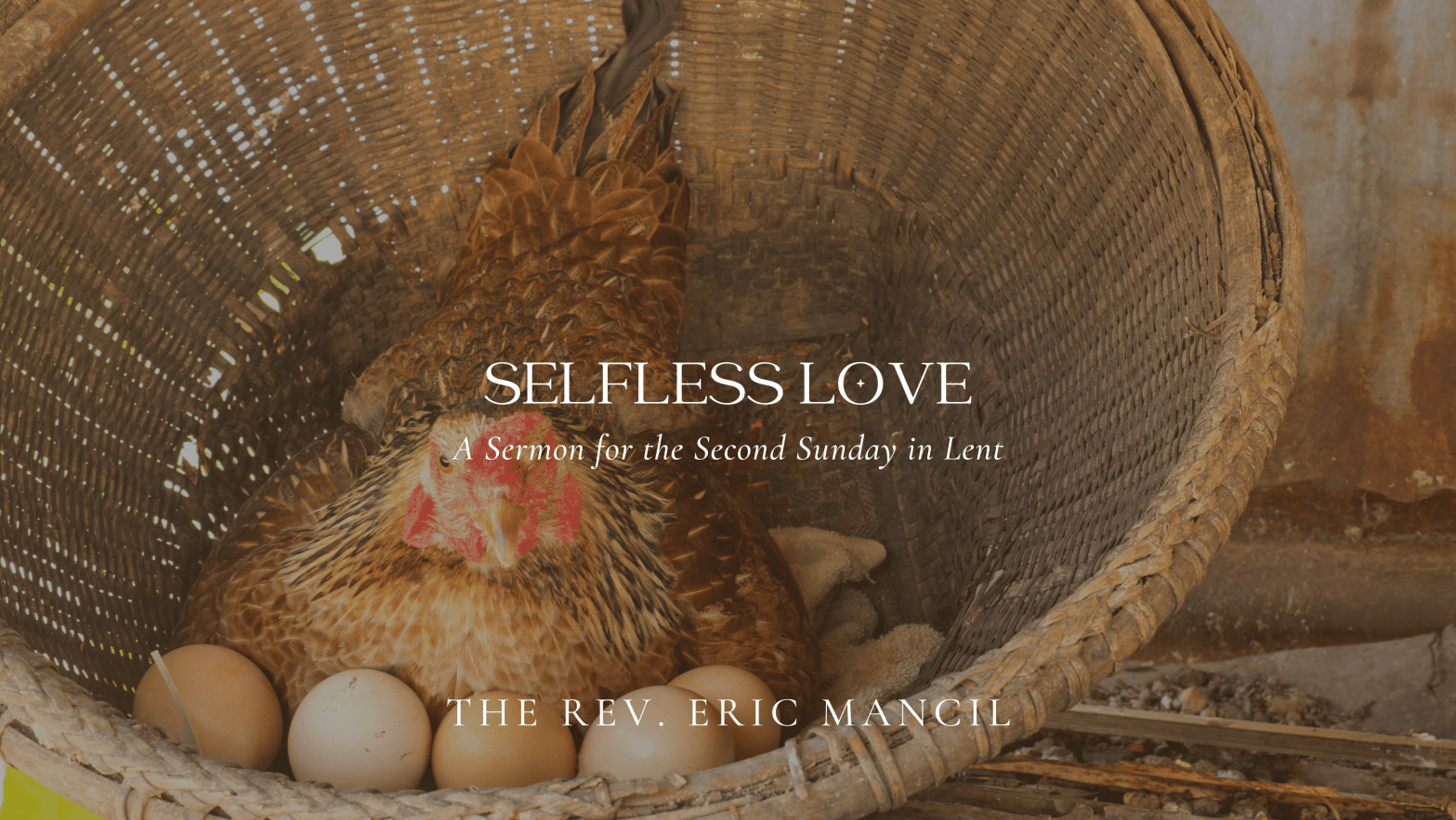
Jesus describes his love for God’s people by comparing himself to a mother hen who takes care of her brood.

Now, I’ll be honest.

I don’t know much about farming or farm animals, but I do know that hens—when they’re brooding—are fiercely protective.

They will do anything to protect their chicks from danger, even at the cost of their own safety and well-being.

In the first century, the Greek historian, Plutarch, praised the many ways that mother hens cherish and protect their chicks, lifting them up as a symbol of motherhood.

He once wrote, “…we have before our eyes every day the manner in which hens care for their brood, drooping their wings for some to creep under, and receiving with joyous and affectionate clucks others that mount upon their backs or run up to them from every direction; and though they flee from dogs and snakes if they are frightened only for themselves, if their fright is for their children, they stand their ground and fight it out beyond their strength.”

The 16th century Italian naturalist and writer, Ulisse Aldrovandi, once described how, at the first sign of a predator, mother hens will immediately gather their chicks “under the shadow of their wings, and with this covering they put up such a very fierce defense—striking fear into their opponent in the midst of a frightful clamor—using both wings and beak—they would rather die for their chicks than seek safety in flight.”

He also describes how a mother hen allows her chicks to eat their fill before satisfying her own hunger.

Thus, he said, mother hens present, in every way, “a noble example of love for their offspring.”

A mother hen provides protection and warmth and comfort for her chicks, always putting the needs and safety of her offspring before her own.

Some might describe this as the kind of love a mother has for her children.

Another word I would use to describe it is selfless.

So, I think it’s perfect that Jesus uses the image of a mother hen to describe the kind of love he feels for God’s children.

It’s the reason why he laments over the city of Jerusalem.

His selfless love for the people there—and for all of God’s children—is like the love a mother hen has for her chicks.

He would do anything to save them—including lay down his own life.

This is the depth of God’s love for each of us.

A love that will be on full display in just a few short weeks when we come to Palm Sunday and our journey through Holy Week.

A love that will lead our Savior to be nailed to a cross.

And yet, we reject God’s love every time we refuse to listen to Jesus and live our lives as he’s called us to live.

In our Gospel lesson for today, Jesus isn’t grieving over the fact that he’s going to be killed in Jerusalem.

He’s grieving for the people there who will fail to recognize him as the Lord’s Messiah and refuse to accept his message of God’s redeeming love.

As much as it pains me to say this, I think Jesus grieves for us as well.

Jesus grieves for us every time we refuse to listen to him and choose instead to follow our own, selfish ways.

Jesus grieves for us every time we refuse to forgive those who’ve hurt us or caused us harm.

Jesus grieves for us every time we see someone hungry or in need and do nothing to help.

Jesus grieves for us every time we stand idly by and allow God’s children to be oppressed or taken advantage of.

Jesus grieves.

But, Jesus also forgives and longs for us to repent and return to the Lord.

Because—like a mother hen cares for her brood—it’s only under the shadow of his wings where we’ll find true peace and joy with our God.

In order to get there—in order to find that peace and joy we seek in our lives—we have to learn to listen for his voice and answer his call to follow.

When you think about it, that’s really the purpose of this season of Lent—this special time we set aside each year to renew our relationship with God.

Sometimes, we get off track and forget how to listen for the sound of Jesus’ voice calling to us in our lives.

Sometimes, we choose to go our own way instead of following the one who came to live and die as one of us and show us the way to eternal life with God.

And so, we learn how to listen again with open minds and open hearts.

We learn how to love again as Jesus taught us to love.

And, we’re reminded, once again, that our true home is with God, under the shadow and protection of his wings.

Amen.

Christ Be With Me

A Sermon for the First Sunday in Lent (Year C)
March 9, 2025

Text: Luke 4:1-13

Now, O Lord, take my lips, and speak through them. Take our minds, and think through them. Take our hearts, and set them on fire. In the name of the Father, and of the Son, and of the Holy Spirit. Amen.

I spent the summer after my first year of seminary participating in a program called Clinical Pastoral Education, or CPE for short. Basically, it’s pastoral care boot camp for those who are training to be priests.

It’s where we go to learn how to be pastors and how to listen and care for people who may be going through difficult times in their lives.

Most of the time, it’s done in a hospital or some other kind of healthcare facility.

I was fortunate enough to do my chaplaincy work at a hospital right down the road from my seminary, not far from where my family and I were living at the time.

On my first day of CPE, I showed up to the hospital, eager and ready to learn all that I could.

There were actually two of us there from the same seminary.

We both walked into the chaplain’s office, and Pat, the director of pastoral care, began explaining some of the things we were going to be doing over the next few months and orienting us to the hospital.

As she was talking, the phone rang.

She picked it up and started talking to the person on the other end of the line.

My friends and I just sat there and waited until she was done with the phone call.

When she was done, she hung up the phone, looked at both of us and said, “Follow me.”

As we were walking, she told us we were headed to the emergency room, but she didn’t tell us anything else.

When we got there, we heard loud cries coming from one of the rooms, and when I say “room,” what I really mean is a small area separated by a curtain.

We walked over to where the cries were coming from.

They were coming from a woman who had just unexpectedly lost her husband due to a heart attack.

Pat told us to wait outside of the room and listen to what was going on.

She drew back the curtain and walked in and immediately started caring for the grieving wife.

The woman was hysterical.

She was crying and kept saying over and over again, “He wasn’t supposed to die today. He wasn’t supposed to die today.”

Pat wrapped her arms around the woman and began to comfort her, and I’ll never forget the words she said to the wife.

Softly, she said to her, “Just imagine it’s Jesus holding you.”

It was a sacred moment, and even though my friend and I were standing on the other side of the curtain, we knew that God was there.

After some time passed, Pat came out of the room, and we walked back to the chaplain’s office, where we had a conversation about what happened.

She told us that things happen like that from time to time, and when they do, it’s our job to show up and do the best we can to offer care and support.

Well, needless to say, I walked away from my first day of CPE less excited than I was when I got there.

Because, to be very honest, I didn’t think there was any way I could do what Pat did that day.

I walked away from my first day of CPE thinking, “There’s no way I can do this.”

“I don’t have what it takes.”

“I’m in way over my head, so I might as well give up now.”

But, what I eventually came to realize is that I was there for a purpose.

I was called by God to go to seminary and be formed as a priest, and part of that call meant going through hospital chaplaincy and learning how to be a pastor.

I wasn’t always going to get it right.

But, I had to trust that, if God was calling me to be a priest and pastor, then God would be with me through it all, including the hard parts.

What I also came to realize is that those thoughts of self-doubt were not from God.

They were from the tempter—the one who uses subtle lies and deception to make us doubt ourselves and think we aren’t good enough or capable enough to do what God has called us to do.

For me, hospital chaplaincy was definitely a time in the wilderness with God.

Most of the time, I really had no idea what I was doing, but I could trust that God was with me through it all, leading me and guiding me and giving me the strength that I needed.

When God calls us to do something, he doesn’t leave us to do it alone.

God empowers us and gives us strength and wisdom by the power of the Holy Spirit.

Eventually, over time, I gained confidence in my ability as a chaplain and pastor, and every time I got anxious or nervous about a situation, I had a prayer that I would pray as I walked to a patient’s room.

I kept it in a little green book of prayers that was given to me on my very first day of CPE, and It goes like this:

Christ be with me, Christ within me,
Christ behind me, Christ before me,
Christ beside me, Christ to win me,
Christ to comfort and restore me,
Christ beneath me, Christ above me,
Christ in quiet, Christ in danger,
Christ in hearts of all that love me,
Christ in mouth of friend and stranger.

Anytime I needed to be reminded of the fact that God was with me wherever I went, I would always return to that prayer.

And, even now, to this day, I return to it from time to time, and I’m reminded that God is always with me, even in those moments when it feels like I’m walking through the wilderness, unsure of where I’m going or what I’m being called to do.

Because, that’s the thing about walking through the wilderness as a follower of Jesus.

Often, we really have no idea where we’re being called to go.

But, we can trust that if we put our faith in God, we can face any challenge that may come our way.

We can trust that God will always be with us.

The reason why I wanted to share this story with you today is because it’s easy to think that the only temptations we face in our lives are external.

In other words—those things we do or say to make ourselves feel better or to satisfy some hunger we have or to fill that God-shaped hole in our hearts.

And, it’s true that sometimes they are.

Sometimes, we indulge in material things that make us feel better, at least for a short time. 

But, often they’re things that cause us to turn away from God or things that prevent us from living more fully into who God created us to be.

Sometimes, we turn to things like alcohol to dull the emotional pain we’re feeling over a loss or heartbreak or to make life a little more bearable when times are hard.

Sometimes, we lie, cheat, or steal in order to get what we want.

Sometimes, we turn to gossip or talk about other people behind their backs because it makes us feel better about ourselves.

There are lots of ways we’re tempted by external things.

But, I’m convinced that perhaps something even more destructive are those internal temptations we face—those subtle whispers or thoughts that the tempter uses to make us feel like we’re worthless.

The subtle whispers that cause us to wonder whether or not we’re worthy of God‘s love or whether or not we’re good enough or capable enough.

The tempter—whether you call him Satan or the devil or any other name—will use deception and subtle lies to make us believe these things are true.

But, I’m here to tell you today, friends, that all of these things our lies.

You are the Lord’s possession.

God has called you by name for a purpose, and he will never leave you.

God will send his Holy Spirit upon you to lead you and guide you in your life and to give you the strength and will to persevere in your walk with Christ.

That doesn’t mean it’ll always be easy.

There will be temptations along the way, but with Christ, we know that we have an advocate and guide—someone who will take us by the hand and never let go.

In our Gospel lesson for this morning from Luke, we hear the story of our Lord’s journey through the wilderness, where he was led by the Spirit and tempted by the devil for forty days.

There’s a reason why this story comes right after the story of Jesus‘s baptism.

And, I think this has a lot to do with us as well in our own lives in Christ.

To be baptized means to be set apart for a special purpose.

It means renouncing the ways of the world—the ways of sin and death—and giving our lives over to Christ and serving only him.

When we do that, we will be tested.

Our lives will be tested.

Our faith will be tested.

Our trust in God will be tested.

That doesn’t mean that God is the one testing us or waiting for us to fail in some way.

It means that every day when we wake up, we have to make the choice of whether to follow Christ or follow our own selfish ways.

We have to make the choice of whether to serve others or serve ourselves.

We have to make the choice of whether to put our trust in the Lord or to put our trust in material things.

These are the temptations we face in our lives every day. 

Some are external. Some are internal.

But, they all threaten to make us lose sight of who we are as God’s beloved.

Just as Jesus was tested in the wilderness, we also will be tested.

And, just like Jesus, we can make the choice to put our trust in God and to always remember that God will be with us no matter where we go or what we do.

If you ever need to be reminded of that, I know a great prayer you can use:

Christ be with me, Christ within me,
Christ behind me, Christ before me,
Christ beside me, Christ to win me,
Christ to comfort and restore me,
Christ beneath me, Christ above me,
Christ in quiet, Christ in danger,
Christ in hearts of all that love me,
Christ in mouth of friend and stranger.

Amen.

Sometimes, We Kneel

A Sermon for Ash Wednesday
March 5, 2025

Text: Joel 2:1-2, 12-17

Now, O Lord, take my lips, and speak through them. Take our minds, and think through them. Take our hearts, and set them on fire. In the name of the Father, and of the Son, and of the Holy Spirit. Amen.

There are so many things I love about being a priest. I love getting to walk alongside people in their journeys with Christ, to see them grow in their faith, and to remind them that God loves them more than they can possibly imagine.

I love getting to celebrate the sacraments and to share them with God’s people, those outward and visible signs of God’s inward and spiritual grace, like Baptism and Eucharist.

They remind us that God is always at work in our lives, leading us and guiding us with his Spirit and giving us the strength we need to continue our walk with Christ.

I love getting to pronounce God’s blessing over God’s people and to assure penitent sinners that they are indeed forgiven by a merciful Lord who wants nothing more than for all of us to be in right relationship with him.

But, if I’m being completely honest—and Ash Wednesday seems like a good day to do that—there are some things I miss about being a layperson.

One of the things I miss most is being able to simply sit in the presence of God in worship and not have to focus on anything but participating in the service.

Now, don’t get me wrong.

It’s an incredible blessing and privilege to be called by God to lead worship, and I try my best never to take that for granted.

Because it really is a wonderful gift to be able to serve as a priest in God’s church.

But, sometimes…I really do miss being able to just soak it all in, without any responsibility of leadership or making sure the service runs smoothly.

Sometimes, I miss the rhythm of sitting in a pew, holding my Prayer Book and hymnal, and waiting for someone else to direct the congregation on what to do next.

Sometimes, I miss being able to walk up to the altar rail during Communion and kneel alongside everyone else, waiting expectantly to receive the Body and Blood of Christ.

To me, there’s something special about being able to just worship—to simply sit in God’s presence without any other responsibilities or thoughts running through my mind.

It’s hard to explain, but I think it has something to do with getting back in touch with who I really am at the center of my being.

On those rare occasions when I do get the chance to just sit in a pew and participate in the service, I’m reminded of the fact that, first and foremost, I am a child of God—just like everybody else.

And, just like everybody else, I’m in desperate need of a Savior.

That’s the power and beauty of our worship.

It humbles us and reminds of who we are and who we were created to be as God’s beloved.

In our liturgy, in our prayers and every time we confess our sins to God, we’re reminded that, without him, we are helpless.

We feel it in our bodies every time we stand to sing God’s praises and every time we sit to hear the Word of God proclaimed in Holy Scripture.

And we feel it, especially, when we kneel.

Sometimes, we kneel to pray and confess our sins because it’s the only posture that seems appropriate.

Sometimes, we kneel, not because we’re afraid of God, but to show our love for God and express our gratitude for all the many blessings we’ve been given.

Sometimes, we kneel to receive the Body and Blood of Christ and to recommit our lives to serving only him.

And sometimes, we kneel to receive a cross of ashes on our foreheads, not because we’re worthless, but because we realize that, sometimes, we need to be reminded of our own mortality and need for repentance.

Sometimes, we need to be reminded, once again, that our lives belong to God and that we need to make amends, for things done and left undone.

That’s why we’re gathered here today as we mark the beginning of our journey through Lent.

It isn’t to beat ourselves up or to dwell on past mistakes.

It’s to be reminded of who we are and to be reconciled with God, to confess our sins and acknowledge that our only help is in the Lord our maker.

The prophet Joel put it this way in his call for repentance to the people of Israel:

“Yet even now, says the Lord, return to me with all your heart, with fasting, with weeping, and with mourning; rend your hearts and not your clothing.”

It was a practice in ancient Israel for people to mourn their sins and express their grief through outward signs like wearing ashes on their heads, wearing sackcloth, and tearing their clothes.

But, to me, what Joel is really saying in this passage is that God doesn’t care so much about outward signs if they’re not also expressing a deep, inward desire to change one’s life.

So, on this day, we come forward and kneel at the altar rail to receive a cross of ashes on our foreheads.

Not just for the sake of doing it.

And not because it’s something we’re obligated to do once a year.

We do it because we know we’ve fallen short of our call to walk in love as Christ has taught us.

We do it because, deep down, we long to be reconciled with our Father in heaven.

We receive the ashes on our foreheads because we know that God is our God, and we are his forever.

From the dust of the earth we were created, and to dust we shall return.

On this Ash Wednesday, be comforted in knowing that God loves you and cares about you in more ways than you can imagine.

But, also know that God cares deeply about the way you live your life and wants nothing more than for you to draw closer to him.

Listen once again to the prophet Joel and his call for repentance:

“Yet even now, says the Lord, return to me with all your heart, with fasting, with weeping, and with mourning; rend your hearts and not your clothing.”

Amen.

The Beatitudes

A Sermon for the Sixth Sunday after the Epiphany (Year C)
February 16, 2025

Text: Luke 6:17-26

Now, O Lord, take my lips, and speak through them. Take our minds, and think through them. Take our hearts, and set them on fire. In the name of the Father, and of the Son, and of the Holy Spirit. Amen.

I want to share with you a story this morning. Some of you have probably heard it before, especially if you’ve been a part of the Episcopal Church for a while.

It begins many years ago—in April of 1965—when a an Episcopal seminarian published an article about his journey south into the Black Belt after responding to Martin Luther King, Jr.’s televised appeal for clergy across the country to come to Selma, Alabama, to help secure the right to vote for all citizens.

In his article, the seminarian described in painful detail the types of atrocities that he and other civil rights activists witnessed during their times in Selma—acts of violence and oppression that good people endured simply because of the color of their skin.

During his time in Selma, the seminarian encountered racism and bigotry at its worst, even from parishioners and clergy at the local Episcopal church.

At the end of his article, the seminarian wrote, “Our life in Selma is filled with ambiguity, and in that we share with men everywhere.”

“We are beginning to see as we never saw before that we are truly in the world and yet ultimately not of it.”

“For through the bramble bush of doubt and fear and supposed success we are groping our way to the realization that above all else, we are called to be saints.”

“That is the mission of the Church everywhere.”

“And in this Selma, Alabama, is like all the world: it needs the life and witness of militant saints.”

The seminarian’s name was Jonathan Myrick Daniels, whom we commemorate in the calendar of the Episcopal Church every year on August 14th.

Nearly four months after his article came out, Jonathan and a few of his companions were arrested in Fort Deposit, Alabama, for joining a picket line and transported to the jail in nearby Hayneville.

Six days later, they were unexpectedly released.

They walked around the corner to a small store near the jail and upon entering were confronted by a man named Thomas Coleman, who was armed with a twelve-gauge shotgun.

He cursed them and threatened to kill them if they didn’t leave the store.

Jonathan immediately pulled seventeen-year old Ruby Sales, an African American girl, to one side in order to protect her.

Coleman fired, and Jonathan was shot in the chest and killed instantly.

On October 1st, less than two months after Jonathan’s murder, Thomas Coleman was found not guilty by an all-white jury after only two hours of deliberation.

Although he was only twenty-six years old when he died, Jonathan’s work and his commitment to the Gospel of Jesus continues to inspire new generations to work for justice and peace.

Every year in Hayneville, on the second Saturday in August, pilgrims from across the southeast and from other parts of the country gather to hear Jonathan’s story and honor the sacrifice he made.

Several years ago, I had the opportunity to attend the Jonathan Daniels pilgrimage for the first time.

We began on the front lawn of the Lowndes County Courthouse.

We formed a long procession, walking in the August heat from the courthouse to the former site of the Lowndes County Jail where Jonathan and his friends were imprisoned.

Then, we walked around the corner to the site where Jonathan was killed.

And all of a sudden, the signs that were carried in procession came into full focus—large, black and white photographs of Jonathan and all the martyrs of Alabama who were killed during the struggle for civil rights.

One by one, pilgrims took their turn kneeling on the steps and touching the storefront porch where Jonathan gave his life, offering silent prayers.

The procession ended back at the courthouse, where we celebrated the Eucharist in the same courtroom where Thomas Coleman was acquitted for Jonathan’s murder.

The judge’s bench, which is still used today, became an altar, and together, we shared the Body and Blood of Christ and recommitted ourselves to the work that God has given us to do.

“To be truly in the world,” as Jonathan once wrote, “but ultimately not of it.”

Looking back on my experience in Hayneville, it was one of those grace-filled moments when I was reminded of the fact that our lives are not really our own—that we’re part of a story that began long ago and one that will continue until God’s Kingdom is fulfilled.

Seeing the photographs in the procession…

Hearing the stories along the way…

Sharing the sacrament in the courtroom…

It was like being surrounded by the saints in light—that great cloud of witnesses that continues to inspire us and teach us about what it means to love as Christ loved.

That’s the legacy of Jonathan Daniels and all the martyrs of the faith who’ve given their lives as an example of God’s love.

It’s a legacy of compassion and mercy, of sacrifice and reconciliation.

Jonathan’s story serves as a reminder to all of us that this Christian life to which we’re called won’t always be easy.

Sometimes, it’ll challenge us to come out of our comfort zones and draw us to places we never expected to go.

Sometimes, it’ll compel us to stand up and speak out in order to protect those who have no voice or power for themselves.

It’s a life that calls us to work for justice and peace among all people and to respect the dignity of every human being.

A life that calls us to help tear down those systems of injustice and oppression in the world that threaten to weigh down and destroy the children of God.

This is painful, difficult work, my friends, but it’s work that must be done—work that Jesus calls us to do in our own time and place.

In the words of Blessed Jonathan, we are called to be saints on earth, which means fully living into the vows and promises of our Baptism.


Pope Francis once said that the best description of a saint, their “identity card” as he put it, is found in the Beatitudes, which we heard earlier this morning from Luke’s Gospel.

In our Gospel lesson, we learn that Jesus came down to a level place to be with his disciples and a large crowd of people from Judea, Jerusalem, and the coast of Tyre and Sidon who had come to hear him preach and be cured from their diseases.

After all of them were healed, Jesus looked up at his disciples and said…

“Blessed are you who are poor,
for yours is the kingdom of God.

“Blessed are you who are hungry now,
for you will be filled.

“Blessed are you who weep now,
for you will laugh.

“Blessed are you when people hate you, and when they exclude you, revile you, and defame you on account of the Son of Man. Rejoice in that day and leap for joy, for surely your reward is great in heaven; for that is what their ancestors did to the prophets.”

“But woe to you who are rich,
for you have received your consolation.

“Woe to you who are full now,
for you will be hungry.

“Woe to you who are laughing now,
for you will mourn and weep.

“Woe to you when all speak well of you, for that is what their ancestors did to the false prophets.”

A lot of people, when they read the Beatitudes, think that it’s a list of commandments.

In other words, they read the line, “Blessed are you who are poor,” and think that Jesus wants them to go out and give away everything they own.

Or, they read the line, “Woe to you who are rich,” and think that Jesus must be condemning wealthy people.

But, that’s not what Jesus is doing here.

The Beatitudes—whether we’re reading Matthew’s version or Luke’s version—aren’t a list of commandments.

They’re a call to action.

They’re Jesus’ way of saying to his disciples that, when God’s Kingdom is finally fulfilled, the world as we know it will be turned upside down.

There will be no more poverty, no more starving people in the world.

Sadness and despair will give way to joy and peace among all people.

Enemies will become friends.

And people everywhere will finally realize and understand that the only thing that will save us is God’s redeeming love.

When we read the Beatitudes faithfully, as Christians, we come to understand that they’re not requirements for getting into heaven.

They’re God’s vision of heaven on earth.

And, it’s our job as followers of Jesus, to help make it a reality, now and in the life of the world to come.


So, in the spirit of the Beatitudes and thinking about the saints and martyrs of the faith who’ve come before us, like Jonathan Daniels, I want to offer my own list of blessings and woes—things we might consider as we seek to be faithful in our own time and place.

Blessed are the poor—Not just financially but also spiritually.

Those who rely on food stamps and other programs to help make ends meet.

Those who struggle to pay their utility bills each month.

Those who are embarrassed to have to ask for help.

Those who have no warm place to lay their head each night.

Those who feel like a failure in life.

For theirs is the kingdom of God.

Blessed are the hungry—

Those who wonder where their next meal will come from.

Those who worry about whether or not they’ll have enough to provide for their children.

Those who have to rely on churches and other groups for a hot meal.

Those who anxiously watch the price of groceries go up each month.

For they will be filled.

Blessed are those who weep now—

Not just for themselves but also for the state of the world.

Those who mourn the loss of loved ones.

Those who are lonely, anxious, or afraid.

Those who live in war-torn countries around the world.

Those who seek refuge from violence, oppression, and discrimination.

Those who have lost their jobs and source of income.

Those who simply want to be treated with dignity and respect.

For they will laugh.

Blessed are those who are hated, excluded, reviled, and defamed—

Those who are treated as unwanted and unlovable.

Those who are told they need to “go back to where they belong.”

Those who are turned away because of the color of their skin.

Those who are made to feel they are “less than” and unworthy.

For they will rejoice.

But woe to those who are rich—

Not only financially but also in power and authority.

Those who do nothing with what they’ve been given to help anyone but themselves.

Those who see people hurting and do nothing to help ease their pain.

Those who use their wealth to manipulate and control others.

For they have received their consolation.

Woe to those who are full now—

Those who have plenty to live on but are unwilling to share.

Those who live comfortably but are unwilling help someone in need.

For they will be hungry.

Woe to those who are laughing now—

Those who are so consumed with their own lives that they fail to see the suffering around them.

Those who take for granted the many gifts they’ve been given.

Those who think they have no responsibility to help anyone else but themselves.

For they will mourn and weep.

Woe to those who are greatly loved and admired—

Those who are in positions of power but don’t use their influence to help others.

Those who are only concerned with maintaining their own reputation and status in society.

Those who use their Christian faith as a way to boost their own power and popularity.

For they have received their reward.

The Beatitudes aren’t just something Jesus intended for a group of disciples two thousand years ago.

They aren’t something we’re meant to read and think to ourselves, “Oh, that’s nice, but it doesn’t really apply to us.”

They are words for us to live by.

Because all of us are called by God to be saints.

And that call comes with a heavy weight and responsibility to refuse to accept the idea that things are the way they are and will never change.

We are called to be a source of light and hope for the world.

To help make God’s vision of heaven on earth a reality.

To show others—through our words and actions—that there’s a better and more loving way to live.

Amen.

Called by God

A Sermon for the Fifth Sunday after the Epiphany (Year C)
February 9, 2025

Text: Luke 5:1-11

Now, O Lord, take my lips, and speak through them. Take our minds, and think through them. Take our hearts, and set them on fire. In the name of the Father, and of the Son, and of the Holy Spirit. Amen.

When I was a teenager, I never dreamed that I would one day be a priest in the Episcopal Church.

As a matter of fact, I didn’t even know what the word “Episcopal” meant until I was a junior in college.

I went to school to study music education with the hope that, one day, I would get a great job teaching music to high school students and enjoy a long career as a choir director.

When I made the decision to study music in college, I felt sure that it was the right path for me to take.

Music had been such an important part of my life in junior high and high school, and being a choir director was something I knew I could do really well, something I knew I would enjoy doing.

So, I worked hard and eventually graduated with a bachelor’s degree in music education.

I began teaching at a high school in Savannah, Georgia, and for the most part, it was wonderful!

After years of hard work, I was finally getting the chance to do the work that I felt called to do.

But, something happened during my first year of teaching—something I never saw coming.

It was almost like a light switch was turned on.

I started asking myself questions like, “Is this really what God wants me to do with my life?”

“Am I really being called to be a music teacher? Or, is there something else I should be doing?”

“What if God is calling me to be a priest?”

“A priest! How ridiculous!” I thought.

“I’m still a brand new Episcopalian! I’ve only been confirmed for about a year.”

“Who do I think I am? There’s no way that God could be calling me to be a priest!”

So, I quickly dismissed the idea and continued on with my career as a teacher, but those thoughts and those questions never completely went away.

About two years later, I was teaching music at a different school, and I was finally able to talk with someone about these thoughts and feelings I’d been having about the priesthood.

I was finally able to say the words out loud.

“I think God may be calling me to be a priest.”

I can honestly say that I’ve never experienced such a weight lifted from my shoulders as I did in that moment.

It felt as if I was finally able to pass through this door that God had prepared especially for me, a door that God was waiting for me to walk through.

It wasn’t that I was unhappy as a teacher.

I could’ve kept teaching for the rest of my life and been perfectly fine.

But, I always would’ve felt this lingering sense that something was missing.

They say that when God calls someone to a particular ministry, that call doesn’t just go away. God is persistent.

And, for me, what started as a gentle nudge from God eventually turned into a calling that I could no longer ignore.

I wanted to share this with you today because the truth of the matter is that all of us—not just me or anyone else who wears a collar—all of us are called by God to serve in some way.

And, I think all of us—at least at some point in our lives—have questioned whether or not God could actually use us in ministry.

Because, let’s be honest.

Most of us are really good at doubting our own self-worth.

We’re really good at putting ourselves down and coming up with reasons why we shouldn’t do something we feel called to do.

We have this internal voice that tries to convince us of things like, “You’re not good enough.” Or, “You’re not smart enough.” Or, “You have no business serving anyone else when you can’t even get your own life together.”

“What makes you think God can use you?”

Does any of that sound familiar?

We’ve all struggled with these thoughts.

And, I’m here to tell you, dear friends, that it’s all a lie.

God can use you, just as you are.

You are enough, despite what the world or anyone else may try to tell you.

God is calling you by name to love and serve others in the name of Jesus Christ.


In our Gospel lesson this morning from Luke, we hear the story of Jesus calling his first disciples, which happens not long after a series of healings in Galilee, including the healing of Simon Peter’s mother-in-law.

Jesus is standing near the lake of Gennesaret, which was another name for the Sea of Galilee, when a crowd starts to gather around him to hear his teaching.

The crowd gets so large that the people start to press in on Jesus.

So, he decides to get into one of the fishing boats he sees on the shore, the one belonging to Simon Peter.

And, he asks Simon to push the boat out a little from the shore.

Then, he sits down in the boat and begins to teach.

When he’s done teaching, he tells Simon to take the boat further out into the lake where it’s deeper and to let his nets down into the water for a catch.

Simon and the other fishermen are tired from working all night long and not catching anything.

So, he thinks it’s pointless to try and catch anything at this point.

But, he tells Jesus, “If you say so, I will let down the nets.”

So, he puts the nets down into the water, and when he draws them back up again, they’re filled with so many fish that the nets start to break.

He calls the fishermen in the other boat to come and help, and by the time they’re done, both boats are loaded down with so many fish that they start to sink.

Simon Peter is so amazed by what he’s witnessed—so overwhelmed with emotion—that he falls down on his knees and says to Jesus, “Go away from me, Lord, for I am a sinful man!”

It’s his way of saying to Jesus, “I’m not worthy.”

“I’m not good enough to stand in your presence.”

I like to imagine that, in that moment, Jesus stopped what he was doing and smiled at Simon Peter and thought to himself…

“If you could only see yourself as God sees you, Simon.”

“Then, you might start to understand that you are worthy of God’s love and compassion and that you’re so much more than your worst mistakes and failures.”

“You are God’s beloved, and God has called you for a special purpose.”

Jesus tells Simon Peter, “Do not be afraid; from now on you will be catching people.”

And, as soon as they return to shore, Simon, along with James and John, drop everything they own and follow Jesus.


Unfortunately, we don’t have Jesus standing right in front of us, pointing us in the direction we’re meant to walk.

In our own lives, the call to follow Jesus isn’t always so easy to hear.

Sometimes, we don’t know what it is that God is calling us to do with our lives.

And so we pray and try to listen for God’s voice, and we rely on each other to help guide us and keep us on track.

In the church, we have a special name for this process of exploring our call.

We call it discernment.

It’s a way of being open to the movement of the Holy Spirit in our lives, without any agenda or selfish ambition.

It’s a way of being honest with ourselves and open to where God is leading us to go.

Through that process, we ask ourselves questions, like “What are the gifts God has given me?”

“What talents do I have?”

“Where am I needed the most?”

And, we do a bit of holy imagining, wondering and dreaming about the possibilities of how God might be calling us to use those gifts and talents we’ve been given to help others.

Frederick Buechner, the Christian writer and theologian, once wrote that “Vocation (or our calling) is the place where our deep gladness meets the world’s deep need.”

I’ve always loved that definition.

And, I think it’s a helpful way of thinking about the process of discerning one’s call.

Of course, when you finally get to the point where you start to feel that nudge or that tug on your heart to serve in some way—when you start to feel God’s call—then comes the hard part.

Saying “yes.”

Because when we say “yes” to God—when we say, “Here I am, Lord, send me,” it often means we have to give up something else in return.

Like the first disciples did when they left everything behind to follow Jesus.

But, we can trust that when we do say “yes” to God’s call, God will be with us every step of the way.

The process of discernment is a spiritual discipline, and it’s an important part of our Christian faith.

Because every single one of us, by virtue of our baptism in Christ, has been called to a life of ministry and service.

Despite our shortcomings and mistakes, despite our self-doubt and fear of the unknown, God can use all of us as instruments of his love and mercy in the world.

God can use you, just as you are.

You are enough, despite what the world or anyone else may try to tell you.

God is calling you by name to love and serve others in the name of Jesus Christ.

All you have to do is say “yes.”

Amen.

Stick to the Script

A Sermon for the Feast of the Presentation
Sunday, February 2, 2025

Text: Luke 2:22-40

Now, O Lord, take my lips, and speak through them. Take our minds, and think through them. Take our hearts, and set them on fire. In the name of the Father, and of the Son, and of the Holy Spirit. Amen.

A couple of weeks ago, I came across a video that was posted on YouTube several years ago, featuring the popular songwriter and jazz musician, Jon Batiste.

The video was from a commencement address he delivered in May of 2017 at Salve Regina University in Newport, Rhode Island.

During his address, he shared a story with the audience—one that he had never shared before—about a time when his band started venturing out and playing at venues that were out of the ordinary.

They were used to playing in jazz clubs and music halls for people who were already huge fans of their music, and they wanted to reach out and introduce other audiences to it.

So, they started playing in different kinds of places like hip hop clubs and opening for rap artists.

As Jon describes it in the video, there was this one time they were playing in a new venue, and before the band even played their first note, the audience started booing and telling them to get off the stage and go home.

The band didn’t know what to do.

They started questioning themselves, wondering whether or not they needed to change what they were planning to do.

So, on the fly and without even rehearsing it first, they started to play a completely different set of music.

About five minutes in, Jon made a decision.

In his own words, he decided they were going to “stick to the script.”

And, they started playing the music they had always played, even through all the “boos.”

When the audience started booing louder, the band got louder, and they kept going back and forth until finally, one of the band members—who was playing the tambourine—accidentally knocked over one of the microphones.

There was feedback from the mic hitting the floor, and for the first time in twenty minutes, there was complete silence.

Everyone in the audience started looking around at each other, and then slowly, they all started clapping for the band.

And, in that moment, at a small dive bar in Philadelphia, Jon realized something very important.

In his speech, he looked directly at the graduating class and told them, “Don’t change who you are to fit the circumstances around you.”

Because at some point in your lives you’re going to be in a situation where the people around you don’t share your values.

When that happens, it’ll test your character, but on the other side of that test, you’ll become even stronger in your values and more confident in who you are.

I think there’s great wisdom in Jon’s speech.

And, over the last couple of weeks, I’ve been thinking a lot about what he said and how that applies to our Christian faith and life.

I’ve been thinking a lot lately about our identity as Christians.

In other words, “Who do we say we are as followers of Jesus, and what are the values we hold dear?”

I think these are really important questions to be asking ourselves right now.

Because, dear friends, we seem to be living in a time when people are questioning—perhaps more than ever before—what it means to be a Christian in the world.

And, there are a lot of people right now who seem to think they have all the answers figured out and that the only way to be a true Christian is to think and believe the same way they do.

Unfortunately, I think a lot of it has to do with the current political climate in our country.

People are more divided than ever.

We see it all around us—in the news, on social media, and even in the Church.

There are some who insist that the only way to be a faithful Christian is if you support a certain political party or vote for a particular candidate.

Our identity as Christians—who we say we are and what we believe—is being tested, and it’s up to us to decide how we’re going to respond.

Do we change who we are to fit the circumstances around us?

Or, do we “stick to the script” and remain faithful to who God is calling us to be as followers of Jesus?


Today is a special feast day in the life of the Church.

In the Prayer Book, it’s called “The Presentation of our Lord Jesus Christ in the Temple.” Or, you could just call it “The Feast of the Presentation.”

On this day, we remember the story from Luke’s Gospel about how Mary and Joseph brought the infant Jesus to the temple in Jerusalem to be presented before the Lord.

Jesus was Mary and Joseph’s first-born son, and so, it was expected that they would bring the baby to the temple to be presented, in accordance with Jewish law.

This was also the time when Mary would go through ritual of purification after giving birth to Jesus, which was also a requirement of the law.

The author of Luke’s Gospel tells us that there was a man in Jerusalem at the time named Simeon, who was a devout follower of God and who had great hope that God would one day redeem Israel by sending his Messiah to save them all.

Luke also tells us that it had been revealed to Simeon by the Holy Spirit that, because of his great faith in God, he would not die before first seeing the Lord’s Messiah.

When Mary and Joseph enter the temple with the infant Jesus, Simeon is already there. 

He walks over to the Holy Family and takes the baby into his arms.

In that moment, Simeon knows that God has fulfilled his promise, and he begins praising God, saying:

Master, now you are dismissing your servant in peace,
according to your word;

for my eyes have seen your salvation,
which you have prepared in the presence of all peoples,

a light for revelation to the Gentiles
and for glory to your people Israel.

If these words sound familiar to you it’s because we use them often in the Episcopal Church, especially in our services of Evening Prayer and Compline.

And, we prayed them earlier this morning at the beginning of the service.

These words are commonly known as “The Song of Simeon” or Nunc dimittis.

And, they speak of God’s great love and mercy for the whole world.

Simeon recognized the infant Jesus for who he truly was—

The long-awaited Messiah, the Anointed One, who will bring redemption and peace—not only to Israel—but to every nation and corner of the world.

He’ll be the One who, in the words of the Prophet Isaiah, will bring good news to the poor.

The One who will proclaim release to the captives and recovery of sight to the blind.

The One who will let the oppressed go free and proclaim the year of the Lord’s favor.

This Jesus—the only-begotten Son of God, who was born among us and who came to live and die as one of us—will be the One who saves us all.

Through his life and ministry, through his glorious death and resurrection, we who proclaim Jesus as our Lord and Savior have come to know who God is and what God has called us to do in our lives.


So, back to my questions from earlier about who we are as Christians.

It’s really quite simple.

We’re a people who not only invite Jesus into our hearts but also a people who strive to live in Christ.

In every thought, in every word, and action, we are called to make the love of God in Christ Jesus known to the world.

That’s who we are.

That’s our identity.

It’s not some political party or who we voted for in the last election.

It’s Jesus.

And, if we can be committed to holding on to that ideal—and not allowing outside influences to convince us otherwise, then maybe there’s a chance that we can make a real difference in the world around us.

Maybe there’s a chance that our church can be a symbol of unity, drawing people together rather than tearing people apart.

Maybe we can be a sign of hope for the world that all is not lost—that there’s still a place for mutual love and respect for each other, despite our differences.

I want to circle back to Jon Batiste for a moment and leave you with one final thought.

At the end of his commencement address, he encouraged the graduates to take some time to think about their purpose in life.

And, he left them with an exercise to do after graduation.

He told them, “After you leave here, take a piece of paper. Write down at the top, ‘This is who I am.’ And, then just start listing things.”

He told them it didn’t matter how different they were. Just start listing.

And, then start to think about how all of those things are connected.

He said, “That’s your integrity. When you make those connections, that’s who you are in its rawest sense.”

Then, he told them to take another sheet of paper and to write at the top, “These are my prayers. And think about who, what, and how you want to serve other people with that first list.”

If we were to take Jon’s advice and do this exercise on our own—as individuals, we would all have different lists because God has given each of us different gifts and talents and called us to serve in different ways.

But, in our shared life together as a church, we have one list.

One list of vows and responsibilities that unite as one Body in Christ, despite our differences.

One list that reminds us from time to time of who we are as Christians and what we’re called to.

One list of values that we all believe in, that shape who we are as a community of faith.

It’s called the Baptismal Covenant.

As Episcopalians, it’s our way of expressing our love for God and our commitment to follow Christ in all that we say and do.

And, I’m thankful for it.

I’m thankful that we belong to a church that recognizes the fact that we don’t all have to agree on everything in order to belong, that there’s a place for everyone at God’s Table.

And we really mean everyone.

I’m thankful that we belong to a church that not only preaches a message of God’s love and radical hospitality but that we also live it out in the ways we seek to love and serve Christ in all persons.

As I mentioned in the newsletter this past week, we belong to a church that makes room for seekers and skeptics alike, recognizing that the journey of faith is a life-long journey, one with hills and valleys, and that it’s okay to have questions and even doubts.

This is a church where you don’t have to have all the answers figured out.

(In fact, we prefer that you don’t.)

But know this.

As you wrestle with the hard questions and as you seek to discover more about what it means to be a Christian and how to follow Jesus in his way of love, you’ll have a community who will walk with you and support you every step of the way. Thanks be to God.

Amen.

Beloved

A Sermon for the First Sunday after the Epiphany: The Baptism of our Lord
January 12, 2025

Text: Luke 3:15-17, 21-22

Now, O Lord, take my lips, and speak through them. Take our minds, and think through them. Take our hearts, and set them on fire. In the name of the Father, and of the Son, and of the Holy Spirit. Amen.

Many years ago, as I was discerning my call to the priesthood, I started to read a lot of books by different spiritual writers, mostly having to do with theology and what it means to be a priest in the Episcopal Church.

For me, one of the most influential writers was Archbishop Desmond Tutu.

Sadly, the archbishop passed away about three years ago at the age of ninety at his home in Cape Town, but his legacy continues on.

As many of you probably know, Desmond Tutu was an instrumental figure in the struggle to tear down the system of legalized racism in South Africa, known as apartheid, which finally came to an end in the early 1990s.

He was also an advocate for peaceful reconciliation in the years that followed.

Under the leadership of Nelson Mandela, Archbishop Tutu served as the chairman of the Truth and Reconciliation Commission, which was established in order to bring healing to the country and offer a way forward.

He was committed to the idea of restorative justice and believed that the only path to true peace and reconciliation—after decades of violence and oppression under apartheid—was by seeking the truth and offering forgiveness to those who were responsible.

Even though he’s no longer with us, I’m so thankful for the life and ministry of Desmond Tutu and for all he taught us about how to love others and offer mercy in the name of Jesus Christ.

Our former Presiding Bishop, Michael Curry, offered these words shortly after his death: “While on this earth, he sought to follow Jesus of Nazareth in God’s way of love and life. In so doing, he showed us how to live God’s dream as children of the one God and creator of all. So, even in our sorrow that he is no longer walking among us, we can thank God that he did.”

I’ll always remember Desmond Tutu as the first person who taught me, through his writing, that all of us—no matter who we are or what we’ve done or left undone—are completely and unconditionally loved by the God who created us.

We were loved into being and formed in the image and likeness of God.

In his book, Made for Goodness—which he co-authored with his daughter—the archbishop wrote, “From the time before eternity our God has awaited each birth with love and delight.”

“‘Before I formed you in the womb I knew you’ is the word of God to the Hebrew prophet Jeremiah. It is equally God’s word to each of us.”

“Before the ‘Let there be…’ of creation, before God breathed Adam’s first breath, God knew us and God loved us.”

“God loves each of us as though there were no one else in the world, as though there were only one person to love.”

“We are so precious to God that, as Jesus reminds us in the pages of Matthew’s Gospel, ‘even the hairs of your head are all counted.’”

It’s almost unimaginable, isn’t it, that God loves us so perfectly and so completely, without reservation or condition.

Our whole lives, we’ve been taught that, in order to succeed in life and be loved by others, we have to earn it.

We have to do certain things or behave a certain way or change our appearance in order to be loved and accepted by those around us.

But, not with God.

We are God’s beloved, God’s possession—loved from before time and forevermore.

In our lesson this morning from Isaiah, the prophet writes, “Thus says the Lord, he who created you, O Jacob, he who formed you, O Israel: Do not fear, for I have redeemed you; I have called you by name, you are mine.”

In other words, dear friends, God has claimed each of us as his own, and there’s nothing we can do or say that will ever change that.

Today is the First Sunday after the Epiphany, the day when we celebrate the Baptism of our Lord.

On this day, we recall the story of our Lord’s baptism at the River Jordan by John the Baptist.

It’s important that we take time to remember this part of Jesus’ life.

Not only does it signal the beginning of his public ministry, but I think it also helps us better understand the significance of baptism in our own lives and the role it plays in our journey with Christ.

In today’s Gospel reading, soon after Jesus receives the baptism of John, the heavens are opened and the Holy Spirit descends upon him in the form of a dove.

Then, Jesus hears a voice from heaven say to him, “You are my Son, the Beloved; with you I am well pleased.”

One way you could read this part of the lesson is that the voice from heaven is God’s response to what Jesus does when he goes to John for baptism.

After all, the voice from heaven doesn’t call out to Jesus until after he’s baptized.

But, I don’t read it that way.

I don’t see this passage as a response from God, as if God’s love for Jesus somehow depends upon whether or not he’s baptized.

I see it as an acknowledgement—a declaration from heaven—claiming Jesus as God’s own.

I see it as God’s way of saying to Jesus, “I’ve known you and loved you since before time, and I’ll continue to know you and love you forever.”

Jesus’ baptism is an acknowledgement of something that began long before he ever made the choice to be baptized.

We often think of Baptism as something we do in the Church that changes us in some way, and I think that’s true. Baptism is the sacrament of new birth.

In the water of Baptism, we are buried with Christ in his death. By it, we share in his resurrection. Through it, we are reborn by the Holy Spirit.

We are changed in the sense that the old way of sin and death has passed away and a new creation has been raised up.

But, in another sense, we’re the same as we always have been.

Since before time, we were known and loved by God.

Baptism is a way for us to acknowledge our belovedness and make the choice to live more fully into who God created us to be as God’s children.

This is why the liturgy for Baptism includes a series of questions and answers for those who are choosing to be baptized and why we join with them in renewing our own baptismal vows.

The vows and promises we make in baptism help guide us and keep us on track.

They remind us of who we are as the beloved of God.

They remind us, in the words of Desmond Tutu, that we were “made for goodness.”

In just a few moments, we’ll take some time to renew the solemn vows and promises of Holy Baptism.

As you say the words, think about that voice from heaven who spoke to Jesus, saying, “You are my Son, the Beloved; with you I am well pleased.”

That same voice continues to speak to each of us, calling us by name into a deeper and more meaningful relationship with God.

I’d like to close by sharing with you some final words from Desmond Tutu.

These words come from the last two pages of his book, Made for Goodness, and are written from the perspective of God, speaking to his beloved—

You are my child,
My beloved.
With you I am well pleased.
Stand beside me and see yourself,
Borrow my eyes so you can see perfectly.
When you look with my eyes then you will see
That the wrong you have done and the good left undone,
The words you have said that should not have been spoken,
The words you should have spoken but left unsaid,
The hurts you have caused,
The help you’ve not given
Are not the whole of the story of you.
You are not defined by what you did not achieve.
Your worth is not determined by success.
You were priceless before you drew your first breath,
Beautiful before dress or artifice,
Good at the core.

And now is time for unveiling
The goodness that is hidden behind the fear of failing.
You shout down your impulse to kindness in case it is shunned,
You suck in your smile,
You smother your laughter,
You hold back the hand that would help.
You crush your indignation
When you see people wronged or in pain
In case all you can do is not enough,
In case you cannot fix the fault,
In case you cannot soothe the searing,
In case you cannot make it right.
What does it matter if you do not make it right?
What does it matter if your efforts move no mountains?
It matters not at all.
It only matters that you live the truth of you.
It only matters that you push back the veil to let your goodness shine through.
It only matters that you live as I have made you.
It only matters that you are made for me,
Made like me,
Made for goodness.

Amen.

That’s What Christmas is All About, Charlie Brown

A Sermon for the Nativity of our Lord Jesus Christ
Tuesday, December 24, 2024

Text: Luke 2:1-20

Now, O Lord, take my lips, and speak through them. Take our minds, and think through them. Take our hearts, and set them on fire. In the name of the Father, and of the Son, and of the Holy Spirit. Amen.

This time of the year reminds me of my childhood. It reminds me of all the wonderful memories that I have from seasons long past and from growing up in a warm and loving family during the holidays.

It always brings me back to a time in my life when I looked forward to so many exciting things during the days and weeks leading up to Christmas, and now, as a father, I’m thankful that I get to share those same joys with my own children each year.

Things like decorating the Christmas tree with beautiful lights and ornaments, putting up Christmas decorations around the house, and getting to watch all of my favorite, must-see Christmas specials and movies on television.

In our family, we like to play a little game each year around Christmas time where we go around the dinner table and tell each other what our favorite Christmas movie is.

And, every year, when it’s my turn to answer, everyone already knows what I’m going to say. “My favorite Christmas movie has to be A Charlie Brown Christmas.”

Now, I know it’s technically not a movie. It has a total run-time of about twenty-five minutes. But, it’s my answer, and I’m sticking to it.

To me, it just isn’t Christmas until I hear those beautiful, jazz arrangements of some of my favorite Christmas songs and watch the story unfold as Charlie Brown seeks to discover the true meaning of Christmas while he and his friends work to prepare for the local Christmas play.

A Charlie Brown Christmas premiered on December 9, 1965, and it was the first animated special featuring characters from the Peanuts comic strip.

It’ll celebrate its sixtieth anniversary next December, and it continues to be a meaningful tradition during the holidays for so many people.

At the beginning of the story, Charlie Brown tells his friends that he’s sad and depressed and that he just doesn’t understand the meaning of Christmas.

He knows that the expectation for Christmastime is joy and happiness, but he also knows that there has to be something more to Christmas than fancy decorations and extravagant gifts, the things in which all of his friends—including his pal, Snoopy—are most excited about.

Charlie Brown’s friends just don’t understand why he’s so upset.

At one point, his best friend Linus says to him, “Charlie Brown, of all the Charlie Browns in the world, you are the ‘Charlie Browniest’.”

Later in the story, Charlie Brown and Linus are assigned the important task of finding the perfect Christmas tree for the Christmas play.

When they arrive at the Christmas tree lot, they’re overwhelmed with a multitude of bright and colorful choices, but ultimately, Charlie Brown chooses a sad, little evergreen with only a few needles hanging from the branches.

Linus says to him, “I don’t know, Charlie Brown. It doesn’t seem to fit the modern spirit.”

Charlie Brown replies, “We’ll decorate it, and it will be just right for our Christmas play. Besides, I think it needs me.”

When Charlie Brown and Linus return to the auditorium to show their friends the new Christmas tree, Charlie Brown is teased and called names for choosing the sad, little tree.

Instead of choosing the biggest and brightest tree, he chose the smallest and most vulnerable, the tree that nobody else wanted, the one that needed the most care.

In that moment, after being teased by his friends, Charlie Brown is ready to give up on Christmas altogether. He says, “Everything I do turns into a disaster. I guess I really don’t know what Christmas is all about.”

Then, he asks, “Isn’t there anyone who knows what Christmas is all about?”

And, this is when it gets really good.

Standing beside him, his friend, Linus, replies, “Sure, Charlie Brown. I can tell you what Christmas is all about.”

Linus walks to the center of the stage, holding his trusty blanket.

The lights in the auditorium dim, and under a single spotlight, he recites a portion of the Nativity story from the Gospel according to Luke, the same Gospel lesson we heard just a few moments ago.

Quoting from the King James version of the Bible, Linus says…

“And there were in the same country shepherds abiding in the field, keeping watch over their flock by night. And, lo, the angel of the Lord came upon them, and the glory of the Lord shone round about them: and they were sore afraid. And the angel said unto them, ‘Fear not: for, behold, I bring you good tidings of great joy, which shall be to all people. For unto you is born this day in the city of David a Saviour, which is Christ the Lord. And this shall be a sign unto you; Ye shall find the babe wrapped in swaddling clothes, lying in a manger.’ And suddenly there was with the angel a multitude of the heavenly host praising God, and saying, Glory to God in the highest, and on earth peace, good will toward men.”

It’s my favorite part of the whole thing.

If you watch this scene closely, you’ll notice that Linus does something unexpected.

When he says the words, “Fear not,” he drops his blanket to the ground.

Then, after the monologue is over, Linus picks up his blanket, walks back over to his friend, and says, “That’s what Christmas is all about, Charlie Brown.”

I love the symbolism of Linus dropping his blanket in the middle of the monologue.

Because, If you know anything about Linus, you know that he never goes anywhere without his trusty blanket.

It’s his most prized possession, his source of comfort and safety.

For Linus to drop his blanket as he’s reciting the story of Jesus’ birth is to send a message that Christmas is about more than presents under the tree and fancy decorations.

It’s about love overcoming fear and light overcoming the darkness.

You may not know this, but the decision to include this scene in A Charlie Brown Christmas was pretty controversial when it was written back in 1965.

The producers of the special suggested that it was too religious for national television, but Charles Schulz, the creator of the Peanuts comic strip, insisted that it be included.

In an early conversation about the scene, the producers told Schulz, “It’s very dangerous for us to start talking about religion now.”

Schulz simply responded, “If we don’t, who will?”

I think this is why A Charlie Brown Christmas is my all-time favorite.

Because it’s a little dangerous.

It takes risks and refuses to “play it safe” at a time when it would be much easier to simply tell a sweet, innocent Christmas story with no mention of Jesus whatsoever.

A Charlie Brown Christmas is bold and unexpected in its proclamation of the Gospel

While Charlie Brown and most of his friends are worried about things like presents and putting on the perfect Christmas play and finding the perfect Christmas tree, the character of Linus once again reminds us of why we celebrate this day in the first place.

You might say that, through Linus, God breaks into the story unexpectedly, similar to how he breaks into our own story of salvation—unexpectedly, being born of a human mother and living as one of us, fragile and vulnerable.

The story of Jesus’ birth is about God breaking into our story at a particular time and place in history in order to redeem us and lead us to the truth so that we may live the full and joyful lives that God intends for us.

It’s about God’s unending love for us and our call, as Christians, to share that love with the world.

It’s a timeless story that’s been handed down from generation to generation and one that continues with you and me, as members of the Body of Christ.

This was part of my children’s homily at the 3:00 service earlier today.

I reminded the children that Christmas isn’t just about something that happened a long time ago in a land far away from here.

It’s also a celebration of Jesus being born in each of us.

No matter where we go, we carry the light of Christ with us.

In every act of love and compassion, every time we share the story of God’s love with the world, Jesus is born anew.

So, as we celebrate the birth of the Christ-child on this Christmas Eve night, let us remember that, like Mary, we are called by God to carry Jesus with us and to be bearers of the Good News.

Let us remember that we are the hands and feet of Christ and that, through us, Jesus continues to be born and made known to the world.

Love itself has broken into our story so that we may learn a new way to live and serve as instruments of God’s love and compassion.

Let us be unafraid and unapologetic in our proclamation of the Gospel. In the words of Charles Schulz, “If we don’t, who will?” Amen.

A Tapestry of Lives

A Meditation for the Service for the Longest Night
Thursday, December 19, 2024

One of my favorite holiday traditions is receiving Christmas cards in the mail from friends and family.

I look forward to it every year, and I save every card we receive so that I can hold on to those memories.

It means a lot to me that someone would take the time to send a card and maybe even a brief message, letting us know how they’re doing and updating us with any major life changes that have happened recently.

Some of the cards we receive each year come from people we haven’t seen or even talked to in a very long time.

What’s nice about receiving a Christmas card is knowing that, even if we haven’t spoken much or seen each other in a while, we’re still a part of each other’s lives.

Last week, I received a card in the mail from two people who’ve meant a great deal to me and my family over the years—Father Wells, a retired Episcopal priest, and his wife, Leigh.

They live in Auburn, and unfortunately, we don’t get to see them very much.

But, we love them both dearly, and they’ll always hold a special place in our hearts.

When I opened the card they sent last week, I also found a letter they had written, and in their letter, they included some updates about their family, mostly about children and grandchildren and what they’ve been up to lately.

Names and ages, interests, hobbies, job changes…things like that.

And, on the other side of the letter, there was a poem, written by Leigh.

I read it to myself, and as soon as I had finished reading it, I knew that I had to share it with you tonight because I think it speaks so beautifully to the tone and purpose of this evening and why we set aside time during this week before Christmas to offer prayers—for ourselves and for others—who find this time of the year to be especially difficult and who may be looking for a little bit of light—or a glimmer of hope—in the midst of the darkness.

So, I sent a message to Leigh and asked her if it would be okay if I shared her poem with you tonight, and she said she would be honored.

I want to share it with you now.

And, I invite you to listen carefully to the words.

As you do, I pray they’ll give you a sense of peace in this season of the year that can often feel anything but peaceful.

As you listen to the words, maybe you’ll begin to ponder in your heart where God is leading you to go and how God is working to bring healing and wholeness to your life.

This poem is entitled, “Under the Christmas Star,” by Leigh Warren.


In the glow of festive lights, so warm and bright.
Amidst the quiet whispers of a winter’s night,
We find time for renewal, a gentle restart,
To mend our spirits and heal the heart.

For self-care is a gift we often neglect,
A promise to us, a bond to protect.
In the stillness of December, with snowflakes in the air,
We learn to embrace and tenderly care.

Divorce, a painful word, a story untold,
Of hearts once entwined, now separate and cold.
Yet in this season, there’s a glimmer of grace,
A chance to rebuild, to find a new place.

Teenagers growing, in the cusp of dreams,
Navigating life, with all its extremes.
Christmas brings hope, and lessons anew,
Guiding their steps as they learn and pursue.

Under the Christmas star, we gather and find,
A tapestry of lives, uniquely entwined.
In renewal, in self-care, in journeys apart,
We celebrate love, the soul of the heart.


When I read Leigh’s poem for the first time, what immediately caught my attention was one of the last lines she wrote:

“A tapestry of lives, uniquely entwined.”

It reminded me of the fact that, at any given moment, we’re all dealing with different struggles and different circumstances in our lives.

For many of us, Christmas is a time of great joy and celebration, and for others, this time of the year stirs up painful memories and reminders of things lost.

“A tapestry of lives, uniquely entwined.”

Some of us are busy decorating our homes for the holidays, planning parties, wrapping presents, and eagerly awaiting Christmas Day.

While others of us are just trying to survive the holidays and do our best to make it to the new year.

Whether we like it or not, Christmas comes around each year and meets us where we are.

Maybe we’ve had the best year we’ve had in a long time. Or, maybe we’re suffering due to the loss of a close friend or family member.

Maybe we’re celebrating a promotion or successful year at work. Or, maybe we’ve recently lost our job and we’re uncertain about what the future may hold.

Maybe we’re closer than ever with our spouse or significant other. Or, maybe we’re grieving over a failed marriage or fractured relationship that’s beyond repair.

Maybe we have exciting plans to celebrate the holidays with friends and family. Or, maybe we’re alone and the thought of celebrating Christmas this year makes us feel even lonelier.

No matter where you find yourself this Christmas, dear friends, know that you aren’t alone. 

Christmas will find you where you are, whether that’s in a good place or in a place where you’d rather not be.

But, no matter where you are, be comforted in knowing that you are loved and that, through Jesus, you’re never alone.

That’s the promise of Christmas.

God has come to dwell with us so that we never have to be alone again. The light has overcome the darkness, and even now, God is working to breathe into us new life.

Amen.