A Meditation for Tuesday in Holy Week March 30, 2021
Text: John 12:20-36
I speak to you in the name of our loving, liberating, and life-giving God: Father, Son, and Holy Spirit. Amen.
The Gospel lesson appointed for Holy Tuesday takes place soon after Jesus’ triumphant entry into Jerusalem. His presence in the city poses a threat to the chief priests and religious leaders, who’ve already begun to plot Jesus’ death. Jesus knows that his time on earth is running short, but rather than hiding from what’s about to happen or trying to change the outcome, he spends his final days and hours doing what he’s always done—teaching others and showing them what it truly means to love.
In our lesson today from John’s Gospel, Jesus says to his disciples, Andrew and Philip, “Very truly, I tell you, unless a grain of wheat falls into the earth and dies, it remains just a single grain; but if it dies, it bears much fruit. Those who love their life lose it, and those who hate their life in this world will keep it for eternal life. Whoever serves me must follow me, and where I am, there will my servant be also.”
It’s a paradox of the Christian faith that, in order to gain the abundant life that God desires for us, in order to bear good fruit for God’s Kingdom, we have to be willing to give up our selves. We have to be willing to go to the cross with Jesus, to be buried with Christ in his death and raised to new life in his resurrection. This is why Holy Week is such an important time in the life of the Church. These sacred days invite us to walk with Christ in his final hours and to be active participants in the story of Jesus’ death and resurrection. Holy Week isn’t just something we do once a year to remind ourselves about what happens to Jesus. We already know the story. No, Holy Week is something we experience in a very personal and meaningful way, and if we allow it, the experience will transform us and breathe new life into our relationship with God.
But, in order for that to happen, we have to be willing to let go of the tight grip we have on our own lives and our constant need for control. We have to put our trust in God, knowing that God has the power to take a single grain of wheat and transform it into good fruit. Self-giving, sacrificial love is the way of Jesus and the path to eternal life with God.
So, my question for you today—the question I invite you to consider as our journey through Holy Week continues—is this: How is God calling you to give up your life in order to bear good fruit for God’s Kingdom? What needs to die in order for you to truly live? Amen.
A Meditation for Monday in Holy Week March 29, 2021
Text: John 12:1-11
I speak to you in the name of our loving, liberating, and life-giving God: Father, Son, and Holy Spirit. Amen.
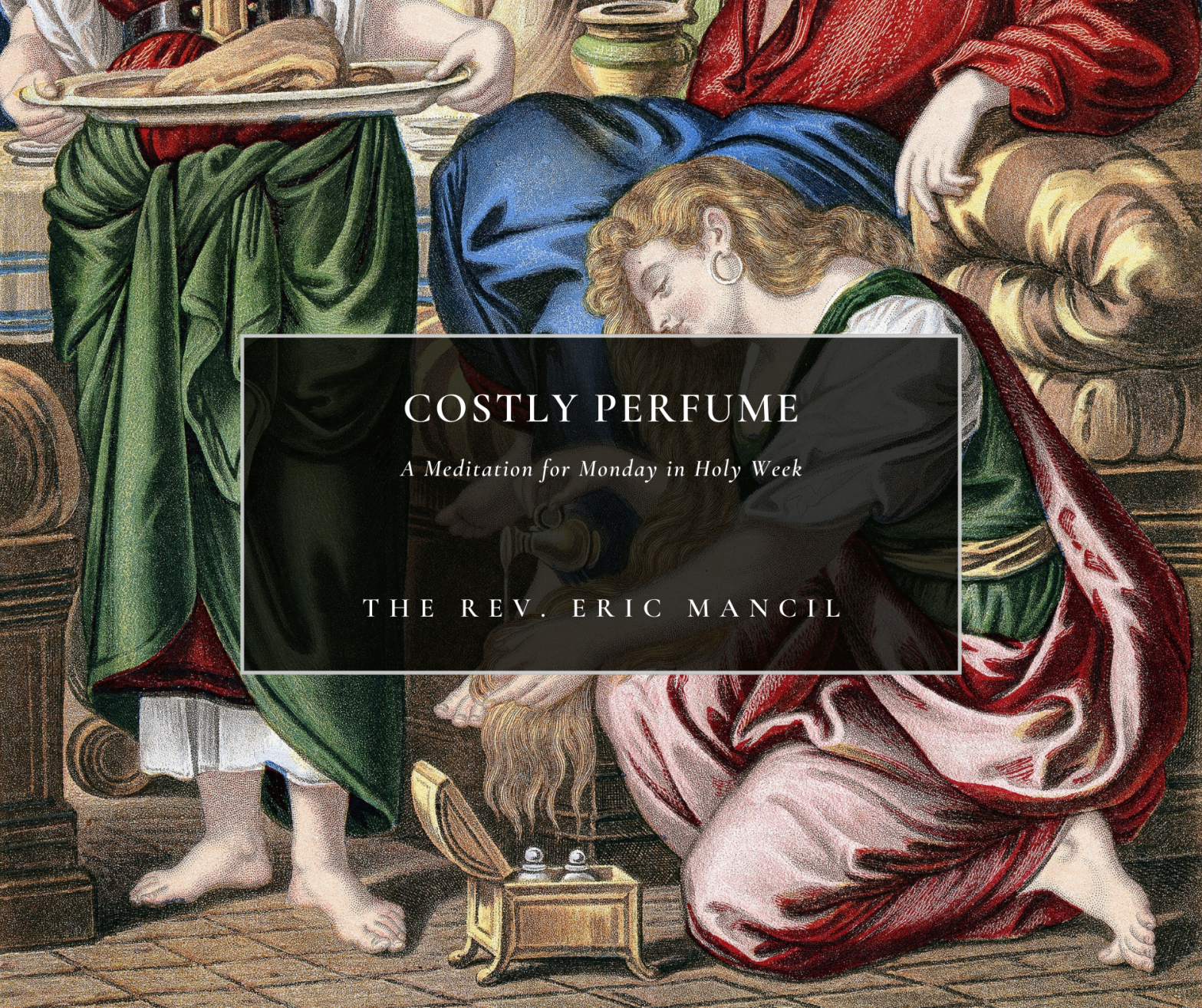
In our Gospel reading appointed for Holy Monday, we hear the story of Mary, the sister of Martha and Lazarus, anointing the feet of Jesus with perfume made of pure nard, a type of fragrant oil that was very expensive in the time of Jesus. In the story, soon after Mary anoints Jesus’ feet, she’s chastised by Judas Iscariot for wasting the perfume on Jesus when it could’ve been sold for three hundred denarii and the money given to the poor. Considering the fact that, at the time, one denarius equaled an entire day’s worth of work for the common laborer, three hundred denarii was a lot of money. But, the writer of John’s Gospel is quick to point out that the reason for Judas’ criticism of Mary isn’t because he actually cared for the poor. It was because Judas carried the common purse and was a thief.
Mary’s actions are praised by Jesus, not because he seeks special attention or treatment, but because of Mary’s generous outpouring of love. He knows the reason why she’s anointing his feet. She’s preparing his body for burial. She knows what Jesus is about to go through. This is her way of giving to Jesus something of herself to show him how much she cares.
When I read this passage from John, I’m often reminded of how easy it is for us to be critical of others when we think we know what’s best or when we think we have all the right answers. Judas, for example, thought Mary was being wasteful by using the perfume to anoint Jesus’ feet. He didn’t see it for what it really was—an act of love and devotion. All he could see was another missed opportunity to take more for himself.
This Gospel lesson invites us to think about the ways we express our love for God and each other. God doesn’t call us simply to love. God calls us to love abundantly by giving up all we have, our whole selves, in order to love and serve others. The way of Jesus is the way of self-giving, sacrificial love. It’s the way of the Cross, the way of life and peace with God.
Yes, the expensive perfume that Mary buys and uses to anoint Jesus’ feet could’ve been used in other ways. It could’ve been sold and the money given to the poor, as Judas suggested. Or, it could’ve been saved and used sparingly over time. But, Mary doesn’t use just a little bit of the perfume when she anoints Jesus’ feet. She uses all of it, the entire pint. The perfume she breaks open and pours out represents everything she has to give, her whole self. She gives it all to honor Jesus, the one who will go to the cross and sacrifice his life for the life of the world.
On this Monday in Holy Week, as our journey with Christ continues, I invite you to consider the example of Mary of Bethany. How is God calling you to give of yourself and to love others abundantly? Like the costly perfume that Mary brings to Jesus’ feet, what are you willing to give up and pour out in order to show your love and devotion to Jesus? Amen.
I speak to you in the name of our loving, liberating, and life-giving God: Father, Son, and Holy Spirit. Amen.
I love the way we worship in the Episcopal Church. One of the reasons why I love it so much is because it involves everyone, not just the clergy. It’s not just one person standing up in the center of the room, doing all the work. Sure, there are parts of the liturgy led by the priest, but there are also parts of the liturgy led by lay people and parts that are spoken responsively, as a call and response between the priest and the congregation. The word “liturgy” literally means, “the work of the people.” It’s work that all of us are called to do in the service of God, and it’s foundational to who we are as Episcopalians.
For example, if I say, “The Lord be with you,” you already know exactly what to do, don’t you? You don’t even need to look down at your bulletin to know what to say. Let’s give it a try.
The Lord be with you. And also with you.
Good. And, if I say, “Lord, have mercy,” you already know what comes after.
Lord, have mercy. Christ, have mercy. Lord, have mercy.
That’s exactly right. Thank you for proving my point. There are parts of the liturgy that we know by heart, words that’ve shaped our lives and become part of who we are as followers of Jesus Christ. These words have deep meaning. They help us understand who God is and how God is at work on our lives.
Several years ago, when I was a parishioner at the Episcopal Church of the Nativity in Dothan, Alabama, our priest taught the congregation a new call and response prayer in one of her Sunday morning sermons. I’ll never forget it because it was one that I had never heard before and one that you won’t find in The Book of Common Prayer. Eventually, I came to discover that this particular call and response is often used by our Christian brothers and sisters in the African American community.
It’s very simple. It goes like this. I say, “God is good,” and you say, “all the time.” Then, I say, “All the time,” and you say, “God is good.”
Let’s give it a try.
God is good, all the time. All the time, God is good.
Great job. The reason why I’m sharing this simple prayer with you is because I want you to carry it with you, today and in the week to come, as we join with Christ in his journey to the cross. If we truly believe that liturgy has the power to shape our lives and form us as Christians, then I want you to consider this prayer a type of liturgy that you can return to, time and again, and be reminded that there’s never a time when God isn’t good, even in those moments when it feels like God has abandoned us or forgotten us.
I want you to hold on to these words as we hear the story of our Lord’s Passion and death unfold and bear witness to the beautiful parts as well as the excruciating parts.
Say it with me.
God is good, all the time. All the time, God is good.
Hold on to these words as we remember the final days and hours of Jesus’ life—how he made his way into Jerusalem, riding on the back of a donkey while crowds of people chanted, “Hosanna! Blessed is the one who comes in the name of the Lord.”
God is good, all the time. All the time, God is good.
Hold on to these words as we remember how shouts of praise from the people of Jerusalem quickly turned into calls for Jesus’ execution. Hold on to them as we remember the times we ourselves have betrayed Jesus’ trust and fallen short of God’s call.
God is good, all the time. All the time, God is good.
Hold on to these words as we remember the upper room where Jesus shared a meal with his disciples for the last time and washed their feet, just before he was arrested and handed over to Roman guards. Hold on to them as we remember his prayer to God while sitting in the Garden of Gethsemane, saying, “Abba, Father, for you all things are possible; remove this cup from me; yet, not what I want, but what you want.”
God is good, all the time. All the time, God is good.
Hold on to these words as we remember the betrayal of Judas and the denial of Peter. Hold on to them as we remember the times we’ve denied knowing Jesus in our own lives. Hold on to these words as we remember the humiliation and pain that Jesus endured, the whips and the crown of thorns, the nails piercing his hands and feet.
God is good, all the time. All the time, God is good.
Hold on to these words as we remember Jesus crying out on the cross, “My God, my God, why have you forsaken me?” Hold on to them as we remember Jesus drawing his last breath and giving up his spirit.
God is good, all the time. All the time, God is good.
Hold on to these words, dear friends, because they’re absolutely true. Despite the horror and humiliation of the cross, there was never a moment in Jesus’ life when God wasn’t good, and there was never a moment when God wasn’t near, weeping for Jesus and surrounding him with love. Hold on to these words because they hold a special meaning in our lives. If God was with Jesus and knows what it means to suffer, then we know that God is with us as well, especially in those moments when we experience great pain and loss. We know that God is on the side of the oppressed and the persecuted, those who have been victimized and weighed down by the evils of this world.
God is good, all the time. All the time, God is good.
Hold on to these words because we know how the story ends, for Jesus and for those of us who have chosen to walk the way of love with Christ. In the end, there is resurrection and new and abundant life. In the end, darkness gives way to light, and death is defeated, once and for all. As we begin our journey through this most sacred time in the life of the Church, may we hold these words in our hearts:
God is good, all the time. All the time, God is good.
Amen.
A video of this sermon is available below, beginning at the 32:42 mark.
A Sermon for the Fourth Sunday in Lent March 14, 2021
Text: John 3:14-21
I speak to you in the name of our loving, liberating, and life-giving God: Father, Son, and Holy Spirit. Amen.
Do you remember what life was like before the pandemic, before our lives were turned upside down and the world completely changed? I do. I remember what it was like. Though, I have to admit that, in some ways, it feels like a lifetime ago.
I know that, before the pandemic, we didn’t have to worry so much about going out in public and being in large groups of people. We took for granted the ability to go wherever we wanted without giving much thought to whether or not we’d get sick or infect others with an unknown virus.
I know that we didn’t wear masks wherever we went, and we didn’t concern ourselves with standing six feet apart from strangers.
I know that we didn’t worry about rushing to the grocery store at the drop of a hat for fear of running out of food or hand sanitizer or toilet paper.
I know that we didn’t have to worry about whether or not our loved ones would have to be alone in the hospital or in a nursing home.
I know that we used to shake hands with people we just met as a sign of respect and hospitality. I know that we used to give hugs when we “passed the Peace” in Church and when we said goodbye after the service was over. I know that we used to enjoy meals together in the Parish Hall. I know that we used to sing hymns and kneel together at this altar rail and receive the Body and Blood of Christ every Sunday morning without any concern at all.
I know all these things, and yet, they feel like a distant memory.
Our lives have changed in so many ways over the past year, and I think we’ve only just begun to consider the long-term effects this virus will have on us. We’ve only just begun to think about what our lives are going to be like once we return to some sense of normalcy. I think we can all agree that, moving forward, many things are going to be different than the way they were before the pandemic.
I had some time to reflect on all of this during the past week as we marked the one-year anniversary. It’s been one year since the World Health Organization declared COVID-19 a global pandemic. It’s been one year since I received that first e-mail from Bishop Kee, announcing that all public worship services and gatherings at the church would have be suspended.
How naive I was, in the beginning, to think that all of this was going to blow over in a matter of weeks. How naive we all were, looking back to March of last year, to think that none of what we’ve experienced over the past twelve months was ever a possibility.
Yet, here we are, one year later. Over half a million people have died in our country as a result of the virus, including a member of our own parish, Paul Clausmeyer—a beloved friend and father. We know others who’ve died as well—friends, family members, co-workers, and loved ones—all lost, but not forgotten. This virus has taken a toll far worse than any of us could’ve predicted or imagined.
We’ve endured much suffering, and while we still have a ways to go before we can take off our masks for the last time and resume many of the things we enjoyed before the pandemic, we’re beginning to see a light at the end of the tunnel. Vaccinations are being developed and distributed all over the world, and eventually, all of us will have access to it. Eventually, enough of us will be vaccinated to where we can finally breathe again and feel comfortable doing the things we love most with the people we care about, including here at church.
The reason why I’m talking about the pandemic this morning is because I think our shared experience over the past year has taught us a lot about who we are as followers of Jesus. It’s caused us to give careful consideration to how our words and actions affect the lives of those around us.
Living through this experience together as a faith community, even though we’ve struggled and had to sacrifice a lot, has taught us so much about what it means to love others as Jesus teaches us in the Gospels. I’m not exaggerating when I say that we’ve walked the way of the Cross with Jesus over the past twelve months, and through all of it, God has been with us, guiding us and giving us the strength we need to endure.
In our Gospel lesson this morning from John, we heard one of the most well-known and beloved verses from Scripture among Christians: John 3:16. Many of us probably have this verse committed to memory. “For God so loved the world that he gave his only Son, so that everyone who believes in him may not perish but may have eternal life.”
This verse from John’s Gospel brings me so much comfort in my life, as it does for so many. But, the comfort I feel when I read it doesn’t come from what you might expect.
We often misinterpret what Jesus was trying to say in this verse. We forget that this passage is actually part of a much longer conversation that Jesus had with a man named Nicodemus, a Pharisee who came to Jesus in secret in order to learn more about him and his teaching. In their conversation together, Jesus tries to explain to Nicodemus that, in order to enter the kingdom of God, in order to experience the abundant life that God desires for all of us, one must be willing to give up their life and be re-born. One must be committed to living a life of self-giving, sacrificial love for the other.
Contrary to what many people think, John 3:16 isn’t Jesus’ way of saying, “Follow me, or else!” It doesn’t have anything to do with where we go when we die or where we spend eternity.
It’s Jesus’ way of saying, “My way of love is the way of God.” It’s his way of saying, “My way of self-giving, sacrificial love is the path that leads to true joy and true peace with God.”
Once again, this verse doesn’t have anything to do with who’s in and who’s out, and it doesn’t have anything to do with God’s love being limited to only a certain group of people.
God loves each of us the same, more than any of us deserves, and nothing can ever change that.
Martin Luther, the sixteenth-century, German monk who sparked the beginning of the Protestant Reformation, once referred to John 3:16 as “the Gospel in Miniature.” He believed that everything you need to know about Jesus and the Gospel could be learned from this one verse of scripture.
And, I think he had a pretty good point.
Everything we really need to know is right there, printed in your bulletin this morning. When it’s all said and done, the message of the Gospel, the Good News of God in Christ, is that God loves us more than we can possibly imagine. God loves us so much that he came to dwell among us, to live and die as one of us, to teach us and show us a better way to live. God loves us so much that he sacrificed himself on the cross to show us that a life lived in the service of others is the only path to abundant life with God.
So, I want to leave you with a question this morning. You don’t have to answer it right now, but I’d like you to give it some thought in the days ahead, especially as we draw closer to Holy Week. Do you really believe that that the message of the Gospel is Good News? Do you believe that dying to self and committing to a life of sacrificial love and service to others is the path to abundant life with God?
If your answer is “yes,” then you should know the sacrifices we’ve made and the precautions we’ve taken over the past year in order to keep ourselves and others safe have been worth it. If you really believe that the Gospel of Jesus is true, then we’ve been faithful over the past year. Every time we made a sacrifice, knowing that it might keep others safe, we’ve been faithful. We’ve been faithful every time we wore a mask, even when it was inconvenient. We’ve been faithful every time we restrained ourselves from hugging a friend or decided to stay at home instead of going out with a large group of people. We’ve been faithful every time we tuned in online to watch church from home, even though we wanted so desperately to be together in person. Don’t think, for a moment, that the choices we’ve made in order to keep others safe were made in vain. Those choices were made in love and service to God and God’s people.
Now, we’re being called to remain vigilant as this pandemic continues. Yes, we’re beginning to see a light at the end of the tunnel, but that doesn’t mean that we can rest easy just yet and go back to the way things were before. Now isn’t the time to stop believing that our words and actions make a difference. Now is the time to remain vigilant.
God has been with us through it all, even in the most difficult moments, and God will continue to be with us until this is all over. That’s God’s promise to us, and that promise will never end. So, hold onto hope, dear friends. Hold onto the knowledge that the way of Jesus is the way of love and the way to abundant life with God. Amen.
A video of this sermon is available below, beginning at the 13:48 mark.
A Sermon for the Third Sunday in Lent (Year B) March 7, 2021
Text: John 2:13-22
This past week, I spent some time re-reading one of Martin Luther King, Jr’s most popular writings: “Letter from Birmingham Jail.” This wasn’t a random, “spur-of-the-moment” decision. It was actually a homework assignment for those of us who recently came together to form a new ministry in our parish called Project Beloved Community.
Over the past several months, this group has gathered monthly to discuss issues related to social justice and racial inequality. It was born last summer in response to the racial tension and protests that we witnessed all across the country. We began our time together with a study of Bryan Stevenson’s book, Just Mercy, which dealt with really difficult subject matter, including: race relations, the criminal justice system in America, and the death penalty. After that, we decided that our work as a group shouldn’t be limited to just one book study. So, we decided to keep meeting with the hope that our newly-formed group might serve as a springboard for future ministry within the parish and the wider community.
Because of the pandemic, most of our work up to this point has been done through reading articles together, watching videos, listening to podcasts, and participating in monthly Zoom meetings. Mostly, we’ve been trying to better educate ourselves and come up with possible ways that our parish might be involved in the work of building the “Beloved Community.” This phrase, by the way, isn’t something that we came up with. “Beloved Community” is a phrase that was made popular by Martin Luther King, Jr. The King Center, an institution founded in memory of Dr. King, defines “Beloved Community” as “a global vision in which all people can share in the wealth of the earth. In the Beloved Community, poverty, hunger and homelessness will not be tolerated because international standards of human decency will not allow it. Racism and all forms of discrimination, bigotry and prejudice will be replaced by an all-inclusive spirit of sisterhood and brotherhood.”
That sounds a lot like Jesus, doesn’t it?
“Beloved Community” is what Jesus refers to, in the Gospels, as “the kingdom of God” or “the kingdom of heaven” depending on which Gospel you’re reading. It’s God’s dream of a world redeemed in the self-giving, sacrificial love of Christ. Or, as our Presiding Bishop likes to say, it’s God turning the world upside down, which is really right side up.
Building the “Beloved Community” is work that all of us are called to do as followers of Jesus. It’s the work of the Gospel. Jesus spent his entire ministry trying to tear down the walls that divide us, to bring healing and reconciliation to the world. He did this by teaching us and showing us a better way to live. He did this by allowing himself to be captured by Roman guards and handed over to be crucified, serving as an example of what it truly means to love as God would have us love.
But, building the “Beloved Community” and working to tear down those walls that keep us cut off from each other and from God isn’t easy. It requires steadfast determination and a commitment to moving beyond the walls of the church. It requires a willingness to be vulnerable and to accept the fact that things aren’t the way that they should be. It requires us to ask ourselves tough questions that might be difficult to answer.
Think about our own parish for a moment. What are some of the questions we might ask ourselves?
Who’s here, and who isn’t?
Who are we reaching out to in the wider community?
Are there groups of people who are being overlooked?
How much of our time and resources are we devoting to things going on here?
And how much of our time and resources are we devoting to outreach?
What is the message we’re sending to the wider community when acts of violence and oppression are being committed against the most vulnerable members of our society?
As I re-read “Letter from Birmingham Jail,” which was written in April of 1963, I was reminded that we still have a lot of work to do as the Body of Christ. Many of the issues we were dealing with in the 1960s are still prevalent today. People of color are still suffering as victims of violence and systemic racism. As the Church, we have a lot of work to do in building the “Beloved Community,” and that work begins with repentance and truth-telling. It begins with acknowledging the fact that the Church, including our beloved Episcopal Church, has played a role in the oppression and discrimination of others. As difficult as that is to say out loud, it’s the truth. As I read it this past week, there was one line in Dr. King’s letter that really hit me hard. He wrote, “When I was suddenly catapulted into the leadership of the bus protest in Montgomery, Alabama, a few years ago, I felt we would be supported by the white church. I felt that the white ministers, priests and rabbis of the South would be among our strongest allies. Instead, some have been outright opponents, refusing to understand the freedom movement and misrepresenting its leaders; all too many others have been more cautious than courageous and have remained silent behind the anesthetizing security of stained glass windows.”
I don’t want to be the kind of priest that Dr. King wrote about in his letter, and I confess to you, my brothers and sisters, that at times, I’ve been more “cautious than courageous.” At times, I’ve been too afraid to speak out about important issues for fear that my comments might be too divisive. At times, I’ve been more concerned with maintaining the status quo, with not wanting to “stir the pot” too much, than to speak the truth in love, even though that’s what the Gospel demands of us. Trust me when I say that it’s much easier to preach a sermon that makes you feel good than a sermon that might disturb you or challenge your ideas and assumptions.
Maybe you feel the same way as I do sometimes. Maybe fear has caused you to doubt whether or not to speak out on difficult issues that demand our attention.
I don’t want us to be the kind of church that Dr. King wrote about, either. I want us to be a mission-focused church, equally as concerned about what goes on in the world around us as we are about what goes on here and unafraid to tell the truth about difficult issues that might challenge us or make us uncomfortable. Don’t get me wrong. I love what we do here as a faith community. Church on Sunday mornings is one of my favorite times throughout the week, and I love being able to spend it with you. But, we’re mistaken if we think of it as a means to an end. Worship on Sundays typically takes up about an hour of our time each week (if the preacher will wrap it up already). But, the reason we come to church isn’t just for that one hour. We come to be renewed and restored, to be formed as disciples of Jesus, so that we can go out, beyond the walls of the church, to bring the light of Christ to the world.
The message of the Gospel is one that the world desperately needs to hear. God needs us to be bearers of the light of Christ, to stand up and speak out when the powers and principalities of this world seek to destroy the children of God. It’s our responsibility, as members of the Body of Christ. And, as Dr. King once said, “The time is always right to do what is right.”
In our Gospel lesson for this morning, we heard John’s account of Jesus cleansing the Temple in Jerusalem. He and his disciples are preparing for Passover, and when he enters the Temple, he sees merchants selling cattle, sheep, and doves—unblemished animals that people could purchase and sacrifice as an offering to God. Jesus also witnesses money changers in the Temple, who were there in order to exchange currency for people who were visiting from outside of Jerusalem. Temple money was the only form of currency that could be used to purchase sacrificial animals for high holy days, and it’s likely that, because of this system of exchanging currency, pilgrims were frequently exploited and taken advantage of. What’s worse is that the religious leaders in the Temple allowed it to happen!
They allowed money and wealth to cloud their judgment. They allowed the Temple to become a place of commerce, a place overly concerned with its own well-being rather than a place of prayer and devotion to God.
When Jesus sees what’s happening, he becomes outraged. He drives the merchants, along with their animals, and the money changers out of the Temple. He pours out their money on the ground and overturns their tables, saying, “Stop making my Father’s house a marketplace!”
His actions aren’t just a criticism of the merchants and money changers. He’s angry with the whole institution. The Temple has become a place committed to something other than what God intended.
I think it’s important for us to consider the possibility that, at times, Jesus is disappointed and even angry with the Church as well, especially in those moments when we’re more concerned with what’s going on here and sustaining our own well-being than being a place solely devoted to the worship of God and serving God’s people. When we forget who we are and why we’re here, it’s easy for us to become focused more on ourselves and less on those whom we’re called to serve.
We love having a beautiful space where we can come and worship God and spend time with each other, but as the Church, we are more than our buildings and property.
We love times of fellowship, sharing meals together, and growing as a parish family, but as the Church, we are more than a social club or a weekly gathering of friends.
We love to come to church on Sunday mornings, to be inspired for the week ahead, but as the Church, we are more than a place where we come to feel good about ourselves once a week.
We are the Body of Christ. We are called to proclaim the Gospel of Jesus through our words and actions and to love and serve God and God’s people. We are called to work for the building up of God’s Kingdom, the “Beloved Community,” to help bring healing and transformation to this broken and sinful world. Nothing else will do. It’s our Gospel imperative to do this work. My prayer is that God will open our eyes and break open our hearts so that we may see and know the truth of who we are and what we’re called to do. May God give us the strength and courage we need to be faithful to our calling and to cast out those things which cause us to forget who we are. Amen.
A video of this sermon is available below, beginning at the 17:50 mark.
A Sermon for the Second Sunday in Lent (Year B) February 28, 2021
Text: Genesis 17:1-7, 15-16
I speak to you in the name of our loving, liberating, and life-giving God: Father, Son, and Holy Spirit. Amen.
One of the things that disappointed me the most about 2020 was not being able to go and serve as a chaplain to the campers and staff members at Sawyerville Summer Camp. Some of you have probably heard me talk about Sawyerville before, but for those of you who haven’t, Sawyerville is basically a summer camp for the children of Hale County—one of the poorest and most underserved counties in our state. Each year, for three weeks during the summer, volunteers and staff members from the Diocese of Alabama travel to Greensboro to provide this wonderful ministry for any child who would like to attend, free of charge. Sawyerville is a ministry of our diocese, which means that it’s supported by all of our parishes.
Over the years, going and serving as a chaplain for a week at Sawyerville has become one of my favorite things to do, and I’m thankful every time I get the chance to return. Last year, due to COVID-19, summer camp had to be canceled, and it broke my heart to know that the children who normally attend Sawyerville wouldn’t be able to. In place of summer camp, the staff and volunteers put together “Camp-in-a-Box” for every registered camper. These boxes provided the children with toys, books, swimsuits, and other items to help make their summer break a little more special, and thanks to your generosity as a parish, we helped contribute to the cause by making a special donation to Sawyerville.
One of the things I missed most about not getting to go to Sawyerville last year was singing all of the silly, camp songs that we normally get to sing with the campers. In case you don’t know, we do a lot of singing at Sawyerville! We sing songs in the morning when the campers first arrive. We sing songs during program time. We sing songs on the bus, to and from the pool. We even sing songs at the end of the day as children are waiting to be picked up to go home.
One of my favorite songs that we sing is called, “Father Abraham.” Has anyone ever heard of it? If you grew up going to Sunday School at church or grew up going to church camp during the summer, you’ve probably sung “Father Abraham,” at least once or twice!
It goes something like this:
Father Abraham had many sons, And many sons had Father Abraham. I am one of them, and so are you. So, let’s all praise the Lord!
And that’s really all there is to it! Once you’ve learned the chorus, you know the entire song! It just repeats over and over again. At Sawyerville, we get faster each time we sing it, and at the end of each chorus we add a movement, which makes it even more fun. By the end of the song, we’re waving our arms and legs. We’re nodding our head to the beat of the music, and we’re sticking out our tongue, trying our best to sing the words in the most embarrassing way possible.
I’m not going to demonstrate that for you today. You’ll just have to come to Sawyerville and see it for yourself! It’s really a fun song to sing with all the campers, and they love it whenever we do.
As I was reading our lesson appointed for today from the Book of Genesis, I was reminded of Sawyerville and the words to “Father Abraham”—especially the part where we sing, “I am one of them, and so are you.”
If you grew up singing this song at summer camp or in Sunday school, have you ever thought about the words and what they really mean? Why, for example, would we refer to Abraham as our “Father,” and why would we call ourselves “sons” or “daughters” of Abraham? As Christians, we tend to focus mostly on the life and ministry of Jesus and how Jesus calls us to live our lives. In our study of the Scriptures, most of us probably spend the majority of our time in the New Testament, especially in the Gospels. So why, then, is Abraham so important? Why is “Father Abraham” a song that we love to teach our children?
In order to answer those questions, we have to go back to the beginning of our story with God, to the Book of Genesis. We have to go back to a time long before Jesus was born and learn about a special relationship that was formed between God and a man named Abram.
When God and Abram first meet, in the twelfth chapter of Genesis, God tells Abram to pick up everything and move from the land he’s always known. God tells him, “Go from your country and your kindred and your father’s house to the land that I will show you. I will make of you a great nation, and I will bless you, and make your name great, so that you will be a blessing.” Abram listens to God and obeys his command. Despite his old age, he picks up everything he has. He takes his wife, Sarai, and all of their possessions and travels to the land of Canaan.
At times, Abram has his doubts about God’s promise, but through it all, God remains faithful to Abram.
In our lesson for today, from the seventeenth chapter of Genesis, Abram receives another message from God. This time, Abram is much older than he was when he first encountered God. God says, “I am God Almighty; walk before me and be blameless. And I will make my covenant between me and you, and will make you exceedingly numerous.”
The Scripture tells us that, at once, Abram falls down on his face in response to God’s message. God continues to speak and tells Abram that he is establishing a covenant with him. “You shall be the ancestor of a multitude of nations,” God says. “No longer shall your name be Abram, but your name shall be Abraham; for I have made you the ancestor of a multitude of nations. I will make you exceedingly fruitful; and I will make nations of you, and kings shall come from you. I will establish my covenant between me and you, and your offspring after you throughout their generations, for an everlasting covenant, to be God to you and to your offspring after you.”
It’s that last line that really spoke to me this past week and inspired me to preach today on this text from Genesis. God makes an “everlasting covenant” with Abraham and promises to be God to him and future generations forever.
So, what does this have to do with us? As members of the Body of Christ, we are spiritual descendants of Abraham. The God of Abraham, Isaac, and Jacob is the same God who chose David, a descendant of Abraham, to be king over Israel. The God of Abraham, Isaac, and Jacob is the same God who spoke through the prophets of the Hebrew Scriptures—people like Jeremiah, who foretold that God would raise up for David a righteous Branch. In the very first verse of the Gospel of Matthew, Jesus is referred to as Messiah, “the son of David, the son of Abraham.”
So, you see, we are spiritual descendants of Abraham. The everlasting covenant made between God and future generations has been fulfilled through Jesus Christ. As Christians, we’ve been promised that God will always be our God and that we will always be God’s children. Nothing can ever separate us from the love of God. Even when we make the worst mistakes and fall short of God’s call, God will always be faithful and ready to forgive us.
But, part of living in a covenant relationship with God means that the commitment to be faithful goes both ways. It isn’t just one-sided. God promises to be faithful to us, and in return, we promise to be faithful to God, no matter what, through the good times and the bad. This kind of relationship is more than just casual. We don’t get to decide from day to day whether or not to be God’s children. It’s a lot like the covenant we make in our baptism. We don’t get to decide from day to day whether or not we’re baptized. Once we’ve received the sacrament of Holy Baptism, we are sealed by the Holy Spirit and marked as Christ’s own forever. Nothing can ever change that.
The problem, though, is that we sometimes allow things to come in between us and God. We allow other things, other relationships, to become a greater priority in our lives than the relationship we share with God. The Bible refers to these things as “idols.” Idols are things that take our attention away from cultivating and growing our relationship with God—and by extension—loving and serving God’s people. Idols are things we worship in place of God because we think they’ll make us happy and fill the empty spaces in our hearts. And, idols come in a variety of different forms.
In the Hebrew Scriptures, for example, Israel’s relationship with God was strained because they believed that an idol—a Golden Calf, of all things—could take God’s place and save them during their time in the wilderness.
Idols can be material things, like money and possessions. They can be thoughts and ideas, like the relationship we have with our work or the desire we have to be more successful and popular.
What idols are standing in between you and God? Which relationships need to change so that your relationship with God can get stronger?
The truth is that only God can save us and fill the empty spaces in our hearts. As much as we try, the idols we worship in place of God will only make us feel good for a brief moment. They’re like a breath—in one moment and out the next. But God, who established with Abraham an everlasting covenant and promised to be our God forever, will never leave us. During our journey through Lent, we’re invited into a time of self-examination and repentance, a time for us to think about the ways we’ve allowed other things, other relationships, to take precedence over our relationship with God. Now is the time. As we move through this holy season and make preparations for Easter, the time is now for us to focus our attention on God and what God desires for our lives. Amen.
A video of this sermon is available below, beginning at the 17:45 mark.
A Sermon for the First Sunday in Lent (Year B) February 21, 2021
The Gospel: Mark 1:9-15
I speak to you in the name of our loving, liberating, and life-giving God: Father, Son, and Holy Spirit. Amen.
Two Sundays ago, on February 7th, the National Cathedral in Washington, D.C., welcomed a guest preacher into their pulpit. The sermon that day was pre-recorded and offered by a man who some of you may have heard of before. His name is Max Lucado. Mr. Lucado is a very prolific author, and his writing is well-known among many people, especially those in the world of evangelical Christianity. He also serves as the pastor at a large, evangelical church in San Antonio, Texas.
I’ll be the first to admit that I’ve never read a single word of Max Lucado’s writing. I don’t know what he’s written about in the past. I don’t know what he teaches or believes about God. The only reason I’m familiar with his name at all is because I’ve seen stacks of his books lining the shelves in various stores. So, I know that he’s fairly popular and that he sells a lot of books, and that’s about it.
When I first heard that the National Cathedral had extended an invitation for Mr. Lucado to preach, I was a little surprised. It seemed like an odd decision to invite an evangelical pastor to preach in an Episcopal cathedral. But, at the same time, I knew that the National Cathedral has a reputation for inviting preachers from other denominations to come and preach. They strive to be a “house of prayer for all people,” meaning that they seek to build bridges with people beyond the Episcopal Church, representing other faith traditions. So, I didn’t really think much more about it.
It wasn’t until later that I started seeing concerns from other people about the invitation and discovered a little bit more about Mr. Lucado and some of the things he’s said and written in the past concerning our brothers and sisters in the LGBTQ community.
Now, I want to stop for just a moment and tell you that my intention in today’s sermon isn’t to publicly criticize or chastise Max Lucado or to even comment on the things he’s said and done in the past. All I’ll say is that some of the things he’s written and said were extremely hurtful to a lot of people. You can decide on your own if you want to explore that further.
No, my intention today isn’t to criticize what one person has done. My intention is to talk about how we, as baptized Christians, are called to live our lives a particular way and to seek repentance when we’ve fallen short of God’s call. My intention is to bear witness to the transforming love of God and what can happen when we allow ourselves to experience true repentance.
Soon after the invitation to preach at the National Cathedral was extended to Mr. Lucado, people from all across the Episcopal Church began voicing their concerns. They wanted to know why an Episcopal cathedral would welcome someone into the pulpit who had written such hateful words about the LGBTQ community. They wanted to know how an Episcopal cathedral, a faith community that has worked for years to become a safe and inclusive space, could betray their trust in such a hurtful way.
I’ll admit that I shared their concerns and was very tempted to write a letter myself to the dean of the Cathedral. There are ways to have an honest and open dialogue and to build relationships with people who represent different theological opinions and beliefs, but in my opinion, the pulpit isn’t the place for that. The pulpit is the place where the love of God in Christ Jesus is proclaimed, and in the Episcopal Church, we trust that the message coming from the pulpit will be that God’s love is for all people and that every person, without exception, is wonderfully and beautifully made in the image of God.
The concerns and comments continued to mount over the days leading up to the service, and news outlets from across the Church covered the story as anxious people waited to hear how the Cathedral would respond. Unfortunately, very little was said. For the most part, the cries of anger and frustration over the Cathedral’s decision were ignored.
The day of the service arrived, and the sermon was preached, as scheduled. During the service, both the dean of the Cathedral, Randy Hollerith, and the celebrant for the day, Bishop Gene Robinson, gave brief remarks concerning the decision to invite Max Lucado to preach. Although the remarks were appreciated by some, many people were still very disappointed and hurt by the decision. Some even went as far to say that it was unforgivable, that they no longer felt welcome in the Episcopal Church.
I waited to see what would happen in the aftermath. I waited and wondered, “What will they do now?” “Now that the damage has been done, how will they respond?” Will they continue to ignore the hurt and the anger they’ve caused? Or, will they acknowledge what they’ve done and seek forgiveness?
In the week following the service, the dean of the Cathedral and the Bishop of Washington, Mariann Budde, expressed great remorse over their decision. Each of them released letters to the public, which have been posted on the home page of the cathedral’s website. Not only were they words seeking forgiveness, but they were also words seeking understanding. Not only did they apologize for their part in causing so much pain, but they also committed to doing better. Tonight, for example, the National Cathedral is hosting a listening session for anyone who would like to speak about their experiences in the Church as members of the LGBTQ community and their allies. Their hope is that this will be the first step in trying to make amends for the pain they’ve caused.
I think it’s important to acknowledge that the leaders of the Cathedral and the Diocese of Washington could’ve easily moved on from what happened without giving it much more thought. Sure, there would’ve been lots of hurt feelings for a while and the reputation of the cathedral might’ve been stained, at least for a short time. But, eventually things would go back to normal, and people would get over what happened once they had a chance to calm down.
That isn’t what happened, though. Rather than simply sweeping things under the rug, as we’ve witnessed churches do in the past, and denying any responsibility for what happened, the dean and the bishop both acknowledged their fault. They made their confession and began the process of trying to make things right, of trying to do better.
It isn’t easy to confess when you’ve done something wrong, and speaking from personal experience, it’s especially difficult when you’re in a position of authority. Leaders are expected to be strong and to have all the answers figured out, at least according to the world’s standards. Admitting when you’re wrong, showing remorse, vowing to make a change for the sake of others—all of these are seen as a sign of weakness.
But, not in God’s eyes. When we confess our sins to God for hurting others in ways that are known and unknown, we take the first step toward true repentance and amendment of life. Repentance is the way that we heal our broken relationship with God and each other. In the first words of his public ministry to the people of Galilee, which we heard in our Gospel lesson for this morning, Jesus says, “The time is fulfilled, and the kingdom of God has come near; repent, and believe in the good news.”
From the very beginning of his ministry, Jesus establishes for us a pattern of holy living. “Repent,” Jesus says, “and believe in the good news.” Why would we ever think that repentance is a bad thing or a sign of weakness when Jesus tells us otherwise? Jesus tells us that our place in God’s Kingdom is based on our willingness to repent—to turn back to God when we’ve fallen short of our call to love and serve others, to turn back to God when we’ve neglected to fulfill our baptismal vows.
We’re going to fall short. It’s part of what it means to be human. Every day, we’re faced with our own wilderness journey. We’re faced with a variety of temptations and choices to make, and sometimes, we’re just going to get it wrong. But, for every temptation we indulge in and every wrong choice we make, we’re also given the opportunity to make things right. By God’s grace, we’re given the opportunity each day to say, “I’m sorry, and I’ll try to do better next time.” During the season of Lent, the Church invites us to practice saying these words so that our relationship with God might be strengthened and renewed. I hope you’ll take these words to heart as our journey through Lent continues.
Remember these words. Bring them with you into prayers. “I’m sorry, and I’ll try to do better next time.”
These words aren’t a sign of weakness, and they aren’t a sign that God loves us any less. They’re a sign that God is working in us and calling us to come back home. Amen.
A video of this sermon is available below, beginning at the 21:24 mark.
A Sermon for Ash Wednesday (Year B) February 17, 2021
Psalm 103:8-14
I speak to you in the name of our loving, liberating, and life-giving God: Father, Son, and Holy Spirit. Amen.
From Psalm 103: “As a father cares for his children, so does the Lord care for those who fear him. For he himself knows whereof we are made; he remembers that we are but dust.”
I don’t often preach on the psalms, but it’s not because I don’t think they’re important. It’s because most of the time, I feel drawn to preach on the Gospel lesson appointed for the day. The Gospels serve as our best and most reliable source for learning about the life and ministry of Jesus, which is why we consider them especially significant and why most priests in the Episcopal Church tend to focus on the Gospel lesson in their preaching.
But the psalms offer us something different. The psalms offer us a window—a glimpse into the lives of an ancient people who put all their hope and all their trust in God. The psalms are a collection of prayers and hymns, expressing a wide range of emotions—everything from joy and thankfulness to pain and sorrow. I think that’s one of the reasons why the psalms resonate so deeply within us. They’re honest about the human condition and the struggle we all feel in trying to be faithful to God.
It’s likely that many of the psalms we use today in public worship were used in a similar way during the time of Jesus in temple worship. There are psalms of lament, expressing Israel’s grief and their hope that God will reach out and save them from their suffering. There are psalms of praise and thanksgiving, expressing Israel’s joy in knowing that God is a loving and merciful god. There are other categories as well, but mostly, the psalms can be divided into two categories: psalms of lament and psalms of praise.
It’s almost impossible to know exactly when the psalms were written and who wrote them, but we do know that many of the psalms, like the one we read just a few minutes ago, are attributed to King David from the Hebrew Scriptures.
Psalm 103, the one appointed to be read every year on Ash Wednesday, falls under the psalm of praise category. It begins with the words, “Bless the Lord, O my soul, and all that is within me, bless his holy name.” You would think that the framers of our lectionary would choose a psalm of lament to be read on Ash Wednesday during the Liturgy of the Word—a psalm that expresses our plea for God to be merciful and kind, to rescue us from our wicked and sinful ways. But instead, we’re given a psalm of praise, a psalm that expresses our thankfulness to the God who loves us more than we can possibly imagine, the God who is always ready to forgive us and welcome us back home. I think this is an important detail to consider as we contemplate the significance of this day and the beginning of our journey through Lent.
Unfortunately, we often get Lent wrong, and we do so to our own detriment. I harp on this every year on Ash Wednesday. What I mean by that is that our common perception of Lent is that it’s a time when we’re just supposed to sit in our own misery and think about the ways we’ve been awful to each other and to God—like a parent who punishes their child by telling them to go and sit in a corner and think about what they’ve done to deserve such a punishment. Another common perception of Lent is that it’s a time when we’re supposed to give up things that we enjoy, usually material things like coffee or sweets or Facebook.
But, when we think of Lent in this way, we run the risk of missing out on how incredibly life-changing it can be. One of my goals as a priest each year, around this time, is to offer a better and more helpful way to think about Lent. It isn’t a punishment from God. It isn’t God sending us to “time out” for forty days and forty nights. It’s actually a time for us to draw closer to God, a time for us to be intentional in rebuilding our relationship with the one who created us, the one who loves us with no exception. Overwhelming feelings of shame and guilt are useless in this work. Now, that doesn’t mean that we shouldn’t acknowledge those moments when we’ve fallen short of God’s call or our need to repent and return to the Lord. But, if we spend all of our time in Lent focused on our sinfulness and what we’ve done wrong, we create a stumbling block for ourselves.
A former professor of mine from seminary recently wrote an article about observing Lent this year based on a question that many of us have probably asked ourselves already. “Must we do Lent this year?” After a year of desperately holding on through a global pandemic, after a year of giving up so much already, after a year of so much death and sadness and isolation, must we do Lent this year? And the answer, of course, is, “no.” No one is forcing us to observe Lent this year, at least not in our day-to-day lives, but why wouldn’t we?
Think about that question. Why wouldn’t we accept the Church’s invitation to observe a holy Lent? Why wouldn’t we accept an opportunity to grow and seek new life with God, to be reminded each day of God’s unending love for us? It’s true. Lent can be an emotional time, especially as we move closer and closer to Holy Week. We know how the story of Jesus unfolds, don’t we? We know that he’ll go through much suffering and pain in Jerusalem before he’s finally sentenced to die on the cross, and perhaps this year, more than most, the emotional weight of Jesus’ suffering will resonate with us even more deeply. But, we also know that the story doesn’t end on the cross. The story ends with joy and resurrection and new life. This is the journey we’re invited to take with Jesus over the next several weeks, a journey to rediscover who we are as God’s beloved children. I hope you’ll join me and accept the invitation. Amen.
A video of this sermon is available below, beginning at the 13:35 mark.
A Sermon for the Last Sunday after the Epiphany (Year B) February 14, 2021
The Gospel: Mark 9:2-9
I speak to you this morning in the name of our loving, liberating, and life-giving God: Father, Son, and Holy Spirit. Amen.
I want to tell you about a time I heard God speak to me. No, I’m not talking about an actual voice from heaven, like the one that Jesus’ disciples heard in our Gospel lesson for this morning. I heard God speak to me as a deep longing in my soul—a longing that I ignored for a long time because I tried to convince myself that God wouldn’t call a person like me to be a priest in the Episcopal Church—a person like me, who grew up un-churched and was practically brand new to the faith; a person like me, who already spent years in college training to become a music teacher and never could’ve imagined doing anything else.
It was in the Fall of 2009, only a few months after Sophie was born. We were living in southeast Alabama at the time, in my hometown of Enterprise. I was working as a choral music teacher at the local junior high school. Chelsea was commuting back and forth from Dothan, working as a nurse in the labor and delivery unit at Southeast Alabama Medical Center.
We had recently returned from Auburn, where Sophie was baptized at St. Dunstan’s by my dear friend, Father Wells. It was an ordinary weekday. I woke up and got ready to go to work, as I did each morning. I left the house and got into my car, completely unaware of what was about to happen. I cranked the ignition, and as soon as the engine came to life, I heard a song playing through the speakers. I knew in an instant what it was—a sacred piece of choral music, recorded by the Cambridge Singers. Samuel Barber’s setting of the Agnus Dei began playing, and all I could do was sit in my car, still parked in the driveway, and listen as the choir sang. The words were in Latin, but I knew the translation:
Agnus Dei, qui tollis peccata mundi, miserere nobis. Lamb of God, you take away the sins of the world, have mercy upon us.
Agnus Dei, qui tollis peccata mundi, dona nobis pacem Lamb of God, you take away the sins of the world, grant us peace.
Those who are familiar with The Book of Common Prayer will recognize these words. We say them often during the Eucharist in the part of the service where the priest lifts up the consecrated bread and breaks it in half, serving as a reminder not only of our Lord’s sacrifice on the cross but also as a reminder that we are the Body of Christ, broken and poured out for the life of the world.
That morning, back in 2009, as I sat in my driveway at home and heard the choir sing the words to the Agnus Dei, I wept. I wept, not because I was sad or upset but because I was finally coming to terms with the fact that I had ignored God’s call for too long. Warm streams of tears rolled down my face as I thought to myself, “What am I doing?” “God is calling, but I haven’t been listening.” If I’m being completely honest, I think I was too afraid to listen.
I heard God speak to me that morning in the deepest depths of my soul. God spoke and said, “You know what you need to do.” Finally, I was willing to listen and overcome my fear. Finally, I was able to accept the fact that I was being called to follow a different path. I was able to admit to myself that God was calling me to be a priest, something I couldn’t ignore any longer.
So, after that day, I reached out to my priest at the time, Mother Ede. The two of us sat down in her office, and I told her everything. I told her about how I began the discernment process for ordination back in 2007 but had to end it because of the new teaching job I took in Enterprise. I told her about my experience sitting in the driveway at home and how I knew that God was calling me to be a priest. She was so supportive of me and my sense of call, and the two of us began meeting regularly, setting me on a course that would change my life and the life of our family forever.
I wanted to share this story with you this morning because I think it has a lot to do with how God speaks to us in our lives. God speaks to us and reveals God’s self in ways that are often unexpected and unimaginable, like through a piece of music playing on the radio. I didn’t expect to wake up one morning and experience some divine revelation, but that’s exactly what happened. God spoke, and I listened.
It’s also what happened to Peter, James, and John in our Gospel lesson this morning in the story of Jesus’ transfiguration. The Gospel writer doesn’t provide us with many details, but I can imagine what must’ve been running through the disciples’ heads as they were led by Jesus to the top of a mountain, in the middle of nowhere. “Where in the world are we going,” they might’ve thought, “and, why is Jesus leaving the other disciples behind while we go off by ourselves?” They probably had a million questions with no idea what to expect. When they finally arrived at the top, they witnessed something beyond comprehension, something unimaginable. There was Jesus, standing before them with clothes that were “dazzling white.” The author of Mark’s Gospel uses the word “transfigured” to describe Jesus’ appearance, which means “changed” or “transformed” in some way. Not only that, but standing next to Jesus and talking with him were Moses and Elijah—prominent figures from the Hebrew Scriptures and pillars of the Jewish faith.
Can you imagine what that experience must’ve been like? Can you imagine how terrifying it must’ve been to witness something so spectacular and unexpected?
At the end of the story, a cloud descends upon all of them, and a voice from heaven proclaims, “This is my Son, the Beloved: listen to him!”
“Listen to him,” the voice cries out. God speaks, and the disciples listen.
We hear the story of Jesus’ transfiguration told every year on this day, on the Last Sunday after the Epiphany, as we prepare to move from one liturgical season to the next. Very soon, we will enter the holy season of Lent, a journey we’re invited to take with Christ each year, a time of intentional prayer and fasting, a time of preparation and repentance as we take a close look at our lives and think about ways that we might change in order to draw closer to God.
Prayer is one way for us to begin the work that the season of Lent invites us to do. The Prayer Book defines prayer as “responding to God, by thought and by deeds, with or without words.” I love that definition so much, especially the part where it talks about “responding to God.” So many of us struggle with the idea of prayer, especially when we think about it in terms of “talking to God” or trying to come up with the right words to say to God. But, if we take the Prayer Book’s definition of prayer to heart, then we come to realize that prayer doesn’t really begin with what we do or say. It actually begins with God. Let me say that again. Prayer begins with God. Our job is to listen out for what God is trying to say and then respond, “by thought and by deeds, with or without words.”
In my vocation as a priest, I’ve often been told, “I just don’t know if God is hearing my prayers,” as if there’s a question about whether or not God is listening to us.
But, what I’ve found is that our question shouldn’t be, “Is God listening?” We know and trust that God hears and answers our prayers. The question shouldn’t be, “Is God listening?” The question we should really be asking ourselves is, “Are we listening?” Are we listening to what God is trying to tell us? Or, are we too afraid to listen?
There are lots of reasons to be afraid because if there’s anything we know about what God calls us to do, we know that it probably has something to do with the cross. We know that it probably has something to do with living a sacrificial life, of giving up our selves in order to love and serve others. We know this because of Jesus and what Jesus goes through when he reaches Jerusalem.
There are reasons why we might be tempted to ignore what God is trying to tell us, but there’s also every reason to be fearless because we already know how the story unfolds. In the end, we know that love wins. The forces that seek to weigh us down and keep us separated from the God who loves us are defeated, once and for all. Listening to God and responding to God’s call isn’t always easy. We know there’ll be challenges and temptations along the way, but we also know that God is faithful and will never leave us to face those challenges and temptations alone.
As we prepare to move into the season of Lent and turn our focus toward Jesus’ journey to the cross, I invite you into a time of prayer, a time of holy listening. “Listen to him,” the voice from heaven told the disciples in our Gospel lesson for today. Listen to Jesus, and don’t be afraid. Open yourselves to the possibility that God is trying to speak to you in ways that are surprising and unexpected. Open yourselves to the possibility that God is calling you to try something new or something different than what you might’ve imagined. God is speaking to us. May we have the courage and wisdom to listen. Amen.
A video of this sermon is available below, beginning at the 16:53 mark.
This past weekend, the Episcopal Diocese of Alabama hosted its 190th diocesan convention at “Wonderful, Wonderful, Camp McDowell”. For those of you who aren’t familiar with the structure and governance of the Episcopal Church, a diocese is basically a district of churches under the guidance and oversight of a bishop (which is where the term “Episcopal” comes from). Most of the time, dioceses are grouped into geographical areas, such as the Diocese of Alabama, which is made up of parishes and worshiping communities from about the top two-thirds of our state (the bottom third falls under the Diocese of the Central Gulf Coast, a different diocese with a different bishop).
According to the canons of the Episcopal Church (a canon is a fancy word for “law”), every diocese is required to meet annually in order to conduct the business of the Church, which is exactly what we, as delegates from each parish and worshiping community, gathered to do this past weekend.
Only this was a convention like no other. Because of limitations in our ability to gather safely due to COVID-19, it was decided that our annual convention in 2021 would be conducted virtually. Unfortunately, this is a decision that many dioceses have had to make this year in order to keep each other safe and to prevent the spread of the virus.
So, on Saturday morning, rather than gathering as a convention in “the Doug” (our nickname for Carpenter Hall at Camp McDowell), about 350 of us logged onto Zoom and took part in the convention from the comfort of our own homes.
I have to admit that, as far as the business side of convention is concerned, I certainly didn’t mind the convenience of being able to log in on my computer and participate virtually. It made the experience simpler and faster (especially when it came time to vote for those nominated to serve on various committees).
But, what I missed this year was the sense of connection. Sure, we could see each other’s faces on the computer screen, but it’s not the same as sitting next to fellow delegates in the convention hall or enjoying a meal with a friend you haven’t seen in a long time or sitting by a fire with a glass of bourbon in hand (we are Episcopalians after all). There are just some things that can’t be replaced with a computer or smart phone. To that end, our diocesan convention this year was fine for what it was, and I greatly appreciate everyone on the Bishop’s staff who worked so hard to put it together. But, I’m looking forward to next year when we can all (hopefully) be back together again in person because diocesan convention is more than just a list of business items that need to be checked off each year. Convention serves as a reminder that we are always connected as the Body of Christ and that we never go about the work of spreading the Gospel alone.
Let’s be honest. Sometimes, the work of the church can feel lonely, especially if you belong to a smaller parish where it’s easy to feel isolated, but when you have the opportunity to gather with so many others who share your convictions and love for Jesus, it’s hard not to be inspired to continue on and return home with a renewed sense of purpose. That’s the real reason I love going to convention. The business part is fine. I know that it’s an important and necessary part of our life as a Church. But, the real reason why I show up each year and love going to convention is the people—the conversations that are shared with friends, old and new, and the relationships that are formed and strengthened as a result. In my opinion, nothing is more valuable than that.