True Joy

A Sermon for the Sixth Sunday of Easter (Year B)
May 9, 2021

Text: John 15:9-17

I speak to you in the name of our loving, liberating, and life-giving God: Father, Son, and Holy Spirit. Amen.

“As the Father has loved me, so I have loved you; abide in my love. If you keep my commandments, you will abide in my love, just as I have kept my Father’s commandments and abide in his love. I have said these things to you so that my joy may be in you, and that your joy may be complete.”

I’m convinced that joy—true joy—is a spiritual discipline—something that takes a lot of practice over time and something that requires us to make a conscious effort every single day of our lives. The great Christian writer, Henri Nouwen, once wrote, “Joy does not simply happen to us. We have to choose joy and keep choosing it every day. It is a choice based on the knowledge that we belong to God and have found in God our refuge and our safety and that nothing, not even death, can take God away from us.”

When Jesus says to his disciples in our Gospel lesson today, “I have said these things to you so that my joy may be in you, and that your joy may be complete,” what he’s really trying to say is that it’s up to them to choose whether or not to follow the path that he’s prepared for them to walk. Jesus has left the choice in their hands. “Keep my commandments,” he says. “If you keep my commandments, you will abide in my love, just as I have kept my Father’s commandments and abide in his love.”

True joy—the kind of joy that Jesus promises us—can’t be bought from a store, and it won’t be found by accumulating wealth or worldly success. True joy can only be found by being faithful to God and following God’s commandment to love and serve others. Joy is different than happiness. Happiness comes and goes, depending on what kind of day you’re having. You can be happy one moment and sad the next. Joy, on the other hand, happens over time, and it’s sustained in our willingness to respond to God’s call. It’s something we choose for ourselves. No one else can choose it for us.

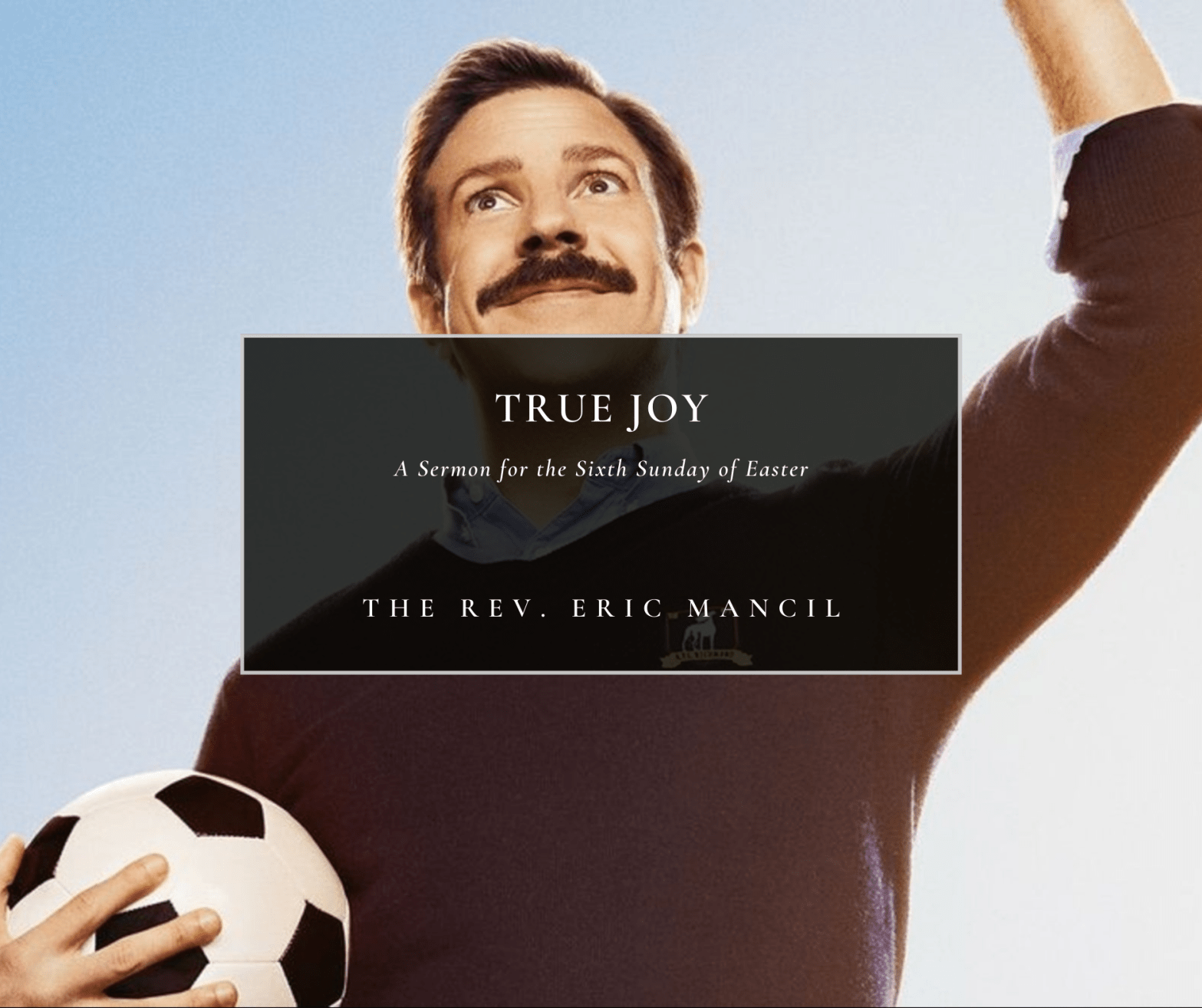
Several months ago, I started reading in the news about a new television show called Ted Lasso. At first, I didn’t pay much attention to it because we didn’t have access to the streaming service that you needed to watch it. It was only available on a service called Apple TV+. After some time passed, we decided to give the service a try, and I began watching Ted Lasso since so many people were talking about how good it was. I’ll admit that it didn’t really seem like a show I would be very interested in. All I knew was that it was a comedy about a college football coach from Kansas who travels to England to begin coaching for a professional soccer team.

I watched the first episode, and I was hooked immediately.

What I found so captivating about the show was the main character, Ted Lasso, played by Jason Sudeikis.  Some of you may know him best from his work as an actor on Saturday Night Live, but he’s been in several movies as well.

Let me tell you about the character of Ted Lasso. He’s upbeat and eternally optimistic. He has a silly, almost childlike, demeanor, and he’s genuinely kind to everyone he meets—even complete strangers. At the beginning of the show, Ted has no idea what he’s walking in to when he’s hired to be the head coach of a professional soccer team. He doesn’t know anything about the sport—the rules or the terminology. He doesn’t know anything about the new country he’s living in. And yet, despite all of this, he remains optimistic and hopeful—almost too optimistic and hopeful to be believed.

As I continued watching the show, I expected at any moment for the character to suddenly change—for the show to reveal to the audience that Ted Lasso wasn’t really who we thought he was all along.

But, what’s interesting about it is that never happened.

Coach Ted was the same lovable, kind, optimistic character from the beginning of the season to the final episode. Now, that doesn’t mean that his life was perfect or that he didn’t make any mistakes along the way. As the season progresses, we learn that he’s actually going through a very difficult transition in his life with his family, who lives back in the United States. We also learn that he was hired for this new position under false pretense. The owner of the team—a woman who was dealing with troubles in her own life—hired him with the hope that he would fail, part of an attempt to get back at someone who hurt her.

So, despite all of his admirable qualities, Ted Lasso isn’t perfect, and he doesn’t have the perfect life.

In fact, he has lots of reasons to simply give up and go back home to Kansas. He has lots of reasons to be angry and upset over the circumstances in his life. He could easily allow all the pressures he’s dealing with—both professionally and personally—to get the best of him. But, he doesn’t, and I think a lot of that has to do with the fact that Ted doesn’t spend his life trying to achieve greatness for himself or trying to impress anyone. He just wants to do what’s right, and for him, that means caring for others and spending his time trying to build others up. That’s where his joy comes from—not from trying to get more for himself—but from giving more of himself to others.

An example of this comes toward the end of the season when he eventually discovers the secret plan of the team owner—the one who hired him to fail and did everything she could to sabotage his efforts along the way. At the end of one episode, she walks into Ted’s office and admits what she’s done. She tells him that he was part of her plan for revenge from the very beginning, and she asks for his forgiveness. He listens to what she has to say, and then—rather than getting angry and storming out of the office—he walks over to her and gives her a hug and tells her, “I think if you care about someone and you got a little love in your heart, there ain’t nothin’ you can’t get through together.” Ted could’ve easily refused her apology and held on to bitterness and hate, but instead, he allowed love to be his guide. He made the choice to forgive her for what she had done. He chose joy.

Ted Lasso isn’t a Christian television show, at least not in the most obvious ways. I don’t think Jesus is mentioned even once throughout the entire season. But, that doesn’t mean that it has nothing to say about the Gospel and how we’re called to live our lives as followers of Jesus.

Jesus teaches us that true joy begins, not with fear or hate, but with love in our hearts, and we express that love by giving up our selves for others. Like the character of Ted Lasso, we have the ability to choose joy, not by living only for ourselves, but by living for those who need our love and our care, for those who need to be lifted up and encouraged. “This is my commandment,” Jesus said, “that you love one another as I have loved you. No one has greater love than this, to lay down one’s life for one’s friends.” As our journey through this Easter season continues, let us abide in God’s love and look for opportunities to live, not only for ourselves, but for others so that we might come to know the joy that God desires for us in our lives and so that our joy may be complete. Amen.


A video of this sermon is available below, beginning at the 14:00 mark.

Spiritual Companionship

A Sermon for the Fifth Sunday of Easter (Year B)
May 2, 2021

Text: Acts 8:26-40

I speak to you in the name of our loving, liberating, and life-giving God: Father, Son, and Holy Spirit. Amen.

From the Acts of the Apostles: “As they were going along the road, they came to some water; and the eunuch said, ‘Look, here is water! What is to prevent me from being baptized?’ He commanded the chariot to stop, and both of them, Philip and the eunuch, went down into the water, and Philip baptized him. When they came up out of the water, the Spirit of the Lord snatched Philip away; the eunuch saw him no more, and went on his way rejoicing.”

The story of Philip and the Ethiopian eunuch is one of my favorite stories from the Book of Acts. Every time I come across it, I’m inspired by Philip’s faithfulness in proclaiming the Good News of Jesus to a complete stranger, someone who had never heard the Gospel. It’s important to point out that the eunuch was on his way home from Jerusalem and reading from the prophet Isaiah, which means that he was probably a convert to the Jewish faith. Upon joining the man on his journey home, Philip took the time to help open up the Scriptures for him. I’m also inspired by Philip’s sense of urgency in the story. When this unnamed stranger from another land asks Philip, “What is to prevent me from being baptized,” Philip doesn’t hesitate. Upon seeing a body of water, the eunuch orders the chariot to stop, and Philip baptizes the man, right there on the spot.

I’ve read this story countless times, but as I was reading it this past week, I noticed a detail that I had never noticed before. The author of Acts makes it very clear that both of these men—Philip and the eunuch—go down in the water together. The author could’ve easily omitted this detail and simply wrote, “Philip got out of the chariot and baptized him.” But, no. This detail is too important to leave out. The author wants us to know that Philip didn’t just baptize the man. He went with him. He accompanied him, side by side, down into the water. Philip became a companion to someone who was brand new to the Christian faith, someone who needed guidance and compassion as he began his walk with Jesus. I imagine Philip taking the man’s hand in his own or wrapping his arm around the man’s shoulder as they both waded in the water until about waist-deep. I imagine Philip scooping up water with both hands and pouring it over the man’s head, saying the same words that so many of us have heard countless times: “I baptize you in the name of the Father, and of the Son, and of the Holy Spirit.”

This story from Acts reminds me so much of my own experience of baptism, which I’m fortunate enough to remember since it happened when I was a student in college. It was the beginning of my senior year at Auburn. Chelsea and I had been attending St. Dunstan’s—the Episcopal campus ministry at Auburn—for about a year, where I served as a member of the student choir. About a week before the annual, Labor Day beach retreat to Fort Morgan, AL, Father Wells, the priest at St. Dunstan’s, discovered that I had never been baptized. So, he approached me one evening after worship and asked, “Would you like to be baptized at the beach retreat?” Without even thinking about it first, I said, “Yes. Yes, I would love to be baptized.”

As time approached for the beach retreat, I grew more and more excited. Not to sound overly dramatic, but it was almost as if something was awakening inside of me that I had never experienced before, as if I was coming alive for the first time in my life and discovering who I was truly created to be. If you’ve ever had an experience like this in your life, you probably know exactly what I’m talking about.

The day of my baptism finally arrived, and all I could feel was an overwhelming sense of anticipation and joy as I was surrounded by my new church family. It was a bright, sunny morning at the beach, not a cloud in sight. The sun reflected off the emerald green waters of the Gulf of Mexico. We began the service on the beach with only  a small table for the bread and wine of Communion set up near the water. We sang songs. We listened to the Scriptures being read. And, when it came time for the Baptism, all of us waded out into the water together, carrying tattered, old copies of the Prayer Book. I was surrounded by love on every side with fellow church members forming a circle around me and Father Wells.

On that day, I was received into the Body of Christ and marked as Christ’s own forever, setting me on a path that I never could’ve imagined for myself. It’s been sixteen years since I received the sacrament of Baptism, and now I’m serving as a priest in the Episcopal Church. A lot of people have been with me and supported me in my journey with Christ up to this point, but I don’t think I would be standing here preaching to you today if it weren’t for Father Wells and the community at St. Dunstan’s. They’re the ones who first welcomed me into the Church, who spread their arms wide and embraced me and said, “You belong here.” They’re the ones who walked with me, side by side, down into the water all those years ago, and I’ll hold onto that sacred memory for as long as I live.

There are people in our lives we can point to who have served as spiritual companions in our journey with Christ, people who not only invited us in and welcomed us as one of their own, but people who also took the time to walk the journey with us, at least part of the way. We can look back in our lives and identify these people because they’re the ones who gave up their time to be with us and show us the path we’re being called to follow, the ones who listened when we needed someone to talk to, the ones who offered us a shoulder to cry on when we felt lost or afraid. They’re the people who didn’t leave us to figure things out on our own, the ones who took us by the hand and wrapped their arms around our shoulders and joined us in our walk with Jesus. These are the people who showed us what it truly means to live in community with our brothers and sisters in Christ.

Can you point to people like that in your life? If you can, be thankful. Be thankful for those people who’ve crossed your path and shown you what the love of God looks like.

And, I want you to know, dear friends, that if you’re new or visiting our parish for the first time, you can find companionship here. Holy Spirit is a place where you can belong, a place where you’ll be loved and accepted for exactly who God created you to be.

As Christians, one of the greatest gifts we can give to another person is the gift of spiritual companionship—of not only telling them they’re loved by God and accepted for who they are but also taking the time to walk side by side with them and letting them know they’re not alone in their walk with Jesus. Speaking from personal experience, I can tell you that this kind of love—the radical love and welcome of Jesus—is life-changing. Like Philip, in our lesson today from Acts, part of our call, as followers of Jesus, is to be ready for wherever the Spirit may lead us. We never know who will cross our path or for how long, but we can be assured that the Spirit is leading us somewhere—often to places and people we least expect. May we be ready and willing to listen for where the Spirit is leading us, and may we have the strength and courage to respond faithfully. Amen.


A video of this sermon is available below, beginning at the 16:56 mark.

Our Model for Ministry

A Sermon for the Fourth Sunday of Easter (Year B)
April 25, 2021

I speak to you in the name of our loving, liberating, and life-giving God: Father, Son, and Holy Spirit. Amen.

Back in January, Episcopalians from all across the Diocese of Alabama joined together online to watch and celebrate the investiture of our new diocesan bishop, The Rt. Rev. Glenda Curry (or “Bishop G” as she likes to be called). Now, you may be wondering, “What exactly does that mean?” Well, in the Episcopal Church, when a new bishop is elected to serve as the head of a diocese, like Bishop G was in January of last year, he or she is first ordained and consecrated to the episcopate, which is just a fancy word for “office of bishop.” Bishop G was ordained and consecrated as a bishop last June and immediately began serving in the diocese as Bishop Coadjutor, which basically means “bishop-in-waiting.” She served in this role until Bishop Sloan’s retirement this past December.

When a current bishop retires, a new bishop takes over, which is the purpose of having an investiture. It’s a ceremonial “passing of the torch” and an opportunity for the Church to ask God’s blessing upon the ministry of the new bishop, who’s been called to lead and offer guidance and care to the entire diocese. It’s a huge weight and responsibility.

Part of the investiture ceremony of a new diocesan bishop is the handing over of the bishop’s crozier, or pastoral staff. This is one of the many symbols associated with the office of bishop. It symbolizes the bishop’s authority as chief priest and pastor of the diocese. If you look at it closely, you’ll notice that it has a very particular shape. The bottom end of the staff is straight and narrow, like a walking stick, but the other end of the staff is curved, almost like the top half of a question mark. You probably know where I’m going with all of this. The bishop’s crozier is actually a shepherd’s crook, which makes the bishop a shepherd and the diocese his or her flock.

When we came to the passing of the crozier during Bishop G’s investiture, Bishop Sloan handed her the staff and said, “On behalf of the people and clergy of the Diocese of Alabama, I give into your hands this pastoral staff. May Christ, the Good Shepherd, uphold you and sustain you as you carry it in his name.” It marked the beginning of her ministry as our new leader—our new shepherd—and was a beautiful moment to witness.

Being a shepherd isn’t an easy job. And, it isn’t a very glamorous job, either.

In Jesus’ time, shepherds pretty much kept to themselves and were seen as very low on the social ladder. Their primary job was to keep watch over their flock and to get them safely to wherever they needed to go. It was dangerous work. Shepherds had to protect their sheep from thieves, robbers, and wild animals, and this is one of the reasons why they carried a shepherd’s crook with them wherever they went. The straight, narrow end of the staff could be used to protect the flock.

The other end of the staff—the curved end—was used to gather the sheep and lead them to wherever the shepherd wanted them to go. Contrary to popular belief, sheep aren’t dumb animals. They can’t be pushed or prodded from behind to get them to go where you want them to go. They have to be led by someone they trust, someone whose voice they recognize. The shepherd goes ahead of the flock and calls to the sheep. This is why Jesus says to the Pharisees in our lesson today from John’s Gospel, “I am the good shepherd. I know my own and my own know me, just as the Father knows me and I know the Father.” When Jesus calls, we know his voice and follow because we love him and put our trust in him. He is the Good Shepherd, the one who leads us and guides us in our lives.

Today is the Fourth Sunday of Easter, also known as “Good Shepherd Sunday.” Each year, on this day, we hear a lesson from John’s Gospel having to do with Jesus as the Good Shepherd—the one who lays down his life for the sheep. On this day, we also hear one of the most popular psalms read during the service—the Twenty-Third Psalm, which begins with the familiar words, “The Lord is my shepherd; I shall not be in want. He makes me lie down in green pastures and leads me beside still waters.” This is the psalm we go to when we think about Jesus as the Good Shepherd. He’s the one who comforts us when we’re lonely and afraid, the one who loves us and cares for us when we’re suffering or in pain. Jesus is also the one who leads us, the one who goes ahead of the flock and guides us to where he would have us go.

Sometimes, I think we forget that part of Jesus’ role as the Good Shepherd. Yes, Jesus comforts us and loves us, but Jesus is also there to lead us and guide us. Sometimes, that includes to places where we don’t want to go or places that challenge us to come out of our comfort zones. I can think of lots of examples in my life when I was perfectly happy and comfortable doing what I was alrighty doing only to have Jesus come along and say, “Follow me.”

It’s no wonder, then, why Jesus, the Good Shepherd, is also our model for ministry in the Church and why people like Bishop G and other ministers are called and entrusted to be shepherds. It isn’t easy or glamorous work, by any means, but it is work that’s necessary in the building up of God’s Kingdom. We need shepherds who are willing minister in Christ’s name, who are willing to go ahead of the flock and guide us, even to places where we may not want to go. We need pastors who are willing to sit with us when we’re hurting or in pain, but we also need pastors who are willing to help us get back on track when we’ve gone astray from the rest of the flock, to help us remember what the voice of the Good Shepherd sounds like.

Now, this is the point in my sermon when I tell you that you don’t have to carry a bishop’s crozier or wear fancy vestments or a white collar to be a shepherd or a pastor. All of us who share in the baptism of Jesus are called to be pastors. The water of Baptism is our investiture. All of us are called to share the love of God in Christ with those who are suffering or in need. All of us are called to help lead the flock of Christ. Bishops help by serving as the chief shepherd of the diocese. Priests help lead by serving as pastors of individual parishes, and deacons help by serving as pastors in the parish as well as in the wider community. But, you don’t have to be ordained to be a pastor. All of us are called to be pastors in some way. All of us are called to look toward Jesus as our perfect example of what true ministry looks like. My prayer for all of us is that  our wills may align with that of the Good Shepherd, that we may look to Jesus, not only for guidance and leadership, but also as an example for what our own ministries might look like in the Church. May we, who share in the ministry of the Good Shepherd, be prepared not only to be guided to places that challenge us but also to lead others there as well, trusting that the way of Jesus will always bring us to greener pastures. Amen.


A video of this sermon is available below, beginning at the 17:35 mark.

You Are Witnesses

A Sermon for the Third Sunday of Easter (Year B)
April 18, 2021

Text: Luke 24:36b-48

I speak to you in the name of our loving, liberating, and life-giving God: Father, Son, and Holy Spirit. Amen.

In Luke’s account of the resurrection story, the risen Jesus appears to his disciples and shows them the marks of the nails in his hands and feet, similar to the account we heard last week in our lesson from John’s Gospel. He wants them to know, without a shadow of a doubt, that he’s truly been raised from the dead. Jesus says to them, “Thus it is written, that the Messiah is to suffer and to rise from the dead on the third day, and that repentance and forgiveness of sins is to be proclaimed in his name to all nations, beginning from Jerusalem. You are witnesses of these things.”

“You are witnesses,” Jesus says.

Why do you think Jesus said this to his disciples? I mean, it seems rather obvious, doesn’t it? Of course they’re witnesses. They’ve seen and heard everything. They’ve been with Jesus and traveled with him since the very beginning of his ministry, through the best of times and worst of times. They’ve seen Jesus heal the sick, restore sight to the blind, and minister to those in need. They’ve heard him preach and share stories about the Kingdom of God and struggled to uncover their meanings. They’ve been his closest friends and allies.

So, of course, they’re witnesses.

Did he think they would somehow forget everything they’ve seen and heard over the past three years?Did he think they would forget the night before he died, that he was betrayed and handed over to the authorities and later crucified on a Roman cross? Did he think they would somehow forget the miracle of his resurrection?  “You are witnesses,” Jesus says. Why do you think he would take the time to point out something so obvious?

Well, I don’t think it was merely an observation, and I don’t think he said it because he was afraid that they would forget everything they’ve witnessed.

When we hear the word “witness” used in our everyday lives, we typically think about people who are called upon to tell the truth, don’t we? We think about people who are called upon to share their experience of a particular event or situation. In legal proceedings, for example, witnesses take an oath, vowing to testify truthfully so that justice may be served. When there’s a car accident or a crime scene, witnesses are frequently called upon by the police to explain the situation with the hope that their testimony will help uncover the truth of what happened. Witnesses share what they’ve seen and heard, and I think this is why Jesus, in Luke’s Gospel, tells his disciples, “You are witnesses.” 

It isn’t merely an observation. It’s a declaration—a calling from Jesus.

Jesus calls his disciples witnesses because he wants them to do something with what they’ve seen and heard. He doesn’t want them to keep it a secret. He wants them to go out and share this amazing story with the whole world—everything they’ve witnessed. He wants them to share the Good News that, through his sacrifice on the cross and resurrection, darkness has given way to the light and the forces of sin and death have been defeated forever. He wants them to share the truth of the resurrection that salvation has come to the world and that new life is always possible.

Friends, as followers of Jesus Christ, this is the message of hope we’ve been given to share with the world. New life is always possible.

Just as he called his disciples, Jesus calls us to do the same—to continue sharing what we know to be true about the Gospel, to continue bearing witness to the redeeming power of God’s love. If we believe the story to be true, that Jesus died to save us all and to proclaim victory over death, then we have every reason to share this Good News—the Best News—with anyone who will hear it.

But, in order to do this—in order to be witnesses for Christ—we have to be prepared and unafraid to share the story of Jesus wherever the Spirit may lead us. And, we have to be prepared and unafraid to share our story—our truth—as well. It’s the most important testimony we can give. When we’re honest about how God’s love has transformed our lives, nothing is more powerful.

About four years ago, I attended my first diocesan convention here in the Diocese of Alabama. It was held at the civic center in downtown Birmingham. The theme of the convention that year was, “Why Jesus? Telling the Compelling Story of God’s Love.” As you can imagine, we talked a lot about evangelism and the importance of being able to share the Good News of God in Christ with people who may have never heard it before or people who have been wounded by the Church or hurt by a particular set of beliefs about God.

During the convention, a priest in the diocese stood up and shared a story about evangelism. In her story, the priest shared that she had recently been invited by a couple with a newborn baby to come over to their home for a gathering of friends and perform a blessing for the baby. The priest already knew this couple, and she knew they weren’t regular church-goers. So, she took some time to explain to them what would be included in the blessing. Everything was great, accept for one minor detail. The parents looked at the priest and said, “We like a lot of what you’re going to say. We like that idea of praying for courage and strength, for kindness and wisdom. We’re on board with that. There’s this one part we have a problem with. It’s all this Jesus language. If you could just figure out how to take Jesus out of this, we’d be really comfortable because we find Jesus, religious talk, absolutely alienating.”

The priest then shared that, rather than getting upset by what the couple asked her to do, she took some time and talked to them about Jesus, and she asked them to talk to her about Jesus.

As I listened to the story about the parents with the new baby, I realized that we have important work to do as evangelists in the Episcopal Church. We have important work to do in bearing witness to the Gospel. We have important work to do in sharing our story with others, in sharing how we’ve come to know the love of God through our faith in Jesus Christ.

I think you’ll probably agree with me that it isn’t easy to talk about our faith, especially when the general perception of Christianity is that we’re a church full of hypocrites. I mean, how many times have we heard news of some influential pastor or church leader who was caught laundering money or who admitted to an adulterous affair? How many times have we heard news of churches advocating for public policies that would discriminate against or hurt those on the margins? How many times have we heard news of churches turning their backs on those who needed them the most?

And how many times have we thought to ourselves, “If that’s what Christianity is about, then maybe I’m not a Christian at all.” I’d be lying to you if I said I never had those thoughts as well.

But, the examples I just listed have nothing to do with Jesus. Jesus is our light and our salvation. Jesus is the one we call Lord and Teacher, the one we look to for guidance and direction in our lives. Through his life, death, and resurrection, we’ve come to know who God is and what God calls us to do.

Jesus doesn’t alienate others because they look different or act different.
He welcomes them with open arms.

Jesus doesn’t discriminate against those on the margins.
He loves them and says to them, “You are blessed.”

Jesus doesn’t turn his back to those in need.
He shows compassion and mercy, and he cares for them.

For these reasons and for so many others, the story of Jesus needs to be shared with the world. No, it isn’t easy to talk about our faith, especially when the Church has been responsible for so much pain and heartbreak, but the Gospel of Jesus—the truth of who Jesus really is—is too important not to share. Our story, the story of how Jesus has transformed our lives, is too important not to share.

At the convention four years ago, after the priest was done sharing her evangelism story about the couple with the new baby, she led all of the convention delegates through a short, spiritual exercise. She asked each of us to take a few minutes to come up with something called an “elevator speech.” For those of you who aren’t familiar with this concept, it’s very simple. In the business world, an “elevator speech” is a one to two-minute pitch that an entrepreneur has prepared in case the opportunity ever arises to present it to a business owner or investor. The intention of an “elevator speech” isn’t to sell something right away but to leave the business owner or investor with something to think about later.

So, our task, as convention delegates that year, was to come up with an “elevator speech” for Jesus. The point of the exercise wasn’t to come up with a way to change someone’s mind or point-of-view or to convince someone that they need to join our church. The point was to come up with a clear and simple way for us to talk about our faith in Jesus. The point was for us to come up with a way to tell our story and to invite others to join us in this life-giving faith that we all share.

Jesus calls all of us to be witnesses, but in order to do that, we have to be prepared and unafraid to tell the truth of what we’ve seen and heard. We have to be prepared and unafraid to go out and proclaim to the world that, through Christ, new life is always possible.

If you were to take a few minutes to come up with your own “elevator speech” for Jesus, what would you say? How has your faith in Jesus changed you? How has Jesus brought you from death into new life?

Amen.


A video of this sermon is available below, beginning at the 15:25 mark.

Faithful Thomas

A Sermon for The Second Sunday of Easter (Year B)
April 11, 2021

Text: John 20:19-31

I speak to you in the name of our loving, liberating, and life-giving God: Father, Son, and Holy Spirit. Amen.

It’s been one week since Easter Sunday. One week since we celebrated the glorious resurrection of our Lord Jesus Christ with Easter hymns and shouts of “Alleluia.” One week since our children came up to the front of the church during the 10:30 service to “flower the cross,” signifying our Lord’s victory over death. It’s been one week since we marked the occasion with a children’s Easter egg hunt on the front lawn of the church and enjoyed the beautiful, springtime weather that God provided for us.

It’s been one week since we did all these things, but in a way, it already seems like a distant memory. Holy Week and Easter have come and gone, and now we’re back to life as usual.

And yet, if you look at the front of your bulletin for today, you’ll notice at the top where it says, “The Second Sunday of Easter.” In the Episcopal Church, Easter isn’t just one day of joy and celebration. It’s actually an entire season of the Church year, beginning on Easter Day and lasting all the way through the Day of Pentecost. We get to celebrate our Lord’s resurrection, not just for one day but for fifty days. While grocery stores have already marked down their bags of Easter candy and department stores have already put up their Easter decorations and started preparing for the next major holiday, here we are, still basking in the joy of Easter. The world around us has already moved on, but the Church has only just begun.

We know that there are still important parts of the story to hear and lessons to learn. We know that the story of that first Easter morning didn’t end with Mary Magdalene discovering the empty tomb of Jesus. It was only the beginning.

Today’s lesson from the Gospel according to John picks up right where we left off last Sunday. In the evening, on the day of resurrection, the risen Jesus mysteriously appears to his disciples for the first time. Despite the doors of the house being locked where the disciples have gathered, Jesus appears, and he says to his friends, “Peace be with you.” As evidence that he’s truly returned, Jesus shows them the mark of the nails in his hands and the side of his body, where he was pierced, and he says to them once again, “Peace be with you.” These are comforting and familiar words to us as Episcopalians. I’m a little surprised that the disciples didn’t respond to Jesus by saying, “And also with you.”

After he says this, Jesus wastes no time. In that same moment, he commissions his disciples to go forth into the world, proclaiming the Good News, saying to them, “As the Father has sent me, so I send you.” Then, he empowers them to do this work with the Holy Spirit by breathing on them and saying, “Receive the Holy Spirit. If you forgive the sins of any, they are forgiven them; if you retain the sins of any, they are retained.”

All of the disciples are there, accept one—Thomas, who was called the Twin. For some unknown reason, Thomas isn’t with the rest of the disciples when Jesus first appears. He shows up later and has to be told what happened by the other disciples. At first, Thomas is skeptical and doesn’t believe them. He says, “Unless I see the mark of the nails in his hands, and put my finger in the mark of the nails and my hand in his side, I will not believe.” Because of his reluctance to believe on word alone, history has given Thomas the unfortunate nickname, “Doubting Thomas.” Of course, we know how this part of the story ends. Jesus appears to the disciples again a week later, and this time, Thomas is with them. This time, Thomas sees for himself the risen Christ and declares to him, “My Lord and my God.”

Yes, it’s unfortunate that history has given Thomas the nickname, “Doubting Thomas,” as if questioning the truth of the resurrection, based on word alone, was such a terrible mistake. Can we really blame Thomas for wanting to see for himself what the other disciples witnessed firsthand? Can we honestly say that we wouldn’t have done the same thing if we were in his position? Think about it for a moment. How many times in our own lives have we believed something that was “too good to be true” only to be let down later. Usually, if something is “too good to be true,” it probably isn’t true at all. We have to see it to believe it.

In my opinion, what many of us perceive as Thomas’ lack of faith isn’t actually a lack of faith. It’s a holy curiosity. It’s a longing and desire to see for himself this miraculous turn in the story. It’s a longing and desire to see for himself if what was once dead can truly be raised up again, if what was lost can once again be found. Curiosity is an attribute that Thomas demonstrates in other parts of the Gospel as well.

Think back to that part of the story when Jesus was with his disciples on the night before he was crucified. Among many things, he told them that he was going to prepare a place for them. He said, “You know the way to the place where I am going.” Curious about what Jesus told them, Thomas said, “Lord, we do not know where you are going. How can we know the way?” Jesus replied, “I am the way, and the truth, and the life. No one comes to the Father except through me. If you know me, you will know my Father also. From now on you do know him and have seen him.”

I imagine that, when Thomas saw the risen Christ for the first time, he recalled what Jesus had told them. “If you know me, you will know my Father also. From now on you do know him and have seen him.” Perhaps it was this memory that inspired Thomas to say to Jesus, “My Lord and my God.” Perhaps it was this memory, combined with the experience of seeing Jesus again with his own eyes, that gave Thomas the strength and courage he needed to go forth into the world to spread the Gospel.

Like Thomas, we need those moments of grace to sustain us in our lives in Christ. We need to witness with our own eyes those outward and visible signs of new life and resurrection. They give us strength and courage. They inspire us and motivate us to continue our walk with Jesus. Without them, it can be easy to forget why we were called in the first place. Without them, it can be easy to forget the importance of our calling. There’s so much darkness in the world around us. We see it every day in the news, from stories of racial injustice and violence to stories of mass shootings and political corruption. We need to witness those moments of new life and resurrection to remind us that God’s Kingdom is still worth fighting for. We need those moments to remind us of the bold proclamation we make as Easter people: Christ is risen, and death is defeated, once and for all!

It isn’t wrong to look for signs of new life and resurrection. If we open our eyes, we can see examples springing up all around us, like last Saturday at the Great Vigil of Easter, when we baptized Evey Thibodeau and welcomed her as the newest member of the Body of Christ. It isn’t wrong to ask questions or to explore God’s creation with a sense of holy curiosity. In fact, I would say it’s the exact opposite. It’s good for us. It’s a sign of hope for what’s to come, a sign of faithfulness. Perhaps, then, we should petition to change Thomas’ nickname to “Faithful Thomas” rather than “Doubting Thomas.”

Just because we can no longer see the risen Christ as he revealed himself to the disciples doesn’t mean that we can’t see signs of Easter. They’re everywhere, all around us, if we’ll only take the time to open our eyes and look. The story of Jesus’ resurrection didn’t end at the conclusion of the Gospels. It continues through us—through our willingness to look for the risen Christ and to serve as the hands and feet of Christ in the world. Amen.


A video of this sermon is available below, beginning at the 16:40 mark.

Rejoice

A Sermon for the Great Vigil of Easter
April 3, 2021

Text: Romans 6:3-11

Let none fear death, for the death of the Saviour has set us free. Christ is risen and the demons have fallen. Christ is risen and the angels rejoice. In the name of the Father, and of the Son, and of the Holy Spirit. Amen.

I would be lying if I told you that I had some deep, theological insight into the mysteries of Holy Week and the events surrounding Jesus’ passion, death, and resurrection. But, the truth, dear friends, is that the liturgies of Holy Week, including Maundy Thursday, Good Friday, and the Great Vigil of Easter, preach themselves in a very profound way, not only through the words we speak and the hymns we sing but also through the experience of walking with Christ from the upper room where he said goodbye to his friends to the rock-hewn tomb in which he was placed after his death on the cross.

Think about all we’ve experienced with Jesus over the past three days:

The water washing over our feet.
The Bread and the Wine, broken and poured out in the Eucharist.
The darkness of the church.
The silence.
The crown of thorns.
The hard wood of the Cross.
The newly kindled fire.
The water of Baptism.
The first, “Alleluia!”

All of these are signs that the Holy Spirit is in motion, stirring up in us that which the world cannot give, a hope that can no longer be contained.

The liturgies of Holy Week and Easter engage our senses and bid us to enter fully into the mystery of joy and suffering as we participate with Christ in his death and resurrection.

Notice that I used the word, “participate.” This shouldn’t come as a surprise, but if it is, I ask you the same question that St. Paul asked in his letter to the first Christians in Rome: “Do you not know that all of us who have been baptized into Christ Jesus were baptized into his death?”

Through the Sacrament of Holy Baptism, we are buried with Christ in his death and raised to newness of life, an affirmation of faith that we proclaim boldly, especially on this night as we celebrate the Passover of the Lord and welcome a new member into the Body of Christ, Evelyn Rae Thibodeau.

“This is the night, when all who believe in Christ are delivered from the gloom of sin, and are restored to grace and holiness of life.”

“This is the night, when Christ broke the bonds of death and hell, and rose victorious from the grave.”

“This is the night,” according to one author, “that is like day, the dawn of reconciliation, peace, and the forgiveness of sin.”

This is the night, when we are once again reminded that not even the shadow of death can separate us from the love of God and that darkness always gives way to the light.

In the sixteenth chapter of John’s Gospel, just before Jesus is arrested and put on trial for sedition against Rome, Jesus tells his disciples that he’ll be with them only a little while longer and that they’ll soon grieve and mourn for him. Knowing that his arrest is imminent, Jesus says to them, “Very truly I tell you, you will weep and mourn while the world rejoices. You will grieve, but your grief will turn to joy. A woman giving birth to a child has pain because her time has come; but when her baby is born she forgets the anguish because of her joy that a child is born into the world. So with you: Now is your time of grief, but I will see you again and you will rejoice, and no one will take away your joy.”

“Now is your time of grief,” Jesus says, “but I will see you again and you will rejoice…”

Rejoice. It’s the first word of the ancient Easter hymn, the Exsultet, proclaimed each year at the beginning of the Great Vigil of Easter.

“Rejoice now, heavenly hosts and choirs of angels…”
“Rejoice and sing now, all the round earth…”
“Rejoice and be glad now, Mother Church…”

Rejoice. Our great Easter proclamation, that death and sin no longer have dominion over us, that grief and suffering have given way to joy.

Over the past year, as we’ve endured this terrible pandemic, I’ve thought a lot about how “sadness and joy,” as Henri Nouwen once wrote, “kiss each other at every moment” and how this informs our understanding of Christian discipleship. We’re formed as disciples of Jesus through our participation in his death and resurrection, and I’m convinced that this is something we’re continually called to do. I’m convinced that, every time we die to self and give up our lives as a living sacrifice, we grow more and more into the full stature of Christ. We continue to experience the resurrected life that God desires for each of us.

For many Christians, one of the most poignant and moving traditions of Lent and Holy Week is participating in The Way of the Cross. This year at Holy Spirit, we observed this ancient prayer practice on Holy Wednesday, as participants walked with Christ along the path of sorrows as he endured the agony of his passion and death.

At each of the fourteen stations, we paused to contemplate not only the sadness and the despair but also the joy and new life that is promised to all who follow in our Lord’s footsteps, an example of how joy and sorrow are so intimately connected in the life of a Christian. 

Even now, as we celebrate the feast of our Lord’s resurrection, in the midst of Easter joy, the world continues to revolve, and people everywhere continue to suffer.

Easter joy isn’t a cure for the brokenness of our world, and it isn’t a goal to reach, as if everything else we experience during Holy Week is simply an obstacle to overcome.

The great joy that we experience at Easter is hope for the world—a sign that all is not lost, that God is still present in our lives, working in us and through us. Our great joy at Easter is the hope that, in the fullness of time, God’s dream of heaven on earth will finally be realized.

But, until that day comes, let us continue to serve God by offering ourselves as instruments of God’s love and mercy to this broken and suffering world, and let us rejoice without ceasing in the saving work of God in Christ. Amen.

I Am Thirsty

A Sermon for Good Friday
April 2, 2021

Text: Psalm 69:1-21

I speak to you in the name of our loving, liberating, and life-giving God: Father, Son, and Holy Spirit. Amen.

From the sixty-ninth psalm:

Save me, O God,
for the waters have come up to my neck. 
I sink in deep mire,
where there is no foothold;
I have come into deep waters,
and the flood sweeps over me. 
I am weary with my crying;
my throat is parched.
My eyes grow dim
with waiting for my God.

I don’t think we can hear the opening verses of Psalm 69 without considering the dangers of one of God’s most precious gifts—the gift of water.

Water is a source of life.
It sustains us when we’re thirsty.
It provides us with the means to wash ourselves when we’re dirty.
It causes the fruits of the earth to grow and flourish.
It cools our bodies in hot, sweltering weather.

But, water can also be dangerous.

It can be a source of destruction and death. All you have to do is ask someone who’s lived through a  flash flood or a major hurricane, and they’ll tell you.

No wonder it’s used to symbolize both death and new life in the sacrament of Holy Baptism, our initiation into the Body of Christ.

No wonder the image of water is so deeply connected to the final days of Holy Week as we draw closer to Jesus and become participants in his death and resurrection.

Last night, in the liturgy for Maundy Thursday, water was used in the washing of feet, a symbol of the new commandment that Jesus gave to his disciples before he was handed over to those who would persecute him.  Jesus said to Simon Peter, “Unless I wash you, you have no share with me.” Jesus says to us, “Unless you allow yourselves to be washed in the love of God, you have no way of knowing what it means to serve God.”

Tomorrow night, on the eve of Easter, water will be used as a symbol of new life. After we kindle the new fire and process into the darkened nave of the church, we’ll once again hear the ancient story of Israel’s deliverance from bondage in Egypt as God’s chosen people were led through the Red Sea on dry land.  Water will also be used to baptize those being received into the Body of Christ and to remind us all of the vows that were made at our own baptism.

But, before we can get to the Great Vigil of Easter, we must observe this solemn day. On this day, there is no water. On this day, the absence of water is used to illustrate the agony that our Lord experienced on the cross. The wellspring has run dry. The font is empty. Like Jesus, we long for water to quench our thirst. We long with Jesus for God’s Kingdom to finally be fulfilled.

Jesus said while hanging on the cross, “I am thirsty.”

Good Friday is our most explicit reminder that the Kingdom of God—God’s dream of redemption for this cruel and sinful world—is not yet fulfilled.

How many of our brothers and sisters in the world struggle each day to make ends meet, unsure of where their next meal will come from, unsure of where they’ll lay their head for the night, unsure of how they’ll provide necessities for their children? How many people live with the fear and constant threat of oppression, violence, and discrimination? How many people around the world wonder whether each new day will be their last?

I ask these questions because on this day, perhaps more than any other day throughout the year, we remember those who’ve been forgotten. We remember those who’ve been overlooked because of the sins of the world, because of the sins we’ve committed, both known and unknown.

I ask these questions because Good Friday is the day when we walk with Christ in his suffering as he journeys to the cross. Today is the day when we offer up our whole selves—our broken and thirsty selves—with the one who was crucified, the one who sacrificed himself so that we might be delivered from the power of sin and death and brought into new and everlasting life.

In our day to day lives, we often lose sight of what it is that we thirst for. Good Friday is the day when we remember. It’s an opportunity to ask for God’s forgiveness as we leave our sins at the foot of the cross.

God knows that we struggle. God knows that we aren’t perfect and that we’re going to get it wrong from time to time. But, God also knows that we’re on a journey to become more like Jesus.

Perhaps, Mary Oliver illustrates this best in her poem, “Thirst.”

Another morning and I wake with thirst
for the goodness I do not have. I walk
out to the pond and all the way God has
given us such beautiful lessons. Oh Lord,
I was never a quick scholar but sulked
and hunched over my books past the hour
and the bell; grant me, in your mercy,
a little more time. Love for the earth
and love for you are having such a long
conversation in my heart. Who knows what
will finally happen or where I will be sent,
yet already I have given a great many things
away, expecting to be told to pack nothing,
except the prayers which, with this thirst,
I am slowy learning.

Oh Lord, be patient with us. In your mercy, grant us a little more time.

Love for the earth and love for you are having such long conversations in our hearts. Daily, we struggle to live our lives as you would have us live.

As we thirst for your Kingdom, accept the prayers and supplications that we offer before you for your whole creation, and in our moments of weakness and transgression, look with favor upon us, we humbly pray.  Amen.

The Servant Song

A Sermon for Maundy Thursday
April 1, 2021

Text: John 13:1-17, 31b-35

I speak to you in the name of our loving, liberating, and life-giving God: Father, Son, and Holy Spirit. Amen.

Years ago, when I was a student at Auburn University, I attended St. Dunstan’s—the Episcopal student center on campus. One of my favorite services to attend at St. Dunstan’s was our weekly Folk Mass, which was held on Tuesdays at 5:30 in the evening.

This service was very different than our normal, Sunday evening service at St. Dunstan’s. For example, there were no fancy vestments. The priest usually just wore a clergy shirt and a stole, something very simple. We didn’t all sit in rows of chairs, facing the altar at the front of the church. Instead, we set up at altar table in the center of the Nave, with groups of chairs surrounding it on each side so that everyone could clearly see what was happening. There was no organ music, and there were no hymns from the hymnal, either. In place of these were guitars and songs from the Alleluia 2 songbook. Some of you may be familiar with these songs, especially if you’ve been to Camp McDowell or attended a Cursillo weekend.

Some of my favorite spiritual songs come from the Alleluia 2 songbook, songs like “Here I Am, Lord” and “They’ll Know We are Christians by our Love” and “May the Road Rise with You.” I have such fond memories of these songs, and every time I get to sing them, it brings me back to places like St. Dunstan’s and Camp McDowell—sacred places that’ve formed me in my life in Christ.

There’s another song from the Alleluia 2 songbook that’s always meant a great deal to me. It’s called “The Servant Song,” and every time I read our passage from tonight’s Gospel reading, I’m reminded of the lyrics.

The first verse goes like this:

Won’t you let me be your servant.
Let me be as Christ to you.
Pray that I may have the grace
To let you be my servant, too.

It’s the last part of that verse that causes me to stop and think every time I sing it. “Pray that I may have the grace to let you be my servant, too.”

It’s hard to let others serve us, isn’t it? It’s hard, especially when we don’t have to do anything in return. I think most of us would probably agree that we’d much rather serve others than allow ourselves to be served. We’d much rather be like Jesus in tonight’s Gospel lesson from John, who gets up from the dinner table after supper, ties a towel around his waist, and begins to wash the feet of his disciples—an act of lowly service normally reserved for women and household slaves in the time of Jesus. It’s one of the final things Jesus will do before he’s arrested later in the evening and handed over to Roman guards.

We’d much rather be the one washing feet than having our own feet washed. To be served as Jesus served his disciples, without anything expected in return, requires a certain amount of vulnerability, of letting go of our need for control, and a willingness to accept the fact that we are loved for who we are, exactly how God made us.

But, that’s easier said than done. We spend so much of our time and energy trying to convince ourselves that we don’t deserve to be loved in such a way, that we don’t deserve to be loved and cared for in the way that Jesus demonstrates to his disciples.

The exchange between Jesus and Peter, in tonight’s Gospel lesson, is a good example of what I’m talking about. When it’s Peter’s turn to have his feet washed by Jesus, Peter looks at him, astonished, and asks, “Lord, are you going to wash my feet?” He can’t believe that Jesus—his Lord and master—would do something normally done for him by a servant. He can’t believe that Jesus would get down on his own two knees, roll up his sleeves, and wash the dirt and grime from his feet. Jesus tells him, “You do not know now what I am doing, but later you will understand.” Peter responds adamantly, “You will never wash my feet.” But, Jesus says to him, “Unless I wash you, you have no share with me.” 

In other words, Jesus says to Peter, “Unless you learn what it means to be served—unless you know what it feels like to be loved unconditionally, you’ll never understand the ministry to which I’m calling you as my disciple.”

Peter doesn’t see himself as worthy of such a lowly and humble act of service by Jesus. His reluctance to be served in such a way is similar, I think, to the way many of us respond in similar situations.

Think about it for a moment. How many of us politely refuse when someone offers to serve us? I’ll be the first person to admit it. When asked if someone can do something for us, how many of us respond with something along the lines of, “Oh, no thanks! I’ve got it!” or “No, don’t worry about it! I can do it myself!” We need to be in control, don’t we? We’d much rather handle things ourselves than allow someone else to handle them for us. We’d much rather bend down and wash our own feet than allow another person to do it.

What we fail to recognize, though, is that, by denying others the opportunity to serve us, we’re limiting ourselves and our ability to learn more about the love of God in Christ Jesus. When we deny others the opportunity to serve us, we’re limiting our ability to draw closer to Jesus and to learn more about what it means to be his disciple.

That’s really what this night is all about—drawing closer to Jesus, like his disciples did on that final night in the upper room.

During the service for Maundy Thursday, it’s a tradition in the Episcopal Church to include the ritual washing of feet, not only as an act of remembrance but also as an act of participation in the servant ministry of Christ. We do it as a way to remember and acknowledge who we are as followers of Jesus so that we can go out and be ready to wash the feet of those who need to be loved and cared for the most.

In just a moment, I’m going to invite those of you who would like to participate to come up in front of the altar and have your feet washed. You’ll also have the opportunity to wash the feet of the person who washed yours. If you don’t feel comfortable doing it, that’s okay. It isn’t required that you participate, but I want to encourage you to give it a try, especially if you’ve never done it before.

By washing each other’s feet and taking the time to serve one another, we grow in our discipleship and carry with us the commandment that Jesus left with his disciples: “Love one another. Just as I have loved you, you also should love one another. By this everyone will know that you are my disciples, if you have love for one another.”

Resist the idea, dear friends, that you’re unworthy of being loved as Christ loves you. You are worthy, and you are loved. Resist the idea that you need to do everything on your own and have no need to be loved and served by others. There is a need. It’s how we grow more and more into the image and likeness of the God who made us.

In the words of “The Servant Song,”

 Won’t you let me be your servant.
Let me be as Christ to you.
Pray that I may have the grace
To let you be my servant, too.

Amen.

Love Lives Again

A Sermon for the Feast of the Resurrection: Easter Day
April 4, 2021

Text: John 20:1-18

I speak to you in the name of our loving, liberating, and life-giving God: Father, Son, and Holy Spirit. Amen.

Life was quite different last Easter, wasn’t it? This time last year, rather than sitting in church on Easter morning, ready to celebrate the glory of our Lord’s resurrection, my family and I sat on the couch in our living room, watching a live broadcast of the Easter service from the Washington National Cathedral. The Most Rev. Michael Curry, Presiding Bishop of the Episcopal Church, preached a lovely and timely sermon while the Rt. Rev. Mariann Budde, Bishop of Washington, celebrated the Eucharist. Our family watched the live-streamed service on our television and listened to the beautiful music, and we did our best to muster up as much Easter joy as we possibly could! We even had a makeshift altar set up in the living room with candles and a colorful arrangement of flowers.

Normally, we would’ve invited other family members over for the weekend to help us celebrate the holiday, but since times were so uncertain a year ago and there was no possibility yet for a vaccine, we decided to “play it safe” and not take any risks. So, our family celebrated Easter alone last year, as so many families did. It was just the four of us.

As you might recall, the weather was awful that day with heavy rain and thunderstorms, which meant that we couldn’t even go outside and enjoy an Easter egg hunt in our front yard. But, some things remained the same, and we weren’t going to let a global pandemic and thunderstorms prevent us from enjoying the day. The Easter Bunny still showed up, leaving gifts and surprises for the kids. We still enjoyed a delicious meal around the dinner table and enjoyed being together. And, most importantly, we still celebrated Easter with shouts of, “Alleluia,” giving thanks to God for the gift of new life we’ve been given through our Lord’s death and resurrection.

Yes, Easter was quite different a year ago, but then again, so were a lot of things.

At the time, we were in the middle of a statewide lockdown, and I was working mostly from home, trying my best to keep things running smoothly here at church and leading services throughout the week that were hopefully meaningful and comforting. At the same time, I was trying my best to be a full-time, stay-at-home dad and school teacher since all of the public schools were closed and teachers had no choice but to offer instruction online.

One memory that I’ve carried with me from that time was a conversation I had with Jude a few days before Easter, on Good Friday. His teacher had given him an assignment. She told him to choose any book he would like, read it, and then answer some questions about the book. Since it was Holy Week and we were getting ready for Easter, Jude decided to pick out an Easter story. He read the story by himself, and when he was done, he started answering the questions. One of the questions was, “What would you change about the story to make it better?” Jude carefully thought about it for a moment, and then, without hesitating, he said, “I would change it so that Jesus didn’t have to die.”

I looked at him, and he looked back at me.

He wasn’t upset, but I could tell that he understood the weight of the story. It had a happy ending, of course, with Jesus being raised from the dead, but in order to get there, Jesus first had to sacrifice himself. Jesus had to endure much suffering and die on the cross in order to be raised back up again.

I think Jude understood this, but it didn’t make the story any easier. For him, the happy ending of Jesus’ resurrection was wonderful, but the story would be so much better without the part about Jesus having to die on the cross.

Honestly, I can’t blame Jude for wanting to change the story. It’s difficult to read. It’s even more difficult to imagine what it must’ve been like for Jesus in those final hours of his life—the pain he endured, how alone he must’ve felt. How many of us, if we were given the opportunity, would change what happened to Jesus? How many of us would do everything we can to spare Jesus from the agony of the cross, even though we know what happens in the end?

Suffering is something we try to avoid at all costs, especially when it involves the people we love. I think that’s why the church is typically a lot more crowded on Easter Day than it is on Good Friday. We would much rather skip over the painful parts of the story and go straight to the joy of Easter. What we sometimes forget, though, is that Good Friday is part of the story, whether we like it or not. It can’t be forgotten or ignored. Without Good Friday, there would be no Easter. Without the suffering servant going to the cross and dying for all of us, there would be no redemption, no promise of new life with God. This is the Paschal Mystery—the mystery we’re invited to experience each year during Holy Week and Easter. The darkness of Good Friday gives way to the light of Easter morning. Jesus has passed over from death into new life, and we are changed forever. Jesus said it this way, just a few days before his death: “Unless a grain of wheat falls into the earth and dies, it remains just a single grain; but if it dies, it bears much fruit.” As followers of Jesus, we are part of the mystery as well. By giving up our lives in the sacrament of Baptism, by renouncing the evils of this world and committing ourselves to the way of self-giving, sacrificial love, we too have passed over from death into new life.

This year, it’s impossible for me to hear the story of that first Easter Day and not immediately think about all we’ve been through over the past year with the pandemic. Last Easter, there’s no way we could’ve known what was coming. There’s no way we could’ve known that, one year into the pandemic, we would still be wearing masks, staying socially distant, and limiting the number of people we can seat in church. There’s no way we could’ve known at the time that so many lives would be lost before all of this was over. We’ve lost so much already. We’ve lost jobs. We’ve lost valuable time with family and friends. We’ve lost loved ones. We’ve had to give up so many things that make life worth living. And yet, if we know anything about the joy of Easter, we know that God has been with us every step of the way and that God will be with us until the very end. If we know anything about the joy of Easter, we know that death has been defeated, once and for all, and that nothing—not even a global pandemic—can separate us from the love of God in Christ Jesus.

Like the disciples who fled from Jesus and went into hiding after he was arrested, we know what it feels like to be scared and alone. We’ve experienced it firsthand throughout this past year, every time we turned on the news and every time we were told to shelter-in-place at home. Like the disciples, who sat and waited after Jesus’ death, uncertain about what the future may hold, we know what it feels like to sit and wait with the fear of uncertainty. In some ways, we’re still waiting as this pandemic drags on.

But, unlike Jesus’ disciples, we have the benefit of knowing what happens on the third day.

On the third day, something happened that no one thought was possible. Early in the morning, while it was still dark, Mary Magdalene discovered that the tomb where they had laid Jesus’ body was now empty. Jesus was risen. Death was put to flight, and love lived once again.

If we truly believe that, dear friends, if we truly believe that death has been defeated and that love lives again, then we have no reason to doubt that God is with us, even as we continue to endure the suffering of this present moment. If we truly believe that Christ is risen from the dead, then we have no reason to be afraid and every reason to spread the Good News of our Lord’s resurrection to the world. Say it with me, and say it like you mean it. Alleluia! Christ is risen! The Lord is risen indeed! Alleluia!

Amen.


A video of this sermon is available below, beginning at the 20:40 mark.

Poor Judas

A Meditation for Wednesday in Holy Week
March 31, 2021

Text: John 13:21-32

I speak to you in the name of our loving, liberating, and life-giving God: Father, Son, and Holy Spirit. Amen. 

I have a confession to make, one that might seem controversial to most people. I actually feel kind of sorry for Judas Iscariot. I know what you might be thinking. “How could you feel sorry for the man who betrayed Jesus?” But, hear me out for a moment.

The Gospels clearly state that Judas was a thief. He carried the common purse and often stole money from Jesus and the other disciples, money that probably would’ve been used to help the poor and needy.

I know that Judas wasn’t someone you’d look to as the model disciple. Like we heard on Monday in our Gospel lesson from John, Judas criticized Mary of Bethany for the loving act of devotion she showed toward Jesus when she anointed his feet with oil, preparing him burial.

And yet, despite all these things, Judas Iscariot was chosen by Jesus to be one of the twelve apostles. Think about it. He was chosen by Jesus to travel alongside him in his ministry, to learn from him, and to spread the Good News to the people of Galilee that the Kingdom of God has come near. Like Simon Peter and his brother, Andrew, and James and John, the sons of Zebedee, Judas was chosen for a reason. Out of all the people Jesus could’ve called, he chose Judas—a person who was willing to trade Jesus’ life for thirty pieces of silver.

It’s often said that God doesn’t call the equipped. God equips the called. God calls the most unprepared, unqualified, and unexpected people to do God’s work, and we see examples of that all throughout the Scriptures. Judas is just one more example.

I think the most tragic part of Judas’ story isn’t the fact that he betrayed Jesus. It’s the fact that he didn’t get to experience reconciliation and forgiveness, at least not in his earthly life. We learn in the Gospel of Matthew that Judas was so consumed with guilt over his betrayal of Jesus that he took his own life. He never got to experience the resurrected Christ or to hear Jesus speak the words, “I forgive you.”

I suppose the real reason I feel kind of sorry for Judas is because his name has become synonymous with betrayal. Yes, he betrayed Jesus in one of the worst ways imaginable, but then again, so did the other apostles. In Jesus’ moment of need—in the moment he needed his friends the most—they all fled and hid away, afraid that they would suffer the same fate as their teacher. Yes, Judas betrayed his friend, but then again, all of us are guilty of betraying Jesus. Every time we turn our back on someone in need of help. Every time we refuse to hear the cries of the oppressed and downtrodden. Every time we forget that each of us is made in God’s image and worthy of love and respect, we betray Jesus.

The Good News, dear friends, is that God is always ready to forgive us. No matter how far we’ve fallen. No matter our betrayal. No matter our refusal to follow in the way of love. God is ready to forgive. On this Holy Wednesday, may we see clearly our need to be forgiven, and may God grant us the strength and wisdom to be faithful in our calling. Amen.