
A Sermon for the First Sunday after the Epiphany: The Baptism of our Lord
January 9, 2022
Text: Luke 3:15-17, 21-22
I speak to you in the name of our loving, liberating, and life-giving God: Father, Son, and Holy Spirit. Amen.
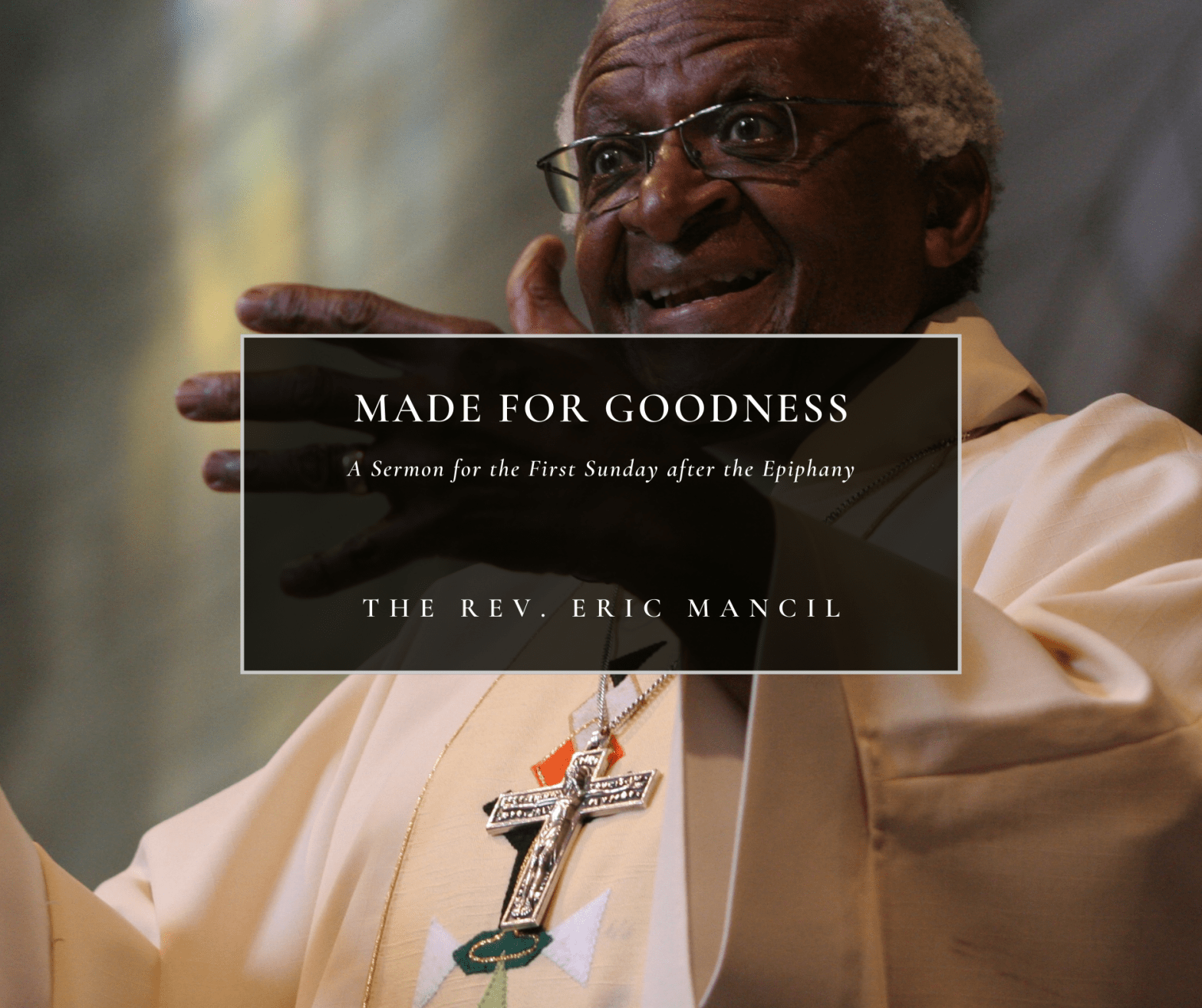
Two weeks ago, on the day after Christmas, the world mourned as we said goodbye to Archbishop Desmond Tutu. The archbishop was ninety years old when he passed away at his home in Cape Town. As most of you probably know already, Desmond Tutu was an instrumental figure in the struggle to tear down the system of apartheid in South Africa, which finally came to an end in the early 1990s. He was also an advocate for peaceful reconciliation in the years that followed. Under the leadership of Nelson Mandela, Archbishop Tutu served as the chairman of the Truth and Reconciliation Commission, which was established in order to bring healing to the country and offer a way forward. He was committed to the idea of restorative justice and believed that the only path to true peace and reconciliation—after decades of violence and oppression under apartheid—was by seeking the truth and offering forgiveness to those who were responsible.
Even though he’s no longer with us, I’m so thankful for the life and ministry of Desmond Tutu and for all he taught us about how to love others and offer mercy in the name of Jesus Christ. Our Presiding Bishop, Michael Curry, offered these words shortly after his death: “While on this earth, he sought to follow Jesus of Nazareth in God’s way of love and life. In so doing, he showed us how to live God’s dream as children of the one God and creator of all. So, even in our sorrow that he is no longer walking among us, we can thank God that he did.”
I’ll always remember Desmond Tutu as the first person who taught me, through his writing, that all of us—no matter who we are or what we’ve done or left undone—are completely and unconditionally loved by the God who created us. We were loved into being and formed in the image and likeness of God. In his book, Made for Goodness—which he co-authored with his daughter, Mpho—the archbishop wrote, “From the time before eternity our God has awaited each birth with love and delight. ‘Before I formed you in the womb I knew you’ is the word of God to the Hebrew prophet Jeremiah. It is equally God’s word to each of us. Before the ‘Let there be…’ of creation, before God breathed Adam’s first breath, God knew us and God loved us. God loves each of us as though there were no one else in the world, as though there were only one person to love. We are so precious to God that, as Jesus reminds us in the pages of Matthew’s Gospel, ‘even the hairs of your head are all counted.’”
It’s almost unimaginable, isn’t it, that God loves us so perfectly and so completely, without reservation or condition. Our whole lives, we’ve been taught that, in order to succeed in life and be loved by others, we have to earn it. We have to do certain things or behave a certain way or change our appearance in order to be loved and accepted by those around us.
But, not with God. We are God’s beloved, God’s possession—loved from before time and forevermore. In our lesson this morning from Isaiah, the prophet writes, “Thus says the Lord, he who created you, O Jacob, he who formed you, O Israel: Do not fear, for I have redeemed you; I have called you by name, you are mine.” In other words, dear friends, God has claimed each of us as his own, and there’s nothing we can do or say that will ever change that.
Today is the First Sunday after the Epiphany, the day when we celebrate the Baptism of our Lord. On this day, we recall the story of our Lord’s baptism at the Jordan River by John the Baptist. It’s important that we take time to remember this part of Jesus’ life. Not only does it signal the beginning of his public ministry, but I think it also helps us better understand the significance of baptism and the role it plays in our journey with Christ.
In today’s Gospel reading, soon after Jesus receives the baptism of John, the heavens are opened and the Holy Spirit descends upon him in the form of a dove. Then, Jesus hears a voice from heaven say to him, “You are my Son, the Beloved; with you I am well pleased.”
On the surface, this passage could easily be interpreted as God’s response to Jesus and his decision to be baptized. When you consider the order of events, the voice from heaven doesn’t call out to Jesus until after he’s baptized.
But, I don’t see it that way. I don’t see this passage as a response from God, as if God’s love for Jesus somehow depends upon whether or not he’s baptized. Rather, I see it as an acknowledgement—a declaration from heaven—claiming Jesus as God’s own. I see it as God’s way of saying to Jesus, “I’ve known you and loved you since before time, and I’ll continue to know you and love you forever.” Jesus’ baptism is an acknowledgement of something that began long before he ever made the choice to be baptized.
We often think of Baptism as something we do in the Church that changes us in some way, and I think that’s true. Baptism is the sacrament of new birth. In the water of Baptism, we are buried with Christ in his death. By it, we share in his resurrection. Through it, we are reborn by the Holy Spirit. We are changed in the sense that the old way of sin and death has passed away and a new creation has been raised up.
But, in another sense, we’re the same as we always have been. Since before time, we were known and loved by God. Baptism is a way for us to acknowledge our belovedness and make the choice to live more fully into who God created us to be as God’s children. This is why the liturgy for Baptism includes a series of questions and answers for those who are choosing to be baptized and why we join with them in renewing our own baptismal vows. They help guide us and keep us on track. They remind us of who we are as the beloved of God. They remind us, in the words of Desmond Tutu, that we were “made for goodness.”
In just a few moments, we’ll take some time to renew the solemn vows and promises of Holy Baptism. As you say the words, think about the voice from heaven who spoke to Jesus, saying, “You are my Son, the Beloved; with you I am well pleased.” That same voice continues to speak to each of us, calling us by name into a deeper and more meaningful relationship with God.
I’d like to end my sermon this morning by sharing with you some final words from Desmond Tutu. These words come from the last two pages of his book, Made for Goodness, and are written from the perspective of God, speaking to his beloved—
You are my child,
My beloved.
With you I am well pleased.
Stand beside me and see yourself,
Borrow my eyes so you can see perfectly.
When you look with my eyes then you will see
That the wrong you have done and the good left undone,
The words you have said that should not have been spoken,
The words you should have spoken but left unsaid,
The hurts you have caused,
The help you’ve not given
Are not the whole of the story of you.
You are not defined by what you did not achieve.
Your worth is not determined by success.
You were priceless before you drew your first breath,
Beautiful before dress or artifice,
Good at the core.
And now is time for unveiling
The goodness that is hidden behind the fear of failing.
You shout down your impulse to kindness in case it is shunned,
You suck in your smile,
You smother your laughter,
You hold back the hand that would help.
You crush your indignation
When you see people wronged or in pain
In case all you can do is not enough,
In case you cannot fix the fault,
In case you cannot soothe the searing,
In case you cannot make it right.
What does it matter if you do not make it right?
What does it matter if your efforts move no mountains?
It matters not at all.
It only matters that you live the truth of you.
It only matters that you push back the veil to let your goodness shine through.
It only matters that you live as I have made you.
It only matters that you are made for me,
Made like me,
Made for goodness.
Amen.
A video of this sermon can be found by clicking on the link below, beginning at the 20:50 mark.
https://www.facebook.com/holyspiritalabaster/videos/1103164360501619



 The Rev. Eric Mancil