Look Again

A Sermon for the Third Sunday of Advent (Year A)
December 14, 2025

Text: Matthew 11:2-11

Now, O Lord, take my lips, and speak through them. Take our minds, and think through them. Take our hearts, and set them on fire. In the name of the Father, and of the Son, and of the Holy Spirit. Amen.

Chelsea and I were sitting on the couch the other day, trying to pick out a Christmas movie to watch. And you know how that goes—you keep scrolling through all the channels, thinking, surely we’re going to find something good to watch.

And before you know it, you’ve spent more time choosing a movie than it would have taken to actually watch one.

Then I remembered a movie I’d been meaning to watch for a while called The Best Christmas Pageant Ever.

It’s a relatively new film—only about a year old—but it’s based on a much older and well-loved book by Barbara Robinson.

The book was written back in the 1970s, and Robinson once said it was inspired by her own experiences watching children—real, imperfect children—show up in church pageants and somehow reveal the heart of the Christmas story in ways adults often missed.

She wasn’t trying to write a sweet Christmas story. She was trying to tell the truth about how God tends to work: not always through the polished and prepared, but often through the unexpected.

So Chelsea and I finally watched it. And I have to say—it really is a good movie. If you’re looking for something meaningful to watch this season with your family, I highly recommend it.

If you know the story, you remember the Herdmans.

They’re a group of brothers and sisters who come from a rough home life and have a reputation for being loud, rough around the edges, and unpredictable. They don’t follow the rules at school. Kids are afraid to be around them. And when people see them coming, they tend to turn and walk the other way.

So when the Herdmans wander into church one Sunday and announce that they want to be in the annual Christmas pageant—and not just be in it, but take all the main roles—the congregation doesn’t quite know what to do.

They start to panic.

They worry the pageant will be ruined.

They worry it won’t be reverent enough, that something sacred will be turned into a mockery.

And if we’re honest with ourselves, we understand that reaction, don’t we? Because most of us carry clear expectations about how things should look and feel—especially around Christmas.

But then something unexpected happens.

For the first time in their lives, the Herdmans hear the Christmas story. They don’t just listen to it—they really hear it.

Not the cleaned-up, familiar version, but the real one. A story about a young mother and father far from home with no one to help them. A baby born in a stable because there was no room for them anywhere else. A family with nowhere to go. A powerful king threatened by a child.

And the Herdmans are stunned.

They can’t believe Mary and Joseph had no help.

They can’t believe Jesus was born among animals.

They can’t believe Herod wanted to kill the baby.

And they respond with this raw, honest emotion that catches everyone off guard. They feel the weight and danger of the story—the vulnerability of it. And as the church watches these children react, something begins to change.

The pageant becomes more than just a performance.

The story comes alive.

And Christmas becomes real again.

By the end of the movie, the very children everyone expected to ruin the Christmas pageant end up helping the whole congregation see Christmas again with fresh eyes.

Grace shows up where no one was looking.

God works through the people no one expected.

And sitting there watching the movie, I was moved to tears, because it was such a beautiful reminder that God often uses people we least expect to show us the truth of God’s love.

That’s what today’s Gospel lesson is all about—learning to look again at how God is working, even when it doesn’t fit our expectations.

John was someone who had very clear expectations about how God was supposed to work.

Just last week, we heard him preaching about fire and judgment—about axes at the root of the trees and a winnowing fork in hand—proclaiming a Messiah who would come in great power and set everything right.

And John didn’t just talk about that vision—he lived it. He spoke truth to power. He confronted injustice. He called people, even rulers and religious leaders, to repentance.

Eventually, that courage landed him in prison.

John was arrested because he confronted King Herod about his unlawful marriage to his brother’s wife. It was a prophetic word spoken to someone who didn’t want to hear it.

And like so many truth-tellers before him, John paid the price. He was bound, locked away, and silenced so he wouldn’t cause any more trouble.

That’s where our story picks up today.

John is sitting in a prison cell, and he starts hearing reports about what Jesus has been up to.

Jesus is healing people.

He’s restoring lives and lifting up the poor and the oppressed.

He’s preaching mercy, not judgment.

And it doesn’t line up with what John expected.

So John sends his disciples to Jesus with a question:

“Are you the one who is to come, or should we wait for another?”

In other words, “Jesus, you’re not what I expected. Are you really the Messiah?”

Jesus doesn’t scold John.

He doesn’t shame him for doubting or tell him to try harder or believe more.

Instead, Jesus tells John’s disciples to go back and report what they hear and see.

The blind receive their sight.
The lame walk.
The lepers are cleansed.
The deaf hear.
The dead are raised.
And the poor have good news brought to them.

And for those who knew the Scriptures—as John certainly did—those words would have sounded very familiar, echoing the promises of the prophet Isaiah about the day when God would come to heal the blind, restore the broken, and bring good news to the poor.

Jesus is saying to John, “Look again.”

Look again at what God is doing.
Look again at how the Kingdom is breaking in.
Look again—because God is at work, even if it doesn’t look the way you imagined.

Jesus isn’t telling John he was wrong to hope for something more. He’s helping him see the bigger picture. He’s helping him see that the Kingdom doesn’t come in the way he imagined—not through force or spectacle, but through healing, mercy, and a love that reaches people where they are.

He’s inviting John to open his eyes to the quiet ways the Kingdom of God is already breaking in.

“Look again,” Jesus says.

Not because John has failed, but because God is doing more than he imagined.

And Jesus invites us to do the same.

Because even though we don’t like to admit it, we’re often a lot like those people in the movie who doubted the Herdmans.

We’re quick to decide who belongs and who doesn’t. We assume we know who God can use and how God is supposed to show up.

But God has a way of surprising us, showing up through people and in places we never would have chosen.

So, Jesus tells us to look again.

Because if we don’t, we risk missing Christ altogether.

The season of Advent isn’t just about waiting for Jesus to come again and make all things new. It’s about learning to recognize Christ in the present.

And if we’re locked into narrow expectations—about who God can use and where God can work—we may walk right past Jesus without even knowing it.

We look again because Christ often comes quietly—because grace shows up in unexpected people.

We look again because God’s Kingdom breaks in at the margins—among the poor, the hurting, the overlooked, the ones who don’t fit in.

If Advent is about preparing for Christ to come again, then it’s also about preparing our eyes and our hearts to recognize him when he does.

If this season is about working toward the fulfillment of God’s Kingdom, then we have to learn to see the world as God sees it—to notice the broken corners of the world that are aching for healing and restoration.

So maybe this Advent, Jesus is saying to us what he said to John: “Look again.”

Look again at the people you’ve written off as unholy or undesirable or unredeemable.

Look again at the places you’ve given up on.

Look again at your own life and the quiet ways God may be at work.

Because when we look again—with openness and humility—we may discover that Christ has been with us all along—healing, restoring, and making all things new.

Amen.

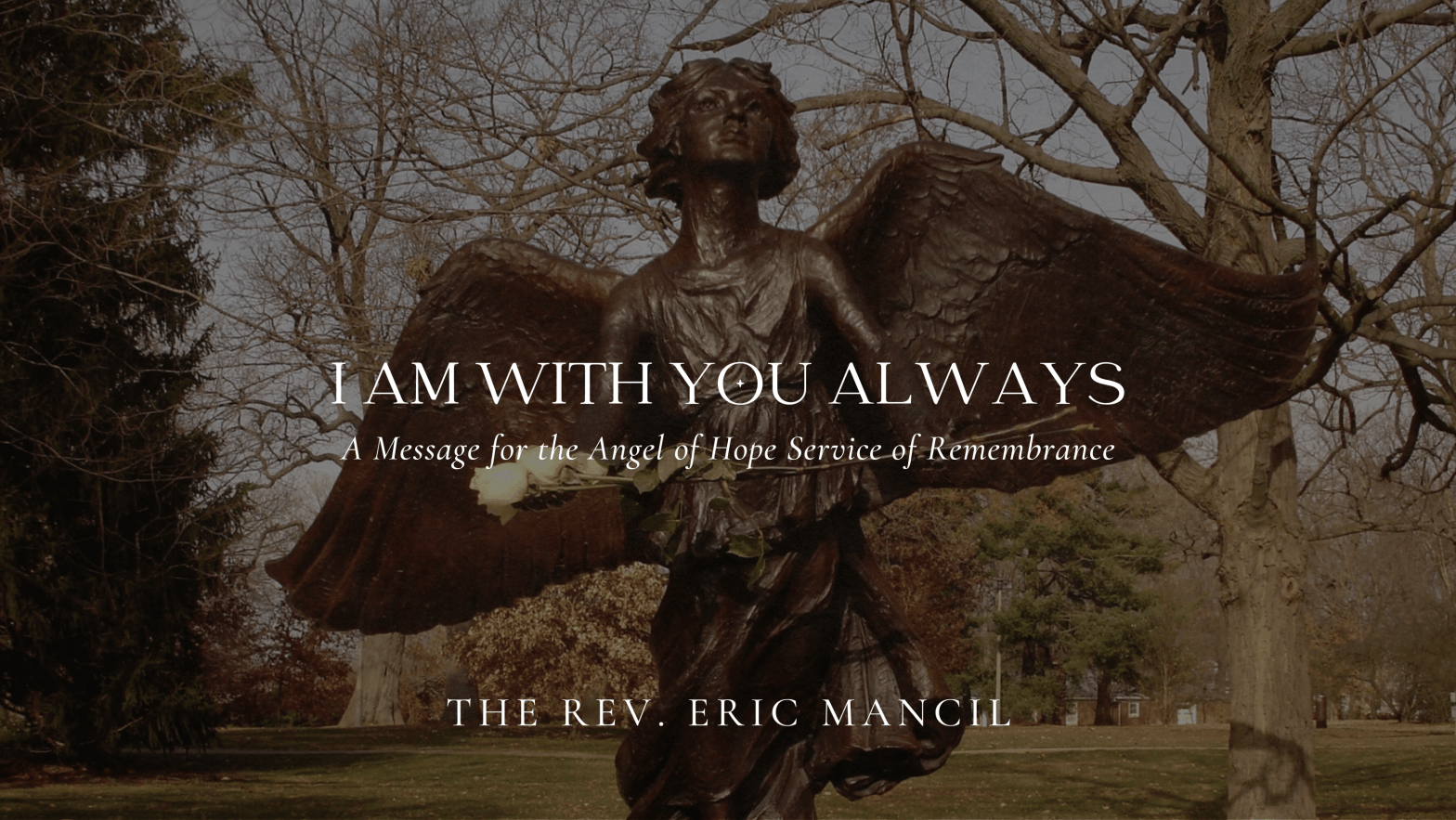
I Am With You Always

A Message for the Angel of Hope Service of Remembrance
Tuesday, December 2, 2025

Good evening, friends.

It’s an honor and a privilege to be with you tonight.

My name is Father Eric Mancil, and I serve as the rector of St. Mary’s Episcopal Church here in Andalusia.

I want to begin by offering my heartfelt thanks to Debbie Grimes and to the other officers for the Angel of Hope for inviting me to be part of this service of remembrance.

The work you do—the compassion you offer, the space you provide for those who grieve—matters deeply to families throughout Covington County. Thank you for making this night possible.

We gather here at the Angel of Hope because this is a sacred place.

Each of us comes here tonight with a story.

Each of us carries a name, a face, a memory that has shaped our life more deeply than words can describe.

Tonight, we gather because we know that love never ends.

And because grief—especially the grief of losing a child—doesn’t follow a timeline or conform to what the world expects of us.

This time of the year makes that especially clear.

As December begins, the world around us tells us we should be cheerful all the time and full of holiday joy.

Everywhere we turn, there are Christmas lights, decorations, music, and messages insisting that this season is all about celebration.

And yet—for so many who carry deep grief—this is the season that hurts the most.

The empty chair at the table, the tradition that feels incomplete, the memory that arrives without warning… all of these can take what is supposed to be a joyful time and make it heavy or too painful to bear.

And so tonight matters.

Tonight gives us permission to be honest.

Permission to feel what we feel.

Permission to acknowledge that grief doesn’t take a holiday break.

Here, in this sacred place, no one has to pretend.

No one has to hide their feelings or their questions.

No one has to put on the holiday mask the world expects. 

Tonight we simply come as we are—carrying all the love, all the longing, all the pain, and all the gratitude that come with remembering a child who will always be part of us.

As a pastor—and as a parent myself—I’ve walked with many people who’ve carried deep grief of all kinds.

And while I’ve never walked through the loss that many of you carry, I do know what it means to love a child with your whole heart.

I know the way a child becomes part of you, the way their life shapes your own.

And because of that, I can only begin to imagine the deep pain that comes with losing a son or daughter.

What I do know is that grief is not a problem to solve or something we should be expected to just “get over.”

Grief is love—love that still aches, love that still reaches, love that still remembers.

Some days that grief feels like a fresh wound.

Other days, it rests quietly in the background until a smell, or a song, or a moment brings it rushing back.

But in every case, grief becomes a companion we never asked for—one that walks with us day after day.

So, please hear me tonight when I say that there’s no right or wrong way to grieve.

There is no timetable.

There is no moment when you are “supposed” to just all of a sudden feel better.

Your grief is real.

Your journey is your own.

And for those who’ve lost a child, their life will always matter.

This Angel of Hope stands here for that very reason.

Her open arms, her outstretched wings, her quiet presence: they remind us that none of us grieve alone.

All around the world, more than 150 of these angels stand in communities just like this one, bearing witness to the truth that a parent’s love does not end with death.

This angel is not a symbol of a simple or shallow hope.

She represents a deeper kind of hope—the kind that rises even in sorrow, that reminds us love is never lost, and that assures us God will never leave us to face our pain alone.

As people of faith, we hold to a promise that sustains us: the promise that God is with us, even in our deepest pain.

Jesus never said we would not face sorrow or heartbreak.

He never said that life would be free from suffering.

What he did say—what he promised—is that we would never face those moments alone. “I am with you always,” he said.

Not just in the easy days, not just in the joyful days, but in the darkest nights and the heaviest hours.

Jesus knew grief.

He wept at the tomb of his friend, Lazarus.

He felt the sting of loss.

And because he knows grief from the inside, we can trust that he walks with us through ours—not to take the pain away, but to carry it with us, to lift us up when we fall, and to remind us that love is stronger than death itself.

In a few moments, many of you will come forward to place a flower at the Angel of Hope.

It is a simple act, but it carries such deep meaning.

It is a way of saying, “My child lived. My child was loved. My child is still loved.”

And through that love, their light continues—shining in your memories, in your stories, in the ways they shaped who you are.

And the hope we proclaim tonight, the hope of the Gospel, adds this: your child is held in the eternal embrace of God in a place where there is no pain, no fear, no suffering, only peace and love beyond our understanding.

Until that day when all things are made new and we’re reunited with those we love, God gives us the strength to keep going.

One breath at a time. One step at a time. One act of courage at a time.

My prayer for you tonight is that you feel surrounded by God’s love, upheld by this community, and filled—if even only for a moment—with a sense of peace.

You’re not alone. Not tonight. Not ever.

May the God who knows your story, who holds your tears, and who loves you and your child more than you can imagine, grant you comfort, strength, and hope—hope deep enough to carry you through the days ahead, and love strong enough to remind you that nothing, not even death, can separate us from the love of God in Christ Jesus.

Let us pray.

Holy and gracious God, tonight we lift before you the children we love and remember. We thank you for their lives, for the joy they brought us, for the ways they shaped our hearts and still shape them even now. Hold their families in your tender care. Surround them with your peace in moments of sorrow, your strength in moments of weakness, and your gentle presence when the weight of grief feels too heavy. Remind us that you are a God who walks with us—not to take away our pain, but to help us carry it, to lift us up when we fall, and to shine light into the darkness.

Bless each person gathered here tonight. Calm their anxious hearts, renew their courage, and fill them with a hope that lasts. And as we leave this place, help us to carry the love of our children with us—not as a burden, but as a sacred flame that continues to burn brightly. All this we pray in the name of the one who is our comfort and our hope, Jesus Christ our Lord. Amen.

Waiting with Hope

A Sermon for the First Sunday of Advent (Year A)
November 30, 2025

Text: Matthew 24:36-44

Now, O Lord, take my lips, and speak through them. Take our minds, and think through them. Take our hearts, and set them on fire. In the name of the Father, and of the Son, and of the Holy Spirit. Amen.

A few weeks ago, my family and I were in Auburn for the weekend. On our way out of town, heading back home, we decided to stop at Tiger Town and do a little shopping. And—much to my delight—we ended up at one of my favorite stores: World Market.

Has anyone ever been to World Market?

If you have, then you know—it’s one of those places filled with treasures from all over the world. Foods you’ve never heard of. Decorations from far-off places. Coffee, candy, and all kinds of kitchen gadgets you don’t really need but suddenly want.

It’s wonderful!

But my favorite time to go to World Market is around the holidays. That’s when the whole store lights up. There are beautiful Christmas ornaments everywhere, shelves full of Christmas cards, chocolates wrapped in shiny paper, and delicious things to nibble on and drink during the holidays.

And this time—as we were looking around—I noticed something else.

Rows and rows of Advent calendars.


Does everyone know what I mean by an Advent calendar? They’re those little boxes with numbered doors—one for each day in December—where you open a flap and find a tiny treat or surprise inside.

At World Market, you can find any kind of Advent calendar you can possibly imagine.

They have the fancy chocolate ones, of course. But they also have coffee Advent calendars. Tea Advent calendars. Hot sauce Advent calendars. They even have one for different kinds of jelly.

If you have a preference or hobby or a favorite snack, chances are they’ve figured out a way to put it behind twenty-four little perforated doors.

And as I walked around, looking at all these different calendars, I thought to myself, “You know, for a lot of people, this is what Advent is.” It’s just a fun way to count down the days to Christmas.

If you’ve ever bought one of those calendars, you know—they usually start on December 1 and go through Christmas Eve. One tiny window for each day, one tiny treat, one day closer to the big celebration.

And don’t get me wrong—there’s nothing bad about any of that. Advent calendars are fun. They’re a sweet way to mark the days—especially for children.

But for us, in the Church, Advent means so much more than just counting down the days until Christmas.

Yes, during Advent we are preparing—once again—to celebrate the birth of Jesus, and that’s an important part of the season.

Every year we light the candles on the Advent wreath, sing the hymns, and hear the Scriptures retold because we need that reminder of God’s nearness and God’s peace.

But Advent is also a season of waiting in hopeful expectation for Christ to come again.

As much as we love the story of Mary and Joseph on their way to Bethlehem, Advent refuses to let us stay there.

It pulls our gaze forward—toward God’s promised future. A future where justice rolls down like waters, where peace is restored, and where every tear is wiped away.

I heard someone recently describe Advent with an old Catholic teaching that says the season is all about “the history, the mystery, and the majesty.”

I love that phrase.”History, mystery, and majesty.”

In history, we look back and remember the birth of Jesus in Bethlehem over two thousand years ago—God coming to dwell with us in human flesh.

In mystery, we recognize that Christ is with us even now, moving and working through his Body, the Church.

In majesty, we look ahead to the day when Christ will return in glory and make all things new.

And that framework helps us understand our Gospel reading this morning. Because today’s reading is not a countdown to Christmas.

It’s not Mary and Joseph. It’s not a sweet story about angels or shepherds keeping watch over their flock by night.

It’s Jesus pointing us toward the majesty—the promised day of his return.

This is a point in the Gospels where a lot of people start to get nervous.

Because Matthew 24 is one of those passages that’s been used, and sometimes misused, to stir up fear about the “end times.”

Some Christians have even used these verses—and others like it—to build up ideas about the “rapture”—this notion that some people will be swept up into heaven with Jesus while others are left behind.

It certainly paints a dramatic picture, and it’s become popular through novels, movies, and preachers online who claim to know the exact date when it will happen.

But here’s something important for us to remember:

This is not how Christians understood these passages for most of Church history.

The whole concept of a secret rapture is actually quite new.

It didn’t appear until the 1800s, when a preacher named John Nelson Darby proposed a new way of interpreting Scripture.

Before that, for nearly eighteen hundred years, no Christian theologian, bishop, or council taught anything like it.

It’s a very modern interpretation, not something rooted in historic Christian teaching, and it can distract us from the real message Jesus is giving us—not a message of fear or escape, but one of readiness and hope.

In our passage this morning from Matthew, Jesus isn’t trying to scare us.

He isn’t describing a secret evacuation plan where God rescues a few and abandons everyone else.

He’s telling us something far simpler—and far more hopeful: Be ready. Stay awake. Keep watch.

Because the Son of Man is coming to restore all things. And none of us knows the day or the hour.

Not even Jesus knows. Only the Father.

He’s calling us to live our lives in such a way that, whenever he does return, he finds us doing the work he’s given us to do.

The Gospel tells us to trust that Christ’s return is good news for the whole creation—not just some, but all. It will be a day of restoration—a day of healing and justice. Not a day to fear, but a day to hope for.

So, the question we should be asking in this passage is not, “How we do avoid being left behind?”

The real question is, “How do we live as people who are waiting for Christ’s return?”

How do we stay awake—not fearfully, but faithfully?

I think it has everything to do with our posture of waiting.

Christian waiting is not passive. It’s not sitting on our hands or looking for secret signs in the sky.

Christian waiting is active. It’s leaning forward with hope.


It’s living today as though Christ might come tomorrow—and wanting him to find us doing the work he’s given us to do.

And we already know what that work is, because we’re doing it all the time.

It’s everything we are called to do as the Body of Christ—

It’s caring for our neighbors through outreach ministries.

It’s feeding people through a warm meal on Thanksgiving Day.

It’s welcoming the stranger, or the person who thought there was no place for them in church.

It’s nurturing our children and youth through Christian formation.

It’s praying for one another—through good times and hard times.

It’s gathering for worship.

It’s caring for the sick and the grieving.

It’s serving with generosity and compassion.

It’s loving one another as Christ has loved us.

All of this—every single bit of it—is kingdom-building work. It’s our way of preparing for Christ’s return.

Not sitting back and waiting for Jesus to come and fix everything for us, but participating in God’s healing work right now.

It’s our way of saying, with our lives, “Come, Lord Jesus.”

Because Advent is not a season of fear.

It is a season of hope.

It’s about trusting that the darkness of this world will not have the final word.

It’s about believing that Christ is coming—not to destroy, but to heal. Not to abandon, but to restore. Not to frighten us, but to bring us into the fullness of God’s reign.

So as we enter this holy season of waiting—this season of history, mystery, and majesty—may we remember that Advent is far more than just a fun way to count down the days to Christmas.

It’s God’s call for us to wake up, to open our eyes, and to live in hopeful expectation.

It’s a season to look honestly at the darkness around us—and within us—and to hold fast to the light of Christ that no darkness can overcome.

It’s a call to live today in such a way that when Christ returns—whenever that may be—he finds us ready. Not because we predicted the hour, but because we lived with love.

So let us wait with joy.

Let us serve with purpose.

Let us hope with confidence.

For Christ has come,

Christ is with us now,

and Christ will come again.

Amen.

Faith Without Fear

A Sermon for the Twenty-second Sunday after Pentecost (Proper 27C)
November 9, 2025

Text: Luke 20:27-38

Now, O Lord, take my lips, and speak through them. Take our minds, and think through them. Take our hearts, and set them on fire. In the name of the Father, and of the Son, and of the Holy Spirit. Amen.

This past week, my family and I went to the Peanut Festival in Dothan. It’s been several years since we’ve been to the Peanut Festival, and we had a wonderful time! I love a good fair!

When I go to the fair, I feel like a kid again. There’s just something about it—the lights, the sounds, the smell of kettle corn and funnel cakes in the air. It just makes me happy.

And I love all the rides! Chelsea doesn’t like that part as much as I do, but I always have a great time.

After we rode a few rides and ate some dinner, we decided to explore some of the exhibit halls for a bit—just to take a break from all the noise and look around. We always enjoy seeing the arts and crafts displays and all the booths from local vendors and businesses.

As we walked through one of the exhibit walls, tucked between two other displays, I noticed a local church booth.

They were there handing out brochures and trying to get people to stop and learn more about their church, which seems harmless enough, doesn’t it?

It’s not exactly my favorite kind of evangelism, but I understood what they were trying to do.

What caught my eye, though, was this enormous sign right in the middle of their display.

It said, in big, bold letters: “Are you 25%, 75%, or 100% sure you’re going to heaven?”

Now, we’ve all seen signs or billboards like that before, haven’t we?

Needless to say, we didn’t stop to talk, and I doubt many others did either.

That sign has stuck stuck with me over the past week.

Because it says a lot about the kind of message that so many people have grown up hearing from the Church—that faith is about certainty, that it’s about being 100% sure you’re going to heaven when you die. As if faith is some kind of test you have to pass in order to be “saved” by God.

And underneath that kind of message, whether we realize it or not, there’s this image of a God that’s distant and angry and quick to punish—a God who’s keeping score, just waiting for us to mess up.

That kind of faith can make people live in fear.

Fear of being wrong all the time. Fear of not believing the right way. Fear of not being a good enough Christian.

And for a lot of us, that’s the kind of faith we grew up with—one focused almost entirely on fear and what happens when we die, instead of how God is calling us to live our lives right now.

Heaven was the goal, and fear was the motivator.

Now, I’m not saying all of this to be overly critical about that church at the Peanut Festival or any other church that preaches a similar message. I’m sure they were good people, just doing what they felt called to do.

But, the problem with that kind of message they’re sending out is that fear and love can’t grow in the same soil.

A faith built on fear can only stand for so long before it crumbles, which is why I believe a lot of people have walked away from the Church—not because they’ve stopped believing in God, but because they can’t find God in the kind of fear-based religion they were given.

Fear makes us desperate for certainty—desperate to have all the answers figured out.

Love invites us to experience the mystery of God.

Fear says, “You’d better get it right, or else!”

Love says, “Even when you get it wrong, you still belong to God.”

I think that’s what Jesus is trying to show us in today’s Gospel lesson from Luke.

In our story this morning, Jesus is approached by a group of Sadducees—religious leaders from a sect of Judaism who didn’t believe in things like the afterlife or the resurrection.

They followed the Law of Moses to the letter and rejected anything they couldn’t see or prove.

For them, this life was all there was.

When you died, that was it. Your only chance at living on was through your family name and the legacy you left behind.

Their hope was rooted only in things they could see and control—things like power, wealth, and reputation.

So, they come to Jesus with a strange question—more like a riddle—about a woman who marries seven brothers, one after another, each dying before she has children.

And they ask him, “In the resurrection, whose wife will she be?”

Now, they’re not asking because they’re curious.

They’re asking because they want to make Jesus sound foolish.

You can almost hear the tone in their voices. “See, Jesus? The resurrection doesn’t make sense. You can’t possibly believe this is true.”

But, Jesus refuses to play along.

He doesn’t try to explain to them what heaven looks like or offer any simple answers.

Instead, he tells them that the life of the resurrection isn’t just a continuation of what we already know—it’s something entirely new and different.

“The people of this age marry and are given in marriage,” Jesus says, “but those who are considered worthy of the resurrection neither marry nor are given in marriage. Indeed, they cannot die anymore, because they are like angels and are children of God.”

Now, I want to pause here for a moment, because sometimes people hear this passage and worry that Jesus is saying that marriage doesn’t matter.

But that’s not what he means at all.

Marriage is one of the most sacred and beautiful ways we can learn what God’s love looks like.

It teaches us about commitment, sacrifice, and humility.

What Jesus is saying here is that in the resurrection, even our deepest and most important human relationships—including marriage—will be transformed.

The love that holds two people together in the covenant of marriage will be made complete in the life of the world to come.

In the resurrection, God’s perfect love will bind everyone together.

The Sadducees are asking the wrong kind of question. They want certainty. They want Jesus to explain what heaven looks like in ways they can understand.

But, Jesus wants them to see that the life of God—and the life of the resurrection—can’t be explained in human terms or contained by logic. They’re a mystery.

The Sadducees want control.


esus invites them to put their trust in God.

And that’s the real difference here.

The Sadducees’ version of faith left no room for mystery.

But, with Jesus, faith is all about the mystery of God

 It’s full of wonder, hope, and the promise that God’s love and life are stronger than death.

Faith isn’t about certainty. It’s about putting our trust in God.

It’s not about having all the answers. It’s about putting our hope in the one who does—the one who created us and promised to never leave us.

And when we live that way—when we really put our trust in God —something beautiful happens in the process.

The fear that once ruled over our lives starts to lose its grip.

The need to always prove ourselves gives way to joy and peace.

Because a faith rooted in love knows that God isn’t sitting up in heaven looking for reasons to punish us.

God wants to redeem us.

As our bishop often says, “Your life is not a test to get into heaven.”

God isn’t keeping score.

God is faithful.

God doesn’t wait for us to have it all together before offering grace.

God meets us right where we are—in our questions, in our doubts, in our confusion—and says, “You are my beloved.”

That’s what Jesus shows us, again and again.

Even when we lose our way, God’s mercy never runs out.

And when we start to really believe that—when we trust that God’s deepest desire is not to condemn us but to redeem us—we are set free.

Free to stop living in fear.

Free to stop worrying about whether we’re “100% sure.”

Free to enjoy this life—the one God has already given us—as a precious gift.

Now, that doesn’t mean we stop caring about how we live.

It doesn’t mean we stop growing in our faith or trying to do better when we fall short.

But, it does mean that we live out of love, not fear.

Because God doesn’t want us to spend our lives anxious and guilt-ridden.

God wants us to live lives full of joy, and peace, and gratitude—lives that reflect the goodness of the one who made us and called us good from the very beginning.

Faith will always be a mystery.

And that’s okay.

Because the heart of that mystery is love—a love stronger than death and deeper than our fears, a love that goes beyond anything we could ever ask for or imagine.

So, maybe the next time we see a sign asking if we’re 100% sure we’re going to heaven”—or something like it—we can smile and say, “I don’t know, but I am 100% sure that God loves me and will never let me go.”

Amen.

The Courage to Say Yes

A Sermon for the Feast of All Saints (Year C)
The Baptism of Ella Grace O’Neill
Sunday, November 2, 2025

Texts: Ephesians: 1:11-23 and Luke 6:20-31

Now, O Lord, take my lips, and speak through them. Take our minds, and think through them. Take our hearts, and set them on fire. In the name of the Father, and of the Son, and of the Holy Spirit. Amen.

Today is one of my favorite Sundays of the entire year—All Saints Sunday. It’s one of the Church’s high holy days, a day that shines with great joy and thanksgiving.

On this day, we give thanks for the lives of all the saints—not just the ones we know by name, or the ones etched in stained glass or included in the Church calendar—but for that great cloud of witnesses who’ve gone before us, and for those sitting right here among us.

And if that weren’t enough reason to celebrate, this morning we also get to baptize Ella Grace O’Neill—to mark her with the sign of the cross, to seal her as Christ’s own forever, and to welcome her into the communion of saints.

It doesn’t get much better than that.

When we think of saints, we often imagine holy people from long ago—the kind of people whose stories we read about in Scripture or church history books. People like St. Francis of Assisi, the one who preached to animals; or St. Mary, the mother of our Lord; or St. Peter, who was one of Jesus’ closest friends and trusted disciples.

But the saints aren’t just those who lived heroic lives of faith. 

They’re the ones, as Frederick Buechner once wrote, “whose lives are windows through which the love of God shines.”

The saints are people who, in small and ordinary ways, make room for God’s grace to shine in the darkness—through acts of kindness, through courage, through compassion.

And sometimes, the saints are people who open their hearts to love in ways that are both costly and unexpected.

Some of you already know the story of how Ella—Hope and Willis’s niece—came to live with them last year, but in case you don’t, I want to share a little bit of that story with you.

I asked Hope earlier this week if I could tell part of their story, and she graciously said yes.

Last year around this time, Hope and Willis found themselves in a situation they never expected.

Ella’s mother had already asked if they’d be willing to take her in once she was born. So, they prayed about it, talked it over, and tried to imagine what that kind of change would mean for their family.

And then, suddenly, everything changed.

Ella was born a little earlier than expected, and because of the circumstances of her birth, Hope got a call—the kind of call that doesn’t give you much time to think, only to act.

Hope and her mother went to the hospital.

And when they learned that Ella needed someone to take her home soon—someone who could love her, protect her, and give her a safe place to live—Hope and Willis said yes.

It wasn’t an easy yes.

And yet, if you asked Hope today, she’d tell you there was really only one answer. She might even say that anyone would’ve done the same.

But, we all know that’s not true.

It takes courage—and a deep trust in God—to let love interrupt your life like that. To say yes when it would be so much easier to say, “No, that’s someone else’s responsibility.”

What Hope and Willis did was more than a decision; it was grace in action. It was love made real. It meant rearranging their home, their routines, and their plans for the future.

But that’s how love works sometimes.

It rarely follows our plans and often shows up in the most unexpected ways.

Hope and Willis didn’t say yes for recognition or praise. They said yes because they knew it was the right thing to do.

And because they said yes, Ella is thriving today. She just celebrated her first birthday last week.

She has a place where she belongs and a family who loves her and cares for her.

And I can’t think of a more beautiful image for All Saints Sunday than that—an act of love that embodies the very heart of the Gospel: opening your life so that someone else can have a place to belong.

In our Gospel lesson this morning, we hear Luke’s version of the Beatitudes. Jesus speaks a word of blessing—not to the rich or the powerful, but to the poor and the hungry, to those who mourn and weep.

“Blessed are you,” he says, “when you are poor, for yours is the kingdom of God.”

“Blessed are you who weep now, for you will laugh.”

It’s one of those passages from Luke that turns everything upside down. Jesus shows us what the kingdom of God really looks like—a world where the last are first, the lowly are lifted up, and love is stronger than death.

And then he goes on to say something even more challenging:

“Love your enemies, do good to those who hate you, bless those who curse you, pray for those who abuse you…Give to everyone who begs from you…and do to others as you would have them do to you.”

In other words, love—even when it costs you something.

That’s the kind of love that defines the saints.

It’s not neat or simple. It’s the love that shows up, time and again—the love that sacrifices, forgives, and endures.

That’s the kind of love that’s been shown to Ella through Hope and Willis, through Willow and Rosemary, through their family and friends, and through this community of faith that now promises to help raise her in the knowledge and love of the Lord.

In just a few minutes, we’ll gather around the baptismal font and welcome Ella into the household of God.

We’ll pour water over her head and say the words that have been said for generations:

“I baptize you in the Name of the Father, and of the Son, and of the Holy Spirit.”

Then we’ll make the sign of the cross and say, “Ella, you are sealed by the Holy Spirit in Baptism and marked as Christ’s own forever.”

What that means is that she’ll never be alone.

No matter what happens in her life—no matter where she goes or what she faces—she will always belong to God.

That’s exactly what Paul reminds us in Ephesians: that in Christ “we have obtained an inheritance,” and that we “were marked with the seal of the promised Holy Spirit.”

Baptism is that seal—the outward and visible sign that we belong to God and share in that inheritance with all the saints.

Paul prays that we may know “the hope to which God has called us” and “the riches of his glorious inheritance among the saints.”

That hope, that inheritance, that love—it’s what we celebrate today in Ella’s baptism.

And that’s not just true for her. It’s true for all of us.

Baptism is God’s promise that we are loved, called, and claimed as Christ’s own—not because we earned it, but because we’re God’s beloved children.

Every one of us, by virtue of our baptism, belongs to the communion of saints—that great cloud of witnesses that stretches across time and space, earth and heaven.

When we talk about the communion of saints, it’s not something abstract or far away. It’s right here—in the people who pray for you, who show up when you’re sick, who cook meals, who sit with you in grief, and who laugh with you in joy.

It’s in people like you and me, like Hope and Willis—the ones who quietly say yes when love calls.

The saints are all around us—sometimes sitting right next to us, even if we don’t see it.

As we celebrate Ella’s baptism this morning, we’re reminded that sainthood isn’t reserved for the extraordinary few.

It’s the calling of every Christian—to live with love, mercy, and faithfulness, even when we stumble along the way.

The saints we remember today in our prayers were not perfect people. They were people who, in their own way, said yes to God’s call.

And so are we.

Each of us has the opportunity, every day, to be a saint in someone else’s life—to make room for others, to forgive, to serve, to listen, and to say yes to God.

Today, as we welcome Ella into this family of faith, we celebrate not only her baptism but the love that made it possible—the love of her family, the love of this church, and above all, the love of God that binds us all together.

On this All Saints Sunday, we remember that saints are not just those whose names fill our history books.

They’re ordinary people who said yes to love.

Today, we see that love in Hope and Willis and their family.

We celebrate that love in Ella Grace.

And we remember that this love is also our calling.

May the God who has claimed us in baptism give us grace to walk as saints—to make room where the world closes doors, to love even when it costs us something, and to shine with the light of Christ wherever we go.

Amen.

Do Not Lose Heart

A Sermon for the Nineteenth Sunday after Pentecost (Proper 24C)
October 19, 2025

Text: Luke 18:1-8

Now, O Lord, take my lips, and speak through them. Take our minds, and think through them. Take our hearts, and set them on fire. In the name of the Father, and of the Son, and of the Holy Spirit. Amen.

Last weekend, our family went up to Auburn to celebrate Jude’s 14th birthday, and even though the football game didn’t turn out how we hoped, we had a great time visiting with family.

On Sunday morning, Chelsea and I went to worship at St. Dunstan’s—the church that meant so much to us during our college years.

It’s also the church where I was confirmed, where Chelsea and I were married, and where both of our kids were baptized.

It’s the place where I first learned what it meant to belong to a community of faith and where I began to understand that church is more than just a building—it’s a family.

On Sunday morning, when we walked through those big red doors of the church, I was immediately taken back and struck by how alive everything felt.

People were laughing and greeting one another at the door, and when we stepped into the nave, nearly every seat was filled.

The choir was singing with such joy, and you could feel the Holy Spirit moving in that place and a sense that people were genuinely glad to be there.

It hasn’t always been easy, though.

There was a time when there was a lot of uncertainty about the future of St. Dunstan’s—especially a few years ago, when the Bishop of Alabama made the decision to change it from a student chapel to a parish church.

When that happened, the congregation had to learn how to sustain itself financially without the ongoing support of the diocese.

After the former priest retired, they went for a long stretch without a rector.

Finances were extremely tight.

And people wondered whether or not they could keep the doors open.

It was a difficult and uncertain time for that little church.

But through it all, there was always a faithful group of people—some of the same faces I saw last weekend—who refused to give up.

They kept showing up to church. They prayed. They served.

They believed that God still had work for them to do.

And because of their persistence—because of their faithfulness—St. Dunstan’s didn’t just survive.

It has grown and flourished.

When I stood there in that familiar place last Sunday—surrounded by all those people—I couldn’t help but think, “This is what faithfulness looks like.”

For a hundred years, St. Dunstan’s has been rooted in downtown Auburn. And because of the faithfulness of the people there—and the grace of God—it’ll continue to be a place of welcome and hospitality, a place where all are invited to experience the love of God in Christ Jesus for years to come.

Thinking about St. Dunstan’s reminded me so much of our own story here at St. Mary’s.

When I arrived a few years ago, I heard stories about our own season of uncertainty—especially during the pandemic and that long period of transition before I was called to be your rector.

Attendance was down.

People were tired.

There were questions about the future.

But just like those faithful parishioners at St. Dunstan’s, there were people here who refused to give up.

Because they believed in this parish.

They believed in its mission and the work that God was calling us to do, not only for ourselves but for the good of our community.

And because of their persistence, St. Mary’s has not only survived—it too has grown and flourished, and we continue to serve our community in beautiful ways that glorify God and share the love of Christ with others.

So, the word I want us to focus on today—the word I want us to hold on to—is persistence.

In our Gospel reading from Luke, Jesus tells a story about persistence—a story about not giving up, even though that would be the easy thing to do.

There are two characters in this story—a widow and an unjust judge.

The widow keeps coming to the judge, day after day, pleading for justice.

We don’t know exactly why.

Jesus doesn’t give us any details about the widow and her desire for justice, but we do know that she had no power of her own.

In the time of Jesus, widows were among the most vulnerable members of society.

They had no legal standing, no influence, no money to bribe a judge or hire a lawyer.

And yet this widow refuses to be silent.

She keeps coming to the judge, asking for justice. She won’t take “no” for an answer.

And finally, the judge—who doesn’t fear God or care about anyone else—gives in, not because he suddenly wants to do the right thing, but because he’s worn down by this persistent widow.

Now…it’s easy to misunderstand this parable.

At first, it almost sounds like Jesus is saying that if we just keep pestering God and praying hard enough, God will eventually give us what we want—like the judge in our story.

But, that’s not what Jesus is saying here.

He isn’t comparing God to the unjust judge—he’s actually showing the contrast between them.

Jesus says, if even a corrupt and uncaring judge can eventually be moved to act, how much more will a loving and faithful God hear and respond to the prayers of his people?

The point Jesus is trying to make is that we don’t have to wear God down with our prayers.

We don’t have to worry about whether or not God is listening.

God is faithful.

Our persistence in prayer doesn’t change God’s heart.

It changes ours.

It teaches us to put out trust in God—to trust that God’s timing is better than our own and that, even when God feels silent, it doesn’t mean he’s left us.

God is there, even in those moments when it’s hard to see clearly what God is doing.

Luke tells us at the beginning of our lesson that Jesus shared this story “so that we might always pray and not lose heart.”

That’s important for us to remember.

Because when life feels uncertain and we start to lose hope, prayer is what keeps us grounded in the love of God, who promises to be with us through it all.

But, there are times when that kind of faith is hard to hold onto, and many of you know exactly what I’m talking about.

Maybe you’ve been in a long season of grief after the loss of someone you love and you wonder if the pain will ever end.

Maybe you’ve been in a season of disappointment or failure when plans have fallen through, when prayers seem to go unanswered, when the future feels unclear.

Maybe you’ve struggled with doubt, wondering if God is really listening, or even real.

Those are the moments when it’s hardest to pray.

But they’re also the moments when prayer matters most.

Because prayer isn’t about getting the results we want. It’s about staying in relationship with the one who loves us.

When we keep praying—even when the words feel empty—we’re putting our trust in God.

We’re saying, “God, I still believe you’re here and that you love us more than we can imagine.”

That’s what it means to “pray always and not lose heart.”

It’s a kind of faith that isn’t flashy or dramatic. It’s steady, enduring, sometimes quiet, but always faithful.

That’s what I was reminded of at St. Dunstan’s last weekend, and it’s what I see here at St. Mary’s.

Churches go through seasons, just like people do.

There are times of abundance and times of uncertainty.

There are times when everything feels exciting and alive and times when we wonder what the future holds.

But what sustains us through those seasons isn’t programs or budgets or the number of people in the pews.

It’s faith.

It’s the persistent faith of people who keep showing up, day after day, month after month, year after year—

Those who show up when it would be so much easier to stay home.

Those who serve, even when they’re tired;

Those who give, even when times are tight;

Those who love, even when it’s hard.

Faith like that changes a church, and it can change the world.

God honors that persistence, and he works through it, even when we don’t see it happening in the moment.

The story of St. Dunstan’s—and our story here at St. Mary’s—are living testimonies to that truth.

Sometimes we think of faith as something that has to be big or heroic.

But most of the time, faith looks a lot more like the persistent widow in Jesus’ story.

It looks like showing up one more time to pray.

It looks like offering forgiveness one more time.

It looks like serving one more meal at Rice and Beans, or making one more visit to someone in need, or offering one more word of hope when you’re not sure it’ll make a difference.

That’s the kind of faith Jesus calls us to—a faith that holds on to hope, even when the answers to our prayers don’t come quickly or the outcome isn’t what we hoped for.

God is with us in the long seasons of waiting. God hears the prayers we barely manage to whisper. God holds us when our strength runs out.

Maybe today, you find yourself in a season of uncertainty.

Maybe you’ve been praying for something for a long time—for healing, for reconciliation, or even for a clear sense of purpose—and you find yourself tired and frustrated.

Maybe you’ve wondered if faith even matters anymore.

If that’s where you are, remember this—

God hasn’t forgotten you.

God isn’t distant or uncaring like the judge in our story.

God is closer than your next breath.

So, keep praying.

Keep showing up.

And keep trusting that the one who created you and loves you beyond all measure is still at work in your life and will never let you go.

Amen.

The Measure of a Life

A Sermon for the Sixteenth Sunday after Pentecost (Proper 21C)
September 28, 2025

Text: Luke 16:19-31

Now, O Lord, take my lips, and speak through them. Take our minds, and think through them. Take our hearts, and set them on fire. In the name of the Father, and of the Son, and of the Holy Spirit. Amen.

Last Sunday, after worship, we walked over to the Parish Hall and found it completely transformed for our Ministry Fair.

The whole room was filled with color and imagination—balloons floating overhead, bright tablecloths draped across the tables, and displays so carefully prepared that you could see the love and creativity poured into every ministry.

There were twenty-two displays in all—everything from our Rice and Beans Ministry to the Altar Guild to the Daughters of the King and even one for our upcoming Fall Festival in November.

It was more than just a room full of sign-up sheets. It was a celebration of giving—of people offering their time, talents, and resources for the sake of God’s Kingdom.

The whole room buzzed with conversation and laughter as people moved from table to table, asking questions and learning about new opportunities to serve.

And I have to tell you, I felt an incredible sense of pride and joy in that moment—pride in seeing so many people participate, and joy in knowing that our parish is alive with a spirit of generosity and service.

I’ve been thinking about it all week!

It was, without question, the best Ministry Fair we’ve had since I’ve been your Rector. And I can’t tell you how much hope that gives me—not just for the strength of our ministries today, but for the future God is shaping for us together as a parish.

I watched people discover ministries they didn’t even know about—someone signing up for the Holiday Jubilee with a smile, others drawn to serve as Lectors or Chalice Bearers.

And you could see it in their faces: signing up to volunteer wasn’t a chore or an obligation.

It was life-giving—a way for them to feel connected to something bigger than themselves.

There was one table, in particular, that really stood out to me.

Now, I don’t like to play favorites, but Deacon Antwon put together an incredible display for our Coat and Blanket Drive.

He probably spent hours working on it—crafting little coats out of construction paper, slipping small treats inside of them, and arranging it all in a way that caught your eye the moment you walked in the room.

It wasn’t just creative. It was inspiring—you could see the love he poured into it.

But more than the display itself, what really stood out for me was what it represented.

Each year during the holidays, we collect new and gently used coats and blankets, and on the third Saturday of December we give them away—not as a separate event, but as part of our Rice and Beans Ministry.

And if you’ve ever been part of that morning, you know it’s special.

Our neighbors come for groceries and a hot breakfast—like they do every month—but before they leave, they also receive the gift of warm clothes and blankets.

It’s a simple act of kindness, but in those moments, you can feel the love of Jesus.

That’s love in action.

That’s what it looks like—not to keep everything for ourselves—but to see the needs of our neighbors and respond with compassion and care.

And that’s exactly the kind of love that Jesus is pointing us to in our Gospel lesson this morning from Luke.

Jesus tells the story of two men.

The first one is rich—so rich that he dresses in fine clothes and feasts every day.

The other is poor, a man named Lazarus, who lies outside the gate—hungry and longing for crumbs from the rich man’s table.

The rich man never notices Lazarus. He goes about his life, day after day—eating and drinking, enjoying his comfort.

Then death comes for both of them.

And suddenly, the great reversal happens.

Lazarus is carried into the arms of Abraham, and the rich man finds himself alone and tormented in the flames.

If you were at church last Sunday, you might remember how the Gospel ended with Jesus saying, “You cannot serve God and wealth.”

He didn’t say wealth is evil. He didn’t say possessions are sinful. What he said was that you can’t serve both—you have to choose which one will hold your heart.

And today’s parable is really just an illustration of what happens when we choose wealth over God, when we choose to live only for ourselves.

The rich man’s life looks good on the outside—fine clothes, a full table, daily feasts. He wants for nothing.

But it’s all focused inward. He serves only himself, and because of that, he doesn’t even see the need right outside his own gate.

That’s the danger Jesus is warning us about.

Not simply that money is tempting, but that it can so easily blind us. It can make us think our security, our comfort, our success is what matters most.

And when we start to believe that, the distance between us and God grows wider and wider.

Now, a lot of people hear this story and immediately think, “Oh, this is what heaven and hell must be like.”

Lazarus dies and goes to paradise, the rich man dies and goes to torment—it seems simple enough.

But that’s not really the point Jesus is making here.

If Jesus wanted to tell us how to get to heaven, he would’ve done it very differently.

Instead, he tells us a parable, and parables are never meant to be taken literally.

They’re stories Jesus uses to shake us up, to shift our perspective, to reveal the truth of God’s Kingdom.

The images Jesus uses would’ve been very familiar to people in his own time.

The idea of a great chasm separating the righteous and the unrighteous was a common theme in Jewish storytelling.

“Abraham’s bosom” was a traditional way of describing God’s care for the faithful.

Even the details about flames and torment weren’t unique to Jesus—they were part of the religious imagination of the time.

Jesus used this imagery because it was familiar, dramatic, and sure to get people’s attention.

But the point is not “here’s what heaven and hell look like.” The point is, “Wake up now, before it’s too late.”

The tragedy of the rich man isn’t simply that he ends up in hell.

The real tragedy is that he lived his whole life blind to the poor man lying right outside his gate, and he didn’t even realize what he was missing.

By the time he finally sees clearly, there’s no way to go back and change it. What’s done is done.

Jesus is reminding us in this story: we only get one life.

One chance to notice, one chance to love, one chance to give. And the time for that isn’t tomorrow—it’s now.

I think about the rich man’s gate.

Day after day, he walked past it, probably without even thinking. And right there, in plain sight, was Lazarus. He wasn’t hidden. He wasn’t invisible. He was right there.

But the rich man never saw him.

And I wonder—who’s lying at our gates? Who are the people we walk past every day without noticing?

Maybe it’s someone in our community who’s hungry.

Maybe it’s a neighbor who’s lonely.

Maybe it’s a friend who’s struggling silently without anyone to talk to.

Maybe it’s even someone in our own family who needs love and attention.

How often do we fail to notice, because we’re too busy, too distracted, or too wrapped up in ourselves?

I think, for me, that’s why last week’s Ministry Fair was so inspiring.

Because it was one way for us to practice giving.

One way for us to practice seeing the needs of those around us and responding.

One way for us to say, “I want to live differently. I want to give. I want to serve. I want to love more deeply.”

The Coat and Blanket Drive is a perfect example, but there are so many others. The needs of our church and the needs of our community never go away. The only question is whether we’ll notice and respond.

And here’s the beautiful thing about giving. When we step forward and offer our gifts—we don’t just help others.

We ourselves are changed. We find joy and peace. We find community. We discover new life in Christ.

I saw that last week at the Ministry Fair.

I see it every month at Rice and Beans. I see it when coats and blankets are handed out in December.

I see it in the life of this parish—every time we choose to live not only for ourselves—but for the sake of others.

The parable of the Rich Man and Lazarus isn’t meant to frighten us. It’s meant to wake us up. To remind us that wealth, comfort, and security are not the measure of a good life—not in God’s eyes.

The true measure is love—love expressed in generosity, love expressed in service, love expressed in our willingness to see and respond to the needs of those around us.

Friends, we only have this one life to live.

And Jesus is clear—the time to notice, the time to love, the time to give is now—not tomorrow.

When we live generously—when we share what God has given us—we don’t just bless others. We are changed in the process. We taste the abundant life that God wants for us.

And in just a few moments, we’ll come to the Table—the place where Christ himself gives everything for us.

Here we are fed, not with crumbs from a rich man’s table, but with the bread of heaven and the cup of salvation.

Here we are reminded that our lives are not our own, that all we have is a gift from God.

Here we are strengthened to go out into the world and share what we’ve received.

So, come to the Table.

Come with open hands and open hearts.

Be fed.

Be filled with God’s grace.

And then go back through the gates of your own life with eyes wide open—ready to see, ready to give, ready to love. Because when we serve the least of these, we serve Christ himself.

Amen.

Reckless Love

A Sermon for the Fourteenth Sunday after Pentecost (Proper 19C)
The Baptism of Serena Grace Walker
September 14, 2025

Text: Luke 15:1-10

Now, O Lord, take my lips, and speak through them. Take our minds, and think through them. Take our hearts, and set them on fire. In the name of the Father, and of the Son, and of the Holy Spirit. Amen.

This morning, I want to start with a song. Now, I’ll admit, I’m usually a traditionalist when it comes to church music. Give me a hymn from the 1982 Hymnal and I’m perfectly happy!

But every once in a while, I discover a newer song that captures a truth of the Gospel in such a powerful way that I can’t help but be moved by it.

For me, one of those songs is Reckless Love by Cory Asbury.

Some of you have probably heard it before, especially if you’re a fan of contemporary Christian music.

The chorus describes God’s love as overwhelming and never-ending, a love that pursues us and never gives up, a love that tears down walls and breaks through barriers to bring us home.

It goes like this:

Oh, the overwhelming, never-ending, reckless love of God.
Oh, it chases me down, fights ‘til I’m found, leaves the ninety-nine.
I couldn’t earn it, I don’t deserve it, still You give Yourself away.
Oh, the overwhelming, never-ending, reckless love of God.

Whenever I hear that song, I can’t help but think of the parable of Jesus we heard in our Gospel lesson this morning from Luke—the story of the shepherd who leaves the ninety-nine sheep behind in order to go and find the one that is lost.

It’s one of the simplest parables Jesus tells, and yet it’s also one of the most profound. 

A shepherd notices that one of his sheep is missing. Ninety-nine are still safe, but one is lost. 

And instead of being content with what remains, the shepherd goes out into the wilderness to search for the lost sheep. 

He doesn’t shrug his shoulders and say, “Well, at least most of the flock is okay.” He doesn’t write off the missing one as if it doesn’t matter. No—he goes, and he searches.

And when he finds that one lost sheep, he doesn’t punish it or drive it back with a stick. He lifts it onto his shoulders and carries it back home, rejoicing.

That’s what God’s love is like. 

It’s reckless, in the best sense of the word. 

Not careless, but extravagant. Unrelenting. Willing to go to any length to find us and bring us back home again.

And that’s the kind of love we celebrate today as we gather to baptize Serena Walker into the household of God and welcome her as the newest member of the Body of Christ.

Baptism is the beginning of our walk with Jesus. It’s the sign and seal of God’s reckless, relentless love.

In baptism, God does for us what the shepherd does for the lost sheep: God finds us, names us, claims us as his own, and carries us home.

It’s important for us to remember that in baptism, we don’t make God love us any more than he already does. God already loves us more than we can possibly imagine. 

What we do in baptism is recognize that love, respond to it, and commit ourselves to walk in it.

Baptism is deeply personal—it marks the beginning of our life in Christ. But it’s also communal—it binds us into the Body of Christ, the family of God. 

That’s why we celebrate the sacrament of Baptism as a church family and not in a private ceremony.

Here at St. Mary’s, we make the joy of baptism visible through our tradition of creating a banner for every person who is baptized or confirmed.

Each banner is unique, just as each of us is uniquely made by God. We hang them all in the Parish Hall, where they serve as a reminder that we belong not only to God, but also to one another.

When you look around and see those banners together, you see more than just fabric and color—you see a community stitched together in love.

And today, Serena’s banner will be added to that collection, a lasting sign that her life and her story are now woven into the story of this church and this family of faith.

Serena first came to St. Mary’s a couple of years ago as a junior in high school. At first, she was a little shy and a little unsure about this place called the Episcopal Church. 

She didn’t quite know what she would find here, or whether or not she would fit in. 

But over time, she discovered that she had a place here. 

She joined our choir as a choral scholar, and her voice became a gift to our worship. 

She found in this community a place where she could grow, ask questions, and feel at home.

Earlier this week, we met to talk about baptism, and one of the things Serena told me was how much this church has meant to her over the past two years. 

She said that one of the things she appreciates most about our parish is that we don’t judge others. 

Here, she found a faith community where she could be herself and feel welcomed, exactly how God made her.

A few weeks ago, at the end of choir practice, she came up to me and said, “Father Eric, before I leave for college, I want to be baptized.” 

Well…as you might imagine I went home that night with the biggest smile on my face, almost moved to tears, thanking God for this wonderful blessing. 

Thanking God for bringing Serena to us, even if it was only for a short time. Thanking God for being present in her life and opening her heart to the movement of the Spirit.

Next month, she’ll head west to Los Angeles to begin her college education, and when she leaves, she’ll carry this new identity with her into the next chapter of her life—child of God, marked as Christ’s own forever.

Serena’s decision to be baptized before she leaves for college is her way of saying yes to God’s love. 

But it’s also a reminder for all of us. 

Baptism isn’t just about one person’s story—it’s about the whole Church. Every baptism is a chance for us to remember who we are, and to renew the promises we made at the font.

Because baptism isn’t just about what God has done—it’s also about what comes next. 

It equips us to walk into the future with faith. It anchors us in God’s love no matter where life takes us.

And this is why baptism matters—not just for Serena, but for all of us.

No matter where we find ourselves in life—no matter what hardships we face—God never walks away. 

God is always with us. 

Given the week we’ve just lived through as a nation, I really needed that reminder.

I needed to be reminded this week of God’s relentless love—a love that seeks us out when we’re lost and brings us back home again.

On Wednesday night, I sat down at the dinner table with my kids, and like many of you, I felt the weight of the news from the day.

Earlier that day, we learned of the tragic death of a well-known public figure. Regardless of his politics or opinions—or whether or not you agreed with him—he was a child of God, a husband and a father, leaving behind a grieving family.

We also learned that there had been another school shooting, this time at a high school in Colorado, leaving two students critically injured and the person responsible dead.

Two tragic reminders of how fragile life is and how deeply our world is broken.

As we talked about it, I told the kids that sometimes the world feels like a dark and lonely place.

There are days when it seems like hope is slipping away, especially when we see all the ways people hurt one another.

We live in a time when even small disagreements can quickly turn into anger and division.

And this isn’t just an “us” versus “them” problem.

It’s not a matter of politics, or religion, or any one group.

It’s a “we” problem. We, as a society, have forgotten how to see the image of God in one another.

Until we recognize that we’re all responsible for the divisions, the anger, the violence, and the hostility, we’ll keep passing the blame back and forth and nothing will ever change.

We’ve stopped listening to each other.

We’ve stopped assuming the best in one another.

And too often, we’ve forgotten that even those we disagree with—even those who frustrate us or threaten us—are still children of God.

But here’s the Good News:

Yes, the darkness of our world is real, but it will never have the final word.

Just like the shepherd in Jesus’ story, God comes searching.

God finds us. God carries us home.

The waters of baptism remind us that God’s love is stronger than hate, stronger than violence, stronger even than death.

When we step into those waters, we step into the light that no darkness can overcome.

That’s why our faith matters so much.

Because in baptism, we’re reminded that there’s another way.

Baptism calls us out of the cycle of hostility and blame and into the way of Jesus—a way marked by mercy, forgiveness, and love.

Baptism reminds us that we’re not defined by the brokenness of the world, but by the love of God.

Baptism tells us that in the midst of darkness, we belong to the light.

Baptism calls us to live not for ourselves alone, but for Christ, who died and rose again.

And so today is not just a celebration for Serena.

It’s a reminder to all of us who have already been baptized.

The way of Jesus—the way of love—calls us to live differently.

When the world says, “hate your enemies,” Jesus says, “love your enemies and pray for them.”

When the world says, “hold tightly to what you have,” Jesus says, “give freely.”

When the world says, “you are what you achieve,” Jesus says, “you are God’s beloved, and nothing can ever change that.”

Today we remember what a gift baptism is—God’s promise of new life and relentless, reckless love.

Serena, in just a few moments, you’ll join us in the waters of baptism, and you’ll rise again—renewed and reborn, a new creation in Christ.

You’ll be marked with the sign of the cross and sealed as Christ’s own forever.

And as we see you claim this promise of new life, all of us will be called back to our own baptism—to remember that we too are children of the light, sent into the world to shine with Christ’s love.

We rejoice with you on this day.

We give thanks for your courage, your faith, and the future God has in store for you.

And we entrust you to the Good Shepherd—the one who seeks, the one who saves, and the one who rejoices over you with love that will never let you go.

Amen.

Let Mutual Love Continue

A Sermon for the Twelfth Sunday after Pentecost (Proper 17C)
August 31, 2025

Texts: Hebrews 13:1-8, 15-16 and Luke 14:1, 7-14

Now, O Lord, take my lips, and speak through them. Take our minds, and think through them. Take our hearts, and set them on fire. In the name of the Father, and of the Son, and of the Holy Spirit. Amen.

I have a friend from seminary who’s now a priest in the Episcopal Church. One day, someone came up to him and asked him, “Why go to church?”

I’ll never forget his answer.

It wasn’t a long, theological explanation.

He just said, “Sometimes you need someone to show up at your door with a casserole.”

And he’s right.

Church isn’t just about Sunday worship or beautiful prayers.

It’s about people who show up when life is hard. It’s about having a family to lean on—especially in times like these.

Because these past couple of weeks have been tough.

I’ve felt it, and I know many of you have, too.

Our dear friends, Johny and Sandra Odom, lost their daughter, Jenny, this past week. She left behind a loving husband and three wonderful children, including our beloved Maci, who watches over our children in the nursery.

We had a beautiful memorial service for Jenny yesterday at her church in Red Level.

Our dear sister in Christ, Joanne Boswell—mother of Debbie Grimes—is with God now.

I was with Joanne and Debbie and their family on Tuesday afternoon, as we gathered around Joanne’s bedside in the hospital and prayed Last Rites together.

It was a beautiful and tender moment, and I know it’s what Joanne would have wanted.

And a little over a week ago, our former rector at St. Mary’s, Mother Cindy, died unexpectedly and entered into the nearer presence of God.

She touched the lives of so many of us here, and countless others in this community and beyond. She was a faithful priest, a dear friend, and she will be deeply missed.

I don’t name these losses to open fresh wounds.

I name them because they are real, because they are heavy on our hearts, and because this is what it means to be church—we hold these things before God together.

We don’t walk through them alone.

I’ll be honest.

There’ve been moments this past week when it felt overwhelming, like the grief was piling up faster than I could catch my breath.

Phone call after phone call. Email after email. Services to plan, volunteers to line up, prayers to offer.

It’s been a lot to take in at one time.

And yet—in the midst of all this sadness—I’ve also witnessed something holy.

I’ve seen people step up and volunteer to serve, to bring meals, to sit quietly with those who are hurting, to simply show up and pray.

I’ve seen people drive to and from Birmingham to celebrate the life of a friend and former priest and offer condolences to a grieving family.

Many of those people are here today, and I want to say, “Thank you.”

Thank you for showing up.

Thank you for being present.

Thank you for doing all the little things I don’t even know about.

In these small but powerful ways, you’ve been embodying the words of Scripture we heard earlier this morning in our lesson from Hebrews:

“Let mutual love continue. Do not neglect to show hospitality.”

That phrase, “Let mutual love continue,” has stayed with me all week. 

It’s short. Simple. Easy to remember.

But it’s also powerful.

In fact, I want us to hold onto it as a kind of refrain this morning—as a touchstone for our life together in this moment of grief and hope.

So, if you don’t remember anything else I say, I want you to remember this: Let mutual love continue.

Let’s say it together: Let mutual love continue.

The passage we heard this morning from Hebrews comes at the very end of the letter.

We don’t know who exactly wrote Hebrews, but we do know it was written to an early group of Jewish Christians who were tired, discouraged, and struggling to keep their faith. 

They were facing pressure from the culture around them, and some were even tempted to turn away from their faith in Christ.

The whole letter—from beginning to end—is a reminder that Jesus is worth holding onto—that he is greater than the angels, greater than Moses, greater than the sacrifices and rituals of the old covenant.

And when you get to the last chapter of Hebrews, the author gets practical:

Here’s how you live, here’s how you keep the faith, here’s how you care for one another.

And it begins right here in our lesson this morning:

“Let mutual love continue. Do not neglect to show hospitality to strangers, for by doing that some have entertained angels without knowing it.”

For me, the word that really stands out in this passage is “hospitality.”

Now, normally, when we think about hospitality, we think about someone who gives it and someone who receives it—a host and a guest.

But, in Scripture, it’s never one-sided.

It’s not just about the host giving and the guest receiving. Both are important, and both are blessed in the exchange.

And that’s exactly what Hebrews is pointing to.

Hospitality isn’t just about setting out a nice table or offering someone a comfortable chair or holding the door open for someone.

It’s about opening your life—your time, your resources, your heart—to another person and being blessed in the process.

It’s about making room for others, seeing them as a guest of God.

It’s about treating the stranger not with suspicion, but as if they might be an angel in disguise.

That’s a radical, risky kind of hospitality—the kind that Jesus calls us to.

And it’s the kind of hospitality I’ve seen in you—especially over this past week.

Every time you’ve delivered a meal, or written a card, or shown up to a funeral, you’ve been practicing hospitality.

You’ve been saying to those who grieve, “You are not alone. You are loved. And you don’t have to carry this burden by yourself.”

And in that love—in that hospitality—you’ve been living out the command: Let mutual love continue.

In our Gospel reading today from Luke, we heard the Parable of the Wedding Banquet, the one where Jesus says, “When you are invited, don’t sit down at the place of honor, but take the lowest place.”

At first, it might seem like a lesson in manners.

But, it’s more than that.

It’s really about humility.

It’s about remembering that the Kingdom of God doesn’t work like the kingdoms of this world.

The world tells us to climb higher, to seek places of honor, to claim what’s rightfully ours.

But Jesus flips the script.

He says the guest who humbles himself is the one who is honored.

The one who takes the lower place is the one who’s lifted up.

C.S. Lewis said it this way: “Humility is not thinking less of yourself, but thinking of yourself less.”

In other words, humility isn’t about denying your worth or pretending you don’t matter.

It’s about turning your gaze outward—making room for others, giving attention to their needs, and finding joy in lifting them up.

That sounds a lot like hospitality, does’t it?

It sounds a lot like what I’ve seen in this parish—people setting aside their own comfort to care for others, people showing up without needing recognition, people making room for one another in the midst of grief—simply because it’s the loving thing to do.

It’s humility and hospitality, woven together by one simple refrain: Let mutual love continue.

If you want another way to think about it, it’s also what we practice every time we gather at this table.

In the Eucharist, we practice mutual love.

Christ is both the host and the guest.

He welcomes us to feast at God’s Table and pours out upon us the gift of grace.

And at the same time, he makes his home within us. We welcome Jesus into our hearts and carry him with us wherever we go.

At this table, the proud are humbled and the humble are lifted up.

Here, the hungry are fed, and the grieving are comforted.

And from here, we’re sent back out into the world to extend the same love and welcome we’ve received.

So in our grief, in our service, in our worship, let us hold fast to these words. Let them be our touchstone, our anchor, our calling: Let mutual love continue.

When sorrow weighs heavy on our hearts and we start to feel overwhelmed or afraid, let mutual love continue.

When meals are shared and prayers are offered with those who grieve, let mutual love continue.

When we gather at the table of our Lord, let mutual love continue.

When we step back into the world, carrying both our grief and our hope, may those words go with us still: Let mutual love continue.

Because it’s in that love—in mutual, humble, hospitable love—that we find Christ present with us.

And that’s what will carry us through.

So, say it with me again: Let mutual love continue.

Amen.

Love Comes First

A Sermon for the Eleventh Sunday after Pentecost (Proper 16C)
August 24, 2025

Text: Luke 13:10-17

Now, O Lord, take my lips, and speak through them. Take our minds, and think through them. Take our hearts, and set them on fire. In the name of the Father, and of the Son, and of the Holy Spirit. Amen.

When I was in the second grade at Pinedale Elementary School in Enterprise, my teacher, Ms. Sellers, had a system for keeping us in line.

Maybe some of you remember something like this from your own school days.

On the wall, she had a big chart with every student’s name written on it. Above each name, there was a pocket with a set of colored cards.

Every morning you started out on green.

If you broke a rule—talked out of turn, forgot your homework, maybe pushed someone in line—you had to get up, walk over to the wall in shame, and change your card.

Green meant you were good.

Yellow meant a warning.

And if you ended up on red, that meant you were in serious trouble.

Now, thankfully, I was never one of those students who had to change my card. (At least, that’s how I remember it!)

But even as a seven-year-old in Ms. Sellers’ class, I learned that rules were serious business and that breaking the rules came with consequences.

Rules are rules. That’s what my teacher taught us.

And of course, rules do matter, right?

We teach our children rules so they can learn right from wrong and stay safe.

We have rules of the road so we can drive without getting hurt or hurting someone else.

We have rules in our households and schools to give structure and order.

But, I think most of us have lived long enough to know that sometimes, rules can get in the way of what really matters.

Sometimes rules—or the way we interpret them—can keep us from doing the good that God is calling us to do.

And that’s exactly what’s happening in our Gospel reading for today.


Luke tells us that Jesus was teaching in a synagogue on the Sabbath day.

Now, the Sabbath was holy to the Jewish people, a sacred day meant to be observed and protected. 

It was one of the Ten Commandments: “Remember the Sabbath day, and keep it holy.”

It was meant to be a gift for God’s people—a day of rest, renewal, and worship.

But over time, that gift became buried under layers of man-made rules.

What started as a blessing could feel more like a burden.

By Jesus’ time, rabbis had created long lists of what counted as “work” and what didn’t—a kind of do’s-and-don’ts guide for the Sabbath.

There were rules about how far you could walk, what you could carry, even whether healing someone was considered “work.”

Even helping someone could be seen as breaking the rules.

Instead of joy, the Sabbath could bring anxiety.

People worried more about breaking a rule than honoring God. And religious leaders often used these rules to control people and protect their own authority.

And then, we have Jesus, who sees this woman in a synagogue who’s been bent over for eighteen years.

She couldn’t stand up straight.

She couldn’t look people in the eye or see the faces of those she loved.

She carried not just a physical burden, but the emotional and spiritual weight of being overlooked, diminished, and forgotten.

Jesus calls her over.

He lays his hands on her, and immediately, she is healed.

She stands up straight.

For the first time in eighteen years, she can look people in the face.

She can see the sky.

She can see the light in the eyes of her neighbors.

She can praise God.

But instead of rejoicing, the leader of the synagogue gets angry.

He says, “There are six days on which work ought to be done; come on those days and be cured, and not on the Sabbath day.”

In other words: Rules are rules.

The healing was good.

But it broke the rules, and that’s one step too far.

Jesus responds with righteous anger.

“You hypocrites! Doesn’t each one of you untie your ox or your donkey on the Sabbath, and lead it to water? Then ought not this woman, a daughter of Abraham, whom Satan bound for eighteen long years, be set free from this bondage on the Sabbath day?”

Love comes first, Jesus says. The commandment to love God and love your neighbor outweighs every other rule.

That is the heart of this story: love—not rules, not appearances, not customs—is what should guide us.

When we love God with all our heart, soul, mind, and strength, and love our neighbors as ourselves, then the rest of the law begins to make sense.

We begin to see what God really desires for us: life, healing, compassion, and restoration—not rigid rule-keeping.

Rules still matter, of course. But love comes first.

If following a rule prevents us from loving God or our neighbor, then we’ve lost sight of what God intends.

The Sabbath was meant to give rest, not to be a burden.

What greater rest could there be for the bent-over woman than to be set free from her suffering?

The law was meant to guide people closer to God, not separate us.

What greater closeness could there be than standing upright for the first time in eighteen years and giving glory to God?

By healing on the Sabbath, Jesus challenged the religious leaders. He put his reputation on the line. He invited controversy. He stepped into conflict.

But he did it because love demanded it.

And that’s what discipleship looks like.

To follow Jesus is to let love be our guide, even when it’s risky—even when it challenges what others might consider “normal.”


That’s the kind of calling we have here in this church: to let love be our guide.

To risk doing things that maybe other people don’t understand.

To open our doors and our hearts wide enough that everyone knows they have a place here.

That’s why we have ministries like our Rice and Beans Ministry—handing out free bags of groceries every month on the third Saturday, along with a hot breakfast. Because people are hungry, and Jesus calls us to feed them. We feed people’s stomachs, but we also feed their souls because when they come through our doors, they know they’ll be welcomed here, no questions asked.

We host Laundry Love every month on the third Thursday—covering the cost of washing and drying people’s clothes. Because love means honoring the dignity of every person and looking after the small, important things—like having clean laundry.

We offer Community Dinners every year on Thanksgiving and Christmas—providing holiday meals for those who might be alone or unable to cook for themselves. And not only do we serve them here, but we deliver meals to those who are homebound. Because love finds a way to show up at someone’s door.

We provide space for AA groups to meet here every week. Because healing comes in many forms, and love makes room for people to gather in honesty and hope.

And every December we hold a Coat and Blanket Drive, collecting and distributing warm clothes for those in need. Because love calls us to care for the needs of others.

Other churches might not do all these things.

They might say, “That’s not really the job of a church.” Or, “That’s not how we do things here.”

But friends, we should never apologize for who we are or what God has called us to do. The ministries we have to offer—the way we show up in our community and care for those around us—reflect the heart of the Gospel.

And it’s not just in our outreach ministries.

It’s also in the way we welcome people here, every Sunday. We mean what we say when we say, “All are welcome.”

In this church, we believe everyone has a place at the Table.

It doesn’t matter where you come from.

It doesn’t matter how much money you make.

It doesn’t matter if you’re a life-long Episcopalian or if this is your first Sunday ever setting foot in a church.

Here, you are welcome.

Here, you are loved exactly how God made you.

Here, you can find peace in knowing that you are God’s beloved and that nothing can ever separate you from that love.

Friends, Jesus calls us to live by love.

Sometimes that means breaking tradition.

Sometimes it means taking risks.

Sometimes it means stepping outside what feels comfortable.

But when love is our guide, we discover freedom—not just for others, but for ourselves.

Think about it for a moment.

The bent-over woman who was healed by Jesus wasn’t the only one set free that day.

The whole community saw God’s power to heal.

They saw that the Sabbath wasn’t about restrictions—but about life.

They saw that God’s love was bigger than their rules.

And when we live that way—when we let love be our rule—we too are set free.

Amen.