
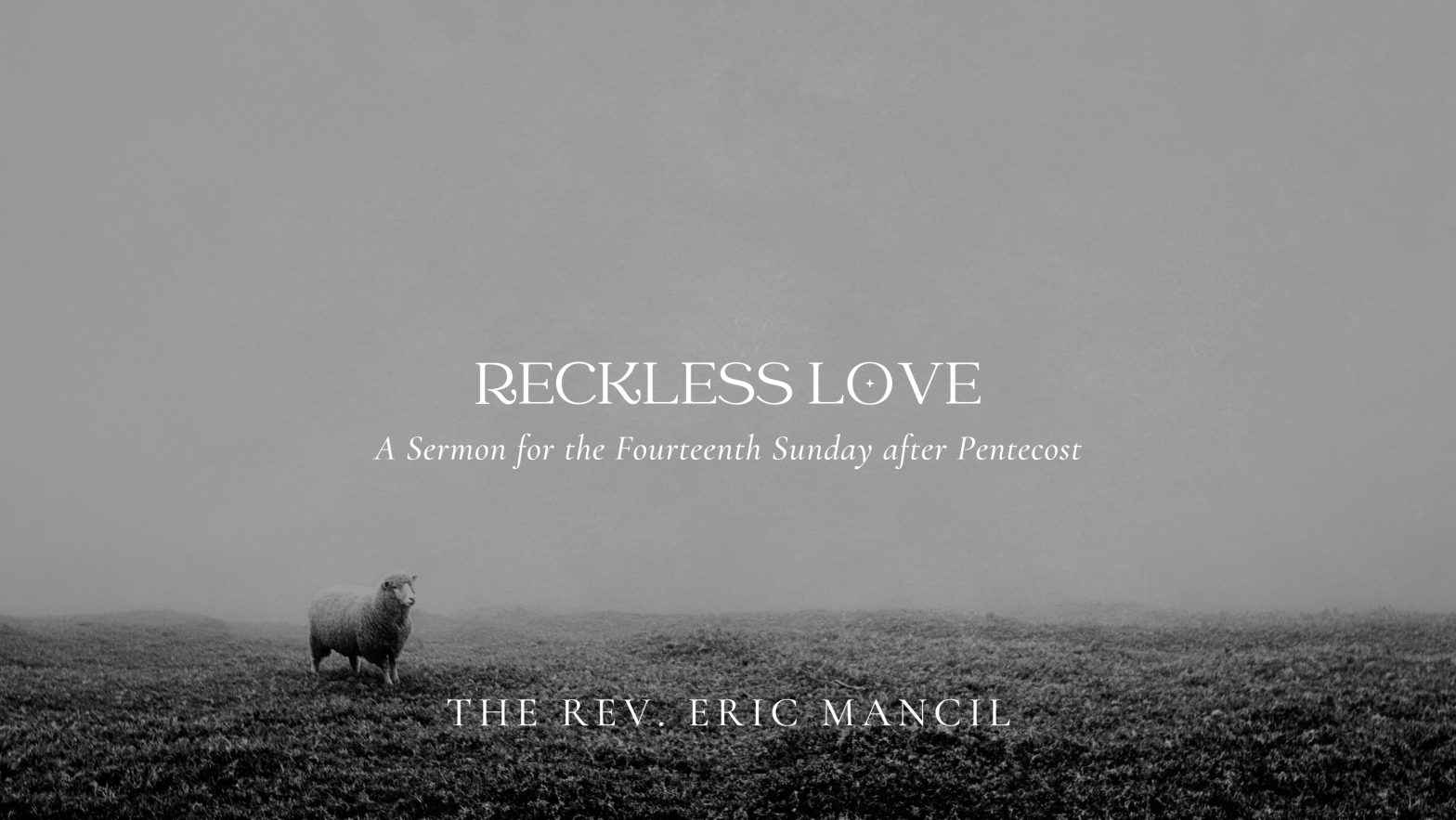
A Sermon for the Fourteenth Sunday after Pentecost (Proper 19C)
The Baptism of Serena Grace Walker
September 14, 2025
Text: Luke 15:1-10
Now, O Lord, take my lips, and speak through them. Take our minds, and think through them. Take our hearts, and set them on fire. In the name of the Father, and of the Son, and of the Holy Spirit. Amen.
This morning, I want to start with a song. Now, I’ll admit, I’m usually a traditionalist when it comes to church music. Give me a hymn from the 1982 Hymnal and I’m perfectly happy!
But every once in a while, I discover a newer song that captures a truth of the Gospel in such a powerful way that I can’t help but be moved by it.
For me, one of those songs is Reckless Love by Cory Asbury.
Some of you have probably heard it before, especially if you’re a fan of contemporary Christian music.
The chorus describes God’s love as overwhelming and never-ending, a love that pursues us and never gives up, a love that tears down walls and breaks through barriers to bring us home.
It goes like this:
Oh, the overwhelming, never-ending, reckless love of God.
Oh, it chases me down, fights ‘til I’m found, leaves the ninety-nine.
I couldn’t earn it, I don’t deserve it, still You give Yourself away.
Oh, the overwhelming, never-ending, reckless love of God.
Whenever I hear that song, I can’t help but think of the parable of Jesus we heard in our Gospel lesson this morning from Luke—the story of the shepherd who leaves the ninety-nine sheep behind in order to go and find the one that is lost.
It’s one of the simplest parables Jesus tells, and yet it’s also one of the most profound.
A shepherd notices that one of his sheep is missing. Ninety-nine are still safe, but one is lost.
And instead of being content with what remains, the shepherd goes out into the wilderness to search for the lost sheep.
He doesn’t shrug his shoulders and say, “Well, at least most of the flock is okay.” He doesn’t write off the missing one as if it doesn’t matter. No—he goes, and he searches.
And when he finds that one lost sheep, he doesn’t punish it or drive it back with a stick. He lifts it onto his shoulders and carries it back home, rejoicing.
That’s what God’s love is like.
It’s reckless, in the best sense of the word.
Not careless, but extravagant. Unrelenting. Willing to go to any length to find us and bring us back home again.
And that’s the kind of love we celebrate today as we gather to baptize Serena Walker into the household of God and welcome her as the newest member of the Body of Christ.
Baptism is the beginning of our walk with Jesus. It’s the sign and seal of God’s reckless, relentless love.
In baptism, God does for us what the shepherd does for the lost sheep: God finds us, names us, claims us as his own, and carries us home.
It’s important for us to remember that in baptism, we don’t make God love us any more than he already does. God already loves us more than we can possibly imagine.
What we do in baptism is recognize that love, respond to it, and commit ourselves to walk in it.
Baptism is deeply personal—it marks the beginning of our life in Christ. But it’s also communal—it binds us into the Body of Christ, the family of God.
That’s why we celebrate the sacrament of Baptism as a church family and not in a private ceremony.
Here at St. Mary’s, we make the joy of baptism visible through our tradition of creating a banner for every person who is baptized or confirmed.
Each banner is unique, just as each of us is uniquely made by God. We hang them all in the Parish Hall, where they serve as a reminder that we belong not only to God, but also to one another.
When you look around and see those banners together, you see more than just fabric and color—you see a community stitched together in love.
And today, Serena’s banner will be added to that collection, a lasting sign that her life and her story are now woven into the story of this church and this family of faith.
Serena first came to St. Mary’s a couple of years ago as a junior in high school. At first, she was a little shy and a little unsure about this place called the Episcopal Church.
She didn’t quite know what she would find here, or whether or not she would fit in.
But over time, she discovered that she had a place here.
She joined our choir as a choral scholar, and her voice became a gift to our worship.
She found in this community a place where she could grow, ask questions, and feel at home.
Earlier this week, we met to talk about baptism, and one of the things Serena told me was how much this church has meant to her over the past two years.
She said that one of the things she appreciates most about our parish is that we don’t judge others.
Here, she found a faith community where she could be herself and feel welcomed, exactly how God made her.
A few weeks ago, at the end of choir practice, she came up to me and said, “Father Eric, before I leave for college, I want to be baptized.”
Well…as you might imagine I went home that night with the biggest smile on my face, almost moved to tears, thanking God for this wonderful blessing.
Thanking God for bringing Serena to us, even if it was only for a short time. Thanking God for being present in her life and opening her heart to the movement of the Spirit.
Next month, she’ll head west to Los Angeles to begin her college education, and when she leaves, she’ll carry this new identity with her into the next chapter of her life—child of God, marked as Christ’s own forever.
Serena’s decision to be baptized before she leaves for college is her way of saying yes to God’s love.
But it’s also a reminder for all of us.
Baptism isn’t just about one person’s story—it’s about the whole Church. Every baptism is a chance for us to remember who we are, and to renew the promises we made at the font.
Because baptism isn’t just about what God has done—it’s also about what comes next.
It equips us to walk into the future with faith. It anchors us in God’s love no matter where life takes us.
And this is why baptism matters—not just for Serena, but for all of us.
No matter where we find ourselves in life—no matter what hardships we face—God never walks away.
God is always with us.
Given the week we’ve just lived through as a nation, I really needed that reminder.
I needed to be reminded this week of God’s relentless love—a love that seeks us out when we’re lost and brings us back home again.
On Wednesday night, I sat down at the dinner table with my kids, and like many of you, I felt the weight of the news from the day.
Earlier that day, we learned of the tragic death of a well-known public figure. Regardless of his politics or opinions—or whether or not you agreed with him—he was a child of God, a husband and a father, leaving behind a grieving family.
We also learned that there had been another school shooting, this time at a high school in Colorado, leaving two students critically injured and the person responsible dead.
Two tragic reminders of how fragile life is and how deeply our world is broken.
As we talked about it, I told the kids that sometimes the world feels like a dark and lonely place.
There are days when it seems like hope is slipping away, especially when we see all the ways people hurt one another.
We live in a time when even small disagreements can quickly turn into anger and division.
And this isn’t just an “us” versus “them” problem.
It’s not a matter of politics, or religion, or any one group.
It’s a “we” problem. We, as a society, have forgotten how to see the image of God in one another.
Until we recognize that we’re all responsible for the divisions, the anger, the violence, and the hostility, we’ll keep passing the blame back and forth and nothing will ever change.
We’ve stopped listening to each other.
We’ve stopped assuming the best in one another.
And too often, we’ve forgotten that even those we disagree with—even those who frustrate us or threaten us—are still children of God.
But here’s the Good News:
Yes, the darkness of our world is real, but it will never have the final word.
Just like the shepherd in Jesus’ story, God comes searching.
God finds us. God carries us home.
The waters of baptism remind us that God’s love is stronger than hate, stronger than violence, stronger even than death.
When we step into those waters, we step into the light that no darkness can overcome.
That’s why our faith matters so much.
Because in baptism, we’re reminded that there’s another way.
Baptism calls us out of the cycle of hostility and blame and into the way of Jesus—a way marked by mercy, forgiveness, and love.
Baptism reminds us that we’re not defined by the brokenness of the world, but by the love of God.
Baptism tells us that in the midst of darkness, we belong to the light.
Baptism calls us to live not for ourselves alone, but for Christ, who died and rose again.
And so today is not just a celebration for Serena.
It’s a reminder to all of us who have already been baptized.
The way of Jesus—the way of love—calls us to live differently.
When the world says, “hate your enemies,” Jesus says, “love your enemies and pray for them.”
When the world says, “hold tightly to what you have,” Jesus says, “give freely.”
When the world says, “you are what you achieve,” Jesus says, “you are God’s beloved, and nothing can ever change that.”
Today we remember what a gift baptism is—God’s promise of new life and relentless, reckless love.
Serena, in just a few moments, you’ll join us in the waters of baptism, and you’ll rise again—renewed and reborn, a new creation in Christ.
You’ll be marked with the sign of the cross and sealed as Christ’s own forever.
And as we see you claim this promise of new life, all of us will be called back to our own baptism—to remember that we too are children of the light, sent into the world to shine with Christ’s love.
We rejoice with you on this day.
We give thanks for your courage, your faith, and the future God has in store for you.
And we entrust you to the Good Shepherd—the one who seeks, the one who saves, and the one who rejoices over you with love that will never let you go.
Amen.
 The Rev. Eric Mancil