
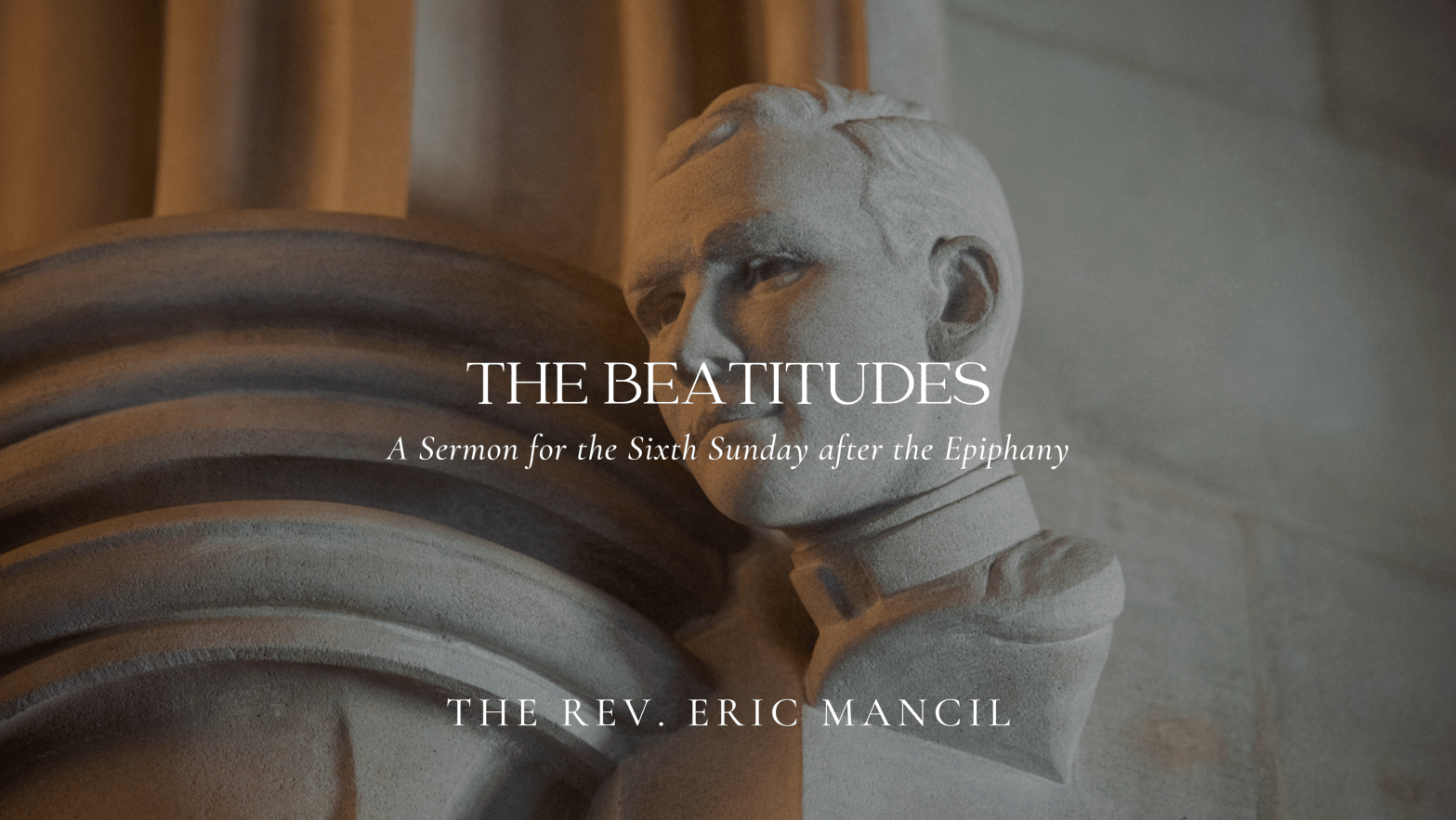
A Sermon for the Sixth Sunday after the Epiphany (Year C)
February 16, 2025
Text: Luke 6:17-26
Now, O Lord, take my lips, and speak through them. Take our minds, and think through them. Take our hearts, and set them on fire. In the name of the Father, and of the Son, and of the Holy Spirit. Amen.
I want to share with you a story this morning. Some of you have probably heard it before, especially if you’ve been a part of the Episcopal Church for a while.
It begins many years ago—in April of 1965—when a an Episcopal seminarian published an article about his journey south into the Black Belt after responding to Martin Luther King, Jr.’s televised appeal for clergy across the country to come to Selma, Alabama, to help secure the right to vote for all citizens.
In his article, the seminarian described in painful detail the types of atrocities that he and other civil rights activists witnessed during their times in Selma—acts of violence and oppression that good people endured simply because of the color of their skin.
During his time in Selma, the seminarian encountered racism and bigotry at its worst, even from parishioners and clergy at the local Episcopal church.
At the end of his article, the seminarian wrote, “Our life in Selma is filled with ambiguity, and in that we share with men everywhere.”
“We are beginning to see as we never saw before that we are truly in the world and yet ultimately not of it.”
“For through the bramble bush of doubt and fear and supposed success we are groping our way to the realization that above all else, we are called to be saints.”
“That is the mission of the Church everywhere.”
“And in this Selma, Alabama, is like all the world: it needs the life and witness of militant saints.”
The seminarian’s name was Jonathan Myrick Daniels, whom we commemorate in the calendar of the Episcopal Church every year on August 14th.
Nearly four months after his article came out, Jonathan and a few of his companions were arrested in Fort Deposit, Alabama, for joining a picket line and transported to the jail in nearby Hayneville.
Six days later, they were unexpectedly released.
They walked around the corner to a small store near the jail and upon entering were confronted by a man named Thomas Coleman, who was armed with a twelve-gauge shotgun.
He cursed them and threatened to kill them if they didn’t leave the store.
Jonathan immediately pulled seventeen-year old Ruby Sales, an African American girl, to one side in order to protect her.
Coleman fired, and Jonathan was shot in the chest and killed instantly.
On October 1st, less than two months after Jonathan’s murder, Thomas Coleman was found not guilty by an all-white jury after only two hours of deliberation.
Although he was only twenty-six years old when he died, Jonathan’s work and his commitment to the Gospel of Jesus continues to inspire new generations to work for justice and peace.
Every year in Hayneville, on the second Saturday in August, pilgrims from across the southeast and from other parts of the country gather to hear Jonathan’s story and honor the sacrifice he made.
Several years ago, I had the opportunity to attend the Jonathan Daniels pilgrimage for the first time.
We began on the front lawn of the Lowndes County Courthouse.
We formed a long procession, walking in the August heat from the courthouse to the former site of the Lowndes County Jail where Jonathan and his friends were imprisoned.
Then, we walked around the corner to the site where Jonathan was killed.
And all of a sudden, the signs that were carried in procession came into full focus—large, black and white photographs of Jonathan and all the martyrs of Alabama who were killed during the struggle for civil rights.
One by one, pilgrims took their turn kneeling on the steps and touching the storefront porch where Jonathan gave his life, offering silent prayers.
The procession ended back at the courthouse, where we celebrated the Eucharist in the same courtroom where Thomas Coleman was acquitted for Jonathan’s murder.
The judge’s bench, which is still used today, became an altar, and together, we shared the Body and Blood of Christ and recommitted ourselves to the work that God has given us to do.
“To be truly in the world,” as Jonathan once wrote, “but ultimately not of it.”
Looking back on my experience in Hayneville, it was one of those grace-filled moments when I was reminded of the fact that our lives are not really our own—that we’re part of a story that began long ago and one that will continue until God’s Kingdom is fulfilled.
Seeing the photographs in the procession…
Hearing the stories along the way…
Sharing the sacrament in the courtroom…
It was like being surrounded by the saints in light—that great cloud of witnesses that continues to inspire us and teach us about what it means to love as Christ loved.
That’s the legacy of Jonathan Daniels and all the martyrs of the faith who’ve given their lives as an example of God’s love.
It’s a legacy of compassion and mercy, of sacrifice and reconciliation.
Jonathan’s story serves as a reminder to all of us that this Christian life to which we’re called won’t always be easy.
Sometimes, it’ll challenge us to come out of our comfort zones and draw us to places we never expected to go.
Sometimes, it’ll compel us to stand up and speak out in order to protect those who have no voice or power for themselves.
It’s a life that calls us to work for justice and peace among all people and to respect the dignity of every human being.
A life that calls us to help tear down those systems of injustice and oppression in the world that threaten to weigh down and destroy the children of God.
This is painful, difficult work, my friends, but it’s work that must be done—work that Jesus calls us to do in our own time and place.
In the words of Blessed Jonathan, we are called to be saints on earth, which means fully living into the vows and promises of our Baptism.
Pope Francis once said that the best description of a saint, their “identity card” as he put it, is found in the Beatitudes, which we heard earlier this morning from Luke’s Gospel.
In our Gospel lesson, we learn that Jesus came down to a level place to be with his disciples and a large crowd of people from Judea, Jerusalem, and the coast of Tyre and Sidon who had come to hear him preach and be cured from their diseases.
After all of them were healed, Jesus looked up at his disciples and said…
“Blessed are you who are poor,
for yours is the kingdom of God.
“Blessed are you who are hungry now,
for you will be filled.
“Blessed are you who weep now,
for you will laugh.
“Blessed are you when people hate you, and when they exclude you, revile you, and defame you on account of the Son of Man. Rejoice in that day and leap for joy, for surely your reward is great in heaven; for that is what their ancestors did to the prophets.”
“But woe to you who are rich,
for you have received your consolation.
“Woe to you who are full now,
for you will be hungry.
“Woe to you who are laughing now,
for you will mourn and weep.
“Woe to you when all speak well of you, for that is what their ancestors did to the false prophets.”
A lot of people, when they read the Beatitudes, think that it’s a list of commandments.
In other words, they read the line, “Blessed are you who are poor,” and think that Jesus wants them to go out and give away everything they own.
Or, they read the line, “Woe to you who are rich,” and think that Jesus must be condemning wealthy people.
But, that’s not what Jesus is doing here.
The Beatitudes—whether we’re reading Matthew’s version or Luke’s version—aren’t a list of commandments.
They’re a call to action.
They’re Jesus’ way of saying to his disciples that, when God’s Kingdom is finally fulfilled, the world as we know it will be turned upside down.
There will be no more poverty, no more starving people in the world.
Sadness and despair will give way to joy and peace among all people.
Enemies will become friends.
And people everywhere will finally realize and understand that the only thing that will save us is God’s redeeming love.
When we read the Beatitudes faithfully, as Christians, we come to understand that they’re not requirements for getting into heaven.
They’re God’s vision of heaven on earth.
And, it’s our job as followers of Jesus, to help make it a reality, now and in the life of the world to come.
So, in the spirit of the Beatitudes and thinking about the saints and martyrs of the faith who’ve come before us, like Jonathan Daniels, I want to offer my own list of blessings and woes—things we might consider as we seek to be faithful in our own time and place.
Blessed are the poor—Not just financially but also spiritually.
Those who rely on food stamps and other programs to help make ends meet.
Those who struggle to pay their utility bills each month.
Those who are embarrassed to have to ask for help.
Those who have no warm place to lay their head each night.
Those who feel like a failure in life.
For theirs is the kingdom of God.
Blessed are the hungry—
Those who wonder where their next meal will come from.
Those who worry about whether or not they’ll have enough to provide for their children.
Those who have to rely on churches and other groups for a hot meal.
Those who anxiously watch the price of groceries go up each month.
For they will be filled.
Blessed are those who weep now—
Not just for themselves but also for the state of the world.
Those who mourn the loss of loved ones.
Those who are lonely, anxious, or afraid.
Those who live in war-torn countries around the world.
Those who seek refuge from violence, oppression, and discrimination.
Those who have lost their jobs and source of income.
Those who simply want to be treated with dignity and respect.
For they will laugh.
Blessed are those who are hated, excluded, reviled, and defamed—
Those who are treated as unwanted and unlovable.
Those who are told they need to “go back to where they belong.”
Those who are turned away because of the color of their skin.
Those who are made to feel they are “less than” and unworthy.
For they will rejoice.
But woe to those who are rich—
Not only financially but also in power and authority.
Those who do nothing with what they’ve been given to help anyone but themselves.
Those who see people hurting and do nothing to help ease their pain.
Those who use their wealth to manipulate and control others.
For they have received their consolation.
Woe to those who are full now—
Those who have plenty to live on but are unwilling to share.
Those who live comfortably but are unwilling help someone in need.
For they will be hungry.
Woe to those who are laughing now—
Those who are so consumed with their own lives that they fail to see the suffering around them.
Those who take for granted the many gifts they’ve been given.
Those who think they have no responsibility to help anyone else but themselves.
For they will mourn and weep.
Woe to those who are greatly loved and admired—
Those who are in positions of power but don’t use their influence to help others.
Those who are only concerned with maintaining their own reputation and status in society.
Those who use their Christian faith as a way to boost their own power and popularity.
For they have received their reward.
The Beatitudes aren’t just something Jesus intended for a group of disciples two thousand years ago.
They aren’t something we’re meant to read and think to ourselves, “Oh, that’s nice, but it doesn’t really apply to us.”
They are words for us to live by.
Because all of us are called by God to be saints.
And that call comes with a heavy weight and responsibility to refuse to accept the idea that things are the way they are and will never change.
We are called to be a source of light and hope for the world.
To help make God’s vision of heaven on earth a reality.
To show others—through our words and actions—that there’s a better and more loving way to live.
Amen.
 The Rev. Eric Mancil