
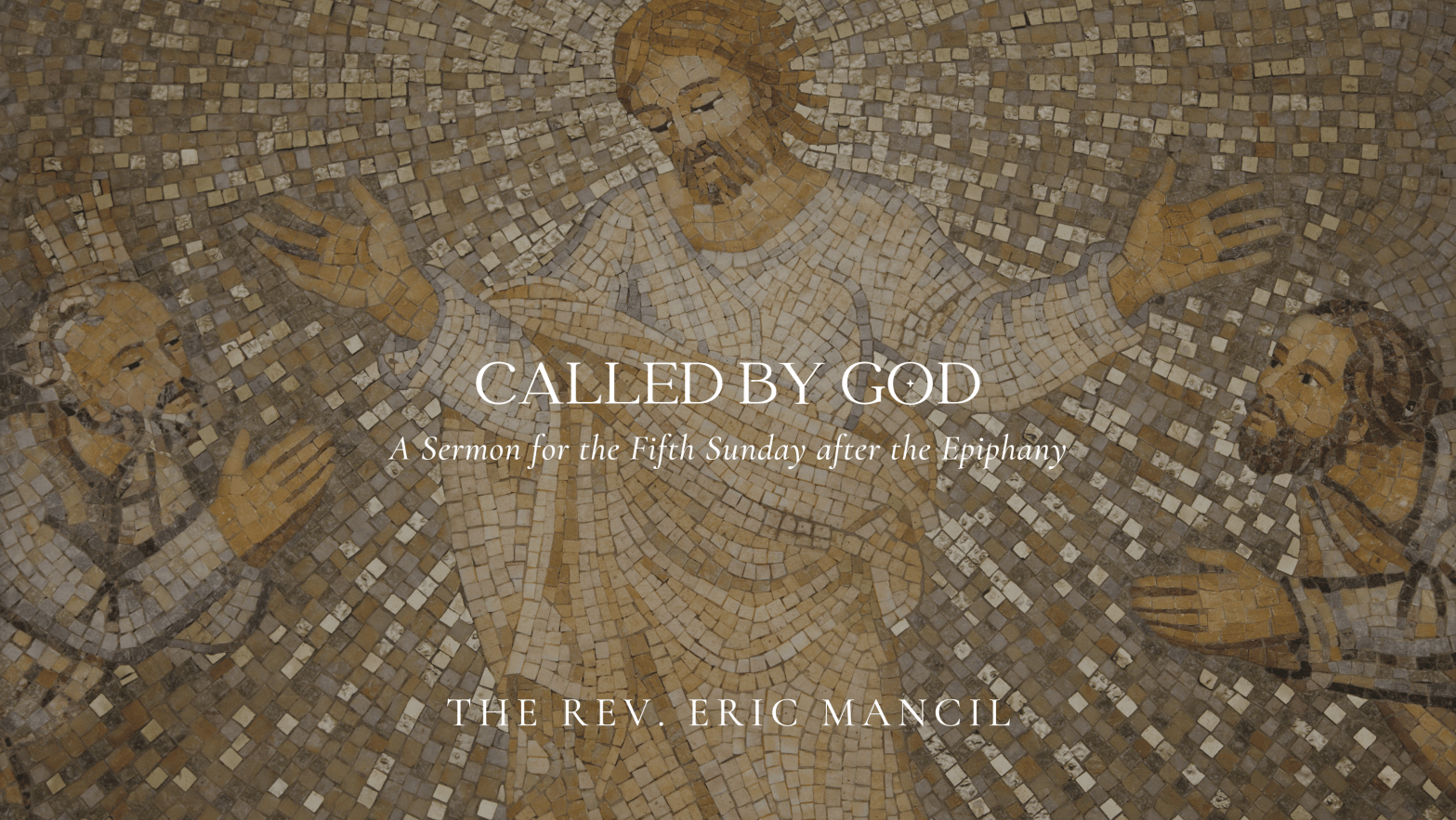
A Sermon for the Fifth Sunday after the Epiphany (Year C)
February 9, 2025
Text: Luke 5:1-11
Now, O Lord, take my lips, and speak through them. Take our minds, and think through them. Take our hearts, and set them on fire. In the name of the Father, and of the Son, and of the Holy Spirit. Amen.
When I was a teenager, I never dreamed that I would one day be a priest in the Episcopal Church.
As a matter of fact, I didn’t even know what the word “Episcopal” meant until I was a junior in college.
I went to school to study music education with the hope that, one day, I would get a great job teaching music to high school students and enjoy a long career as a choir director.
When I made the decision to study music in college, I felt sure that it was the right path for me to take.
Music had been such an important part of my life in junior high and high school, and being a choir director was something I knew I could do really well, something I knew I would enjoy doing.
So, I worked hard and eventually graduated with a bachelor’s degree in music education.
I began teaching at a high school in Savannah, Georgia, and for the most part, it was wonderful!
After years of hard work, I was finally getting the chance to do the work that I felt called to do.
But, something happened during my first year of teaching—something I never saw coming.
It was almost like a light switch was turned on.
I started asking myself questions like, “Is this really what God wants me to do with my life?”
“Am I really being called to be a music teacher? Or, is there something else I should be doing?”
“What if God is calling me to be a priest?”
“A priest! How ridiculous!” I thought.
“I’m still a brand new Episcopalian! I’ve only been confirmed for about a year.”
“Who do I think I am? There’s no way that God could be calling me to be a priest!”
So, I quickly dismissed the idea and continued on with my career as a teacher, but those thoughts and those questions never completely went away.
About two years later, I was teaching music at a different school, and I was finally able to talk with someone about these thoughts and feelings I’d been having about the priesthood.
I was finally able to say the words out loud.
“I think God may be calling me to be a priest.”
I can honestly say that I’ve never experienced such a weight lifted from my shoulders as I did in that moment.
It felt as if I was finally able to pass through this door that God had prepared especially for me, a door that God was waiting for me to walk through.
It wasn’t that I was unhappy as a teacher.
I could’ve kept teaching for the rest of my life and been perfectly fine.
But, I always would’ve felt this lingering sense that something was missing.
They say that when God calls someone to a particular ministry, that call doesn’t just go away. God is persistent.
And, for me, what started as a gentle nudge from God eventually turned into a calling that I could no longer ignore.
I wanted to share this with you today because the truth of the matter is that all of us—not just me or anyone else who wears a collar—all of us are called by God to serve in some way.
And, I think all of us—at least at some point in our lives—have questioned whether or not God could actually use us in ministry.
Because, let’s be honest.
Most of us are really good at doubting our own self-worth.
We’re really good at putting ourselves down and coming up with reasons why we shouldn’t do something we feel called to do.
We have this internal voice that tries to convince us of things like, “You’re not good enough.” Or, “You’re not smart enough.” Or, “You have no business serving anyone else when you can’t even get your own life together.”
“What makes you think God can use you?”
Does any of that sound familiar?
We’ve all struggled with these thoughts.
And, I’m here to tell you, dear friends, that it’s all a lie.
God can use you, just as you are.
You are enough, despite what the world or anyone else may try to tell you.
God is calling you by name to love and serve others in the name of Jesus Christ.
In our Gospel lesson this morning from Luke, we hear the story of Jesus calling his first disciples, which happens not long after a series of healings in Galilee, including the healing of Simon Peter’s mother-in-law.
Jesus is standing near the lake of Gennesaret, which was another name for the Sea of Galilee, when a crowd starts to gather around him to hear his teaching.
The crowd gets so large that the people start to press in on Jesus.
So, he decides to get into one of the fishing boats he sees on the shore, the one belonging to Simon Peter.
And, he asks Simon to push the boat out a little from the shore.
Then, he sits down in the boat and begins to teach.
When he’s done teaching, he tells Simon to take the boat further out into the lake where it’s deeper and to let his nets down into the water for a catch.
Simon and the other fishermen are tired from working all night long and not catching anything.
So, he thinks it’s pointless to try and catch anything at this point.
But, he tells Jesus, “If you say so, I will let down the nets.”
So, he puts the nets down into the water, and when he draws them back up again, they’re filled with so many fish that the nets start to break.
He calls the fishermen in the other boat to come and help, and by the time they’re done, both boats are loaded down with so many fish that they start to sink.
Simon Peter is so amazed by what he’s witnessed—so overwhelmed with emotion—that he falls down on his knees and says to Jesus, “Go away from me, Lord, for I am a sinful man!”
It’s his way of saying to Jesus, “I’m not worthy.”
“I’m not good enough to stand in your presence.”
I like to imagine that, in that moment, Jesus stopped what he was doing and smiled at Simon Peter and thought to himself…
“If you could only see yourself as God sees you, Simon.”
“Then, you might start to understand that you are worthy of God’s love and compassion and that you’re so much more than your worst mistakes and failures.”
“You are God’s beloved, and God has called you for a special purpose.”
Jesus tells Simon Peter, “Do not be afraid; from now on you will be catching people.”
And, as soon as they return to shore, Simon, along with James and John, drop everything they own and follow Jesus.
Unfortunately, we don’t have Jesus standing right in front of us, pointing us in the direction we’re meant to walk.
In our own lives, the call to follow Jesus isn’t always so easy to hear.
Sometimes, we don’t know what it is that God is calling us to do with our lives.
And so we pray and try to listen for God’s voice, and we rely on each other to help guide us and keep us on track.
In the church, we have a special name for this process of exploring our call.
We call it discernment.
It’s a way of being open to the movement of the Holy Spirit in our lives, without any agenda or selfish ambition.
It’s a way of being honest with ourselves and open to where God is leading us to go.
Through that process, we ask ourselves questions, like “What are the gifts God has given me?”
“What talents do I have?”
“Where am I needed the most?”
And, we do a bit of holy imagining, wondering and dreaming about the possibilities of how God might be calling us to use those gifts and talents we’ve been given to help others.
Frederick Buechner, the Christian writer and theologian, once wrote that “Vocation (or our calling) is the place where our deep gladness meets the world’s deep need.”
I’ve always loved that definition.
And, I think it’s a helpful way of thinking about the process of discerning one’s call.
Of course, when you finally get to the point where you start to feel that nudge or that tug on your heart to serve in some way—when you start to feel God’s call—then comes the hard part.
Saying “yes.”
Because when we say “yes” to God—when we say, “Here I am, Lord, send me,” it often means we have to give up something else in return.
Like the first disciples did when they left everything behind to follow Jesus.
But, we can trust that when we do say “yes” to God’s call, God will be with us every step of the way.
The process of discernment is a spiritual discipline, and it’s an important part of our Christian faith.
Because every single one of us, by virtue of our baptism in Christ, has been called to a life of ministry and service.
Despite our shortcomings and mistakes, despite our self-doubt and fear of the unknown, God can use all of us as instruments of his love and mercy in the world.
God can use you, just as you are.
You are enough, despite what the world or anyone else may try to tell you.
God is calling you by name to love and serve others in the name of Jesus Christ.
All you have to do is say “yes.”
Amen.
 The Rev. Eric Mancil