
A Sermon for the Second Sunday of Advent (Year C)
December 8, 2024
Text: Luke 3:1-6
Now, O Lord, take my lips, and speak through them. Take our minds, and think through them. Take our hearts, and set them on fire. In the name of the Father, and of the Son, and of the Holy Spirit. Amen.
One of the things I love most about the season of Advent is that we get to sing so many beautiful hymns each week. Some of my favorite hymns that we sing come from the Advent section of the hymnal.
This is one of the reasons why I decided that our Wednesday night Advent program for this year would focus on music.
And, before I continue on, I want to say that we had a wonderful time this past Wednesday, and I want to encourage you to come this Wednesday night, even if you weren’t able to make it last week.
We’d love to have you join us.
The hymns and carols of Advent have a lot to teach us about the significance of this season and why we spend four weeks preparing for the birth of our Savior and looking ahead to his return.
The popular Advent hymn, “O come, O come, Emmanuel,” for example, speaks to the expectancy of the one who will come to dwell with us, the one who is Emmanuel—“God with us.”
Or, my absolute favorite Advent hymn, “Lo! he comes, with clouds descending,” the eighteenth-century hymn by Charles Wesley, which looks beyond our present time to the second coming of Jesus at the end of the age.
There are so many others—hymns like “Comfort, comfort ye my people,” drawing from the prophecy of Isaiah, and “Prepare the way, O Zion,” which we sang just a few minutes ago.
We can learn a lot about the season of Advent and its significance simply by turning to the hymnal, by reading the words and singing the marvelous hymns that our tradition has to offer.
Many of these were featured last Sunday night in our service of Advent Lessons and Carols, which was put together by John Beasley and our choir. If you weren’t able to make it, you really missed out.
It was a beautiful service!
Another one of my favorite Advent hymns is “On Jordan’s bank the Baptist’s cry,” which we’ll sing later this morning at the end of the service.
It begins with the words, “On Jordan’s bank the Baptist’s cry announces that the Lord is nigh; awake and hearken, for he brings glad tidings of the King of kings.”
Did you know that this is one of the only hymns in our hymnal related to the life and ministry of John the Baptist?
If you don’t believe me, open up a hymnal, and thumb through the Advent hymns.
There aren’t many at all related to John the Baptist, and it makes me wonder why that is—especially since John is such a central figure during the season of Advent.
Maybe the editors of the hymnal didn’t think it was necessary to include more than a couple of hymns about John.
Or, maybe his message of repentance make us all a little uncomfortable?
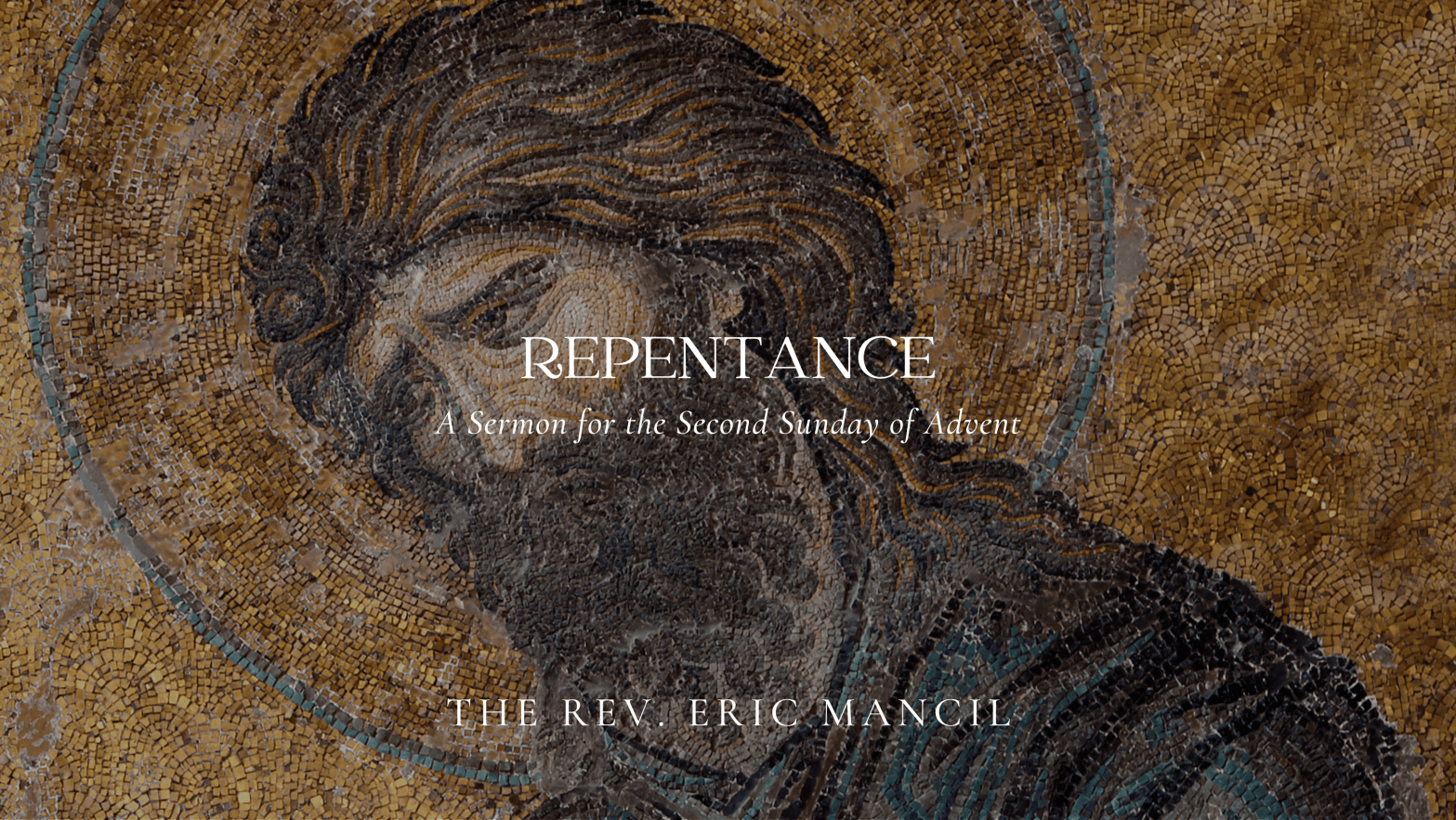
In today’s lesson from the Gospel of Luke, we encounter John the Baptist, who appears in the wilderness around the Jordan River and offers the people of Judea a baptism of repentance for the forgiveness of their sins.
His message to the people who have gathered is not a message of comfort or one that we would normally describe as “good news.”
He isn’t there to console them or to make them feel better about themselves.
His purpose is to prepare the way for Jesus, and he does this by proclaiming to the people that preparation begins with repentance.
He’s there to let the people know that the Savior they’ve been waiting for is coming into the world, and they need to be ready.
Repentance isn’t a word that we normally hear around this time of the year, is it?
No, during the days and weeks leading up to Christmas, our lives are typically consumed with making plans for the holidays.
We have Christmas parties to attend, gifts to wrap, and Christmas decorations to put up around the house—things that most of us consider to be fun and exciting!
We usually save words like “repentance” for the season of Lent as we prepare for Holy Week and Easter.
So, what place does repentance have during this season, and what does the message of John the Baptist have to teach us on this Second Sunday of Advent?
We know that John’s message must be an important part of the season because it shows up every year in our Sunday readings.
Whether we’re in Matthew, Mark, or Luke, John the Baptist shows up with his message of repentance, and in each version of the story, he says basically the same thing to the people who come to him for baptism.
“Repent, for the kingdom of heaven has drawn near. I am not the Messiah. I baptize you with water, but one who is coming who will baptize you with fire and the Holy Spirit.”
John’s message of repentance continues to speak to us today as we prepare, not only for our celebration of Christmas, but also as we look ahead to the day when Christ will come again.
As one author writes, “John demands that we get ready for Jesus.”
“Before we can bask in Christmas joy and the birth of a special baby, John forces us to examine ourselves and our world.”
If the season of Advent is meant to prepare us for the coming of Jesus, then it’s important for us to think about what repentance actually means because there’s a lot of misunderstanding when it comes to that word.
We often look at repentance in a negative way, don’t we?
We consider it a form of punishment or something we should try to avoid at all costs.
We think that, if you’re at a point in your life when you need to repent, then you must have done something pretty bad.
When many of us hear that word, we imagine street-corner preachers standing on their soapboxes, spewing angry messages at people as they walk by.
But, I want to suggest to you that repentance doesn’t have to be seen as something negative, and it doesn’t have to be seen as a form of punishment for doing something wrong.
And, this is important, because when we think of repentance as punishment, it’s easy for us to be overwhelmed with feelings of guilt and shame.
But, that’s not what God wants for us.
What God wants is for us to love others and to know that we’re loved, also.
I don’t believe God would call us to repent if it was meant to harm us or cause us to doubt our own self-worth.
When we read about John’s message of repentance and we hear the call of the prophets of the Hebrew Scriptures, we’re reminded of who we are as children of God and given an opportunity to return to the God who loves us more than we can possibly imagine.
Several years ago, just before our family moved from Texas back home to Alabama, I had the opportunity to attend my final convention in the Diocese of Northwest Texas.
The Bishop of the diocese delivered a thoughtful and inspiring message to those of us who were there.
During his address, he reminded me of something about repentance that I had once heard.
He said that we typically have two understandings of the word, “repent.”
In our culture, we tend to think of repentance as “feeling bad for doing bad things.”
And, in the Church, we tend to think that repentance is a call to conversion or a call to return to the Lord.
He told us that, while both of these understandings can be helpful, the actual meaning of the word, “repent,” in the original Greek means “to go beyond the mind” or to change one’s point of view.
The Bishop reminded us at the convention that Jesus uses parables and stories in his teaching that encourage us to go beyond the way we typically think or “to go beyond the mind” so that we can better understand what God is calling us to do in our lives.
But, how exactly do we do that?
How do we “go beyond the mind” and begin to change the way we think?
In his address, the Bishop suggested that we might begin by thinking about how we’re all connected.
He told us that, when we think about Jesus’ commandment to his disciples to “love your neighbor as yourself,” he’s not actually telling us to love our neighbors as much as ourselves but to love our neighbors as an extension of ourselves.
That’s what it means to “go beyond the mind” and into the mind of Christ.
To remember that we’re all connected and that we were created—not to care only for ourselves—but to love and serve each other.
When we think about repentance in this way, as a way of remembering that we’re all connected and called to love one another as an extension of ourselves, we can start to develop a much more helpful understanding of what repentance actually is.
It’s not something we should feel guilty about or something we should try to avoid doing at all costs.
When we recognize our need for it and allow ourselves to experience it, repentance can actually draw us into a deeper and more loving relationship with each other and with God.
So, as we continue to move through this Advent season and prepare for Christmas, let us remember the true meaning of the word “repentance,” and let us hold firmly to the message of John the Baptist and the prophets, who call us not to feel guilty about what we’ve done or left undone but to remember who we are and who we were created to be.
Amen.
 The Rev. Eric Mancil