
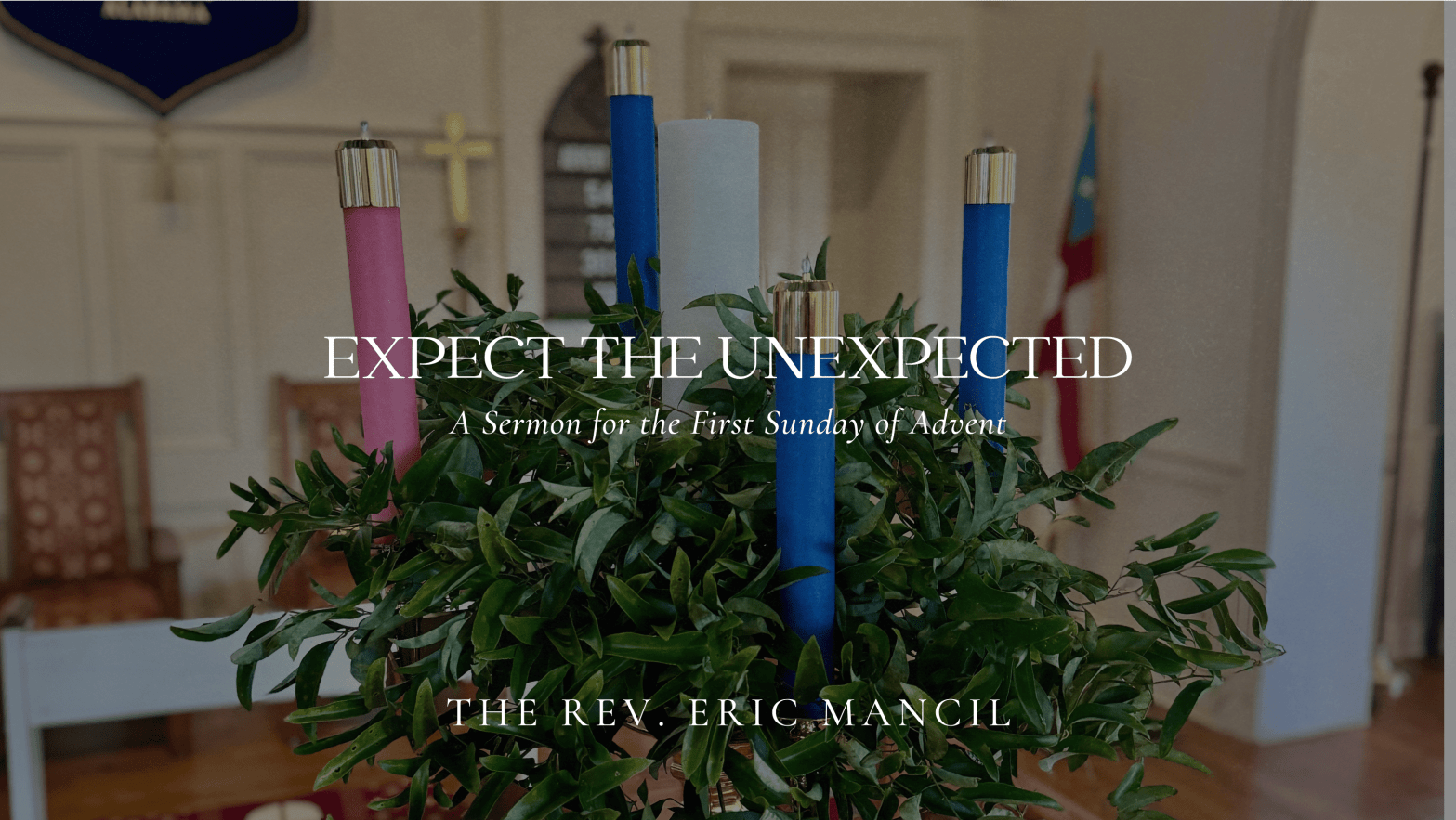
A Sermon for the First Sunday of Advent (Year C)
December 1, 2024
Text: Luke 21:25-36
Now, O Lord, take my lips, and speak through them. Take our minds, and think through them. Take our hearts, and set them on fire. In the name of the Father, and of the Son, and of the Holy Spirit. Amen.
There’s a lesson that my father once taught me at a young age. In fact, he started drilling this lesson into my head right around the age of fifteen, when I first started learning how to drive a car.
Every time I went with him to practice driving, I would get into the driver’s seat, and he would get into the passenger’s seat.
And, once I backed out of the driveway and started driving, he would always tell me, “Eric, you have to always expect the unexpected.”
Of course, being a fifteen year old at the time, I didn’t pay much attention to what he said, and there might’ve been some occasional eye rolling going on.
But, every time we went driving together, he would always say the same thing, and to this day, he still says it from time to time.
“You have to always expect the unexpected.”
What I think he meant by that was that I always needed to be alert and on the lookout for sign of trouble because terrible things could happen behind the wheel of a car in a matter of seconds.
My father always told me that it wasn’t me that he was worried about.
It was other people—distracted drivers on the road—who may not see me coming or who may be too focused on other things when they should have their complete attention focused on driving.
I still remember my father’s lesson from when I was fifteen, and while I’ve certainly made my fair share of mistakes behind the wheel of a car, his lesson has stayed with me all these years.
I still do my best to “expect the unexpected,” knowing that my life and the lives of those around me could drastically change in a moment’s notice.
In the blink of an eye, life as we know it can change.
Sometimes these changes are good for us, and sometimes they’re not so good.
Sometimes, what we thought we knew about something—or someone—turns out to be completely wrong, and we’re caught off guard.
Sometimes, unexpected things happen to us, and we don’t know what do or how to move forward.
So, the wisdom of the phrase “expect the unexpected” can help us prepare for those moments when it feels like everything has changed and we have no control over what’s happening.
Over the years, I’ve come to understand how the wisdom of the phrase “expect the unexpected” can also be used in our relationship with God.
I think about my own life and the things that have happened to me and my family over the years, things that I never imagined or thought possible.
There are moments and experiences that I can point to and say with absolute certainty that the only explanation for them happening was because of God.
I think about my call to the priesthood and deciding one day that God was calling me and my family to go to seminary, to pick up and move nine hundred miles away from our home in south Alabama to northern Virginia.
In my experience, I’ve discovered that, when God calls us, it often happens in ways that are unexpected and beyond our understanding.
I also think about those moments in the Scriptures when God calls the most unlikely people to serve in the most extraordinary ways.
The Old Testament is filled with good examples—people like Moses, who wasn’t the natural-born leader you’d expect God to choose. But despite his limitations and mistakes, God called him to set his people free and lead them out of slavery in Egypt into the land of promise.
The New Testament is also filled with good examples of how God chooses the most unlikely people to serve in the most remarkable ways.
Some of them we encounter early on in the Gospels, in the story of Jesus’ birth.
People like Elizabeth, the mother of John the Baptist, who’s told that she will bear and give birth to a son, even at her old age.
And her much younger relative, Mary, who is visited by the angel Gabriel and told that she will bear and give birth to the Son of God.
The Scriptures, especially the ones we hear during the seasons of Advent and Christmas, are filled with examples of why we should always “expect the unexpected” when it comes to God and God’s plan for salvation.
In fact, if I could assign a tagline to the season of Advent, it would be “expect the unexpected.”
Expect that God is doing a new thing.
Expect that, even now, God is working to make all things new.
This was true two thousand years ago in a small town called Bethlehem.
And, it’s true for us today as well as we await the return of Christ.
God came into the world in this amazing, unexpected way by sending his only Son to be born of a human mother, to live and die as one of us, and to show us the way to everlasting life and peace with God.
Despite everything that could’ve gone wrong—despite the fear and uncertainty that Mary and Joseph likely felt in the days and weeks leading up to the birth of Jesus—despite all the odds stacked against them—nothing could stop the light from coming into the world.
Love came down from heaven on that first Christmas Day, and the world has been changed forever.
The seasons of Advent and Christmas invite us to contemplate the miracle of Christ’s birth, but these seasons of the Church year aren’t just about a single event that took place centuries ago.
They’re also about what God in Christ is doing now—in our own time and place—and what God is preparing us for in the future.
This is the reason why our Gospel lesson for this morning—on this First Sunday of Advent—looks ahead to the final coming of Christ.
Jesus is warning his disciples to stay alert—to keep awake and be prepared for the day of his return.
He tells them, “There will be signs in the sun, the moon, and the stars, and on the earth distress among nations confused by the roaring of the sea and the waves.
People will faint from fear and foreboding of what is coming upon the world, for the powers of the heavens will be shaken. Then they will see ‘the Son of Man coming in a cloud’ with power and great glory.”
From the description Jesus gives us, it sounds like something we should be afraid of, doesn’t it?
The picture Jesus paints doesn’t exactly stir comforting thoughts or emotions.
It sounds terrifying, to be honest.
Like, we want Jesus to come back, but maybe not too soon.
But, I don’t think Jesus said these things to scare us.
I think it was a wake-up call.
I think it was his way of saying to the disciples—and to us—that one day, everything as we know it now will fade away, and we need to be ready.
The Son of Man will return and finally bring to fulfillment God’s reign of peace on the earth.
The old heaven and the old earth will pass away, and a new creation will be born.
And, until that day comes, it’s our call, as Christians, to help make God’s Kingdom a reality.
So, our Gospel lesson this morning from Luke shouldn’t be read as a message of fear.
It’s actually a message of hope—hope that, one day, God’s plan of redemption will finally be fulfilled.
Jesus says it like this: “Now when these things begin to take place, stand up and raise your heads, because your redemption is drawing near.”
St. Bernard of Clairvaux, a French theologian and Benedictine monk who lived during the eleventh century, once wrote that there are actually three advents—or three comings of Christ.
In the first Advent, Christ came to us as a helpless child, born of a human mother, to usher in the Kingdom of God and to bring salvation to the world.
In the third and final Advent, Christ will come again and will bring to fulfillment God’s Kingdom. He will judge both the living and the dead, and his kingdom will have no end.
The second Advent of Christ is where we find ourselves now, in our own day and time and in every moment of our lives. Christ is present with us wherever we go, and we see Christ in every person we encounter.
If Bernard is right—and I like to think that he is—then we’re living in between the first and third Advents of Christ.
Our lives are the middle part—the second coming of Christ.
We have the ability, through our words and actions, to make the love of Christ present— here and now.
We have the ability to be the hands and feet of Christ in the world around us—to bring light to where there’s darkness—to bring hope where there’s despair.
And so, as we begin the season of Advent, let us draw close to Jesus and consider what God would have us do with the lives we’ve been given.
Because you never know where God will call us to go next.
But, we can trust that, wherever we’re called to go, God will be with us, and God will use us to help bring to fulfillment his plan of redemption.
Expect the unexpected.
Expect that God is doing a new thing.
Expect that, even now, God is working to make all things new.
Amen.
 The Rev. Eric Mancil