
A Sermon for the Seventeenth Sunday after Pentecost (Proper 19, Year B)
September 15, 2024
Text: Mark 8:27-38
Now, O Lord, take my lips, and speak through them. Take our minds, and think through them. Take our hearts, and set them on fire. In the name of the Father, and of the Son, and of the Holy Spirit. Amen.
Imagine, for a moment, that you’re taking a walk through what appears to be a very nice neighborhood. You’re walking down a sidewalk lined with tall, luscious trees and beautifully landscaped yards.
Judging from the appearance of the homes in this neighborhood and the people who live here, it’s probably made up of mostly middle to upper class families.
There’s no trash on the ground anywhere, and you imagine that it would be a grave sin to even consider going more than a couple of weeks without cutting the grass.
The appearance of this neighborhood is well-maintained, and you imagine that the residents who live here want to keep it that way.
After a few blocks of walking down the sidewalk, you come to what appears to be a church in the middle of this pristine neighborhood.
The church, like the neighborhood in which it resides, is beautiful.
The front yard is immaculate, enclosed with red, brick columns and a black, wrought iron fence.
You imagine that it must take a lot of work to maintain such a lovely appearance.
Upon further investigation, you discover that this church is an Episcopal Church, and as you continue walking by, you witness a very shocking sight, indeed—something out of of place and unexpected.
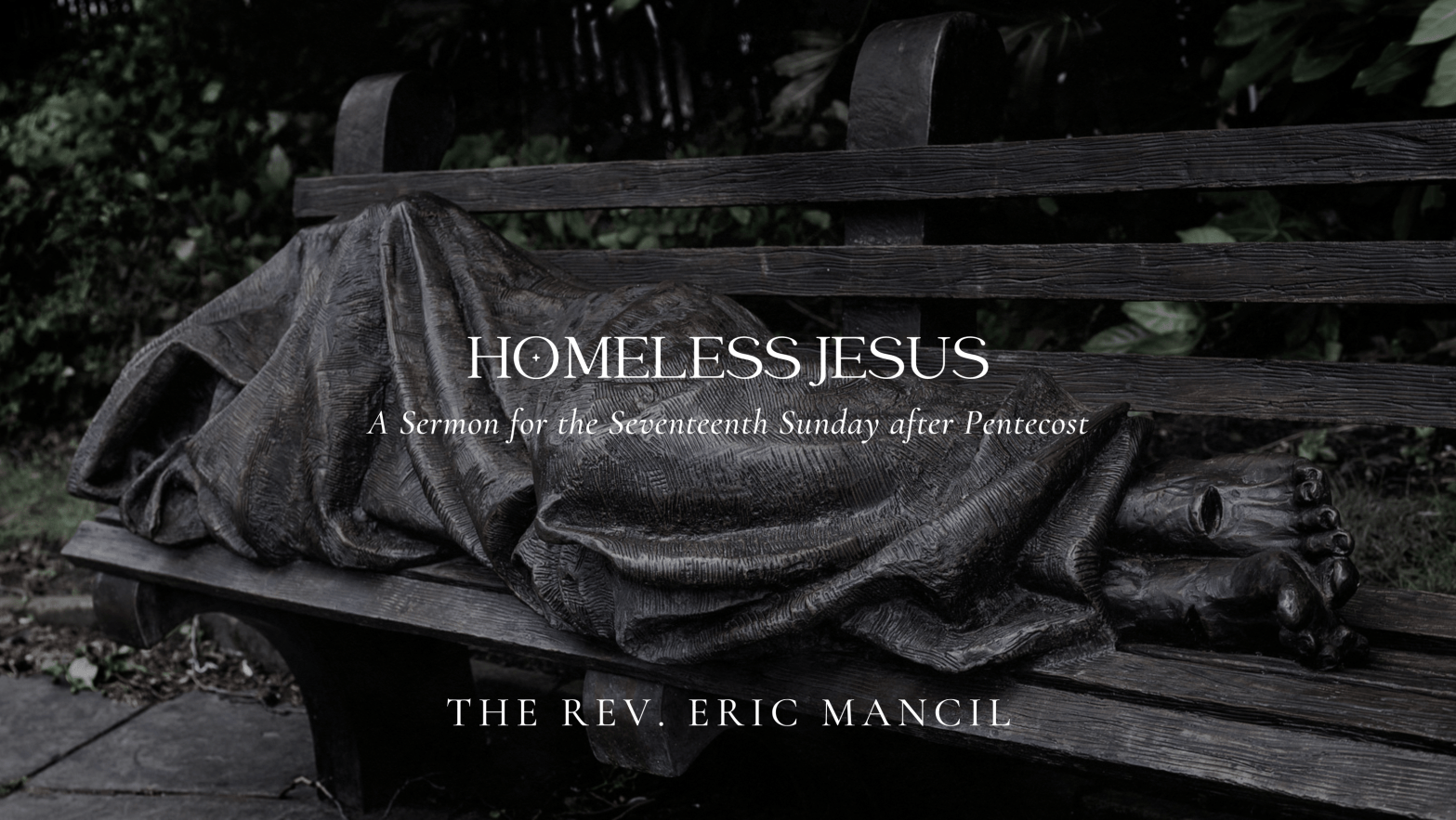
From a short distance, you see what appears to be a homeless person, covered up with a long blanket and sleeping on a park bench next to the church.
You ask yourself, “How did they get here? How could there be a homeless person sleeping here in the middle of this perfect neighborhood?”
You decide to move a little closer to see if there’s any way you can help. Maybe they need some food or a little bit of money.
So, you move closer, and as you approach the covered up person on the bench, you notice something strange about their feet—the only part of their body that isn’t covered up with the blanket.
You notice that each foot has a large, round scar in the center, and then it dawns on you. This isn’t just any homeless person.
These are the feet of Jesus.
In February of 2014—almost ten years ago—St. Alban’s Episcopal Church in Davidson, North Carolina, installed a bronze replica of Homeless Jesus, a sculpture that was originally designed and created by a Canadian artist named Timothy Schmalz.
The original sculpture was intended as a visual translation of the passage in the Book of Matthew, in which Jesus tells his disciples, “As you did it to one of the least of my brothers, you did it to me.”
The rector of the church at the time stated that the sculpture is “a good Bible lesson for those used to seeing Jesus depicted in traditional religious art as the Christ of glory, enthroned in finery.”
Well, as you can imagine, the church received mixed reactions from the community at first. Some people loved it. Others found it revolting.
One woman from the neighborhood actually called the police the first time she drove by because she thought it was an actual homeless person.
Another person wrote a letter to the church, claiming that the statue was creepy.
Others felt that it was insulting to depict Jesus as a homeless person.
I have to admit that, when I first saw the pictures of Homeless Jesus, I didn’t quite know what to think.
On one hand, I found it to be incredibly powerful.
The sculpture serves as a vivid and poignant reminder that, in order to serve Jesus, we have to be willing to serve our others, especially the most vulnerable among us.
On the other hand, it challenged my perception of who Jesus is.
It made me realize that I’m not very comfortable with the idea of a Savior who sleeps on a park bench, covered up with an old, tattered blanket.
It made me realize that I don’t really know if I want a Savior with scars on his feet, reminding me that this Christian life to which we’re called is one that requires us to take up our own cross in order to follow Jesus.
Like Peter, in our lesson this morning from the Gospel of Mark, I don’t want to hear about Jesus having to go through great suffering and being rejected and killed.
No, I want a Savior who’ll reassure me that everything’s fine and under control—a Savior who’ll tell me that I can follow him without really having to do anything or give up anything in return.
I want the long-expected Messiah, the mighty king who will come and fix everything that’s wrong with the world.
If I’m being completely honest, I want a safe Jesus—a Jesus who’ll protect me from getting hurt and shelter me from any kind of suffering.
In other words, I don’t want Good Friday Jesus.
I want the resurrected Jesus.
The problem with that is that we don’t get to separate the two. We don’t get to skip over Good Friday and go straight to Easter.
We don’t get to look at the homeless Jesus lying asleep on the park bench and say, “That’s not my Jesus.”
Whether we like it or not, our Jesus is the one who lies covered up on the park bench, waiting for us to reach out in love.
Our Jesus is the one who suffers right alongside those on the margins of society.
Our Jesus is the one who goes to the cross, who is persecuted and killed, in order to teach us that the way of the cross is the path to eternal life with God.
N.T. Wright, once wrote, “Jesus’s call to follow him, to discover in the present time the habits of life which point forward to the coming kingdom and already, in a measure, share in its life, only makes sense when it is couched in the terms made famous by Dietrich Bonhoeffer: ‘Come and die.’
Jesus didn’t say, as do some modern evangelists, ‘God loves you and has a wonderful plan for your life.’ Nor did he say, ‘I accept you as you are, so you can now happily do whatever comes naturally.’
He said, ‘If you want to become my followers, deny yourself, take up your cross, and follow me.’”
Dear friends, God does love us more than we can imagine, and God does have a wonderful plan for our lives.
But, that plan doesn’t involve material things or worldly comforts, and it doesn’t involve freedom from suffering or passively waiting around for someone else to come along and do the work for us.
God’s plan is for us to participate in the building up of God’s Kingdom, to help bring healing and restoration to the world that God has made.
Jesus began this work in his ministry and sacrifice on the cross, and it’s the work that we’re called to continued as his disciples.
God loves us and accepts us as we are, but that doesn’t mean that God wants us to stay as we are.
As followers of Jesus, we believe that new life is always possible and that forgiveness and redemption are always within our reach.
This Christian life to which we’re called is a lifelong journey of transformation, but in order to experience the transformation that God wants for us, we have to be willing to let go of the things that are holding us back, including our false ideas and expectations of who Jesus is and what Jesus calls us to do.
My brothers and sisters in Christ, may we always hold on to the image of the homeless Jesus lying on a park bench, reminding us that his place—and our place—is with the poor, the sick, and the oppressed.
May we always hold on to the image of the scars on Jesus’s feet, reminding us that his journey to the cross is the journey we’re called to make as well.
And finally, may we always hold onto the words of St. John Chrysostom, a pillar of the early Christian church, who once wrote, “If you cannot find Christ in the beggar at the church door, you will not find Him in the chalice.”
Amen.
 The Rev. Eric Mancil