
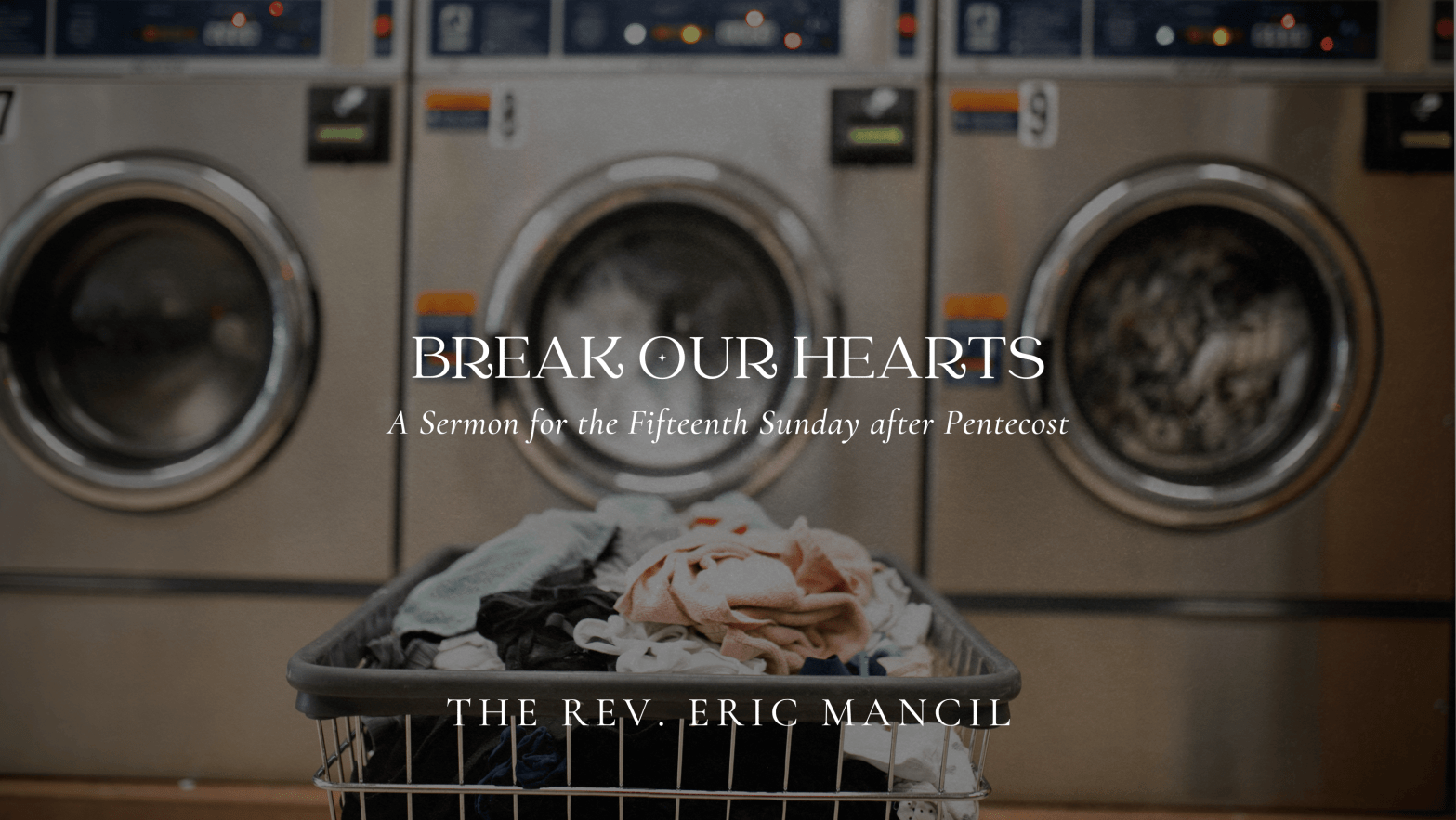
A Sermon for the Fifteenth Sunday after Pentecost (Proper 17, Year B)
September 1, 2024
Text: Mark 7:1-8, 14-15, 21-23
Now, O Lord, take my lips, and speak through them. Take our minds, and think through them. Take our hearts, and set them on fire. In the name of the Father, and of the Son, and of the Holy Spirit. Amen.
As many of you know, our church recently started offering our Laundry Love Ministry again after a long pause during the pandemic.
For those of you who are new to St. Mary’s, Laundry Love is a ministry that was started several years back.
When it first started, the idea was that a few churches around town—including St. Mary’s—would come together once a month to offer free loads of laundry to anyone in our community who needed it.
The churches provided laundry detergent, dryer sheets, and coins to operate the machines.
Once the pandemic hit, Laundry Love became a thing of the past—until our church decided to bring it back this past June.
In the spring, Susan Stephens and I met with the owner of the laundromat down the road to discuss our plans. We made signs and put the word out to the community through the local radio station and social media.
We started collecting money at the church using the coin boxes that have Laundry Love printed on the front. And we even had laundry detergent and dryer sheets donated to us from another church.
There was so much excitement and enthusiasm from members of the community. Several people reached out to tell us how wonderful it was that we were bringing this ministry back.
Which is why I was surprised when another member of the community shared with me that they didn’t think the church should be doing Laundry Love at all.
Basically, this person’s comment was that the church doesn’t need to be spending money helping people with their laundry and that the kind of people who go to the laundromat are just going to go out and use the money they save to buy things they don’t need.
I have to admit I was kind of shocked when I heard it, and I didn’t really know how to respond. Nothing I could’ve said would’ve convinced this person otherwise.
I wasn’t angry or upset.
Mostly, I just felt sorry for the person I was talking to.
Because their heart was hardened to the truth of who Jesus really is and what Jesus calls us to do in our lives.
After giving it some thought, what I would love this person to know—and really what I want all of us to know—is that we don’t do Laundry Love (or any other ministry, for that matter) because we feel sorry for the people we help or think that they deserve a handout.
And, we don’t do it to make ourselves feel better.
We do it because we believe that God’s love has the power to transform lives and to heal the world.
We do it because we believe that God has called us to be instruments of his love and compassion in the world and that through us, others may come to know the love of God at work in their own lives.
It’s really as simple as that.
We do these things because we believe that even the smallest act of kindness and generosity—like helping someone pay for a load of laundry—might be a sign for others that God really is here and that God really does care about them.
A few weeks ago, at our last Laundry Love, I met a friendly, young lady who was fairly new to Andalusia. She had only been in town for about a year.
I told her who I was and where we were from and that it was Laundry Love day.
At first, she didn’t understand. So, I explained to her why we were there and how it all worked.
And, she was so surprised when I told her. The look on her face told me that she didn’t come to the laundromat that day expecting people to show up and help pay for her laundry.
In fact, she had already washed her clothes. So, I offered to help her get started with the dryers. She put her clothes in the machines. I put the money in and hit the start button.
After a few minutes, we continued talking, and after a while, I started to get the sense that something was weighing on her heart.
So, I asked her, “Is everything okay?” “Can I pray for you in some way?”
And, that’s when she shared with me that she had been in an abusive relationship and that she was just trying to get her life back on track.
I told her that I would pray for her.
And, in that moment, I could tell that she was sincerely thankful that we were there.
Friends, I truly believe that God guides us into people’s lives for a reason.
Sometimes, we don’t know why, and we may never know why. And, then there are some days, when it all comes into focus and we know exactly why we were sent.
It didn’t take much for us to be at Laundry Love that day.
A little soap. A few dryer sheets. A few rolls of quarters.
But, God took what we had to give and used it to bring a little bit of light to someone’s life who I think really needed it in that moment.
And I’m so thankful to have been part of it.
That’s why we do what we do. To be a small part of God’s plan to bring healing and restoration to the world.
In today’s Gospel lesson, Jesus is having a debate with some of the Pharisees and scribes from Jerusalem.
When they gather around Jesus, they notice that some of his disciples are eating without first washing their hands.
Now…for most of us, we wash our hands before a meal because we want to stay healthy. We don’t want to take the risk of getting sick by not washing our hands.
But, in Jesus’ time, washing your hands before a meal was something that Jews were expected to do, not for sanitary reasons (like we do today), but because the ritual of hand washing was such an important part of their tradition.
Many believed that if you ate food without washing your hands first, you would be considered unclean and unacceptable before God.
Israel’s religion included many laws about ritual purity and holiness, and many of those had to do with dietary restrictions.
A good example of this is Leviticus 11 where the Lord instructs Moses and Aaron to tell the people of Israel which animals are acceptable to eat. This is where the Jewish restrictions on eating pork and shellfish comes from.
But, if you look closely at the Hebrew Scriptures, there was no law about washing your hands before eating.
This was a man-made tradition that emerged over time from a very loose interpretation of Exodus 30, which required temple priests to wash their hands and feet before ministering at the altar.
There was no actual law requiring Jews to wash their hands before eating. It was a “tradition of the elders,” something that was expected but not required.
So, when the Pharisees and scribes question Jesus about his disciples not washing their hands, they’re not accusing them of breaking God’s commandments.
They’re criticizing them for not living according to the tradition.
Well, Jesus doesn’t take very kindly to the criticism.
He responds by calling them hypocrites who are more concerned with upholding human traditions than actually living according to the commandments of God.
Then, he gathers a crowd of people around him and says, “Listen to me, all of you, and understand: there is nothing outside a person that by going in can defile, but the things that come out are what defile.”
It was Jesus’ way of saying that it’s not what we eat that makes us unclean. It’s what comes from our hearts and what comes out of our mouths that makes us unclean.
For Jesus, he’s not concerned with whether or not someone washes their hands before they eat or whether or not someone washes a piece of fruit from the market before they eat it.
His concern is what comes from the heart.
It’s what comes from the heart that defiles us and makes us unclean.
Jesus wants us to be healed and to be made whole, and he taught us that, in order to do that, we have to take a close look at our hearts.
Because the heart is where evil thoughts and intentions come from.
Jealousy, anger, resentment, hatred for those who aren’t like us, judgment toward others for their lifestyle choices and circumstances.
All of these are matters of the heart.
And when our hearts are hardened, it makes it really difficult for us to see how God is at work in our lives and in the lives of those around us.
The heart is the root of how we think, feel, and act.
This is what Jesus was concerned about—not what we put into our bodies—but what comes from our hearts.
Because he knew that in order for us to live as God has called us to live—in order to be faithful in our call to love and serve others—we have to allow the love of God to flow through us.
And the only way for that to happen is for us to allow those hard edges around our hearts to break open for those who are suffering.
To realize that, maybe, it isn’t our job to judge other people after all but to love them, despite their choices and circumstances in life.
To realize that, maybe, jealousy, anger, resentment, and hatred—those things that harden and infect our hearts—aren’t life-giving but life-draining.
God wants us to take a close look at our hearts and to think about the ways that we need to be healed.
Why?
Well, it’s not just for our sake.
It’s for the sake of the Gospel. Because in order to be faithful to God—in order to do the work that God has called us to do—our hearts have to be in the right place.
In the words of Mother Teresa, “May God break our hearts so deeply that the whole world falls in.”
Amen.
 The Rev. Eric Mancil