
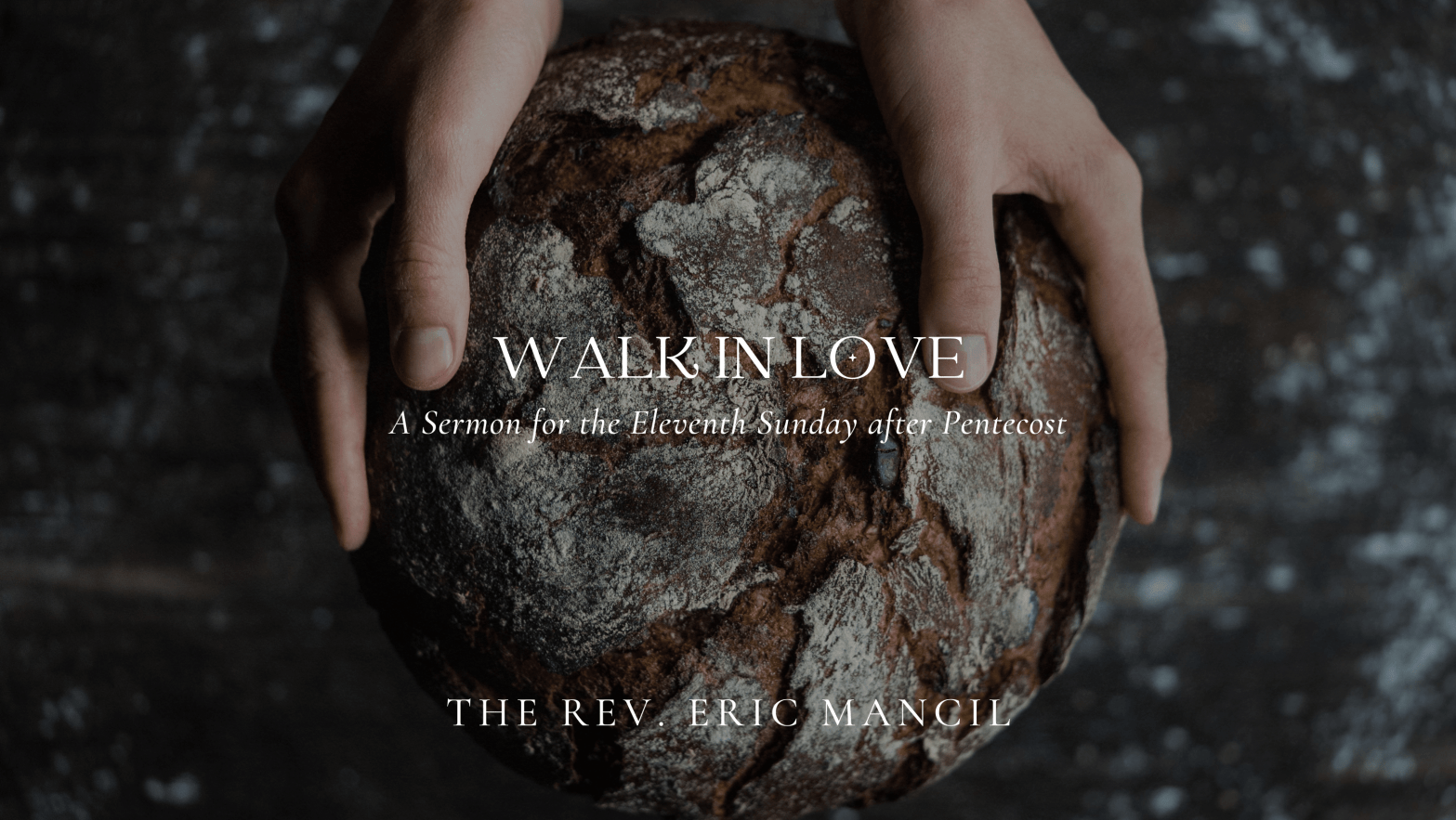
A Sermon for the Eleventh Sunday after Pentecost (Proper 13, Year B)
August 4, 2024
Texts: Ephesians 4:1-16 and John 6:24-35
Now, O Lord, take my lips, and speak through them. Take our minds, and think through them. Take our hearts, and set them on fire. In the name of the Father, and of the Son, and of the Holy Spirit. Amen.
From the letter to the Ephesians: “I therefore, the prisoner in the Lord, beg you to lead a life worthy of the calling to which you have been called, with all humility and gentleness, with patience, bearing with one another in love, making every effort to maintain the unity of the Spirit in the bond of peace.”
“I beg you, “ the author writes, “to lead a life worthy of the calling to which you have been called.”
I love these words.
To me, they convey a sense of Christian responsibility and urgency, and they remind us that this life to which we’ve been called, as followers of Jesus, is built upon a foundation of compassion and human decency.
As Christians, the way we treat our brothers and sisters really does matter. We have the ability, through our words and actions, to be examples of God’s love to those we meet in our everyday lives—whether that’s in person or through a text or phone call or on social media. The author of Ephesians uses very specific words to describe how we’re called to speak and act—words like humility and gentleness, patience and love.
And Lord knows, the world needs all of these things, perhaps now more than ever.
I think there’s something else, though—something more to be discovered from this text. To me, these words from Ephesians also seem to suggest that our calling is actually a gift from God.
Have you ever considered that before? Have you ever thought of your call to follow Jesus as a gift from God? We tend to think of God’s call as something that’s extended to everyone, and that’s true. As Christians, all of us are called to live lives worthy of the Gospel, and God gives each of us the freedom to choose whether or not to respond to that call.
But, I’m not sure that we give enough thought to the fact that God’s call is actually a gift, extended to us in love.
Perhaps, that’s because responding to God’s call is sometimes very difficult, especially when it requires us to let go of things that we so desperately want to cling to. Things like bitterness and hatred and jealousy and contempt for those who don’t think or believe the same way as we do.
Sometimes, God’s call feels more like a stumbling block than anything. Sometimes—or maybe most of the time—God’s call to love others with humility and gentleness and patience feels more like an obstacle to overcome than a blessing.
What do we do, then, when we feel as though we’ve reached the limit of our ability to sow seeds of God’s love in a world that seems broken and beyond repair? What do we do when our call to walk in love feels more like a burden than a blessing? Where do we go when we need a renewed sense of hope and reassurance?
Well, I have some thoughts about that, but first, I want to share with you a story.
Several years ago, when I was in my first call as a priest in northwest Texas, we put on a Vacation Bible School program called, “Abundant Life,” which was inspired by the work of Episcopal Relief and Development—an organization of the Episcopal Church that works to alleviate poverty, hunger, and the spread of disease in countries all around the world.
The goal for our Vacation Bible School program that summer was to offer children the opportunity to consider the many ways that God calls us to be good stewards of creation. So, we talked about God’s gifts of water, soil, seeds, and animals and how all of these gifts impact our relationship with the earth. We listened to stories from Holy Scripture. We planted flower seeds in clay pots that the children decorated themselves. We played games and sang songs, and we had a wonderful time doing it all.
On the last evening of VBS, during our closing Eucharist, I explained to the children how the fruits of the earth that we receive from God can be used to create things that nourish us, such as bread.
During the sermon, I held up a large bowl full of flour, and I asked the children, “Who knows what this is?”
Many of them already knew what it was.
They shouted out, “Flour!” Then, I passed the bowl around so they could feel the flour in between their fingers, and as I passed it, I asked them, “What kinds of things can we make with flour?”
Well, as you can imagine, I received some pretty colorful answers.
Without hesitating, one child raised their hand and shouted out, “Cake!”
Another shouted, “Bread!”
Then, another shouted, “Cookies!”
And then, my favorite response of all, “Peanut Butter Balls!”
I didn’t know what they were, but they sounded wonderful.
The children continued passing the bowl of flour around, and when the last child in the group had a chance to touch the flour, I said, “Yes, we can make lots of things with flour, and like someone already mentioned, we can make bread.”
Then, I walked back to the Altar table that we had set up in the Parish Hall. I held up several flat, round loaves of bread that I had baked the day before, and I explained to the children that we can use bread in different ways.
It tastes good, and we use it to nourish our bodies. But, we also use it during communion at church because it’s a sign for us that God loves us and that Jesus is here with us when we receive the bread and the wine.
I told them, “When we receive the bread and wine in communion, we carry Jesus with us wherever we go so that we may love others as Jesus taught us to love.”
“In what ways does Jesus teach us to love others?” I asked them.
Then, I read a familiar passage from the Gospel of Matthew, a children’s version of Matthew 25.
“The Kingdom is yours,” I said. “Come. When I was hungry, you fed me. When I was thirsty, you gave me a drink of water. You welcomed me when I didn’t know anyone. When I needed clothing, you gave me some. You took care of me when I was sick and visited me in prison.”
“That is how we love like Jesus wants us to love,” I told the children. “We love by taking care of other people, especially those who have less than we do, those who have no one else to care for them.”
I’ve been a priest for a little over nine years, and in that time, I’ve experienced moments of grace that are beyond anything I could’ve expected or imagined. One of those moments was getting to celebrate the Eucharist at the end of Vacation Bible School one summer with thirty children gathered around a makeshift Altar table.
I believe children instinctively know what’s going on when we receive the Body and Blood of Christ in the Eucharist. They may not be able to articulate it, but they know something special is happening. They may not seem overly interested in what’s going on, but the Holy Spirit is present. God shows up when we gather around the Table.
But, God does more than show up.
God uses simple things like bread and wine to show us how to live as Jesus lived. God uses bread and wine to form us into the Body of Christ and to give us the spiritual food we need to continue the journey.
So, back to my questions from before.
What do we do when we feel tired and helpless, like the weight of the world is too much to bear? How do we walk in love when we feel like we have no more love to give?
I think the answer is in our lesson today from John’s Gospel when Jesus says to the crowd, “I am the bread of life. Whoever comes to me will never be hungry, and whoever believes in me will never be thirsty.”
When we feel lost or afraid, we hold on to Jesus. When we feel like we have nothing left to hold on to, we come to the Table to be fed. We remember that there’s nothing in this world, nothing other than Jesus, that can fill us with what we truly need for the life to which we’ve been called.
It’s the reason why the Eucharist is seen as our principal act of worship in the Episcopal Church and why it lies at the center of everything we do as a community of faith.
The abundant life to which we’re called by God is one of self-giving, sacrificial love and a commitment to serve God’s people. But, it isn’t easy, and we can’t go about this work alone. We need to be strengthened and renewed in our walk with Christ. We need Jesus to be present in our lives and to fill us with that spiritual food which only he can provide.
I want to leave you with some words that’ve been a comfort to me over many years, words of invitation to communion from the Iona Community, which I’ve used from time to time in my own ministry as a priest.
Listen to these words. Carry them with you, and remember them, especially in those moments when it feels like God’s call to walk in love feels like too heavy a burden to bear.
“This is the table, not of the Church but of Jesus Christ. It is made ready for those who love God and who want to love God more. So come, you who have much faith and you who have little; you who have been here often and you who have not been for a long time or ever before; you who have tried to follow and you who have failed. Come, not because the Church invites you; it is Christ who invites you to be known and fed here.”
Amen.
 The Rev. Eric Mancil