
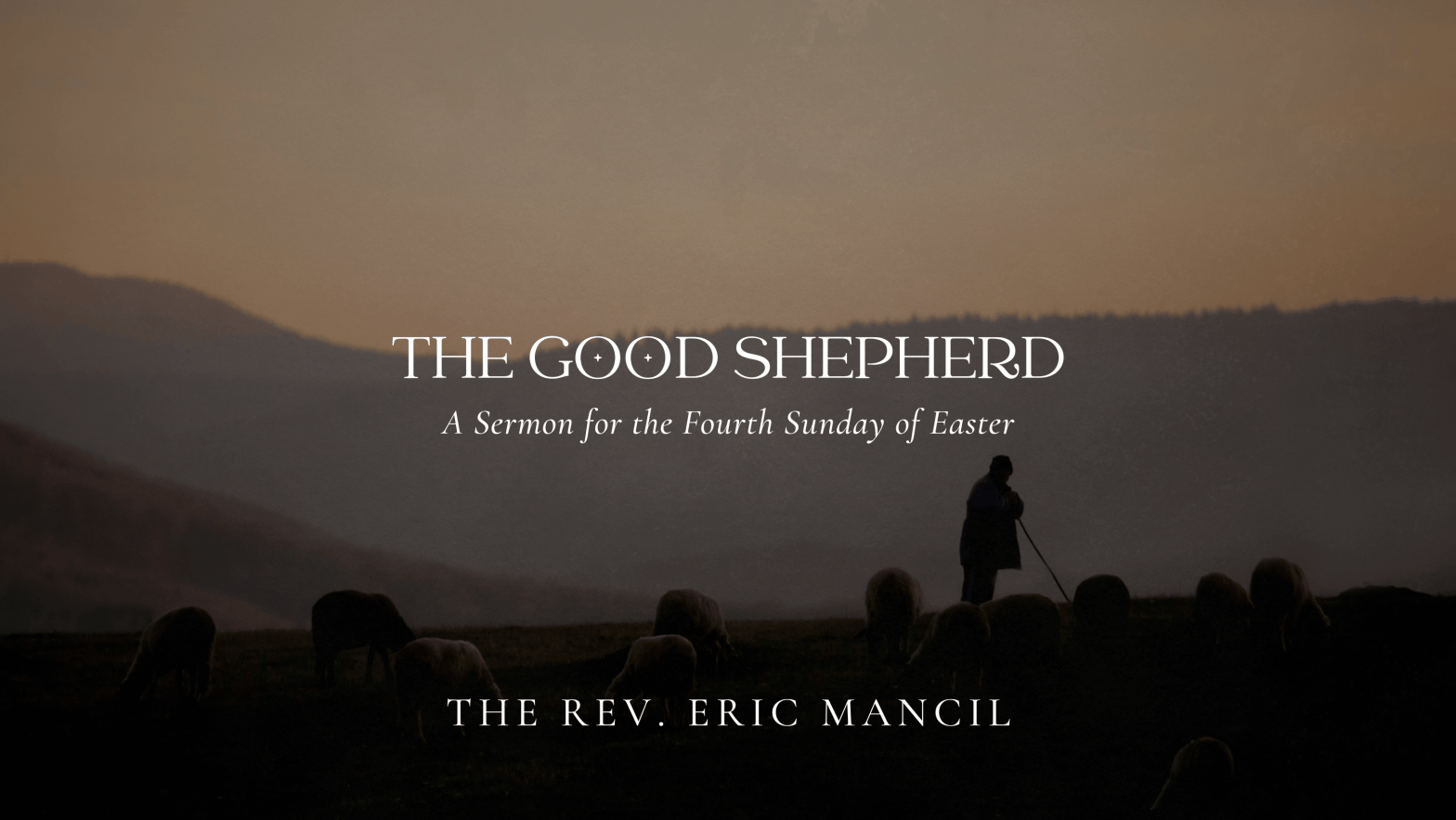
A Sermon for the Fourth Sunday of Easter (Year B)
April 21, 2024
Text: John 10:11-18
Now, O Lord, take my lips, and speak through them. Take our minds, and think through them. Take our hearts, and set them on fire. In the name of the Father, and of the Son, and of the Holy Spirit. Amen.
Back in January of 2021, while I was still serving as a priest in the Diocese of Alabama, we had an investiture service for the newly ordained Bishop of Alabama, the Rt. Rev. Glenda Curry. This was only about ten months into the pandemic. So, most of the diocese—including myself—had to watch the service online.
Now, you may be wondering, “What exactly is an investiture?”
Well, in the Episcopal Church, when a new bishop is elected to serve as the head of a diocese, he or she is ordained and consecrated to the episcopate, which is just a fancy word for “order of bishops” (and where the term “Episcopal” comes from).
In most cases, the newly ordained bishop immediately begins serving as the Diocesan Bishop—like Bishop Russell did when he was elected to serve as the bishop of our diocese.
But, in some cases, bishops are elected and consecrated before the current bishop retires in order to allow a time of transition while both bishops are still serving. When this happens, the new bishop is referred to as Bishop Coadjutor, which is a fancy way of saying “bishop-in-waiting.”
The Investiture and Seating of a Diocesan Bishop takes place when a current bishop retires and a new bishop takes over. It’s a ceremonial “passing of the torch” and an opportunity for the Church to ask God’s blessing upon the ministry of the new bishop, who’s been called to lead and offer guidance and care to the entire diocese. It’s a huge weight and responsibility.
Part of the investiture ceremony of a new diocesan bishop is the handing over of the bishop’s crozier, or pastoral staff. If you were at church a couple of weeks ago during Bishop Russell’s visit, you saw him carrying his crozier.
This is one of the many symbols associated with the office of bishop. It symbolizes the bishop’s authority as chief priest and pastor of the diocese. If you look at it closely, you’ll notice that a bishop’s crozier has a very particular shape. The bottom end of the staff is straight and narrow, like a walking stick, but the other end of the staff is curved like a hook. You probably know where I’m going with all of this. The bishop’s crozier is actually a shepherd’s crook, which makes the bishop a shepherd and the entire diocese his or her flock.
When we came to the passing of the crozier during Bishop Curry’s investiture, the former bishop handed her the staff and said, “On behalf of the people and clergy of the Diocese of Alabama, I give into your hands this pastoral staff. May Christ, the Good Shepherd, uphold you and sustain you as you carry it in his name.”
It marked the beginning of Bishop Curry’s ministry as the new leader and shepherd of the diocese and was a beautiful moment to witness.
Being a shepherd isn’t an easy job. And, it isn’t a very glamorous job, either.
In Jesus’ time, shepherds pretty much kept to themselves and were seen as very low on the social ladder. Their primary job was to keep watch over their flock and to get them safely to wherever they needed to go.
It was dangerous work. Shepherds had to protect their sheep from thieves, robbers, and wild animals, and this is one of the reasons why they carried a shepherd’s crook with them wherever they went. The straight, narrow end of the staff could be used as a weapon to protect the flock.
The other end of the staff—the curved end—was used to gather the sheep and lead them to wherever the shepherd wanted them to go. Contrary to popular belief, sheep aren’t dumb animals. They can’t be pushed or prodded from behind to get them to go where you want them to go. They have to be led by someone they trust, someone whose voice they recognize. The shepherd goes ahead of the flock and calls to the sheep.
This is why Jesus says to the Pharisees in our lesson today from John’s Gospel, “I am the good shepherd. I know my own and my own know me, just as the Father knows me and I know the Father.” When Jesus calls, we know his voice and follow because we love him and put our trust in him. He is the Good Shepherd, the one who leads us and guides us in our lives.
Today is the Fourth Sunday of Easter, also known as “Good Shepherd Sunday.” Each year, on this day, we hear a lesson from John’s Gospel having to do with Jesus as the Good Shepherd—the one who lays down his life for the sheep.
On this day, we also hear one of the most popular psalms—the Twenty-Third Psalm, which begins with the familiar words, “The Lord is my shepherd; I shall not be in want. He makes me lie down in green pastures and leads me beside still waters.” This is the psalm we go to when we think about Jesus as the Good Shepherd. He’s the one who comforts us when we’re lonely and afraid, the one who loves us and cares for us when we’re suffering or in pain. Jesus is also the one who leads us, the one who goes ahead of the flock and guides us to where he would have us go.
Sometimes, I think we forget that part of Jesus’ role as the Good Shepherd. Yes, Jesus comforts us and loves us, but Jesus is also there to lead us and guide us. Sometimes, that includes to places where we don’t want to go or places that challenge us to come out of our comfort zones in order to love and serve others. I can think of lots of examples in my life when I was perfectly happy and comfortable going about my business only to have Jesus come along and say, “Follow me.”
It’s no wonder, then, why Jesus, the Good Shepherd, is also our model for ministry in the Church and why people like bishops and other ministers are called and entrusted to be shepherds. It isn’t easy or glamorous work, by any means, but it is work that’s necessary in the building up of God’s Kingdom.
We need shepherds who are willing minister in Christ’s name, who are willing to go ahead of the flock and guide us, even to places where we may not want to go. We need pastors who are willing to sit with us when we’re hurting or in pain, but we also need pastors who are willing to help us get back on track when we’ve gone astray from the rest of the flock, to help us remember what the voice of the Good Shepherd sounds like.
Now, this is the point in my sermon when I tell you that you don’t have to carry a bishop’s crozier or wear fancy vestments or a white collar to be a shepherd or a pastor. All of us who share in the baptism of Jesus are called to be pastors in some way. The water of Baptism is our investiture. All of us are called to share the love of God in Christ with those who are suffering or in need. All of us are called to help lead the flock of Christ.
Bishops serve as the chief shepherd of the diocese, and priests lead by serving as pastors of individual parishes. But, you don’t have to be ordained to be a pastor. All of us are called to be pastors in some way. All of us are called to look toward Jesus as our perfect example of what true ministry looks like.
My prayer for all of us is that our wills may align with that of the Good Shepherd, that we may look to Jesus, not only for guidance and comfort, but also as an example for what our own ministries might look like in the Church. May we, who share in the ministry of the Good Shepherd, be prepared not only to be guided to places that challenge us but also to lead others there as well, trusting that the way of Jesus will always bring us to greener pastures. Amen.
 The Rev. Eric Mancil