
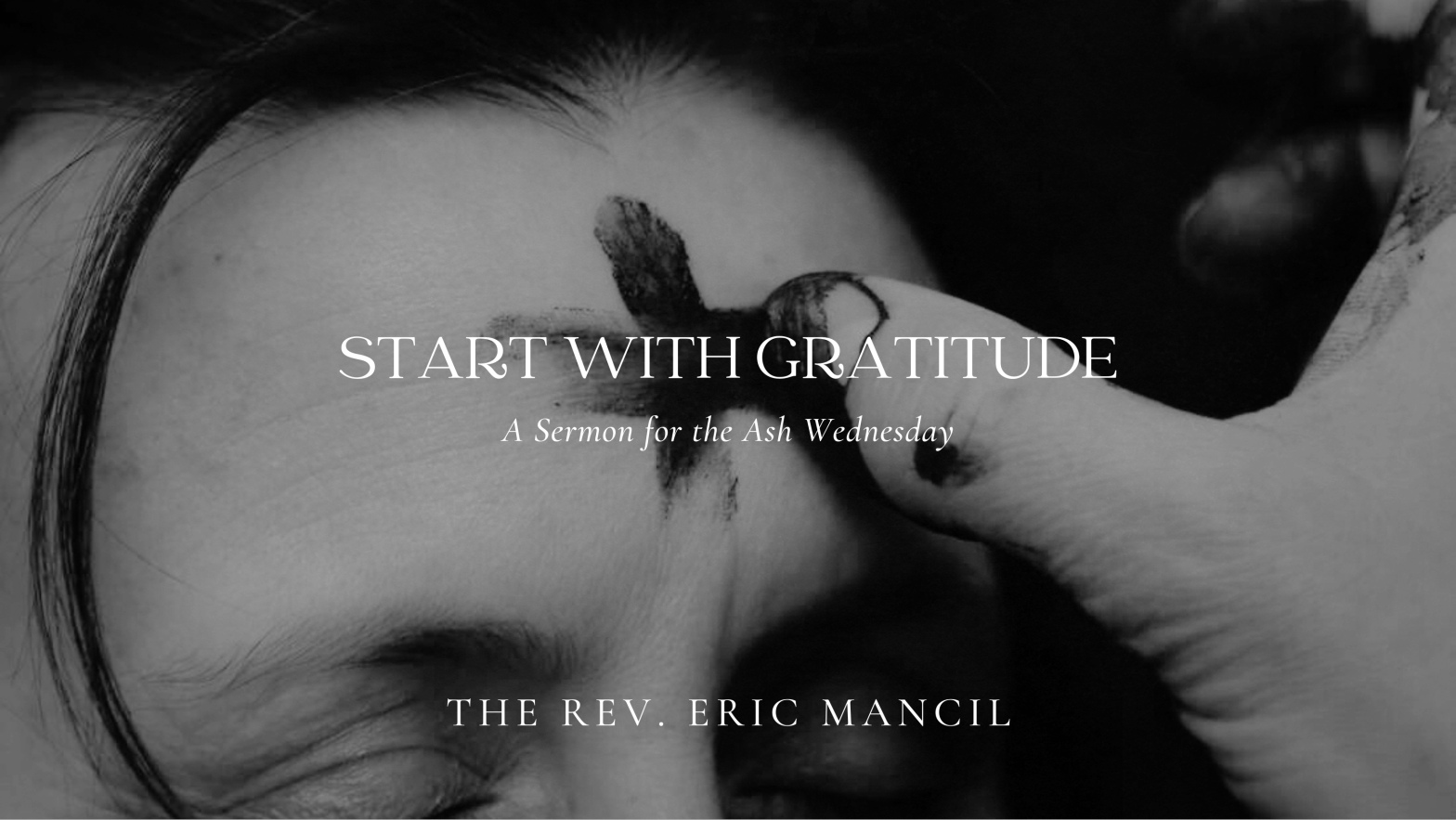
A Sermon for Ash Wednesday
February 14, 2024
Text: Psalm 103:8-14
Now, O Lord, take my lips, and speak through them. Take our minds, and think through them. Take our hearts, and set them on fire. In the name of the Father, and of the Son, and of the Holy Spirit. Amen.
From Psalm 103: “As a father cares for his children, so does the Lord care for those who fear him. For he himself knows whereof we are made; he remembers that we are but dust.”
I don’t often preach on the psalms, but it’s not because I don’t think they’re important. It’s because most of the time, I feel drawn to preach on the Gospel lesson appointed for the day. The Gospels serve as our best and most reliable source for learning about the life and ministry of Jesus, which is why we consider them especially important and why most priests in the Episcopal Church tend to focus on the Gospel lesson in their preaching.
But the psalms offer us something different. The psalms offer us a window—a glimpse into the lives of an ancient people who put all their hope and all their trust in God. The psalms are a collection of prayers and hymns, expressing a wide range of emotions—everything from joy and thankfulness to pain and sorrow. I think that’s one of the reasons why the psalms resonate so deeply within us. They’re honest about the human condition and the struggle we all feel in trying to be faithful to God.
It’s likely that many of the psalms we use today in public worship were used in a similar way during the time of Jesus in temple worship. There are psalms of lament, expressing Israel’s grief and their hope that God will reach out and save them from their suffering. There are psalms of praise and thanksgiving, expressing Israel’s joy in knowing that God is a loving and merciful god. There are other categories as well, but mostly, the psalms can be divided into two categories: psalms of lament and psalms of praise.
It’s almost impossible to know exactly when the psalms were written and who wrote them, but we do know that many of the psalms, like the one we read just a few minutes ago, are attributed to King David from the Hebrew Scriptures.
Psalm 103, the one appointed to be read every year on Ash Wednesday, falls under the “psalm of praise” category. It begins with the words, “Bless the Lord, O my soul, and all that is within me, bless his holy name.” You would think that the creators of our lectionary would choose a psalm of lament to be read on Ash Wednesday during the Liturgy of the Word—a psalm that expresses our plea for God to be merciful and kind, to rescue us from our wicked and sinful ways.
But instead, we’re given a psalm of praise, a psalm that expresses our thankfulness to the God who loves us more than we can possibly imagine, the God who is always ready to forgive us and welcome us back home again. I think this is an important detail to consider as we contemplate the significance of this day and the beginning of our journey through Lent.
Unfortunately, we often get Lent wrong, and we do so to our own detriment. I harp on this every year on Ash Wednesday. What I mean by that is that our common perception of Lent is that it’s a time when we’re supposed to just suffer in our own guilt and think about the ways we’ve been awful to each other and to God—like a parent who punishes their child by telling them to go and sit in a corner and think about what they’ve done to deserve such a punishment.
Another common perception of Lent is that it’s a time when we’re supposed to give up things that we enjoy, usually material things like coffee or sweets or Facebook.
But, when we think of Lent in this way, we run the risk of missing out on how incredibly life-changing it can be. One of my goals as a priest each year, around this time, is to offer a better and more helpful way to think about Lent.
It isn’t a punishment from God. It isn’t God sending us to “time out” for forty days and forty nights. It’s actually a time for us to draw closer to God, a time for us to be intentional in rebuilding our relationship with the one who created us, the one who loves us with no exception.
Overwhelming feelings of shame and guilt are useless in this work. Now, that doesn’t mean that we shouldn’t acknowledge those moments when we’ve fallen short of God’s call or our need to repent and return to the Lord. But, if we spend all of our time in Lent focused on our sinfulness and what we’ve done wrong, we create a stumbling block for ourselves.
So, I want to offer you another way you might begin your journey through Lent this year.
I want to suggest that, rather than focusing on all the things you’ve done wrong, think about how much God loves you and cares about your life and your relationship with him. Instead of beginning this season with an overwhelming sense of guilt about things done or left undone, begin with gratitude.
Start by saying “thank you” to God.
Start by saying thank you, Lord, for your loving-kindness. Thank you, Lord, for your love and mercy. Thank you for your willingness to forgive us when we sin against you and each other. And, thank you for giving us the grace in our lives to be transformed, to change and draw closer to you.
Back in February of 2021, after almost a year of living through a global pandemic, a former professor of mine from seminary wrote an article about observing Lent. In the article, he asked the question, “Must we do Lent this year?” And the answer, of course, was “no.” No one was forcing us to do Lent—even during the height of the pandemic.
It’s a question that many of us might ask ourselves each year when we come to Ash Wednesday. “Must we do Lent this year? Life is already hard enough, and we’re too busy to take on one more thing. Must we do Lent?” And the answer now is the same as it’s always been. No one is forcing us to take the journey.
But, my question is, “Why wouldn’t we?”
Why wouldn’t we accept the Church’s invitation to observe a holy Lent? Why wouldn’t we accept another opportunity to grow and seek new life with God, to be reminded each day of God’s unending love for us?
It’s true. Lent can be an emotional time, especially as we move closer and closer to Holy Week. We all know how the story of Jesus unfolds, don’t we? We know that he’ll go through much suffering and pain in Jerusalem before he’s finally sentenced to die on the cross. But, we also know that the story doesn’t end there. The story ends with joy and resurrection and new life. This is the journey we’re invited to take with Jesus over the next several weeks, a journey to rediscover who we are as God’s beloved children. I hope you’ll join me and accept the invitation. Amen.
 The Rev. Eric Mancil