
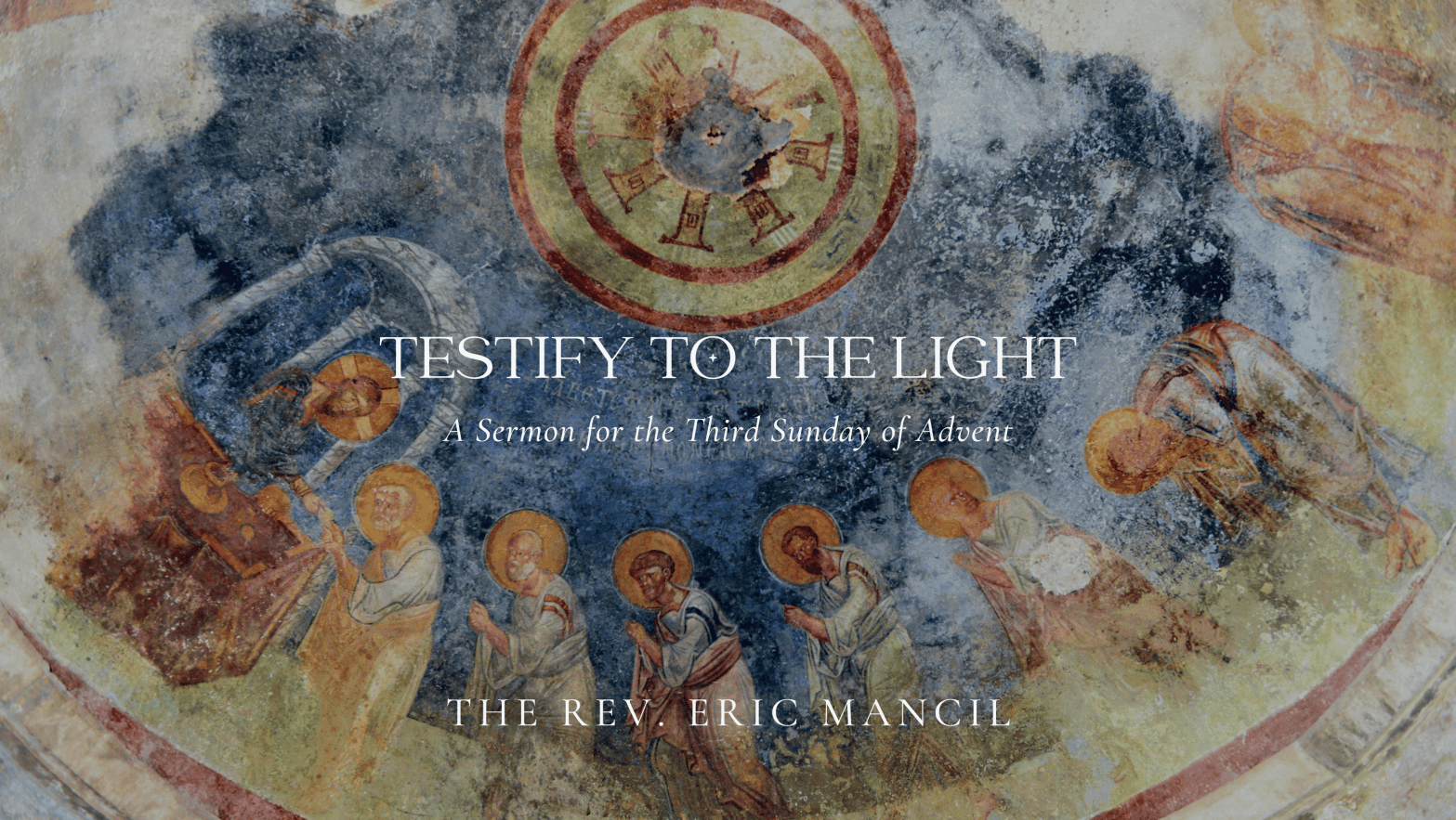
A Sermon for the Third Sunday of Advent (Year B)
December 17, 2023
Text: John 1:6-8, 19-28
Now, O Lord, take my lips, and speak through them. Take our minds, and think through them. Take our hearts, and set them on fire. In the name of the Father, and of the Son, and of the Holy Spirit. Amen.
Several years ago—way back in 2006—an old friend of mine and former priest from college, Father Wells, wrote a children’s story about the life and ministry of a famous bishop who lived a long time ago, during the third and fourth centuries.
You may have heard of him before. His name was St. Nicholas.
And, in case you’re wondering, “Is that the St. Nicholas?” Yes, it is.
The story of Santa Claus began centuries ago in an ancient city known as Myra, which was located in modern-day Turkey. St. Nicholas was the Bishop of Myra, and in the Episcopal Church, we celebrate his feast day every year on December 6th.
Father Wells used to celebrate the Feast of St. Nicholas each year with the children of St. Dunstan’s in Auburn. During the service, he would give the children chocolate gold coins, and in place of a sermon, he would share with them the wonderful story he wrote about St. Nicholas.
And, I want to share it with you today.
It is a children’s story, but it’s also a beautiful illustration of the kind of love we’re called to share with others as followers of Jesus, and I think it’s a wonderful reminder for all of us—especially as we move closer and closer to Christmas—that it’s much better to give than to receive.
***
THE STORY OF ST. NICHOLAS
Long ago, in a City far away, there lived a homeless boy with no Father, or Mother, or Brothers, or Sisters. The boy was all alone in the world. Early on Christmas Eve, the boy walked the crowded streets of the City. It was early morning, and he was cold and hungry.
He turned the corner and saw Angus Pennypincher, the Greedy Grocer, selling fresh oranges and red apples, roasted nuts and chocolate candies. They looked and smelled delicious! When old man Pennypincher looked away, the boy stuffed oranges and apples and nuts and candies in his pockets and ran down the street! “Stop, thief!” cried Angus Pennypincher. “Catch him! That red-headed boy has stolen my goods!”
Just then, the High Sheriff arrived, and the boy ran right into his arms. “That’s the one,” cried Pennypincher. “The red-haired boy! He is a thief! Arrest him! Arrest him!” The High Sheriff arrested the boy and threw him into the prison wagon.
Suddenly a tall man appeared, dressed in red, with big black boots and a shepherd’s staff. He was Father John, the Bishop of the City! The Bishop spoke sternly to the Greedy Grocer. “Angus Pennypincher, I will pay you for your trouble, but this boy belongs to God.” He placed three gold coins in Angus Pennypincher’s greedy hands.
Then the high sheriff let the boy go free. “Come with me, my son,” said the Bishop. “It’s Christmas Eve!” He began walking toward the Great Cathedral, and the boy hurried after him.
“I am Father John, the Bishop of the City,” said the tall man. “What is your name, my young friend?” “I am Nicholas,” said the red-haired boy. Father John asked, “And where do you live, Nicholas?” “I am an orphan,” said Nicholas. “I have no home.”
“Fear not, my son,” replied the Bishop. “You may come to live in the Great Cathedral. If you wish, you can work and study and grow up to serve God and the Church. Would you like that, Nicholas?”
“Yes, I would,” said Nicholas. “Thank you very much, Father John!” So, the homeless red-haired boy came to live in the Great Cathedral, where he was baptized and given his very own room behind the High Altar. Nicholas worked in the Sacristy, polishing brass and silver. He swept and mopped the Narthex of the Great Cathedral. He washed the stained-glass windows. He greeted the people, rich and poor, who came to worship God. In the cathedral services, Nicholas carried the brass processional cross.
In time, Nicholas became a scholar and a priest. Nicholas was a kind young man, and he never forgot the kindness shown to him by Father John.
Nicholas enjoyed visiting people, and he cared for the poor. He gave them food and clothing. At night, he would often return silently to the poorest homes and leave fresh oranges, red apples, roasted nuts, and chocolate candies on doorsteps and windowsills.
Great sadness came to the Cathedral one day. Nicholas was away, visiting the poor. The beloved Bishop, Father John, was dying. He called the other bishops and priests to his bedside and said to them, “I have had a vision from God. The first person who comes through my door will be Bishop!”
They turned toward the door of the Bishop’s bed chamber, and immediately Nicholas appeared before them. “Father John! Do not leave us!” cried Nicholas, with tears in his eyes. “God’s servant and fried has come!” said Father John. “Behold your Bishop!” Nicholas was very surprised and sad at the same time.
The bishops and people buried Father John in the Great Cathedral. The next day, they brought Nicholas to the High Altar and placed him in the Bishop’s Chair. Three Bishops from near-by cities laid their hands on his head and consecrated Nicholas the Bishop of the City.
The new Bishop of the City was given beautiful vestments—a red cope and miter, big black boots, and a shepherd’s staff carved of the finest wood. They also gave Father Nicholas a white horse, which he named “North Star,” for the star that leads travelers home.
Good Nicholas was a kind and loving Bishop. Throughout the year, he rode his horse North Star to visit the churches and people. And every night, Father Nicholas made secret visits to give fresh oranges, red apples, roasted nuts, chocolate candies, and gold coins to poor children.
Winter nights were cold, and snow fell in great drifts, but Good Father Nicholas wore a heavy cloak and fur cap over his red vestments to keep safe and warm. His beard grew long and white, for his red hair had turned to the color of snow. For many years, Good Father Nicholas continued to give unexpected gifts. Soon his good work spread far beyond the borders of the City.
At Christmas time, children everywhere began receiving fresh oranges and red apples, roasted nuts and chocolate candies, toys and cakes, gold coins and goodies.
The Verger of the Great Cathedral secretly helped Nicholas. He was a tiny old man with a long white beard. He gathered sacks from Weavers, toys from Carpenters, and cakes from Bakers in the City. Each night, the Verger loaded North Star with goodies for Father Nicholas to leave on doorsteps and windowsills without a sound or a whisper.
In different parts of the world, Bishop Nicholas became known as “Father Christmas” and “Saint Nicholas” and “Santa Claus” and “Sinter Klaas” and “Pere Noel” and “Grandfather Frost”—and so he is known to this very day!
***
I hope you enjoyed that story as much as I have over the years.
The reason why I wanted to share it with you today is because it isn’t just about St. Nicholas. It’s about what one person can do to make a difference in the lives of others and how acts of love and kindness and generosity can spread over time.
Think about it for a moment.
At the beginning of the story, Father John, the old Bishop, shows compassion toward Nicholas and provides him with food and shelter and a purpose in life. His kindness inspires Nicholas, who eventually grows up and becomes a priest and bishop himself and a symbol of love and compassion for the whole world. His actions inspire others to continue the work he began, and that legacy continues today—centuries later.
Sometimes, it’s easy to lose sight of what Christmas is all about, especially when we get wrapped up in that growing list of things to do during the holidays. But, the spirit of Christmas is the same as it always has been. St. Nicholas embodied that spirit in his desire to serve the poor and give to others.
Like Nicholas, we have the ability to embody the spirit of Christmas in our own lives and to inspire others with our words and actions.
This is part of our call as Christians—not to draw attention to ourselves in the things we say and do but to point others toward Jesus, the one true light.
At the beginning of our Gospel lesson for this morning, the author introduces John the Baptist with these words: “There was a man sent from God whose name was John. He came as a witness to testify to the light, so that all might believe through him. He himself was not the light, but he came to testify to the light.”
John the Baptist understood his calling from God. He understood his role in preparing a place for Jesus to come into the world.
He knew that he wasn’t the Messiah but that one was coming after him who would bring salvation to all people. His role was to “testify to the light.”
I love that phrase.
It makes me think of St. Nicholas and how he would visit the poorest homes in the city at night, secretly bringing gifts to the children. Maybe it wasn’t just for the element of surprise. Perhaps, it was his way of testifying to the light—his way of saying to the world that the light always overcomes the darkness.
Like John the Baptist, Nicholas understood his calling. He understood his role as one who testifies to the light—not drawing attention to himself but always pointing others toward Jesus.
I think we all have our own special ways of testifying to the light.
Some of us are great with words. Some of us are better with acts of service. Some of us share the light of Christ through art and music.
I see it all the time here at St. Mary’s. I saw it yesterday at Rice and Beans as we gave away bags of food and coats and blankets to our neighbors in the community. I saw it last Sunday when members of the EYC went shopping for Christmas gifts for children in our community. I see it every time someone shows up to church, ready to volunteer for whatever needs to be done.
We do these things, not for our own glory or benefit, but to point others toward Jesus—to tell the truth of who Jesus is and to show others the same kind of love we’ve been given.
This is our calling, and there’s no better time to be reminded of that than now, as we make our final preparations for Christmas. Amen.
 The Rev. Eric Mancil