
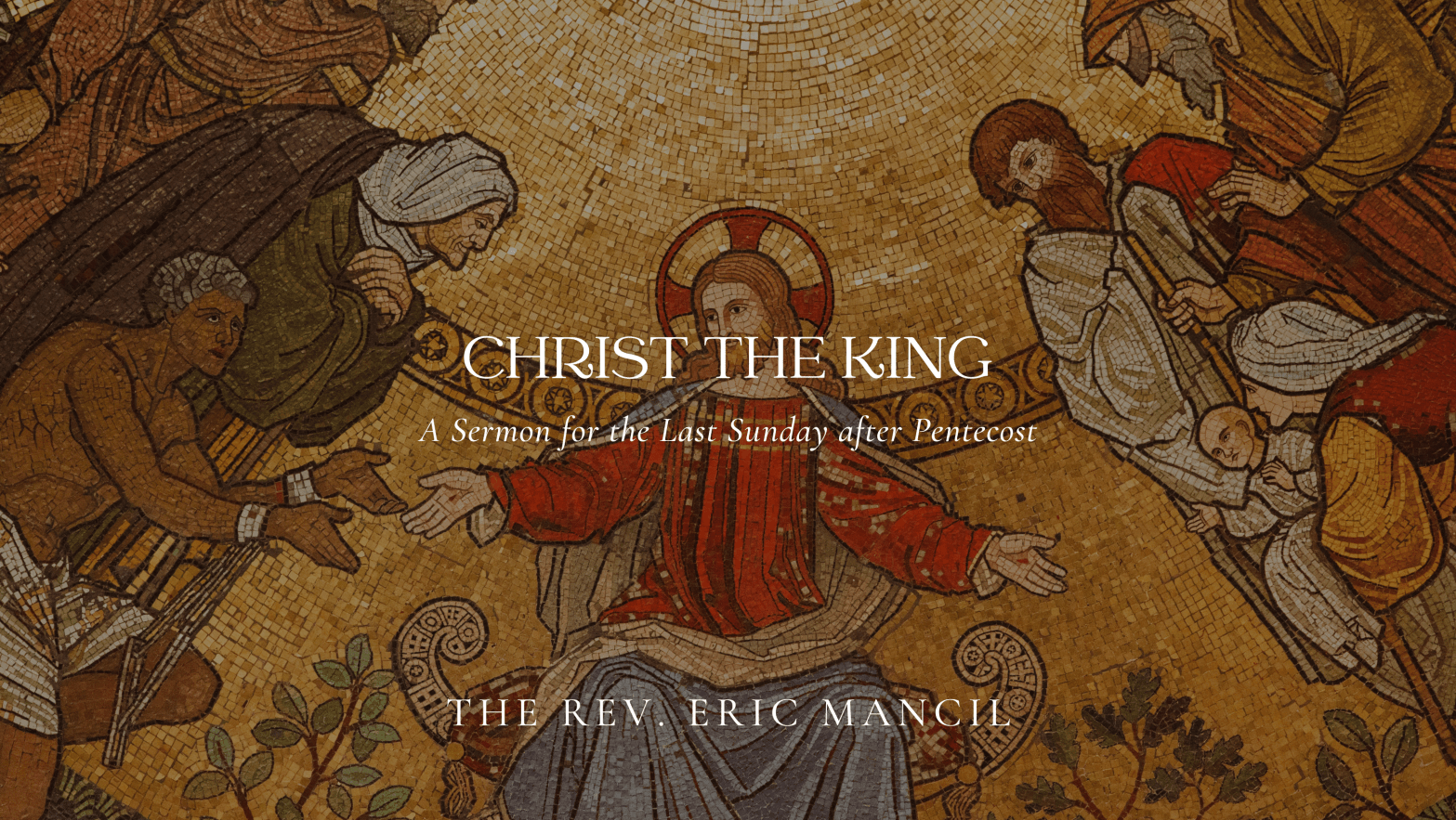
A Sermon for the Last Sunday after Pentecost (Proper 29, Year A)
November 26, 2023
The Baptism of Sibylle Marie Hamilton
Text: Matthew 25:31-46
Now, O Lord, take my lips, and speak through them. Take our minds, and think through them. Take our hearts, and set them on fire. In the name of the Father, and of the Son, and of the Holy Spirit. Amen.
I subscribe to a series of daily meditations from the brothers at the Society of St. John the Evangelist, an Anglican monastery located in Cambridge, Massachusetts. Every morning, when I wake up and check my email, I find a short meditation written by one of the brothers at SSJE. Over the past several years, they’ve become part of my morning routine, something I look forward to reading each day.
All of them are good, but occasionally, I come upon one that’s especially meaningful—one that sticks with me for a long time.
A few years ago, I came upon a meditation simply titled “Citizenship,” and I want to share it with you today because I think it has something important to teach us about what it means for Christ to be our King. Today, after all, is the Last Sunday after Pentecost, also known as Christ the King Sunday—the day when we remember that our true allegiance, as Christians, is to the Kingdom of God.
In his meditation, one of the brothers wrote, “We live in a world where Me is king. But our citizenship is not of this world. We are citizens of another country, whose king is a servant, whose orb is a towel, whose scepter a wash basin, whose crown is humility, and whose motto is service. As citizens and subjects of that kingdom, we cannot swear ultimate allegiance in any other way than taking up our towels, holding our basins, and getting down on our knees.”
As I read the brother’s meditation, I was struck by the contrast he made between those traditional symbols of royalty—the orb, the scepter, and the crown—and the symbols that we often associate with the servant ministry of Christ—the towel, the wash basin, and the washing of feet. It reminded me that, as Christians, we are called to be in the world but not of the world. Our citizenship is in God’s Kingdom, and our one true king is Jesus Christ, the one who emptied himself and lived and died as one of us to show us the path to abundant life with God.
Jesus gave his life to show us that mercy and forgiveness matter more than power and prestige, that love and service to others matter more than our own selfish ambitions. We are first and foremost citizens of God’s Kingdom, and we’re called to walk in the way of our King, to take up our own cross and follow him.
In recent years, one of my favorite television shows has been The Crown on Netflix. If you haven’t seen The Crown yet, I highly recommend it. The show traces the life and reign of Queen Elizabeth II, beginning with her wedding to Prince Philip in 1947.
The first season depicts the struggles that Elizabeth experienced soon after the death of her father, King George VI, in 1952. After her father died, Elizabeth quickly ascended to the throne and was later crowned in a coronation ceremony at Westminster Abbey on June 2, 1953.
My favorite episode of The Crown is the one where we witness the coronation of the Queen with all of its pageantry and mystery. We witness Elizabeth accept the Coronation Oath and the Archbishop of Canterbury anoint her with holy oil. We witness her being crowned with the Crown of St. Edward as the choir sings “Zadok the Priest,” the traditional coronation anthem. And, in one of the final moments of the episode, we see the newly crowned Queen processing down the aisle, carrying the orb and scepter—the traditional symbols of the monarchy.
I was interested to learn that, according to tradition, the Sovereign’s Orb is a symbol of Godly power. It’s in the shape of a globe with a cross on top, which represents “Christ’s dominion over all the world.” During the coronation ceremony, it’s presented to the Sovereign after they put on the Imperial Robe. The orb is brought from the altar by the Dean of Westminster and given to the Archbishop of Canterbury to place in the Monarch’s right hand.
The Sovereign’s Scepter is actually one of two scepters used in the coronation ceremony. According to tradition, the scepter is a symbol of the Sovereign’s worldly power. During the ceremony, it’s placed in the left hand of the Monarch by the Archbishop of Canterbury.
As I was watching the episode with the Queen’s coronation, I noticed a lot of similarities between the symbols and traditions of the coronation ceremony and the symbols and traditions we associate with the sacrament of Baptism.
Do we not accept our own Coronation Oath in the covenant that we make with God in baptism?
Are we not anointed with holy oil in Baptism as a symbol of the unbreakable bond that we share with Christ?
Are we not crowned in Baptism through the Church’s invitation to join with Christ in his eternal priesthood?
These symbols and traditions matter because they connect us with something far greater than ourselves and remind us that we’ve been called to follow a particular way of life, a way that doesn’t include orbs and scepters but one that does include towels and wash basins.
Like the monarchy, the Church, as we know it today, is a human institution. We aren’t perfect. We have good days, and we have bad days. On our worst days, we care only for ourselves. On our best days, we remember that the real reason we exist is for the benefit of those on the outside, those who are hungry to hear the Good News we have to share with the world. The mission of the Church is to work for the building up of God’s Kingdom, “to restore all people to unity with God and each other in Christ.”
Our call as Christians is to follow Jesus into a life of humble service, to care for those whom the world has rejected. Jesus said it this way in our Gospel lesson for this morning:
“Come, you that are blessed by my Father, inherit the kingdom prepared for you from the foundation of the world; for I was hungry and you gave me food, I was thirsty and you gave me something to drink, I was a stranger and you welcomed me, I was naked and you gave me clothing, I was sick and you took care of me, I was in prison and you visited me.”
This is one of the last things Jesus said to his disciples. In just a couple of days from when this passage take place, Jesus will be betrayed and handed over to be crucified. So, I think it’s reasonable to assume that we should take these words to heart. Of all the things Jesus could’ve said to his disciples with the time he had left, he said this:
Feed the hungry.
Give drink to the thirsty.
Welcome the stranger.
Clothe the naked.
Take care of the sick.
And visit those who are in prison.
One day, Jesus will return to judge both the living and the dead, and on that day, we won’t be judged by the amount of money or influence we gained in this life.
We won’t be judged by how successful we were in our jobs or how many friends we had or how popular we were.
And, we won’t be judged by how many Bible verses we memorized or whether or not we had perfect attendance at church.
We will be judged by how we cared for the “least of these.”
Jesus said it himself in our Gospel lesson for today—not to scare us into doing these things—but to help us understand that, in order to experience the abundant life God desires for us, we must be willing to lay down our lives and follow in his way.
The way of Jesus—the way of self-giving, sacrificial love—is the path to eternal life with God. The way of “capital M Me”—the way of selfishness and self-service—is the path that leads us away from God.
God has given us the freedom to choose which path we will follow. Will we choose to serve only ourselves? Or, will we turn and follow Jesus?
The Church has a way for us to answer those questions, and it’s called the sacrament of Holy Baptism. When we make the choice to follow Christ—or, in some cases, when our parents and godparents make that choice on our behalf—we make solemn promises and vows before God and the Church to turn from the way of sin and death to the way of everlasting life with God. We are buried with Christ in his death and raised to newness of life through his resurrection.
In just a few moments, we’ll celebrate the sacrament of new life as we welcome Sibylle Marie Hamilton into the Body of Christ, and with her and her parents and godparents, we’ll renew our own Baptismal Covenant with God—those same promises and vows we once made to turn toward Jesus.
Sibylle doesn’t realize it now, but she’s about to be baptized into a royal priesthood of believers—not one with orbs and scepters but one with towels and wash basins. Promises and vows will be made on her behalf to follow Christ with the hope that one day, she’ll grow into a mature life of faith and make the decision for herself to be confirmed, to renew those same promises and vows that were made for her today.
She will be anointed with holy oil as a sign that she is sealed by the Holy Spirit in Baptism and marked as Christ’s own forever. Nothing can ever change that.
And, she will be welcomed as one of our own—a member of the Body of Christ. It will be our responsibility—along with her parents and godparents—to help guide her in the Christian life and faith, to lift her up when she falls, and to always be a loving and supportive presence in her life.
Because, dear friends, Baptism isn’t just about the person being baptized. It’s about all of us, working together, to proclaim Christ as our King, to let the world see and know that his Kingdom will reign forever. Amen.
 The Rev. Eric Mancil