
A Sermon for the Feast of All Saints (Year A)
November 5, 2023
Text: Matthew 5:1-12
Now, O Lord, take my lips, and speak through them. Take our minds, and think through them. Take our hearts, and set them on fire. In the name of the Father, and of the Son, and of the Holy Spirit. Amen.
“Who lives? Who dies? Who tells your story?”
If you’re familiar with the world of musical theater, you probably recognize this popular refrain. It comes from one of my favorite musicals—one that’s become incredibly popular over the past eight years since it debuted on Broadway in the summer of 2015. Of course, I’m talking about the Tony Award-winning musical, Hamilton, which was written and composed by Lin-Manuel Miranda.
For those of you who are unfamiliar with it, Hamilton tells the story of Alexander Hamilton, one of the founding fathers of our country, the first Secretary of the Treasury, and the creator of our national banking system. The show begins with Hamilton’s arrival in the British colonies only a few years before the start of the Revolutionary War and spans his entire life, culminating in his famous duel with Aaron Burr.
Now, unfortunately, I’ve never had the opportunity to see Hamilton in person, but I’m very familiar with the music. I can’t tell you how many times our family has listened to the original cast recording! It’s unique and unlike any other musical that’s ever been written. The story is told not only through dialogue but also through an interesting blend of hip-hop and rap and various other styles of music, opening up the world of musical theater to a whole new generation. Once you hear it for the first time, it’s hard to stop listening!
But, for me, what makes Hamilton even more compelling than the music is one of the central themes of the show—a theme found throughout the Scriptures as well: we all live; we all die; and our story continues through the people we know and love, the people who carry us with them in their hearts long after we’re gone.
At the end of the Gospel of Matthew, we see a good example of this in the Great Commission, which takes place not long after Jesus’ death and resurrection. Jesus meets his disciples on top of a mountain in Galilee, and as he’s preparing to leave them and ascend to the Father, he says, “All authority in heaven and on earth has been given to me. Go therefore and make disciples of all nations, baptizing them in the name of the Father and of the Son and of the Holy Spirit,and teaching them to obey everything that I have commanded you. And remember, I am with you always, to the end of the age.”
In his final moments with them, Jesus empowers his disciples to continue the mission he began, giving them the courage and strength they need to carry on and continue telling the story so that future generations will come to know who he is.
The final act in the musical, Hamilton, also captures this idea that we continue to “live on” through those who come after us. You see, the finale of Hamilton isn’t told from the perspective of the main character but through his wife, Eliza Hamilton, who shares with the audience all of the many things that she’s able to accomplish in her life after the death of her husband.
She keeps his legacy alive by sharing his story with future generations and by continuing to do important work in her own life. In the final moment of the show, the company sings the refrain, “Who lives? Who dies? Who tells your story,” encouraging the audience to ponder these questions as they leave the theater.
So, today, dear friends, I ask you to consider these same questions. “Who lives? Who dies? Who tells your story?” What stories do you want future generations in the Church to tell about you? What kind of legacy do you want to leave behind?
It’s good for us to consider these questions as we celebrate the Feast of All Saints and give thanks for all those who’ve come before us in the faith, guiding us with their wisdom and providing us with examples of holy living.
Some people refer to All Saints’ Day as the Church’s “memorial day,” but it’s actually a lot more than that. It’s also a time for us to consider how we might pattern our lives on Jesus and live more fully into our own sainthood.
We have special days throughout the Church year when we commemorate the lives of individual saints, well-known figures like the apostles, Peter and Paul; Mary, our patron saint; and Francis of Assisi; but All Saints’ Day is the day when we commemorate the lives of ordinary saints, people like you and me who’ve committed ourselves to living a particular way of life—the way of Jesus—which calls us to live with open hearts so that God’s love may flow through us and be made known to others.
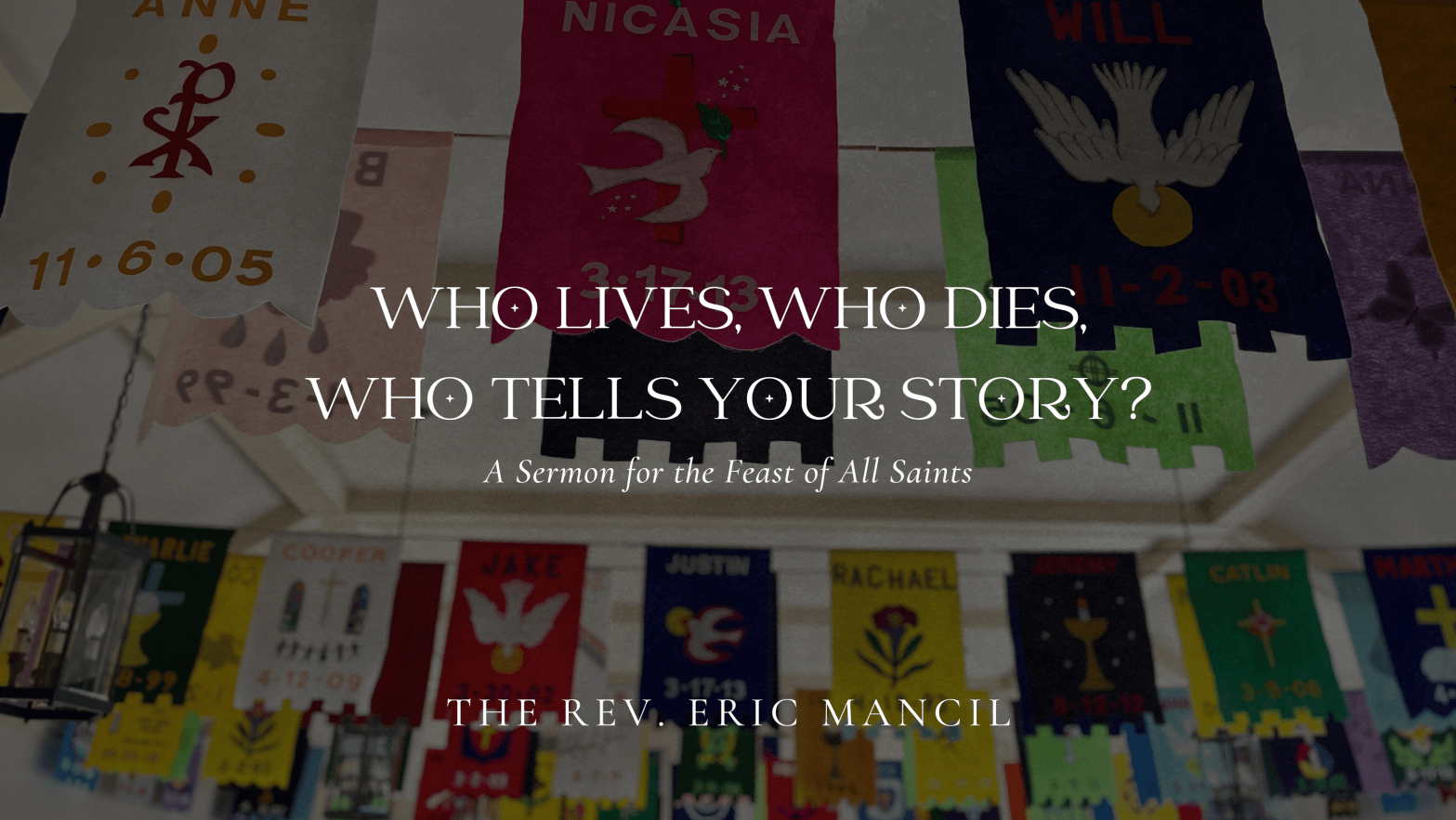
The saints who’ve come before us have important stories to share. Some of those stories are about falling short and struggling to remain faithful. Some of them are about sacrifice and self-giving. In the past ten months, since I began serving as your Rector, I’ve heard lots of stories about the saints of St. Mary’s—people like George Proctor and Tammy Portemont and Kathy Kyzar, just to name a few. A lot of them have banners hanging in the Parish Hall next door, reminding us of the lives they lived and the legacy they left behind.
We also have important stories to share, stories that will surely be told long after our time on earth has come to an end and our banners continue to hang in the Parish Hall of this church.
Our lives are unique to us as individuals because of the stories we have to tell, and yet, as Christians, we’re also part of a single, ongoing narrative, one that began long ago with Jesus and the first disciples and one that will continue for generations to come. When we commit ourselves to Christ through the sacrament of Baptism, we add our own, individual stories to that ongoing narrative.
And, even though we all lead different lives and we all have different gifts to share, we’re joined together by that central story—the story of Jesus—the one who lived and died and rose again, the one who calls us to share in his death and resurrection through the sacrament of new birth.
Our Gospel lesson for this morning from Matthew—commonly known as the Beatitudes—offers those of us who have committed our lives to Christ words of comfort and reassurance as we continue to work for the building up of God’s Kingdom.
Jesus says to the crowd, “Blessed are the poor in spirit, for theirs is the kingdom of heaven.” “Blessed are those who mourn, for they will be comforted.” “Blessed are the meek, for they will inherit the earth.” “Blessed are those who hunger and thirst for righteousness…” “Blessed are the merciful…” “Blessed are the pure in heart…” “Blessed are the peacemakers….” “Blessed are those who are persecuted for righteousness’ sake…” “Blessed are you when people revile you and persecute you…”
Now, notice what Jesus doesn’t say (even though we like to pretend he does).
Jesus doesn’t say, “Blessed are you who have everything figured out in your lives.” He doesn’t say, “Blessed are you who have perfect faith in God all the time and never doubt.” And, he doesn’t say, “Blessed are you who do everything perfectly.”
The life of a saint isn’t about being perfect. Being set apart and called by God doesn’t mean that we have to have all the answers figured out or that we aren’t allowed to make any mistakes. Actually, I think it means quite the opposite.
Being a saint is about having the humility to realize that we don’t have all the answers and that we desperately need a savior to lead us and guide us to the truth.
It’s about being willing to show up for Jesus and to be transformed by the power of God’s love so that we can go out and change the world, even when the going gets tough. It’s about sowing seeds for God’s Kingdom so that future generations will be willing and able to continue in our footsteps.
In just a few moments, we’ll once again recommit our lives to the work of Jesus as we renew our baptismal vows, and as we do, let us remember the saints who’ve gone before us and consider how God is calling us to continue their legacy of sharing the Good News of God in Christ with the world. Amen.
 The Rev. Eric Mancil