
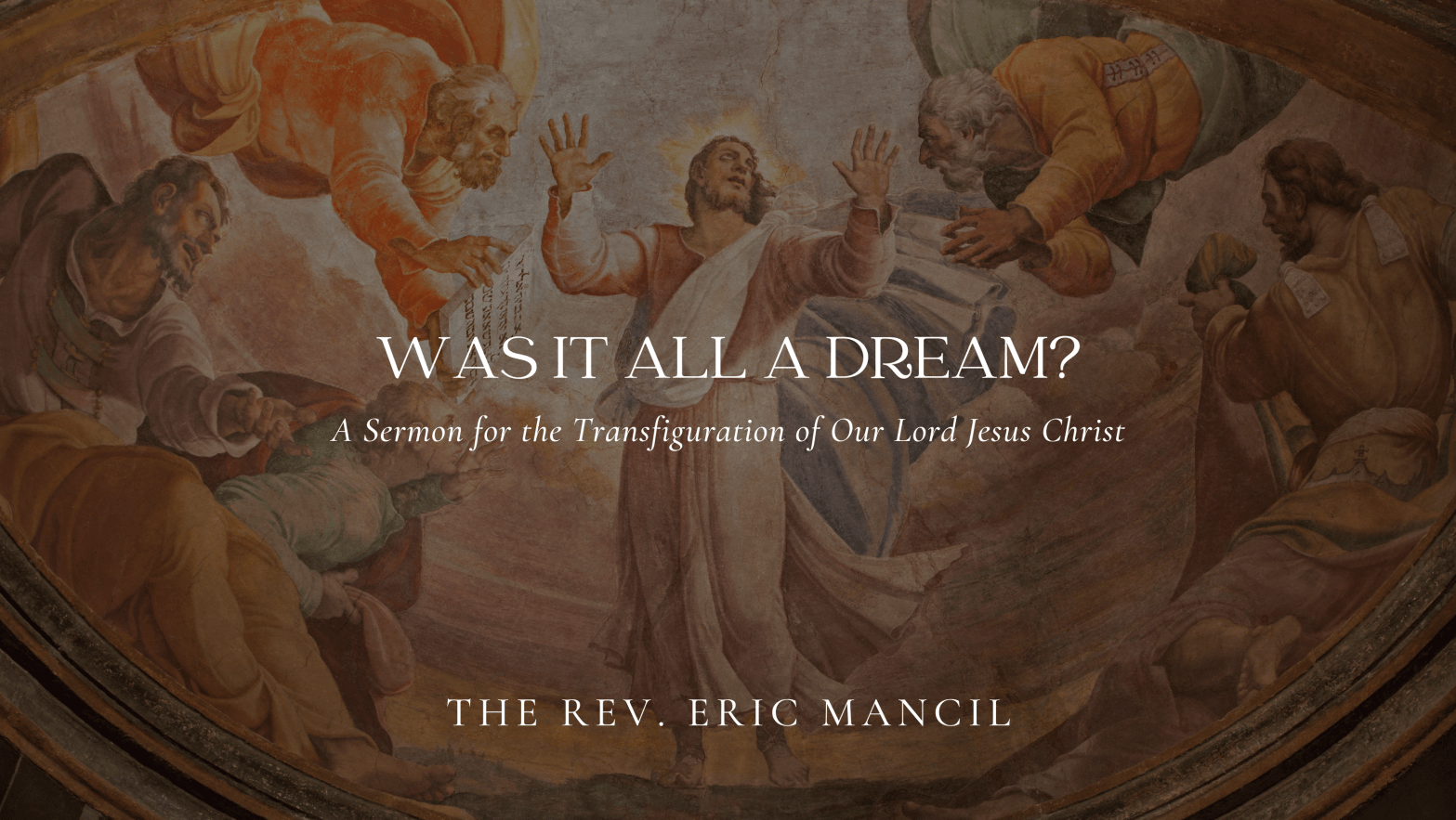
A Sermon for the Transfiguration of Our Lord Jesus Christ
August 6, 2023
Text: Luke 9:28-36
Now, O Lord, take my lips, and speak through them. Take our minds, and think through them. Take our hearts, and set them on fire. In the name of the Father, and of the Son, and of the Holy Spirit. Amen.
As a young child, one of my favorite movies was the beloved classic, The Wizard of Oz. I loved it so much that my grandparents even had it recorded on an old video cassette so I could watch it when we came to visit or spend the night.
Any time it came on television, I would stop what I was doing, sit down, and watch it as it retold the story of Dorothy Gale and her adventure in the magical Land of Oz.
There’s so much to love about the movie and so many reasons why it’s still considered a classic after eighty-four years. There’s the music, including the timeless song, “Somewhere Over the Rainbow.” There’s the story, which featured so many wonderful and larger-than-life characters, including Dorothy’s new friends—the Scarecrow, the Tin Man, and the Cowardly Lion—and of course the main villain—the dreaded Wicked Witch of the West. And, there’s the heart-warming finale to the film, reminding us that there’s really no place like home.
My favorite part of the movie, though, comes at the end of the first act. Dorothy has run away from home to protect her dog, Toto, from being taken away and euthanized. She runs into Professor Marvel, a crackpot fortune-teller who tells Dorothy to return home quickly because her aunt is heartbroken. Just as she’s returning home a tornado approaches the farm, and Dorothy and Toto are unable to get into the storm shelter. So, they go inside the house to take cover.
I think we all remember what happens next. Dorothy is knocked unconscious from the violence of the storm. The tornado lifts the house off the ground and it begins to spin in the air. Dorothy wakes up and notices some strange things through the window.
And, when the house finally lands, she walks out of her bedroom and opens the front door.
What she witnesses in that moment is unlike anything she’s ever seen before. It’s like stepping into a dream—out of black-and-white and into color. She doesn’t know where she is or how she got there, but she knows it isn’t home. And, after walking around and exploring for a bit, she says to Toto, “I have a feeling we’re not in Kansas anymore.”
As I was reading and reflecting on our Gospel lesson for this morning, I thought about this moment in The Wizard of Oz when Dorothy sees the Land of Oz for the very first time.
I thought about how incredibly awesome and terrifying it must have been for the three disciples in our Gospel reading—Peter, James, and John—to follow Jesus up the holy mountain and to see his appearance suddenly change from what they’ve always known to what must have seemed like a dream.
The author of Luke’s Gospel doesn’t give us many details about the experience. All we know for sure is that the appearance of Jesus’ face changed and that his clothes became dazzling white. Other translations of the passage describe the appearance of his clothes to be as bright as a flash of lightning.
And, as he’s praying, suddenly, two men appear with Jesus—Moses and Elijah—two prominent figures of the Jewish faith. They begin talking with Jesus about his “departure,” which he’ll soon accomplish in Jerusalem.
The disciples are so mesmerized by what they’re seeing that they don’t really know what to do or how to respond. So, Peter says the first thing that comes to mind. “Master, it is good for us to be here; let us make three dwellings, one for you, one for Moses, and one for Elijah.”
Just then, a cloud overshadows the disciples and they become terrified. And, they hear a voice from heaven say to them, “This is my Son, my Chosen; listen to him!”
After the voice speaks, the disciples find Jesus alone, standing by himself.
“Was it all a dream?” they might’ve asked themselves. “Or, did we just witness a miracle?”
Historically, artists have depicted the Transfiguration of Jesus with even more amazing details than Luke provides. Many paintings and icons, for example, depict Jesus floating high above the mountain-top with his entire body bathed in glorious light—like something out of a movie.
And, in Matthew’s version of the story, Jesus says to his disciples, “Tell no one about the vision until after the Son of Man has been raised from the dead.”
Did it really happen? Or, was it all a dream?
Whether or not the disciples thought it was a dream, it must’ve been an incredible experience—one that surely changed their lives forever. Peter even refers to the experience in his second epistle, which we heard earlier this morning.
For them—and for us—the Transfiguration confirms that Jesus really is God’s Son. He is the one whom the Father sent to redeem and save us all. He is the one who came into the world to bring to fulfillment all the Law and the prophets. He is the Messiah, the Lord.
But, this Messiah—this King—won’t reveal God’s glory through acts of strength and worldly power. He’ll reveal God’s glory on another hilltop, outside of Jerusalem, as he willingly goes to the cross to suffer and die on our behalf.
The story of the Transfiguration is one that a lot of preachers struggle to preach about because it’s not really about anything Jesus says or does. In fact, Jesus doesn’t say a word in today’s Gospel reading. There is no teaching, no parable. And, Jesus doesn’t cast out demons or perform any kind of miraculous healing.
No, this story isn’t about something Jesus does. It’s about something that God does through Jesus so that the disciples who witness it—and future generations—will come to know and believe the truth about who Jesus really is.
In theological terms, the Transfiguration is a theophany—a visible manifestation of God to humankind—not unlike the experience Moses has when God appears to him on Mount Sinai and gives him the Ten Commandments.
We could spend all our lives trying to figure out how and why the Transfiguration happened. We could spend all our lives trying to understand the mystery.
But, in doing so, we might risk missing out on the central truth of the story and taking away from it what God has intended.
And the central truth is this: Jesus really is the Son of God, and as his disciples, we are called to follow and listen to him.
Did it really happen? Or, was it all a dream? Who can really tell?
And, more than that, does it really matter?
Did Dorothy really travel to a magical land in The Wizard of Oz? Or, was it all a dream? Who can really tell?
And, more than that, does it really matter?
In the end, all that really matters is that she’s back at home, right where she’s supposed to be, surrounded by her friends and family with a renewed sense of thankfulness, which is better than anything she could’ve ever asked for or imagined.
The same is true for us in our Gospel lesson for this morning. All that really matters is what we’re left with at the end of the story and what God has revealed to us to be true. Jesus is exactly who we believe he is, which is better than anything we could ever ask for or imagine. Amen.
 The Rev. Eric Mancil