
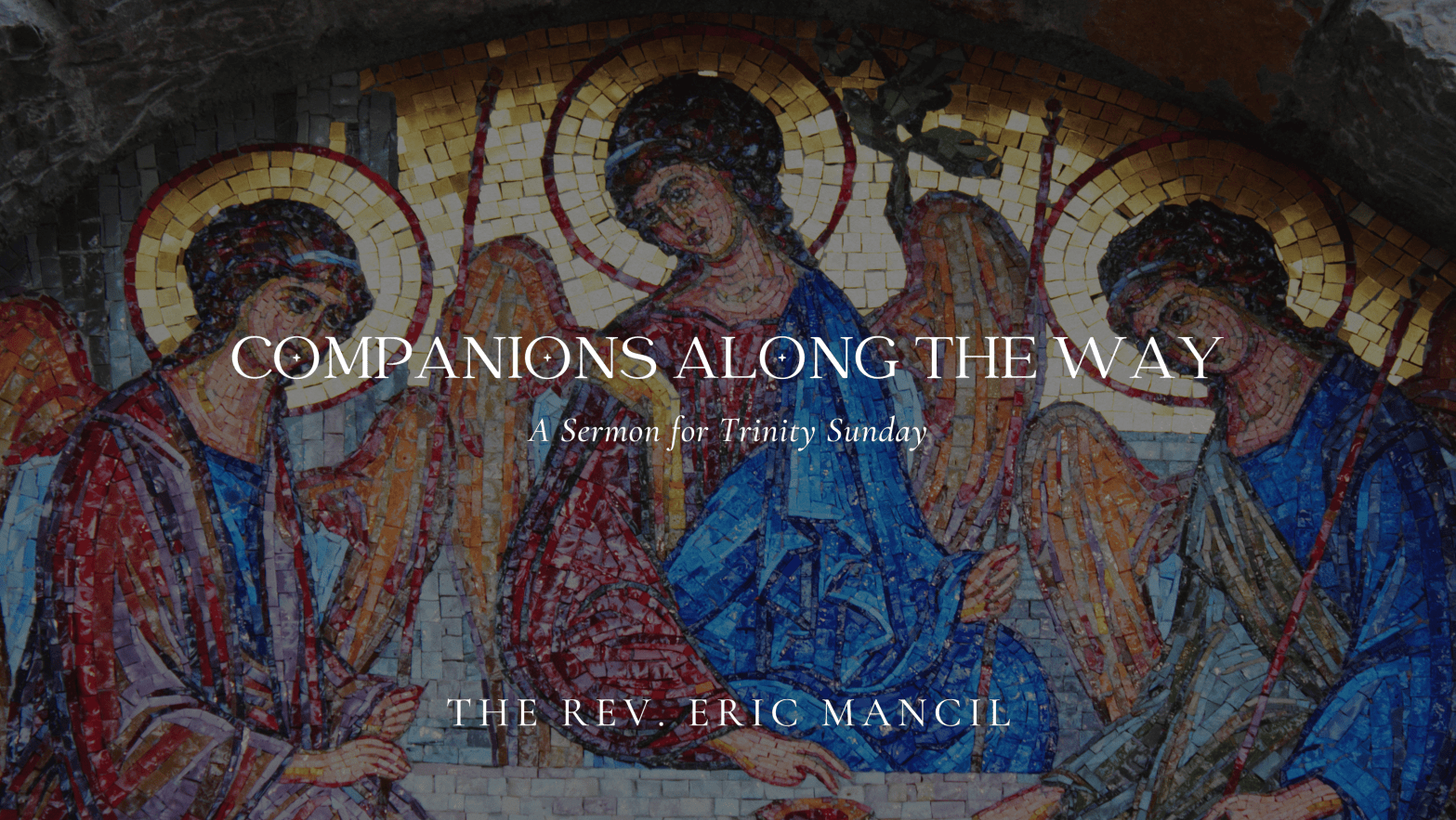
A Sermon for the First Sunday after Pentecost: Trinity Sunday
June 4, 2023
Text: Matthew 28:16-20
Now, O Lord, take my lips, and speak through them. Take our minds, and think through them. Take our hearts, and set them on fire. In the name of the Father, and of the Son, and of the Holy Spirit. Amen.
One day, a few years back, I was having lunch with a friend of mine who was also serving as a priest in the Birmingham area at the time.
Somehow, the topic of preaching came up, and I shared with him that I was preaching the following Sunday, which happened to be Trinity Sunday. Well, you might guess what his first response was.
“Oh, wow! Trinity Sunday! I’m so glad I avoided that one!”
In case you don’t know, some priests try to avoid preaching on Trinity Sunday, if at all possible. Many of us try to avoid it like the Plague. Rectors of large parishes will assign the task to their associates. Some priests will just happen to “be away” on Trinity Sunday or they’ll arrange for a guest preacher to preach that day.
All joking aside, the reason why preachers love to avoid preaching on this day is because the doctrine of the Trinity—our uniquely Christian belief that God is three-in-one and one-in-three—is a mystery to all of us.
It’s a mystery that escapes our ability to comprehend and fully express in words. That doesn’t mean we haven’t tried, though. We use words like “Father, Son, and Holy Spirit,” even though we know that God isn’t a particular gender. God is God.
We use beautiful, descriptive words like “Creator, Redeemer, and Sustainer,” even though we know that the fullness of God is much more than just the ways in which God is at work in our lives.
Yes, God continues to create, redeem, and sustain us. Yes, God is “Father, Son, and Holy Spirit.” But, God is also so much more. The words we use to express the mystery of the Trinity are really just our best efforts to explain the unexplainable.
Using the language of music, one of my favorite Christian poets describes the Trinity as “three notes resounding from a single tone.” If you know anything about music, you know how preposterous that sounds. It’s impossible for three notes to resound from a single tone, just like it’s impossible for God to be three-in-one and one-in-three.
Or, is it?
Personally, I’m happy to be preaching this morning. I’m happy to be sharing with you my thoughts about the Trinity because, from my perspective, it isn’t very helpful for us to try and explain the unexplainable with complicated, theological terms.
And, it isn’t helpful for us to use dated analogies or metaphors to try and explain the mystery. To me, it’s much more helpful to think about how the doctrine of the Trinity impacts us as Christians and what it can teach us about ourselves and our relationships with God and each other.
What I think the Trinity has to teach us most is that God values relationships.
I really do believe that God calls us to live our lives in community with each other and that, above all else, it’s how we’re called to live as Christian people. Not alone or isolated, but with each other.
Several years back, when I was serving as the priest at St. Catherine’s Episcopal Church in Chelsea, I led an Inquirers Class for those who were new to the church and those who just wanted to come and participate.
Some of you may know this about me already, especially if you attended the “Episcopal 101” class that I led a few weeks back, but one of my favorite things to do as a priest is to teach others about the Episcopal Church. I love it! It’s such a privilege for me to get to share the things I love most about our church with those who are brand new and seeking a new church home.
Well, during our Inquirers Class at St. Catherine’s, there was a woman who was new to the parish. Her name was Barbara, and at the time, she had only recently begun attending services. I told her that we were about to start a class for newcomers, and she was so excited to start attending.
So, we had our first class. And, it’s my practice during the first session of an Inquirers Class to begin by going around table and asking everyone to introduce themselves and share a little bit about why they decided to participate.
So, we went around the table, and everyone told us their name and where they were from and what drew them to the Inquirers Class.
When we came to Barbara, she introduced herself. And, then she gave a very simple response to why she was there. She said, “I’m here because I can’t do this alone.” That’s all she said. “I can’t do this alone.”
Her response has stuck with me all these years, and I think it’s because it’s absolutely true for all of us. We can’t do this alone—this Christian life, this work that we’ve been called to do as followers of Jesus. We can’t do it alone because sometimes the weight is too much to bear for one person.
We need each other, especially in those times when following Jesus seems especially difficult and we just need someone else to lift us up and encourage us to carry on.
We need each other in those moments when life hits us with something unexpected, like the death of a loved one or the loss of a job or an illness or injury.
We weren’t made to live in isolation. God created us to live in community with each other because that is God’s nature, and we’ve been called to draw others into the life of the community as well.
In our Gospel lesson this morning from Matthew, which takes place at the very end of the Gospel, the resurrected Jesus is gathered with his disciples on the top of a mountain in Galilee. And, he gives them one final instruction: “Go therefore and make disciples of all nations, baptizing them in the name of the Father and of the Son and of the Holy Spirit, and teaching them to obey everything that I have commanded you. And remember, I am with you always, to the end of the age.”
This passage from Matthew, commonly known as the Great Commission, could be interpreted in a number of ways. On the surface, it almost sounds like Jesus is telling the disciples to go out and just start baptizing as many people as they can, as if converting people to Christianity is the most important thing.
Now, it’s true. Part of our call is to share the Gospel. But, I don’t think Jesus wants us to be terribly concerned about going out and finding people to fill the pews on Sunday mornings.
Because anyone can fill a pew.
No, I think what Jesus is really saying in our Gospel lesson this morning is that he wants us to make disciples. He wants us to go out and share this life of Christian discipleship with others, drawing them into the community of faith with us.
Why? Because God is three-in-one and one-in-three. God values relationships, and we were created to share this life together.
We can’t do the work of following Jesus alone. We need others to be our companions along the Way. We need the community to walk with us in our journeys of faith and to lift us up and support us when we fall down. We can’t do it alone, no matter how hard we try.
Sometimes—and this is a challenge for many of us—that also means allowing others to take care of us when we need help, even if we’d rather do it ourselves.
Trinity Sunday isn’t the time for us to explain the unexplainable mystery of the Triune God. It’s a time for us to celebrate unity in the midst of diversity and diversity in the midst of unity. It’s a time for us to remember the importance of building relationships and living together in community, despite our differences.
Our God is a relational God, always at work in our lives in more ways than we can count, and as God’s children, we were created to live in the same way, to live in relationship with each other and to work together in the building up of God’s Kingdom. Amen.
 The Rev. Eric Mancil