
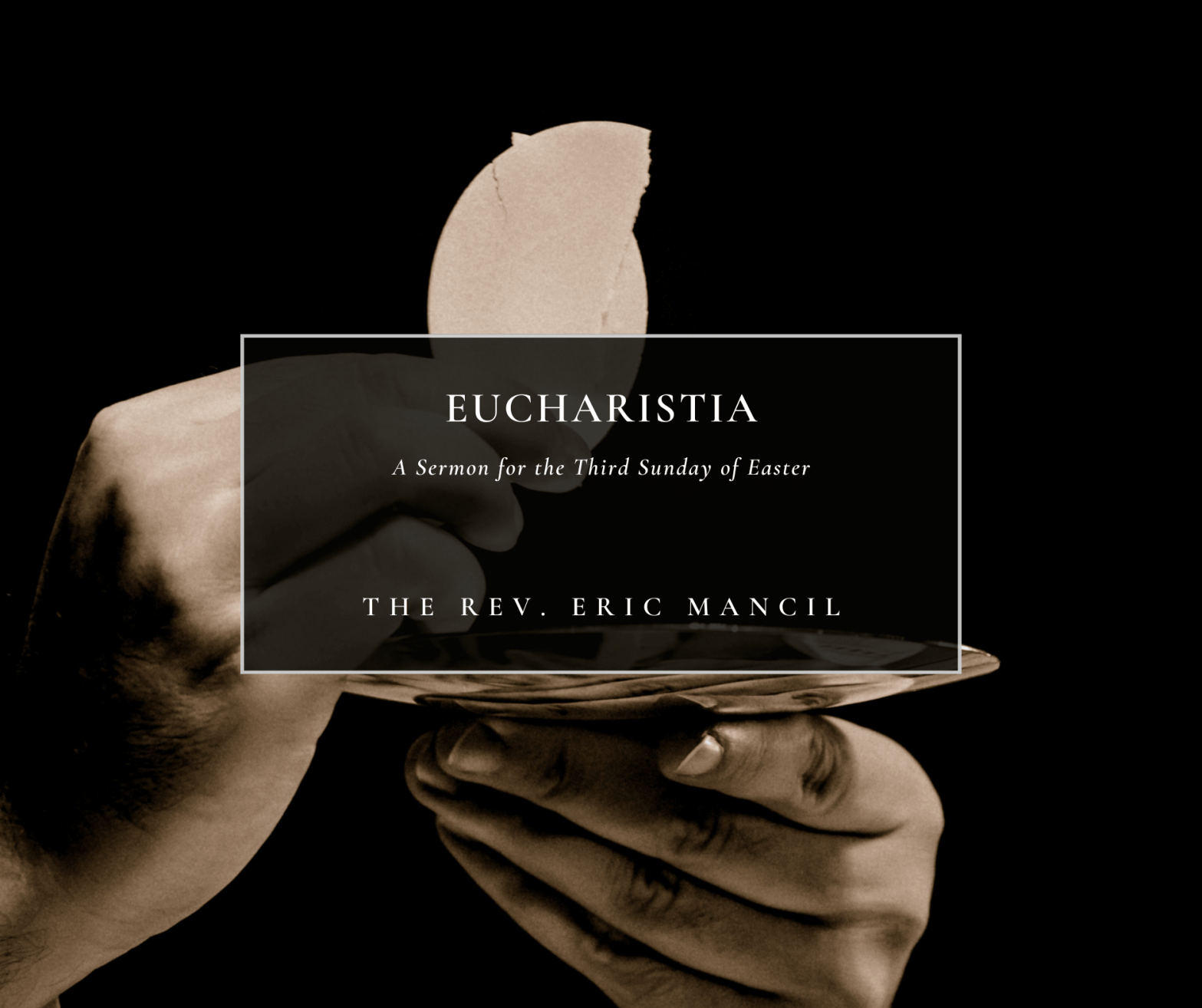
A Sermon for the Third Sunday of Easter (Year A)
April 23, 2023
Text: Luke 24:13-35
Now, O Lord, take my lips, and speak through them. Take our minds, and think through them. Take our hearts, and set them on fire. In the name of the Father, and of the Son, and of the Holy Spirit. Amen.
Several years ago, before I went to seminary, I came across a short video online that was posted by an Episcopal priest. The title of the video was “Eucharistia.” If that name sounds familiar, that’s because Eucharistia is where the word “Eucharist” comes from. It’s a Greek word, which means, “thanksgiving.”
What the priest created was basically a video meditation about the significance of the Eucharist and its place in our lives as followers of Jesus.
It featured a small group of people, including a priest and several lay people, gathered together in a large, open room. Among them was a shy, young woman—a stranger to the group—who was reluctant to participate at first but eventually came to realize that what was happening around her was so important that she had to be part of it.
One thing that made the video so interesting was that it was shot as a silent film. So, the only thing you could hear was a bit of music playing in the background. The story was told through actions and gestures rather than dialogue.
At the beginning of the video, the group sat in a circle on the wooden floor as they watched the priest prepare a place in the center for the Eucharist to be celebrated.
On a square piece of white cloth, the priest placed a ceramic chalice filled with red wine, a plate with a loaf of bread, and something else, something unexpected—a wrinkly, folded up newspaper.
My first thought was, “Ok. I get why the bread and wine are there, but what’s going on with the newspaper? What’s that for?”
Finally, the Eucharistic prayer began. The priest held up the plate with the loaf of bread. Then, she lifted up the chalice of wine, and even though I couldn’t hear the words that were being spoken, I was familiar enough with the prayer that I could understand what was going on.
After the prayer, the bread was broken and passed from person to person, each one having the opportunity to share the Sacrament with the next person in the circle.
Then, the chalice was passed around in the same way. One by one, each person took a sip of wine and passed it on to the next person in the circle.
After everyone had received the bread and wine, something different happened—something we normally don’t do when we celebrate the Eucharist.
The priest took the folded up newspaper, tore a piece of it off, and passed it to the next person. Likewise, the rest of the group did the same. The newspaper was passed from person to person, each one having the opportunity to tear off a piece and read it.
At first, it took me a moment to understand what was happening and why it was important.
And, then it clicked.
The newspaper symbolized the group’s connection to the outside world and the work that all of us are called to do as followers of Jesus. As they read their torn-off pieces of newspaper, you could sense that the boundaries of the circle were fading away.
For the group on the video, the newspaper served as an important reminder that what we do when we’re gathered around the Altar is about much more than just a single act of worship.
The Eucharist is not about serving ourselves. It’s about serving our Lord Jesus, the one who continues to send us out, beyond the walls of the church.
In the Eucharist, we come to the Altar, not only to be fed with the Body and Blood of Christ, but also to offer ourselves as living bread so that others may come to know the love of God through us.
Our lives are filled with countless opportunities to be Eucharist for others—to be the hands and feet of Christ in a world that’s hungry for the Good News we have to share—that God in Christ has indeed been risen and that salvation has come to the whole world.
There are a lot of stories about feeding and being fed in the Gospels.
There’s the Feeding of the Five Thousand—a story that’s familiar to most us and one that appears in all four Gospels.
There’s the Institution of the Lord’s Supper, where Jesus shared a final meal with his disciples on the night before he died and instructed them to continue breaking the bread and sharing the cup.
And then, there’s our Gospel lesson for today, which takes place on the day of the Lord’s resurrection. Two of Jesus’ disciples are traveling along the road to Emmaus—a small village about seven miles from Jerusalem—discussing the events that just took place. As they’re walking along, they encounter someone who appears to be a stranger.
They begin talking with the man, unaware that it’s the risen Lord, and sharing with him their fears and disappointments after Jesus was crucified.
They had hoped that he was the Messiah—the one who would come to redeem Israel and set them free from Roman oppression. They’ve heard rumors of his resurrection, but they haven’t seen it for themselves.
Then Jesus, beginning with Moses and the prophets, begins interpreting to them the Scriptures about himself.
As they approach the village, the two disciples invite Jesus to stay with them because it’s getting dark outside and unsafe to travel. Jesus agrees, and when they come inside, they share a meal together around the dinner table.
At the table, Jesus takes the bread. Jesus blesses the bread. Jesus breaks the bread, and then he shares it with the two disciples.
And in that moment, they finally realize the truth. Jesus was with them all along. The man they assumed was a complete stranger turned out to be the risen Christ.
Jesus was made known to them in the breaking of the bread. He never once told them who he was. It was in the breaking of the bread that their eyes were opened to the truth.
So, it should come as no surprise to anyone that our central act of worship in the Episcopal Church takes place around a table where bread and wine are shared. It’s in this sacred meal—in the breaking of the bread—where we discover the risen Christ and the true meaning of what it means to be a follower of Jesus.
We take ordinary bread and wine, the fruits of our labor, created by human hands from the gifts God has given us in creation.
We acknowledge God’s goodness and pray for God to bless the bread and wine that they may become for us spiritual food.
We break the bread and pour out the wine so they may be shared among us.
And finally, we give these gifts back to God. By receiving the holy mysteries of Christ’s Body and Blood in the Eucharist, we become that which we receive—the Body of Christ, broken and poured out for the life of the world.
We take the bread and wine.
We bless it.
We break it.
And we give it.
And we do these things, not only for our own sake, but for the sake of others.
St. Augustine of Hippo, who lived during the fourth and fifth centuries, put it this way in a sermon he once wrote about the Holy Eucharist: “One of the deep truths of Christian faith is that through our participation in the sacraments (particularly Baptism and Eucharist), we are transformed into the Body of Christ, given for the world.”
This is the way Christians have been worshiping for centuries.
And we continue that tradition today.
Every time we come to the Altar to receive Communion, we should be reminded that it isn’t just about us. It’s about reconnecting with God and being strengthened and nourished in our faith so that we can be instruments of God’s grace in the world around us.
Just as Jesus made himself known to his disciples in the breaking of the bread, Jesus continues to make himself known to us, and we continue to make Jesus known to the world when we go forth from this place.
Eucharist isn’t just a nice thing we do on Sunday mornings, and it isn’t just a symbolic meal or a way for us to retell the story, week after week.
It’s our pattern for living. Take. Bless. Break. And give.
If we can remember that, then there’s nothing we can’t do for the good of God’s Kingdom. Amen.
 The Rev. Eric Mancil