
A Sermon for the Sixth Sunday after the Epiphany
February 12, 2023
Text: Matthew 5:21-37
Now, O Lord, take my lips, and speak through them. Take our minds, and think through them. Take our hearts, and set them on fire. In the name of the Father, and of the Son, and of the Holy Spirit. Amen.
This past October, Chelsea and I finally had the opportunity to do something we had been waiting to do for a long time. We attended a Cursillo weekend up at Camp McDowell, which is the camp and conference center in the Diocese of Alabama.
Cursillo is a Spanish word, which means “short course,” and that’s exactly what it is. It’s a short course in the fundamentals of the Christian way of life that takes place over the course of a three-day weekend. But, it’s also much more than just a weekend retreat at camp. It’s an opportunity for Christians to grow in their faith and find new life in their walk with Christ.
It’s not uncommon at all for people to come away from a Cursillo weekend with a restored sense of purpose and a desire to give more of their time and energy to their local parish.
Cursillo is especially helpful, I think, for those who are feeling sort of lukewarm or lackluster about their faith or those who are struggling to feel a connection with God. It’s also helpful for people who may be wondering where their place is in the life of the church and how they can use the gifts God has given them to better serve others.
It’s a wonderful ministry—one that’s also very active right here in the Diocese of the Central Gulf Coast, and if Cursillo sounds like something you’d like to do, I’d be happy to tell you more.
But…I can’t tell you much more.
Because another thing you’ll quickly learn about Cursillo is that there are a lot of surprises that happen throughout a Cursillo weekend, and if I told you exactly what was going to happen, it would ruin the experience.
So, you’ll just have to trust me when I say that Cursillo is a great blessing to our Church and something I would highly recommend, especially for those who are needing a little jump-start in their faith.
This past week, as I was reflecting on our Gospel lesson for today, I thought about my Cursillo experience this past Fall and a gift that was given to me by my small group leader.
How many of you remember those bracelets that were popular back in the 90s that had the letters “W.W.J.D.” printed on them? Do you remember those? Apparently, they’ve made a comeback recently.
Well, I never owned one of those bracelets myself, but I do remember what the letters stood for, as I’m sure most of us do. They stood for “What would Jesus do?”
And, if you remember as I do, the idea was that people would wear these bracelets to remind themselves of this important question as they went about their everyday lives.
If someone made you angry, for example, and you didn’t know how to respond, you could ask yourself, “What would Jesus do?”
If someone hurt you in some way or betrayed your trust, “What would Jesus do?”
If someone asked you for help, “What would Jesus do?”
You get the idea.
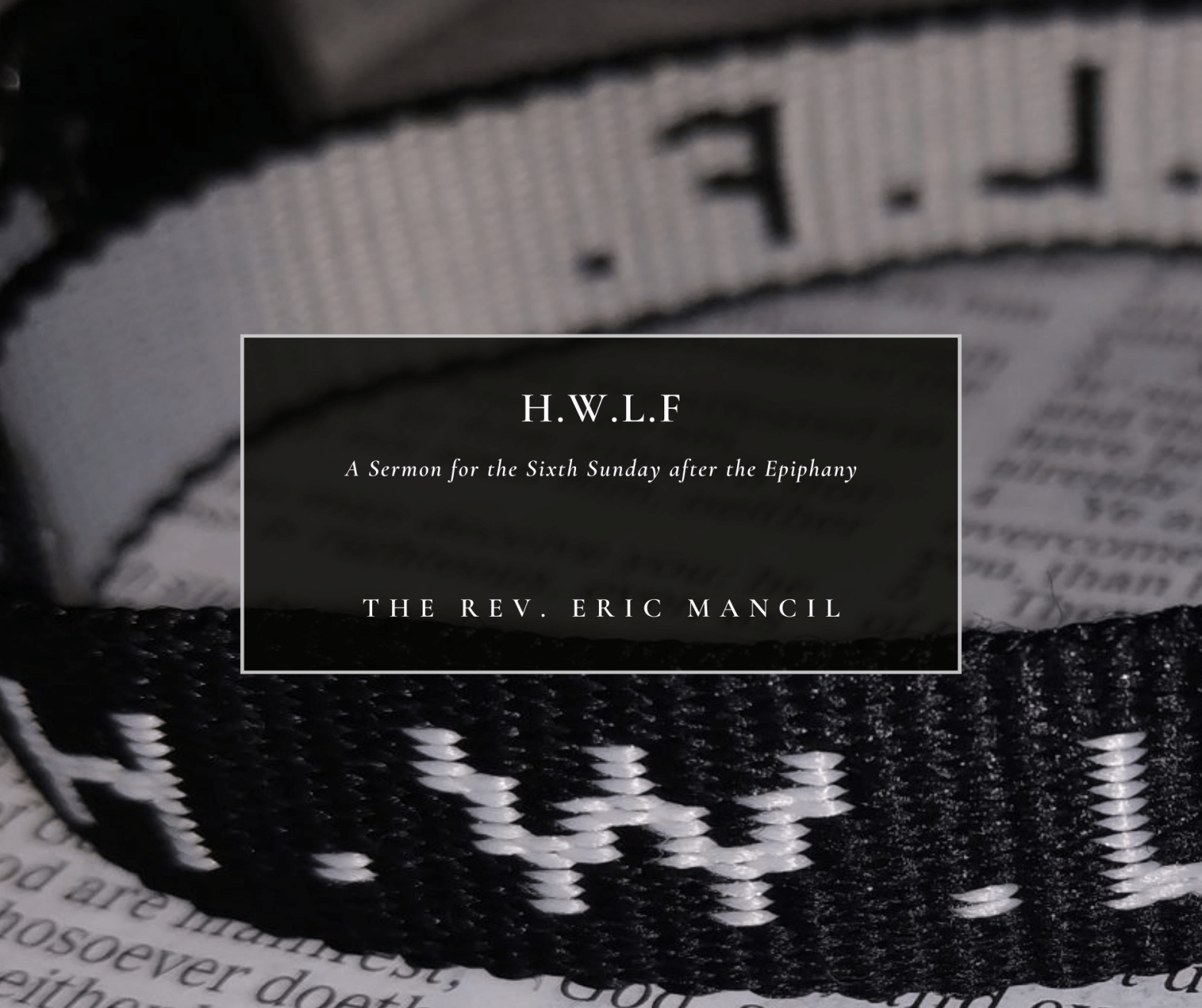
Well, my small group leader at Cursillo didn’t give me a bracelet with the letters “W.W.J.D.” on it. Instead, he gave me one with the letters, “H.W.L.F.”
I actually wore it to church this morning to show you.
When I first received it, I had no idea what the letters stood for.
So, I went up to him and asked him, “What does this mean.”
He looked at me and replied, “What would Jesus do?”
“H.W.L.F.”
“He would love first.”
Above all else—above every possible answer to the question, “What would Jesus do?”—Jesus would love first.
I wanted to share this with you today because I think it’s important for us to remember—especially when we’re given such a challenging Gospel lesson as we are this morning.
On the surface, Jesus’ words seem very harsh, don’t they—especially when he starts talking about plucking out eyes and cutting off hands and being thrown into hell.
It would be easy for us to read this passage and think that Jesus is ready to condemn anyone who violates God’s commandments.
But, I think, in order to understand where Jesus is coming from in our lesson for today, we have to back up a little bit and look at something Jesus said to his disciples in last week’s Gospel lesson.
Earlier in Matthew, after Jesus teaches his disciples about salt and light, he says to them, “Do not think that I have come to abolish the law or the prophets; I have come not to abolish but to fulfill. For truly I tell you, until heaven and earth pass away, not one letter, not one stroke of a letter, will pass from the law until all is accomplished.”
Jesus has come—not to abolish the law and the prophets—but to fulfill them.
So, he teaches his disciples in today’s reading from Matthew that simply following the law of Moses—as it’s been handed down from generation to generation—isn’t enough.
In order to live as God would have us live, Jesus says, we have to do more. We have to go above and beyond the letter of the law.
He says to his disciples, “You have heard the commandment, ‘You shall not murder.’” But, then he goes on to say, “Even if you’re angry with a brother or sister, you’ll be liable to judgment.”
Jesus isn’t talking about righteous anger—the kind of anger we feel when someone is treated unfairly. He’s talking about the kind of anger that can build up inside of us over time and cause us to forget that all of us—even those who hurt us and make us angry—are beloved children of God.
Jesus says, “You have heard the commandment, ‘You shall not commit adultery.’” But, then he goes on to say, “Even looking at another person with lust is a sin.”
Jesus isn’t talking about romantic or physical attraction between two people. He’s talking about the kind of lustful desire that can cause us to forget that every person is created in God’s image and worthy of dignity and respect.
Jesus says, “Whoever divorces his wife, let him give her a certificate of divorce.” But, then he goes on to say, “Anyone who divorces his wife causes her to commit adultery, and anyone who marries a divorced woman commits adultery.”
In the time of Jesus, women had very few rights and were treated as little more than property. The law of Moses dictated that men could issue certificates of divorce to their wives for any reason, often leaving women stranded and homeless. So, when Jesus speaks of divorce, he isn’t talking about it in the same way we think about it today. He’s talking about an easy and convenient way for a man to casually dismiss his wife and move on to someone else.
Finally, Jesus says, “You have heard the commandment, ‘Do not bear false witness.’” In other words, “Don’t make empty promises to God.” But, then he goes on to say, “Don’t make any promises at all.”
Jesus isn’t saying that we shouldn’t make a commitment to God—far from it! He’s saying that actions speak louder than words. “Let your word be, ‘Yes, Yes’” Jesus says, “or, ‘No, No’; anything more than this comes from the evil one.”
In every example Jesus provides, he’s teaching his disciples—and us—that it’s not enough to simply follow the law as it’s written.
In order to experience abundant life with God, we have to be willing to go above and beyond what’s expected. We have to learn to open our hearts and allow the love of Christ to be our guide.
These words of Jesus in our Gospel lesson for today may sound harsh to our twenty-first century ears. But, at the heart of the Gospel is a message of love and compassion. Jesus didn’t come to condemn the world. He came to save us from the power of sin and death and to open up for us the way to abundant life with God.
God’s greatest desire is for us to be reconciled with him and to experience new and abundant life, but the only way to do that is for us to be in right relationship with each other.
Jesus gives us ways we can do that…
By being willing to forgive and seek forgiveness
By remembering that each and every one of us is beloved by God and created in God’s image
By making good on our promise to respect the dignity of every person
So, if you ever have a question about how God is calling you to treat a brother or sister, think about Jesus and ask yourself, “What would Jesus do?”
And the answer is the same now as it’s always been. He would love first. Amen.
 The Rev. Eric Mancil