
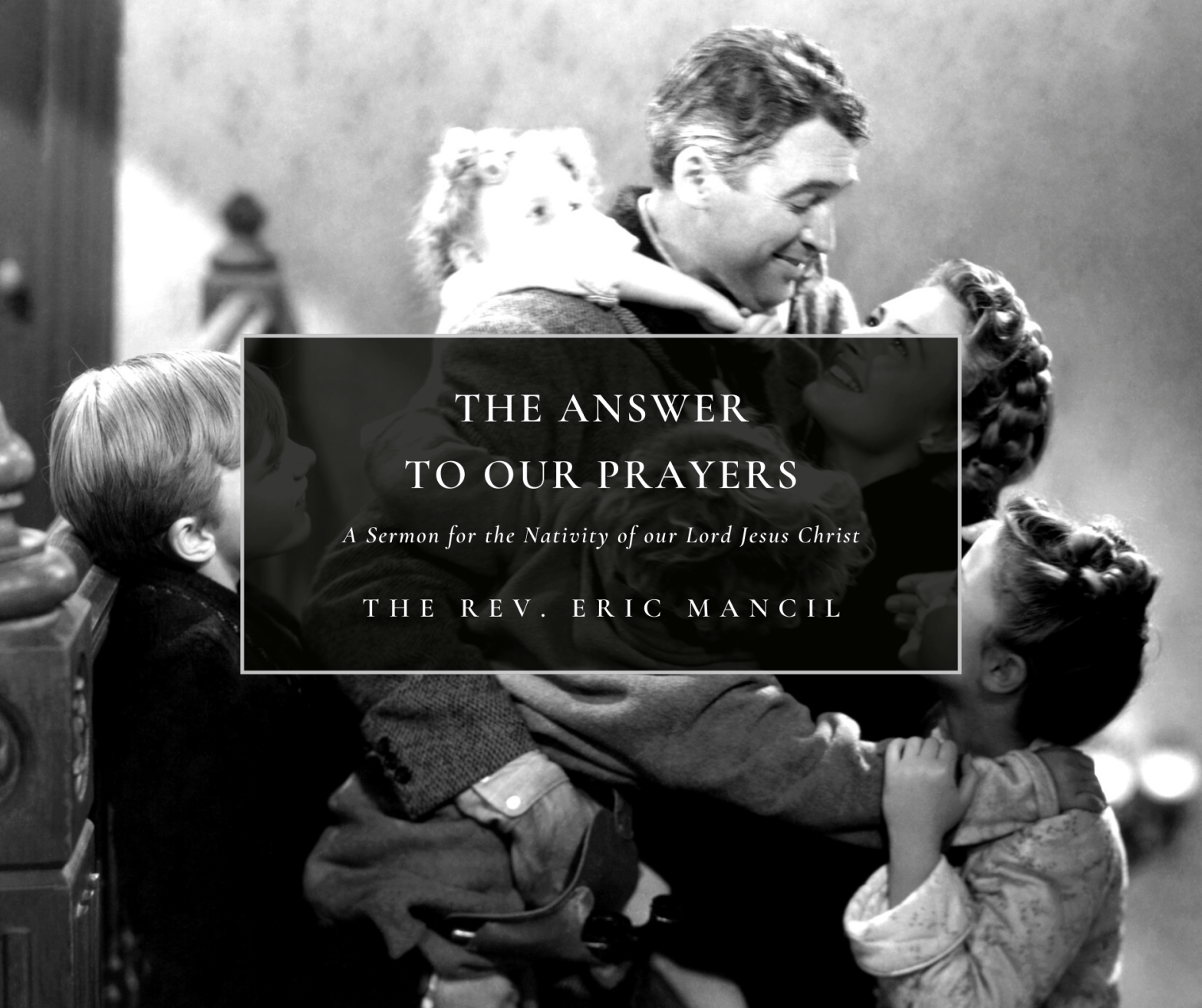
A Sermon for the Nativity of our Lord Jesus Christ
Friday, December 24, 2021
Text: Luke 2:1-20
I speak to you in the name of our loving, liberating, and life-giving God: Father, Son, and Holy Spirit. Amen.
A couple of weeks ago, Chelsea and I had the opportunity to finally do something we’ve been talking about doing for quite some time. We went to the historic, Alabama Theater in downtown Birmingham to watch a Christmas movie, just the two of us. This wasn’t just any Christmas movie, though. This was the beloved holiday classic, It’s a Wonderful Life, which celebrated its 75th anniversary this past Monday. It’s been seventy-five years since audiences first experienced the story of George Bailey, the main protagonist of the film and a character who serves as an example of self-giving, sacrificial love. On more than one occasion, George puts his own dreams and hopes for the future aside in order to help those around him, including friends, family members, and other members of the community.
Throughout the film, we learn that George lives a fairly comfortable life. He’s married to a woman who loves him very much, and he has four, beautiful children. He has a roof over his head, food on the dinner table, and a job with a steady income. But, as the film progresses, we learn that George’s life in Bedford Falls isn’t perfect.
Eventually, some unfortunate things start to happen. One day, Billy Bailey, George’s uncle, who works with him at the Building and Loan, goes to the bank in order to deposit a large sum of money. Billy becomes distracted and loses the money he’s supposed to deposit. When George finds out, he becomes infuriated, and in a moment of fear and desperation, he crawls to Mr. Potter, the head of the bank, to ask him for a loan to cover the missing deposit. The only thing George has to offer Mr. Potter as collateral for the loan is an insurance policy worth $15,000. The cruel banker laughs in George’s face and tells him, “You’re worth more dead than alive.” Then, he tells George that he’s calling the police to let them know about the missing money.
Well, if you’ve seen the film before, you’re already familiar with what happens next. This is where things start to get really interesting. George flees the bank and runs to a local bar. Feeling alone and afraid, he prays for God to send help but ends up getting even more frustrated and angry when he doesn’t receive the help that he wanted.
George is at the end of his rope. So, he goes to a nearby bridge in order to end his life, and just as he’s getting ready to jump off the bridge into the river, his guardian angel, Clarence, intervenes and jumps into the river first. Of course, George is unaware of who Clarence really is, but when he sees him struggling in the water, he jumps in and saves Clarence from drowning.
Later on, as the two are drying their clothes, Clarence reveals his identity to George. Of course, George doesn’t believe the angel, at least not at first. As the two continue their conversation, George comes to the conclusion that the people in his life would be better off without him. He makes a wish and tells Clarence, “I wish I’d never been born.” George’s wish sparks an idea with Clarence, and he decides to grant George’s wish. “Okay, you’ve got your wish,” Clarence says. “You’ve never been born.” George is given a very special gift—the chance to see what life in his hometown would be like if he had never existed. What follows is a series of unpleasant encounters for George. The people closest to him no longer know who he is, and for most of them, their lives have been dramatically changed by having never known George. George learns that his younger brother, Harry, died at a very early age because he wasn’t there to save his life. The pharmacist, Mr. Gower, was sent to prison because George wasn’t there to stop him from unintentionally poisoning a child. George’s mother tells him that his uncle was institutionalized after the Building and Loan failed, and George’s wife, Mary, is working at the local library, all alone with no family. All of this is too much for George to handle. Finally, he comes to realize that, even though his life isn’t perfect, it’s better to live than to have never existed at all. He comes to realize that he does have a purpose in life.
So, he prays to God once again. Only this time, he prays for God to give him his life back. “Please God,” George prays, “Let me live again.”
George’s life is restored, and everything is as it was before. Excited and relieved, George runs home, expecting to be arrested for the missing money. What happens instead is a miracle. People from all over town, people whose lives have been touched by George, start showing up to the Bailey household carrying as much money as they can find to help out their friend. The last one to show up is George’s younger brother, Harry—the one he saved—who shares a toast and says, “To my brother, George—the richest man in town!”
Of course, Harry isn’t talking about the unexpected sum of money that shows up on George’s doorstep. He’s talking about George’s life—and everything that makes George who he is. In the film’s final moments, George’s youngest daughter, Zuzu, hears bells ringing on the Christmas tree, and she says to her father, “Look Daddy! Teacher says, ‘Every time a bell rings, an angel gets his wings.’” George smiles, knowing that his friend, Clarence, finally got his wings, and everyone begins singing the song, “Auld Lang Syne,” as they celebrate Christmas together. It’s perhaps one of the most touching finales to a movie that’s ever been made, and it brings tears to my eyes every time I see it.
Frank Capra, the director of It’s a Wonderful Life, considered it his favorite film that he ever directed. The movie is listed by the American Film Institute as the eleventh best film ever made and number one on their list of the most inspirational movies of all time.
Now, I should stop here for a moment and remind you that the movie is a work of fiction and probably not the most accurate depiction of angels or the way that God moves in our lives. For example, I don’t think that angels have to “earn their wings” by doing good deeds or that angels are really just human beings who died a long time ago and were resurrected as heavenly messengers. There’s nothing in Scripture that even suggests such a thing. But, that doesn’t mean that the movie has nothing to teach us—especially during the season of Christmas.
I think the reason why the film is so powerful and why it resonates so deeply with those who watch it is because we can all relate—at least to some degree—with the character of George Bailey. All of us have things in our lives for which to be thankful, but we also know what it feels like when everything around us seems to be going wrong, when we feel like all hope is lost. We’ve all been in situations before when we stop and ask ourselves, “Does my life even matter?”
Well, I want you to know, my brothers and sisters, that it really does. Your life matters more than you may ever know. As a former priest of mine used to say all the time, “Your life is of infinite value and importance to God.” We were created—each of us—in God’s own image for a very specific purpose, and that purpose is to make the light of God in Christ Jesus known to the world.
This is the True Light, which came down from heaven and was born as one of us. The True Light, who humbled himself and took on human form in order to teach us and show us how to love others as God has called us to love. The True Light, who reminds us that, even in the darkest of times, there’s always hope.
That’s what Christmas is all about. Hope overcoming fear, light overcoming darkness, and a weary world rejoicing that God has sent us a Savior to redeem us and free us from the bondage of sin and death. All of this is beautifully captured in the first verse of the classic, Christmas hymn, “O Holy Night,” as we sing:
O holy night, the stars are brightly shining,
It is the night of the dear Savior’s birth;
Long lay the world in sin and error pining,
‘Till he appeared and the soul felt its worth.
A thrill of hope the weary world rejoices,
For yonder breaks a new and glorious morn…
In the film, It’s a Wonderful Life, a man named George Bailey reaches out to God, hoping for an answer to his prayers. What he receives is a response far greater than anything he could have expected or imagined. God shows up and reveals to George that his life is important and full of meaning.
The same is true for us now, dear friends, just as it has been and always will be. God has heard the collective prayers of God’s people and intervened by sending us the hope of the world. Jesus is the answer to our prayers, our unexpected gift, showing us that our lives matter more to God than we can possibly imagine. On this Christmas Eve night, I hope you feel wrapped up in God’s love and worthy of God’s grace. I hope you carry with you into the world a spirit of hope and the knowledge that your life is full of meaning and purpose. That purpose is to be bearers of the light so that others may come to know the redeeming love of Christ Jesus in their own lives. Amen.
A video of this sermon can be found at the following link, beginning at the 19:10 mark.
https://www.facebook.com/91363777474/videos/1304468520003764
 The Rev. Eric Mancil